
Weak accounts payable processes can damage cash flow, tax deductions, reporting accuracy, and fraud defenses, even when sales are growing. Bills arrive, someone enters them into QuickBooks, a manager approves them by email, and a payment goes out. The business keeps moving, but nobody can confidently explain which invoices were received, which liabilities remain open, or whether every deduction has proper support.
Thank you for reading this post, don't forget to subscribe!The transition away from manual AP is already underway. In 2024, 74% of AP teams were only partially automated, while just 5% were fully automated, and 52% of AP professionals spent more than 10 hours per week processing invoices, according to the Accounts Payable Automation Trends 2024 report. Manual invoice keying also fell to 60% from 85% in 2023, showing that digitization is growing without necessarily creating a controlled end-to-end process.
This guide focuses on eight accounts payable best practices that connect invoice processing to cash flow forecasting, tax compliance, fraud prevention, financial reporting, and audit readiness. It also addresses changing tax requirements in 2026. Accurate bookkeeping and fractional CFO guidance can help small and midsize businesses stay compliant without hiring a full-time finance leader. If slow collections are creating pressure on your payment schedule, review these practical ideas for managing slow paying operators as part of the same cash-flow conversation.
1. Implement a Three-Way Matching Process for Invoice Verification and Tax Compliance
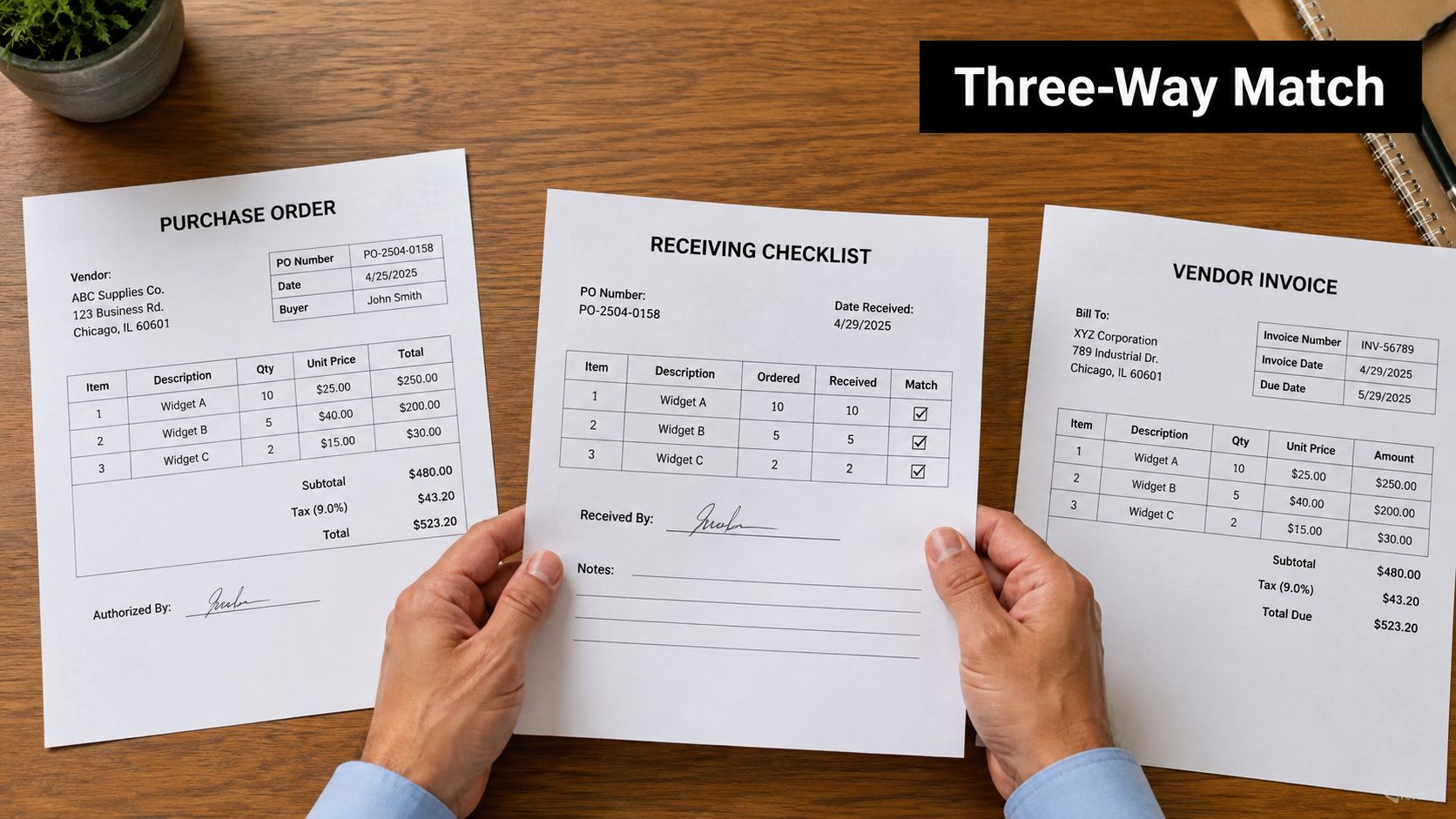
Three-way matching gives every payment a basic evidence trail. Before an invoice reaches the payment queue, compare the purchase order, the receiving report, and the vendor invoice. The business should be able to answer three simple questions: Did we authorize the purchase, did we receive the goods or services, and did the vendor bill us at the agreed price?
The process looks different by industry. A healthcare practice might compare a medical supply order with delivery records and the supplier's invoice before approving payment. A construction company can match the material purchase order to the job-site receiving report and the invoice, helping confirm that costs belong to the correct project. A retail operation can compare SKU quantities ordered with goods received and billed quantities.
Make exceptions visible
A mismatch shouldn't disappear into an email thread. Set up QuickBooks vendor records with payment terms and tax information, establish a receiving procedure, and document who resolves price, quantity, and approval discrepancies. An escalation policy can require staff to resolve most discrepancies within 5 business days, with unresolved items routed to an owner, controller, or fractional CFO.
Useful controls include:
- Require receiving evidence: Staff should inspect physical goods or confirm service completion before recording approval.
- Train the right people: Procurement, receiving, project managers, and AP staff all need to understand why documentation matters.
- Review the process: Conduct quarterly audits of sample matches and refine the workflow annually with a fractional CFO.
Three-way matching won't eliminate every error. It will, however, make unsupported payments harder to approve and give your tax preparer, auditor, or management team a clearer record of what happened.
2. Establish a Vendor Payment Terms Strategy and Cash Flow Planning
Vendor terms should match the timing of customer collections, payroll, taxes, and other obligations. A construction company collecting deposits might negotiate net 60 terms for materials. A healthcare practice could request net 45 terms from a pharmaceutical supplier. A retailer may accept an early-payment discount only when its cash reserves support the choice.
Payment terms affect supplier relationships, working capital, and fraud risk. Reliable communication and predictable payments give vendors a reason to discuss better terms. Unexplained delays can lead to penalties, stricter upfront requirements, weaker service, or a damaged relationship. Benchmarking shared by the Accounts Payable Association in 2025 reports ongoing late-payment pressure among AP teams and suppliers.
Start with a vendor payment terms audit. Record negotiated terms, discount windows, recurring charges, renewal dates, and vendors that require advance deposits. Store the agreed terms in QuickBooks vendor records, then compare them with invoices before scheduling payments. This creates an operating record that supports cash planning, tax review, reporting, and audit readiness.
Build the calendar around cash availability, not only invoice due dates. Include:
- Due dates and discount deadlines: Record when an invoice is due separately from when an early-payment discount expires.
- Cash requirements: Add payroll, sales tax, income tax, loan payments, subscriptions, and expected customer collections.
- Communication ownership: Assign a person to contact vendors before a delay becomes a surprise.
A weekly review can flag a tight cash period early enough to reschedule noncritical purchases, request revised terms, or protect funds reserved for taxes and payroll. Do not postpone a payment without documenting the reason and expected date. That small record helps owners, bookkeepers, and a fractional CFO distinguish a planned cash decision from disorganized AP.
Use cash flow forecasting tools to test payment scenarios and turn the calendar into a management resource. Review terms quarterly, monitor tax-law changes that may affect cash requirements, and ask outsourced bookkeeping or fractional CFO support to challenge assumptions. The goal is controlled timing, preserved supplier trust, and enough cash for the obligations that cannot wait.
3. Automate Invoice Processing and Implement Digital Approval Workflows
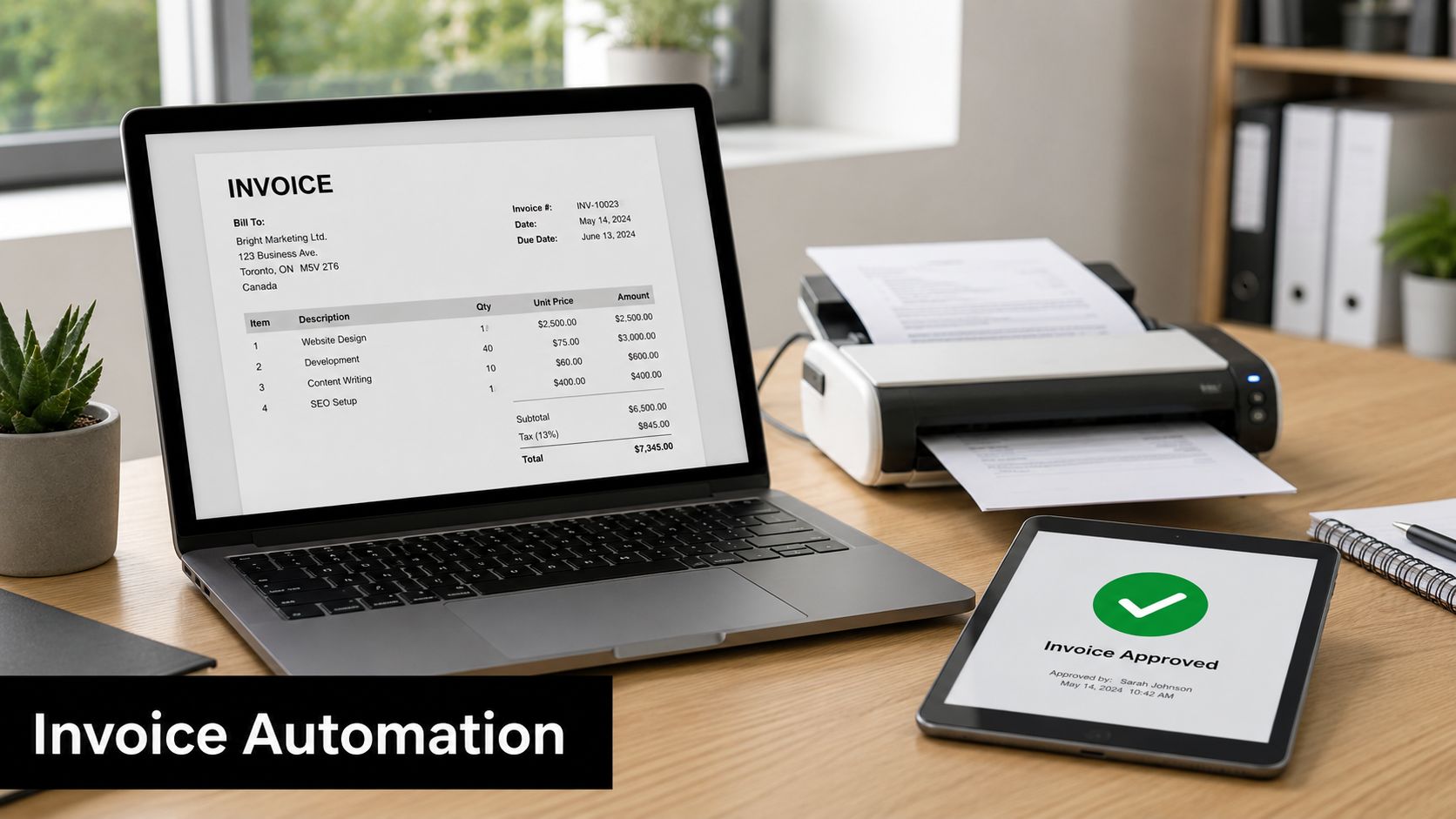
Automation works best when it removes repetitive handling without removing judgment. An AP automation workflow should capture invoice data, route the bill to the correct approver, flag missing or inconsistent information, and preserve a timestamped record of each action. QuickBooks-integrated tools can support that structure without requiring a custom software project.
A healthcare practice may route medical supply invoices to an office manager for receipt confirmation and a clinical leader for unusual purchases. A construction company can route invoices by job, location, or cost category. A nonprofit can require a grant manager to confirm that an expense belongs to the approved funding source before payment.
Automate the routine, escalate the unusual
Set approval hierarchies and dollar-based limits before turning on automation. Otherwise, the system may just move confusion faster. Staff also need training on how to approve, reject, code, and investigate invoices.
Start with accounting process automation that integrates with the company's QuickBooks environment. Configure automatic alerts for invoices that fail validation, and assign someone to resolve those alerts within 24 hours. Periodically audit approval rules, especially after a manager changes roles or a department expands.
The human role doesn't disappear. It shifts toward exception handling, vendor communication, and review of unusual transactions. That's where automation earns its keep. It should stop routine invoices from waiting in an inbox while directing questionable invoices to someone capable of making a reasoned decision.
A well-designed workflow also helps businesses streamline exporter invoicing when documentation, approval timing, and transaction records must remain organized across multiple parties.
4. Maintain Compliant Vendor Master Files and Tax Identification Documentation
A vendor record should tell your accounting team who the supplier is, how the supplier should be paid, and what tax documentation supports the relationship. At a minimum, maintain the vendor's legal name, taxpayer identification information, business classification, payment terms, contract details, and current Form W-9 when applicable.
This control matters in every industry. A construction company needs organized W-9 records for subcontractors. A healthcare practice must distinguish independent contractors from other suppliers and retain the documentation supporting that classification. A nonprofit should be able to produce vendor tax records during an audit without searching through personal inboxes and paper folders.
Make onboarding a gate, not a cleanup project
Require vendor onboarding before the first payment. The checklist should collect the W-9, contract or engagement letter, payment instructions, and approval evidence. Store those documents centrally, restrict access to sensitive tax identification information, and verify changes to bank details through an independent communication channel.
QuickBooks can help flag vendors with missing tax information, but software can't decide whether a document is authentic or whether a classification is appropriate. Staff should verify documentation before processing payments, and an accountant should review classifications when circumstances change.
Federal reporting rules also require monitoring. Starting in 2026, the federal reporting threshold for Forms 1099-NEC and 1099-MISC increases from $600 to $2,000, with future inflation adjustments. Backup withholding follows the same threshold, while the 1099-K threshold returns to $20,000 and 200 transactions for third-party payment platforms such as PayPal and Venmo, according to 2026 tax-change guidance for small businesses.
Don't treat that change as permission to ignore smaller payments. Keep complete records, review vendor classifications annually with your accountant, and monitor whether federal or state requirements apply differently to a specific payment.
5. Reconcile Accounts Payable Subsidiary Ledgers to the General Ledger Monthly
The AP subsidiary ledger shows what the business owes each vendor. The general ledger control account shows the total liability recorded in the financial statements. Those two records should agree after adjustments are properly documented. If they don't, management may be looking at inaccurate liabilities, expenses, cash needs, or tax information.
Monthly reconciliation catches problems that invoice approval alone won't find. A duplicate payment may look legitimate when reviewed in isolation. A vendor credit can remain unused for months. An unauthorized payment may be buried among routine transactions. Reconciliation gives someone a defined point at which to compare the detailed records with the accounting books.
Use a repeatable workpaper
Schedule the reconciliation as a recurring monthly task. Export or review the QuickBooks payable aging, compare vendor-level balances to the general ledger, and attach supporting documents to the workpaper. Investigate variances immediately and record the explanation, correction, and responsible reviewer.
A healthcare practice may discover duplicate payment activity while comparing vendor statements with its ledger. A construction company may find a credit for returned materials that should be applied to a future invoice or requested as a refund. A retail business may identify an unfamiliar vendor payment and investigate whether the issue came from an entry error, weak access controls, or fraud.
Practical rule: A reconciling item can be temporary, but it can't be invisible. Give every difference an owner, an explanation, and a resolution date.
Review reconciliations with a fractional CFO to identify recurring patterns. If the same vendor credit, duplicate invoice, or coding issue appears repeatedly, fix the process that creates it instead of correcting the symptom every month.

6. Implement Segregation of Duties Controls in Accounts Payable Functions
AP fraud becomes easier when one person can create a vendor, approve an invoice, release payment, and reconcile the related bank activity. Separate authorization, recording, and custody wherever staffing allows. This protects cash, keeps QuickBooks records trustworthy, and gives auditors a clear trail.
A healthcare practice might assign invoice review, payment approval, and bank-release authorization to different people. A construction company can separate invoice entry, job-cost review, and check signing. A nonprofit may require finance committee approval for significant vendor payments. Each assignment should reflect the organization's risk and staffing, not an idealized finance department.
Write the control into a simple responsibility matrix. List each AP task, approval limit, QuickBooks permission, backup person, and review frequency. Restrict access to only the functions each role needs. Recheck permissions when an employee changes position or leaves, because old access can outlast the job that justified it.
Small businesses can add oversight without hiring a full department:
- The owner reviews vendor changes and payment batches before release.
- An outside bookkeeper or fractional CFO examines reconciliations, unusual transactions, and high-value payments.
- An independent reviewer tests a sample of payments without advance notice.
- Cross-training gives the business coverage and can reveal inconsistent approvals or unusual vendor activity.
Document exceptions, too. If one employee must enter and approve a payment during an absence, require owner review, retain the reason, and attach evidence of the later check. A control that exists only in a policy manual will not protect the business.
Explain the purpose to staff. Separation protects both company funds and the employee handling payments. Practical guidance on managing accounts payable should sit beside QuickBooks access rules, approval records, and periodic testing. For suspected vendor or payment fraud, the Lighthouse Consultants forensic team outlines warning signs that warrant investigation. Small and mid-sized businesses can also ask an outsourced bookkeeping provider or fractional CFO to test the controls before an error becomes a tax, cash-flow, or audit problem.
7. Implement Tax Deduction Substantiation and Category Coding Systems
A payment isn't automatically a deductible business expense because it left the bank account. The books should show what the business bought, why it bought it, where the cost belongs, and what supporting record proves the transaction. A consistent chart of accounts makes tax preparation easier and gives management more useful reporting throughout the year.
Industry-specific coding is essential. A healthcare practice may separate medical supplies, facility expenses, and costs by service line. A construction company needs job and cost-type categories that support project profitability. A retailer should distinguish ordinary operating expenses from capital improvements that may require depreciation treatment.
Code for decisions, not just tax forms
Work with a fractional CFO or CPA to design a chart of accounts that reflects the business model. Then create QuickBooks vendor defaults for recurring suppliers, while preserving a review step for unusual invoices. A default code saves time, but it shouldn't turn every invoice from a complex supplier into the same category forever.
Require business-purpose documentation with each payment. Receipts, contracts, quotes, purchase orders, job records, and approval notes should be stored with the transaction. Train employees to explain the business purpose in plain language rather than writing vague descriptions such as “supplies” or “miscellaneous.”
Federal tax changes make timely review even more useful. The IRS says P.L. 119-21 makes the 20% qualified business income deduction permanent for qualified active trades or businesses, and the income thresholds for QBI deduction limitations have increased, as described in IRS Publication 334. The deduction's application still depends on the taxpayer's facts, business structure, income, and other rules, so coding shouldn't be treated as a substitute for tax advice.
Also monitor investment-related changes. Businesses can generally expense 100% bonus depreciation for qualified property placed in service after January 19, 2025, and Section 179 expensing rises to $2.5 million with a $4 million phaseout threshold, with inflation adjustments going forward, according to tax-law guidance for year-end financial statements. Your accountant should review whether a purchase is currently deductible, depreciable, or subject to other limitations.
8. Monitor and Manage Cash Discounts and Payment Terms Optimization
Cash discounts affect more than invoice cost. A supplier may offer 2% for payment in 10 days, but early payment can strain cash reserved for payroll, taxes, or a higher-cost obligation. Approve the discount only when its return exceeds the cost and risk of using cash or borrowing.
Industry conditions change the decision. A healthcare practice can capture discounts from strategic suppliers while cash is strong. A construction company can automate deadline alerts across project invoices, provided customer collections support the schedule. A retailer may take discounts during stronger seasonal periods and preserve liquidity during slower months.
Build the decision into QuickBooks
Audit major vendors for discount opportunities, then record terms in the vendor master file. Configure QuickBooks or an integrated AP tool to flag deadlines, and review missed discounts monthly. Compare the discount's effective return with actual borrowing costs, forecasted cash needs, and tax payment dates.
Use this checklist before approving early payment:
- Confirm eligibility: Check the invoice, discount terms, and approval status.
- Check liquidity: Verify that payment will not disrupt payroll, taxes, or other required obligations.
- Compare alternatives: Weigh the discount against borrowing costs and other uses of cash.
- Record consistently: Document whether the business uses gross or net accounting, then confirm the treatment with its tax advisor.
Do not pursue every discount. A modest saving can cost more if it causes a late payroll tax payment, weakens a supplier relationship, or triggers emergency borrowing. AP should connect savings with cash-flow planning, compliance, and reliable reporting.
For a checklist-ready control, assign one person to monitor deadlines and another to review exceptions. An outsourced bookkeeping team can maintain the schedule, while a fractional CFO can test whether the policy still fits seasonal cash flow and changing tax-law requirements.
8-Point Accounts Payable Best Practices Comparison
| Item | Implementation Complexity 🔄 | Resource Requirements 💡 | Expected Outcomes ⭐📊 | Ideal Use Cases 📊 | Key Advantages ⚡ |
|---|---|---|---|---|---|
| Implement a Three-Way Matching Process for Invoice Verification and Tax Compliance | Moderate–High: cross-department workflow; easier with automation | Accounting system (QuickBooks), AP/procurement staff, training, automation tools | Strong controls; reduces overpayments/fraud (70–90%); audit-ready tax substantiation ⭐📊 | Businesses with PO/receiving processes, construction, healthcare, retail | Prevents overpayments; improves cash flow; provides audit defense ⚡ |
| Establish Vendor Payment Terms Strategy and Cash Flow Planning | Low–Moderate: policy design and negotiation effort | CFO/fractional CFO support, vendor analysis, cash forecasting tools | Improved working capital; reduced short-term financing; better forecasting ⭐📊 | Firms needing working-capital optimization, construction, retail, healthcare | Extend payables, capture discounts strategically, lower financing costs ⚡ |
| Automate Invoice Processing and Implement Digital Approval Workflows | High initial: software selection, OCR/rules setup, change management | Invoice automation software, IT/support, staff training, QuickBooks integration | Faster processing (70–80% time savings); fewer duplicates; complete audit trail ⭐📊 | High invoice-volume organizations, construction, healthcare, non-profits | Rapid processing, error reduction, easier discount capture ⚡ |
| Maintain Compliant Vendor Master Files and Tax Identification Documentation | Low–Moderate: process and documentation discipline | Staff time to collect/store W‑9s, vendor database, QuickBooks integration | Accurate 1099 reporting; reduced IRS penalty risk; audit-ready records ⭐📊 | Businesses using many contractors/subcontractors | Ensures compliance, simplifies onboarding, reduces audit exposure ⚡ |
| Reconcile Accounts Payable Subsidiary Ledgers to General Ledger Monthly | Moderate: recurring monthly process requiring accounting skill | Accountant/bookkeeper, reconciliation templates/tools, QuickBooks reports | Early detection of errors/duplicate payments; accurate liabilities under GAAP ⭐📊 | Any business with regular payables; multi-location or job-costing entities | Detects fraud/errors early; recovers cash; strengthens financial statements ⚡ |
| Implement Segregation of Duties Controls in Accounts Payable Functions | Moderate–High: role design, access controls, possible compensating controls | Adequate staffing or compensating controls, access management in QuickBooks | Reduced fraud risk; improved auditability and accountability ⭐📊 | Medium+ businesses or grant-funded/non-profits with fraud risk | Prevents unauthorized payments; demonstrates strong internal controls ⚡ |
| Implement Tax Deduction Substantiation and Category Coding Systems | Moderate: chart-of-accounts redesign and policy enforcement | Fractional CFO/accountant, training, coding defaults in QuickBooks | Maximized defensible deductions; clearer reporting and job costing ⭐📊 | Businesses needing precise tax/cost reporting, construction, multi-service firms | Improves tax positions; simplifies tax prep and audit defense ⚡ |
| Monitor and Manage Cash Discounts and Payment Terms Optimization | Low–Moderate: policy + tracking; some negotiation effort | Cash-flow forecasting, QuickBooks alerts, vendor master tracking, CFO analysis | Higher realized returns from discounts; lower net payables cost ⭐📊 | Businesses with predictable cash flow and discount opportunities | Captures high annualized returns; improves margins and vendor terms ⚡ |
Turn AP Controls Into Business Confidence
The eight practices work best as one connected operating system. Three-way matching supports payment accuracy. Vendor master files support tax reporting. Digital approvals create an audit trail. Reconciliations validate the books. Segregation of duties reduces the opportunity for unauthorized payments. Category coding supports deductions and management reporting. Payment-term planning protects cash while preserving supplier relationships.
Start with documentation before buying software. Write the AP policy, define who can approve purchases, establish receiving requirements, collect vendor tax forms, and decide how invoices should be coded. A clear policy exposes gaps quickly. If employees can't explain where invoices enter the process or who resolves a mismatch, automation won't solve the problem.
Next, automate the repeatable steps and restrict access by role. A QuickBooks-integrated workflow can capture invoices, route approvals, flag exceptions, and preserve records. Keep humans responsible for unusual transactions, vendor changes, related-party payments, and judgment-heavy decisions. Automation should reduce clerical work, not create a faster way to approve bad data.
Then reconcile and measure. Track invoice cycle time, cost per invoice, touchless processing, exception rates, late payments, duplicate payments, unused credits, and missed discounts. Benchmark research summarized in 2026 found best-in-class organizations processing invoices in 3.1 days, compared with an industry average of 10.9 days, while fully loaded cost per invoice was $2.78 for best-in-class organizations versus $10.89 for the average organization. The same research reported best-in-class touchless processing at 52.8% in 2025, up from 47.2% in 2024, while the all-buyer average remained near 25%, according to AP automation benchmark reporting. Use these figures as reference points, not promises. Your own baseline matters more than a generic target.
Tax monitoring belongs on the recurring finance calendar. Review 1099 requirements, QBI planning, depreciation changes, vendor documentation, and payment timing with a qualified tax professional. The IRS Tax Calendar says EFTPS users must schedule payments by 8 p.m. ET at least one calendar day before the tax due date, a practical timing requirement for small-business AP, payroll tax, and other tax payments, as shown in the IRS Tax Calendar.
Most small businesses don't know every requirement that applies to their vendors, payments, industry, and tax situation. They need accurate bookkeeping and someone who can connect daily transactions to cash flow, compliance, and business decisions. A full-time finance leader may not fit the budget, but a fractional CFO can review controls, explain reports, monitor changes, and guide owners through decisions that shouldn't be made from a bank balance alone.
Bookkeeping and Accounting of Florida Inc. supports clean QuickBooks records, bookkeeping, AP and AR processes, payroll, tax preparation, audits, reviews, healthcare accounting, construction accounting, nonprofit reporting, and forensic audit work. Its QuickBooks ProAdvisors can organize the system, while fractional CFO services provide senior financial guidance without full-time overhead. For businesses in Jacksonville and Northeast Florida, that combination can turn AP from a recurring source of uncertainty into reliable financial information for planning and growth.
Bookkeeping and Accounting of Florida Inc. can help you organize QuickBooks, strengthen accounts payable controls, prepare for tax reporting changes, and build cash flow visibility with bookkeeping and fractional CFO support. Visit Bookkeeping and Accounting of Florida Inc. to discuss your AP process, compliance needs, and the financial guidance your business needs next.