
A Jacksonville contractor usually calls after the pain shows up in cash, not when it starts in the books. The bank asks for a draw support package. A surety wants current financials. A project manager swears the job is profitable, but the checking account says otherwise. Meanwhile invoices are sitting in a truck, labor hours came in by text message, and retainage is mixed into regular receivables like it's spendable cash.
Thank you for reading this post, don't forget to subscribe!That's where construction bookkeeping services stop being clerical help and start becoming operating control. In Northeast Florida, contractors deal with stretched payment timing, storm interruptions, rushed change orders, mixed crews, and software that never quite talks to the field. If the books don't reflect what's happening on each job, margin disappears and compliance problems show up late.
Why Jacksonville Contractors Need Specialized Bookkeeping
A Ponte Vedra Beach general contractor can land a strong custom home job and still end up in trouble if the books are built like a retail business. I've seen profitable work look unprofitable because lumber, drywall, and subcontractor bills all got dumped into overhead instead of job costs. By the time a lender asks for job-level margin support, the damage is already done. The WIP is unreliable, the draw package falls apart, and access to cash tightens at the worst possible time.
That kind of problem isn't rare around Jacksonville. Field supervisors send photos, paper tickets, and texted approvals. Office staff enters bills later, often without cost codes. Hurricane season adds another layer. A project may pause, re-sequence, or absorb cleanup work that changes cost timing before anyone updates the estimate to complete.
Where generic bookkeeping fails
Generic bookkeeping can reconcile a bank account. It usually can't answer the questions that matter on a live job.
- Which project is burning labor: You need job and cost-code detail, not one construction expense bucket.
- What can be collected this month: Retainage can't sit inside ordinary accounts receivable if you want a usable cash forecast.
- Whether billing is ahead or behind production: Without current project data, underbilling hides in plain sight.
A practical primer like Pipeline On bookkeeping is useful because it shows why contractor books have to follow projects, not just transactions.
Clean books don't protect a contractor. Clean books tied to jobs, draws, and payroll do.
What specialized service means in practice
Specialized construction bookkeeping services bridge the gap between the jobsite and the general ledger. The chart of accounts gets built around projects and cost behavior. Daily field activity gets tied back to vendor invoices, payroll, deposits, and change orders. The result is a set of reports a lender, owner, surety, and tax preparer can use.
That matters more now because bookkeeping isn't some fringe add-on inside construction finance. The construction accounting software market was valued at USD 2.6 billion in 2025 and is projected to reach USD 4.8 billion by 2035, with a 6.3% CAGR from 2026 to 2035, while a parallel estimate places the global construction accounting outsourcing service market at USD 2.53 billion in 2025 and USD 5.16 billion by 2034 at an 8.4% CAGR. In that same market, bookkeeping accounted for about 28.5% of outsourced construction accounting work in 2025, ahead of payroll management at 22.0% and tax preparation at 18.5% according to construction accounting market analysis from GM Insights.
What Construction Bookkeeping Services Actually Include
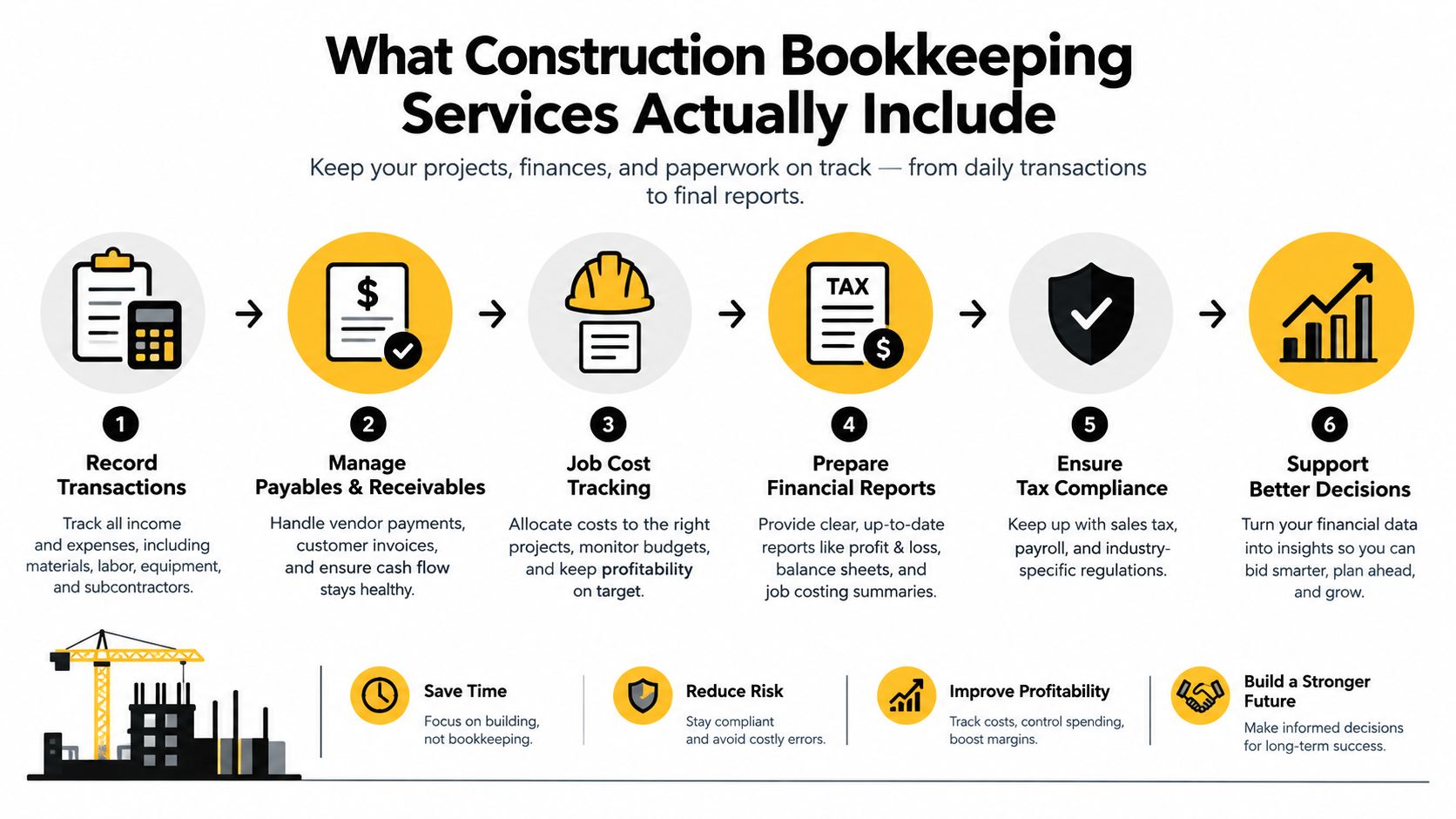
Contractors often think bookkeeping means reconciliations, a profit and loss statement, and maybe payroll. In construction, that's the supporting layer. Deliverables are job-centered and deadline-driven.
The monthly outputs that matter
A competent construction bookkeeping workflow closes the month by posting all job costs, including payroll burden, materials, subcontractor pay applications, and equipment, into the job-cost ledger. Then it runs a WIP schedule using costs to date, estimated cost to complete, percent complete, and earned revenue. That process identifies overbilling and underbilling, and the same close package should reconcile WIP earned revenue back to the general ledger while updating retainage releases and subcontractor retainage payouts in the cash forecast, as outlined in construction retainage and WIP bookkeeping guidance from Daniel Sandler CPA.
What should show up each month usually includes:
- Job-cost reporting: Actual versus estimated cost to complete for every active project.
- Payroll allocation: Labor and payroll burden assigned to the right job, and separated correctly when crews cross projects.
- Retainage schedule: Owner-held retainage and subcontractor-held retainage tracked outside standard receivables and payables.
- Progress billing support: Draw-ready billing detail for AIA-style applications or equivalent schedules.
- WIP support: Balance sheet and project-performance alignment so revenue timing makes sense.
Payroll and compliance are not side work
Construction payroll is a bookkeeping function, not just a payroll processor function. Recent industry coverage points out that contractors deal with union rules, prevailing wage, worker classification, and reporting requirements that ordinary payroll workflows miss. It also notes that vendors are pushing AI and automation to reduce manual hour collection and payroll prep because the demand for faster, more accurate labor-cost allocation is real, as discussed in Construction Today's review of construction payroll software and compliance pressures.
That means the books should also support:
- W-9 collection before first payment
- Vendor tracking for year-end 1099 filing
- Certified payroll records on covered work
- Change orders and backcharges posted to the right cost code
- Sales tax and routine monthly close tasks
Why stale project data is expensive
Many firms still close monthly while project costs change weekly. That delay creates stale financials. A 2025 accounting-industry report noted that construction firms face complex job costing, heavy manual reconciliation, and a disconnect between field and accounting systems, which is why real-time project visibility remains an underserved need according to CPA Practice Advisor's report on construction accounting workflow gaps.
Practical rule: If a superintendent can approve extra work on Tuesday, accounting shouldn't learn about it after month-end.
That's why good construction bookkeeping services build weekly routines, not just month-end cleanup. The goal is current project financials, not prettier historical reports.
Job Costing, Retainage, and Progress Billing Explained
Construction is unusual because contractors spend first and collect later. Books that ignore that timing problem create false confidence. Books that handle it correctly become a cash-management system.
In 2024, 82% of contractors reportedly waited more than 30 days for payment, up from 49% two years earlier, and slow payments were estimated to cost the U.S. construction industry about USD 280 billion that year. The average payment cycle was about 83 to 90 days from pay application submission to cash receipt, while subcontractors waited an average of 56 days after submitting a pay application to a general contractor. The same dataset notes average retainage withheld at 7.59% on private projects, 5.56% on state projects, and 3.26% on federal projects, according to construction invoicing and payment timing statistics compiled by Billed.
Job costing tells you where the margin went
Job costing starts with discipline. Every bill, timecard, and draw-related cost has to land on a specific project and cost code. If material purchases, equipment charges, and subcontractor invoices are blended together, a contractor can't tell whether the May job made money or whether another project covered the loss.
For a deeper look at that structure, this guide on construction job costing is a solid reference.
Retainage is not normal receivables
Owners commonly withhold 5% to 10% of each progress payment until substantial completion. If that holdback sits inside standard AR or AP, aging reports and cash forecasts overstate what can move this month. Practical bookkeeping tracks retainage receivable by job on the contractor side and retainage payable by job on the subcontractor side, with monthly reconciliation against billing records and cumulative contract retainage, based on Tidy Flow's retainage bookkeeping guidance.
Retainage Tracking Example: $500,000 Contract
| Line Item | Contract Value | Billed to Date | Retention Rate | Held Amount |
|---|---|---|---|---|
| Original contract | $500,000 | $250,000 | 10% | $25,000 |
| Revised draw position | $500,000 | $400,000 | 10% | $40,000 |
| Final billed contract | $500,000 | $500,000 | 10% | $50,000 |
Progress billing has to match production
Progress billing translates job progress into a receivable the owner can approve. If percent complete in the field doesn't match the billing package in the office, cash slows down and disputes start. Done well, the billing package, the job-cost ledger, and the cash forecast all tell the same story.
When the draw is approved, the contractor should know exactly what portion is collectible now and what portion is still sitting in retainage.
Setting Up QuickBooks the Right Way for Contractors
Most contractor QuickBooks files are built too simply. They may be tidy, but they aren't useful. A contractor needs a file that mirrors how jobs are estimated, billed, staffed, and reviewed.
A proper setup starts with a chart of accounts that separates direct job costs from overhead. Projects should be tracked through the job or project function, and cost categories should map to how the company bids work. Labor, materials, subcontractors, equipment, and overhead need clear separation. If progress billing is part of the workflow, the items list also has to support the schedule of values.
This walkthrough can help if you're comparing implementation approaches in more detail: construction accounting in QuickBooks.
Desktop versus Online
Some contractors still do better in QuickBooks Desktop Premier Contractor because the reporting structure fits their workflow. Others do fine in QuickBooks Online when it's paired with a construction add-on and someone who knows how to map field data correctly.
QuickBooks Desktop vs Online for Jacksonville Contractors
| Feature | QuickBooks Desktop Premier Contractor | QuickBooks Online + Construction Add-On |
|---|---|---|
| Job-cost reporting style | Strong native contractor-style reporting | Flexible, depends on setup and add-on |
| Progress billing workflow | Familiar for many established GCs | Works well with the right app stack |
| Remote access | More limited without hosting | Easier for distributed teams |
| Best fit | Established contractor with detailed office controls | Smaller or growing team that needs cloud access |
A short visual can help if you're sorting out the basics before setup:
The setup choices that matter
A strong contractor file usually includes:
- Entity separation: Each legal entity gets its own bank feeds and books. Don't blend operations because it feels convenient.
- Project structure: Jobs need consistent naming so payroll, billing, and vendor costs land in the same place every time.
- Budget mapping: Estimates should line up with cost codes used in accounting, or variance reporting becomes guesswork.
The biggest mistake is overspending on software before the workflow is fixed. A two-crew subcontractor usually doesn't need an elaborate stack. A GC with multiple active jobs, progress billings, and outside subcontractors often does.
Payroll, Certified Payroll, and 2026 Compliance Updates
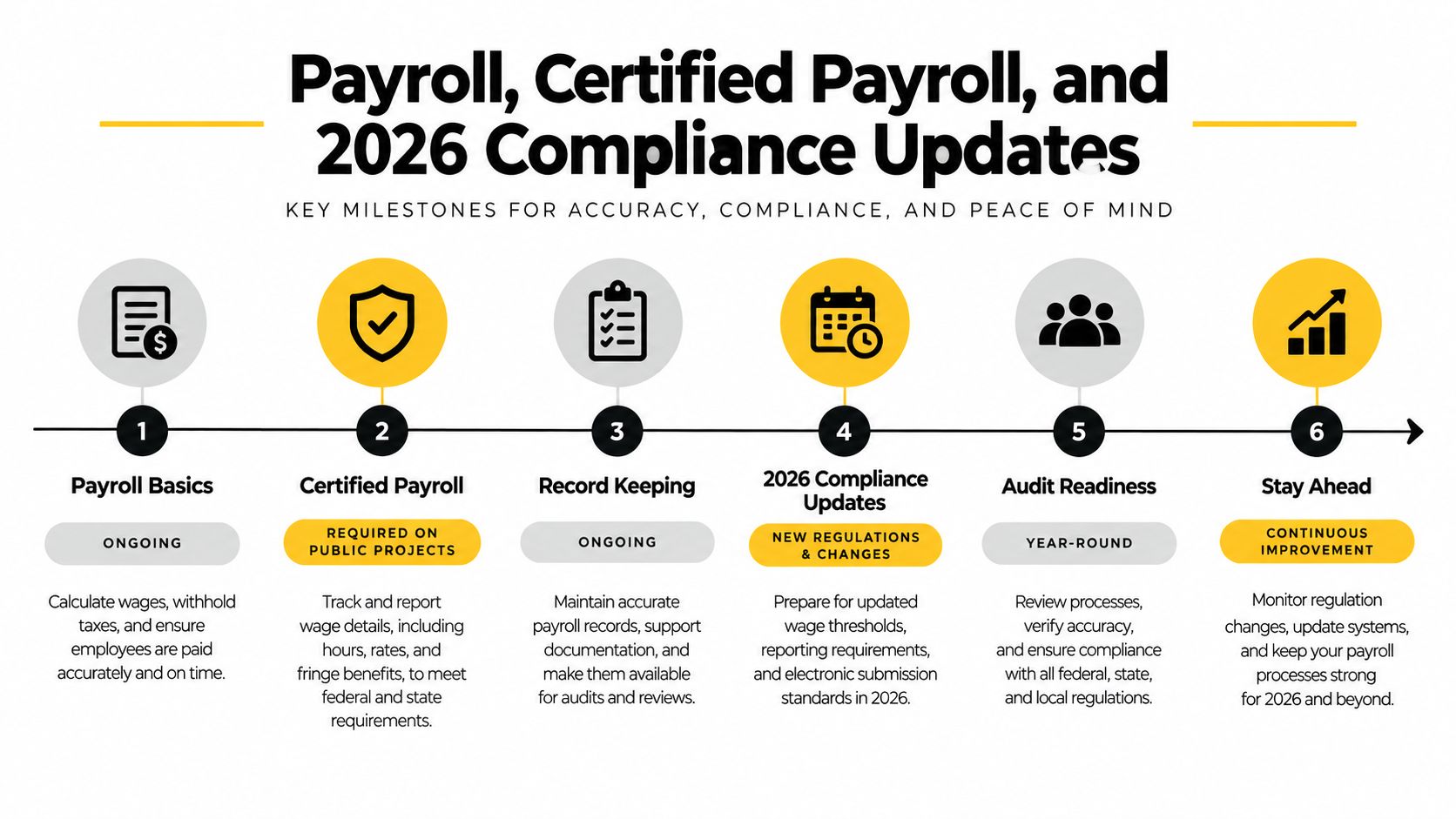
Payroll is where tax, labor, and project accounting all collide. When contractors treat payroll as a stand-alone process, they miss the compliance chain that connects wage withholding, labor costing, certified payroll, subcontractor reporting, and equipment-expensing decisions.
The 2026 payroll numbers contractors need to update
For 2026, the federal Social Security wage base is $184,500, and the combined FICA rate remains 15.3%, split evenly between employer and employee. The employer portion stays 6.2% Social Security plus 1.45% Medicare per employee, according to Xero's 2026 payroll compliance summary.
If a payroll system isn't updated on time, the error doesn't stay in payroll. It affects job-costing accuracy, quarterly filings, and year-end cleanup.
The 1099 threshold changed for 2026
For payments made in 2026, the federal Form 1099-NEC and 1099-MISC reporting threshold rises from $600 to $2,000, with inflation indexing beginning in 2027, based on Uncle KAM's 2026 tax strategy guide discussing the filing rule change.
That doesn't mean contractors should loosen vendor onboarding. W-9 collection still belongs at the front end. Waiting until January to identify who should receive a form is how small businesses fall out of compliance.
Tax law changes that affect contractors directly
For 2026, Section 179 expensing is limited to $2,560,000, with a $4,090,000 phaseout threshold. The same source notes a major restriction on the percentage-of-completion method for residential construction contracts beginning with contracts entered into in tax years beginning after enactment of the law, according to Toran Accounting's construction tax law update.
Those rules affect more than tax returns. They influence equipment-buying decisions, fixed-asset planning, and how a contractor measures taxable income timing across open work.
Certified payroll belongs on the same calendar
Certified payroll isn't a separate island. If you run public or prevailing-wage work, your bookkeeping process has to connect time collection, trade classification, payroll calculation, job costing, and reporting support in one chain. A practical starting point is understanding certified payroll reporting requirements.
Contractors don't need more forms. They need one compliance calendar that ties payroll runs, tax deposits, certified payroll support, and year-end vendor reporting together.
A fractional CFO earns their keep. Most small businesses don't know what all is required, especially once they mix employees, subcontractors, public work, equipment purchases, and changing tax law. A construction-focused accounting team can guide the owner through those decisions so the business stays compliant instead of reacting after notices arrive.
In-House Bookkeeper vs Generalist vs Construction CPA Firm
Once spreadsheets and catch-up entries stop working, contractors usually look at three options. Hire in-house. Use a generalist. Or hand the whole function to a construction-focused CPA firm that can also provide advisory support.
The right answer depends less on pride and more on what reports the business needs every month.
What each option really delivers
An in-house bookkeeper can be a good fit when the office is already disciplined, the owner is willing to supervise closely, and there's enough consistent volume to justify a dedicated seat. A generalist bookkeeper can manage transaction entry and reconciliations, but many won't be comfortable with WIP, progress billing, certified payroll support, or retainage reconciliation. A construction CPA firm usually brings bookkeeping, payroll coordination, tax-readiness, and fractional CFO visibility together under one scope.
Comparing Bookkeeping Options for Contractors
| Option | Typical Cost | Job-Cost Depth | Best Fit |
|---|---|---|---|
| In-house bookkeeper | Full-time salary and overhead | Varies by experience | Contractor with stable internal processes |
| Generalist bookkeeper | Hourly or monthly outsourced fee | Usually limited | Very small contractor with simple work |
| Construction CPA firm | Monthly service scope | High | Contractor needing reporting, compliance, and guidance |
Why fractional CFO support matters
A contractor doesn't just need data entry. The owner needs someone to interpret gross margin drift, underbilling patterns, payroll exposure, and tax planning before year-end. That's the gap between bookkeeping and management. It's also why many companies need a fractional CFO before they need a full-time controller.
For firms juggling calls, paperwork, and follow-up, resources like the SkipCalls guide for accountants are useful because they highlight how communication systems affect service delivery just as much as technical skill.
One practical option in this market is Bookkeeping and Accounting of Florida Inc., which provides bookkeeping, payroll, tax, and fractional CFO services for growing businesses including construction companies. That model fits contractors who need guidance and accountability without building a full internal finance department.
How to Choose the Right Provider in Northeast Florida
A construction bookkeeper should be vetted like a subcontractor. If the scope is vague, the handoff will be messy and the bill will grow.

Questions worth asking before you sign
Ask the provider to describe the month-end close in contractor terms, not generic accounting language. They should be able to explain how they handle job-cost reports by cost code, retainage reconciliation by contract, and regular WIP support. If they dodge those points, keep looking.
Use a checklist like this:
- Reporting cadence: Can they produce job-cost reporting shortly after month-end, or do you wait until tax season to find out what happened?
- Retainage control: Do they reconcile owner retainage and subcontractor retainage separately?
- Public job experience: Have they supported certified payroll and prevailing-wage records before?
- Software fluency: Can they work in QuickBooks Desktop Premier Contractor, QuickBooks Online, and import-driven environments tied to project platforms?
- Audit and tax readiness: Can they hand your CPA clean books instead of a cleanup project?
Red flags contractors miss
Watch for warning signs that sound harmless but usually create rework:
- Hourly-only scope: If every cleanup task becomes billable drift, disorganization gets rewarded.
- No sample reports: If they can't show you a contractor-style report package, they probably don't produce one.
- Weak onboarding questions: A provider who doesn't ask about draws, payroll mix, subcontractors, or sales tax isn't thinking like a construction accountant.
Ask for the actual reports, not a promise that they can produce them later.
Northeast Florida contractors also need someone who understands the practical local mix. Residential, commercial, storm-related interruptions, county-by-county operational differences, and owner-managed field teams all create bookkeeping pressure points. The right provider won't just post transactions. They'll build a workflow that keeps project financials current enough to run the business.
Your Next Step Toward Cleaner Books and Better Margins
Every month of sloppy books costs a contractor something. Sometimes it's obvious, like a delayed draw or a payroll problem. More often it's quieter. Understated labor burden, stale job costs, missed retainage follow-up, weak subcontractor documentation, or tax planning done after the year is over.
Construction bookkeeping services matter because contractors need more than a reconciled bank balance. They need current job margins, organized payroll support, clean vendor records, and year-end books that don't collapse into cleanup work. They also need guidance. Most small businesses don't know every filing rule, tax-law change, or payroll requirement that applies once crews, subs, public work, and equipment enter the picture.
A good construction accounting partner closes that gap. They connect field data to the ledger, keep reporting current, and help the owner make decisions before the problem becomes expensive. That includes the strategic side too. Equipment purchases, payroll setup, subcontractor tracking, and entity-level reporting all improve when a fractional CFO is part of the conversation.
If you're a Jacksonville or Northeast Florida contractor and your books still feel like an after-the-fact record instead of a management tool, it's time to change the system. The cost of doing nothing isn't just inconvenience. It's lost cash control, weaker compliance, and thinner margins on work you thought was profitable.
Bookkeeping and Accounting of Florida Inc. helps Jacksonville contractors with construction bookkeeping services, payroll support, tax preparation, QuickBooks setup, and fractional CFO guidance that ties field activity back to clean financial reporting. If your job costs are stale, your retainage tracking is messy, or you need help staying compliant with payroll and contractor reporting rules, visit Bookkeeping and Accounting of Florida Inc. to start the conversation.