
You win a substantial project, hire crews, order materials, and send the first invoices. The bank balance looks healthy, but your books can't tell you which job is profitable, where labor is overrunning budget, or how much cash is trapped in retainage. By the time the problem appears on a year-end profit-and-loss statement, the money is already gone.
Thank you for reading this post, don't forget to subscribe!That's why construction business accounting can't be treated as ordinary small-business bookkeeping. Contractors need project-level cost control, accurate work-in-progress reporting, compliant payroll, current tax planning, and financial guidance that connects daily transactions with long-term decisions. Software helps, but clean coding and experienced oversight matter more.
Why Construction Accounting Is a Different Beast
A contractor can have strong sales and still lose money. The usual cause isn't a lack of effort. It's a lack of visibility.
A general contractor may land a large commercial project while several residential jobs remain active. Payroll gets posted to one general expense account, subcontractor invoices sit in an inbox, equipment costs are spread across the company, and change orders are tracked in email. The income statement says the business is busy. It doesn't say whether each project is carrying its share of labor, materials, subcontractors, equipment, and overhead.
Construction accounting solves that problem by treating each job as a separate profit center. Standard accounting aggregates company performance. Construction accounting tracks performance by project, phase, cost code, contract, and billing status. That distinction drives every serious decision, from bidding and staffing to purchasing and financing. The construction accounting overview from Construction Executive also highlights job costing and project-level tracking as the foundation of contractor financial management.

The reports that actually matter
A generic profit-and-loss statement won't answer the questions an owner needs answered before the next draw or bid. Construction firms should monitor:
- Gross profit margin: Is the contract producing the margin included in the estimate?
- Labor productivity: Are labor hours and classifications tracking against the job budget?
- Overbilling and underbilling: Does billing reflect earned progress, or is cash temporarily disguising weak performance?
- Backlog value: What work remains, and what margin does that work realistically carry?
- Change-order volume: Are scope changes being approved, priced, and billed before costs accumulate?
Cash pressure makes this discipline even more important. About 82% of contractors reportedly waited more than 30 days for payment in 2024, and slow payments were estimated to cost the U.S. construction industry about $280 billion that year, according to Construction Executive's construction accounting guide. Those figures show why billing accuracy and job-cost visibility aren't administrative preferences. They protect working capital.
Practical rule: If your accounting system can't show the cost and margin of every active job, you're bidding and managing with incomplete information.
Project risk also extends beyond the ledger. Owners evaluating exterior materials, for example, may benefit from resources that help them compare timber cladding risks before committing to a specification. The accounting workflow should then capture the financial effect of that choice through the correct material, labor, maintenance, and change-order codes.
Job Costing and Revenue Recognition That Actually Works
Job costing is the control system of construction accounting. It isn't a report prepared after the project is over. It's the mechanism that tells you whether today's work is consuming the budget faster than the contract is earning revenue.
Start with a consistent cost structure. Every transaction should identify the project and the relevant category, including:
- Labor and payroll burden
- Materials and supplies
- Subcontractors
- Equipment
- Allocated overhead
A vendor bill coded only to “materials expense” may be acceptable for a simple service company. For a contractor, it's incomplete. The bill should identify the job, phase, and cost code so management can compare actual spending with the estimate before the phase closes. A construction-focused system such as project-based construction job costing can support that structure when paired with disciplined review.
How ASC 606 changes the timing
ASC 606 replaced the construction-industry-specific ASC 605-35, which had been in place since 1981. The newer U.S. GAAP standard took effect in 2018 for public companies and for private companies with fiscal years beginning after December 15, 2018. It uses a five-step model centered on performance obligations and the transfer of control, while qualifying long-term contracts commonly continue to use over-time recognition.
Under ASC 606, most construction contracts recognized over time use a percentage-of-completion approach measured with a cost-to-cost input method. The formulas are:
- Completion percentage = costs incurred to date ÷ estimated total costs
- Revenue earned to date = completion percentage × total contract value
The ASC 606 construction accounting explanation from Finlens describes this relationship and its importance to WIP reporting.
Suppose a project has incurred substantial labor and material costs, but the estimate of total remaining costs rises because of a delay, labor overrun, or change-order complication. The completion percentage can fall because estimated total cost has increased. Previously expected profit may then reverse into an immediate margin squeeze.
That's why estimating discipline and accounting discipline are inseparable. A weak estimate feeds an unreliable completion percentage, which distorts earned revenue, gross margin, WIP balances, and contract assets or liabilities. A fast close with bad coding only produces bad information sooner.
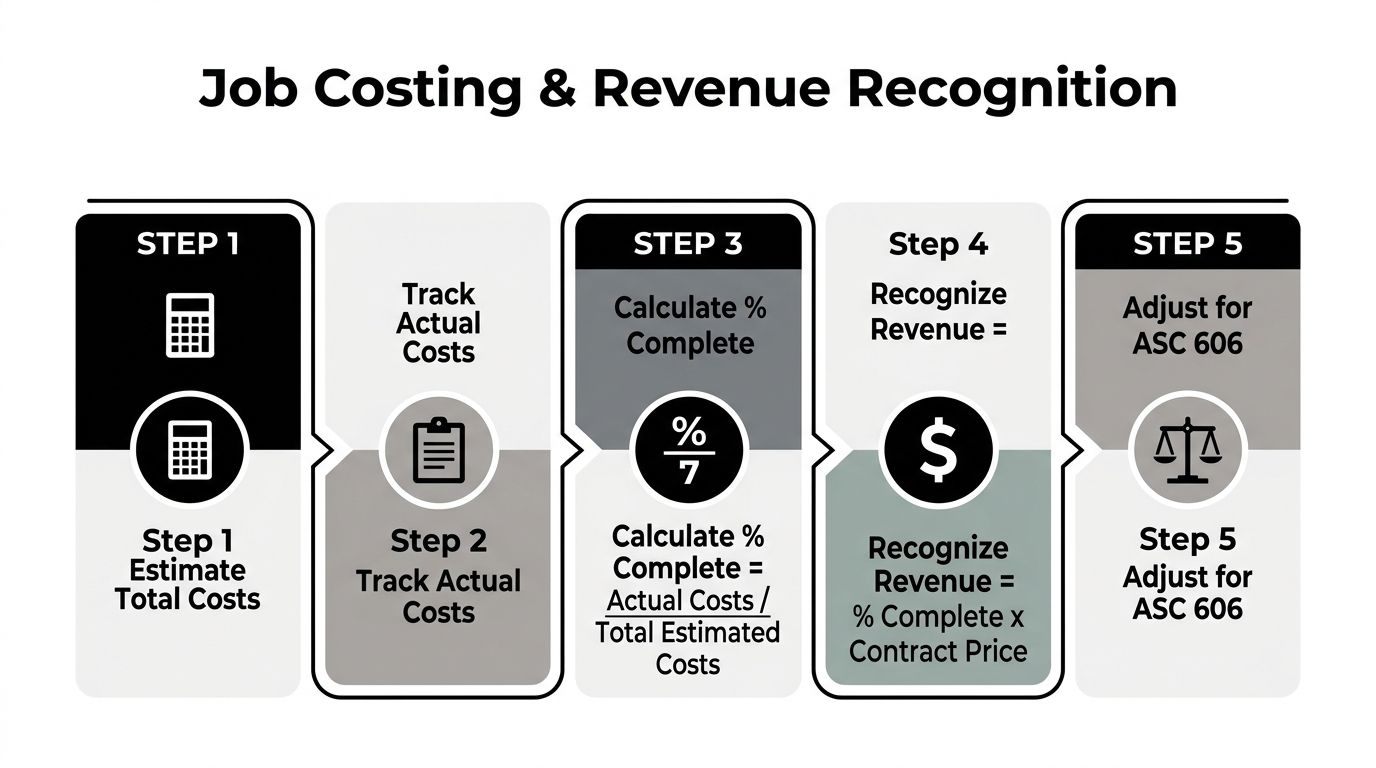
The right workflow is straightforward, although it requires consistency. Field teams submit time and purchase information promptly. Accounting codes each transaction to the correct job. Project managers review committed and incurred costs. Finance updates estimated total costs and prepares WIP reporting. Management then acts on exceptions instead of waiting for a completed project to reveal the loss.
Progress Billing, Retainage, and Certified Payroll Compliance
Cash flow often fails before profitability does. A project can be profitable on paper while the contractor struggles to pay workers, suppliers, and subcontractors because billing, retainage, and payroll records don't line up.
Progress billing should follow the contract's schedule of values or approved milestones. Each pay application needs to connect billed work with the related job costs and documented progress. Underbilling can conceal a cash shortage because the contractor has spent money without invoicing enough. Overbilling can create a temporary cash cushion while signaling that the project has billed ahead of earned progress. Both conditions require review in the WIP process.
Retainage deserves separate treatment. When a customer withholds part of an approved billing until completion or another contractual milestone, that amount isn't immediately available operating cash. Posting retainage as ordinary receivables can make liquidity look stronger than it is and can confuse collection priorities. Track it separately by job, contract, customer, and expected release condition.
Certified payroll is an accounting responsibility
Publicly funded work adds a compliance layer that ordinary payroll processes often can't handle. Contractors must submit certified payroll records weekly, including weeks with no work on covered projects, and maintain payroll records for at least three years after project completion, according to the certified payroll compliance guidance from hh2.
Payroll data must be segregated by:
- Project: The labor cost must land on the correct contract.
- Worker classification: The recorded trade or classification must support prevailing-wage reporting.
- Wage rate: The system must preserve the information needed to demonstrate compliance.
- Work period: Weekly reporting depends on timely and complete entries.
A mismatch can lead to restitution, back wages, and audit exposure on government work. It can also damage the accounting itself. If labor isn't assigned accurately by project and worker class, job costing becomes unreliable, and WIP reporting may misstate project margin.
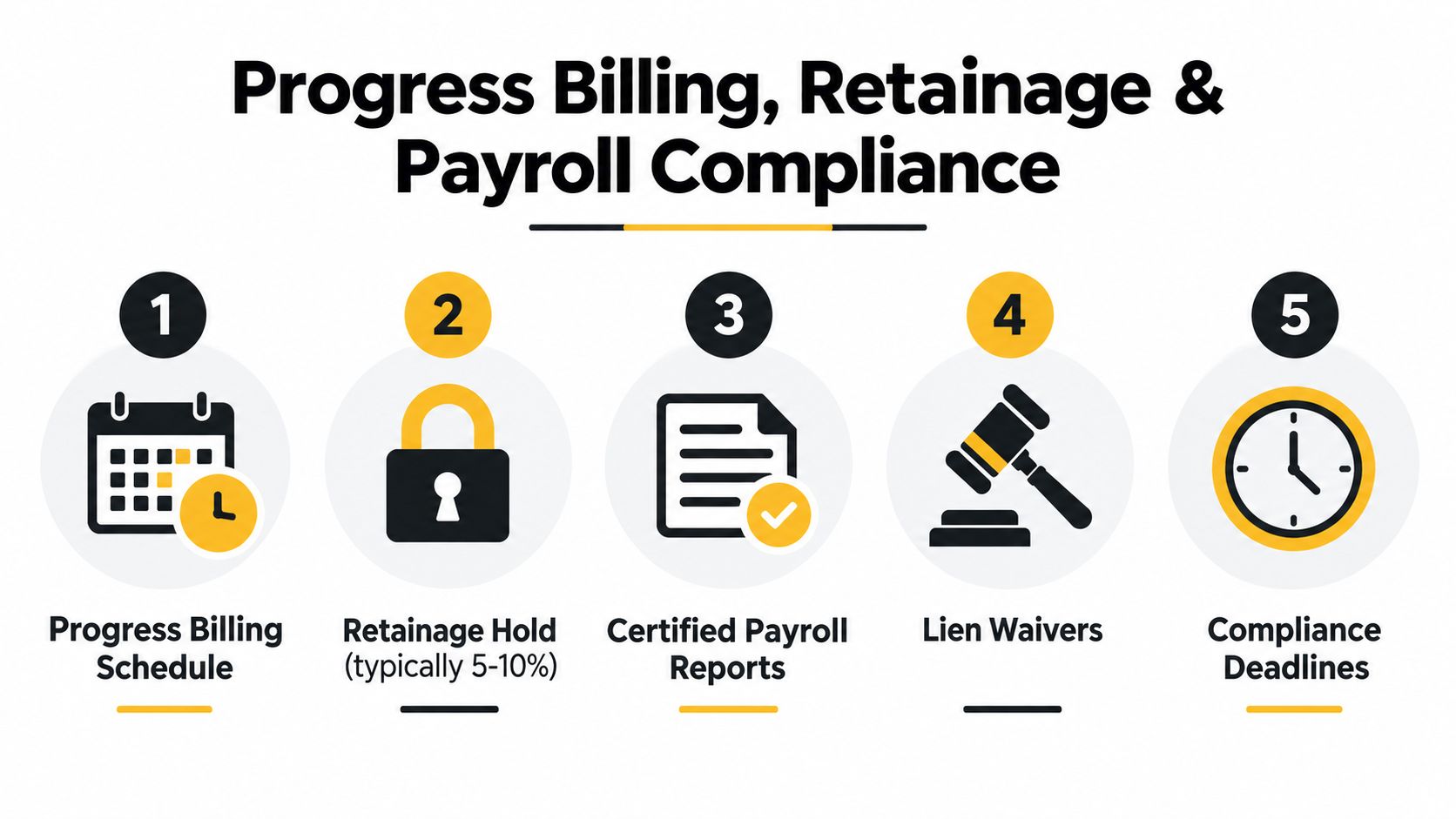
A construction payroll workflow should therefore feed the accounting system in near-real time. Waiting until month-end to reconstruct labor by job invites errors, delays billing support, and makes compliance harder to prove.
For contractors using QuickBooks, the platform can work well when the chart of accounts, customer-job structure, payroll settings, classes, and cost codes are configured correctly. The QuickBooks support page for construction companies provides a relevant starting point, but configuration alone won't replace review controls.
2025 and 2026 Tax Law Changes Every Contractor Must Know
Last year's tax plan may no longer fit your contracts. Recent changes affect revenue recognition, equipment purchases, contractor reporting, and the timing of taxable income. Treating these changes as automatic savings is a mistake. The correct decision depends on contract type, duration, entity structure, project mix, and cash needs.
The One Big Beautiful Bill Act expanded the old home-construction exception from percentage-of-completion accounting to a broader category of residential construction contracts. The change applies to contracts entered into in tax years beginning after July 4, 2025, as explained in this analysis of the residential percentage-of-completion rules. For calendar-year taxpayers, that generally points to contracts signed in 2026 and later.
The broader tax changes also include an extension of the small-business contract threshold from two years to three years, restored 100% bonus depreciation, and changes involving R&E expenses and Section 179D deductions. These provisions can affect whether a contractor accelerates equipment purchases, revisits contract accounting, or preserves cash for payroll and project financing.
Decision points for construction owners
| Tax Provision | What Changed | Impact on Contractors |
|---|---|---|
| Residential construction exception | Expanded to a broader category of residential construction contracts for contracts entered into in tax years beginning after July 4, 2025 | May change when revenue and taxable income are recognized on qualifying residential work |
| Small-business contract threshold | Extended from two years to three years | May affect eligibility for contract accounting treatment |
| Bonus depreciation | 100% bonus depreciation was restored | May influence equipment purchases and year-end capital spending |
| Section 179 | For tax years beginning in 2025, the limit was $2.5 million and phaseout began at $4 million, as detailed by construction tax deduction guidance | Requires purchase timing, documentation, and taxable-income analysis |
| 1099-NEC reporting | The threshold rose from $600 to $2,000 for payments made in 2026, according to this contractor tax checklist | Changes reporting mechanics, but not worker-classification rules |
The right question isn't “How do I pay less tax?” It's “Which method preserves cash without damaging financial reporting, bonding readiness, or project decision-making?” A construction accountant should model the effect before you change billing schedules or purchase machinery. Use construction tax deductions guidance as part of a broader review, not as a substitute for contract-specific advice.
Why Growing Contractors Need a Fractional CFO
Bookkeeping records what happened. A fractional CFO helps decide what happens next.
That distinction matters once a contractor has overlapping projects, changing labor and material costs, retainage, subcontractor obligations, WIP reporting, and tax decisions occurring at the same time. A bookkeeper can reconcile accounts and process transactions. The owner still needs someone to interpret project performance, forecast cash, challenge estimates, and explain why the bank balance doesn't match reported profit.
The leadership gap
Fractional CFO services provide forecasting, profitability analysis, cash-flow management, month-end close oversight, WIP reporting, and strategic planning without the cost of a full-time executive, according to this overview of fractional CFO services for construction companies.
A construction-focused fractional CFO should help you:
- Review bids: Test assumptions about labor, materials, subcontractors, equipment, overhead, and contingency.
- Monitor active jobs: Compare actual and committed costs with estimated total costs.
- Manage cash: Align collections, pay applications, payroll, supplier payments, and tax obligations.
- Improve the close: Establish a reporting cadence that gives owners current information rather than stale month-end summaries.
- Prepare for financing: Organize financial statements and project reports lenders, bonding partners, or investors may request.
- Coordinate tax planning: Connect revenue recognition and deductions with equipment spending and working-capital needs.
The goal isn't to add another report. It's to give the owner enough clarity to act before a margin problem becomes a cash problem.
The model fits small and midsized firms particularly well. Hiring a full-time executive creates a fixed internal role. Fractional CFO support gives the company senior financial direction while allowing the level of involvement to match its project pipeline and reporting needs.
Software remains useful. QuickBooks, construction management platforms, payroll systems, and invoicing tools can reduce manual work. None of them decides whether an estimate is realistic, whether a change order belongs in the WIP schedule, or whether a tax election supports the company's financing strategy. Those are judgment calls, and contractors need an experienced person responsible for making them.
Building Your Construction Accounting Workflow with Expert Support
A dependable workflow has a clear sequence:
- Set up the books correctly. Build a chart of accounts, customer-job structure, cost codes, payroll categories, and reporting classes that reflect the way your projects operate.
- Capture transactions promptly. Code labor, materials, equipment, subcontractors, purchase orders, and vendor bills to the right job and phase.
- Reconcile operational data. Match payroll, commitments, invoices, receipts, change orders, and progress billing records.
- Review WIP and cash. Compare earned revenue with cost burn, identify underbilling or overbilling, and separate retainage from available receivables.
- Plan taxes deliberately. Evaluate revenue-recognition treatment, deductions, equipment purchases, and contractor reporting obligations before deadlines arrive.
- Use leadership reporting. Turn project data into forecasts, margin analysis, cash planning, and decisions about bidding or hiring.
Technology can support that workflow, particularly when estimating, project management, payroll, invoicing, and accounting systems exchange clean data. If you're evaluating tools, a guide to best invoicing software can help you compare billing features, but the software must still reflect your contract terms and cost structure.
Bookkeeping and Accounting of Florida Inc. provides construction bookkeeping and accounting support, including job costing, project-based financial reporting, payroll workflows, tax preparation, QuickBooks setup, and fractional CFO services. The Jacksonville-based firm has supported construction and other industries for more than 20 years, with services designed to turn timely financial information into practical planning and cash-flow decisions.
The right partner doesn't make the books look tidy. They help you understand each job, meet compliance deadlines, protect working capital, and make decisions before the numbers become an emergency.
Bookkeeping and Accounting of Florida Inc. offers construction bookkeeping, job costing, payroll and tax compliance, QuickBooks support, and fractional CFO guidance for contractors that need more than basic data entry. Visit Bookkeeping and Accounting of Florida Inc. to discuss your accounting workflow and build reporting that keeps your projects and business on solid financial ground.