
Your Form 990 isn't just a tax form—it's your nonprofit's annual report card, broadcast to the world. Get it right, and you build trust. Get it wrong, and you invite scrutiny you really don't want, especially with tax laws constantly changing.
Thank you for reading this post, don't forget to subscribe!The core form 990 filing requirements hinge on two simple numbers: your gross receipts and total assets. These figures determine which version of the form you’re stuck with, and filing it correctly is non-negotiable for keeping your tax-exempt status. Most small businesses and nonprofits don't know what all is required, making professional guidance essential for survival.
Understanding Your Form 990 Filing Requirements
For most nonprofit leaders, IRS compliance feels like a high-stakes game where the rules are constantly shifting. Form 990 isn’t just about filling in boxes; it's the main way you prove your organization is transparent, financially sound, and actually doing what you promised.
But let’s be honest—most small nonprofits do not know what all is required and don't have a CPA on speed dial. This is where innocent mistakes turn into massive headaches. With tax law changes and electronic filing now the standard, it's easier than ever to fall out of compliance. They need us to help them stay compliant.
Why Compliance Is So Critical
Screwing this up has consequences. We’re talking serious financial penalties and legal trouble. The Form 990 is one of the single most important compliance tasks you'll face all year.
The biggest landmine? If you fail to file your Form 990 for three consecutive years, the IRS automatically revokes your tax-exempt status. Just like that. Your ability to accept tax-deductible donations vanishes, and you’re suddenly on the hook for income taxes. The stakes couldn't be higher.
Think of your Form 990 as a financial story you tell the public, your donors, and the IRS. A poorly told story can raise red flags and damage your reputation, while a clear, accurate one builds trust and supports your fundraising efforts.
Go Beyond Basic Filing—Get Strategic
To nail your Form 990, you need solid bookkeeping from day one. A great starting point is understanding the basics of Fund Accounting for Nonprofits, which is the bedrock of accurate reporting.
But knowing the rules isn't the same as having a strategy. This is why all companies need a fractional CFO and someone to guide their business.
This is why you need more than a simple tax preparer; you need a guide. A fractional CFO gives you that high-level strategic oversight without the painful cost of a full-time executive. They don’t just hit deadlines—they help you manage cash flow, stay compliant with changing tax laws, and turn confusing financial data into smart decisions. Our business accounting services are designed for this.
We handle the compliance so you can get back to what actually matters: running your mission.
Which Form 990 Version Is Right for Your Nonprofit?
Picking the right Form 990 is the first, and arguably most important, step in your annual compliance dance with the IRS. Get it wrong, and you're already starting on the wrong foot. The IRS doesn’t offer a one-size-fits-all form; instead, you get a menu of options based on your nonprofit's financial size.
Think of it like this: you wouldn't use a teaspoon to dig a foundation. Using the wrong form is just as ineffective and creates a mess you’ll have to clean up later.
This is a classic tripwire for nonprofit leaders who are, understandably, more focused on their mission than on memorizing tax code. But going it alone here is a gamble with your organization's tax-exempt status. They need us to help them navigate these complex choices.
Matching Your Finances to the Right Form
The two magic numbers that determine which form you’ll file are your gross receipts and total assets. As your nonprofit grows and brings in more money, the IRS expects a whole lot more transparency.
- Form 990-N (e-Postcard): The simplest filing, basically an electronic postcard for the smallest nonprofits.
- Form 990-EZ: A shorter, "easier" version of the full form for organizations that are growing but not quite in the big leagues yet.
- Form 990: The full, comprehensive beast required for larger, more financially complex organizations.
This flowchart lays it all out. It’s a simple decision tree to keep you on the straight and narrow.
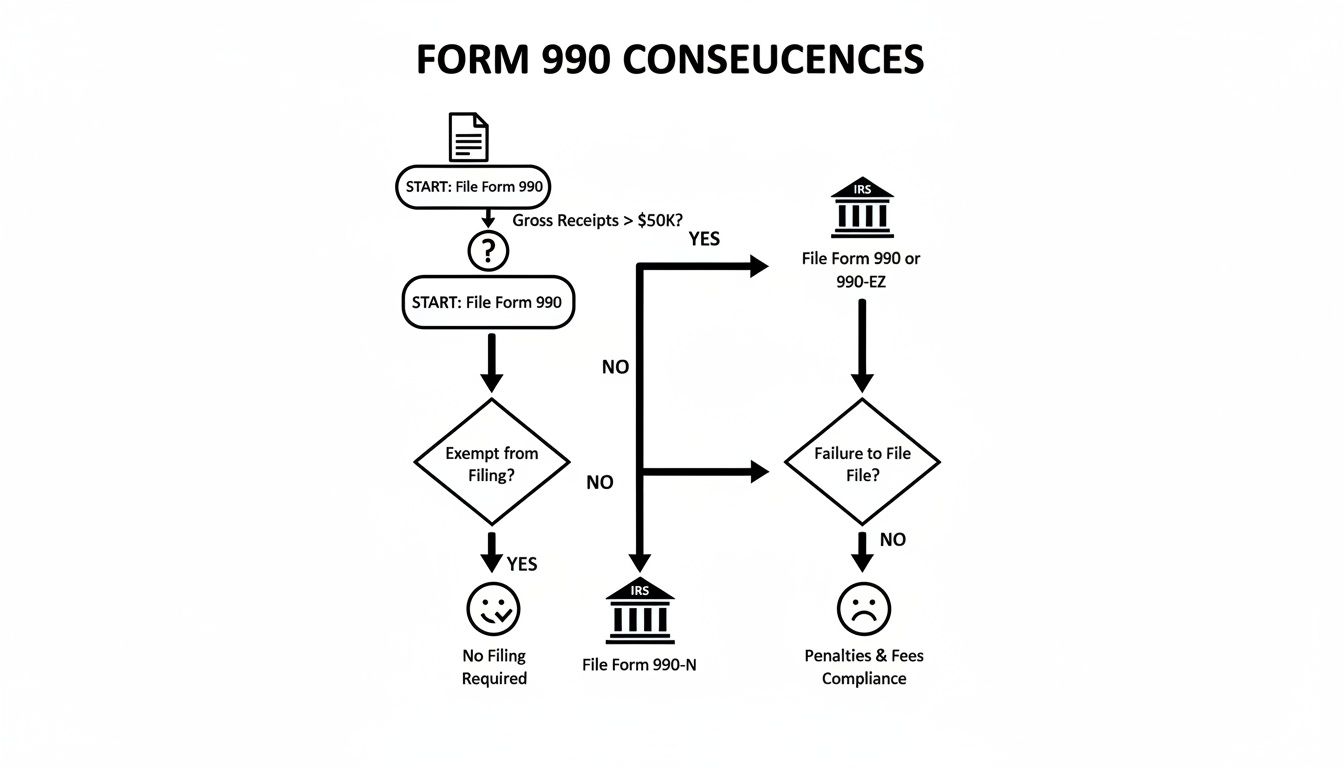
The main takeaway here is that those financial thresholds are not suggestions. Misunderstanding them is the fastest way to attract unwanted attention and penalties from the IRS.
Which Form 990 to File? A Quick Guide
To make it even clearer, this table breaks down the thresholds. Find your nonprofit's financial snapshot below to see exactly which form you should be looking at.
| Form Version | Annual Gross Receipts Threshold | Total Assets Threshold | Who It's For |
|---|---|---|---|
| Form 990-N (e-Postcard) | Normally ≤ $50,000 | N/A | The smallest nonprofits just needing to check in with the IRS. |
| Form 990-EZ | Less than $200,000 | Less than $500,000 | Mid-sized organizations that aren't yet required to file the full form. |
| Form 990 (Full) | $200,000 or more | $500,000 or more | Larger, more established nonprofits with significant financial activity. |
Remember, if your organization meets either the gross receipts or total assets threshold for the full Form 990, that's the one you have to file. You can dig into the specifics on the IRS website, but these numbers are your starting point.
Key Insight: You can always choose to file a more detailed form than what's required (like filing a Form 990-EZ when you only need to file a 990-N). It can be a good move for transparency with donors. But you can never file a simpler form than what your financials demand. That’s a one-way ticket to trouble.
Special Forms for Special Cases
Just when you thought you had it figured out, the IRS throws in a few curveballs. Certain types of organizations have their own unique, and often more complex, filing requirements.
Form 990-PF (Return of Private Foundation)
If you’re a private foundation, you file a Form 990-PF. Period. It doesn't matter how big or small you are. This form is an intense look at your grants, investments, and charitable spending. The rules for private foundations are notoriously strict, and trying to handle a 990-PF without professional help is a true act of bravery (or foolishness).
Form 990-T (Exempt Organization Business Income Tax Return)
Does your nonprofit earn money from activities that aren't directly related to its mission? If you make $1,000 or more in gross income from this "unrelated business income" (UBI), you must file a Form 990-T. Figuring out what actually counts as UBI can feel like a riddle, and getting it wrong means facing a tax bill you weren't expecting.
These specialized forms are exactly why you need an expert in your corner. Without a fractional CFO or a dedicated accountant, you’re left trying to become a tax law expert while also running your organization. It's a recipe for burnout and costly mistakes. Our business accounting service is designed to handle the compliance details so you can stay focused on your mission.
Navigating Critical Deadlines, Penalties, and Tax Law Changes
Filing your Form 990 isn't just another piece of paperwork. It’s a non-negotiable deadline that stands between your nonprofit and losing its tax-exempt status. For most nonprofit leaders, juggling mission-critical work and a labyrinth of IRS rules feels like a constant battle, and it's shockingly easy for these dates to fall through the cracks.
The standard deadline for your Form 990 is the 15th day of the 5th month after your fiscal year closes. So, if you run on a calendar year, your due date is May 15th. This isn't a suggestion—it’s a hard stop, and missing it triggers a cascade of problems you really don't want.
Let's be honest: most nonprofit leaders are passionate about their cause, not tax calendars. This is exactly why so many organizations get into hot water. Without an expert eye on these deadlines, they're left wide open to costly and completely avoidable errors.
The High Cost of Missing Deadlines
Blowing past your Form 990 deadline isn't a minor hiccup. It comes with immediate and painful penalties. The IRS is serious about this stuff; they see it as a core part of ensuring transparency in the nonprofit world.
- For smaller organizations (with gross receipts under $1,208,500), the penalty starts at $20 per day the return is late. That can rack up to a $12,000 maximum fine, or 5% of your gross receipts—whichever is less.
- For larger organizations (those with gross receipts over $1,208,500), the penalty skyrockets to $120 per day, capped at a whopping $60,000.
These aren't just theoretical numbers. They represent real money being siphoned away from the people and programs you're meant to serve.
The Ultimate Penalty: Automatic Revocation
As bad as those daily fines are, they’re nothing compared to the worst-case scenario. If your organization fails to file its required Form 990 for three consecutive years, the IRS won’t just send you a bill. They will automatically revoke your tax-exempt status.
Automatic revocation is basically the nonprofit "death penalty." It means you can no longer receive tax-deductible donations, and your income could suddenly become taxable. Getting your 501(c)(3) status back is a long, expensive, and frustrating process that feels a lot like starting from scratch.
This is a devastating blow that can completely shut down your mission and destroy your credibility overnight. It’s a stark reminder that proactive compliance isn't just "nice to have"—it's essential for survival.
Filing for an Extension with Form 8868
So, what happens if you know you're not going to make the deadline? The IRS does throw you a lifeline. You can get an automatic six-month extension by filing Form 8868, Application for Extension of Time To File an Exempt Organization Return.
But here's the catch: you must file Form 8868 on or before your original Form 990 due date. It’s a simple way to buy more time, but it’s a temporary fix, not a long-term strategy for disorganization. You still have to get it done.
Staying Ahead of Tax Law Changes
The rules of the game are always changing. Tax law changes are frequent; electronic filing is now mandatory for all Form 990 returns, and the IRS constantly tweaks reporting thresholds and schedule requirements. A tiny change in how you define program service revenue or a new question about your governance policies can easily trip you up.
Staying compliant means staying informed, which is a full-time job in itself. It’s a task that’s nearly impossible for leaders already wearing a dozen other hats. You need an expert in your corner to track these moving targets for you.
A fractional CFO doesn’t just do your taxes. We monitor these changes, so you’re always ahead of what's next. As you plan, it's also smart to look into nonprofit audit requirements by state to get a complete view of your obligations. With our guidance, you can turn compliance from a source of anxiety into a smooth, seamless part of your operations.
Telling Your Story Through Key Schedules and Public Disclosure
Your Form 990 isn't just a tax document the IRS makes you file. It's a public billboard telling everyone—donors, foundations, your community—what your nonprofit is all about. Think of the main 12-page form as the book cover. The real story, the juicy details, and the plot twists are all in the schedules.
For most nonprofit leaders, figuring out which schedules to attach feels like trying to read a secret code. Each one is triggered by specific activities, and missing one is a serious compliance fumble. This isn't a "what you don't know can't hurt you" situation. It absolutely can. A botched schedule can paint a confusing or, worse, a negative picture of your hard work.

Cracking the Code on Key Form 990 Schedules
While there are a bunch of potential schedules, a few pop up constantly. Knowing what they are and why they matter is step one. Honestly, most leaders are too busy running their organization to know which ones apply, putting them at immediate risk.
Here are three of the most common ones you'll run into:
- Schedule A (Public Charity Status and Public Support): This is the big one for most 501(c)(3) public charities. It's where you prove to the IRS you're supported by the public, not just a handful of rich relatives. Mess this up, and your public charity status is on the line.
- Schedule B (Schedule of Contributors): If you get a sizable check from a single donor, you’ll likely file Schedule B. The good news? While the IRS needs this info, donor names and addresses are kept confidential from the public, so their privacy is protected.
- Schedule O (Supplemental Information): Think of this as your "let me explain" section. It's a blank slate to clarify anything on your 990 that needs more context—a governance change, a one-off program expense, you name it. Using Schedule O wisely shows you’re transparent and on top of your game.
Your 990 Is Now a Marketing Tool
Once you file it, your Form 990 becomes public. Anyone can pull it up on sites like GuideStar and ProPublica. This is where your boring compliance task turns into a powerful fundraising tool. A clean, meticulously prepared return screams competence and builds trust with donors and grantmakers.
On the flip side, a sloppy or incomplete 990 is a massive red flag. It suggests you're disorganized, not transparent, or have weak financial oversight. For a savvy donor, that's enough to walk away and fund someone else.
Your Form 990 tells the world who you are, what you do, and how well you do it. It’s your chance to prove your impact. Don't leave that story to chance.
Stop Guessing, Start Guiding Your Narrative
This is where professional help stops being a luxury and becomes a necessity. We don't just "do your taxes." We make sure your form 990 filing requirements are met, but we also help you turn it into a story that's not only compliant but compelling. That's why you should use our business accounting services.
We ensure every number is right, every required schedule is attached, and your Schedule O explains your year with strength and clarity. Beyond the tax form, a solid online presence is vital for sharing your story. Choosing from the best website builders for nonprofits helps amplify the transparent narrative your 990 establishes.
Ultimately, we take a complex headache and turn it into an asset that fuels your fundraising and proves your mission's worth. To see how this data comes to life, check out our guide on nonprofit financial statements examples.
Why Your Nonprofit Needs a Fractional CFO Not Just a Tax Preparer
Filing your Form 990 is just the beginning. Getting it done correctly is the bare minimum—the price of admission to keep your nonprofit status. But let’s be honest, meeting form 990 filing requirements is the starting line, not the victory lap.
Thriving nonprofits know that financial health isn't just about filing a tax return on time. It's about strategy, growth, and survival. All companies need a fractional CFO and someone to guide their business.
For most growing nonprofits, the idea of a full-time Chief Financial Officer (CFO) feels like a fantasy. You can’t justify a six-figure executive salary, but you’re drowning in strategic questions that your tax preparer can’t answer. This is where things get dangerous.

Beyond Tax Prep The Strategic Role of a Fractional CFO
A tax preparer has one job: get your Form 990 filed. They look at last year's numbers and slot them into the right boxes. It's essential, but it's entirely reactive. It does nothing to help you plan for next year, manage a cash crunch, or make a tough call on a new program.
A fractional CFO is your forward-looking financial guide. You get senior-level expertise on a part-time basis, giving you all the benefits of a high-powered financial mind without the crippling overhead. They’re the expert every organization needs to not only stay compliant but to actively build a sustainable future.
A tax preparer tells you what happened. A fractional CFO helps you decide what happens next. It’s the difference between looking in the rearview mirror and having a GPS for the road ahead.
Most nonprofit leaders are so focused on their mission they don't even know what they don’t know about financial compliance and strategy. A dedicated partner isn't a luxury; it’s a necessity. They need us to guide their business.
Navigating Constant Change with an Expert Partner
Tax laws are a moving target. The IRS changes the rules, electronic filing mandates shift, and new schedule requirements pop up with little notice. For an executive director already wearing ten hats, keeping up is impossible. A fractional CFO makes it their job.
They don't just file your Form 990; they build the financial systems that make filing it painless and accurate. This includes:
- Strategic Budgeting & Forecasting: Building a budget that actually supports your mission and helps you plan for the future, not just survive the present.
- Cash Flow Management: Making sure you have the money you need, when you need it, to avoid those heart-stopping "will we make payroll?" moments.
- Grant Reporting & Compliance: Taming the beast of complex grant reporting so you can keep your funders happy and secure more money.
- Board-Level Financial Insights: Turning dense financial reports into clear, simple stories that empower your board to govern effectively.
Every organization needs a guide to steer the ship. We become that guide.
Your Dedicated Partner in Northeast Florida
At Bookkeeping and Accounting of Florida Inc., we serve as your dedicated financial partner. Our Jacksonville-based fractional CFOs live and breathe the challenges facing nonprofits right here in Northeast Florida. We know the federal IRS rules inside and out, but we also know the specific state-level headaches you face.
We give you the peace of mind that comes from knowing your financial house is in order. You get to offload the stress of compliance and put 100% of your energy into what actually matters: your mission.
The risks of going it alone are just too high. Ready to see how our business accounting expertise could work for you? Learn more about what’s included in our fractional CFO services and let us become your strategic partner.
Your Top Form 990 Questions, Answered
Let's be honest. You started a nonprofit to change the world, not to become a tax compliance expert. But the form 990 filing requirements can feel like a full-time job, and a confusing one at that.
Most nonprofit leaders are in the same boat, trying to decipher IRS rules while running their programs. Here are some straight answers to the questions we hear all the time.
What Should We Do If We Find a Mistake on a Past Form 990?
That sinking feeling when you spot a mistake on a filed 990 is awful, but it's not the end of the world. The fix is to file an amended return—and do it quickly.
You’ll use the same form number you originally filed (like Form 990 or 990-EZ) but make sure you check that little "Amended return" box.
The most important step is attaching a Schedule O to clearly explain what changed and why. Voluntarily fixing your own mistakes shows the IRS you’re acting in good faith and can help you dodge penalties or a deeper look into your books. This is not the time to be vague; clarity is your best friend.
Are There Separate State Filing Requirements for Florida Nonprofits?
Yes, and this is a big one that trips up countless Florida nonprofits. Getting right with the IRS is only half the compliance puzzle.
If you solicit donations in Florida, you must also register and renew annually with the Florida Department of Agriculture and Consumer Services (FDACS). This is known as the "Solicitation of Contributions" registration, and it almost always requires a copy of your federal Form 990.
Think of it as double jeopardy. Failing to file with both the IRS and the state can bring penalties from two different agencies, draining your funds and your credibility.
This is exactly why having local expertise matters. As a Jacksonville-based firm, we live and breathe Florida’s specific nonprofit rules, so you don't have to. We'll make sure you're covered on all fronts.
Can We Just Use Software to File Our Form 990 Ourselves?
Using DIY tax software for your 990 can feel like a smart way to save a few bucks. But it’s a gamble that puts your nonprofit at serious risk.
Software is just a data-entry tool. It can’t ask you strategic questions, help you frame your financial story to showcase your impact, or tell you when you’ve accidentally misclassified an expense that will raise a red flag. A simple error can easily trigger an IRS audit or make savvy donors on sites like GuideStar think twice.
Sure, for the super-simple Form 990-N postcard, software is probably fine. But for the full Form 990 with its maze of schedules? The risk is just too high. A CPA isn't an expense; it’s an insurance policy for your accuracy, your compliance, and your reputation.
Keeping your nonprofit compliant is a job in itself, but your mission already is one. You need a partner who can untangle the complexities of your form 990 filing requirements and give you the financial insight to grow. At Bookkeeping and Accounting of Florida Inc., we act as your fractional CFO, getting your financial house in order so you can get back to what matters. Let us handle the paperwork so you can handle the mission.