
Your phone is buzzing, sales look great, and your team is busy. From the outside, the business looks healthy. Then payroll hits on Friday, two vendors want payment now, and the checking account looks like it just went through a hurricane.
That mess is why owners start asking, what is working capital management, and usually ask it a little too late.
I've seen this movie before. A contractor lands solid jobs but waits forever to get paid. A clinic shows strong revenue but insurance reimbursements crawl in on their own sweet time. A retailer has money sitting on shelves in the form of inventory while rent, wages, taxes, and suppliers all want cash, not good intentions. Profit on paper doesn't pay the electric bill.
Working capital management is the discipline of making sure your business can keep breathing between the time money goes out and the time money comes back in. It's not just accounting jargon. It's payroll, vendor trust, tax compliance, debt pressure, and whether you sleep at night.
Most business owners already know the moving parts. Cash. Receivables. Inventory. Payables. What they don't have is a tight system for managing them together. If you want a plain-English breakdown of cash, receivables, and inventory management, that framework is useful. So is getting serious about processes that help you get paid faster and improve your cash flow, because slow collections will choke a growing company faster than weak sales in plenty of cases.
The hard truth is simple. A business can be “successful” and still run out of cash. That's not a contradiction. That's bad working capital management.
Introduction Why Sales Are High But Your Bank Account Is Low
Take a common Jacksonville small business scenario. You had a strong month. Invoices went out. Revenue looks respectable in the accounting system. Then you open the bank app and start mentally moving money around like a guy at a card table hoping the dealer won't notice.
That gap between sales and usable cash is where owners get blindsided.
The problem isn't always profit
You can make money and still be broke this week. Why? Because timing runs the show. Customers pay late. Inventory sits too long. Suppliers want payment before your client clears their invoice. Payroll doesn't care that a big check is “coming soon.”
Practical rule: Revenue is an opinion until the cash lands in your account.
This is why working capital management matters. It controls the everyday financial rhythm of the business. It tells you whether your operation can fund itself without panic, borrowing, or robbing Peter to pay Paul.
Why small businesses get this wrong
Most owners are taught to watch sales, profit, and maybe taxes at year-end. That's not enough. You need to watch the short-term engine of the company. If you don't, growth can hurt you. Fast growth often means more labor, more materials, more overhead, and more unpaid invoices floating around while your obligations come due now.
And if you're relying on software alone to “keep an eye on things,” that's like using a bathroom scale to diagnose chest pain. Wrong tool.
The Engine Room of Your Business Uncovered
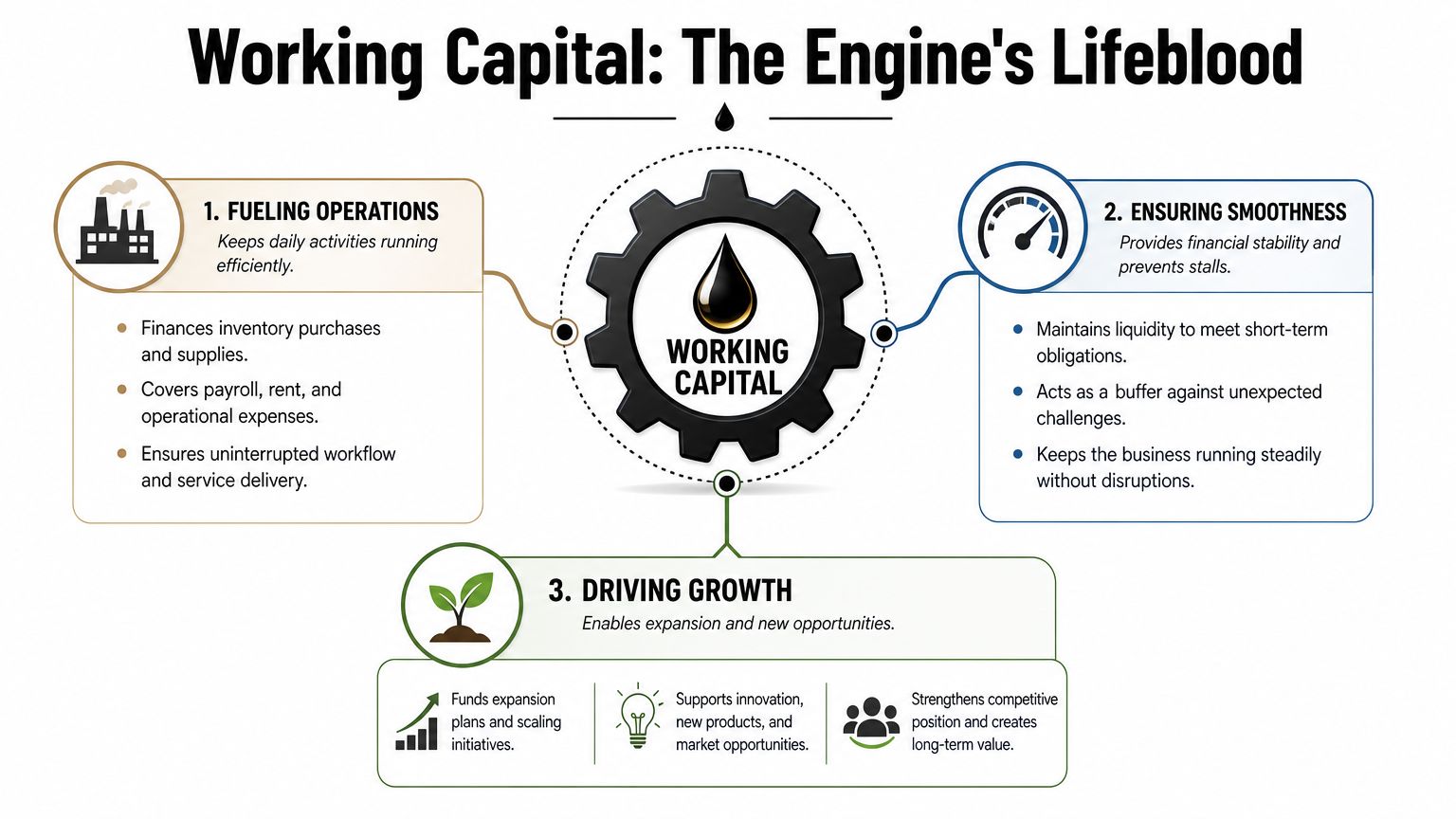
Working capital is the oil in the engine. You don't need a swimming pool of it. But if the level gets too low, things grind, overheat, and eventually seize.
Formally, working capital means current assets minus current liabilities. In plain English, it's what you have available in the short term to cover what you owe in the short term.
What counts as current assets
Current assets are the things likely to turn into cash within the next year.
- Cash: The cleanest asset you have. No explanation needed.
- Accounts receivable: Money customers owe you. Helpful, but only if they pay.
- Inventory: Stock on shelves, parts in the warehouse, supplies waiting to be sold or used.
There's a big difference between having cash and having inventory. One pays bills today. The other hopes to become cash later.
What counts as current liabilities
Current liabilities are the bills and obligations coming due in the near term.
- Accounts payable: What you owe vendors and suppliers.
- Short-term debt: Loan payments and credit obligations that can't be ignored.
- Accrued expenses: Payroll, taxes, and other obligations that build up gradually and then show up loud.
If you want a cleaner understanding of how these balances interact, this guide on accounts payable vs. accounts receivable is worth your time.
Why the balance matters
Too little working capital and you're playing defense every day. Too much, and you may have cash trapped in unproductive places like stale inventory or sloppy collections. The point isn't to worship one formula. The point is to keep the machine running without starving it or clogging it.
A lot of owners only start caring when something breaks. Vendor puts you on hold. Payroll gets tight. Sales tax deadlines creep up. A lender asks for cleaner financials than you can produce.
That's why you need systems that help you manage your business finances with some discipline instead of gut feel and optimism.
Your business doesn't fail in one dramatic moment. It usually leaks cash, misses signals, and drifts into trouble.
Key Metrics You Can't Afford to Ignore
If working capital is the engine oil, these metrics are the dashboard lights. Ignore them and you're basically driving at night with duct tape over the gauges.
Working capital metrics at a glance
| Metric | Formula | What It Measures | The Question It Answers |
|---|---|---|---|
| Current Ratio | Current Assets ÷ Current Liabilities | Short-term liquidity | Can I cover near-term bills with near-term assets? |
| Quick Ratio | (Current Assets – Inventory) ÷ Current Liabilities | Immediate liquidity without relying on inventory | If inventory doesn't move, am I still okay? |
| Cash Conversion Cycle | Days Inventory Outstanding + Days Sales Outstanding – Days Payable Outstanding | How long cash stays tied up in operations | How fast does cash go out and come back? |
Current ratio
The current ratio gives you the broadest snapshot. It compares what you can use soon against what you owe soon. That sounds simple because it is simple. Interpreting it correctly is where owners get tripped up.
A healthy-looking current ratio can still hide ugly problems if receivables are old or inventory is collecting dust. Numbers don't lie, but they sure can wear makeup.
Quick ratio
The quick ratio strips inventory out of the picture. That matters because inventory can be stubborn. A stack of products in the warehouse may look valuable on paper, but it won't help if payroll is due tomorrow and nobody's buying.
This metric asks a tougher question: if your least liquid current asset isn't available fast enough, can the business still stand upright?
A ratio is not a trophy. It's a warning light or a green light, depending on the quality behind the number.
Cash conversion cycle
The cash conversion cycle is the one owners should care about far more than most do. It tracks how long cash is tied up after you spend it on operations and before you get it back through collections.
A long cycle means your money is wandering around town instead of working for you. It's tied up in stock, sitting in receivables, or trapped by poor process.
If you need a better handle on receivables speed, review the mechanics behind the accounts receivable turnover ratio. That number won't solve the problem by itself, but it will tell you whether collections are dragging like a wet tarp.
Why interpretation matters more than calculation
Anybody with a spreadsheet can calculate these metrics. That doesn't make them a financial manager. A construction company, a medical practice, and a nonprofit can post the same ratio and mean three different things operationally.
That's why I'm blunt about this. You need more than bookkeeping. You need someone who can interpret the data, connect it to taxes, debt, payroll, compliance, and growth plans, then tell you what to do next. That's fractional CFO work. Not data entry. Not guesswork.
Practical Strategies for Optimizing Your Cash Flow
Good working capital management isn't magic. It's disciplined pressure applied in the right places.

Tighten accounts receivable first
If customers take forever to pay, you're financing their business with your money. That's a bad hobby.
Start here:
- Invoice fast: Send invoices immediately. Not next week. Not when you “get around to it.”
- Set terms clearly: If your quote, contract, and invoice all say different things, you created the delay.
- Follow up automatically: Use scheduled reminders. Owners who rely on memory to chase invoices are asking for trouble.
- Make payment easy: ACH, card, payment links, and clean instructions matter.
A lot of owners study pricing and ignore collections. That's backwards. A sale with lousy collection discipline is like winning a fishing tournament with a hole in the boat.
Be smart with accounts payable
Don't confuse “paying late” with strategy. Real payable management means controlling timing without torching supplier relationships.
- Negotiate terms before you're desperate: Vendors can smell panic.
- Use due dates intentionally: Pay according to terms, not emotionally.
- Preserve key suppliers: Some relationships are worth protecting because they keep your operation moving.
- Review recurring charges: Small leaks turn into real cash drain.
Get serious about inventory
Inventory is where cash goes to take a nap. Sometimes a long nap.
You need enough stock to serve customers, but not so much that your money is sitting in boxes. Slow-moving inventory, obsolete items, and poor purchasing habits strangle working capital.
Check your shelves, reorder logic, and buying habits. If you keep buying based on fear instead of data, you're turning your warehouse into a savings account with terrible liquidity.
Efficiency is good. Resilience is better.
This is the part most generic advice misses. Yes, you want lean operations. No, you do not want to run so lean that one disruption knocks you sideways.
Recent guidance on working capital has shifted toward resilience, not just squeezing every dollar out of the system. One cited reason is that a 2025 supply-chain survey found only 35% of leaders were very confident in supply-chain resilience, which supports building cash buffers, using dashboards, renegotiating supplier terms, and stress-testing liquidity for disruptions, according to Allianz Trade's working capital management guidance.
That means the old macho nonsense of “keep no excess cash, run everything razor-thin” can backfire. Late-paying customers, supply delays, sudden tax obligations, labor spikes, and equipment problems don't send polite invitations.
For a broader angle on cash planning, even outside the U.S., this piece on UK freelancer financial strategy makes a practical point that owners everywhere should hear. Planning cash beats reacting to cash.
Here's a useful walkthrough on the bigger picture:
Where a fractional CFO earns their keep
Professional guidance is no longer optional.
A fractional CFO should help you:
- Build rolling cash forecasts instead of staring at last month's reports.
- Model best-case and ugly-case scenarios before they happen.
- Set credit policies so sales staff don't hand out terms like candy.
- Coordinate cash strategy with tax planning and compliance so deadlines don't ambush you.
- Decide how much buffer you need for your business model.
That last point matters. There's no universal “right” amount of working capital. There's only what's right for your risk, seasonality, customer base, and operating cycle.
How Working Capital Differs Across Industries
The worst working capital advice on the internet comes wrapped in a clean formula and zero context. Same ratio targets. Same canned benchmarks. Same recycled tips. That's dangerous.
Most guides miss the practical issue of how much working capital is enough for your specific industry. Even mainstream guidance recognizes that whether a metric like DSO is “ideal” or “slow” depends on the business model, which is why Stripe's explanation of working capital management points toward industry context rather than one-size-fits-all answers.
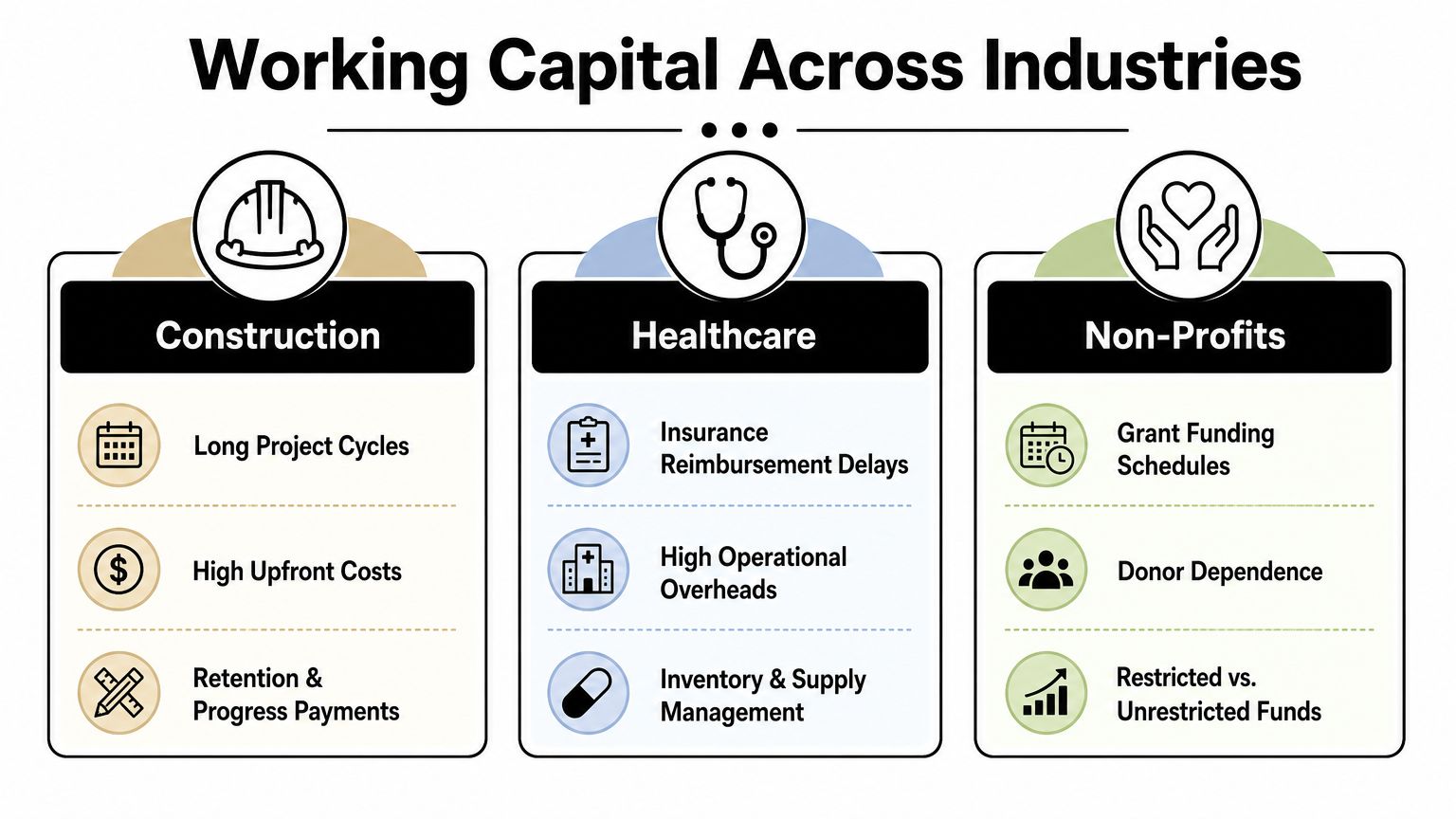
Construction
Construction companies often bleed cash upfront. Materials, mobilization, subcontractors, fuel, equipment, and payroll hit before the project cash lands. Then come payment delays, change orders, and retainage headaches.
That means a contractor's working capital needs are usually shaped by project timing and billing discipline, not some generic textbook ratio.
Healthcare
A healthcare clinic can look profitable while receivables crawl through payer processes. Insurance reimbursements move on their own schedule. Meanwhile, wages, rent, supplies, software, and compliance costs keep marching.
For healthcare, strong working capital management means clean billing workflows, aggressive claim follow-up, and realistic cash forecasting. Wishful thinking won't speed up reimbursements.
Nonprofits
Nonprofits deal with a different flavor of stress. Grant timing may not line up with payroll or program expenses. Restricted funds may exist on paper while unrestricted operating cash stays tight.
That means leadership has to track not only how much money exists, but what money can be used now. Plenty of nonprofit stress comes from that mismatch.
Industry context changes everything. A number that signals trouble in one business might be normal in another.
The point is straightforward. Benchmarking by sector, seasonality, and operating cycle beats generic finance advice every time.
Why Your QuickBooks Is Not a Financial Manager
A lot of owners learn this lesson on a Thursday afternoon. Payroll is due Friday. A sales tax payment is coming up. Two big customer checks still have not cleared. QuickBooks says the month looks profitable, yet the bank balance is gasping for air.
That happens because QuickBooks is a recordkeeping tool, not a decision-maker. It can organize transactions, reconcile accounts, and spit out reports. It cannot tell you whether your cash cushion is too thin, whether your draw habits are reckless, or whether a slow quarter will turn into a tax mess by year-end.
Rearview mirror versus windshield
QuickBooks works like a rearview mirror. Useful, yes. Sufficient, no.
Working capital management lives in the windshield. It requires someone to forecast collections, map out payables, time debt service, and see compliance deadlines before they become expensive surprises. If you are using software alone to manage cash, you are flying a plane by checking where the runway used to be.
That is how profitable businesses get blindsided. They grow, hire, buy equipment, extend customer terms, and keep paying vendors. Then cash tightens, lenders start asking harder questions, and the owner realizes the books were clean but the plan was sloppy.
Compliance costs cash
Bookkeeping and compliance are related. They are not the same job.
A clean general ledger does not automatically cover the decisions that protect working capital and keep you out of trouble. Someone still needs to stay on top of:
- Payroll tax deposits and filings
- Sales and use tax exposure
- Estimated tax planning
- Entity returns and state filings
- Lender, audit, or review documentation
- Tax rule changes that change your cash needs
Miss any one of those and cash gets drained fast. Penalties, interest, rushed borrowing, and bad decisions show up like termites. You usually do not notice the damage until the floor starts sagging.
That is why owners with employees, debt, uneven receivables, or industry-specific reporting needs need actual financial oversight. Bookkeeping keeps score. A CPA and fractional CFO help you decide what to do next, protect compliance, and keep working capital strong enough to survive a rough patch.
Bookkeeping and Accounting of Florida Inc. offers bookkeeping, tax, payroll, audit-related support, and fractional CFO services. That combination matters because survival takes more than categorized transactions. It takes judgment, planning, and someone willing to tell you the truth before cash trouble turns into a full-blown fire.
Your Actionable Working Capital Checklist
You don't need more theory. You need a routine.
Weekly
- Check cash balances: Know what's available, not what you hope is available.
- Review upcoming payables: See what's due before it becomes a surprise.
- Look at overdue receivables: Call on the oldest money first.
- Watch payroll and tax timing: Those deadlines don't care how busy you are.
Monthly
- Review your current and quick ratios: Not to admire them. To spot pressure early.
- Examine A/R aging: Old invoices need action, not excuses.
- Review inventory movement: Identify slow stock and bad purchasing habits.
- Compare forecast to reality: If your forecast keeps missing, fix the assumptions.
Quarterly
- Reforecast cash flow: Update for seasonality, hiring, debt, and tax obligations.
- Revisit supplier and customer terms: Timing matters more than owners think.
- Stress-test your cash needs: Ask what happens if payments slow or expenses jump.
- Schedule a strategic review with your CPA or fractional CFO: Interpretation drives decisions.
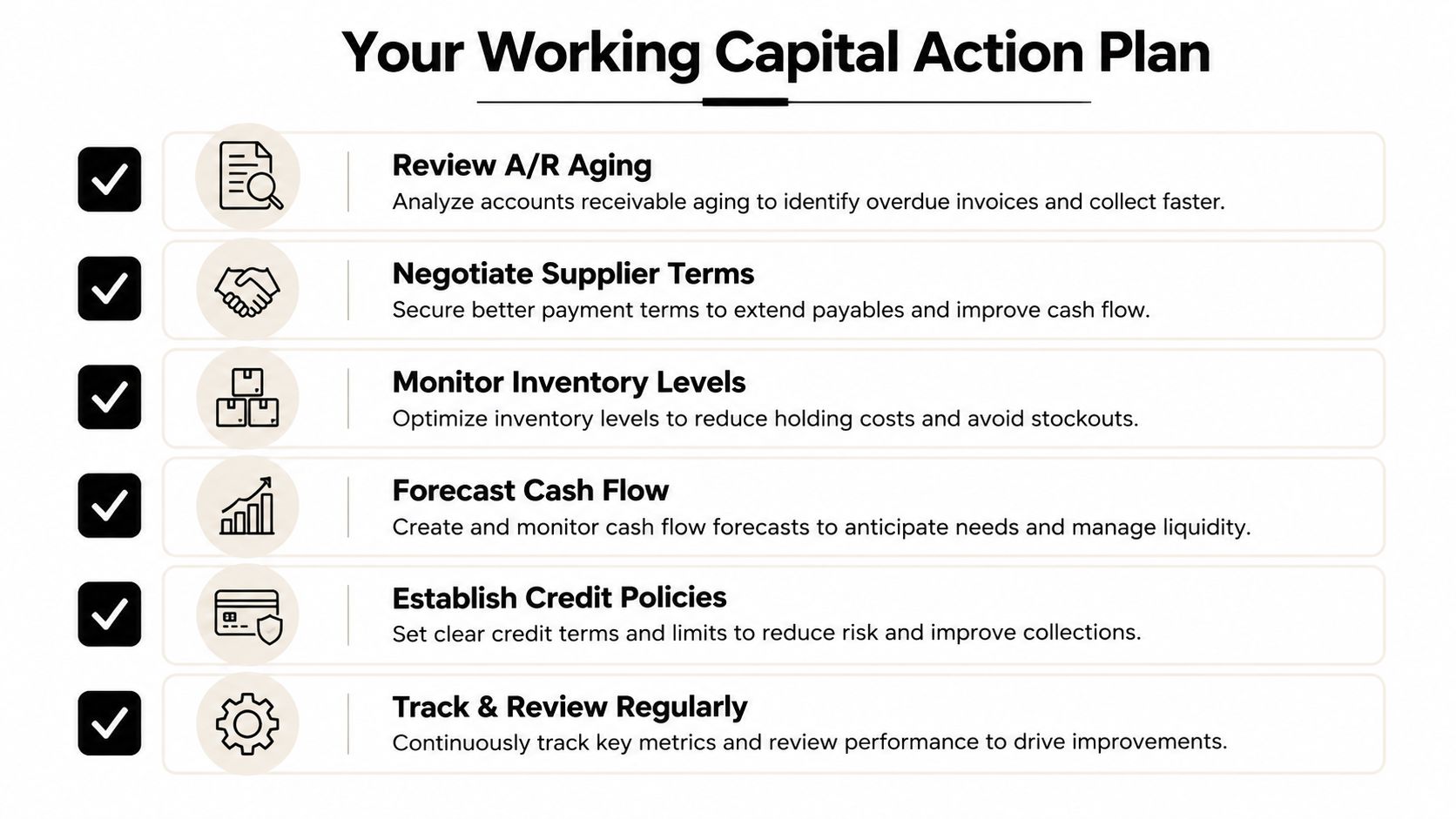
If that checklist feels like real work, that's because it is. Working capital management isn't a side task you squeeze in after lunch. It's an operating discipline. Ignore it, and your business will eventually teach you the lesson the expensive way.
If your sales look fine but cash still feels tight, it's time to stop guessing. Bookkeeping and Accounting of Florida Inc. helps Jacksonville and Northeast Florida businesses keep clean books, stay compliant, plan for tax obligations, and get senior-level financial guidance through fractional CFO support. If you want someone to help you read the numbers, pressure-test your cash flow, and build a practical action plan, that's the conversation to have now, not after the bank account starts wheezing.