
You're probably in one of two spots right now.
Business is busy. The phone rings, jobs are moving, patients are booked, invoices are going out, and sales look better than they did a year ago. But when somebody asks, “Are we making money the way we planned?” the room gets quiet.
That's where a lot of Jacksonville and Northeast Florida owners get stuck. They know revenue. They know bank balance. They know whether the week felt good or ugly. What they don't know is whether the business is performing against a plan, whether spending is under control, whether tax obligations are being handled correctly, and whether a strong month was real or just noisy.
Budget vs actual reporting fixes that. It takes the guesswork, wishful thinking, and “we'll sort it out at year end” nonsense out of the picture. It shows you the plan, the actual result, and the gap between the two. More important, it gives you something useful to talk about before small problems become expensive ones.
Your Sales Are Up But Are You Profitable
A business owner in Jacksonville can have the best sales month of the year and still feel uneasy. That feeling usually isn't paranoia. It's math.
Maybe the company brought in more revenue, but payroll ran hot, materials cost more than expected, overtime got out of hand, or collections slowed down. On paper, the place looks busy. In reality, profit got squeezed. Owners see the top line rising and assume the bottom line is tagging along. It often isn't.
Busy doesn't mean healthy
I've seen this in construction, healthcare, retail, and service businesses. The owner says, “We're slammed.” Then we look under the hood and find margin leaks all over the place. Sales were never the problem. Visibility was.
That's why budget vs actual reporting matters. It's your financial GPS. Without it, you're driving I-95 with confidence and no map, which is a bold move if you enjoy surprises.
A clean report also depends on clean underlying data. If your books don't tie out, your report won't either. If you need a plain-English primer on that cleanup process, this explanation of what is data reconciliation is a useful place to start.
Your bank balance tells you where you are today. A budget vs actual report tells you whether you're steering the business well.
What owners usually miss
Most small business owners don't need more dashboards. They need fewer blind spots.
Here's what sales numbers alone won't tell you:
- Margin pressure: Revenue can rise while gross profit falls.
- Spending drift: Expenses creep up line by line until nobody notices.
- Cash timing problems: A profitable month on paper can still produce a cash crunch.
- Tax trouble: If reporting is sloppy, tax planning turns into tax panic.
If you want to run a serious company, you need more than “we had a good month.” You need a plan, actual results, and a disciplined comparison between the two.
Budget vs Actual The Plan and The Reality
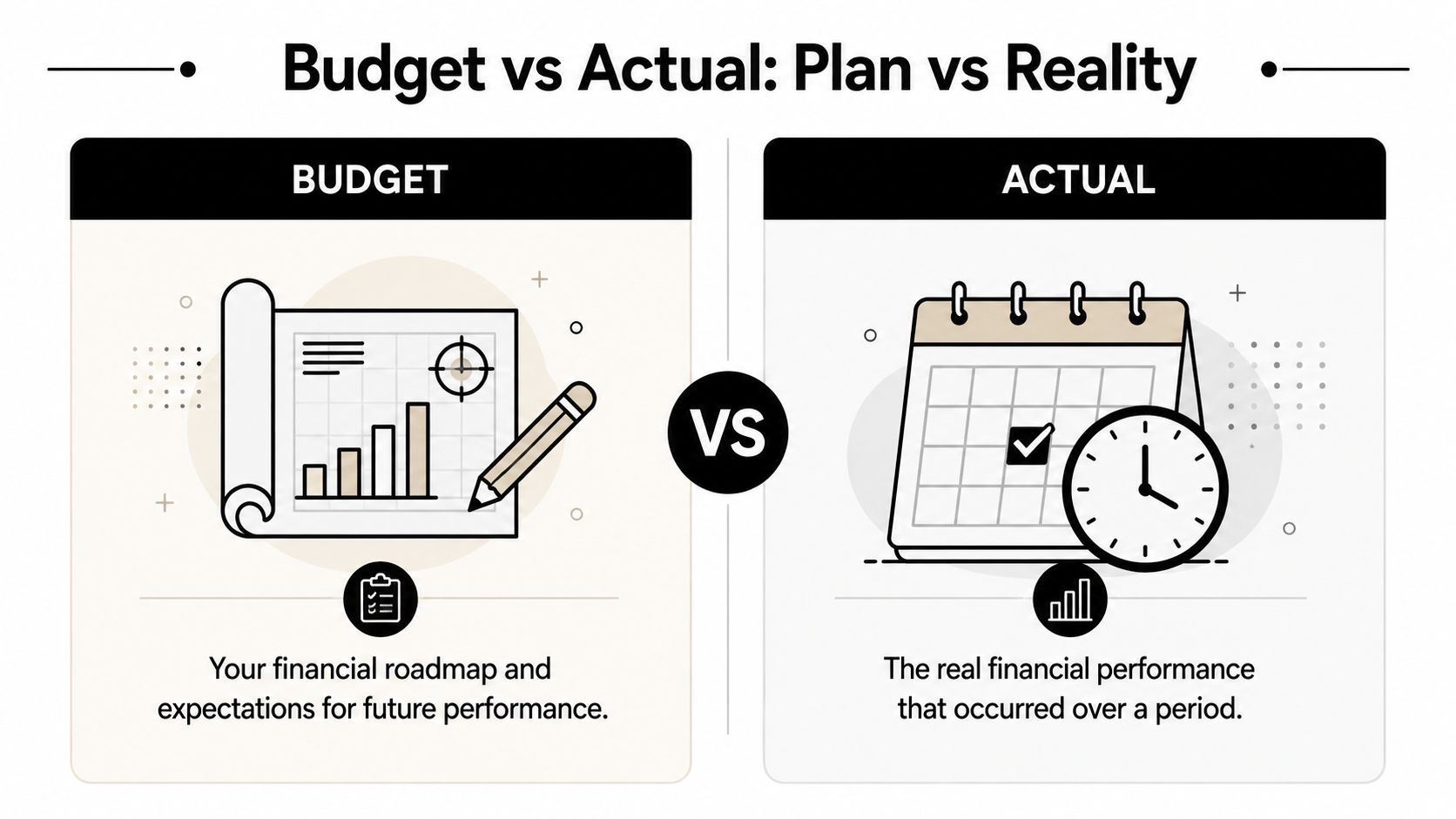
A budget is your financial game plan. Actuals are what really happened. That's the cleanest explanation you'll get, and it's the one most business owners need.
In construction, the budget is the blueprint. Actuals are the building you ended up with. In a medical practice, the budget is expected patient volume, payroll, rent, supplies, and provider compensation. Actuals are the numbers that hit the books after the month closes. One is intention. The other is evidence.
| Part | What it means | What it answers | Common mistake |
|---|---|---|---|
| Budget | Your planned revenue and expenses for a period | “What did we expect?” | Setting it once and never revisiting it |
| Actual | The real financial results recorded in your books | “What happened?” | Trusting inaccurate books |
| Variance | The difference between budget and actual | “Where did we miss or outperform?” | Reading the difference without context |
| Action | The decision you make after reviewing the gap | “What do we do next?” | Treating the report like a report card instead of a management tool |
Budget is a plan, not a fantasy
A proper budget isn't a random spreadsheet you throw together in December because your CPA asked for it. It should reflect how the business operates.
That means using your historical results, current obligations, staffing plans, contract pipeline, seasonality, payroll realities, debt service, and expected tax exposure. It also means accounting for changes in tax law that affect deductions, payroll handling, entity strategy, and compliance deadlines. Tax law changes don't care whether you were busy. If your reporting is weak, you'll react late and pay for it.
Actuals are only as good as your books
If your bookkeeping is behind, coded wrong, or full of unreconciled accounts, your actuals are fiction dressed up as accounting. That's not harsh. That's accurate.
For actuals to mean anything, your books need to reflect reality:
- Transactions categorized correctly
- Payroll posted accurately
- Loan activity separated from operating expenses
- Sales tax and payroll tax obligations tracked properly
- Bank and credit card accounts reconciled on time
Practical rule: If the underlying books are messy, don't trust the variance report. Fix the books first.
Budget vs actual reporting works when the plan is grounded and the accounting is clean. Then the comparison becomes useful instead of decorative.
Why This Report Is Your Most Powerful Business Tool
Most owners treat budget vs actual reporting like a finance exercise. That's too small. It's a management tool, a tax planning tool, a cash control tool, and a compliance tool all in one.
If you review this report monthly, you stop making decisions based on mood. You stop assuming that because revenue is strong, operations are efficient. You stop waiting until year end to discover that a department, a job, a location, or a service line has been underperforming for months.

It helps you catch problems while they are still fixable
A good report points to specific trouble. Not “expenses are high.” Specific trouble.
Maybe fuel costs climbed on jobs that should've been profitable. Maybe front-office payroll in a clinic rose faster than patient revenue. Maybe marketing spend increased without improving booked work. For contractors, detailed operational reporting can help improve asphalt contractor profitability when margin leaks hide inside production and job-level performance.
Here's what this report helps you do:
- Spot cash flow drains early: You'll see recurring overruns before they turn into emergency borrowing.
- Hold managers accountable: Department heads can't hide behind general busyness when the numbers are lined up against plan.
- Allocate resources better: You can shift money toward what's working and cut what isn't.
- Prepare for financing: Lenders and investors want organized, credible financial reporting, not stories.
It keeps tax and compliance from becoming a mess
This part gets ignored until somebody gets a notice.
Small businesses deal with payroll filings, sales tax issues, estimated tax planning, expense classification, and changing tax rules that affect deductions and reporting treatment. Most small businesses do not know all that's required to stay compliant. That's not a character flaw. It's because they're busy running the business.
A disciplined budget vs actual process helps because it forces regular review of payroll, contractor payments, operating expenses, and unusual transactions. That makes tax planning sharper and year-end cleanup smaller.
If you only look at your numbers when the tax return is due, you're not managing the business. You're autopsying it.
It gives you control
Owners say they want control. Then they avoid the one report that gives it to them.
Budget vs actual reporting tells you whether performance matches intention. If it doesn't, you can act. That's the point. Not to admire the spreadsheet. To run the company better.
How to Build Your Budget vs Actual Report
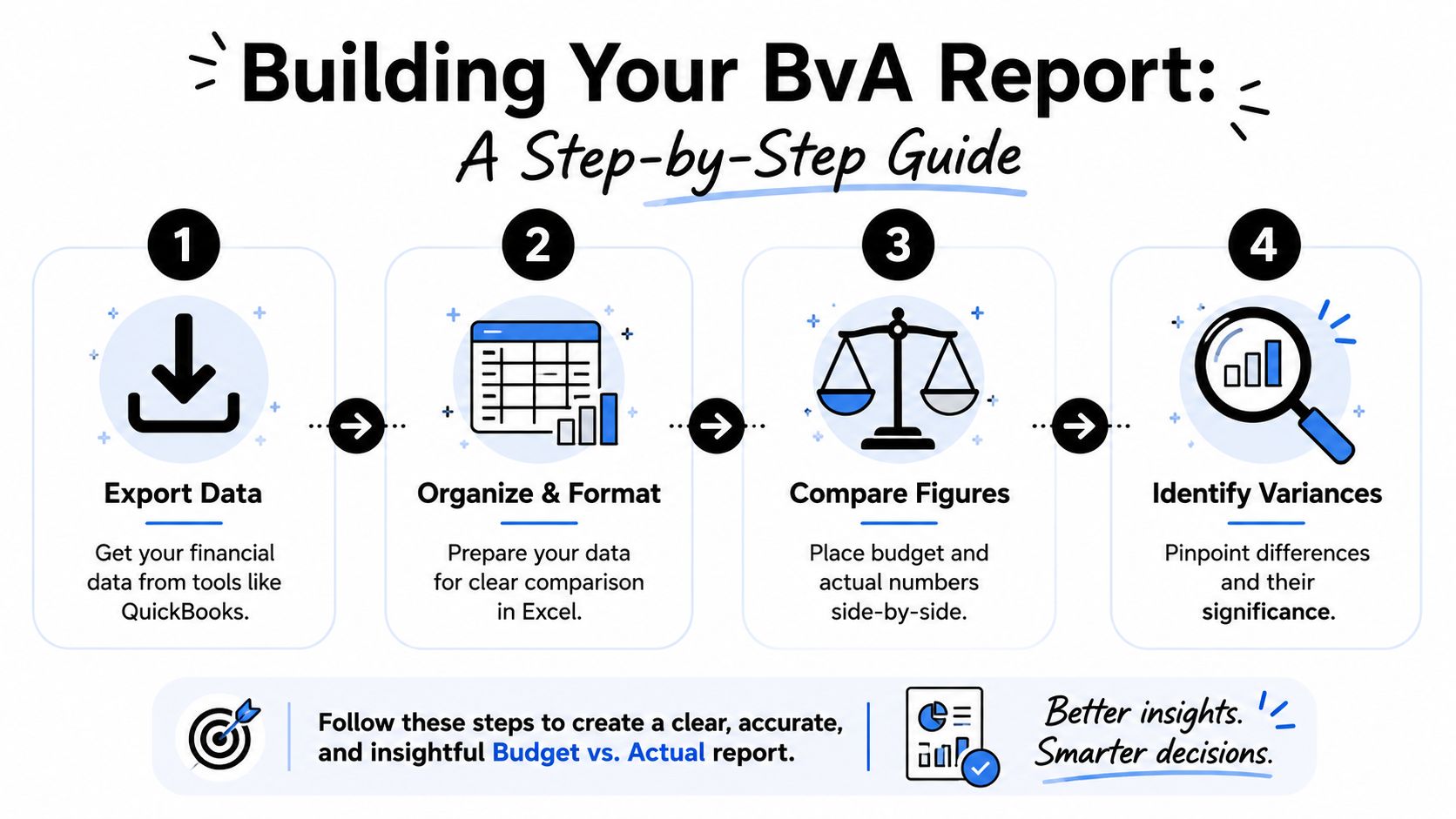
You don't need fancy software to build a workable report. QuickBooks and Excel can do the job if the books are organized and the logic is right. If your chart of accounts is sloppy, fix that first. This guide on how to set up chart of accounts in QuickBooks gives you the structure you need before you start comparing anything.
Start with clean source data
Pull your Profit and Loss statement for the period you're reviewing. That gives you the actuals. Then line those numbers up against the budget for the same month, quarter, or year-to-date period.
Make sure the categories match. If your budget says “Repairs and Maintenance” but your bookkeeping split those costs across three different accounts, your report will be muddy and you'll waste time arguing with the format instead of the results.
For operators who like examples, restaurant owners often benefit from seeing category structure in real life. These P&L examples for restaurants are helpful for understanding how line items should be grouped before comparison.
Build the report line by line
At a minimum, your spreadsheet should include:
- Account or line item
- Budget amount
- Actual amount
- Dollar variance
- Variance percentage
- Comments or explanation
That comment column matters more than people think. Numbers without explanation create arguments. Numbers with explanation create decisions.
A practical workflow looks like this:
- Export actual financials from QuickBooks.
- Paste them into Excel or your reporting tool.
- Insert the matching budget amounts beside each line.
- Add formulas for variance.
- Flag significant differences.
- Write short notes on why the gap happened.
Here's a useful walkthrough if you want to see a visual process in action.
Use the right variance formula
At this stage, many reports go off the rails.
Budget vs actual reporting employs two distinct variance metrics with specific directional logic: Dollar variance is calculated as (Actual – Budget) for revenue lines to flag negative deviations, while for expense lines, the formula reverses to (Budget – Actual) to ensure overspending generates a negative signal, preventing misinterpretation of cost control performance. This bidirectional logic ensures that management dashboards consistently use conditional formatting where negative values universally indicate unfavorable performance regardless of the line type, enabling rapid identification of material discrepancies in revenue shortfalls or cost overruns (Vareto).
That sounds technical, but the practical takeaway is simple. Your report should make bad news look bad consistently. If overspending on expenses shows up as a positive number, people misread the report and make dumb decisions.
Keep the workflow realistic
Not every business needs a giant FP&A system. Some need a disciplined monthly process and somebody who knows how to read the output. Options include QuickBooks, Excel, reporting add-ons, or outsourced support from firms such as Bookkeeping and Accounting of Florida Inc., which provides bookkeeping, accounting, and fractional CFO support for businesses that need reliable financial reporting and guidance.
How to Read The Story Your Variances Are Telling
A variance column is not decoration. It's the story of where the plan collided with reality.
If you read that story wrong, you'll reward the wrong behavior, cut the wrong costs, and miss the actual problem. That happens all the time when owners see a positive number and assume it's good, or see a negative number and assume it's bad.
Positive and negative are not enough
Many existing guides treat variance as a simple subtraction (Actual – Budget) without distinguishing between revenue and expense contexts, leading to critical confusion. A favorable variance in revenue (Actual > Budget) is positive, but a favorable variance in expenses (Actual < Budget) is negative in that same formula, creating a negative signal for savings unless the formula is inverted for expenses. This nuance is frequently glossed over, causing owners to misread their financial health (supporting explanation).
That's exactly why interpretation matters. The numbers aren't lying, but they can be presented in a way that invites bad reading.
| Line Item | Budget | Actual | Variance ($) | Variance (%) | Interpretation |
|---|---|---|---|---|---|
| Sales Revenue | Budgeted amount | Higher than budget | Positive under revenue logic | Favorable | Revenue exceeded plan |
| Sales Revenue | Budgeted amount | Lower than budget | Negative under revenue logic | Unfavorable | Revenue missed target |
| Payroll Expense | Budgeted amount | Higher than budget | Negative under expense logic | Unfavorable | Payroll overspend |
| Payroll Expense | Budgeted amount | Lower than budget | Positive under expense logic | Favorable | Payroll came in under plan |
Ask better questions
Once a variance is flagged, don't stop at “good” or “bad.” Ask what drove it.
Use a short review checklist:
- Was it timing or trend: Did the expense hit early, or is it running high every month?
- Was it volume related: Did higher sales require higher labor or materials?
- Was it a coding issue: Did somebody book a cost to the wrong account?
- Was it a strategic choice: Did management knowingly spend more to support growth?
If you want the underlying financial statement to make more sense before you analyze variances, this guide on how to read income statement is worth keeping handy.
A variance isn't a verdict by itself. It's a signal to investigate.
Don't overreact to one line
One ugly line item doesn't always mean poor management. It may reflect seasonality, delayed billing, a one-time purchase, insurance timing, or a strategic investment. But if the same category misses plan month after month, that's no longer noise. That's a pattern.
Good leaders don't chase every fluctuation. They focus on the variances that are material, recurring, or operationally meaningful.
From Reporting Verdict to Strategic Conversation
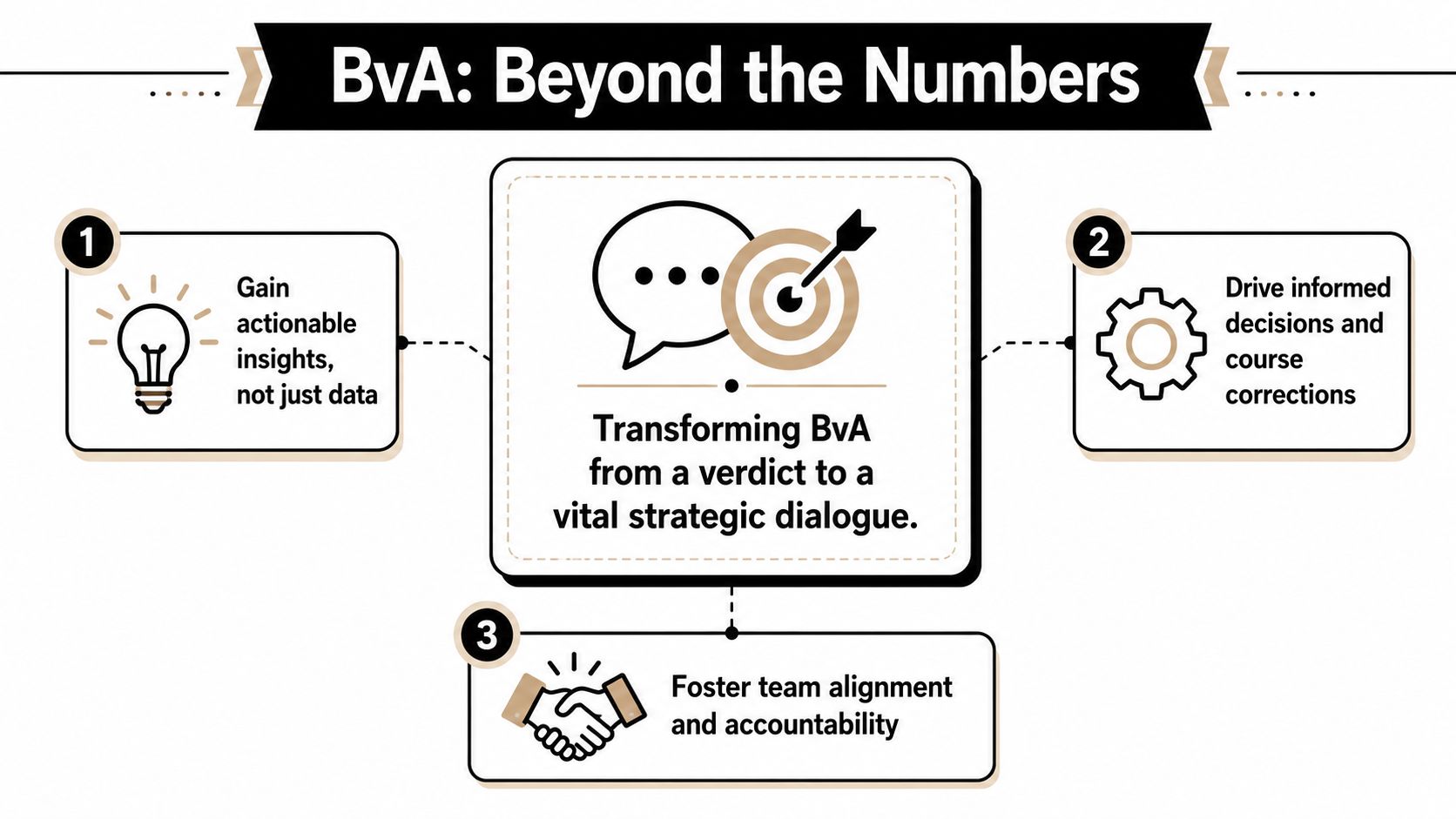
Most businesses use budget vs actual reporting like a school report card. Somebody missed the budget. Somebody overspent. Everybody feels mildly defensive. Then the meeting ends and nothing changes.
That approach is weak. It wastes the report.
A significant gap in how teams use BvA is that they treat it as a backward-looking verdict instead of a forward-looking conversation. Over 70% of finance teams report using BvA analysis primarily for retrospective compliance rather than forward-looking decision-making, and 65% of SMBs abandon monthly BvA tracking because the explanations remain static and fail to drive mid-year strategy adjustments (Marvin Webb on LinkedIn).
Use the meeting to make decisions
A strong monthly review meeting doesn't center on blame. It centers on choices.
Instead of saying, “Marketing was over budget,” ask, “What did we buy, what did it produce, and should we keep funding it?” Instead of saying, “Labor was high,” ask, “Did overtime support profitable work, or are we scheduling badly?”
Try this framework in leadership meetings:
- What changed: Identify the biggest variances.
- Why it changed: Get the operational reason, not a vague excuse.
- What it means next: Decide whether to hold, cut, invest, or revise the plan.
- Who owns the follow-up: Assign a person and a deadline.
This is where a fractional CFO earns their keep
A report doesn't talk. A good advisor does.
A fractional CFO turns the numbers into decisions. They help management separate timing noise from real performance issues, connect tax law changes to planning, build better forecasts, and keep the business compliant while owners stay focused on operations. All companies need a fractional CFO or somebody acting in that role, even if they're not ready for a full-time executive. Otherwise, the numbers sit in a file, and everybody goes back to guessing.
The point of the report is not to prove what happened. The point is to decide what happens next.
Keep it local and practical
For Northeast Florida businesses, the conversation has to fit actual conditions. Contractors need job-cost discipline. Clinics need provider, payroll, and reimbursement visibility. Nonprofits need compliant reporting. Retailers need inventory and margin control. Different industries, same problem. The plan and reality drift apart unless somebody is watching and asking sharp questions.
You Need a Guide Not Just a Report
At this point, the hard truth should be obvious. The report matters, but the report alone won't save you.
You need clean books. You need a budget grounded in reality. You need actuals that are coded correctly. You need someone who understands variance logic, cash flow, payroll, compliance, tax planning, and how tax law changes affect decisions before year end. Most owners do not have time to become experts in all of that, and they shouldn't have to.
Why guidance matters
A business can have QuickBooks, spreadsheets, payroll software, and a stack of reports and still be flying blind. Tools don't interpret. Tools don't challenge assumptions. Tools don't tell you that a margin problem is coming, that your payroll setup is off, or that staying complaint requires more than filing something when a deadline gets close.
That's why outsourced guidance makes sense. If you need an overview of what that role looks like, this page on fractional CFO services lays out the model clearly.
What smart owners do
They stop treating accounting like a cleanup project.
They use business accounting as a management system. They review budget vs actual reporting every month. They ask for explanations, not excuses. They use a fractional CFO to guide decisions, tighten compliance, support tax planning, and help the business grow without turning the back office into chaos.
If you're serious about running a stronger company in Jacksonville or anywhere in Northeast Florida, get the report. Then get the guidance to use it well.
If your business needs clear financial reporting, ongoing compliance support, tax-aware planning, and a fractional CFO who can turn numbers into decisions, talk with Bookkeeping and Accounting of Florida Inc.. They help Northeast Florida businesses clean up the books, build better budget vs actual reporting, and use that information to guide the business instead of just explaining the past.