
If you're the one closing the books for a small nonprofit in Jacksonville, you already know the pattern. One donor gives through a website, a city grant lands with strings attached, somebody drops off in-kind supplies, payroll still has to clear, and the Form 990 deadline sits there like a bright red warning light. That mix is exactly where accounting for nonprofits stops looking like ordinary bookkeeping and starts behaving like compliance, cash management, and mission control at the same time.
The reason this gets messy so fast is simple. Nonprofits aren't organized around owners and profit, they're organized around mission, restrictions, and reporting obligations. In the U.S., the sector is enormous, with about 1.935 million registered organizations, roughly $3.7 trillion raised each year, about $3.5 trillion spent each year, and about 12.5 million people employed, making it the third-largest employer in the country, according to Candid's sector data. When a sector handles that much activity, sloppy classification isn't a small bookkeeping issue, it's a governance problem.
Why Nonprofit Accounting Is Its Own Discipline
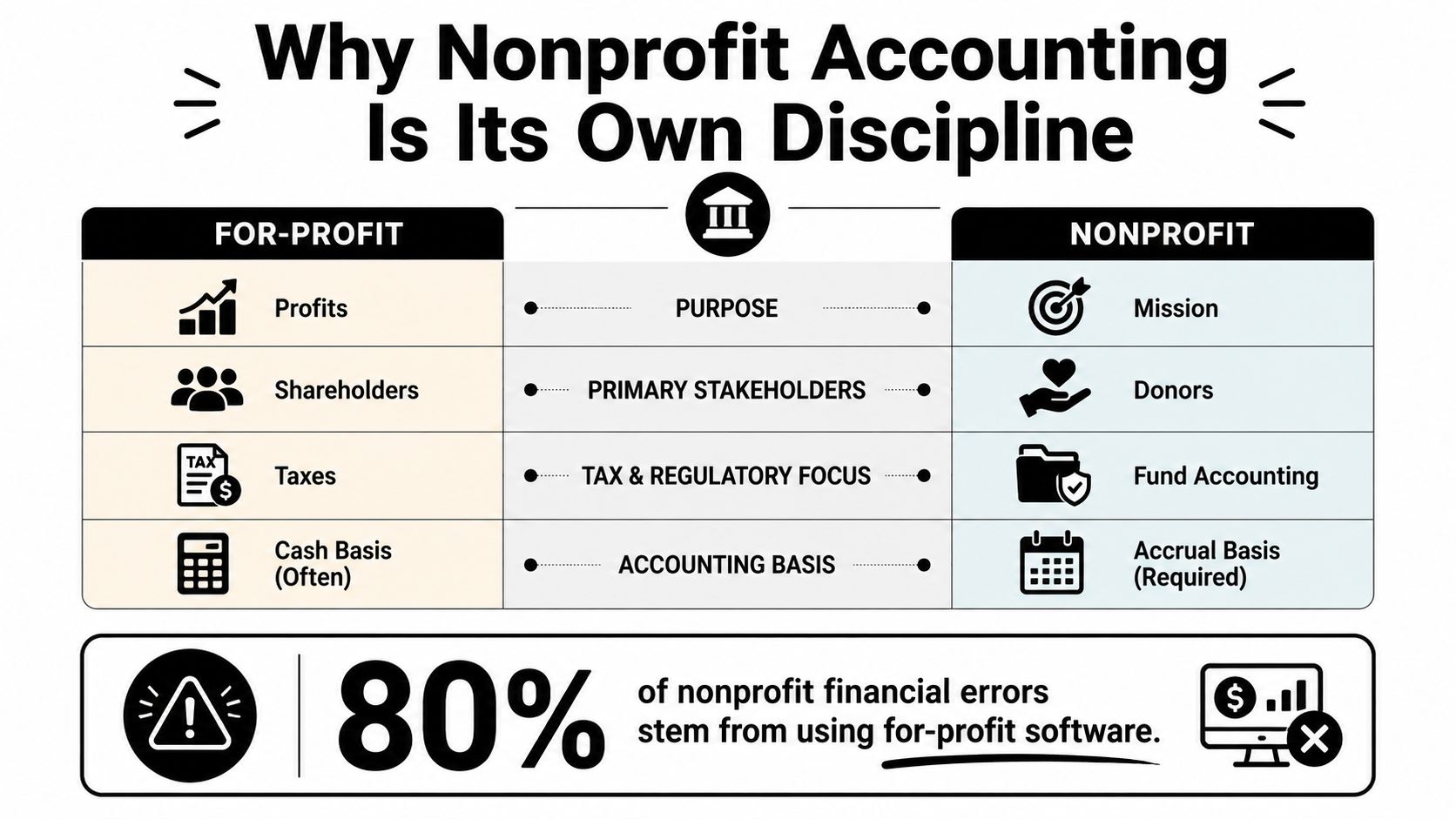
A small Jacksonville nonprofit can look calm from the outside and still leave the bookkeeper juggling four separate realities. The team may be charging program fees, tracking a restricted city grant, recording an in-kind donation from a hospital, and trying to finish the month before the board packet goes out. For-profit habits break down fast in that setting. The question is what the money can be used for.
Mission first, not profit first
For-profit accounting is built to answer whether owners made money. Nonprofit accounting has a different job. It has to show how resources support the mission, how restrictions limit use, and how much of the organization is available for operations. That is why the standard nonprofit statements use net assets instead of equity, and why the statement of activities matters more than a standard profit-and-loss report.
Practical rule: if donor intent, grant conditions, or program purpose affect spending, the money needs to be tracked before it ever becomes part of the bank balance in your mind.
That distinction sounds basic until it collides with real life. A church, a health clinic, or a youth nonprofit can have cash in the account and still be short on usable operating funds. A widely cited 2018 analysis referenced by Sage found that among U.S. nonprofits, 7–8% are technically insolvent, 30% face potential liquidity issues, 30% have lost money over the previous three years, and about 50% have less than one month of operating reserves. Sage's nonprofit financial health discussion puts that liquidity problem in plain terms. Those numbers are why nonprofit accounting has to function like risk management, not just recordkeeping.
Fund accounting is the organizing idea
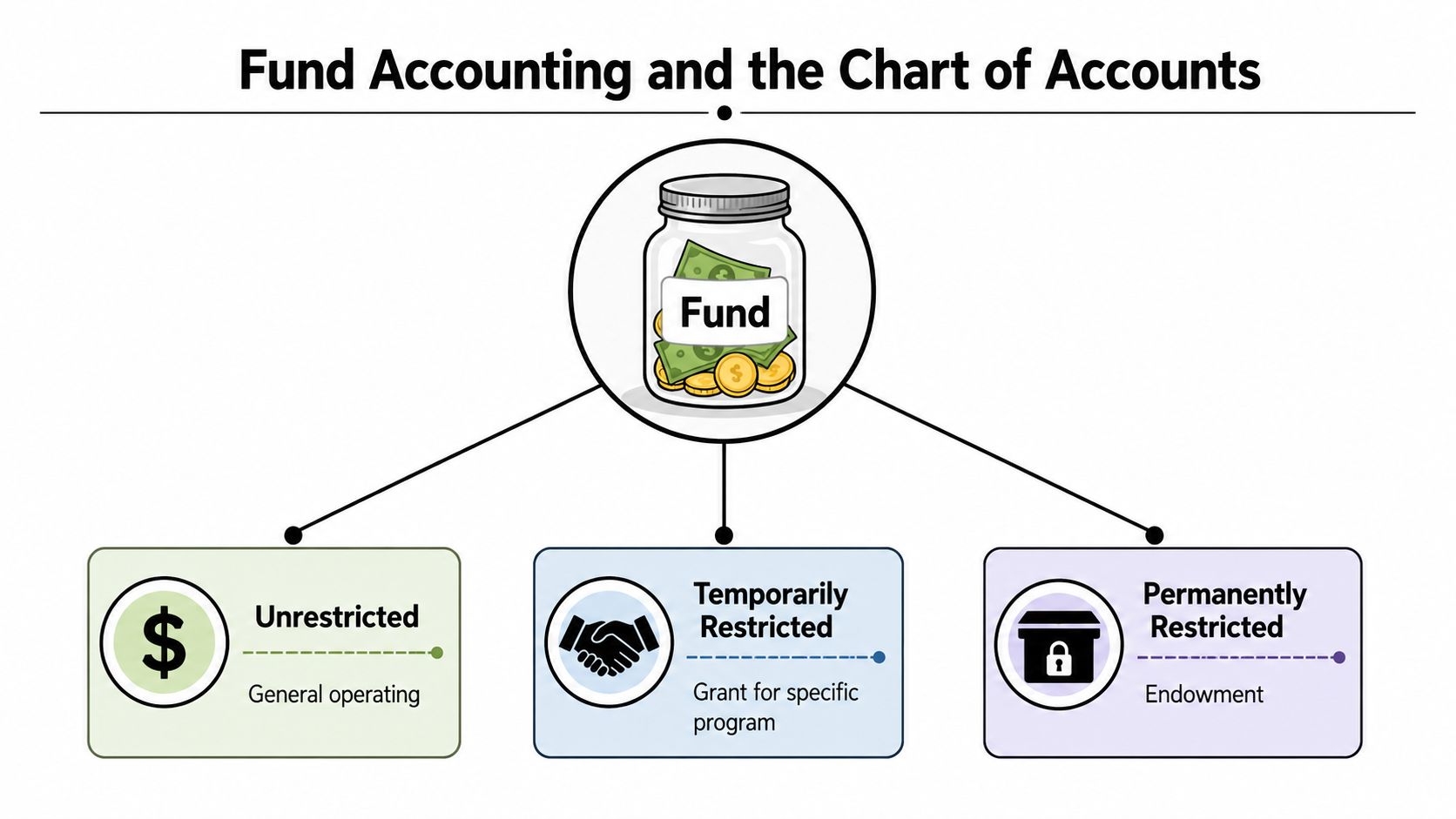
The easiest way to understand fund accounting is with jars on a counter. One jar holds unrestricted operating cash. Another holds a restricted grant. A third holds a capital campaign gift. You cannot move money between jars just because the checking account balance looks healthy.
That is the operational reason nonprofit accounting has its own discipline. The rules are not decorative. They keep management from overpromising, keep the board from approving spending that should not happen, and keep an audit from turning into a cleanup project. For the most common nonprofit structure, 501(c)(3) public charities make up about 75% of registered nonprofit organizations according to Candid, which means this is the default accounting environment for most U.S. charities.
A clean chart of accounts and a disciplined fund structure also help when you are making operating decisions. I have seen a church stewardship campaign go sideways because the books looked healthy at the checking-account level while designated gifts and operating cash were getting mixed together. If you are trying to keep a donor campaign on track, the planning habits in 2026 stewardship success tips are a useful reminder that the accounting setup has to match the promises being made.
Fund Accounting and the Chart of Accounts
Fund accounting works best when people stop treating it like a software feature and start treating it like a labeling system. Every dollar needs a label that says what it's for, and every account in the chart of accounts needs to support that label cleanly. If the labels are sloppy, the reports are sloppy, and once the reports are sloppy, the board starts making decisions on bad assumptions.
Build the chart of accounts around restrictions and function
The two-class net asset model under GAAP gives you the first split, with donor restrictions and without donor restrictions. That split matters because restricted funds can't be treated like general operating cash, even if they sit in the same bank account. The chart of accounts should mirror that reality by making it easy to tag transactions by restriction status and by function, so program, management, and fundraising costs don't get blended together.
A workable structure in QuickBooks or Aplos usually starts with a clean account hierarchy, then layers in classes, locations, or funds only where they help. Too many nonprofits create an overly clever system and then nobody uses it correctly. I'd rather see a simple chart of accounts that people can post to consistently than a fancy setup that only one staff member understands.
The practical test is whether you can answer three questions quickly:
- What fund did this money belong to?
- What restriction, if any, applied to it?
- What function did the expense support?
If you can't answer those from the general ledger without a scavenger hunt, the chart needs work.
Use real gift types to test the structure
A $25,000 hurricane-relief donation should not sit in the same bucket as unrestricted annual fund revenue. A multi-year literacy grant needs separate tracking so you know what was awarded, what's been spent, and what remains available. An unrestricted annual fund gift belongs in operating resources, unless the donor explicitly says otherwise.
That's also where board reporting gets clearer. When the finance committee can see restricted and unrestricted activity side by side, it stops asking whether the bank balance is “good” and starts asking whether the organization can fund payroll, programs, and reserves. For practical stewardship ideas that fit this kind of gift tracking, 2026 stewardship success tips is a useful reference point for campaign language and donor communication discipline.
The point is not to make accounting more complicated. The point is to make sure your records can defend the mission when a donor, auditor, or board member asks where the money went. If you need a practical starting point for system setup, best accounting software for nonprofits is a useful internal guide for comparing options.
GAAP, FASB, and the Rules That Change Your Close
A nonprofit close gets harder when the accounting has to prove donor intent, grant status, and how the organization used restricted money. If the team treats every deposit like ordinary revenue, the books will drift fast, and the board will be looking at a cash balance that does not match the true operating picture. The standards that matter in practice are the ones that change classification, timing, and the way expenses appear on the statements.
Net assets, expenses, and revenue recognition
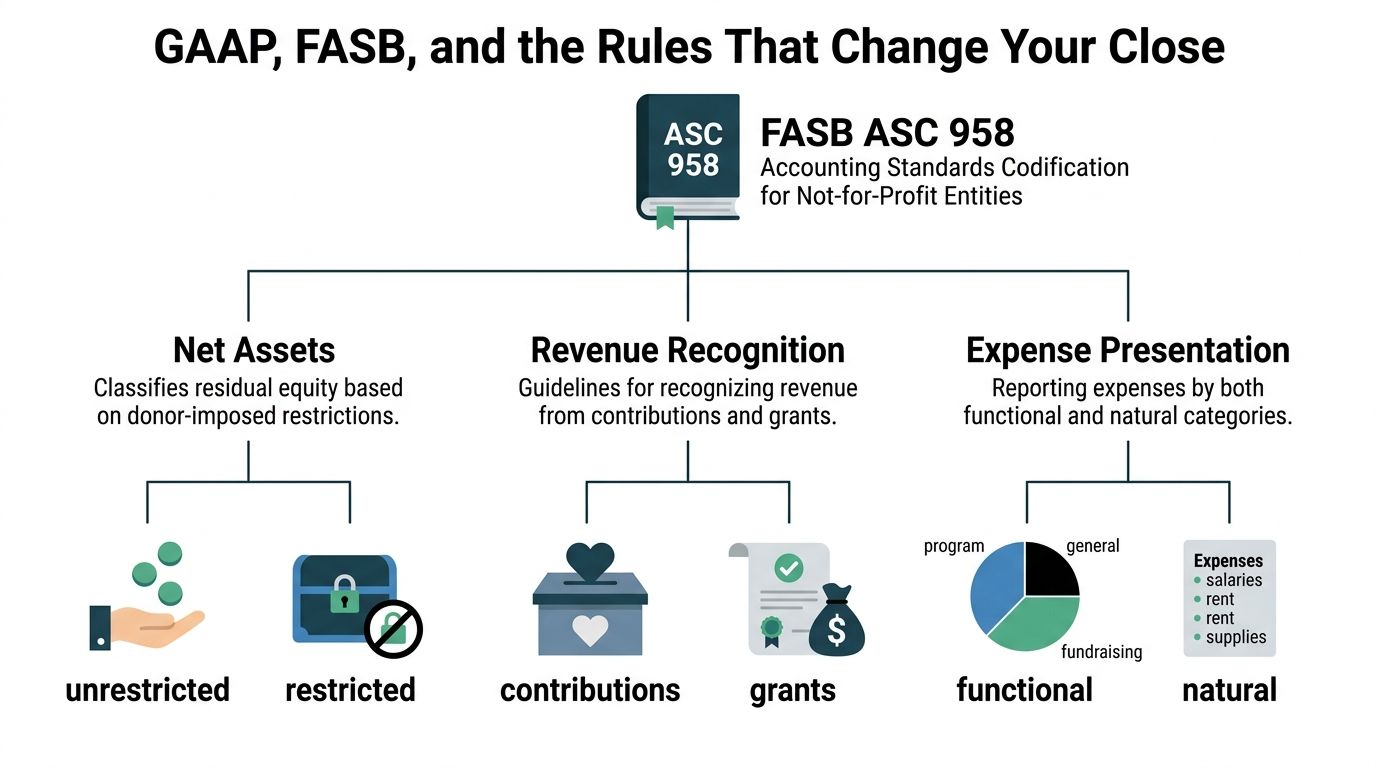
ASC 958 is the backbone here. It requires the two-class net asset model, with and without donor restrictions, and it also requires functional expense reporting, so expenses must be shown by both nature and function. Payroll, rent, supplies, and similar costs cannot just sit in one lump without being mapped to program, management, or fundraising.
That changes the month-end checklist right away. Transaction-level tagging has to hold up under review, because payroll allocations need to stay consistent and occupancy costs need the same treatment every month. If those allocations drift, the statement of activities stops being useful, and board oversight gets weaker along with donor confidence.
A board cannot manage liquidity well if the financial reports blur restricted resources into operating cash.
Contributed nonfinancial assets and conditional gifts
ASU 2020-07 requires donated goods and services to be shown as separate line items, with disclosure about how they were used. Organizations that receive in-kind supplies, professional services, or other noncash support need documentation that can support the fair value and the presentation. Without that support, readers can get a false view of how much actual support the organization received.
ASU 2018-08 draws the line between conditional and unconditional contributions. That line decides whether revenue is recognized now or only after the barrier or condition is satisfied. If a grant is conditional and the condition has not been met, the money should not be treated like current-period operating revenue. Misclassifying it can make one month or one year look healthier than it really is, then leave a funding gap later.
For membership fees, service income, and similar earned revenue, ASC 606 may apply. A nonprofit with program fees or contracts needs more than a generic “donations and expenses” setup, it needs documentation that matches the substance of the transaction, not just the deposit memo. That is where a practical close saves time later, because the ledger supports the statement instead of forcing cleanup after the fact.
A detailed technical overview is available in the firm's internal resource on non-profit accounting standards. For a broader plain-English walkthrough of these changes, the nonprofit accounting standards update explains why in-kind items and contribution timing matter so much.
If you need a working checklist for the year-end close, the 2026 nonprofit compliance checklist is a practical place to start.
Form 990, State Filings, and Audit Triggers
Deadlines are where a lot of small nonprofits get into real trouble, because nobody notices the risk until the mail pile is already too old. The federal Form 990 deadline is the 15th day of the fifth month after the organization's fiscal year ends, so a calendar-year nonprofit files by May 15. If the organization misses Form 990 for three consecutive years, the IRS automatically revokes tax-exempt status on the due date of the third missed return, according to this compliance overview.
What small nonprofits usually need on the calendar
Florida organizations also have state filing duties, including the Florida Annual Report through Sunbiz and any documentation needed to preserve state sales-tax exemption. Those items are easy to ignore when the month-end close is behind schedule, which is exactly why a 12-month compliance calendar has to live in the finance function, not in someone's memory.
The practical filing plan should answer three questions early in the year. Which Form 990 series return applies. What state filings are due. Whether the organization is likely to need a review or audit because of funder requirements, grant conditions, or other reporting obligations. A nonprofit that waits until December to ask those questions is already behind.
| Organization Profile | Required Federal Form | Annual Filing Deadline | Review or Audit Trigger |
|---|---|---|---|
| Smaller 501(c)(3) with limited receipts and straightforward activity | Form 990, 990-EZ, or 990-N depending on filing profile | May 15 for calendar-year filers | Review or audit may be required by grant, donor, or board policy |
| Operating nonprofit with grants and restricted gifts | Form 990 or 990-EZ | 15th day of the fifth month after fiscal year-end | Review or audit may be required if funder rules demand it |
| Larger or more complex nonprofit | Form 990 | Same federal deadline | Audit is more likely when lenders, government grants, or governing documents require it |
For a practical checklist that helps a board keep the calendar straight, 2026 nonprofit compliance checklist is a useful supplemental resource. If the filing process itself is still unclear, the firm's internal guide to Form 990 filing requirements gives a cleaner starting point for year-end planning.
The blunt lesson is clear. Compliance is not a year-end fire drill. It is a monthly bookkeeping outcome.
Bookkeeping Software and the Monthly Close
The software matters, but only after the workflow is right. I've seen organizations spend too much time shopping for a platform, then keep using it with a broken process. The result is the same, late reconciliations, muddy reporting, and a board packet nobody fully trusts.
Pick software based on complexity, not hype
QuickBooks Online works well for nonprofits that need flexibility, decent bank feeds, and enough structure to track classes or locations without overengineering the books. Aplos is built more directly around fund accounting, which helps organizations that need a nonprofit-first framework instead of a general business ledger. Sage Intacct makes more sense once a nonprofit has outgrown entry-level systems and needs stronger reporting, more controls, and more detailed dimensional tracking.
The right choice depends on staffing and reporting demands. If the organization has a lean office, the question isn't which product has the longest feature list. It's which platform the team can keep current every month without breaking controls.
Practical rule: software should reduce judgment errors, not hide them.
Cloud-based tools also change the way teams work. A plain-language explanation of what cloud accounting software is is useful for boards that still think “the books” means one desktop file sitting on one laptop. In practice, donor platforms, payroll systems, and bank feeds need to talk to the ledger, or someone will keep rekeying data and introducing mistakes.
Close the month the same way every time
A defensible monthly close for a lean nonprofit usually includes bank and credit card reconciliations, restricted-versus-unrestricted review, grant allowability checks, allocation entries, and a board-ready packet by the 15th of the following month. That date matters because delays compound. If January is open when March begins, the year is already drifting.
Segregation of duties still matters even in a two-person office. One person should not open all mail, approve every disbursement, and reconcile every account. If staffing is thin, responsibilities can be separated by process instead of headcount, but the control has to exist somewhere.
The software setup checklist should cover donor platform integrations, payroll feeds, class or fund structure, recurring journal entries, document storage, and a monthly close calendar. If you're comparing systems, the firm's internal guide on best accounting software for nonprofits is a sensible starting point. For many small and mid-size nonprofits, the right setup is less about bells and whistles and more about making the close repeatable.
When to Outsource and Why a Fractional CFO Pays for It
A lot of nonprofits try to keep everything in-house because that feels prudent. In reality, the risk usually shows up when one overstretched finance manager is expected to do bookkeeping, grant compliance, payroll review, audit prep, and board reporting all at once. At that point, the organization doesn't have a finance function, it has a bottleneck.
Keep the routine in house, outsource the judgment
Routine work can stay in house when staff are trained and supervised properly. Bank reconciliations, payroll processing, donor receipts, and basic coding are all tasks that can be systematized. The harder questions are different. Chart of accounts design, restricted-fund policy, revenue recognition decisions, Form 990 prep, and audit liaison work all require senior judgment.
That is where fractional CFO support fits. It gives a nonprofit access to higher-level financial oversight without carrying a full-time executive salary. For smaller organizations, that can be the difference between guessing and governing. I've seen boards relax once someone explains cash forecasts, reserve tracking, and grant burn rates in language they can use.
Capacity design beats heroics
The staffing problem in nonprofit finance is real. Industry commentary has been pointing toward turnover pressure, automation, SOPs, and cross-training as survival tools, and that tracks with what I see in practice. If every reconciliation and board package depends on one person's memory, the organization is exposed the moment that person is sick, quits, or gets pulled into another crisis.
That's why the choice isn't just “hire or don't hire.” It's “what work belongs where.” A fractional CFO can help design the close, set reporting cadence, monitor liquidity, and prepare board memos that focus on decisions instead of raw numbers. For some organizations, that support is enough to keep things stable. For others, it reveals that their internal process needs a cleanup before they add more staff.
One place where that mix of bookkeeping, compliance, and oversight shows up every week is in the Jacksonville market, where Bookkeeping and Accounting of Florida Inc. supports nonprofits alongside bookkeeping, accounting, payroll, tax preparation, audits, reviews, and fractional CFO services. That kind of combined support matters because small nonprofits rarely need just one thing.
KPIs, Common Mistakes, and Your Next 90 Days
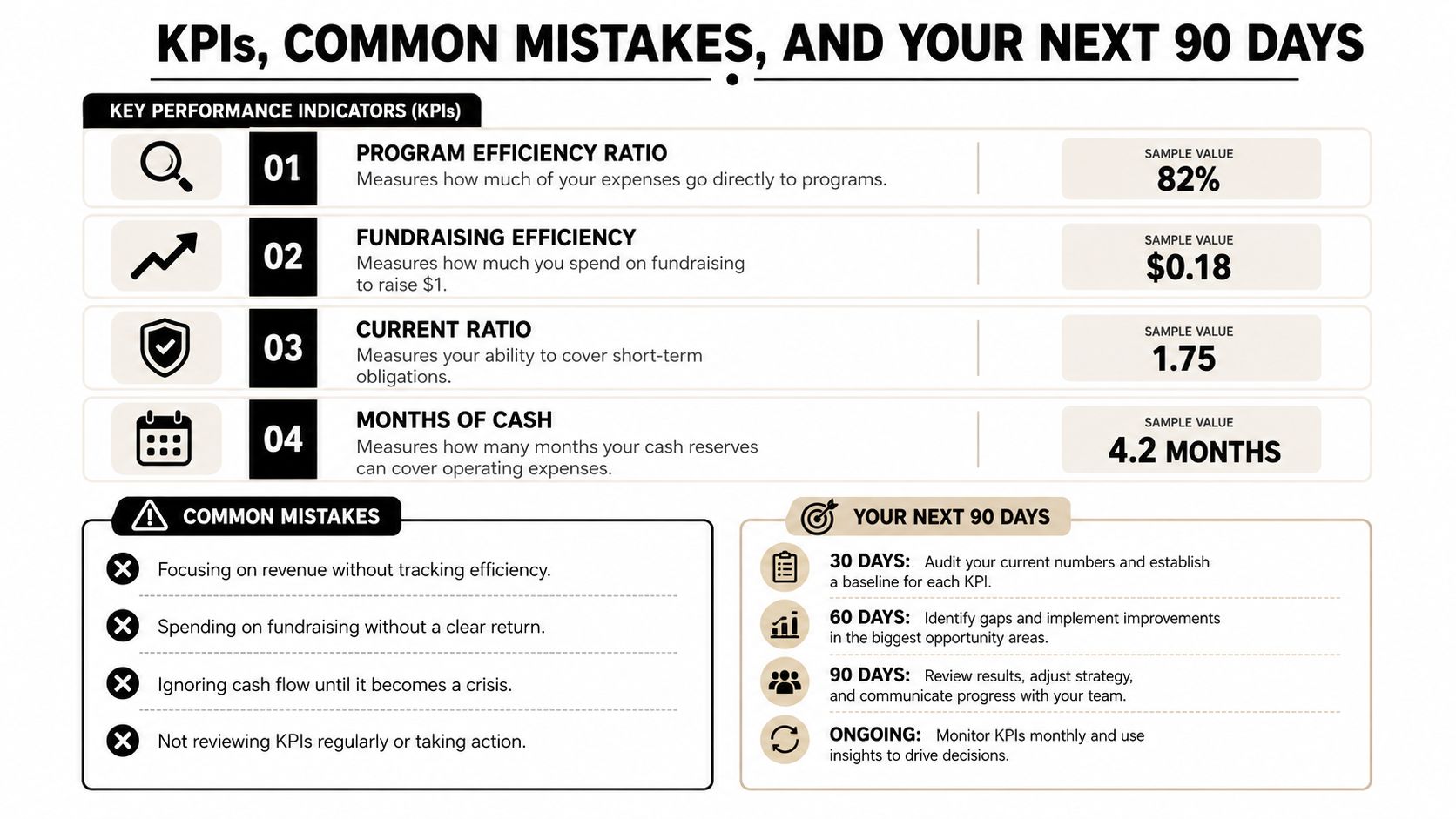
A board doesn't need twenty metrics. It needs the right few, read the same way every month, from statements the finance team can defend. For nonprofit accounting, that usually means program efficiency ratio, fundraising efficiency, current ratio, months of operating reserves, and the mix of restricted versus unrestricted cash.
The mistakes that keep showing up
The same problems repeat in small nonprofits because the root causes are structural, not moral.
- Commingling restricted funds: Separate the coding, not just the bank balance, so donor-restricted money never gets treated like free cash.
- Missing Form 990 deadlines: Build a filing calendar that starts after year-end close, not the week before the return is due.
- Weak in-kind documentation: Record fair value, date, donor intent, and usage notes before the support gets buried in email.
- No written gift acceptance policy: Document what the organization will accept, especially for restricted, noncash, or unusual gifts.
- Chart of accounts that doesn't match functional expenses: Rebuild account structure so the statements can present by both nature and function.
A clean 90-day reset
In the next 30 days, clean up the chart of accounts and set the fund structure. In the next 60 days, draft the restricted-fund and gift acceptance policies, then lock in the close calendar. By day 90, connect the donor platform, payroll, and accounting system, then review the board packet format so leadership sees the same numbers every month.
If your nonprofit's books are behind, or if the board keeps asking questions the current reports can't answer, Bookkeeping and Accounting of Florida Inc. can help with bookkeeping, payroll, tax preparation, audit support, reviews, and fractional CFO guidance built around nonprofit compliance. Visit Bookkeeping and Accounting of Florida Inc. to set up a conversation about getting the books current, tightening controls, and building a monthly close your board can trust.