
A profitable Jacksonville business can still miss payroll, delay a tax payment, or lean on a line of credit while the income statement looks perfectly healthy. The usual culprit is timing. Customers haven't paid invoices, inventory has absorbed cash, or the owner has pulled money out faster than the business can replenish it.
Thank you for reading this post, don't forget to subscribe!That's why learning how to read a cash flow statement matters. The report tracks actual cash movement, not just revenue earned or expenses recorded. It helps owners, lenders, and a fractional CFO answer a harder question than “Did we make money?”: Did the business generate enough usable cash to support itself?
Why Cash Flow Tells the Truth Profit Hides
A medical practice can record revenue when insurance claims are earned, even while collections lag. A contractor can show a strong month because completed work was billed, even though payroll and materials were paid before the customer's check arrived. QuickBooks may show profit, but the bank account only recognizes money that moved.
I've seen plenty of small-business books where the owner says, “We had our best month,” while asking why the checking account feels worse. That isn't always an accounting error. It may be a genuine difference between accrual earnings and cash conversion. The income statement measures profitability under accounting rules. The cash flow statement shows how cash entered and left the business during the period.
A practical explanation of this distinction appears in why cash flow management matters for business owners. The point isn't to choose one report over another. You need the income statement to understand margins and the balance sheet to understand what the business owns and owes. The cash flow statement then explains why the bank balance changed.
The three questions that keep owners out of trouble
Read the statement through three questions:
- Did operations generate cash? Customer collections, payroll, vendor payments, taxes, and other core activity belong to this question.
- Did the business buy or sell long-term assets? Equipment, vehicles, property, and certain investments can consume or release cash without saying much about recurring demand.
- How did the business fund itself? Loans, owner contributions, equity, repayments, and distributions show whether outside capital supported the period.
A business can report positive total cash flow because it borrowed money while operations consumed cash. That may be sensible during expansion, but it isn't the same as a self-supporting business. Positive cash from selling equipment can also hide a deteriorating operating position.
Practical rule: Profit explains performance. Cash flow explains survival.
What you should be able to spot
A useful review separates repeatable operating cash generation from temporary balance-sheet timing. It asks whether customers are paying faster, whether inventory is moving, and whether the business is stretching vendor payments. Those signals matter more than a single attractive ending balance.
By the end of this walkthrough, you'll know how to read each section from the top down, trace operating cash back to net income, test short-term liquidity, recognize quality-of-earnings warnings, and identify when bookkeeping cleanup or CPA guidance is necessary.
What the Three Sections Really Mean and How to Read Them Top Down
A cash flow statement is built around operating, investing, and financing activities. Each category answers a different business-health question, and mixing them together is how owners end up celebrating borrowed cash as if it were sales.
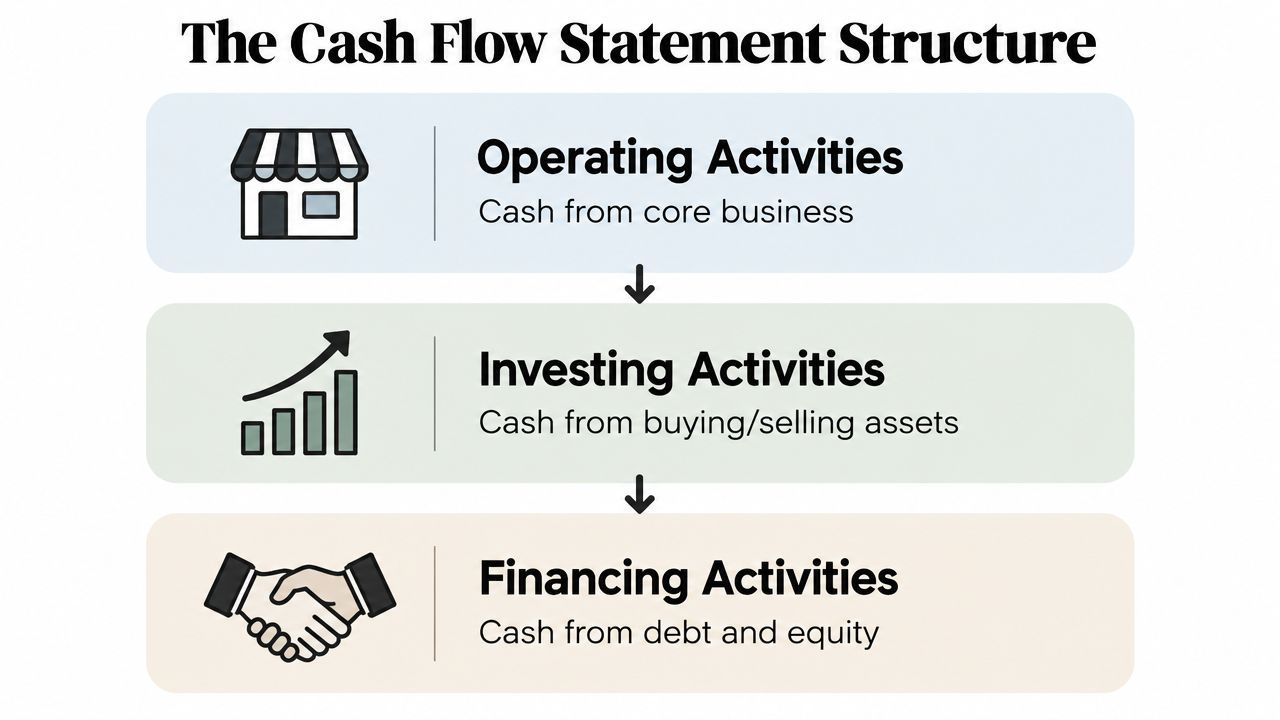
Operating activities
Operating cash flow covers the company's principal revenue-producing activity and other activity that isn't classified as investing or financing. Under IAS 7's statement of cash flows requirements, that distinction keeps daily business cash separate from asset purchases and funding decisions.
For a small business, operating activity usually includes collections from customers and payments for suppliers, employees, rent, taxes, and other ordinary costs. This is the first place to look because it shows whether the core business is producing cash without depending on a lender, investor, or asset sale.
Investing activities
Investing cash flow records money spent on or received from long-term assets. Buying equipment or a vehicle generally creates an outflow. Selling an asset creates an inflow. A negative investing section can be healthy when the business is adding productive capacity, but the purchase should make commercial sense and fit the cash forecast.
An investing inflow deserves context. Selling an underused asset may improve liquidity, but recurring asset sales to cover payroll or vendors suggest the operation isn't funding itself.
Financing activities
Financing cash flow shows how the business interacts with lenders and owners. Borrowing, owner contributions, equity funding, principal repayments, and distributions belong here. It explains how the company filled a cash gap or used excess cash, but it doesn't prove that the underlying business model works.
Read the statement top down:
- Start with operating cash flow.
- Review investing outflows and inflows.
- Check financing support, repayments, and distributions.
- Confirm that the net change in cash reconciles to the change between beginning and ending cash on the balance sheet.
That order keeps the source of cash in view. A helpful visual companion for readers who want to leggere rendiconto finanziario can reinforce the structure, but the same discipline applies whether you're reviewing a small clinic, a construction company, or a nonprofit.
How to Follow Operating Cash Flow From Net Income to Real Cash
The operating section often uses the indirect method. It starts with net income and adjusts that accrual-based result until it reflects cash generated by operations. The direct method instead presents major classes of gross cash receipts and payments, such as collections from customers and payments to vendors.
Under IAS 7, both methods are permitted. The indirect method is more common because it connects the cash result to reported earnings and exposes where accrual profit differs from cash generation. In the United States, a major reporting milestone arrived in 1987, when the Financial Accounting Standards Board issued Statement of Financial Accounting Standards No. 95, formally requiring the statement of cash flows and permitting either method while requiring reconciliation under the indirect approach. The history is covered in cash flow accounting standards and the direct or indirect method.
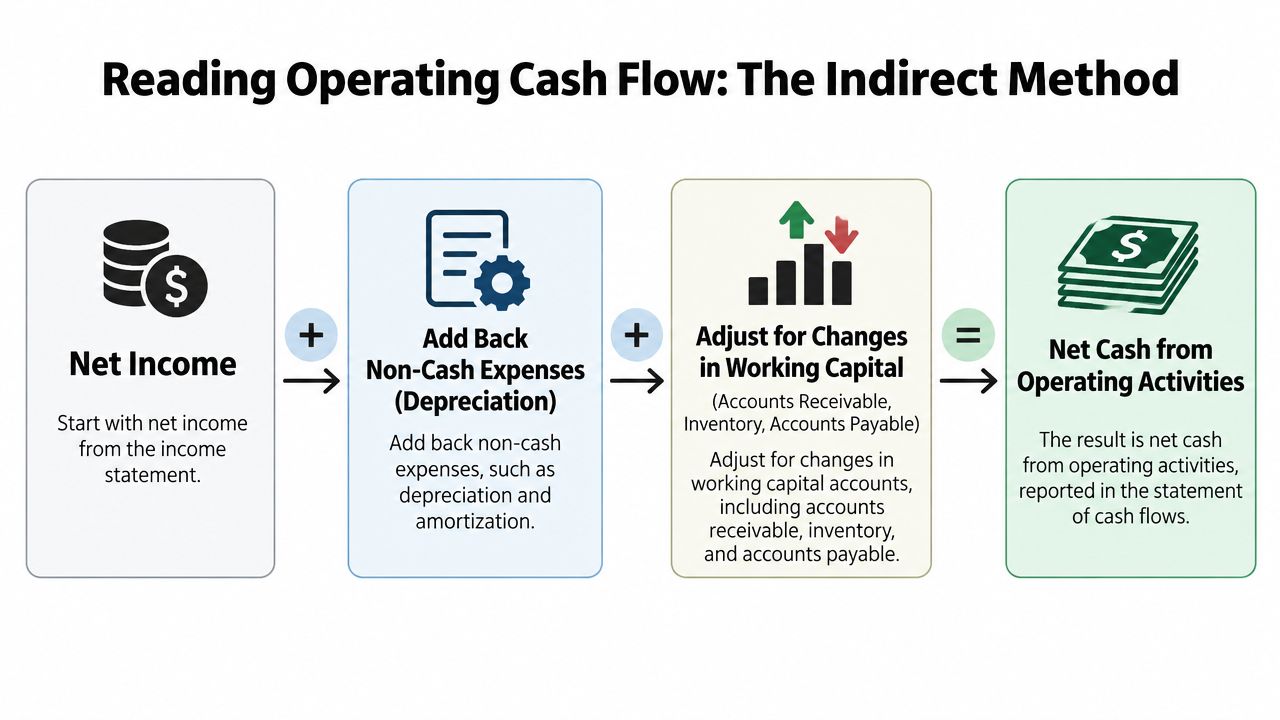
Start with net income, then remove accounting noise
The reconciliation isn't busywork. It explains why reported profit does or doesn't become cash.
- Add back depreciation and amortization. These expenses reduce accounting profit but don't represent a current-period cash payment.
- Remove non-operating gains. A gain on an asset sale can increase net income, but the cash proceeds belong in investing activities.
- Review accounts receivable. An increase usually means the business recognized revenue that customers haven't paid yet. That growth consumes operating cash.
- Review inventory. More inventory generally means cash has moved into goods that haven't yet produced a collection.
- Review accounts payable and accruals. An increase can preserve cash because the business hasn't paid all recorded obligations. That benefit may reverse when vendors and employees are paid.
- Review prepaids. Paying insurance, software, or other costs before the related period uses cash before the expense fully appears in profit.
A rising receivable balance isn't automatically bad. A growing business may invoice more as sales expand. The question is whether collections follow the invoices and whether the aging schedule supports management's explanation. A higher payable balance may also be ordinary timing, or it may mean vendors are being asked to wait.
For a visual walkthrough, the indirect method loan preparation guide offers another way to follow the reconciliation. Owners should also compare the cash report with how to read an income statement because the gap between the two reports often contains the most useful information.
Watch the practical explanation below, then trace every unusual line back to the balance sheet and the underlying transaction.
A clean indirect statement is only as reliable as the books behind it. Misapplied customer deposits, unreconciled bank accounts, duplicate bills, and owner transactions posted to expenses can make the reconciliation look mysterious when the problem is bookkeeping.
Spotting Strength Weakness and Red Flags in Every Section
The statement becomes useful when you stop treating every cash inflow as equally good. Operating cash generated by repeat customer activity is different from cash raised through a loan, and both differ from proceeds received after selling equipment.
Start with the operating cash flow ratio
The operating cash flow ratio is operating cash flow divided by current liabilities. It tests whether current operations generated enough cash to cover obligations coming due in the near term.
- A ratio below 1.0 is a short-term liquidity warning sign.
- A ratio above 1.0 indicates that operations generated enough cash to cover near-term obligations without relying on borrowing or asset sales.
The ratio isn't a verdict. A seasonal company may close a period just before a major collection cycle. A healthcare practice may be waiting on insurance payments. A construction firm may have a legitimate billing milestone that shifts cash into another close. Trend the ratio across monthly or quarterly closes and investigate the operating details behind the movement. Variance analysis and reporting can help connect the change to receivables, inventory, payables, payroll, and other account activity.
Read investing and financing as context
Investing outflows often show reinvestment. Equipment, vehicles, technology, and property can support future revenue, but the business still needs a plan for funding those purchases. Investing inflows may represent a sensible disposal, or they may indicate liquidation of assets that operations can't replace.
Financing activity answers a separate question: who supplied the cash? Debt and equity can fund growth, while distributions and repayments reduce available liquidity. Frequent financing inflows that compensate for weak operating cash deserve attention, especially if management describes the business as profitable.
| Section | Constructive pattern | Pattern that needs investigation |
|---|---|---|
| Operating | Cash from core activity remains durable | Cash depends on delayed collections or unpaid obligations |
| Investing | Spending supports capacity or productivity | Asset sales repeatedly fund ordinary bills |
| Financing | Funding matches a documented growth plan | Borrowing masks weak operations or distributions strain reserves |
ICAEW identifies classification of subsidiary acquisitions and disposals, including related cash and cash-equivalent adjustments, as a recurring cash flow statement error. That matters because moving an item into the wrong section can distort the story lenders and owners are using to evaluate the company.
Positive cash can still be a warning
This is the quality-of-earnings trap. Operating cash flow can be positive because receivables fell, inventory was reduced, or payables increased. Those movements may release cash temporarily without demonstrating repeatable demand.
Ask two questions:
- Did customers pay faster, or did the company collect old invoices while new sales weakened?
- Did suppliers receive payment on normal terms, or did the company delay obligations?
A business that cuts inventory can create cash while reducing its ability to fulfill orders. A business that stretches payables can protect the bank account today and create a vendor problem tomorrow. One strong period can be helpful, but it doesn't replace a trend review.
Real World Examples for Small Businesses and What 2026 Changes Mean
A cash flow statement needs industry context. The same line can signal ordinary timing in one business and serious weakness in another.

Healthcare practices
A clinic may show earned patient or insurance revenue while accounts receivable grows. The operating section then looks weaker than the income statement because claims and reimbursements haven't converted to cash. Review the receivables aging, payer mix, claim workflow, payroll calendar, and expected collection dates before blaming the practice's profitability.
Healthcare accounting also requires careful separation of patient receipts, refunds, payroll, taxes, and owner activity. A clean chart of accounts makes the cash flow statement more useful than a report assembled after the bank balance becomes uncomfortable.
Construction and trades
A construction company can have profitable jobs and still face cash pressure when payroll and materials arrive before progress payments. Job-costing should connect project activity with billing, retainage, vendor commitments, and payroll timing. An increase in receivables may reflect work completed but not collected, while an increase in payables may reflect vendors waiting for payment.
The statement should be read alongside job-level reporting. A company can't make a sound borrowing or hiring decision from total cash alone if one project is consuming cash and another is producing it.
Nonprofits
A nonprofit needs to distinguish available operating cash from restricted funds and project-specific obligations. Positive cash on the statement may not mean management can use every dollar for payroll or general administration. Audit preparation, grant reporting, donor restrictions, and board reporting all depend on records that identify the purpose attached to cash.
2026 compliance and classification changes
For payments made after December 31, 2025, the threshold for certain Form 1099 information reporting increases from $600 to $2,000, so the higher threshold applies to tax year 2026, as explained in this 2026 tax compliance update. That doesn't mean businesses can stop tracking vendor payments below the threshold. Your bookkeeping system still needs accurate payee records, payment classifications, and year-end review procedures.
Classification also affects comparisons across reporting frameworks. IAS 7 permits direct and indirect operating cash flow presentation, and evolving IFRS guidance means interest and dividend cash flows may be classified based on a company's specified main business activities under IFRS 18 changes. ACCA's discussion of cash flow reporting reform highlights why users need to understand classification before comparing companies.
For U.S. small businesses using QuickBooks, practical preparation means reconciling bank and credit accounts, mapping loan principal separately from interest, tracking vendors consistently, and reviewing 1099 settings before year-end. Clean books help lenders, auditors, CPAs, and owners work from the same facts.
Your Next Steps to Stay Compliant and Get Expert Guidance
Run this review on a consistent close schedule:
- Start with operating cash flow and compare it with net income.
- Trace receivables, inventory, payables, prepaids, and accrual movements.
- Review investing purchases and sales for business purpose.
- Identify whether financing is supporting growth or covering operating weakness.
- Calculate the operating cash flow ratio and trend it across closes.
- Confirm the ending cash balance reconciles to the balance sheet and bank records.
- Check vendor tracking and information-reporting workflows for 2026 tax compliance.
DIY review can work when reconciliations are current, transactions are classified correctly, and the business has stable working-capital patterns. Bring in a CPA or fractional CFO when the operating cash flow ratio remains below 1.0, financing inflows repeatedly rescue operations, cash movements don't reconcile, or tax, audit, payroll, and lending deadlines are approaching.
Every company benefits from someone who can translate financial reports into decisions. A fractional CFO can help with cash flow forecasting, lender preparation, budgeting, pricing, working capital, and growth planning without the cost of a full-time executive. A CPA and experienced bookkeeping team can also keep required filings, payroll records, vendor reporting, audits, and QuickBooks data in order, areas where many small-business owners haven't been taught what compliance requires.
Bookkeeping and Accounting of Florida Inc. provides bookkeeping, accounting, payroll, tax preparation, audit support, healthcare accounting, forensic audits, QuickBooks ProAdvisor services, and fractional CFO guidance for companies in Jacksonville and Northeast Florida. The firm has supported businesses for more than 20 years, with services designed around accurate financials, compliance, cash-flow management, and practical decision-making.
Bookkeeping and Accounting of Florida Inc. can clean up and maintain your QuickBooks records, prepare reliable cash flow reporting, and help you interpret the red flags before they become a cash crisis. Visit Bookkeeping and Accounting of Florida Inc. to discuss bookkeeping, CPA compliance support, or fractional CFO guidance for your Jacksonville or Northeast Florida business.