
Your board meeting is next week. Someone asks a simple question: “Do we need an audit this year?” The treasurer says probably not. The grant manager says maybe. Your outside bookkeeper says it depends. That confusion is normal, but it's also dangerous.
Thank you for reading this post, don't forget to subscribe!Most nonprofits don't get in trouble because they intended to ignore the rules. They get in trouble because they guessed. They tracked revenue, not funding source. They watched Form 990 deadlines, not state charity thresholds. They assumed last year's answer still applied after tax law changes, grant changes, and new compliance rules.
Small organizations are especially exposed. Most small businesses and nonprofits don't know what all is required. That's why expert accounting, nonprofit bookkeeping, audit preparation, and fractional CFO oversight matter. If you want to stay compliant, protect funding, and avoid expensive cleanup, you need a real system and someone who knows how to guide the business.
Decoding Nonprofit Audit Requirements
A common nonprofit story starts with a shoebox, a spreadsheet, and confidence that “we're too small to need an audit.” Then the board reviews a grant agreement, the bylaws, and a state filing requirement. Suddenly the answer changes.
That's the first thing boards need to understand about nonprofit audit requirements. There isn't one trigger. There are several, and they don't all measure the same thing. One rule may focus on federal awards expended. Another may focus on contributions. Another may come straight from your own governing documents, lender covenant, or funder contract.
The three triggers that matter
An audit requirement usually comes from one of these places:
- Federal funding rules: If your organization spends enough federal awards in a fiscal year, federal audit rules can apply.
- State law: Many states tie audit or review requirements to charitable solicitation, revenue, or contribution thresholds.
- Internal or contractual requirements: Your board may require an annual audit. A foundation, bank, or government pass-through entity may require one too.
That's why lazy accounting causes compliance mistakes. The shoebox method doesn't separate restricted funds well. It doesn't track grant spending cleanly. It doesn't tell the board which threshold applies.
Audit, review, and compilation aren't the same
Boards often use these terms interchangeably. They shouldn't.
- Audit: An independent CPA examines the financial statements and performs a deeper level of testing.
- Review: A CPA provides a lower level of assurance, usually with less testing.
- Compilation: Financial statements are assembled from management information without the assurance level of an audit or review.
Practical rule: If your team can't explain which service your bylaws, grant agreement, or state filing actually requires, you're not ready for year-end.
Good nonprofit accounting starts long before an auditor arrives. Your chart of accounts, grant tracking, restricted fund reporting, board packet, and month-end close process all affect whether you stay compliant. If your finance function still runs on catch-up work, fix that first with stronger accounting for nonprofits support.
Federal Single Audit and Uniform Guidance Updates
Your board approves a federal grant budget in January. By summer, spending accelerates across programs, payroll allocations are messy, and nobody can answer one basic question: are you approaching the Single Audit line based on federal awards expended, or are you still looking at cash received? That confusion is how nonprofits miss federal compliance requirements.
The federal rule changed. The Office of Management and Budget increased the Single Audit threshold from $750,000 to $1,000,000 in federal awards expended for fiscal years beginning on or after October 1, 2024, as summarized in this Single Audit threshold update.
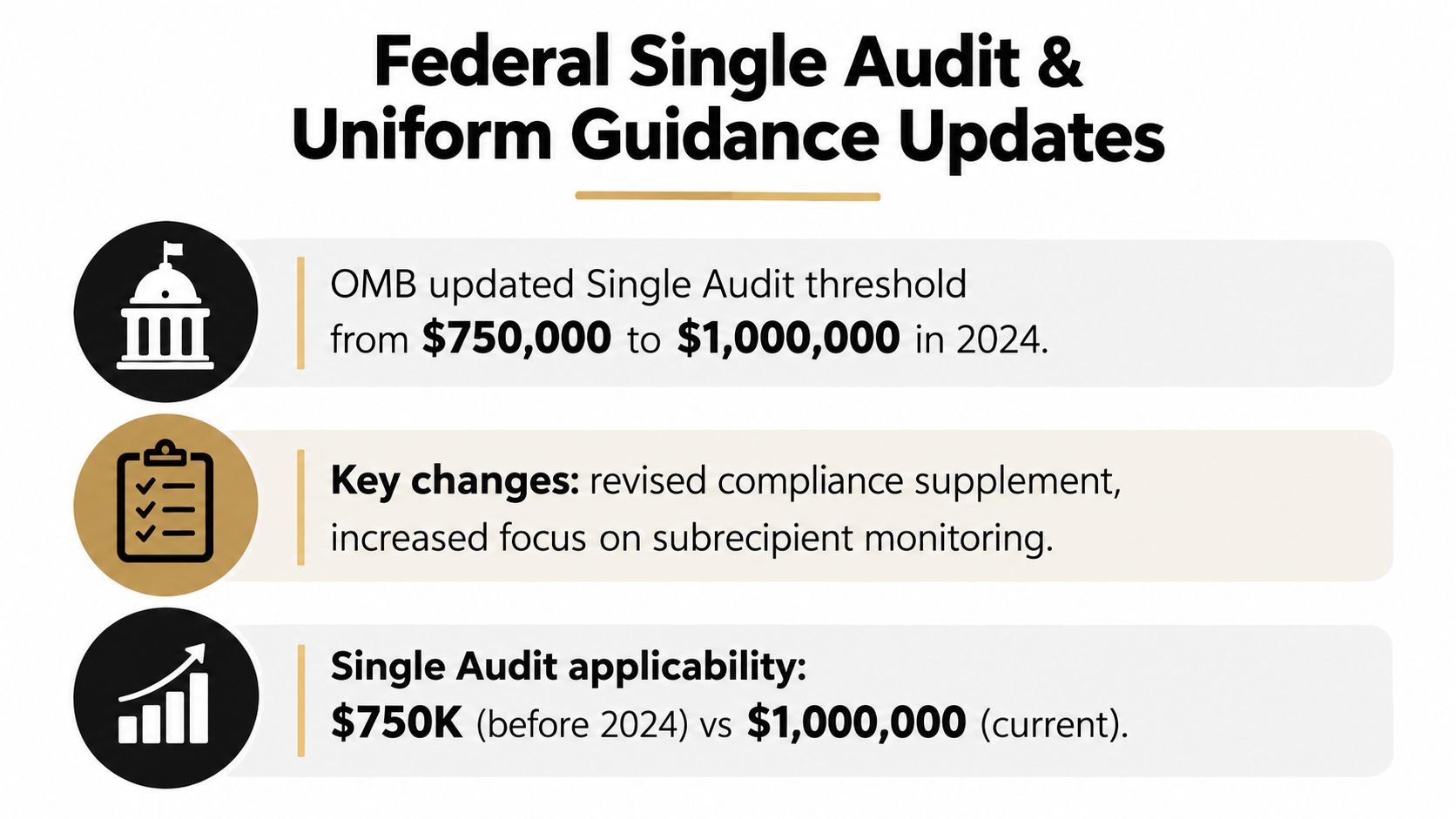
That higher threshold gives some organizations breathing room. It also creates a new board-level risk. Teams assume they are exempt because total revenue is under control, while federal expenditures cross the audit trigger.
The legal test is federal awards expended, not total organizational revenue, and not grant cash collected. Under 2 CFR 200.501, a nonprofit that expends $1,000,000 or more in federal awards during the fiscal year must have a Single Audit, or in limited circumstances, a program-specific audit, as explained by the Council of Nonprofits federal audit guide.
That distinction matters more in 2026 than many boards realize. A nonprofit can sit below the new federal threshold and still face a separate Florida review or audit requirement based on a different metric. Federal compliance and state compliance are now a threshold-mapping exercise. If nobody on the finance side is reconciling those rules during the year, your board is guessing.
Here is the practical standard I recommend. By the end of the first quarter, management should be able to show the board or audit committee a clean schedule of federal awards by grant, pass-through entity, assistance listing number, expenditures to date, and projected year-end total. If that report does not exist, fix the reporting process before year-end.
A fractional CFO usually catches this problem early because the job is not just closing the books. The job is translating grant activity into compliance decisions before the deadline passes.
Focus on four controls now:
- Track federal expenditures monthly. Do not rely on grant award letters or drawdown activity.
- Code pass-through awards correctly in the general ledger. Misclassified grants distort the threshold analysis.
- Review subrecipient and vendor treatment early. That decision affects testing, documentation, and audit scope.
- Set a formal threshold review date with the board. Do it before the fiscal year is too far gone to correct weak records.
Boards should not be asking after year-end whether a Single Audit was required. They should see the answer coming months in advance.
Navigating Florida State Audit Obligations
Your board approves the budget in June, closes the year in September, and learns in March that Florida required an audit you did not plan for. That failure usually starts with one mistake. Management tracks revenue totals and misses the legal trigger Florida uses.
Florida compliance gets messy fast because the state does not use one standard. Charitable solicitation rules focus on annual contributions. State funding rules focus on state financial assistance expended. Federal thresholds do not answer either question.
Florida charitable contribution rules
If your nonprofit solicits contributions in Florida, start with Florida Statute 496.407. The statute requires an independent CPA audit when annual contributions reach $1 million or more. If annual contributions are at least $500,000 but less than $1 million, the organization must obtain an independent CPA review or audit.
The key word is contributions. Boards get this wrong all the time. The test is not total revenue, total assets, or operating budget. If grant income, program service revenue, special event revenue, and donated support are being lumped together without a clean contributions schedule, your threshold analysis is unreliable.
Florida state financial assistance rules
Florida also imposes a separate audit requirement for state funding. Under Florida Statute 215.97, a nonstate entity that expends $750,000 or more in state financial assistance during the fiscal year must have a state single audit or a project-specific audit. The same statute sets the filing deadline. Submit the audit report to the Auditor General and applicable state awarding agencies within 45 days after delivery to the governing body, and no later than nine months after fiscal year-end.
That deadline is tighter than many boards expect.
Florida Nonprofit Compliance Thresholds
| Funding Type | Dollar Threshold | Required Action |
|---|---|---|
| Annual charitable contributions | $1 million or more | Independent CPA audit |
| Annual charitable contributions | At least $500,000 but less than $1 million | Independent CPA review or audit |
| State financial assistance expended | $750,000 or more | State single audit or project-specific audit |
Here is my recommendation. Do not wait for year-end to decide which Florida rule applies. Assign that responsibility during the year to a finance lead who can separate contributions from other revenue, track state assistance by program, and flag threshold risk before the board approves timelines and fees. In many nonprofits, that person is a fractional CFO.
Multi-state organizations need one more layer of discipline. Florida may require an audit based on contributions while another state applies a different trigger entirely. Use a current state-by-state nonprofit audit requirements reference and map each threshold to the correct entity, registration, and funding source. Generic national guidance is not enough in 2026.
Internal Controls and Board-Requested Reviews
A nonprofit can sit below every mandatory threshold and still need outside financial oversight. In my view, that's not overkill. It's good governance.
Boards ask for reviews because weak books create bad decisions. Funders ask for them because restricted funds need discipline. Lenders ask for them because cash flow stories without reliable reporting aren't credible.
Why voluntary oversight pays off
When a board orders a review or agreed-upon procedures engagement, it's buying clarity. It wants to know whether month-end reports are reliable, whether restricted funds are tracked consistently, and whether finance policies are being followed.
A clean review process also exposes operational problems early. Common examples include stale bank reconciliations, undocumented journal entries, payroll coding issues, missing board approvals, and grant expenses posted to the wrong class or fund.
Strong internal controls don't exist to impress auditors. They exist so the executive director, finance committee, and board can trust the numbers before they make decisions.
Controls that actually matter
Nonprofits don't need fancy language. They need habits.
- Segregation of duties: Separate authorization, custody, and recording whenever staffing allows.
- Timely reconciliations: Reconcile bank, credit card, payroll, and key balance sheet accounts every month.
- Grant tracking: Maintain support for restricted revenue, releases, and allowable program costs.
- Board documentation: Keep minutes, approvals, and finance committee records organized and accessible.
- Access control: Limit who can post entries, approve payments, and change vendor data.
Reviews reduce audit pain later
Organizations that wait until a mandatory audit threshold hits usually pay more in time, stress, and cleanup. The trial balance needs repair. Supporting schedules don't tie out. Deferred revenue, prepaid expenses, and net asset classifications need rework. Then leadership wonders why the audit is dragging.
A board-requested review is often the smarter move. It creates discipline before the stakes get higher. It also helps staff build a repeatable close process, which matters when tax law changes, grant conditions, and reporting obligations keep shifting.
If your organization is growing, don't use “we're under the threshold” as an excuse for weak accounting. That mindset creates preventable compliance problems.
The Strategic Value of a Fractional CFO
Every growing nonprofit needs financial leadership, even if it can't justify a full-time CFO. That's why I'm direct about this point. All companies need a fractional CFO and someone to guide their business, especially when funding rules, tax law changes, board expectations, and audit preparation all collide.
A controller or bookkeeper can keep records moving. A fractional CFO interprets what those records mean, what risks are building, and what the board should do next.

What a fractional CFO actually fixes
The value isn't just producing reports. It's judgment.
A strong fractional CFO should help your nonprofit:
- evaluate whether funding sources are creating audit exposure
- build cash flow forecasting around grant reimbursement timing
- tighten internal controls before an auditor finds the weaknesses
- coordinate the board, outside CPA, and operations team
- prepare for multi-state compliance when fundraising expands
- translate tax law changes and reporting changes into action items
This is also where legal and financial oversight need to work together. If your board is revising governance documents, grant terms, or compliance processes, outside legal support such as affordable fractional GC for founders can complement finance leadership and keep responsibilities clearly assigned.
Why small organizations need this more, not less
Smaller nonprofits often assume executive finance support is a luxury. It isn't. They have fewer staff, thinner controls, and less room for mistakes. One misread grant term or missed filing can consume months of management attention.
That's why outsourced support works well. A service like fractional CFO for nonprofits gives boards ongoing financial guidance without adding full-time overhead. Bookkeeping and Accounting of Florida Inc. is one example of a firm that provides that structure alongside bookkeeping, audit preparation, tax support, and reporting support for nonprofits.
If your executive director is the only person connecting grants, cash flow, compliance, and board reporting, the organization is carrying too much key-person risk.
Your Audit Readiness Checklist and Timeline
Audits usually break down for one reason. The support isn't organized. The numbers may be mostly right, but the documentation trail is incomplete, scattered, or sitting in someone's inbox.
That's preventable if you build an audit timeline before year-end. Use a real prepared-by-client process, assign owners, and force deadlines.
Start early and assign responsibility
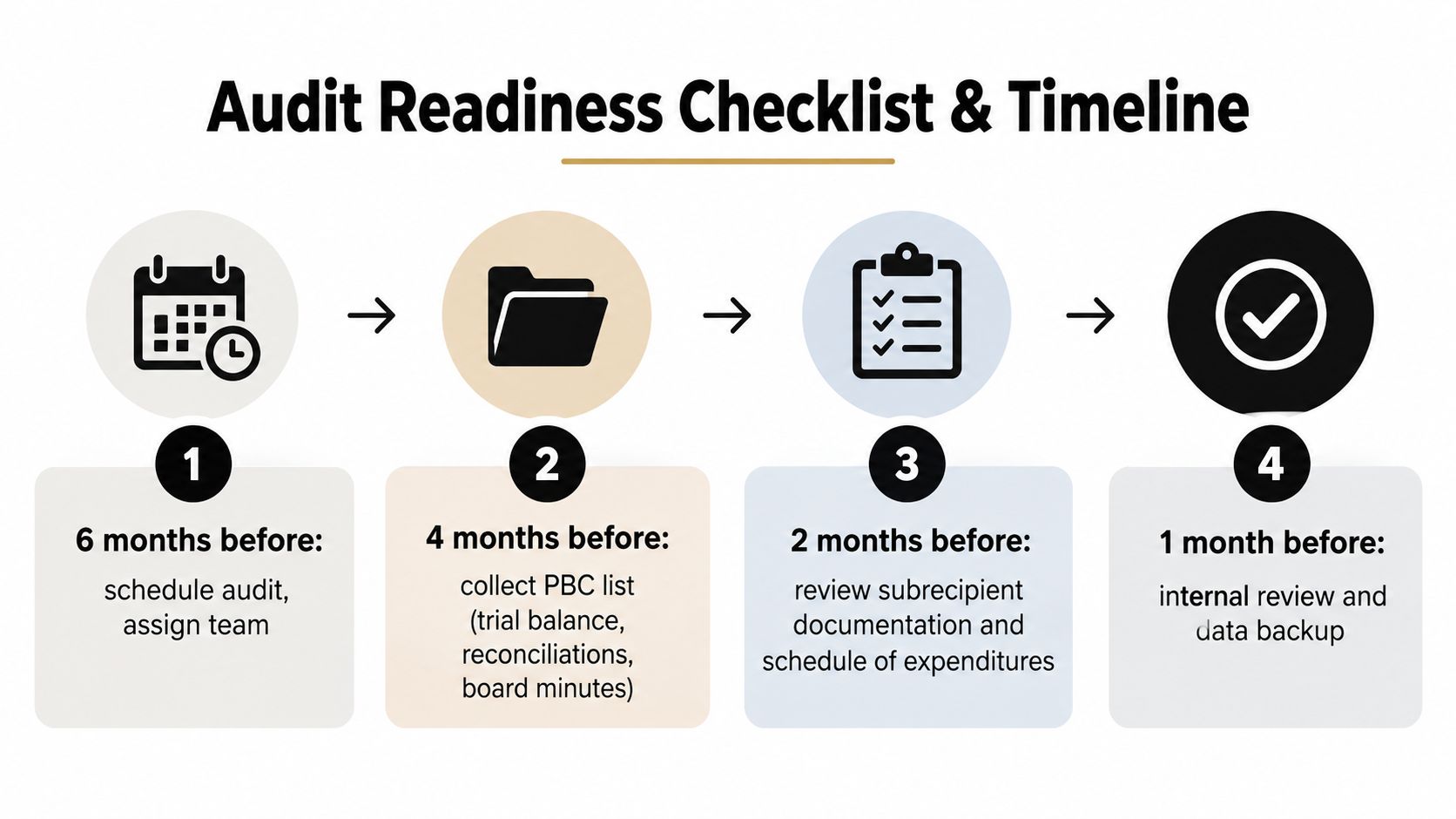
An audit calendar works best when one person owns the master list and every department knows what it owes. Finance can't carry the whole process if development holds donor records, HR controls payroll files, and program managers keep grant support offline.
A useful audit timeline also gives the board visibility. Audit readiness shouldn't become a surprise project two weeks before fieldwork.
A practical readiness checklist
Use this checklist as an operating discipline, not a once-a-year scramble:
- Six months out: Confirm whether an audit, review, Single Audit, or state-specific engagement is required. Engage the CPA firm early and set a document timeline.
- At month-end, every month: Reconcile all bank and credit card accounts. Review receivables, payables, payroll liabilities, and restricted fund balances.
- Before year-end close: Gather grant agreements, amendments, board minutes, debt agreements, lease schedules, and major vendor contracts.
- Immediately after year-end: Lock down the trial balance, post final routine entries, and prepare supporting schedules for cash, receivables, fixed assets, payables, revenue, expenses, and net assets.
- Before fieldwork: Review user access, approval workflows, and unusual journal entries. Resolve obvious questions before the auditors ask them.
- During fieldwork: Route all requests through one internal owner so the response process stays controlled.
Board advice: Ask management for the audit request list before the auditors arrive, not after delays start.
This walkthrough is also worth sharing with your team:
The documents auditors expect
Your auditors will usually ask for a disciplined package of records, including:
- Financial support: Trial balance, general ledger, reconciliations, debt schedules, fixed asset detail, and revenue schedules.
- Governance records: Board minutes, bylaws, conflict policies, and major approvals.
- Grant support: Award letters, grant agreements, reporting submitted to funders, and restrictions by program or purpose.
- Payroll and HR records: Payroll summaries, tax filings, benefit support, and compensation approvals.
- Technology and backup discipline: Organized digital files, document naming standards, and a secure backup of the accounting file.
QuickBooks users should pay close attention to class tracking, grant coding, donor restrictions, and year-end closing entries. If those basics are messy, audit prep becomes detective work. Clean books reduce year-end costs, speed up fieldwork, and lower the chance that management spends the audit answering avoidable follow-up questions.
Securing Expert Accounting and Compliance Support
Nonprofit compliance is too technical for guesswork and too important for part-time cleanup. Between federal audit rules, Florida filing requirements, board governance, grant restrictions, and tax law changes, you need more than someone who can reconcile a bank account.
You need accounting leadership that can read the rules, apply them to your facts, and keep the organization compliant all year. That means current bookkeeping, accurate financial statements, disciplined month-end close, solid internal controls, audit preparation, and board-ready reporting. It also means knowing when a review is enough, when a full audit is required, and when a state-specific rule changes the answer.
What smart boards do differently
Smart boards don't wait for the annual panic.
They ask harder questions earlier:
- What threshold applies to this entity?
- Which funding source creates the compliance obligation?
- Are we tracking expenditures or just receipts?
- Do our bylaws or grant terms require more than the law does?
- Who owns audit readiness inside management?
That's where business accounting support matters. Not just for nonprofits, either. Most small businesses don't know what all is required, and the same is true for many nonprofit leaders. Strong CPA support and fractional CFO oversight keep organizations from learning compliance lessons the expensive way.
If your books are behind, your board reports are inconsistent, or your team is still debating what kind of engagement you need, stop improvising. The cost of expert guidance is usually far lower than the cost of a missed requirement, delayed filing, grant issue, or preventable audit problem.
Bookkeeping and Accounting of Florida Inc. helps nonprofits and small businesses with bookkeeping, accounting, audit preparation, tax support, reviews, internal controls, and fractional CFO guidance that keeps compliance from turning into a year-end crisis. If your board needs clear answers on nonprofit audit requirements or Florida-specific filing obligations, visit Bookkeeping and Accounting of Florida Inc. and start building a cleaner, audit-ready finance function.