
A general ledger is the master record for every financial transaction in a business, organized by a chart of accounts and built on double-entry bookkeeping, where every transaction records equal debits and credits. It's the backbone of your financial statements, and the modern system traces back to 1494, when Luca Pacioli published the double-entry method that still shapes accounting today.
Thank you for reading this post, don't forget to subscribe!If you're a business owner in Jacksonville, there's a decent chance you've had this moment: tax season shows up, payroll reports don't quite match, a contractor payment is sitting in the wrong bucket, and QuickBooks is giving you that polite little stare that says, “I recorded what you told me to record.”
That's where the general ledger matters more than most owners realize.
Messy books usually don't start with a dramatic mistake. They start small. A bank transaction gets miscategorized. Payroll liabilities don't get cleared correctly. A reimbursement lands in meals instead of contractor expense. Then year-end arrives, and now your profit and loss, balance sheet, tax return, and compliance filings are all trying to tell slightly different stories.
Introduction Why Your General Ledger Matters More Than You Think
It is Tuesday afternoon, payroll is due, a grant report is waiting, and your bookkeeper finds vendor costs posted to three different accounts. That is how a normal week turns into a tax problem, an audit headache, or a bad decision based on numbers that do not match.
Your general ledger is the business's single source of truth. It is the central record that every financial report depends on. If the ledger is clean, your profit and loss, balance sheet, tax return, and compliance filings can line up. If the ledger is messy, each report starts drifting from the others, and nobody enjoys where that movie ends.
A good way to picture it is a master blueprint. If the blueprint is accurate, the crew can build safely. If the blueprint has walls in the wrong place, every trade downstream pays for it. Your general ledger works the same way. Clean design at the ledger level helps prevent compliance failures, tax surprises, and the kind of blind spots that leave a fractional CFO staring at a dashboard and asking, "Are these numbers comparable month to month?"
That matters in real businesses, not just accounting offices.
A healthcare practice may need clean separation of provider revenue, payroll liabilities, and insurance-related activity. A construction company needs job costs and subcontractor payments classified correctly or estimates and margins get distorted. A nonprofit has to keep expenses and restricted funds organized well enough to support board reporting, grant tracking, and audit questions. Different industries, same problem. If the ledger is not structured well, the reports built from it will not hold up.
The modern general ledger grew out of the double-entry system formalized by Luca Pacioli in 1494, a framework still used in accounting systems today (Britannica's overview of double-entry bookkeeping and Pacioli).
Owners usually do not get in trouble because they ignored the books. They get in trouble because small posting errors pile up. Payroll liabilities stay uncleared. Card charges hit the wrong expense bucket. A reimbursement lands where it does not belong. Months later, the financial statements look polished, but the foundation underneath is crooked.
Here is why that matters day to day:
- Financial reporting: Your statements are only as reliable as the ledger entries behind them.
- Tax preparation: Account coding drives how income and expenses flow into the return.
- Compliance: Payroll filings, vendor reporting, grant support, and audit trails all trace back to ledger detail.
- Decision-making: Pricing, hiring, cash planning, and forecasting depend on numbers you can trust.
You do not need to speak fluent accountant. You do need to know why the general ledger sits at the center of accurate reporting, clean compliance, and better decisions.
What Is General Ledger in Simple Terms
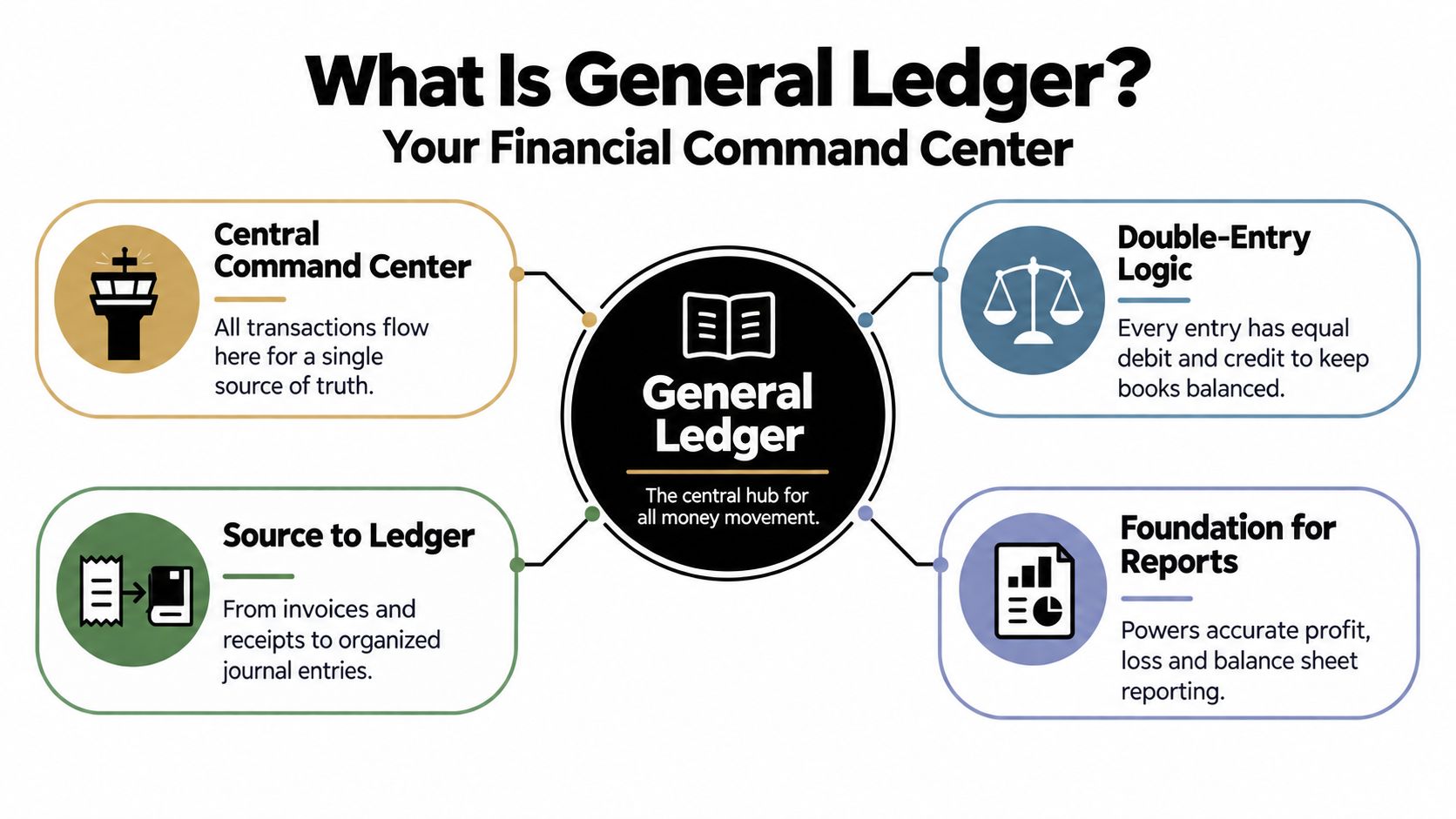
Think of the general ledger like the main control room for your business finances. Every sale, bill, payment, payroll run, and adjustment eventually flows there. If your accounting system were an airport, the general ledger would be the tower.
The plain-English definition
A general ledger is the master record of your business's financial transactions. It organizes activity by account, using your chart of accounts, and it's used to produce financial statements. In double-entry accounting, every transaction must be recorded with equal debits and credits, which helps preserve the accounting equation and reveal posting problems if the trial balance doesn't tie (Xero's explanation of the general ledger and trial balance role).
Core idea: The general ledger is where your accounting system turns scattered activity into organized financial truth.
That's the phrase I want you to hold onto: organized financial truth.
If you buy office supplies with a company card, the ledger doesn't just remember that money left the bank. It also records what that spending was for. If a customer pays an invoice, the ledger doesn't just show cash came in. It shows that revenue was earned or that a receivable was cleared.
Why debits and credits aren't just accountant trivia
People's eyes sometimes glaze over, so let's keep it simple.
Double-entry bookkeeping means every transaction has two sides. Money doesn't just “go somewhere.” It moves from one account effect to another.
A simple example:
| Transaction | Debit | Credit |
|---|---|---|
| Customer pays an invoice | Cash | Accounts Receivable |
| You pay monthly rent | Rent Expense | Cash |
You don't need to memorize every debit and credit rule to understand the point. The system forces balance. That balance is what keeps your books from wandering off into fantasyland.
General ledger versus journal versus subledger
These terms get mashed together a lot.
- Journal: The first record of a transaction
- General ledger: The master file where transactions are grouped by account
- Subledger: Detail records that support one area, like accounts receivable or accounts payable
What is general ledger? Here it is: journals capture activity first, subledgers hold detail when needed, and the general ledger pulls everything into one reliable record for reporting.
That's why it's the authoritative source. If the ledger is wrong, your reports are wrong. If it's right, your reports mean something.
Inside the General Ledger Key Accounts and Structure
Open a general ledger for any business and you are really opening its master filing cabinet. If the drawers are labeled well, you can find what you need for taxes, audits, lender questions, and monthly decisions without a scavenger hunt. If the labels are sloppy, the same numbers can create tax surprises, compliance headaches, and blind spots for whoever is trying to steer the business.
The five account categories most owners should know
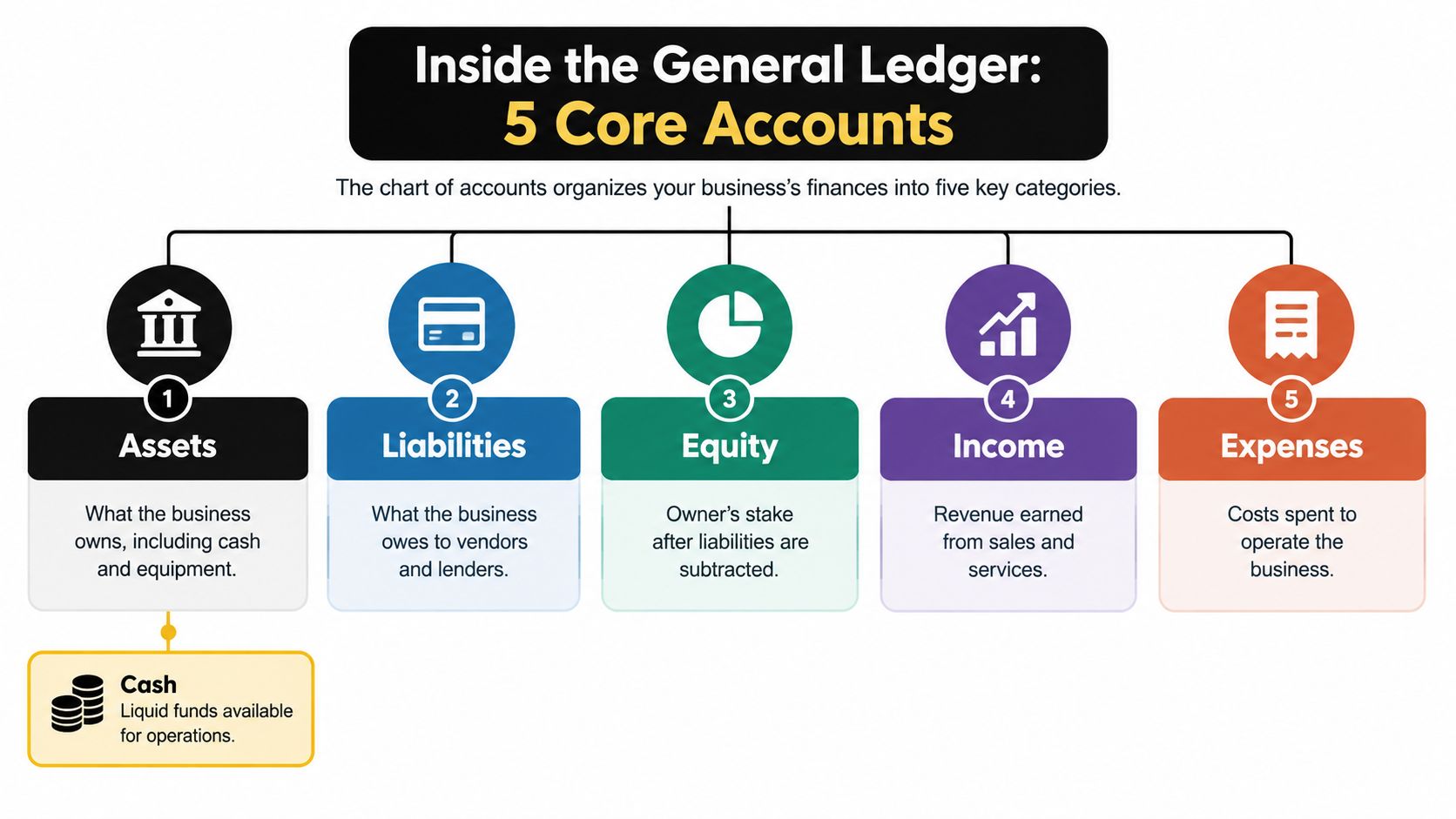
At the center of the ledger are five main buckets. Everything gets sorted into one of them.
- Assets: What the business owns or can collect, like cash, equipment, inventory, and accounts receivable
- Liabilities: What the business owes, like loans, payroll taxes, sales tax, and vendor bills
- Equity: The owner's stake, retained earnings, or fund balance depending on the organization
- Income: Money earned from services, programs, projects, or product sales
- Expenses: The costs of running the business, from wages to rent to software
Cash deserves extra attention, but it is still an asset, not its own sixth category. That detail sounds small until someone builds reports around the wrong structure and starts asking why the numbers feel off.
A good way to picture this is a kitchen pantry. Flour, coffee, pasta, and dog treats may all live in the same room, but you still want them on the right shelves. The ledger works the same way. The categories are the shelves, and each account is a labeled container.
Why structure determines whether reports are usable for tax and audit review
A chart of accounts is not just bookkeeping housekeeping. It decides whether your profit and loss, balance sheet, and supporting schedules tell a clear story.
If payroll tax expense is mixed into general wages, cleanup takes longer at tax time. If restricted grant revenue sits in the same bucket as donation income, a nonprofit can struggle to prove how funds were used. If a construction company dumps every job cost into one broad expense account, project profitability becomes a guess. If a medical practice blends provider compensation, lab costs, and merchant fees together, a fractional CFO has less to work with and weaker visibility into margins.
That is why clean design matters so much. A thoughtful chart of accounts setup often fixes reporting problems before anyone changes tax strategy or builds fancy dashboards.
If you want a visual example of how ledgers can be organized, these Allied Tax Advisors ledgers show the kind of structure that makes review easier.
How accounts are usually organized in real life
Most small businesses do better with a chart that is simple, consistent, and specific enough to answer real questions. Too few accounts and everything gets lumped together. Too many accounts and your team starts guessing.
A practical setup often groups accounts by type, then by purpose inside that type. For example:
- Assets might include cash, accounts receivable, prepaid expenses, fixed assets, and accumulated depreciation
- Liabilities might include accounts payable, credit cards, payroll liabilities, sales tax payable, and loans
- Income might separate service revenue, product revenue, construction change orders, patient service revenue, or contribution income
- Expenses might break out payroll, rent, insurance, subcontractors, supplies, professional fees, and software
The exact labels should match how the business runs.
Healthcare groups may need cleaner separation between provider revenue, insurance receivables, and refunds. Construction companies usually need clearer job cost buckets and retainage tracking. Nonprofits often need account structure that supports grants, restrictions, and functional expense reporting. The single source of truth only works if the source is designed for the way the organization earns, spends, and reports money.
Consistency beats cleverness
A fancy numbering system does not save a messy ledger. What helps is using the same account for the same kind of transaction every month, with account names your team can recognize without a decoder ring.
You want reports that survive scrutiny from a CPA, auditor, lender, board member, or outsourced CFO. Clean ledger structure makes that possible. It turns the general ledger from a data dump into a reliable operating tool.
How the General Ledger Powers the Accounting Cycle
The general ledger doesn't work alone. It sits in the middle of a repeating process that starts with a real-world transaction and ends with reports you can trust. This is the accounting cycle in action.
The basic flow from activity to reports
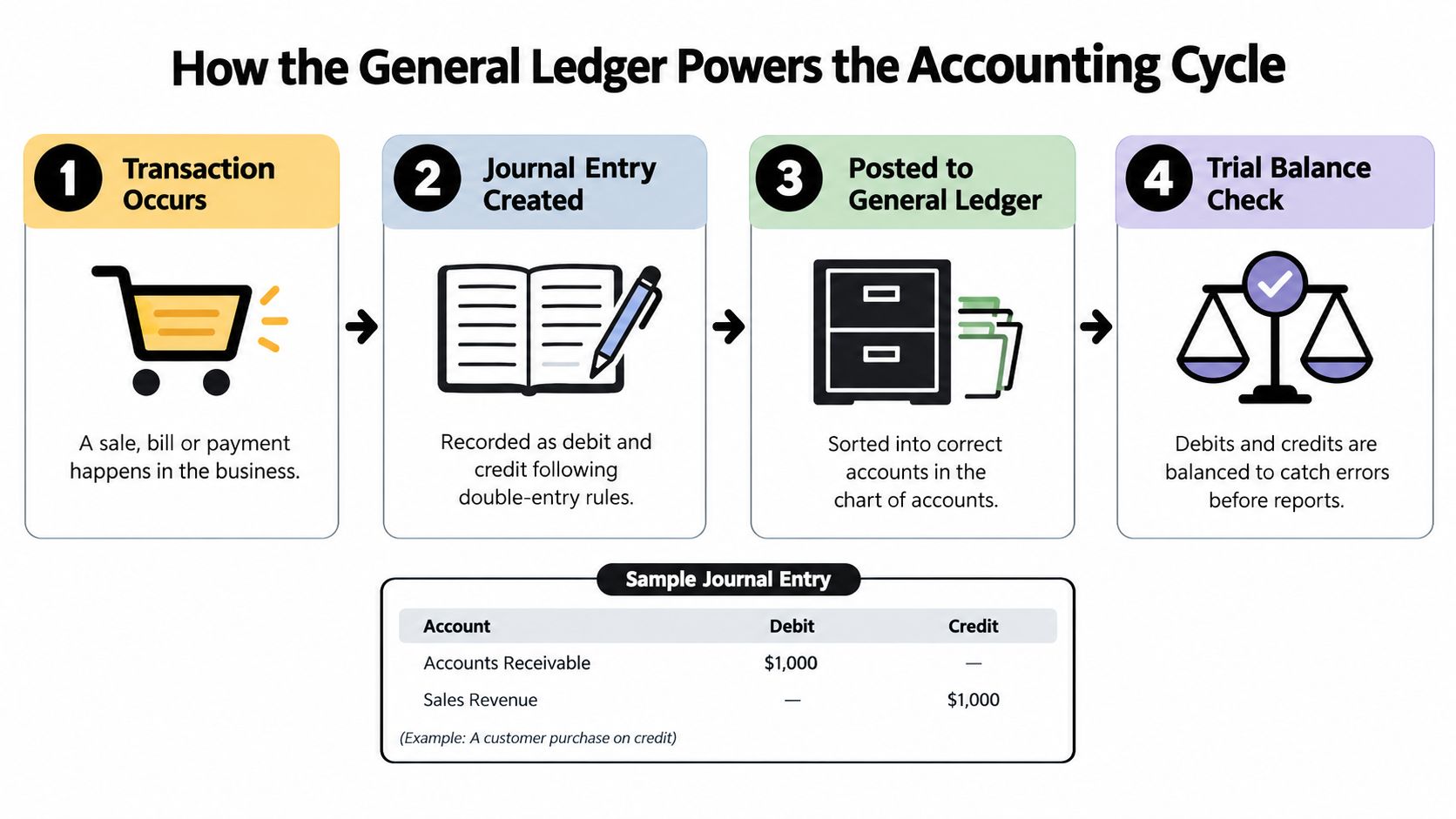
Here's the short version:
- A transaction happens. A customer pays you, you buy supplies, payroll runs, or a bill comes due.
- It gets journaled. The system records the transaction as a debit and a credit.
- It gets posted to the general ledger. The entry lands in the correct accounts.
- The trial balance checks the math. If debits and credits don't line up, something needs attention.
The ledger acts like a control layer, not just a storage bin.
To show the flow visually, this short video does a nice job of simplifying the process for non-accountants:
A simple transaction walkthrough
Let's say your business provides a service and a client pays right away.
The entry might look like this in plain language:
| What happened | Debit | Credit |
|---|---|---|
| Client payment received | Cash | Service Revenue |
Now let's say you pay for internet service:
| What happened | Debit | Credit |
|---|---|---|
| Internet bill paid | Utilities Expense | Cash |
The journal entry records the event. The general ledger groups those effects into the proper accounts over time. At month-end, the trial balance helps confirm that the debit and credit totals still match.
Where errors usually show up
Owners often think mistakes happen only when someone types the wrong number. That's one kind of mistake, but there are others.
For example:
- Posting to the wrong account: Marketing expense hits office supplies
- Missing an entry: A bill exists but never reaches the books
- Duplicate activity: A bank feed imports something already entered manually
- Cutoff confusion: A transaction is posted in the wrong period
If you're dealing with accruals, that last one shows up often. This practical guide on how OneSafe handles accruals is a useful companion for understanding timing-based journal entries.
A disciplined 2026 month-end close process checklist helps catch these issues before they spill into tax filings or board reports.
When the trial balance doesn't tie, the ledger is doing its job. It's telling you to investigate before bad data reaches your financial statements.
That's a good interruption, not an annoyance.
QuickBooks Mini Walkthrough for Small Businesses
Most small businesses don't maintain a general ledger by hand, and thank goodness for that. In QuickBooks, the ledger sits behind the scenes, but it still depends on the choices you make every day.

Step one is getting the chart right
If the chart of accounts is sloppy, QuickBooks will happily produce sloppy reports with great confidence.
That's why setup matters. You want enough detail to understand the business, but not so much that every transaction turns into a guessing game. For owners working through the mechanics, this guide on setting up a chart of accounts in QuickBooks is a solid starting point.
A clean setup usually includes clear revenue accounts, separate payroll-related liability accounts, organized expense categories, and a consistent place for owner activity, loans, sales tax, and contractor payments.
The daily habits that keep the ledger clean
Once the structure is in place, work is routine.
Here's what that looks like in practice:
- Categorize transactions consistently: If software subscriptions go to software expense this month, they shouldn't land in office expense next month.
- Use journal entries carefully: They're useful for accruals, corrections, and payroll adjustments. They're not a substitute for fixing workflow problems.
- Match books to source documents: Bank statements, payroll reports, invoices, loan statements, and merchant reports should support the ledger.
- Review exception patterns: Don't just click “add” on bank feeds and hope for the best.
Reconciliation is where the truth shows up
A lot of introductory articles define the general ledger but skip the hard part. The hard part is reconciliation.
Current guidance frames reconciliation as matching the ledger to source records and highlights four common exception types: timing differences, duplicates, missing transactions, and misclassifications (OneSafe on general ledger reconciliation exceptions).
That list is practical because it mirrors real cleanup work:
- Timing differences happen when the bank clears an item in a different period than your books.
- Duplicates sneak in when imported transactions and manual entries both stay on the ledger.
- Missing transactions create silent gaps.
- Misclassifications give you clean math but wrong reporting.
Reconciliation isn't bookkeeping busywork. It's the moment you find out whether the story in QuickBooks matches what actually happened.
For businesses that need outside support, Bookkeeping and Accounting of Florida Inc. is one option for general ledger bookkeeping, reconciliations, and QuickBooks organization when internal staff needs backup or oversight.
Best Practices and Common Errors That Cost You Money
Some general ledger problems come from neglect. Others come from trying too hard.
One of the most common traps is believing that more detail always creates better control. Sometimes it does. Sometimes it creates a ledger so bloated that nobody can close the books cleanly.
The fat GL problem
There's a useful contrarian idea here. Adding more dimensions and account detail can create what practitioners call fat GL syndrome, where extra complexity increases reconciliation work and extends the close instead of improving visibility. Market coverage points to current trends around cloud accounting, real-time reporting, ERP integration, and automated reconciliation, which suggests cleaner automation and stronger governance often beat a bigger ledger (Research and Markets coverage of general ledger software trends).
In plain English, don't build a monster chart of accounts just because the software lets you.
A restaurant doesn't need separate expense accounts for “forks,” “other forks,” and “fork-adjacent events.” I'm joking a little, but only a little.
What works better than over-detailing
Use judgment. Keep categories meaningful. Let software classes, locations, customers, jobs, or reporting tags carry some of the detail when appropriate, instead of turning every question into a new ledger account.
A practical best-practice checklist:
- Reconcile on a routine schedule: Catch issues while source documents are easy to find.
- Separate tax-sensitive categories: Meals, contractor payments, payroll liabilities, and owner draws deserve clean handling.
- Reduce duplicate pathways: If staff can enter the same activity in multiple places, they eventually will.
- Document unusual entries: Accruals, reclasses, and corrections should have support.
- Review the ledger before year-end: Waiting until tax prep raises cleanup cost and stress.
The expensive errors owners miss
The general ledger often becomes the first place compliance failures could have been caught.
For example, vendor payment data needs to be captured accurately throughout the year, not sorted in a panic after the fact. Guidance for 2026 notes that the federal reporting threshold for Forms 1099-NEC and 1099-MISC rises from $600 to $2,000, while the 1099-K rule reverts to the prior $20,000 and 200-transaction standard. The same guidance notes tighter meal deductibility handling, which means your chart of accounts should clearly separate deductible and nondeductible meal expenses (Vulcan Tax on bookkeeping and compliance requirements).
That's not glamorous accounting. It's useful accounting.
Industry Notes and When to Get Expert Help to Stay Compliant
A general ledger should work like the business's master map. If the map is sloppy, healthcare owners miss reimbursement problems, contractors miss margin leaks, and nonprofits mix restricted and unrestricted money without realizing it until audit time.
The basic ledger rules stay the same across industries. The risk points do not. That is why a clean GL is more than bookkeeping hygiene. It is the single source of truth your tax preparer, auditor, payroll provider, and fractional CFO all rely on.
Healthcare, construction, and nonprofits each need different GL guardrails
Healthcare practices often collect money through several paths at once. Insurance payments, patient payments, refunds, provider payroll, and clearing from billing systems can all hit the books on different days. One practical GL fix is to use a reimbursement clearing account that sits between claims activity and bank deposits. That gives you a place to match what was billed, what was paid, and what is still hanging out in receivables. Without that step, revenue can look right while cash, adjustments, or refunds are off.
Construction companies need a ledger built around jobs, not just expense types. A plain account called “materials expense” tells you almost nothing if you are running five projects at once. A better structure uses job-cost detail and a work-in-progress setup so costs, billings, retainage, and earned revenue can be tracked by contract. That matters even more because IRS guidance for certain residential construction contracts changed under IRC § 460, which can affect how books and tax reporting line up (IRS guidance in the 2026-39 Internal Revenue Bulletin). If your ledger is not organized by project and contract status, your CPA ends up rebuilding the story after the fact.
Nonprofits have a different trap. The bank account may be one pot of cash, but the money often comes with strings attached. A grant for a youth program cannot cover general admin just because the checking account balance looks healthy. The GL should separate net assets and revenue by restriction class or fund so management reports, board reports, and audit schedules all pull from the same structure. That design choice prevents one of the most common nonprofit headaches: spending restricted funds without clear support in the books.
Federal accounting offers a useful reminder about why structure matters. The U.S. Standard General Ledger exists because consistent account design makes reporting and oversight easier across large organizations, and federal agencies are required under 31 U.S.C. § 3512 to use systems that substantially comply with that framework (Budget Counsel on the U.S. Standard General Ledger). Small businesses do not need federal-style accounting. They do benefit from the same principle. Standardized books are easier to review, easier to explain, and much harder to misread.
A few compliance changes only matter if your ledger captures them correctly
Rules change. The ledger has to keep up.
Here is the practical version:
| Change area | What changed | GL or workflow fix |
|---|---|---|
| Contractor reporting | Reporting thresholds for Forms 1099-NEC and 1099-MISC increased, and 1099-K handling changed, as noted in current compliance guidance (Vulcan Tax on bookkeeping and compliance requirements) | Track vendor payments in the right accounts all year, and flag payments that belong on information returns instead of sorting it out in January |
| Payroll taxes | The 2026 Social Security wage base and FICA rules remain a live payroll control point, along with deposit and filing deadlines (Patriot Software on 2026 payroll compliance figures) | Reconcile payroll liability accounts monthly, and make sure wage categories in payroll map cleanly to the GL so tax deposits and returns tie back to the books |
| Payroll filing calendar | Ongoing deposit and filing deadlines still drive compliance risk throughout the year (Xero payroll tax deadline guidance) | Assign one owner for payroll calendar monitoring and review unpaid payroll liabilities in the GL before each filing cycle |
| Construction tax treatment | Certain residential contract rules changed under IRC § 460 (IRS guidance in the 2026-39 Internal Revenue Bulletin) | Review job-cost, WIP, and revenue-recognition accounts so tax treatment and management reporting are using the same underlying ledger logic |
That is where compliance problems usually start. Not with a dramatic mistake. With a ledger that never captured the detail needed to answer a basic question later.
When outside guidance pays for itself
Some businesses can keep a clean ledger with a solid bookkeeper and a monthly review. Others hit a point where the current setup is no longer sufficient.
Get expert help if you have any of these conditions: multiple revenue streams, payroll with changing tax rules, grant restrictions, job costing, insurance reimbursements, or reports that never seem to match from one month to the next. Those are not just bookkeeping annoyances. They are signs that your single source of truth may have blind spots.
A fractional CFO helps turn the ledger into a management tool, not just a tax file. A CPA firm helps confirm that account design, reconciliations, and reporting hold up under tax, audit, and payroll pressure. For healthcare, that may mean cleaning up reimbursement flow. For construction, it often means fixing WIP and contract reporting. For nonprofits, it usually means tightening fund and restriction tracking before audit season gets expensive.
If your books feel messy, your reports do not line up, or you are worried about tax and payroll compliance, Bookkeeping and Accounting of Florida Inc. can help organize your general ledger, reconcile the details, and provide CPA and fractional CFO support that keeps small businesses on track. We work with growing companies that need clean financials, better visibility, and a reliable process for staying compliant before year-end surprises show up.