
Your bank balance looks healthy, but payroll is approaching, a major customer still hasn't paid, and the equipment purchase you approved will consume cash before the next billing cycle. Your income statement shows profit, yet you're unsure whether the business can comfortably fund its obligations. That uncertainty is exactly why cash flow statement preparation matters.
Thank you for reading this post, don't forget to subscribe!A cash flow statement doesn't merely document what happened at year-end. Prepared properly, it shows how operations generate cash, where investment is consuming liquidity, how financing decisions affect the business, and whether the next period requires faster collections, delayed spending, or additional capital. QuickBooks can assemble a report, but it can't replace judgment about classification, non-cash transactions, tax requirements, or the forecast behind the numbers.
Understanding the True Purpose of Cash Flow Statements
Many owners treat the cash flow statement as a tax-season formality. That's a costly mistake. Profit measures performance under accrual accounting, while cash flow reveals whether the business can pay its obligations when they come due. A company can report revenue and net income while cash remains trapped in receivables, inventory, or long-term investments.
The modern cash flow statement exists because older financial reporting focused on a broader and less precise concept of “funds.” In the United States, FASB issued Statement No. 95 in 1987, making the cash flow statement a required financial statement and standardizing its operating, investing, and financing classifications. The framework replaced the earlier statement of changes in financial position with a clearer cash-based model that supports liquidity analysis and lender decisions. Texas Financial Management provides useful historical context on that development.
Three sections that answer three different questions
Operating activities show whether the core business produces cash through collections and day-to-day activity. Receivables, inventory, payables, payroll, supplier payments, and other operating movements belong in the analysis.
Investing activities show cash used for or received from long-term assets and investments. Equipment purchases, property transactions, and asset disposals belong here when cash changes hands.
Financing activities show how the business raises and returns capital. Borrowings, repayments, equity transactions, and distributions affect this section.
Noncash investing and financing transactions don't belong in the cash flow statement itself. An asset acquired through a finance lease or an equity-for-asset exchange changes the financial position, but it isn't a cash receipt or payment. The transaction still requires appropriate disclosure outside the statement. IAS 7 guidance from IFRS establishes this global reporting baseline.
Practical rule: If no cash moved, don't force the transaction into a cash flow line merely because the balance sheet changed.
Turn historical reporting into operating intelligence
A monthly cash flow statement should help you decide whether to extend payment terms, accelerate collections, purchase equipment, hire staff, or seek financing. It should also be read beside the income statement and balance sheet, not in isolation. The statement answers, “Where did the cash go?” A forecast adds, “What will cash look like after the decisions already under consideration?”
That distinction is often missed. ACCA's 2026 financial reporting review identifies the compliance mindset as a recurring weakness and points to a poor connection between cash flow reporting and forecast cash generation. The remedy is straightforward: prepare the report consistently, investigate the drivers, then convert those drivers into a forward-looking cash plan.
Owners who want a practical explanation of how the report fits with the rest of the financial statements can also review this guide to how to read a cash flow statement. Before analyzing any report, make sure the underlying bookkeeping is complete. A clean general ledger and a clear understanding of what is a journal in accounting give you the transaction-level evidence needed to defend each classification.
Choosing Between Direct and Indirect Preparation Methods
Accounting standards allow two presentation methods. The difference affects the operating activities section, not the requirement to present operating, investing, and financing cash flows.
| Method | How it works | Practical fit |
|---|---|---|
| Direct method | Lists major classes of gross cash receipts and payments, such as customer collections and supplier payments | Useful when transaction-level cash data is captured consistently |
| Indirect method | Starts with profit or loss and reconciles to operating cash flow through noncash items and working-capital movements | Usually more practical for accrual-basis books and QuickBooks workflows |
The direct method gives an owner a more immediate view of cash received from customers and cash paid to suppliers, employees, and other providers. Its strength is transparency. Its weakness is the data discipline required. The books must distinguish operating cash receipts from payments throughout the period, rather than reconstructing them later from accrual balances.
The indirect method starts with profit or loss, then adjusts for items that affected accounting income without affecting cash. Depreciation, provisions, deferred taxes, and unrealized foreign exchange gains or losses require adjustment. Changes in inventories, operating receivables, and operating payables then convert accrual results into operating cash flow. IAS 7's issued standard describes both approaches and the reconciliation required by the indirect method.
Which method should a small business use?
For most small and midsized companies using QuickBooks, the indirect method is the sensible default. QuickBooks already maintains the income statement, balance sheet, general ledger, and working-capital accounts that support the reconciliation. That makes the method easier to repeat during monthly or quarterly close.
The direct method can be worthwhile when management needs detailed visibility into collections and disbursements, or when the accounting system has been configured to capture those categories reliably. It shouldn't be selected because it looks easier to read. If the source data is inconsistent, a direct-method report can create a polished presentation built on incomplete classifications.
Both methods must arrive at the same operating cash result when applied correctly. The choice is therefore about data quality, reporting needs, and workflow reliability, not about changing the underlying cash economics.
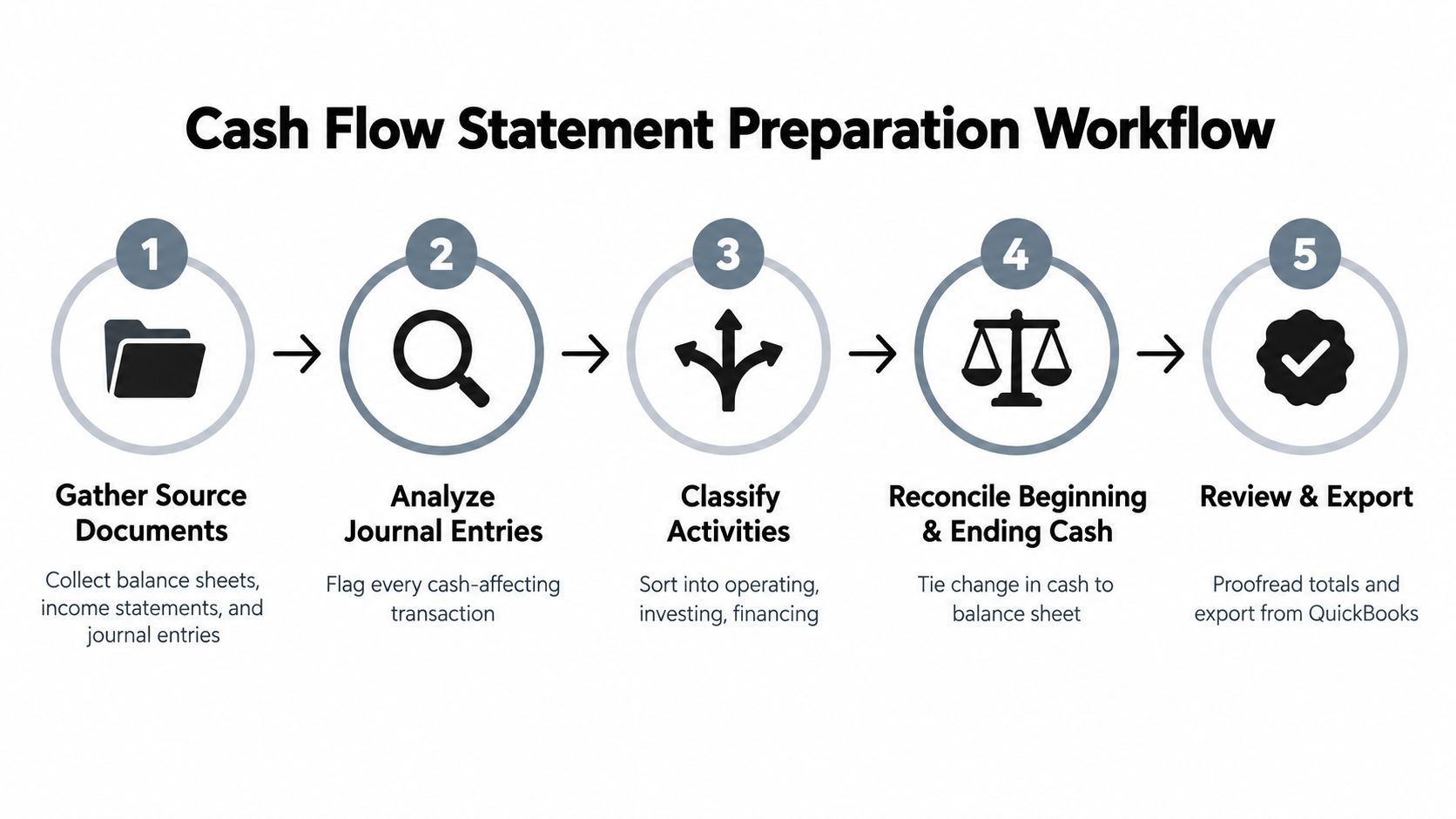
A short visual walkthrough can reinforce the distinction between the methods and the preparation sequence:
Executing the Cash Flow Statement Preparation Workflow
A dependable workflow begins with records, not with the report button in QuickBooks. Start by defining the reporting period and collecting the opening and closing balance sheets, the income statement, bank records, cashbook, and general ledger. If the opening balances are wrong, every later conclusion will be wrong even if the spreadsheet formulas work perfectly.
Build the report from verified movements
Work through the balance sheet line by line. Identify how each account changed during the period, then determine whether the movement involved cash, a noncash entry, or a combination of both. Under the indirect method, changes in operating receivables, inventory, and payables explain why net income differs from operating cash flow.
Next, classify actual cash movements:
- Operating cash flows include cash connected with the ordinary delivery of products or services, collections, payroll, vendors, and operating costs.
- Investing cash flows include cash paid for or received from long-term assets and investments.
- Financing cash flows include cash from borrowing, repayment, equity activity, and distributions.
Don't let the account name make the decision for you. A loan-related fee, lease payment, tax payment, or interest transaction may require policy and standard-specific analysis. Under IAS 7, income tax cash flows must be disclosed separately and are normally classified as operating cash flows unless they can be specifically associated with investing or financing activity. The IAS 7 standard text sets out that requirement.
Remove noncash items before you reconcile
Noncash transactions are where automated reports often need human review. An acquisition through a finance lease, an exchange of equity for an asset, or another transaction that changes assets and liabilities without a cash payment must be excluded from the cash flow statement. Record and disclose the transaction appropriately, but don't present it as cash movement.
Then verify every investing and financing amount against bank statements and the cashbook. The final change in cash should reconcile the beginning cash balance to the ending cash balance. The ending cash total should match the cash account on the balance sheet, a control emphasized in current cash flow statement guidance from Allianz Trade.
A professional close file should retain the source reports, reconciliation notes, classification decisions, and explanations for unusual movements. That documentation matters when a lender asks why cash declined, when a tax professional reviews the books, or when a future employee needs to understand the prior period.
Navigating Industry-Specific Cash Flow Challenges
Generic bookkeeping instructions fail when the operating model creates specialized timing and reporting issues. Cash flow statement preparation must reflect how your industry earns, bills, collects, spends, and receives restricted funds. The same balance-sheet movement can carry a different management meaning in a clinic, a construction company, and a nonprofit.
Healthcare practices and clinics
Healthcare businesses often deliver services before receiving payment from insurers, patients, or other payors. That creates a gap between recorded revenue and collected cash. A clinic can appear profitable while receivables grow and cash tightens.
The cash flow review should separate patient and insurance collections, monitor receivables by payer and age, and connect staffing, supplies, rent, and technology spending to appointment volume and reimbursement timing. Payroll deserves particular attention because it is recurring, difficult to defer, and often one of the largest operating cash commitments.
Healthcare accounting also needs clean support for compiled financial statements, including the cash flow report, balance sheet, and income statement. A generic chart of accounts won't answer whether a collection delay comes from billing workflow, payer timing, or a documentation problem. That requires industry-aware review.
Construction and trades
Construction companies face a different challenge. Job costs, deposits, retainage, progress billings, subcontractor payments, equipment purchases, and payroll can move on different schedules. A project may show accounting revenue while the contractor is still funding labor and materials ahead of collection.
A useful cash flow process connects the general ledger to job-costing records and project forecasts. Review cash by project, distinguish operating payments from equipment acquisitions and debt activity, and investigate changes in contract-related receivables and payables. Owners need to know whether a cash shortage comes from an underbilled job, slow payment, cost overrun, or planned capital investment.
Nonprofits and restricted funds
Nonprofits must protect the distinction between unrestricted operating cash and funds restricted by grants or donor conditions. A large bank balance doesn't necessarily represent money available for payroll, rent, or general administration.
The accounting workflow should document restrictions, grant receipts, qualifying expenditures, and releases from restriction. Management reporting should show whether ordinary operations are self-supporting without treating restricted inflows as freely deployable liquidity. Audits and compliant reporting depend on that discipline.
Tax law and reporting changes
Tax law changes can affect payment timing, estimated tax planning, payroll obligations, deductions, and the cash cost of business decisions. Don't treat a tax update as a year-end issue. Ask how the change affects forecast cash, required records, entity-level decisions, and the classification or disclosure of related payments.
Reporting requirements are evolving as well. IFRS staff discussions in 2026 highlight the need for clearer reporting of noncash transactions and greater transparency around cash flow measures not specified in IFRS. Amendments connected with IFRS 18 are projected to apply to annual and interim periods beginning on or after January 1, 2027, according to the IFRS staff paper. Businesses should review the effect with their CPA before the applicable reporting period, rather than discovering a presentation issue during close.
Avoiding Common Reconciliation Mistakes and QuickBooks Export Tips
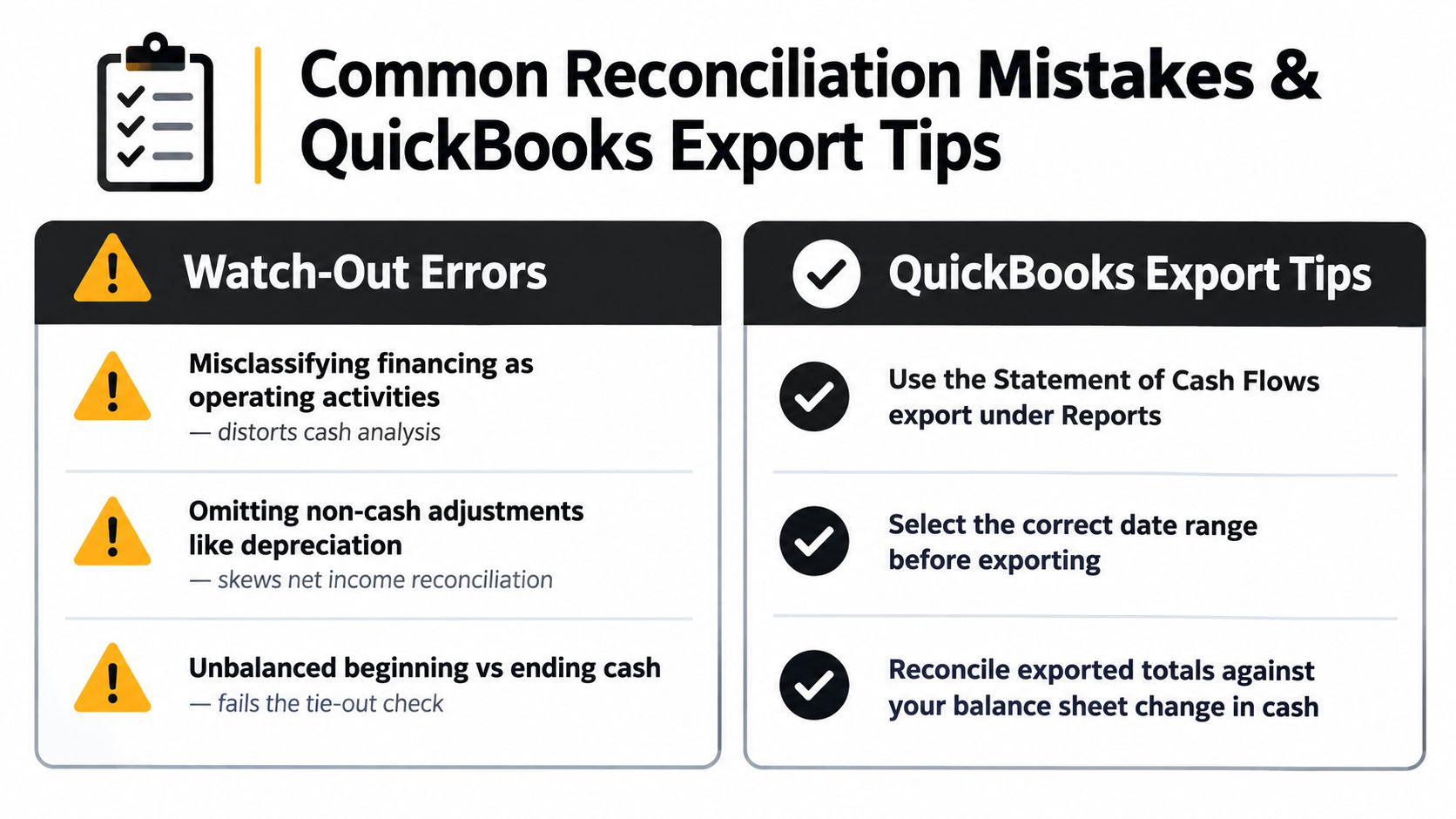
QuickBooks can produce a cash flow report quickly. It can't decide whether a complex transaction was coded correctly, whether an overdraft belongs inside cash and cash equivalents under the applicable framework, or whether classifications remain consistent from one period to the next.
The most dangerous errors usually begin upstream. A bookkeeper posts a loan proceeds entry to revenue, records an equipment purchase as an operating expense, or leaves a transfer unreconciled. The software then reports the consequences faithfully.
Review the high-risk areas first
- Working capital: Check accounts receivable, inventory, accounts payable, accrued expenses, and prepaid accounts against the underlying activity. Small classification errors can distort the operating cash reconciliation.
- Cash-equivalent boundaries: Review overdrafts, cash pooling arrangements, foreign currency balances, and other accounts that may not receive identical treatment across reporting frameworks.
- Noncash adjustments: Confirm that depreciation, provisions, deferred taxes, unrealized foreign exchange movements, and other noncash items are handled correctly under the chosen method.
- Consistency: Compare classifications with prior periods. A change may be justified, but it must be documented and applied deliberately.
Use QuickBooks as a controlled workflow
Before exporting, reconcile bank and credit-card accounts, review unapplied payments, confirm the date range, and inspect unusual journal entries. Then export the Statement of Cash Flows from the Reports area and compare the result with the balance sheet change in cash and the supporting ledger.
Don't rely on the report title alone. Open the account detail behind material movements and confirm that each amount belongs in the correct section. Keep a close checklist that records who reviewed the report, which accounts were tested, and how differences were resolved.
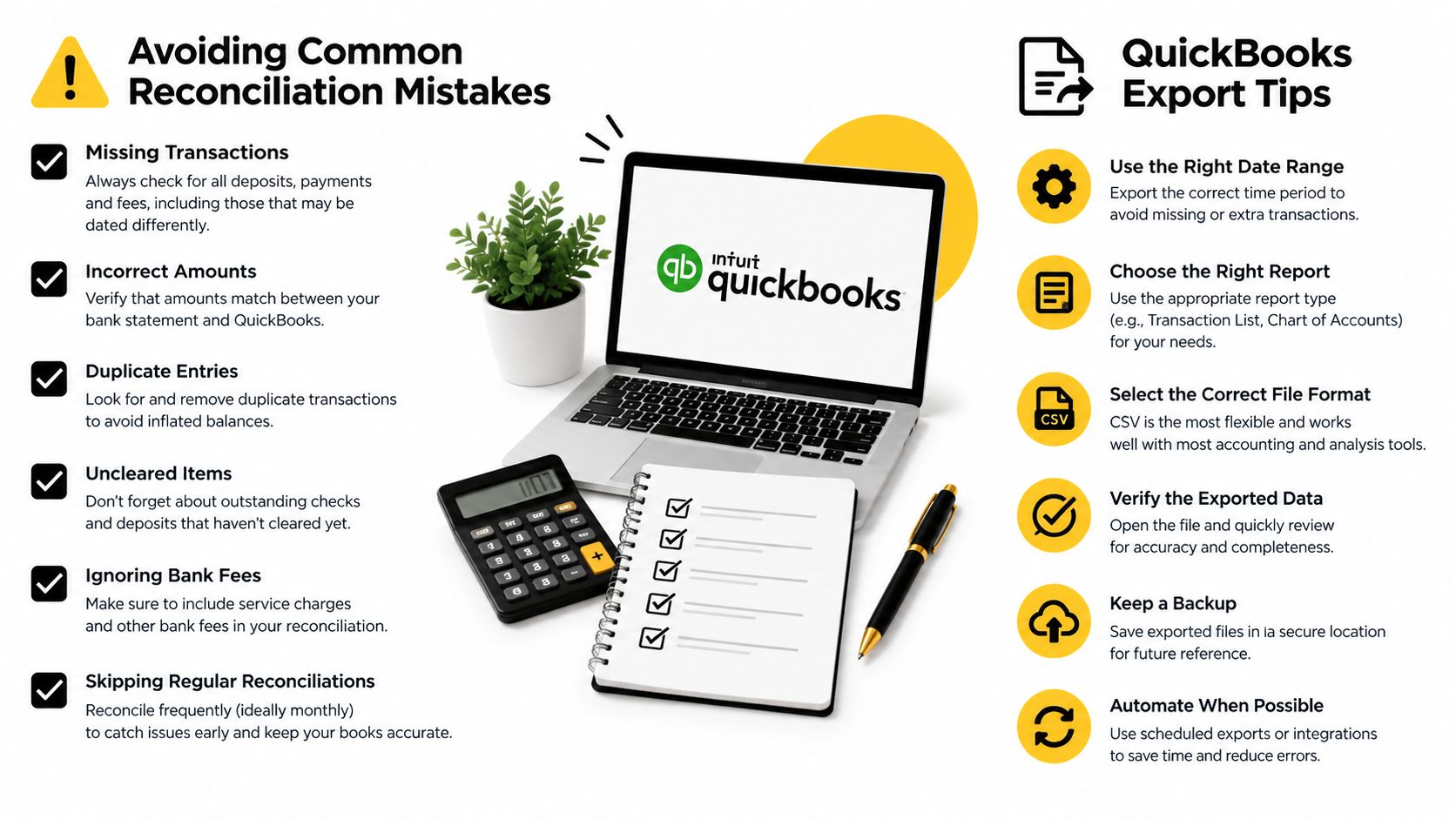
If the file has accumulated duplicate vendors, uncategorized transactions, old reconciliations, or inconsistent account mappings, fix the foundation before interpreting the report. This guide to cleaning up QuickBooks Online is a useful starting point, but complex corrections should be reviewed by an accounting professional before you alter historical periods.
Control that matters: The ending cash balance must tie to the balance sheet. If it doesn't, stop the analysis and find the difference.
Why Growing Businesses Need a Fractional CFO
A report tells you what happened. A fractional CFO helps you decide what to do next.
That distinction becomes important as a business adds employees, locations, projects, financing arrangements, or tax obligations. The owner may still approve payments personally, but the financial system now requires consistent controls, cash forecasting, scenario planning, and explanations that a basic bookkeeping package doesn't provide.
From report production to cash decisions
A fractional CFO reviews operating cash generation separately from investing and financing activity. They can identify whether a cash decline reflects weak collections, deliberate expansion, debt repayment, inventory buildup, or a nonrecurring transaction. They can then convert that diagnosis into decisions about hiring, purchasing, pricing, credit terms, reserves, and financing.
A useful cash flow forecasting framework starts with reliable historical statements, then layers in expected collections, payroll, vendor commitments, taxes, debt service, capital spending, and management assumptions. The forecast should be updated when actual results arrive, not left untouched in a spreadsheet.
CFO perspective: A cash flow statement is a rear-view mirror. A forecast is the windshield. Growing companies need both.
Compliance is an operating responsibility
Many small-business owners don't know everything required to maintain compliant books. They may understand that taxes are due, but miss the supporting schedules, reconciliations, documentation, classification policies, payroll records, industry-specific reporting, or noncash disclosures that make the financial statements defensible.
Tax law changes make that problem harder. A change in deductions, estimated payments, payroll treatment, or entity planning can alter cash needs before the owner sees the effect in the bank account. A fractional CFO works with the bookkeeper and tax professional to connect those changes to the cash plan, while the CPA team handles the appropriate compliance and reporting work.
For a Jacksonville or Northeast Florida business, the right support may include bookkeeping, payroll, tax preparation, audit or review assistance, healthcare accounting, construction job-costing, nonprofit reporting, and fractional CFO guidance. Bookkeeping and Accounting of Florida Inc. provides those services, including QuickBooks ProAdvisor support and cash flow projections, with a focus on turning timely financial information into operating decisions.
You don't need a full-time CFO to gain senior financial guidance. You do need someone who will challenge the numbers, explain the obligations, maintain the controls, and help you act before a cash problem becomes an emergency.
Bookkeeping and Accounting of Florida Inc. can prepare and review your cash flow statements, clean up QuickBooks workflows, coordinate bookkeeping and tax requirements, and build cash projections around your actual operating cycle. Visit Bookkeeping and Accounting of Florida Inc. to request a conversation about keeping your financial reporting compliant and using cash data to guide growth.