
The bank account is reconciled, payroll has been processed, and the tax deadline is getting closer. Then your preparer asks for missing vendor forms, asset records, payroll filings, owner distributions, and explanations for transactions that looked harmless when they appeared in the bookkeeping system. What seemed like a simple tax return becomes a reconstruction project.
Thank you for reading this post, don't forget to subscribe!Tax preparation for businesses works best when it starts months before filing season. Accurate returns depend on clean books, properly classified transactions, complete payroll records, documented deductions, reconciled accounts, and a clear understanding of the business structure. Tax compliance isn't a once-a-year administrative chore. It's an operating discipline that affects cash flow, hiring, pricing, financing, and the owner's ability to make decisions with confidence.
The Reality of Business Tax Obligations
A business owner may think the annual return is the main event. In practice, the return is the final product of many connected responsibilities, including bookkeeping, payroll tax reporting, information returns, estimated payments, fixed-asset tracking, state registrations, and local requirements. A company can have accurate sales numbers and still file incorrectly if contractor payments, payroll liabilities, inventory, or owner transactions weren't recorded properly.
The scale of the system makes casual preparation risky. During fiscal year 2023, taxpayers filed approximately 13 million business income-tax returns, representing about 5% of the roughly 271 million total returns and forms received by the IRS, according to the Treasury Inspector General report available through the Office of Inspector General. Those filings cover far more than corporate income-tax returns. Payroll, partnership, trust, nonprofit, information, and other business-related submissions all require reliable records.
Why annual scrambling fails
Consider a growing medical practice that has payroll employees, independent contractors, reimbursed expenses, equipment purchases, and owner distributions. If the bookkeeping system combines those categories, the tax preparer has to determine what happened after the fact. That delays the return and can lead to conservative treatment of expenses or missed compliance issues.
Construction businesses face a different problem. A bank reconciliation won't show whether labor and materials belong to a completed project, a project in progress, or an overhead account. Without job-level coding, the books may be technically balanced while profitability and taxable income remain difficult to evaluate.
Practical rule: A reconciled bank account proves that cash activity was recorded. It doesn't prove that every tax-relevant transaction was classified correctly.
Compliance is an operating process
Small companies often don't know every filing, documentation, and retention requirement that applies to them. That's understandable. Requirements vary by entity, industry, employees, contractors, jurisdictions, and transaction types. It isn't reasonable to expect an owner to monitor all of those details while also managing customers and staff.
A professional accounting team helps turn scattered financial activity into a controlled process. Monthly bookkeeping, payroll reconciliation, quarterly tax projections, and an organized document index give the tax preparer evidence before the return is drafted. That approach costs time throughout the year, but it avoids the more expensive alternative, a rushed cleanup when deadlines are already approaching.
Navigating Recent Tax Law Changes
Tax law changes matter because they alter what businesses must track, not just what appears on the final return. A change to a deduction can affect income projections and owner distributions. A change to information reporting can affect accounts payable workflows. A change to electronic filing controls can affect how a business reviews a return before submission.
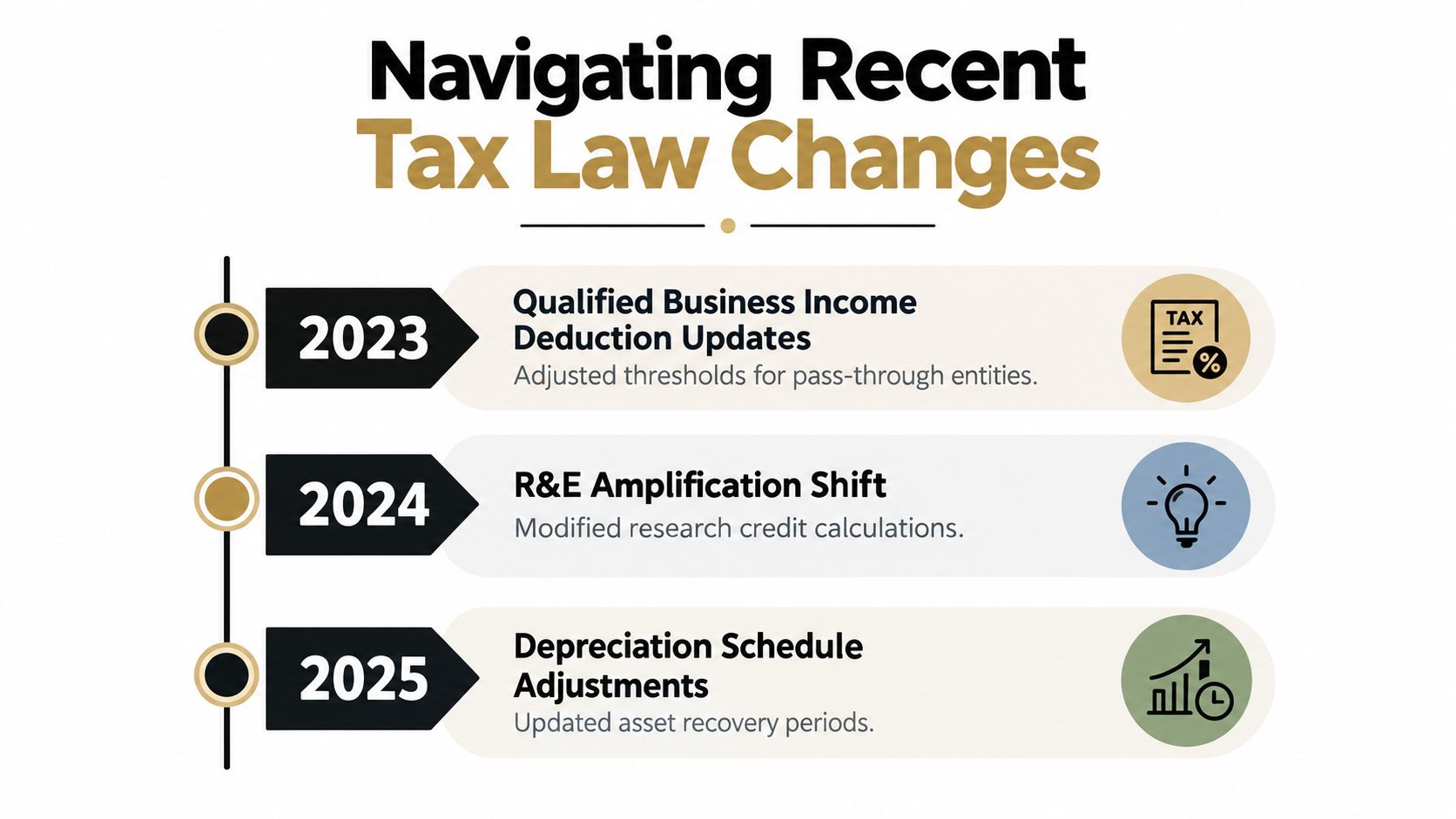
The IRS's 2025 small-business guide reflects several changes that require year-round tracking, including the permanent 20% qualified business income deduction and revised income thresholds. Pass-through owners shouldn't wait until the return is being prepared to ask whether the business has the records needed to evaluate eligibility and calculate the deduction. Compensation, business income, expenses, and entity-level information should be reviewed throughout the year.
Information reporting requires better vendor records
Beginning with payments made after December 31, 2025, the federal information-reporting threshold for certain business payments rises from $600 to $2,000, according to the IRS explanation of the business tax provisions. For qualifying payments made during calendar year 2026, a business generally won't need to issue the affected Form 1099-MISC or provide a payee statement below the new threshold. Related backup-withholding rules also use the new threshold, subject to the applicable exceptions and requirements.
That doesn't mean a company can stop tracking vendor payments. Accounts payable still needs payment categories, taxpayer identification information, vendor classifications, and exception notes. A lower form burden can create a higher risk of poor internal records if owners interpret the change as permission to stop collecting information.
Entity structure changes the analysis
A sole proprietorship, partnership, S corporation, and C corporation don't produce the same tax work. Owner compensation, distributions, estimated taxes, information reporting, and return preparation differ by structure. The right approach isn't to choose a structure because one form appears simpler. It is to evaluate tax, payroll, legal, administrative, and cash-flow consequences together.
Tax law updates also create timing questions. A business may need to decide whether to purchase equipment, make a contribution, pay a bonus, or retain cash based on projected income and operational needs. Those decisions require current financial statements. Outdated books turn tax planning into guesswork.
Essential Forms and Filing Deadlines
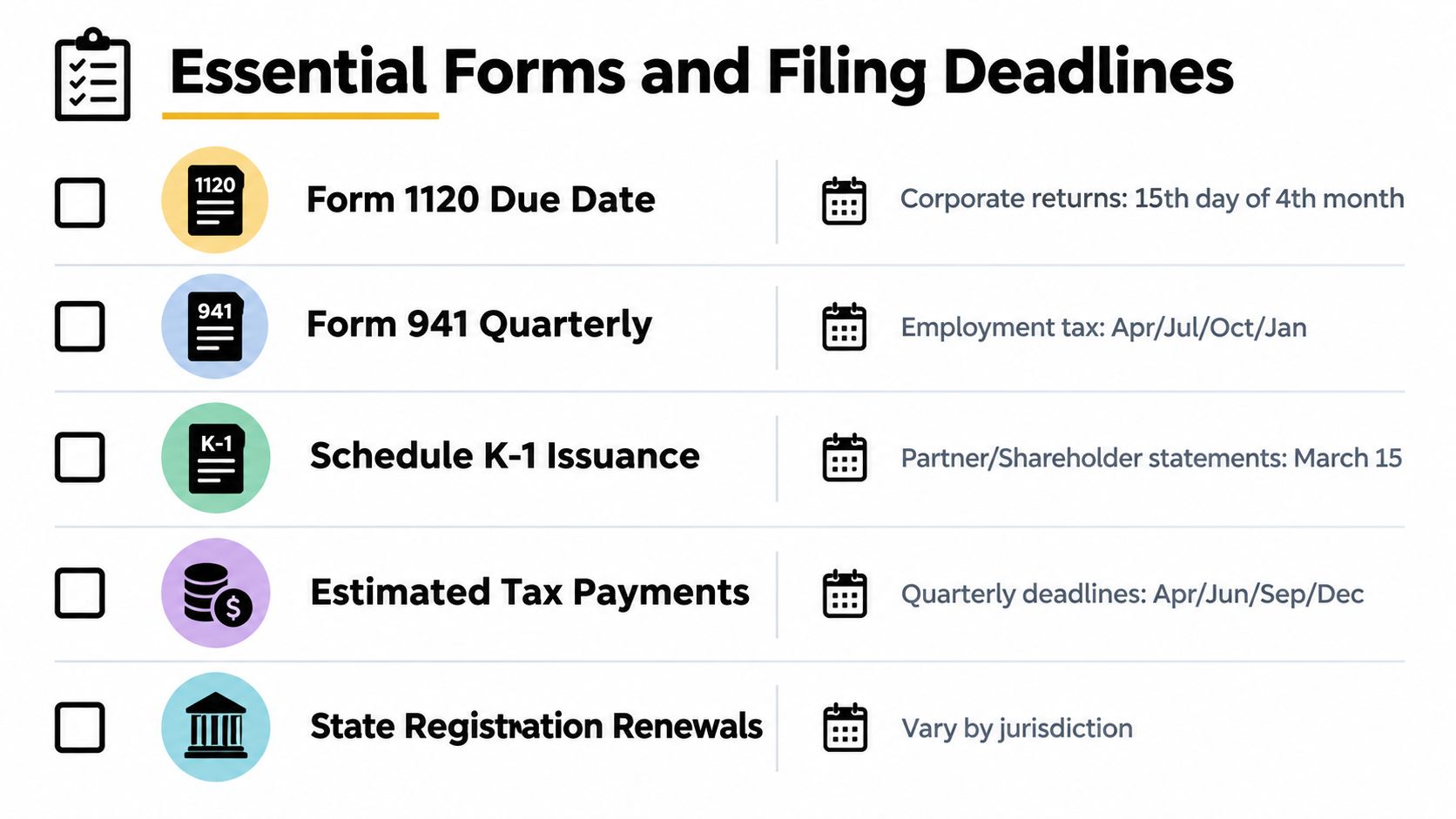
The tax calendar should live in the accounting workflow, not in the owner's memory. Start by listing every federal, state, and local filing connected to the business, then assign an owner, preparation date, review date, and evidence folder for each item.
Build the calendar around the entity
A corporation generally uses Form 1120, while a partnership generally files Form 1065. S corporations have their own return requirements, and pass-through owners may receive Schedule K-1 information for their individual filings. The exact due date depends on the entity's tax year and applicable rules, so the calendar should be confirmed with a tax professional rather than copied from a generic checklist.
Employment tax reporting needs its own control. Employers use Form 941 for quarterly federal employment tax reporting and must reconcile the form to payroll registers, tax deposits, employee wage records, and year-end Forms W-2. A payroll provider's report isn't a substitute for reviewing whether the underlying employee classifications and compensation records are correct.
Use a working calendar with these categories:
- Income-tax returns: Identify the applicable federal return, state income-tax filings, extensions, and payment dates.
- Employment taxes: Match payroll registers to Form 941 filings, deposits, year-end wage statements, and fringe-benefit records.
- Information returns: Track vendor payments, taxpayer identification information, exceptions, and required recipient statements.
- Estimated payments: Project liability and compare required installments with payments already made.
- State and local obligations: Record registrations, renewals, sales-tax requirements, business licenses, and jurisdiction-specific filings.
Protect the evidence behind each form
The IRS allows a recordkeeping system that clearly shows income and expenses, but supporting documents must substantiate purchases, sales, payroll, deductions, credits, and asset basis. Employment-tax records should generally be retained for at least four years after the fourth-quarter filing, including wage and payment dates, employee information, Forms W-4, tax-deposit confirmations, filed returns, fringe-benefit records, reimbursement records, and credit-support documentation, as described in the IRS recordkeeping guidance for businesses.
In 2022, on-time filing rates across surveyed tax administrations generally averaged between 76% and 87%, and at least 100 million returns were filed late worldwide, according to the OECD's Tax Administration report. A business can reduce deadline pressure by preparing schedules before the filing period and using an extension appropriately. An extension generally gives more time to file, not more time to pay. Owners who need help evaluating that distinction can review this business tax filing extension resource.
Strategic Tax-Saving Opportunities
Tax savings usually come from better decisions and better records, not from a last-minute search for exotic deductions. Clean bookkeeping shows what the business spent, when it spent it, why the expense was business-related, and whether the transaction belongs to the company or the owner.

A monthly close can uncover deductible expenses, missing vendor documentation, incorrect payroll classifications, unrecorded equipment purchases, and owner transactions that need reclassification. It can also show when an apparent tax-saving decision would create a cash-flow problem. A deduction is useful only when the business can support it and still meet its operating obligations.
Turn bookkeeping into planning data
For a construction company, job-costing reports can separate labor, materials, subcontractors, equipment, and overhead by project. That information supports tax preparation while also helping management evaluate work in progress, contract performance, change orders, and gross margins.
A healthcare practice needs a different chart of accounts. Payroll, contractor payments, clinical supplies, rent, equipment, reimbursements, and owner compensation should not be blended into broad categories. A nonprofit should keep restricted and unrestricted activity, program costs, administrative expenses, grants, and donor-related records distinguishable enough to support compliant reporting and financial review.
Startups also benefit from disciplined classification. Formation costs, technology purchases, research activity, payroll, contractor payments, and investor-related transactions can have different accounting and tax treatment. The earlier the business establishes approval and documentation procedures, the less likely it is to spend filing season reconstructing its history.
Use quarterly forecasts instead of guesses
Estimated-tax planning is a cash-flow control problem for pass-through owners and self-employed businesses. The IRS generally requires estimated payments when an individual expects to owe at least $1,000 after withholding and credits. Underpayment penalties can generally be avoided when timely payments equal at least 90% of current-year tax or 100% of prior-year tax, whichever is smaller, as explained in IRS Publication 583.
Corporations generally must make installments when expected tax is $500 or more, with installments commonly calculated using current-year or prior-year tax methods. The exact calculation should be reviewed for the entity and tax year.
A practical quarterly process is straightforward:
- Update projected revenue, gross margin, payroll, depreciation, owner distributions, and deductible expenses.
- Compare projected liability with cumulative federal payments.
- Review whether cash reserves can support the next installment.
- Document changes so the preparer can explain payment variances.
For owners dealing with past-due obligations, a resource on IRS back-tax solutions for owners can provide additional context. The important point is that tax planning should inform decisions before money leaves the business.
A short educational overview can also help owners understand how tax planning connects with financial management:
The Value of Professional CPA Services
DIY tax software can be adequate for a straightforward business with uncomplicated books and limited filing obligations. It becomes less attractive when the company has payroll, multiple owners, contractors, fixed assets, inventory, several jurisdictions, unusual transactions, or an industry-specific reporting burden.
A CPA-led process begins before data entry. The professional reviews the entity structure, accounting records, prior returns, payroll filings, estimated payments, balance-sheet accounts, fixed assets, owner activity, and supporting documents. That review can reveal problems that a form-based software interview won't identify, such as personal expenses recorded as business costs or customer deposits treated as revenue without considering the accounting method.
What professional review should include
A useful engagement should produce more than a completed return. Ask whether the service includes:
- Books-to-return reconciliation: Income, expenses, payroll, distributions, assets, liabilities, and equity should tie to the return schedules.
- Documentation review: Large deductions, credits, contractor payments, payroll data, and asset basis should have supporting evidence.
- Estimated-tax analysis: Projected liability should be compared with payments and expected cash needs.
- Filing coordination: Federal, state, local, payroll, and information-reporting obligations should be considered together.
- Follow-up support: The business should know who handles notices, rejected submissions, amended returns, and questions from taxing authorities.
A fractional CFO adds another layer. The CFO doesn't replace the tax preparer. Instead, the role connects tax planning with pricing, budgeting, cash reserves, compensation, financing, and growth decisions. For a growing company, that senior guidance can be available without the cost of a full-time executive.
E-filing still needs human controls
Electronic filing can make submission more efficient, but it doesn't eliminate data risk. A Treasury Inspector General review of new or modified IRS business e-file rules for the 2025 filing season found that only 64% were accurately rejecting returns, highlighting the possibility of unnecessary correction work or unclear filing problems, as reported in the TIGTA review.
Before authorization, someone besides the preparer should review legal names, identification numbers, bank details, payroll totals, payment information, schedules, and prior-year comparisons. If the IRS rejects a return, distinguish a formatting or data rejection from a disagreement about a tax position. Preserve the rejection message, corrected data, approval record, and final acceptance confirmation.
Owners who want a practical explanation of the CPA's broader role can review what a CPA does for a small business. The right professional relationship gives the business a reviewer, an interpreter, and a planning partner, not just a form preparer.
When to Hire a Firm or Fractional CFO
The choice isn't just DIY versus a traditional accounting firm. Businesses can use internal staff, a tax-only preparer, a bookkeeping service, a CPA, or a fractional CFO. Each option solves a different problem, and the right combination depends on the business's complexity and management needs.

Compare the options honestly
DIY preparation may work when the books are current, the entity is uncomplicated, transactions are well documented, and the owner understands the filing obligations. The trade-off is time and exposure. The owner must interpret tax changes, verify forms, monitor deadlines, and handle notices without an experienced reviewer.
A tax-only preparer can be appropriate when the records are already clean and the business needs a return completed. The limitation is that a preparer working from a disorganized ledger may spend the engagement cleaning up symptoms rather than improving the process that caused them.
A bookkeeping and CPA team is more useful when monthly records, payroll, reconciliations, tax filings, and planning need to work together. The team can create a consistent close process and deliver records that are ready for tax review.
A fractional CFO becomes especially valuable when the owner needs forward-looking guidance. Rapid growth, uneven collections, project-based work, new financing, expansion into another jurisdiction, or difficult compensation decisions can all justify senior financial oversight.
Industry complexity is a hiring signal
A healthcare practice may need help separating employees from contractors, tracking reimbursements, and reporting equipment and operating expenses. A construction company may need job-costing, payroll coordination, work-in-progress analysis, and project-level documentation. A nonprofit may need support with restricted funds, grants, audits, and compliant reporting. A startup may need cash runway analysis, investor reporting, and controls that can scale as the business grows.
Most small businesses don't know everything required to stay compliant. That isn't a character flaw. It is a predictable result of running a company while tax, payroll, reporting, and accounting requirements continue to change.
A fractional CFO earns value before the tax deadline by helping management make decisions with reliable numbers.
Cash-flow pressure often exposes the need for broader support. Guidance on professional services cash flow can help owners think about collections, reserves, payment timing, and operating commitments alongside tax obligations. A firm should be judged by the quality of its process, communication, documentation, and decision support, not merely by whether it files a return.
Taking Control of Your Business Taxes
Reliable tax preparation begins with a reliable operating rhythm. The business needs current books, documented transactions, reviewed payroll, accurate vendor information, reconciled tax accounts, and a calendar that assigns responsibility before a deadline becomes urgent.
The first step is to identify the gaps. Pull the general ledger, balance sheet, profit and loss statement, payroll reports, filed payroll returns, contractor records, fixed-asset schedule, prior tax return, estimated payments, and bank statements into one review. Then ask where the transaction-to-return trail breaks. If a preparer can't trace a significant deduction or balance-sheet figure to supporting records, the process isn't ready.
A practical tax-readiness checklist
- Close the books monthly: Reconcile bank and credit-card accounts, review unusual entries, and investigate old unreconciled items.
- Control payroll data: Tie payroll registers to Form 941 filings, tax deposits, Forms W-2, employee records, reimbursements, and benefits.
- Maintain fixed-asset schedules: Record placed-in-service dates, basis, disposals, financing, and supporting invoices.
- Track vendors carefully: Keep taxpayer identification information, payment categories, exceptions, and documentation for reportable payments.
- Separate industry activity: Use job-level coding for construction, distinct clinical and administrative categories for healthcare, and appropriate fund classifications for nonprofits.
- Forecast estimated taxes: Update projected income and payments quarterly instead of waiting for the return.
- Review entity decisions: Evaluate compensation, distributions, payroll obligations, and operating needs with a CPA.
- Secure approvals: Require a documented review of legal names, identification numbers, bank details, schedules, and supporting documents before e-filing.
- Retain evidence: Maintain a monthly document index so the preparer can verify transactions without reconstructing the year.
These controls do more than reduce filing risk. They give owners a clearer view of cash flow, margins, staffing costs, project performance, and available reserves. They also help a fractional CFO distinguish a temporary cash squeeze from a structural problem.
The right support isn't limited to filing season. It combines bookkeeping and accounting, payroll, tax preparation, tax planning, internal controls, industry-specific reporting, and ongoing financial guidance. That combination helps a company stay compliant while giving its owner the information needed to grow deliberately.
Bookkeeping and Accounting of Florida Inc. provides bookkeeping, payroll, business tax preparation, tax planning, industry-specific accounting, and fractional CFO support for companies in Jacksonville and Northeast Florida. Visit Bookkeeping and Accounting of Florida Inc. to organize your records, build a year-round tax workflow, and get practical financial guidance before the next deadline.