
Compliance reporting is the documented process of gathering records, checking them, and submitting required information to show that a business follows applicable laws, regulations, accounting standards, and contractual obligations. It connects everyday bookkeeping and internal controls to filings and other reports, and the SEC's review of financial-reporting violations illustrates why that connection matters: of 227 matters, 126 involved improper revenue recognition and 101 involved improper expense recognition (SEC enforcement study).
Thank you for reading this post, don't forget to subscribe!A Northeast Florida business owner might feel ready for a tax deadline because the financial statements look polished. Then the preparer asks for payroll records, vendor tax information, evidence of approvals, or reconciliations that no one has assembled. The books may look tidy, but a filing can't be dependable until its underlying information is complete and traceable.
For small businesses, the work is often spread across the owner, bookkeeper, payroll provider, and tax adviser. That's why compliance reporting works best as an ongoing operating discipline, not a form-filling rush at year-end. Understanding the reporting system helps you identify obligations, keep useful records, respond to tax-law changes, and decide when CPA or fractional CFO guidance can make the work more manageable.
Why Compliance Reporting Matters for Business
A polished profit-and-loss statement doesn't automatically prove that a business's reports are accurate. Consider a Jacksonville contractor who's preparing to report payments to subcontractors. The books show expenses, but some vendor files lack taxpayer information, job costs haven't been reconciled, and the owner can't locate approval records for several payments. The numbers may be in the ledger, but the business still needs to establish what each payment was for and whether it must be reported.
That gap is one reason compliance reporting is more than filing forms. It brings together financial records, approvals, policies, reconciliations, and review evidence so that the business can support what it reports. A form is the endpoint. The process starts much earlier, when transactions are recorded and responsibilities are assigned.
Why the work gets missed
Small businesses often divide the process among people who don't share one complete view of the records. A bookkeeper enters transactions, a payroll provider handles payroll, the owner approves spending, and a tax preparer works from information delivered later. If no one owns the full reporting calendar, missing details can remain unnoticed until a filing deadline is close.
The Small Business Administration distinguishes external requirements, such as government paperwork and taxes, from internal compliance requirements. It also reports that taxes and recordkeeping are each among small businesses' most time-consuming compliance activities, at 73% (SBA guidance on staying legally compliant). That helps explain why a company may know it has obligations but still struggle to coordinate the records and review needed to meet them.
Clean financial statements are useful. A reliable compliance report also needs a clear path from the numbers back to the records, decisions, and approvals behind them.
A dependable process gives each filing a named owner, a deadline, supporting-document requirements, and a reviewer. That structure can help business owners spot gaps early, whether the report concerns taxes, payroll, financial controls, or an industry-specific obligation. Small businesses may not need the same reporting framework as public companies, but they still benefit from accurate books and evidence that explains how a reported figure was determined.
Understanding the Compliance Reporting Process
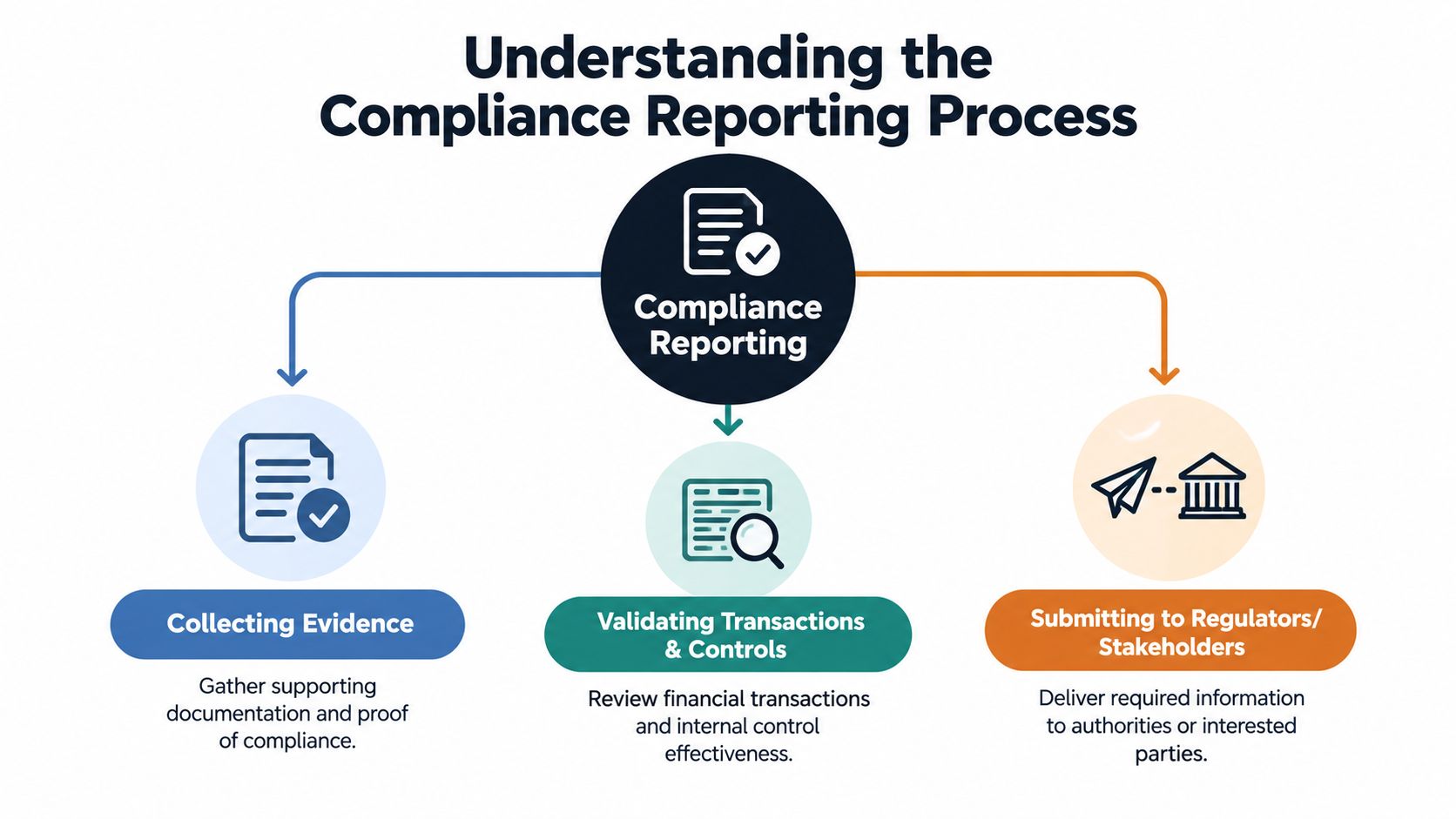
To understand what compliance reporting is, follow one number from its source to its destination. Suppose a business reports payments to a vendor. The evidence chain begins with the invoice and payment record, continues through correct account coding and reconciliation, includes review of the payee information, and ends with a submitted return and filing confirmation. If a question arises later, the business should be able to retrace that chain without guessing.
That's the practical meaning of compliance reporting: collecting evidence, validating transactions and controls, then submitting required information to regulators or other stakeholders. Each step answers a different question. Does the transaction exist? Was it recorded in the right place? Did someone review it? Can the business show that the report was filed?
Recurring reports and event-driven notices
Some reporting follows a recurring calendar. Tax returns, payroll reports, and financial statements may be prepared on a regular schedule. Other obligations arise after an event. For example, under the European Union's GDPR, organizations generally must notify the relevant supervisory authority of a qualifying personal-data breach within 72 hours of becoming aware of it (GDPR breach reporting requirements). That kind of deadline calls for a defined escalation process, not just a year-end checklist.
The distinction matters because event-driven reporting depends on employees recognizing a reportable event and quickly informing the right person. Businesses need clear responsibility, documented incident decisions, and a way to track deadlines alongside ordinary filings.
Controls, review, and assurance
Controls are the routines that help keep source records and reports reliable. Examples include approval procedures, account reconciliations, reviews of unusual transactions, and exception tracking. In larger reporting environments, management certifications, control testing, and independent assurance may also be required. These aren't isolated paperwork exercises. They provide evidence that people responsible for the reporting process assessed the information and addressed problems.
For U.S. public-company reporting, the Sarbanes-Oxley Act of 2002 established important requirements. Section 404(a) requires management to assess and report on the effectiveness of internal control over financial reporting; Section 404(b) generally requires an independent auditor to attest to management's assessment for covered issuers. Those rules don't apply in the same way to every small business, but the underlying lesson is useful: a report is stronger when the organization can show how the information was prepared and reviewed.
Exploring Compliance Reporting Types and Requirements
Compliance obligations differ by business activity. A retailer, a medical practice, a construction company, and a nonprofit won't all file the same reports or rely on the same records. Start by asking what activity creates an obligation, what evidence supports the report, where it must go, and who will prepare and review it.
| Reporting Type | What Triggers It | Core Evidence | Where It Goes | Operating Effect |
|---|---|---|---|---|
| Tax | Taxable activity, income, or reportable payments | Reconciled ledgers, invoices, payment details, tax records | Tax authorities and recipients, as applicable | Requires routine bookkeeping and deadline tracking |
| Payroll | Employee pay and payroll-related obligations | Payroll registers, employee records, time and payment information | Relevant tax authorities and employees | Connects payroll processing to accounting and year-end reporting |
| Industry-specific | The organization's services, funding, licenses, or regulated activity | Operational records, required forms, policies, and supporting documents | Relevant regulators, funders, or oversight bodies | Varies with the business's activities |
| Internal | Management's need to monitor controls and financial activity | Reconciliations, approvals, exception logs, and reports | Owners, managers, and governing bodies | Supports decisions and helps prepare for external reporting |
Tax and information-return reporting
Tax reporting can include business income-tax returns, sales-tax obligations, and federal information returns for certain payments. Businesses making reportable payments generally must file information returns and furnish statements to recipients. Form 1099-NEC is generally due January 31, while paper-filed Form 1099-MISC is generally due February 28 of the following year (IRS guide to information returns).
The important point isn't just remembering a date. Bookkeeping needs to capture the payee's identity, payment amount, payment type, and other details needed to decide how a payment should be reported. A total expense balance alone may not provide enough information to prepare an accurate return.
Payroll reporting also depends on underlying records. Payroll registers, employee information, withholdings, and general-ledger entries need to agree. When payroll is processed in one system and accounting records are maintained in another, someone should check that the records align before filing.
Industry and internal reporting
Industry-specific reporting depends on what a business does, not just what it calls itself. A clinic may need to consider healthcare documentation and applicable industry rules; a nonprofit may have financial reporting and grant documentation needs; a contractor may need records that connect vendor payments and job costs. Confirm requirements for your own activities rather than assuming that a checklist designed for another business applies to you.
Internal reporting is different from a regulatory filing, but it helps prepare for one. Owners and managers use reconciliations, review notes, and exception reports to find missing or inconsistent information before it reaches an outside party. Treat internal reviews as part of the reporting system, not as optional administration.
Building Reliable Records Before Filing
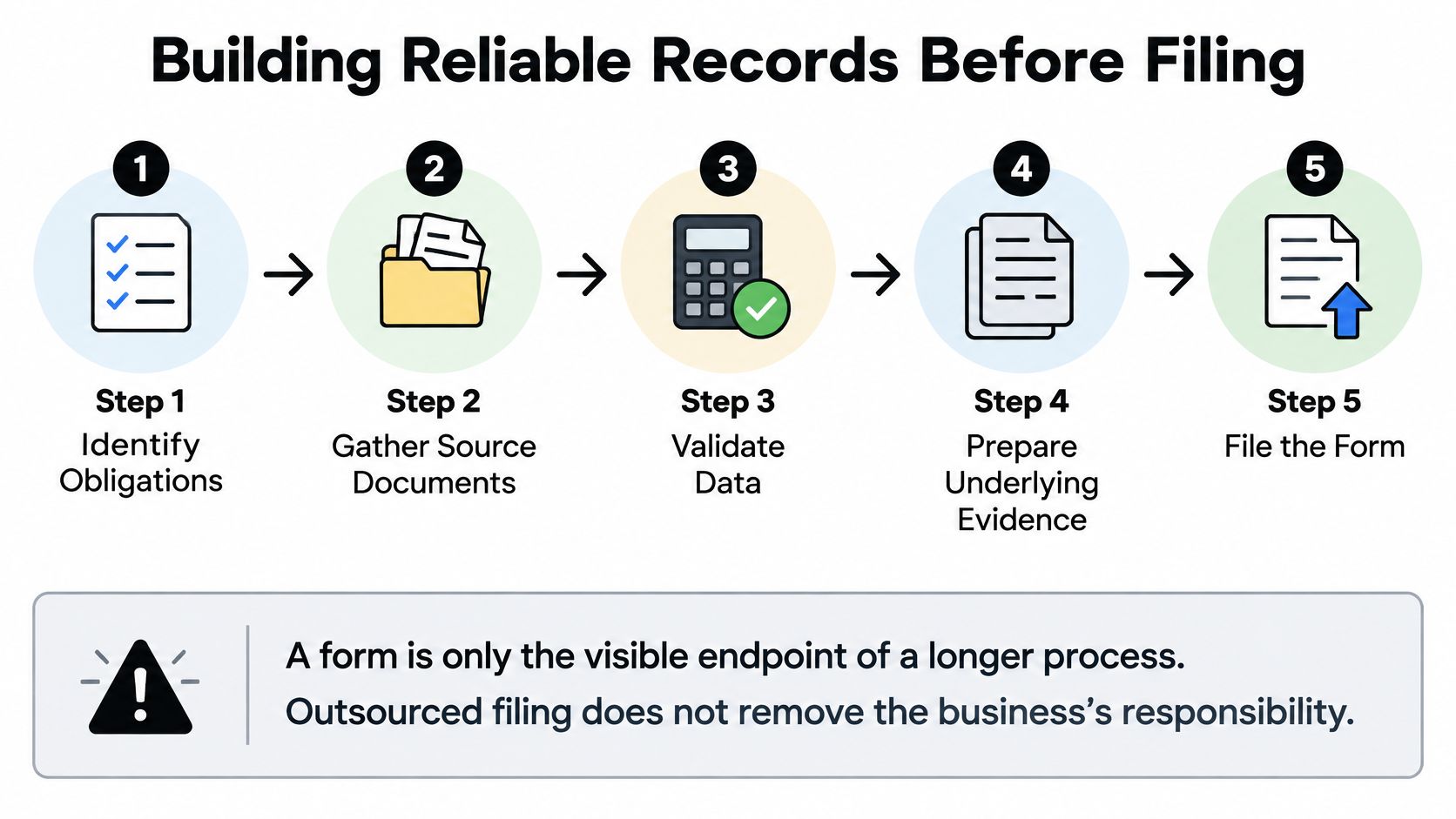
A form is only the visible endpoint of a longer process. Outsourcing its preparation may save time, but it doesn't make incomplete source records accurate or remove the business's responsibility for the information behind the filing.
The Small Business Administration's distinction between external and internal requirements is useful here: external reports rely on internal habits such as recordkeeping, review, and approval. To see how to structure and protect documentation, businesses can organize evidence by security framework. The framework may differ, but the practical aim is the same: make evidence easy to locate, understand, and trace to the claim it supports.
Create a traceable record path
A workable records process begins with identifying the obligations that apply. Assign an owner to each filing, then gather the source records the report will depend on. For a payment report, that could mean invoices, payment records, and complete vendor details. For payroll, it could mean employee records, pay data, and payroll reports.
Next, review the transaction coding and reconcile the relevant accounts. Check that the reporting period has a clear cutoff date, and record how corrections or estimates were handled. If the person entering a transaction also approves it, consider whether another person can review the transaction or reconciliation. Segregation of duties is a way to reduce the chance that errors go unnoticed, even when a small team must divide responsibilities creatively.
Before filing, you should be able to trace every reported figure and event back to a source record and a documented review.
Keep evidence organized and current
An exception list can flag missing tax details, unusual entries, duplicate transactions, or discrepancies between systems. Resolve or document those items before preparing the final report. Retain the relevant source documents, reviewer sign-off, corrections, submission confirmation, and any follow-up correspondence according to the business's record-retention practices.
A consistent electronic records process makes it easier to find supporting documents when staff change or an adviser asks a question. Businesses can review their electronic records management practices to see whether their current systems keep records accessible and organized.
The final readiness test is straightforward: can someone other than the preparer follow the path from the report back to the approved records? If not, pause and resolve the gap before submission. This approach turns filing preparation into regular data-quality work rather than a scramble to reconstruct decisions after the fact.
Managing Industry-Specific Reporting Examples
A Jacksonville clinic that posts insurance payments to the wrong month will see a different failure than a St. Augustine contractor who codes subcontractor labor as supplies. The bookkeeping discipline is the same. Trace, reconcile, review. The questions you ask during review are not.
Healthcare practices
Patient-service revenue rarely equals bank deposits in the same week. Adjustments, denials, refunds, and timing differences sit in between, and payroll and vendor expenses add another layer. Managers need a reconciliation that shows gross charges, adjustments, net collections, and who reviewed the exceptions.
A clinic reconciling patient-service revenue to deposits and adjustments is doing different work than a contractor tying subcontractor payments to job codes, so the review questions differ even when the underlying discipline is the same. Healthcare documentation, nonprofit grant reporting, and payroll compliance each draw on different record sets, so confirm which apply to your activities.
Owners who want a healthcare-specific checklist can review the healthcare compliance reporting guidance for practices and compare it against their current close process.
Construction companies
For a contractor, the control point is the job. Every subcontractor invoice, material purchase, and labor hour needs a job code before it hits the general ledger. If a payment is coded only as a general expense, you lose the ability to check job margin, verify vendor totals for information returns, and answer a question about a specific project months later.
Keep vendor W-9 details current, reconcile payments by vendor and by job, and review classifications before year-end. For contractors who want to understand the paperwork behind progress billing, Drawra automates pay application creation offers a related resource. A pay application records what was billed and approved. It does not replace job-cost accounting or tax reporting, but clean project paperwork makes the review faster and more reliable.
Nonprofits and specialized review
Nonprofits add restriction tracking to the system. Contributions, grants, and pledges must tie to board minutes, award letters, and release of restrictions. Financial statement reporting is not the same as an audit or review engagement. Whether an organization needs an audit, review, or another form of assurance depends on its funding agreements, charter requirements, and size.
Bring in specialized CPA guidance when transactions need treatment your staff rarely handles, documentation sits in three places, or no one can explain how a reported number was built. Early review works like a pre-inspection. It finds missing support and unclear responsibilities while corrections are still inexpensive, before they turn into filing problems.
Tracking Deadlines, Tax Changes, and Penalties
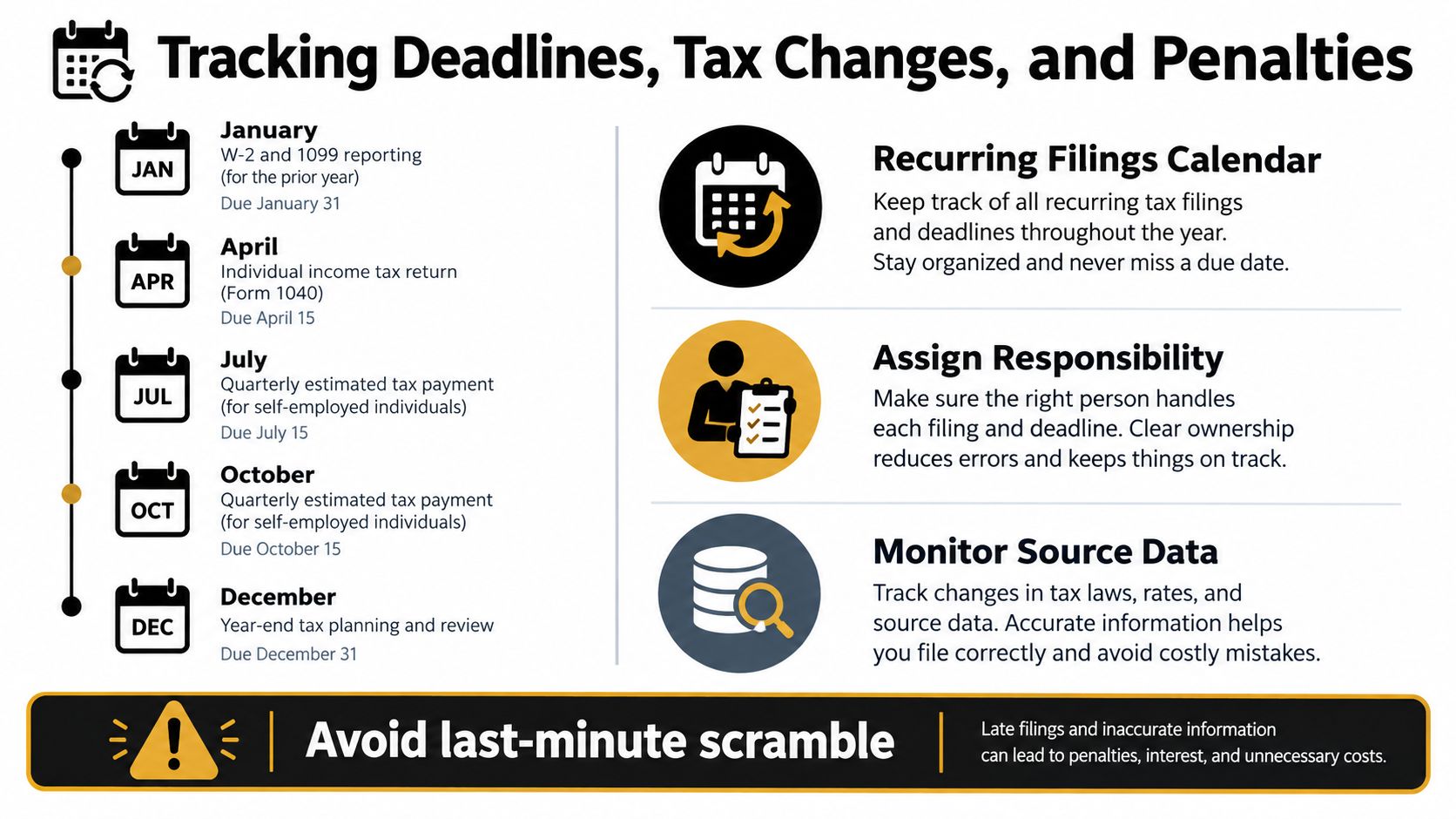
A compliance calendar turns deadlines into assigned work. Record each filing date, name the person responsible, set an earlier date to gather and review records, and retain the submission confirmation. The owner should also know who to contact if information is missing or a return needs correction.
Apply the 2026 information-return change carefully
For payments made after December 31, 2025, the federal reporting threshold for certain payments rises from $600 to $2,000, affecting 2026 Forms 1099-NEC and 1099-MISC (IRS explanation of business tax provisions). This change does not eliminate the need to maintain complete vendor records or classify payments correctly. Businesses still need to understand what a payment represents and whether another reporting rule applies.
A system that flags payments near a threshold can help the person reviewing year-end data. It can't decide whether a payment has been classified correctly if the transaction description is vague or the vendor record is incomplete.
Correct information-return errors promptly
Federal information-return penalties for 2026 depend on when an error is corrected or a late return is filed. The amounts are $60 per return when corrected within 30 days, $130 when corrected after 30 days but by August 1, and $340 when filed after August 1 or not filed. Intentional disregard can result in a $680 per-return penalty (IRS information-return penalties). These figures apply to federal information-return penalties, not every type of compliance obligation.
Software can schedule reminders, track filing status, and flag missing fields. A person should still investigate discrepancies, determine whether information is reportable, and approve corrections. Florida businesses should also review state-specific registrations and tax obligations rather than copying last year's procedures. For example, an aviation-fuel tax and registration change affecting Florida air carriers took effect on January 1, 2026 (Florida Department of Revenue tax registration information). Owners can also seek support with business tax preparation when changing rules or multiple obligations make the calendar harder to manage.
Choosing Automation and Professional Support
Automation is useful for recurring, rules-based work. Accounting and payroll software can capture routine transactions, flag duplicates, check whether required fields are blank, track deadlines, and show whether a filing has been submitted. But software can still produce a timely report from incomplete or misclassified information. A report that goes out on schedule isn't necessarily a correct report.
PwC's 2025 global compliance survey found that 85% of respondents viewed requirements as more complex, while 72% used technology for regulatory disclosures and reporting (PwC's 2025 global compliance survey). Those figures describe technology use and perceptions of complexity, not proof that automation removes the need for review.
Decide what people should review
Use automation to move routine work forward, then reserve human attention for matters that need context or judgment. Examples include unusual transactions, related-party payments, changing rules, amended returns, ambiguous payment classifications, and differences between accounting, payroll, and operational records.
A practical division of responsibility looks like this:
- Let software handle routine checks: Use deadline reminders, recurring data extraction, field validation, duplicate detection, and filing-status tracking.
- Keep judgment with a reviewer: Have a knowledgeable person assess exceptions, confirm classifications, review amended filings, and resolve mismatches between systems.
- Document decisions: Record who reviewed an issue, what evidence they considered, and how they resolved it.
- Escalate uncertain obligations: Ask a CPA when a rule change or unusual business activity may affect what the business must report.
For healthcare practices, operational requirements can extend beyond accounting. A guide for practices on credentialing can help owners understand a related area of administration, while a qualified professional can help determine how responsibilities fit the practice's own operations.
Add experienced guidance where it changes decisions
CPA support can help businesses improve bookkeeping, clarify tax questions, coordinate information from payroll and accounting systems, and review reporting exceptions before submission. That guidance is especially useful when the owner is unsure which obligations apply or when several people handle disconnected parts of the process.
A fractional CFO adds ongoing financial oversight without requiring a full-time finance department. The role can help owners build reporting routines, monitor cash flow, understand timely financial information, and make decisions with clearer visibility into upcoming obligations. For many small businesses, the need isn't another software tool. It's a knowledgeable person who can help set up the process, review the information, and guide the owner when circumstances change.
Bookkeeping and Accounting of Florida Inc. provides bookkeeping, payroll, tax preparation, audit and review, healthcare accounting, and fractional CFO services for businesses in Jacksonville and Northeast Florida. If you need help connecting your records to dependable compliance reporting, visit Bookkeeping and Accounting of Florida Inc. to discuss support for your business.