
You sent the invoices, recorded the revenue, and used those receivables to justify payroll, equipment purchases, or the next project. Then payment dates passed. A major customer disputed an invoice, an insurance payer slowed remittances, or a project owner started missing obligations. Your profit still looks healthy on paper, but the cash isn't arriving.
Thank you for reading this post, don't forget to subscribe!That gap is why the allowance for doubtful accounts matters. It gives your financial statements a disciplined estimate of receivables you may not collect, instead of letting gross invoices make your business look more profitable and liquid than it is. For a small business, this isn't a year-end bookkeeping detail. It affects lending decisions, tax conversations, cash-flow planning, and compliance.
Why Your Business Needs an Allowance for Doubtful Accounts
A business owner in Jacksonville may have a full accounts receivable ledger and still lack the money needed to operate. Healthcare practices wait on claims. Construction companies carry progress billings while projects move through approval. Nonprofits record grant receivables that depend on documentation and funding conditions. In each case, the invoice or receivable can be valid while collection remains uncertain.
The allowance for doubtful accounts addresses that uncertainty before a specific customer default is fully confirmed. Under U.S. GAAP and SEC reporting principles, trade receivables are presented at outstanding principal, adjusted for charge-offs and the allowance, rather than at gross invoice value. The underlying purpose is to report the amount management reasonably expects to collect, consistent with the SEC discussion of receivables and allowance estimates.

Matching revenue with realistic collection
The matching principle is straightforward. Record revenue in the period earned, and recognize the related expected credit loss in a way that prevents that revenue from overstating economic performance. If you wait until a customer definitely fails to pay, the expense can land long after the sale that created the receivable.
That timing problem can distort decisions. A lender may see a strong receivables balance, an owner may approve hiring based on apparent profits, and an investor may assume the company has more usable working capital than it does. An allowance presents accounts receivable at a more useful net amount.
Practical rule: If your receivables aging is worsening, your allowance policy should respond before the cash shortfall becomes a crisis.
The standards treat the allowance as a recurring valuation process. Management revisits it at each reporting date, considers collection experience and current conditions, and updates the estimate. This approach reflects the broader shift from recognizing losses only after they are incurred toward expected-loss concepts, a transition reinforced internationally by IFRS 9. Under IFRS 9, an entity measures 12-month expected credit losses when credit risk hasn't increased significantly since initial recognition, and lifetime expected credit losses when it has.
Ignoring doubtful receivables can create more than an inaccurate balance sheet. It can produce audit questions, weaken covenant calculations, and leave management without a credible explanation for why reported profit doesn't convert into cash. Treat the allowance as a credit-risk control, not as a cosmetic reserve.
How the Allowance for Doubtful Accounts Actually Works
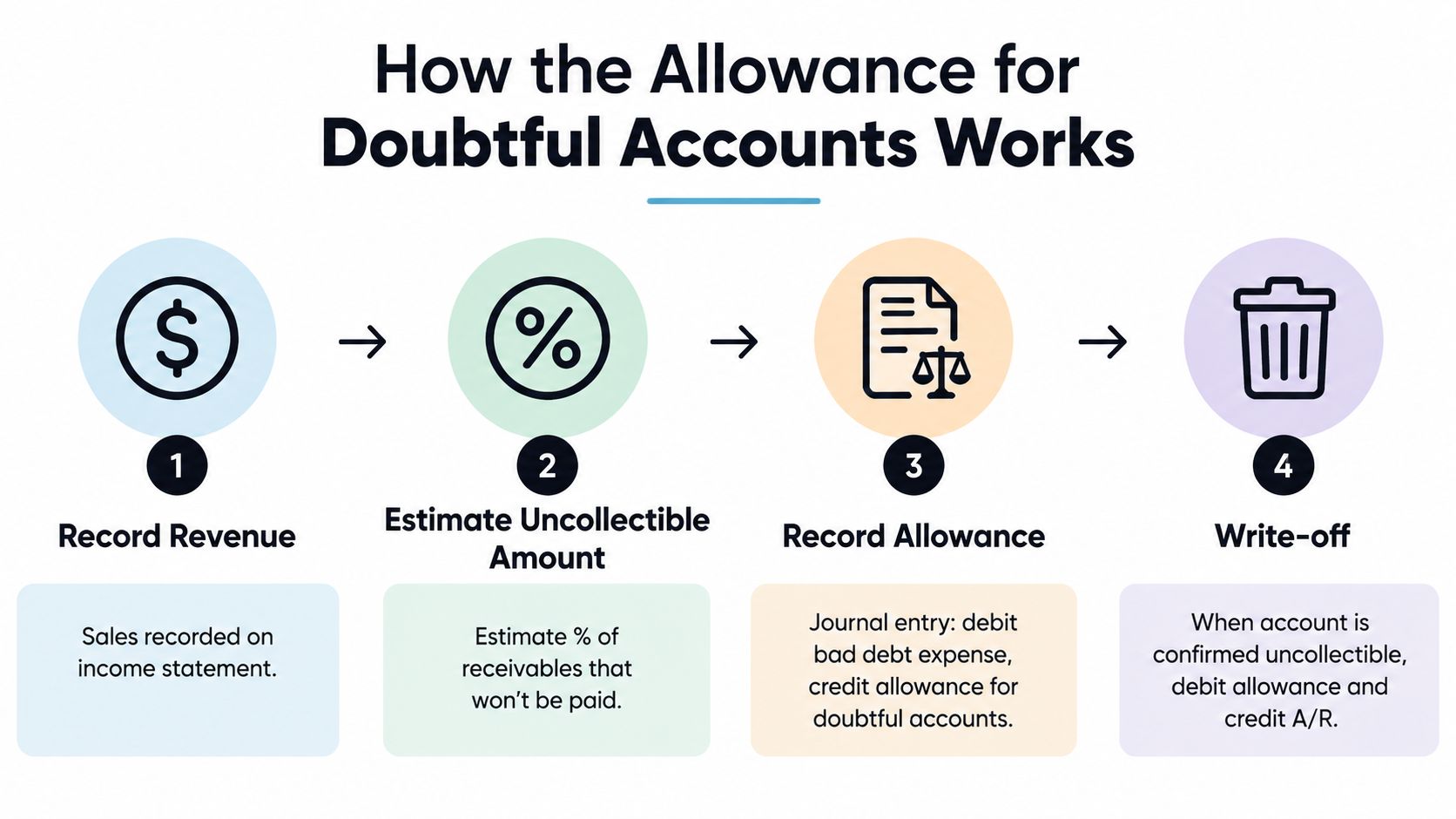
The accounting mechanics use two separate events. First, you estimate expected uncollectible receivables at period end. Later, when a particular account is confirmed as uncollectible, you write it off against the allowance rather than recording a second bad debt expense for the same amount.
The period-end estimate
Assume your company reports $100,000 of accounts receivable and determines that $5,000 probably won't be collected. The period-end entry is:
| Account | Debit | Credit |
|---|---|---|
| Bad Debt Expense | $5,000 | |
| Allowance for Doubtful Accounts | $5,000 |
The expense reduces income. The allowance is a contra-asset account, so it reduces accounts receivable on the balance sheet without removing individual invoices that remain under collection efforts. Your net receivables become $95,000, representing the amount management expects to collect.
That presentation separates an estimate from a confirmed write-off. It also preserves a better period-to-period comparison because the cost of extending credit is recognized alongside the revenue it supports. The allowance method is therefore more informative than waiting for a customer to fail and then recording the entire loss at once.
The confirmed write-off
Suppose a customer account of $5,000 is later approved for write-off. The entry is:
| Account | Debit | Credit |
|---|---|---|
| Allowance for Doubtful Accounts | $5,000 | |
| Accounts Receivable | $5,000 |
This entry reduces both the allowance and gross accounts receivable. It doesn't create a new bad debt expense because the expected loss was already recognized.
The accounts receivable aging explanation can help owners understand how invoice age supports the estimate. For businesses without an internal accounting manager, a virtual CFO for small businesses can also provide guidance on policy design, reporting, and the connection between receivables and cash planning.
Don't let QuickBooks show an allowance balance that no one can explain. Maintain a written policy, preserve collection notes, identify approval authority for write-offs, and reconcile the allowance roll-forward to the general ledger at every reporting date.
Choosing the Right Estimation Method for Your Business
There isn't one correct allowance formula for every company. A medical practice with recurring payer patterns may have usable historical experience, while a construction company with project-specific billings may need invoice-level review. A nonprofit may need to separate government grants, private grants, program service receivables, and amounts subject to compliance documentation.
Two methods appear most often. The percentage-of-credit-sales method applies an expected loss rate to credit sales for the period. Bloomberg Tax describes the approach with an industry rate of 2% of credit sales, meaning the company records 2% of each period's credit sales into the allowance. The accounts-receivable aging method applies different default rates to receivables grouped by age, as described in Bloomberg Tax's bad-debt guidance.
A practical comparison
| Method | Best For | Data Required | Complexity |
|---|---|---|---|
| Percentage of credit sales | Businesses with stable sales and collection patterns | Credit sales history and observed loss experience | Lower |
| Accounts receivable aging | Businesses with varied customer risk and payment behavior | Invoice dates, aging buckets, customer history, and collection results | Moderate to higher |
A percentage-of-credit-sales approach can be efficient for a service company with consistent customers and payment terms. It becomes weak when the receivables ledger includes a distressed payer, a new market, or a major change in billing practices. A single blended rate may hide the fact that older invoices carry materially greater collection risk.
An aging schedule gives management more visibility. A Philippine finance memorandum provides a concrete schedule of 0% for accounts not yet due, 5% at 30 days, 10% at 31 to 90 days, 20% at 91 to 180 days, 40% at 181 to 365 days, and 60% for accounts over 365 days, with 100% for dormant accounts with no reasonable chance of collection. The memorandum also required the allowance to be updated annually, as shown in the published institutional policy.
QuickBooks can organize invoices, aging reports, and allowance accounts, but software doesn't choose defensible rates. Review the accounts receivable turnover ratio alongside aging. If turnover slows, update the assumptions and document why. Manual adjustments are appropriate when customer mix, geography, payer behavior, or economic conditions make historical averages unreliable.
New CECL Rules and the 2025 Practical Expedient
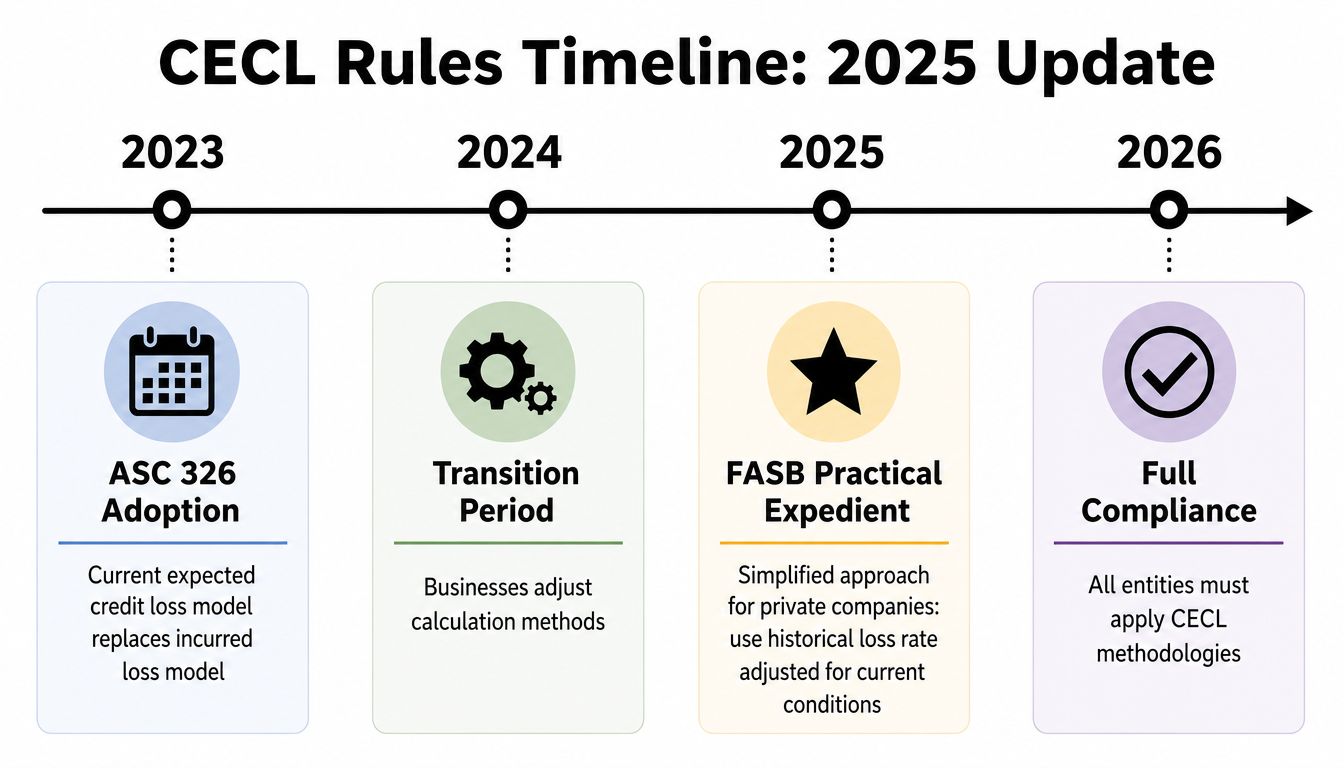
Many small-business explanations stop at an aging schedule. That isn't enough for companies applying the Current Expected Credit Loss model, or CECL, under ASC 326. CECL requires a forward-looking estimate of expected credit losses for receivables, rather than a calculation based only on losses that have already occurred.
For trade receivables without a significant financing component, IFRS 9's simplified approach similarly requires lifetime expected credit losses from initial recognition. The allowance is a probability-weighted estimate based on the present value of expected cash shortfalls over the receivable's life. Businesses typically use a provision matrix, group receivables by shared risk characteristics, and adjust historical loss rates for current conditions and forward-looking macroeconomic information, as explained in the HMRC corporate finance guidance on expected credit losses.
What the 2025 update changes
A 2025 FASB update introduced a practical expedient allowing entities to assume current conditions won't change for the remaining life of the asset. That option can reduce forecasting complexity for eligible private companies and smaller organizations, but it doesn't eliminate judgment or documentation. Management still needs to show why the expedient fits the receivables, how historical loss information was developed, and how the policy was applied consistently.
The expedient shouldn't become an automatic shortcut. A healthcare practice facing payer disruption may need more specific analysis. A construction company with a concentrated project-owner balance may need customer-level support. A nonprofit with grant receivables may need to distinguish collectability from compliance or funding conditions.
The discussion of the 2025 CECL practical expedient for trade receivables highlights the policy gap many SMB guides miss. For 2026 financial statements and beyond, your accounting file should identify the selected method, source data, adjustments, management review, and approval. Auditors will care less about whether your spreadsheet looks polished than whether the estimate is reproducible and supported.
A practical training resource can help your team understand the model, but it doesn't replace a written policy and professional review.
When Customer Concentration Creates Hidden Risk
A technically correct formula can still produce a dangerously low allowance if it ignores who owes you the money. Historical averages assume the future resembles the past. That assumption breaks quickly when one payer, project owner, or grantor represents a substantial share of receivables.
Public filings illustrate the problem. One filing reported $8.4 million of receivables written off over six months, primarily because of bankruptcies in wholesale operations. Another disclosed an allowance of $1.138 million against $4.008 million in receivables at mid-2025. These examples appear in SEC-filed receivables disclosures, and they show why allowance analysis must connect accounting data to customer distress.

Three Jacksonville risk patterns
Healthcare practices may depend heavily on a limited group of insurance payers, large employer plans, or patient balances. A clean aging report doesn't answer whether a payer has changed adjudication rules, delayed claims, or disputed a service category. Review denial trends, correspondence, payment patterns, and significant balances separately from the general provision matrix.
Construction companies can carry large receivables tied to a project owner or general contractor. Retainage, change orders, lien disputes, and payment applications create different risks from ordinary trade invoices. If a major project owner shows financial stress, a historical portfolio rate may understate the exposure.
Nonprofits often rely on major grantors and restricted funding. A receivable can be recorded while collection depends on compliance, reporting, or continued funding. Separate grantor-specific risk from ordinary program receivables, and preserve the documents supporting expected collection.
Stress-testing the estimate
Ask three direct questions:
- Who owes the largest balances? Rank customers, payers, project owners, and grantors by receivable exposure.
- What changed recently? Look for bankruptcies, disputes, delayed payments, sector pressure, contract changes, or funding uncertainty.
- What happens if one major payer fails? Model the effect on the allowance, cash runway, covenants, and operating plans.
U.S. GAAP treats the allowance as a valuation account that reduces receivables to the net amount expected to be collected. SEC disclosures under ASC 326-20-50-13 also distinguish the allowance from write-offs, which are charged against the allowance, as shown in recent SEC reporting on credit-loss disclosures. Your file should preserve the judgment behind concentration adjustments, not just the final number.
Why Growing Companies Need Professional Accounting Guidance
Growth increases accounting risk before it increases accounting sophistication. More invoices, new payment terms, larger contracts, multiple locations, and specialized customers create a receivables portfolio that a basic bookkeeping routine may not evaluate properly. Most small-business owners don't know every GAAP, CECL, payroll, tax, audit, and reporting requirement that applies to their situation. They shouldn't have to learn it through an audit finding.
Book accounting and tax accounting can also diverge sharply. Indonesia's PMK-74 regulation, summarized in KPMG's tax analysis, allows deductible write-offs through either a direct method or an indirect allowance method. Under that rule, the deductible allowance is calculated from the ending allowance balance minus the initial balance, with the initial balance defined as the beginning allowance adjusted for write-offs during the fiscal year. The lesson is broader than the jurisdiction. Never assume your book allowance automatically equals your tax deduction.
What professional support should deliver
A capable bookkeeper maintains the transaction foundation. A CPA evaluates reporting and tax treatment. A fractional CFO connects the estimate to cash forecasting, lender reporting, pricing, customer terms, and growth decisions.
You need documented answers to questions such as:
- Which receivables belong in the estimate?
- Which aging buckets and loss rates are appropriate?
- How are current conditions evaluated?
- When does customer-specific risk override the general matrix?
- Who approves write-offs?
- How does the allowance reconcile to the general ledger?
- Which differences require tax adjustments?
Bookkeeping and Accounting of Florida Inc. provides bookkeeping, accounting, payroll, tax preparation, audit and review support, healthcare accounting, forensic audits, QuickBooks ProAdvisor services, and fractional CFO guidance for growing organizations. That type of support gives owners a senior financial resource without hiring a full-time CFO, while keeping day-to-day records organized for reporting and compliance.
Reliable books aren't merely historical records. They are the operating system for decisions about hiring, borrowing, collecting, and expanding.
A professional review also protects credibility. Lenders want consistent numbers. Investors want understandable estimates. Auditors want evidence. Your team needs timely information before a cash problem forces an emergency response.
Your Action Plan for Managing Doubtful Accounts
Start with the ledger you have, not the one you wish you had. Export the accounts receivable aging, reconcile it to the general ledger, identify disputed and dormant balances, and separate ordinary trade receivables from payer, project, and grantor exposures.
Then make the policy explicit:
- Choose the method: Use percentage of credit sales when your customer mix and collection history are stable. Use aging or a hybrid approach when invoice age, customer type, or payment terms create different risk levels.
- Set the evidence standard: Retain historical collection results, aging reports, customer correspondence, dispute records, economic assumptions, and management approvals.
- Review concentration: Flag any customer, payer, project owner, or grantor whose failure would materially affect cash flow. Apply specific analysis instead of hiding that exposure inside an average rate.
- Configure QuickBooks: Use a dedicated allowance account, map bad debt expense correctly, and prevent unauthorized users from deleting or writing off invoices without approval.
- Reconcile the roll-forward: Document beginning allowance, new provision, write-offs, recoveries if applicable, and ending allowance. Tie every amount to the general ledger.
- Separate tax treatment: Ask your tax professional whether book estimates, tax bad-debt rules, and required documentation produce different results.
The accounts receivable best practices guide can support your collection process, but don't treat collection activity as a substitute for credit-loss accounting. A customer can be receiving reminders and still require an allowance.
Signs you need outside help
Bring in a CPA or fractional CFO when your aging report no longer matches cash behavior, one customer dominates receivables, you receive audit questions, your company is applying CECL, or management uses receivables to support borrowing and expansion. Healthcare clinics, construction companies, and nonprofits should seek specialized review when payer, contract, grant, or compliance conditions affect collection.
Reassess the allowance at every reporting date, not only when your tax return is prepared. If the estimate changes, record the reason while the evidence is available. A defensible allowance is built through consistent monthly habits, clear controls, and experienced judgment.
Bookkeeping and Accounting of Florida Inc. can reconcile your accounts receivable, establish an allowance policy, document CECL judgments, and connect collection risk to cash-flow planning through bookkeeping, tax, and fractional CFO services. Visit Bookkeeping and Accounting of Florida Inc. to schedule a conversation about keeping your financial statements accurate, compliant, and useful for your next business decision.