
An audit should not be your first reconciliation. Audit readiness is built throughout the year, while transactions are recorded, payroll is processed, controls are tested, and tax decisions are documented. Modern guidance describes readiness as the ability to produce evidence efficiently, reconstruct workflows, and show that controls operate in real time, rather than as a year-end document hunt. Yet one industry benchmark says only 42% of organizations are fully assurance-ready for AI-enabled finance processes. That gap is a warning for every growing business, not just large enterprises. (Workday's audit-readiness guidance)
Thank you for reading this post, don't forget to subscribe!This audit readiness checklist moves from clean books to tested controls, current tax compliance, cash flow, payroll, fixed assets, revenue, debt, deadlines, and ownership. It also addresses the practical reality that many small businesses don't know every requirement that applies to them. Whether you're preparing for an external financial audit, lender review, tax examination, nonprofit reporting requirement, or a compliance assessment, the evidence should already be organized.
Bookkeeping and Accounting of Florida Inc. helps small and mid-sized companies in Jacksonville and Northeast Florida maintain compliant books, prepare records, manage tax obligations, and receive fractional CFO guidance without adding a full-time executive to payroll. The same discipline that helps you avoid 401(k) audit penalties can also reduce surprises across the rest of your financial operation.
1. Financial Records Organization and General Ledger Review
Clean financial records are the foundation of every other audit-readiness control. Start with the general ledger, trial balance, financial statements, bank and credit card reconciliations, accounts payable, accounts receivable, payroll reports, contracts, invoices, purchase orders, and supporting receipts. Each balance should have a clear explanation and a traceable path back to source documentation.
Review transaction coding before an auditor does it for you. A chart of accounts that mixes personal spending with business costs, records job expenses in broad overhead accounts, or combines restricted and unrestricted funds makes reliable reporting harder. A well-maintained general ledger gives management and auditors a consistent record of what happened, when it happened, and how it was classified.
The right structure depends on the industry. A construction company may need job-costing ledgers that separate contract revenue, labor, materials, retainage, and change orders. A healthcare practice should distinguish patient collections, insurance billings, adjustments, and operating expenses. A nonprofit needs a clear structure for donor contributions, restricted funds, grants, and program expenses. Retail companies should reconcile inventory accounts to physical counts and investigate differences.
Make recordkeeping someone's job
Monthly reconciliation shouldn't be an informal favor performed when time allows. Assign each account to a preparer, set a close calendar, and require a reviewer to sign off. Keep a document retention policy that explains what belongs with each transaction and how records are stored.
A QuickBooks ProAdvisor can establish account structures, recurring workflows, and document standards that fit the business. Bookkeeping and Accounting of Florida Inc. uses QuickBooks expertise to help owners maintain books that support tax filings, lender requests, management reporting, and audit evidence.
Practical rule: If a balance can't be explained by a person who didn't create it, it isn't ready for review.
2. Tax Compliance Documentation and Current Year Tax Law Changes
Tax compliance belongs inside the audit readiness checklist, not in a separate folder opened only before filing season. Maintain support for tax positions, deductions, estimated payments, payroll tax deposits, sales tax filings, tax elections, credits, and professional advice. Your accounting records should explain not only the amount claimed, but also why the position applies and which documents support it.
For 2026, U.S. small businesses need to account for several federal tax changes. The information-reporting threshold for certain payees rises to $2,000 for payments made after 2025, the maximum net self-employment earnings subject to the Social Security portion of self-employment tax is $184,500, and the standard business mileage rate is 72.5 cents per mile, according to IRS Publication 334. These figures affect vendor reporting, owner tax planning, and reimbursement records, so your accounting workflow should capture the underlying information consistently.
The 20% qualified business income deduction remains a major planning item for many pass-through businesses. Under 2026 guidance, the deduction is permanent, and the income-threshold phase-in for the limitation increases to $75,000 for individuals and $150,000 for joint filers. (Grant Thornton's 2026 individual tax planning guide)
Build a tax evidence file
Keep written support for S corporation elections, qualified business income calculations, depreciation choices, research credits, sales tax treatment, and estimated quarterly payments. Current business tax planning guidance also highlights separate reporting of qualified tips and qualified overtime compensation on Form W-2 or Form 1099-NEC where applicable, the return of full expensing for domestic research and experimentation costs under Section 174A, and 100% bonus depreciation for certain assets. (Grant Thornton's 2026 business tax planning guide)
A tax calendar should list federal, state, payroll, sales tax, nonprofit, and industry-specific deadlines. A fractional CFO or CPA can monitor changes, connect them to your books, and help prevent missed filings or unsupported tax positions. If you're also evaluating financing, keep tax returns and financial statements organized for a lender or SBA loan broker costs explained.
3. Internal Controls Assessment and Documentation
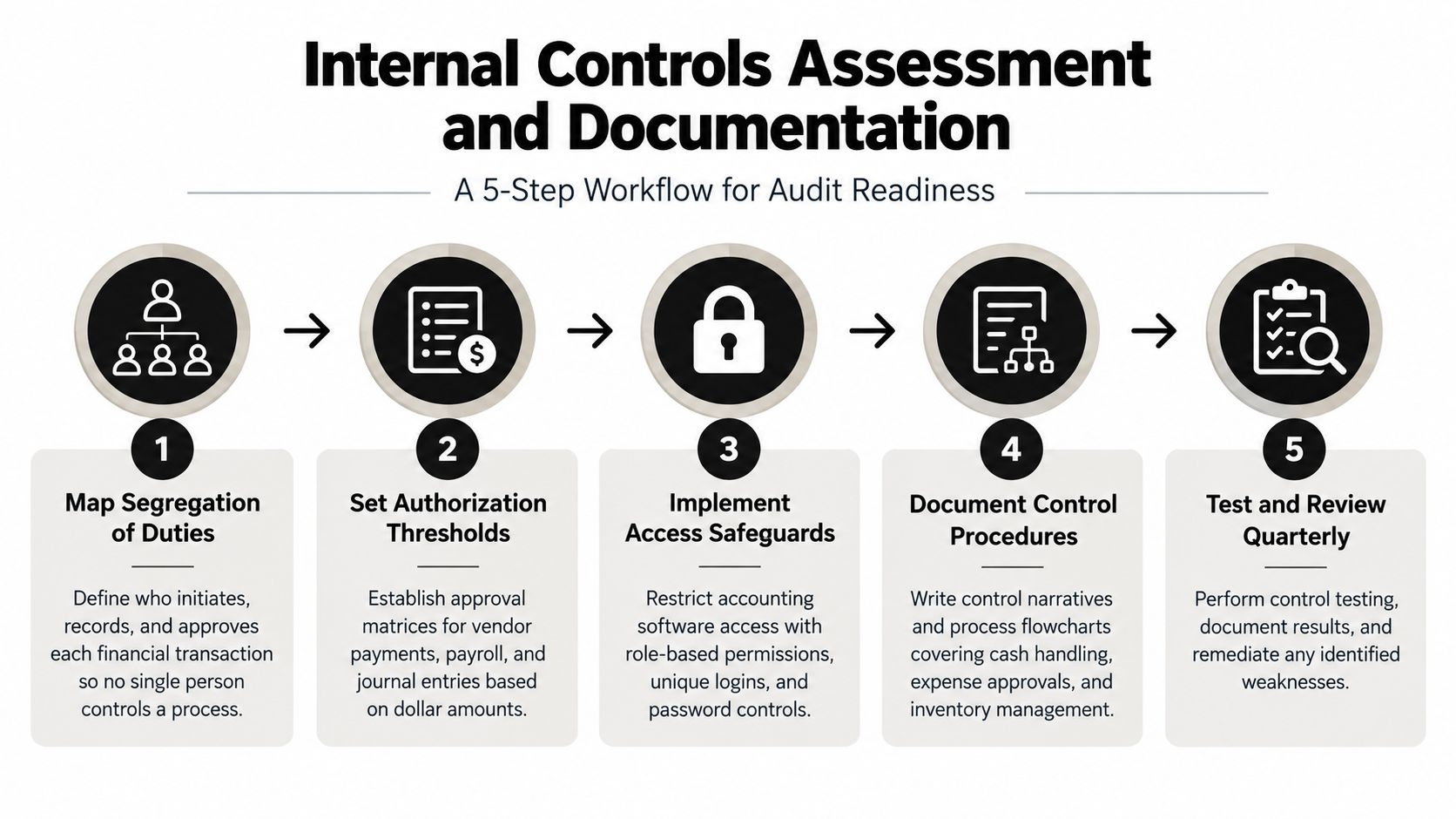
Internal controls don't need to look like a multinational corporation's policy manual. They need to address the risks your business faces and show that people follow the procedures. At minimum, document who can initiate, approve, record, and review cash movements, payroll, vendor payments, journal entries, refunds, credit memos, and system access.
Small businesses often can't achieve perfect segregation of duties with a small staff. That doesn't make controls impossible. An owner can review bank reconciliations, payroll registers, new vendors, and unusual journal entries while an employee handles routine processing. The trade-off is that the review must be documented and performed consistently, not treated as a verbal check-in.
Map risks to owners and evidence
Start with cash, payroll, purchasing, and vendor payments. For each area, record the risk, control activity, control owner, frequency, evidence produced, reviewer, and exception process. Control narratives and simple flowcharts can show how a transaction moves from request to approval, payment, recording, and reconciliation.
Industry examples make the design more concrete. A healthcare practice might require dual approval for sensitive patient billing entries and medication expenses. A construction company can compare time and material charges against job records. A nonprofit should protect donor restrictions and separate fundraising activity from administrative spending. A retailer can require independent verification of cash counts and inventory counts.
The benchmark matters because readiness becomes more useful when it can be measured. One GRC benchmark recommends bringing the unmapped-control rate below 3% and the artifact older-than-90-days rate below 15% before fieldwork. (Continuum GRC's audit-readiness benchmark) Use those thresholds as operational targets where they fit your environment, rather than as a substitute for judgment.
Test controls during the year. Save approval records, reconciliation sign-offs, access reviews, and remediation notes in a central evidence folder. When a control fails, document the exception, compensating control, responsible owner, and closure date.
4. Bank Reconciliation and Cash Flow Documentation
Cash is where accounting records meet an independent outside statement. A bank reconciliation should explain the difference between the book balance and the bank balance, identify timing items, and expose unauthorized, duplicated, or incorrectly recorded transactions. A reconciliation that exists only as an unexplained spreadsheet is less useful than one with supporting statements, outstanding-item detail, and reviewer sign-off.
Complete reconciliations promptly after statements arrive. Review deposits in transit, uncleared checks, merchant processor deposits, bank fees, transfers between accounts, and unusual withdrawals. A service business may need to reconcile credit card deposits to gross sales and fee deductions. A healthcare practice may compare patient deposits and insurance payments with explanation-of-benefits records. A construction company should connect job advances and periodic payments to contracts and bank activity.
Turn reconciliations into cash intelligence
Bank reconciliation is also a cash-flow control. Once the books are current, management can see whether cash is tied up in receivables, inventory, retainage, uncashed checks, or slow customer payments. That information supports payroll planning, vendor negotiations, borrowing decisions, and lender reporting.
Use QuickBooks bank feeds for initial transaction matching, but don't confuse automation with review. The feed can suggest a category. It can't decide whether an unusual payment is a legitimate subcontractor cost, a capital asset, an owner draw, or a duplicate.
A reconciliation tells you what happened to cash. A cash-flow forecast helps you decide what happens next.
Keep a sign-off process with a preparer and reviewer. Follow up on old outstanding items, document unusual transactions, and maintain a rolling schedule of expected receipts and disbursements. For a practical process, use this guide to reconcile bank accounts.
A fractional CFO adds value by turning reconciled data into decisions. The service isn't merely about matching transactions. It can help management understand liquidity, prepare for seasonal pressure, evaluate financing, and escalate exceptions before they become audit findings.
The following visual can help teams explain how control activities, reviews, and evidence fit together.
For another perspective on the workflow, review the embedded accounting controls video.
5. Payroll Tax and Employee Records Compliance
Payroll creates overlapping obligations. Your records should support time worked, wage calculations, overtime, deductions, benefits, employee classifications, tax deposits, quarterly filings, year-end forms, workers' compensation, and applicable state requirements. Payroll errors can affect employees directly, so auditors and regulators expect a clear trail from timekeeping to paycheck to tax filing.
Worker classification deserves special attention. A healthcare practice may use both employed clinicians and independent contractor physicians, but the records should explain why each arrangement is classified as it is. Construction companies may need documentation for union and non-union positions, subcontractor relationships, and job assignments. Nonprofits should distinguish genuine volunteers from people receiving compensation for services.
Reconcile payroll to the books
Payroll reports should tie to the general ledger every month. Investigate differences in gross wages, employer taxes, benefits, garnishments, and payroll liabilities. Keep copies of federal and state payroll tax returns, deposit confirmations, W-2 and 1099 records, and supporting timekeeping reports in an accessible location.
QuickBooks Payroll or similar software can automate calculations and reminders, but it won't resolve a weak process. Someone still needs to review employee setup, pay rates, overtime, benefit deductions, new hires, terminations, and unusual changes. A payroll tax deposit calendar should include responsible owners and backup coverage for holidays or staff absences.
Payroll control: The person who approves the payroll register shouldn't be the only person who can change employee bank details.
Review classifications regularly, retain written support for decisions, and resolve payroll liability balances instead of carrying unexplained amounts forward. A fractional CFO can coordinate payroll providers, bookkeepers, tax professionals, and owners so deadlines aren't lost between systems. That coordination is especially valuable for growing companies whose payroll has outgrown an owner-managed spreadsheet.
6. Fixed Asset Register and Depreciation Documentation
A fixed asset register answers basic questions an audit or lender will ask. What did the company buy? When was it placed in service? What did it cost? Where is it located? Which depreciation method applies? What accumulated depreciation has been recorded? What happened when the asset was sold, traded, damaged, or abandoned?
Without that register, businesses may expense capital purchases inconsistently, leave disposed assets on the books, or support depreciation with incomplete records. Construction companies often have equipment spread across job sites. Healthcare practices may own medical equipment, leasehold improvements, and specialized technology. Nonprofits may receive donated equipment that requires separate contribution and depreciation documentation.
Separate book and tax decisions
Book depreciation and tax depreciation don't always follow the same treatment. Document the capitalization policy, useful-life guidelines, depreciation method, placed-in-service date, and tax elections. Review Section 179 and bonus depreciation eligibility with the tax professional, then make sure the accounting records preserve the connection between the return and the underlying purchase.
A practical register can live in dedicated software or a carefully controlled spreadsheet. Include purchase invoices, financing records, serial numbers, locations, photographs, tags, disposal documents, and approval evidence. Reconcile the register to the general ledger and investigate differences during the year.
Bookkeeping and Accounting of Florida Inc. can help businesses establish fixed asset tracking that supports financial reporting, tax preparation, lender packages, and valuation discussions. Accurate assets improve more than audit support. They also help owners understand the capital tied up in equipment and whether replacement or financing decisions are affordable.
Don't overlook impairment or idle assets. If equipment no longer produces expected benefit, document management's assessment and any resulting accounting treatment. A physical count can also reveal assets that were moved, sold, or recorded twice.
7. Revenue Recognition and Customer Accounts Receivable Aging
Revenue deserves a written policy because the timing of recognition can change reported profit, receivables, deferred revenue, and covenant calculations. The policy should address when the business has delivered the promised product or service, how contracts are modified, what happens with refunds or credits, and how collectability is assessed.
Construction revenue may be recognized over a contract period or at milestone completion, depending on the arrangement and applicable accounting framework. A subscription company needs support for monthly recognition and deferred revenue. A healthcare practice should connect patient billing, insurance claims, contractual adjustments, collections, and bad-debt analysis. A nonprofit should document grant conditions and donor contribution pledges.
Keep the revenue trail intact
For significant or unusual transactions, retain the contract, invoice, delivery or completion evidence, approval, payment record, and accounting analysis. Auditors may test revenue around period-end, so cutoff procedures matter. Make sure invoices recorded before the close relate to goods delivered or services performed under the policy.
Review the accounts receivable aging regularly, not just before year-end. A balance that has remained unpaid may require collection activity, a reserve, a write-off, or a discussion with management. The allowance for doubtful accounts should have a documented rationale based on customer history, current circumstances, and known disputes.
Analyze revenue by customer, product, service line, location, or contract type. Unexpected changes don't automatically mean something is wrong, but they deserve an explanation. A fractional CFO can help management connect revenue reporting with pricing, capacity, customer concentration, contract profitability, and cash collection.

The strongest revenue file lets a reviewer trace a transaction from signed agreement to performance evidence, invoice, receivable, collection, and final general ledger entry.
8. Debt Obligations and Loan Documentation Management
Debt records often become fragmented across email, lender portals, closing binders, and the bookkeeping system. Bring them together in a debt register that lists each loan, line of credit, equipment note, lease obligation, lender, principal balance, interest terms, payment schedule, maturity date, collateral, covenants, and reporting requirements.
Construction companies may carry several equipment loans and revolving lines of credit. Healthcare practices may have equipment financing and real estate mortgages. Businesses with SBA loans need to preserve agreements and satisfy specific lender reporting obligations. Nonprofits should consider how restricted funds and donor requirements affect borrowing capacity and permitted use of proceeds.
Reconcile debt monthly
Compare recorded principal and interest with lender statements. Separate current and long-term portions where applicable, record accrued interest, and document fees or refinancing costs according to the relevant accounting treatment. Keep original agreements, amendments, payment schedules, guarantees, security agreements, and covenant calculations together.
A debt calendar helps prevent missed payments and reporting deadlines. Covenant monitoring should happen before a breach, not after a lender asks about it. If a business expects pressure, communicate with the lender early and preserve the correspondence and any waiver or amendment.
Debt information also improves decision-making. A lender-ready financial package should explain obligations, cash requirements, collateral, and repayment capacity. A fractional CFO can model refinancing, early payoff, additional borrowing, and covenant effects using current books rather than rough estimates.
Lender-ready test: You should be able to answer what you owe, when it is due, what secures it, and which financial conditions you must maintain without searching through old emails.
8-Point Audit Readiness Comparison
| Item | Implementation complexity 🔄 | Resource requirements ⚡ | Expected outcomes ⭐📊 | Ideal use cases 💡 | Key advantages 📊 |
|---|---|---|---|---|---|
| Financial Records Organization and General Ledger Review | High, extensive cleanup and monthly maintenance 🔄 | Moderate, accounting software (QuickBooks) + bookkeeper/CFO ⚡ | High, clean books, faster audits, accurate reporting ⭐📊 | Small businesses with disorganized records (retail, construction, non‑profit) 💡 | Streamlines close, reduces audit time/costs, improves decision data 📊 |
| Tax Compliance Documentation and Current Year Tax Law Changes | Medium–High, continuous monitoring and updates 🔄 | High, tax expertise (CPA/CFO), subscriptions, tax software ⚡ | High, reduced penalties, optimized deductions, audit defensibility ⭐📊 | Businesses affected by recent tax law changes, multi‑state operations, credit claims 💡 | Minimizes tax risk, captures credits, documents tax positions for auditors 📊 |
| Internal Controls Assessment and Documentation | Medium, process mapping, control design, testing 🔄 | Moderate, staff time, documentation tools, periodic testing ⚡ | High, lower fraud/error risk, reduced audit scope ⭐📊 | Cash‑intensive or growing businesses lacking formal controls 💡 | Prevents fraud, demonstrates competent management, streamlines audits 📊 |
| Bank Reconciliation and Cash Flow Documentation | Low–Medium, routine monthly process with timely follow‑up 🔄 | Low, bank access, reconciler + reviewer, reconciliation tools ⚡ | High, accurate cash position, early fraud detection ⭐📊 | Businesses with frequent bank activity or tight cash management needs 💡 | Detects discrepancies, prevents overdrafts, improves cash forecasting 📊 |
| Payroll Tax and Employee Records Compliance | High, multi‑jurisdictional rules and ongoing updates 🔄 | High, payroll software, HR/payroll expertise, tax deposit systems ⚡ | High, reduced payroll penalties, defensible worker classifications ⭐📊 | Employers with many employees/contractors or multi‑state payrolls 💡 | Ensures payroll/legal compliance, lowers audit and litigation risk 📊 |
| Fixed Asset Register and Depreciation Documentation | Medium, detailed registers, useful‑life estimates, reconciliations 🔄 | Moderate, asset tracking tools, physical counts, accounting oversight ⚡ | Medium–High, accurate depreciation, reliable balance sheet reporting ⭐📊 | Asset‑heavy firms (construction, healthcare, manufacturing) 💡 | Proper depreciation, tax planning (Section 179/bonus), valuation support 📊 |
| Revenue Recognition and Accounts Receivable Aging | Medium–High, contract analysis and ASC 606 application 🔄 | Moderate, contract management, AR processes, accounting expertise ⚡ | High, correct revenue reporting, improved collections, audit support ⭐📊 | Long‑term contracts, subscription models, businesses with material AR 💡 | Prevents revenue misstatement, strengthens cash collection and audit evidence 📊 |
| Debt Obligations and Loan Documentation Management | Medium, centralized tracking and covenant monitoring 🔄 | Moderate, debt register, lender files, finance oversight ⚡ | High, accurate liabilities, covenant compliance, reliable cash planning ⭐📊 | Businesses with multiple loans/leases or covenanted financing (SBA loans) 💡 | Prevents covenant breaches, supports refinancing decisions, ensures timely payments 📊 |
Turn the Checklist Into a Monthly Operating System
An audit readiness checklist works only when ownership is visible. Create an ownership matrix for each control and recurring task. Name the preparer, reviewer, backup, due date, evidence location, and escalation contact. If a task is assigned to “accounting,” it isn't assigned. A person needs to know what they own and what finished work looks like.
Use a recurring calendar that matches the pace of the business. Monthly work should include bank and credit card reconciliations, payroll-to-ledger reconciliation, accounts receivable review, accounts payable review, debt reconciliation, unusual transaction review, and document filing. Quarterly work can include control testing, access reviews, estimated tax analysis, fixed asset reconciliation, covenant calculations, and management reporting. Annual work should include chart-of-accounts review, worker classification review, policy approvals, physical asset verification, tax planning, and a readiness assessment.
Score maturity and prioritize gaps
A useful self-assessment framework scores documentation completeness, reconciliation currency, control evidence, data lineage clarity, and issue-resolution speed from 1, ad hoc, to 5, continuous, creating a composite range of 5 to 25. (OneTribe Advisory's internal-controls framework) The point isn't to chase a perfect score. It's to find the weakest dimension and connect corrective work to a specific owner and deadline.
This approach is more effective than a generic folder of documents. Public checklists often list records but don't explain who owns a control, how often it must be tested, or how quickly evidence should be produced during fieldwork. Recent readiness guidance emphasizes year-round ownership, monthly monitoring, and evidence retrieval speed. (Elevate Consulting's monthly audit-readiness guidance)
Match the checklist to the business
A healthcare practice needs attention to patient billing, access, privacy-related procedures, payer records, and sensitive expenses. Construction companies need job costing, contract changes, retainage, equipment, payroll, and subcontractor documentation. Retail businesses need inventory, cash handling, merchant deposits, and shrinkage procedures. Nonprofits need donor restrictions, grant support, board approvals, Form 990 records, and program expense allocation.
Don't blend every audit type into one generic checklist. Financial audits, SOC 2-style reviews, IT audits, healthcare compliance assessments, and lender examinations require different evidence. Commonly missed areas include formal policy approvals, access reviews, vendor management, backup and restore testing, corrective-action closure, and proof that controls operated rather than merely existed on paper. (Secure's SOC 2 readiness assessment checklist)
Companies without enough in-house accounting depth should consider outside support before an audit date is fixed. Bookkeeping and Accounting of Florida Inc. can help organize records, maintain compliant books, prepare tax documentation, support payroll and reconciliations, conduct internal and independent audit work, and provide fractional CFO guidance for cash flow, reporting, planning, and decisions. Every company may not need a full-time CFO, but growing companies do need someone accountable for turning financial information into timely action.
Schedule a readiness review with Bookkeeping and Accounting of Florida Inc. if your books are behind, tax-law monitoring is inconsistent, lender reporting takes too long, or no one owns the control calendar. Visit AurenWell's invoice software guide for contractors if invoicing is part of the documentation problem, then contact the accounting team to connect billing, bookkeeping, compliance, and financial oversight into one operating process.
Bookkeeping and Accounting of Florida Inc. offers bookkeeping, payroll, tax preparation, audit support, QuickBooks ProAdvisor services, healthcare accounting, nonprofit reporting, and fractional CFO guidance for growing companies. Visit Bookkeeping and Accounting of Florida Inc. to request a readiness review, organize your records, and build a monthly accounting system that supports compliance, cash flow, and better business decisions.