
If you're running your first payroll, it probably doesn't feel like “administration.” It feels like juggling a calculator, a stack of forms, a time sheet that came in late, and the quiet fear that one wrong click is going to annoy an employee, trigger a notice, or both.
Thank you for reading this post, don't forget to subscribe!That feeling is normal. Payroll looks simple from the outside because employees only see the paycheck. You, unfortunately, have to deal with everything behind it. Hours, rates, taxes, deductions, deadlines, records, and the awkward cleanup when something goes sideways. That's why the basics of payroll processing matter so much for Florida small businesses. Payroll isn't a clerical chore. It's a compliance system with cash flow consequences.
Why Getting Payroll Right Is Not Optional
A Jacksonville business owner hires a few employees, sets up direct deposit, and figures payroll can't be that complicated. Then the first pay run arrives. One employee forgot to submit hours. Another changed bank accounts. Someone's withholding form doesn't match what's in the system. Suddenly “just paying the team” turns into a mini audit you didn't ask for.
That's the part most owners underestimate. Payroll isn't only about moving money. It's about proving that the money was calculated correctly, withheld correctly, filed correctly, and documented correctly.
Payroll errors don't stay small
Employees notice payroll mistakes fast, and they take them personally. They should. If your team did the work, they expect to be paid accurately and on time. According to PayNW's payroll overview for managers, 49% of U.S. workers consider a new job after just two payroll errors. That is a brutal reminder that payroll mistakes don't just create accounting problems. They create retention problems.
Practical rule: If payroll feels “good enough,” it probably isn't. Good enough doesn't survive an employee complaint, a tax deadline, or a records request.
For owners already wearing six hats, payroll becomes the hat that catches fire first. It touches HR, tax compliance, employee trust, and your books. If you're already dealing with grant tracking or restricted funds on the nonprofit side, you can see a similar compliance mindset in nonprofit fund accounting guidance. Different rules, same principle. The details matter because the reporting matters.
Think of payroll as business protection
The better way to view payroll is simple. You're not just paying people. You're protecting the business from preventable errors that can spill into taxes, morale, and cash flow. That's why experienced owners stop treating payroll like a side task once headcount grows, benefits kick in, or remote workers enter the picture.
If you want fewer surprises, start by respecting payroll for what it is. A control function. Not a Friday errand.
What Payroll Processing Actually Involves
Payroll is the foundation of the house, not the paint color. If the foundation is crooked, every room above it starts to show cracks. Your books get messy, tax filings stop matching, and employees lose confidence.
The basics of payroll processing start with one core truth. Payroll is a regulated sequence, not a single action. As explained in Sage's payroll processing guide, payroll requires accurate employee information, hours worked, gross pay calculation, deductions, and reporting to tax authorities. A single missing timesheet or outdated tax record can affect wages, filings, and employee trust in the same pay cycle.
What sits inside a payroll run
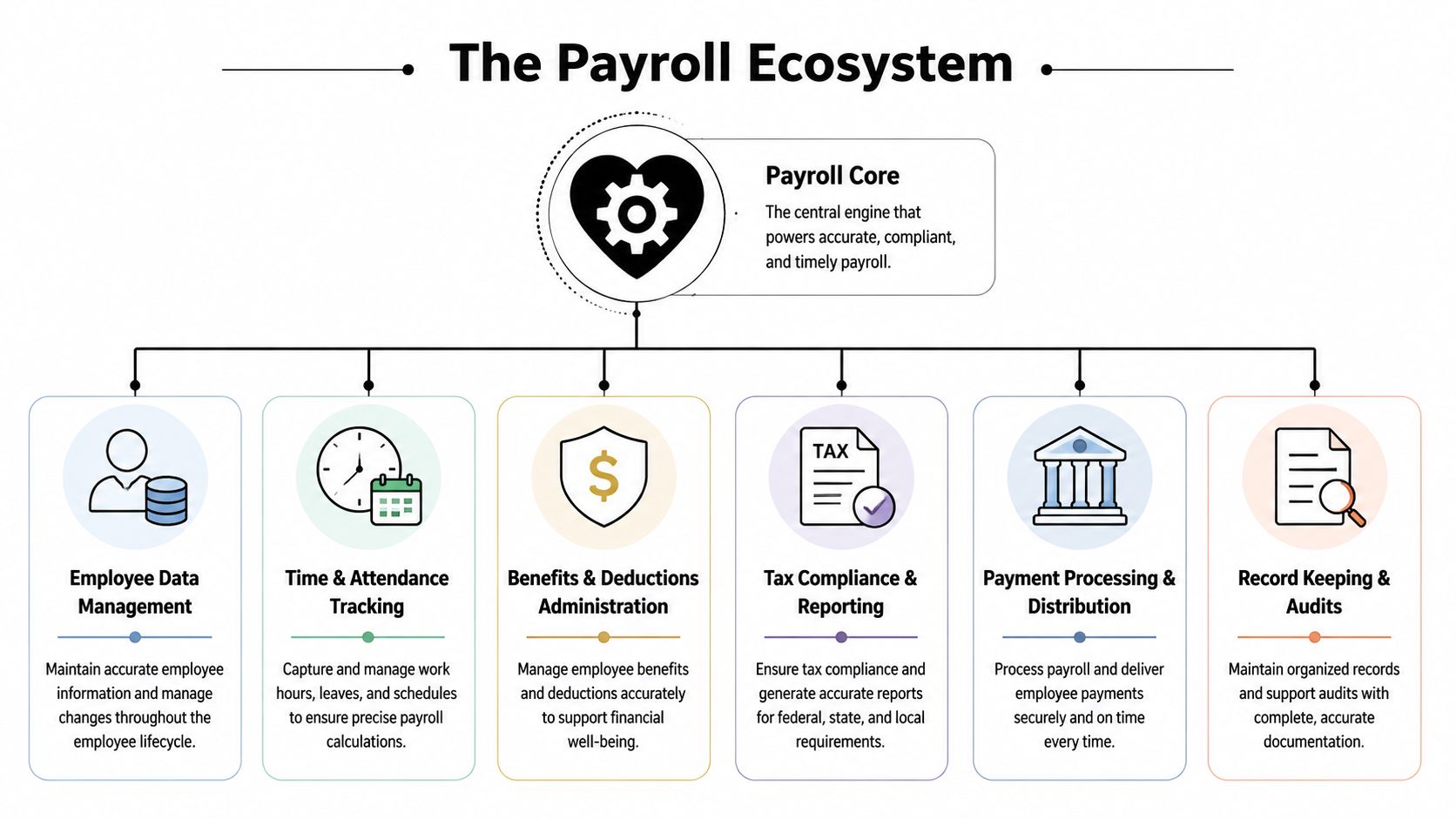
A proper payroll process usually includes several moving parts:
- Employee data: Legal name, address, tax forms, pay rate, status, and payment details.
- Time and attendance: Hours worked, overtime, paid time off, bonuses, and other earning inputs.
- Gross pay calculation: Wages before deductions.
- Deductions: Taxes, benefits, retirement contributions, garnishments, and other authorized withholdings.
- Net pay distribution: Direct deposit or other approved payment methods.
- Reporting and records: Payroll tax filing, payslips, journals, and retention of support documents.
None of that is optional. If one piece is wrong, the rest of the chain gets contaminated.
Why clean inputs matter more than clever software
Owners sometimes assume software will save them from bad data. It won't. Software is a fast calculator, not a mind reader. If the timesheet is wrong, the paycheck will be wrong faster.
That's one reason practical operations advice still matters. If you want another operational perspective, Paradigm International payroll insights are useful because they reinforce the process side of payroll, not just the software side.
Payroll works like bookkeeping. Garbage in, garbage out. The difference is that payroll errors upset actual humans by payday.
Why owners get tripped up
Most entrepreneurs are smart enough to build a business, but payroll asks a different question. Can you maintain a repeatable system that handles changing hours, changing deductions, and filing requirements without dropping a stitch?
That is why payroll deserves professional discipline. You're handling sensitive employee and tax data every pay cycle. Treat it like the back-office equivalent of surgery prep, not like ordering printer paper.
The Three-Stage Payroll Processing Workflow
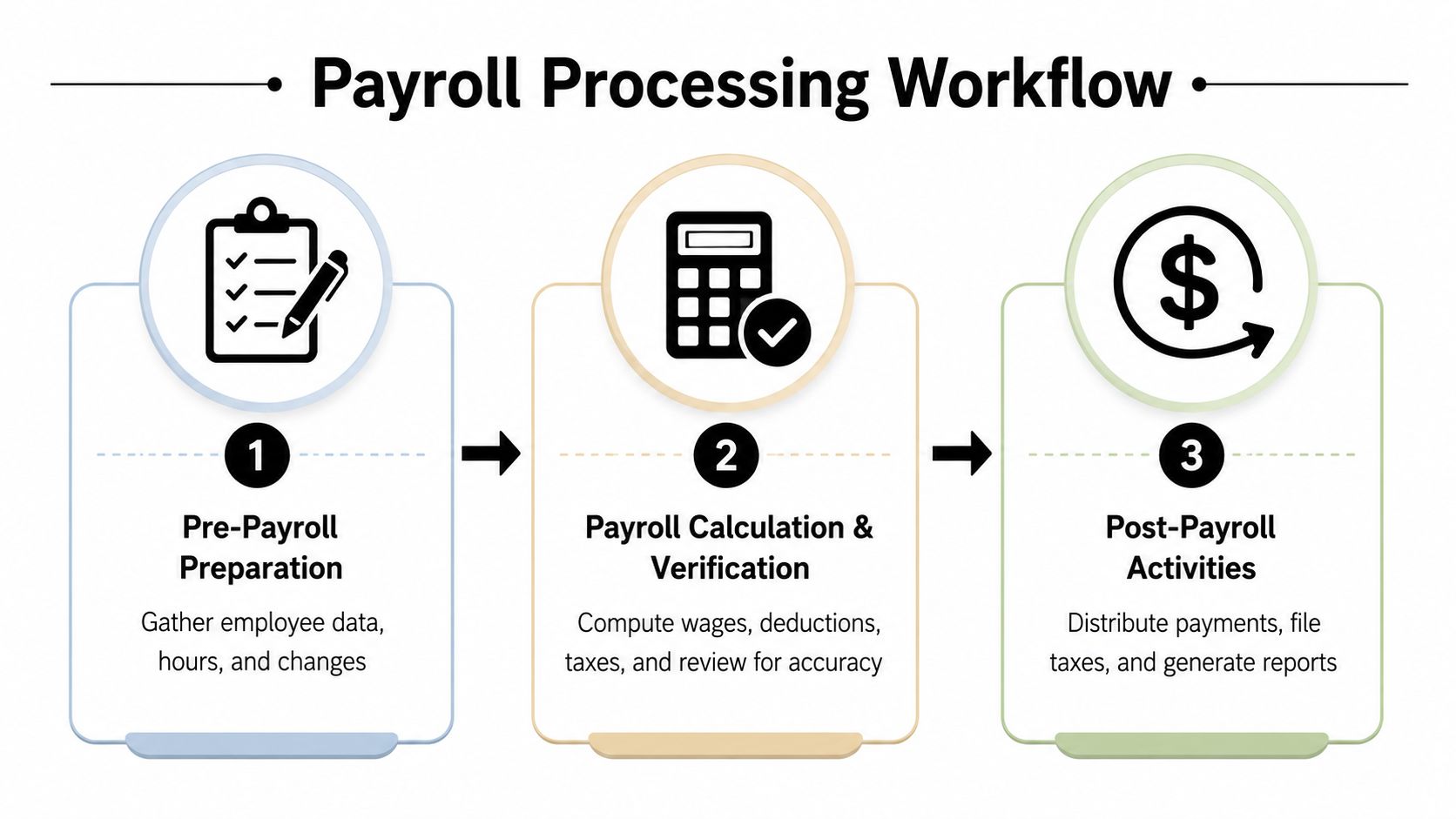
The cleanest way to understand payroll is to split it into three stages. That keeps you from treating payday like the whole event when it's really the middle of the story.
Start with preparation. Then calculation. Then cleanup and compliance.
Pre-payroll preparation
Without proper foundational data, most small businesses encounter payroll trouble. Before you run anything, you need verified employee details, pay rates, tax forms, approved hours, overtime records, PTO data, and any changes to deductions or benefits.
According to Vantage Circle's payroll processing discussion, failing to validate input data like timesheets and tax forms can lead to a 15 to 20% increase in post-payment errors and tax penalties. That's why pre-payroll review isn't “extra work.” It's the work that saves you from rework.
Use a short pre-run checklist:
- Confirm people data: Names, addresses, tax forms, and direct deposit details.
- Review labor inputs: Timesheets, overtime approvals, bonuses, and leave.
- Check changes: New hires, terminations, pay rate updates, benefits elections.
Payroll calculation and verification
Once the inputs are clean, the actual run becomes much less dramatic. This stage includes calculating gross pay, applying taxes and deductions, and arriving at net pay. For hourly employees, accuracy matters even more because missed hours and overtime mistakes show up immediately.
A quick walkthrough helps:
- Salaried employees generally follow a set pay schedule.
- Hourly employees depend on accurate time tracking and approved hours.
- Deductions have to be applied correctly and consistently.
- Final review should happen before funds are released.
If your team needs a simple visual explanation, this short video does a decent job of showing the flow without burying you in jargon:
Post-payroll activities
This is the stage owners skip, and skipping it is a mistake. After the pay goes out, you still have to handle filings, record retention, payroll journal entries, and reconciliation.
Owner advice: Payday is not the finish line. It's the handoff from payroll processing to payroll verification.
Post-payroll should include at least these actions:
- Distribute records: Make sure employees receive the proper pay information.
- File required taxes: Deposit and report payroll taxes on the correct schedule.
- Reconcile entries: Match payroll totals to your accounting records.
- Store support: Keep payroll records organized and audit-ready.
Think of payroll like a manufacturing line. Quality control at the end doesn't fix bad raw materials, but it can catch defects before they become a bigger financial mess.
Navigating Federal and Florida Payroll Compliance
Florida owners usually start with a dangerous assumption. “I only have a few employees, so payroll compliance can't be that complicated.” It can. Small headcount doesn't reduce legal requirements. It just reduces your margin for error.
At the federal level, payroll compliance generally means handling employee tax withholding, employer payroll tax obligations, reporting, and timely deposits. In Florida, you also need to pay attention to state-specific employer obligations such as reemployment-related payroll requirements. If you have hourly workers, commissioned employees, or benefit deductions, complexity rises fast.
Tax law changes don't wait for you to catch up
Payroll is not a set-it-and-forget-it system. Rules change, forms change, and deduction workflows change. One example matters right now. As noted in ADP's payroll processing resource, the SECURE 2.0 Act will require automatic enrollment for many new 401(k) plans starting in 2025, which adds another payroll deduction workflow that many business owners never planned for.
That's the practical lesson. Benefits administration and payroll aren't separate planets. If retirement plan setup changes, payroll setup changes too.
Hybrid and remote work complicate everything
A remote worker in another state may trigger registrations, tax handling differences, and process changes you didn't have when everyone sat in one Florida office. Such situations can cause DIY payroll to wobble.
Keep your eye on these issues:
- Worker location: Where the employee performs work can change payroll obligations.
- Registration requirements: Hiring outside Florida can create additional tax setup steps.
- Benefit setup: Deductions have to be configured correctly from the start, not patched in later.
- Documentation: Every state and federal requirement depends on accurate records.
A simple rule works well here. The moment your payroll crosses state lines, stop guessing.
What smart owners do
They don't try to become part-time payroll attorneys at midnight. They build a process, use reliable systems, and get expert oversight when the rules start moving faster than the business owner can.
Compliance isn't about paranoia. It's about avoiding the expensive kind of improvising.
Common Payroll Pitfalls and How to Avoid Them
Most payroll mistakes aren't random. They're symptoms of a sloppy process. Bad onboarding creates bad setup. Bad setup creates bad payroll. Bad payroll creates cleanup work you didn't budget for.
And the ugly part often shows up after employees have already been paid.
The mistakes that keep recurring
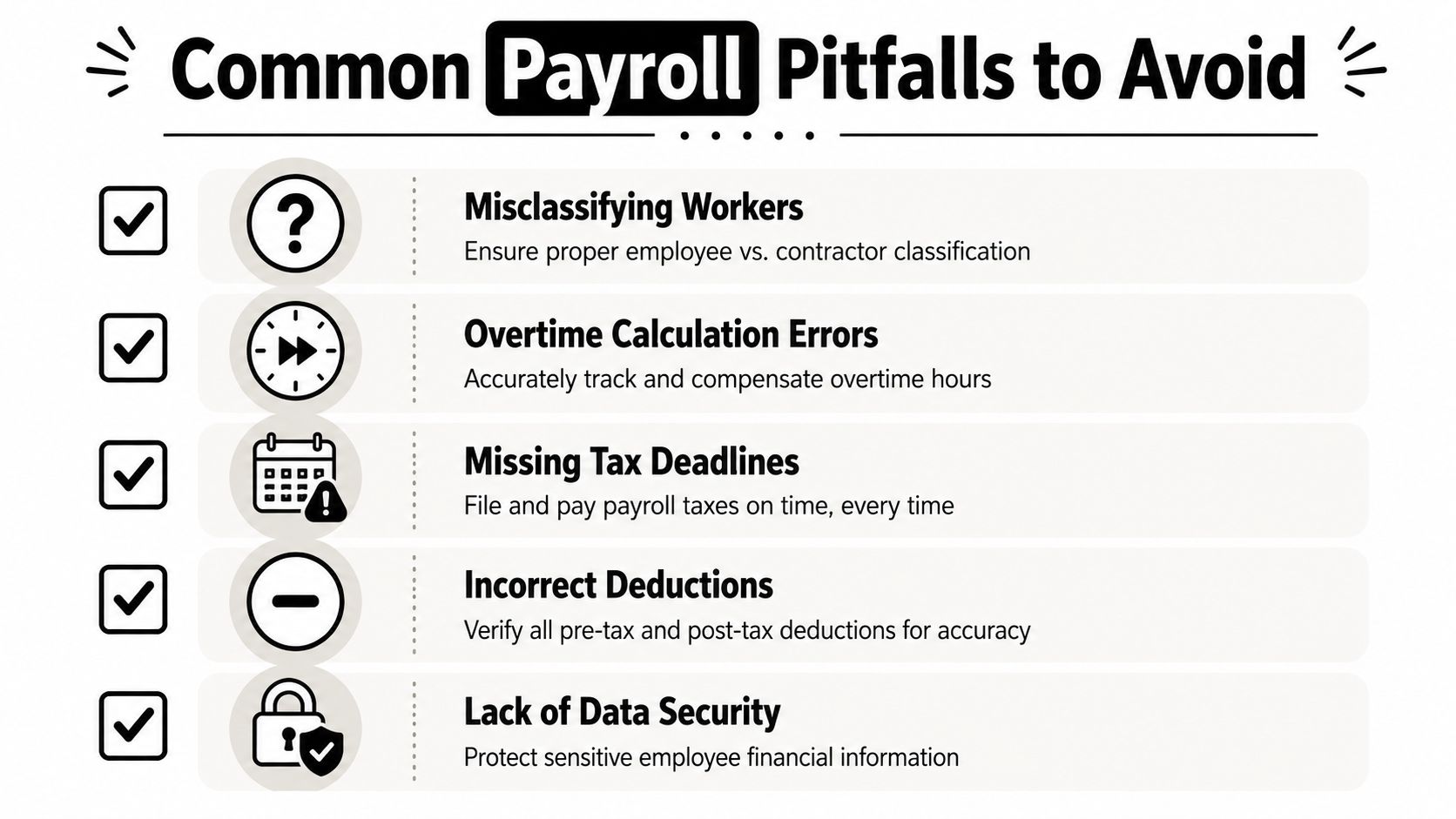
Some payroll errors show up so often they're basically classics:
- Worker classification confusion: Paying someone like a contractor when the facts say employee.
- Overtime problems: Missing hours, wrong rates, or poor approvals.
- Deduction mistakes: Benefits or other withholdings entered incorrectly.
- Missed deadlines: Taxes filed or paid late.
- Weak security: Payroll data stored or shared carelessly.
Misclassification deserves special attention because it spills into payroll tax, benefits, and reporting. If that's even remotely a concern in your business, review payroll or contractor misclassification risks before it turns into a larger mess.
The part most owners forget after payday
A lot of basic payroll articles act like the job ends when direct deposit lands. It doesn't. The costlier issues often show up in reconciliation and reporting. Lano's payroll processing overview points out the importance of post-payroll tasks, and it notes that the IRS automated underreporter program proposed $32.8 billion in adjustments for 2022. That should get your attention.
What to review after every payroll run:
| Check | What you're looking for |
|---|---|
| Payroll register | Do totals match expectations for wages and deductions? |
| General ledger posting | Did payroll hit the right expense and liability accounts? |
| Tax liabilities | Are withholdings and employer obligations recorded correctly? |
| Employee exceptions | Any odd net pay, duplicate hours, or missing deductions? |
If you don't reconcile payroll to the books, you're not done. You're just postponing the argument.
Practical fixes that prevent repeat problems
Use symptom-and-solution thinking:
- If hours keep changing late, lock approval deadlines and require manager signoff.
- If deductions keep drifting, review benefit setup whenever an employee status changes.
- If you hire in risky industries, make sure insurance and payroll records align. For businesses reviewing coverage options, it can help to get workers comp quotes alongside payroll process reviews so classification and payroll assumptions are consistent.
- If quarter-end corrections keep happening, your setup process is weak, not unlucky.
Good payroll teams don't just process transactions. They investigate anomalies. That's how small mistakes stay small.
In-House Payroll vs Outsourcing to an Expert
Some businesses should run payroll in-house. Most growing businesses shouldn't. That's my opinion, and it's based on what owners consistently get wrong. They count the software fee, but they don't count their own time, the cleanup work, or the cost of one preventable compliance mistake.
If you have a tiny team, stable salaries, no multi-state complexity, and someone internally who understands payroll controls, in-house can work. Once headcount grows or payroll gets uneven, DIY starts costing more than it appears.
Decision Matrix In-House vs Outsourced Payroll
| Factor | In-House Payroll (DIY/Software) | Outsourced Payroll (CPA Firm) |
|---|---|---|
| Time commitment | Owner or staff must gather data, review, process, file, and reconcile | Much of the processing and oversight moves off your plate |
| Expertise required | You need working knowledge of payroll taxes, deductions, deadlines, and records | You rely on specialists who already work inside those rules |
| Compliance liability | You still carry the risk if setup or filings are wrong | Risk doesn't disappear, but expert review usually reduces preventable errors |
| Scalability | Gets harder as benefits, remote workers, and pay variations increase | Easier to adapt as payroll complexity grows |
| Visibility into books | Often disconnected unless accounting is integrated well | Can be tied more closely to bookkeeping, reporting, and tax planning |
| Owner focus | Pulls attention into admin work | Frees time for sales, operations, and hiring |
The real question is where your time belongs
Owners often say, “I can do payroll myself.” Sure. You can also cut your own hair. That doesn't make it a good growth strategy.
In-house payroll makes sense when the process is simple and someone internally owns it with discipline. Outsourcing makes sense when the business needs reliability, cleaner books, and fewer compliance surprises. That's why some firms use payroll software plus outside oversight. Others hand off the whole function.
For Florida businesses that want payroll tied directly into bookkeeping and financial reporting, Bookkeeping and Accounting of Florida Inc. is one option because the firm handles payroll alongside accounting, tax, and broader financial support. That matters when you want payroll to match the books instead of living in its own little universe.
A blunt recommendation
If payroll interruptions pull you away from customers, if quarter-end cleanup is routine, or if your accountant is constantly fixing what your payroll system exported, you're past the point where DIY is “saving money.”
You're subsidizing complexity with your own time.
Beyond Processing When a Fractional CFO Is Your Best Payroll Ally
Payroll processing is tactical. Payroll strategy is financial leadership.
That distinction matters more than owners realize. A payroll clerk or software platform can help process wages. A fractional CFO asks tougher questions. Can your cash flow support headcount growth? Are compensation decisions aligned with margins? Are benefit deductions, payroll timing, and tax obligations structured in a way that supports the business instead of surprising it?
Payroll affects more than payroll
When payroll grows, it touches nearly every financial lever in the company:
- Cash flow planning: Payroll is often the largest recurring outflow.
- Hiring decisions: New compensation commitments affect runway and pricing.
- Benefit administration: Deductions need to work operationally and financially.
- Compliance oversight: Payroll mistakes can spill into tax, labor, and audit issues.
- Forecasting: Headcount planning without payroll modeling is guesswork in nicer clothes.
That's where a fractional CFO becomes useful. Not because they push buttons in payroll software, but because they connect payroll to the full financial picture.

When you need more than a processor
A few signs stand out:
- You're hiring faster than your systems are maturing
- Your payroll data doesn't line up cleanly with your financial statements
- You're adding benefits, remote workers, or new entities
- You want guidance, not just transaction processing
If that's where you are, learn what fractional CFO services cover. For many small and midsize businesses, this is the missing layer between basic payroll administration and real financial control.
A good fractional CFO doesn't just help you pay people correctly. They help you decide when, how, and whether the business can afford to add more people in the first place.
That's the bigger point behind the basics of payroll processing. At some stage, payroll stops being an admin problem and becomes a leadership issue. When that happens, expert oversight isn't overhead. It's infrastructure.
If payroll is eating your time, creating compliance stress, or leaving your books messy after every pay run, Bookkeeping and Accounting of Florida Inc. can help you put structure around it. The firm supports Florida businesses with payroll, bookkeeping, tax, and fractional CFO guidance so payroll doesn't keep turning into a monthly fire drill.