
You can have full crews booked solid, invoices out the door, and still feel the cash pinch every Friday. That's the contractor trap, the job looks profitable, the bank balance says otherwise, and payroll doesn't care that retainage is still sitting on someone else's desk. Good bookkeeping for contractors is the difference between knowing your margin and guessing at it.
Most owners don't need prettier reports. They need books that tell the truth about job costs, billing timing, and when cash is available to spend. If your current setup can't separate earned revenue from collected cash, it's already failing you.
Why Contractor Bookkeeping Is Nothing Like Regular Bookkeeping
A contractor can land a $200,000 job, look profitable on paper, and still miss payroll because retainage of 5% to 10% is being withheld until final completion, which means $10,000 to $20,000 can be tied up on that job alone. That's not a bookkeeping nuisance, it's a cash timing problem that regular small-business accounting never had to solve. Construction bookkeeping evolved because the work is earned in phases, billed in stages, and collected later, often much later.

The numbers tell the real story
The labor market reflects that specialization. The U.S. Bureau of Labor Statistics reported 1,501,910 bookkeeping, accounting, and auditing clerks in May 2023, with a mean annual wage of $49,580 and a median annual wage of $47,440. In the construction-adjacent industry category Building Equipment Contractors, the same occupation employed 41,630 workers at a mean annual wage of $50,970. In accounting, tax preparation, bookkeeping, and payroll services, the occupation employed 97,770 clerks at a mean annual wage of $49,330. Those figures show scale, but they also show why contractor books are a niche discipline, not generic admin work. BLS occupation data for bookkeeping clerks
The core mismatch is simple. You can earn revenue before you collect it, bill before the job is fully complete, and carry retainage that's technically yours but not usable. If your books don't track labor coding, progress billing, and job-level margin control, you're flying blind.
Practical rule: If a job can be profitable on paper while your bank balance is shrinking, your bookkeeping system is too generic for construction.
The industry-specific systems outperform the generic ones for a reason. The Construction Financial Management Association's 2023 Financial Survey found that contractors using industry-specific accounting systems were 76% more likely to report improved project profitability, compared with 34% for firms using general accounting software. That gap is the whole game. Construction accounting and profitability survey context
A contractor's books should tell you three things every week. What was earned, what was billed, and what cash is still trapped in the pipeline. If your bookkeeping setup can't answer those questions cleanly, it isn't protecting profit, it's hiding problems.
Building a Construction Chart of Accounts That Actually Works
A generic chart of accounts blurs the line between job costs and overhead, and that's how contractors fool themselves into thinking jobs are profitable when they aren't. A construction-ready chart of accounts needs to separate direct costs from overhead and then push every direct cost into a job number, phase, or cost code. That means labor, materials, subcontractors, equipment, permits, and job-specific expenses each get their own lane. For a practical setup model, see chart of accounts setup for construction.
Build the structure around the job, not the bank feed
Start with a unique job number for every contract. Break the work into phases, then map each phase to cost codes that mirror how the field works. Payroll should hit jobs every pay period, not sometime later when the books feel convenient.
Bottom line: If a dollar can't be tied back to a job, it belongs in overhead until proven otherwise.
Here's the difference between a sloppy setup and a workable one.
| Category | Generic Setup | Construction-Optimized Setup |
|---|---|---|
| Labor | Wages | Wages by job, phase, and crew |
| Materials | Office supplies, materials | Materials by project and phase |
| Subcontractors | Contract labor | Subcontractors tied to job number |
| Equipment | Vehicle expense | Equipment by job or overhead, depending on use |
| Permits | Licenses and fees | Permits coded to the specific project |
| Overhead | Miscellaneous expense | Office rent, admin payroll, insurance, and other true overhead |
That structure matters because every direct cost should support job costing, not disappear into a catch-all expense bucket. Best-practice guides also emphasize time tracking by job, payroll mapping each pay period, and comparing actual job profit against estimates in the job P&L. Construction bookkeeping essentials
QuickBooks can work if it's set up properly. Classes, locations, and project tracking should mirror how your crews and estimators think, not how a tax preparer thinks in April. If you're using finance partners to bridge payment timing, it's also worth understanding how factoring solves cash flow, because the right accounting structure helps you see whether short-term funding is addressing the core issue or just masking bad billing.
The wrong chart of accounts creates false confidence. The right one shows margin leakage while there's still time to fix it.
Mastering Progress Billing and Retainage Without Losing Cash Visibility
A contractor can do everything right in the field and still look cash poor because the billing cycle lags the work. Progress billing helps, but it doesn't eliminate the gap between earned revenue and collected cash. Retainage makes that gap worse because a portion of each payment sits outside your available cash until the job closes.
On a $200,000 project with 10% retainage, $20,000 is withheld until final completion. That money is earned, but it isn't usable working capital. If your dashboard treats it like normal receivables, you'll overstate your cash position and understate the risk.
Record the timing, not just the amount
Progress billing should be tied to milestones, and retainage should live in a separate receivable account. That way, billed-but-uncollected amounts don't get mixed up with cash you can spend. The major mistake I see is contractors posting everything as one lump in accounts receivable, then wondering why the bank balance doesn't match the P&L.
Treat retained cash as promised money, not available money.
Change orders need the same discipline. If work starts before approval, the cost still hits the job, but the revenue side should be handled carefully so the job cost report doesn't get polluted with phantom profit. That's where work-in-progress tracking matters more than simple invoice tracking.
For a clean system, your reports should separate these buckets:
- Earned revenue, the portion of the contract completed.
- Billed revenue, the amount invoiced to the client.
- Retainage receivable, the amount withheld but still owed.
- Collected cash, what's in the bank.
That separation is what keeps profitable jobs from turning into cash emergencies. It also helps you see when a project is temporarily cash-negative, even though the margin is healthy. If you want the software side of that workflow, QuickBooks for construction companies can work well when it's configured for retainage, progress billing, and project-level reconciliations instead of generic invoicing.
A profitable contractor who ignores billing timing is still at risk. A profit-and-cash dashboard that separates earned revenue from collected cash gives you the visibility to finance payroll, materials, and subcontractors without guessing.
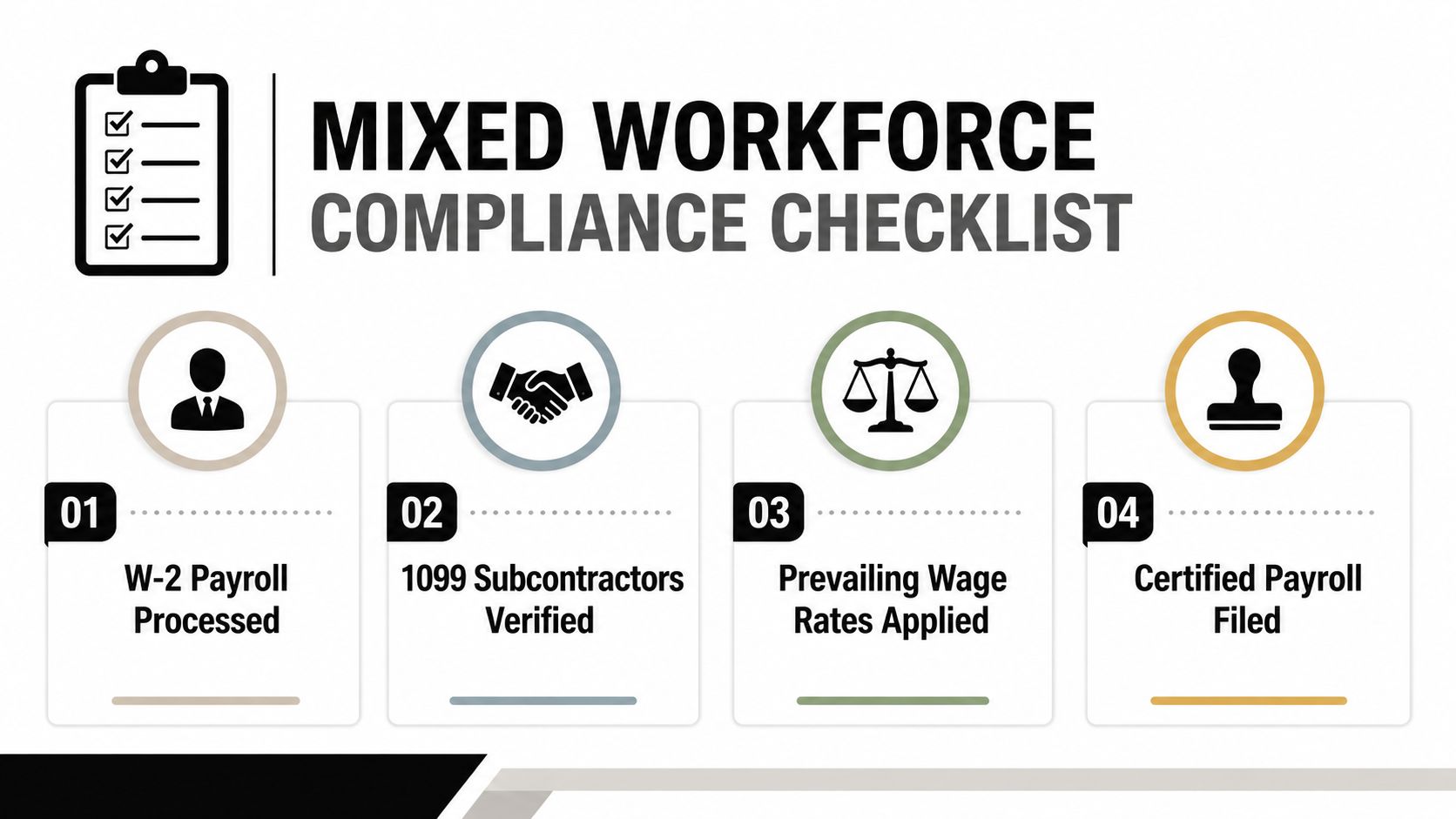
Payroll and 1099 Compliance for Contractors With Mixed Workforces
Contractors live in the messiest workforce environment in small business. One crew has W-2 employees, another job uses subcontractors, and a government contract may pull in prevailing-wage or certified payroll requirements. If your bookkeeping doesn't reconcile those layers, your compliance risk climbs fast.
Start with classification, then document everything
The first control is worker classification. Employees belong in payroll. Subcontractors belong in a separate vendor workflow with agreements, W-9s, and payment records attached before the first check goes out. If you blur those lines, you invite IRS and state labor problems.
A solid contractor file should keep these items together:
- Subcontractor agreements, so the relationship is documented.
- W-9s, collected before payment starts.
- 1099-NEC support, reconciled against actual vendor payments.
- Certified payroll records, when public work or prevailing wage rules apply.
Compliance is bookkeeping, not cleanup. If the records aren't built as you go, the year-end scramble gets expensive.
Multi-jurisdiction work raises the stakes. Crews that cross state lines can create payroll tax complexity, and subcontractor-heavy businesses need books that reconcile job costing with compliance documentation, not just a clean income statement. The nuanced problem here isn't only whether you paid someone, it's whether you can prove how they were classified and where the work occurred.
For contractors comparing payroll structures, PEO Metrics on construction payroll is a useful outside reference on how construction payroll support gets organized. It's worth reading alongside your own process so you're not treating payroll as a back-office afterthought.
I'll say this plainly. A contractor who guesses on payroll compliance is gambling with audit exposure. The right bookkeeping process keeps the paper trail attached to the job, the person, and the jurisdiction.
The Weekly Close Routine That Keeps Contractor Books Audit-Ready
Waiting until month-end to touch the books is how contractors end up with stale receivables and cost overruns they should've caught weeks earlier. A weekly close keeps the file current, reduces uncoded transactions, and gives you a fighting chance to correct jobs before the numbers harden. It also keeps your tax prep from turning into a rescue operation.
Use a fixed cadence every week
Each week, transactions should be categorized, receipts matched, bills entered, invoices sent, and open items reconciled. That's not busywork, it's control. If a transaction sits unassigned for too long, it's more likely to get coded wrong or forgotten entirely.
The monthly close should be tighter and more formal. Review the P&L, reconcile bank and credit-card accounts, check loan amortization, and run a job cost variance report before the books are locked. That last step matters because the job margin needs to stay visible enough to catch overruns before the month closes.
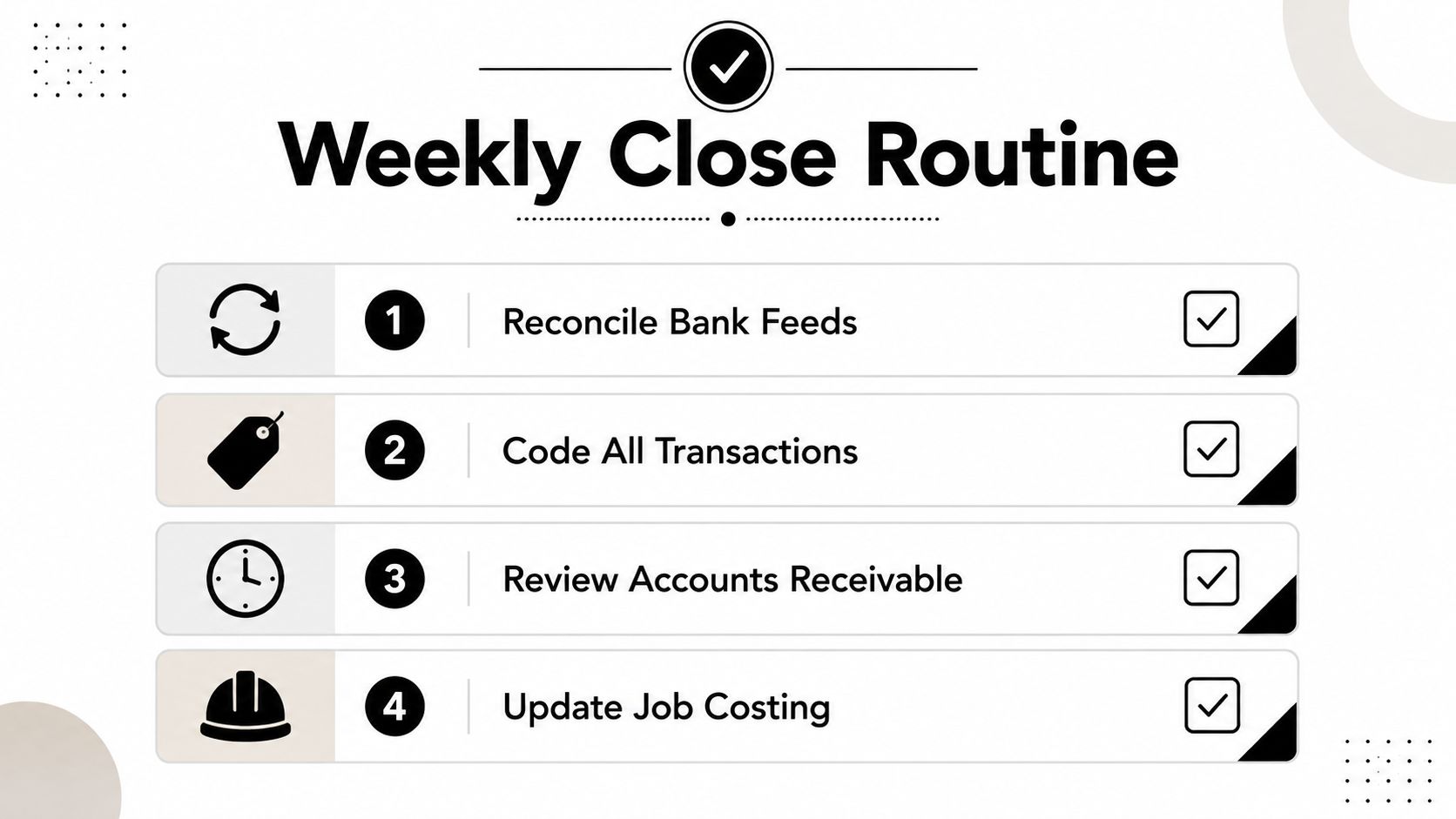
Here's the sequence I prefer:
- Reconcile bank feeds. Clear the obvious mismatches and duplicates.
- Code every transaction. No uncoded spend gets left behind.
- Review accounts receivable. Stale invoices need collection follow-up.
- Update job costing. Compare actuals against estimate while the job is still movable.
Rule of thumb: Weekly cleanup keeps month-end from becoming archaeology.
The payoff is practical. Receivables stop aging in the shadows, job margins stay visible, and tax filings are based on current data instead of a pile of last-minute receipts. If you want a bookkeeping partner to own this cadence, a firm like Bookkeeping and Accounting of Florida Inc. can handle contractor bookkeeping, payroll, tax prep, and cleanup work as part of a broader accounting system.
That weekly rhythm is what separates a bookkeeper who keeps records from one who manages risk.
Tax Law Changes and Compliance Risks Contractors Cannot Ignore in 2026
Contractors get hurt when they treat taxes as a year-end event instead of a year-round file maintenance problem. Tax law changes, depreciation schedules, and state-level filing obligations all sit on top of your bookkeeping, and if the books are messy, the tax return will be messy too. Entity structure matters here, because sole proprietorships, LLCs, and S-corps don't handle self-employment tax, payroll tax, or deductions the same way.
Flat-percentage tax set-asides are too crude for construction businesses with mixed labor models. A subcontractor-heavy shop, a payroll-heavy shop, and a multi-state contractor do not have the same reserve profile, so the same percentage can leave one business short and another over-reserved. Scenario-based estimates tied to entity type, payroll mix, and filing obligations are the better answer.
Compliance documentation has to be built into the books
Depreciation schedules need to stay current, deductions need support, and estimated payments should reflect actual liability instead of wishful thinking. That's especially important where tax law changes intersect with changing project mix, equipment purchases, and labor structure. Contractors who wait until April to sort this out are usually paying for preventable cleanup.
Smart reserve planning is scenario planning, not guesswork.
The broader point is simple. Compliance-first bookkeeping is becoming more important than after-the-fact cleanup, especially when contractors juggle payroll, subcontractors, and entity changes over time. The public content around construction accounting often oversimplifies taxes, but the real world does not. You need books that can support a return, explain a payment, and stand up if a question comes later.
If your books aren't organized with tax documentation in mind, your CPA is already starting behind. That's a bad place to be when the IRS wants clean support and the state wants payroll records that line up with actual work.
When to Bring in a Fractional CFO or CPA for Your Contracting Business
DIY bookkeeping stops working the moment your cash flow gets unpredictable, your tax bills surprise you, or your bonding capacity starts limiting the jobs you can win. Those are not bookkeeping annoyances. They're signs that the business needs a financial operator, not just a data entry person.
A fractional CFO gives you cash-flow forecasting, job profitability analysis, bonding support, lender-ready financial statements, and strategic tax planning. That kind of oversight is the difference between reacting to problems and seeing them early enough to act. If you want a practical overview of that role, outcome-based CFO solutions for startups is a useful outside reference for how senior financial guidance gets packaged for growing businesses.
Know the signals before the damage spreads
You need help when the following show up together or keep repeating:
- Profitable jobs, weak cash, which usually means billing timing is out of sync.
- Surprise tax bills, which usually means reserves and estimates were never built correctly.
- Bonding problems, which usually means job profitability and WIP are not trustworthy.
- Audit notices or compliance gaps, which usually means the books and the paperwork don't match.
A fractional CFO isn't a luxury for a contractor who wants to scale. It's a control layer. What fractional CFO services do matters because the job goes beyond reports, it connects cash planning, tax planning, and growth decisions.
Bookkeeping and Accounting of Florida Inc. provides QuickBooks ProAdvisor setup, full-service bookkeeping, payroll, tax preparation, and fractional CFO services for construction companies in Jacksonville and Northeast Florida. That combination is useful when the business needs clean books, compliance support, and someone who can explain what the numbers are saying.
Most small businesses don't know everything required to stay compliant, and contractors feel that gap faster than most. If your books are still built like a generic service business, it's time to replace guesswork with a construction accounting system that can handle the work.
If your contractor books are hiding retainage, masking job overruns, or leaving you unsure about tax reserves, Bookkeeping and Accounting of Florida Inc. can clean up the file and build a system that fits how construction works. Visit Bookkeeping and Accounting of Florida Inc. to get bookkeeping, payroll, tax, and fractional CFO support built for contractors who need clear cash visibility and compliance they can trust.