
You reconcile the bank account, match a few receipts, and assume the books are clean. Then an IRS notice arrives, a partner questions a vendor payment, or an employee leaves with access to payroll and accounting software. Suddenly, “clean books” means more than balanced accounts. It means records that explain every material transaction, preserve the evidence, and withstand questions from the IRS, a lender, an insurer, a regulator, or a courtroom.
Thank you for reading this post, don't forget to subscribe!For Jacksonville and Northeast Florida businesses, the difference between thinking you're compliant and knowing you're compliant often comes down to controls, documentation, and experienced financial oversight. A forensic audit process helps uncover what ordinary bookkeeping can miss, while professional accounting and fractional CFO guidance help prevent those problems from becoming expensive investigations.
When Your Books Surprise You – The Reality of Forensic Audits
A Jacksonville healthcare clinic may discover that a practice manager used the business card for personal purchases, patient payments were posted inconsistently, and payroll records don't match the general ledger. A construction company may find that job costs were assigned to the wrong project, subcontractor documentation is incomplete, and the owner can't explain several unusual transfers. In both situations, the books may have looked acceptable during routine monthly work. They weren't defensible under scrutiny.
A standard audit isn't a fraud investigation
A standard financial audit generally evaluates whether financial statements are fairly presented under the applicable reporting framework. A forensic audit asks a different question: what happened, who was involved, how did the money move, and can the findings be supported with evidence suitable for legal or regulatory action?
A forensic audit typically includes evidence collection, document analysis, transaction tracing, and formal reporting. It may address suspected fraud, asset misappropriation, disputed insurance claims, partner disagreements, employee theft, or unexplained financial losses. It can also give an owner clarity when the records are too disorganized to support a reliable decision.
The distinction matters because a routine reconciliation can identify that a balance is wrong, while forensic work investigates why it is wrong and whether someone benefited from the error. Missing records, weak segregation of duties, and late reconciliations make fraud harder to detect and tax issues easier to miss, as explained in this overview of business tax and accounting considerations.
Why the history still matters
Forensic accounting developed around disputes where financial expertise had to stand up under legal examination. The 1817 Meyer v. Sefton case in Canada is widely cited as the first recorded instance of an accountant serving as an expert witness in a bankruptcy-related dispute. The field gained major public recognition in the 1930s, when forensic accountant Frank Wilson's detailed analysis helped secure Al Capone's 1931 tax evasion conviction. The history is useful because it explains why forensic accounting is more than bookkeeping. It was built to reconstruct facts and communicate them credibly.
Practical rule: If you might need to defend a transaction later, preserve the records before you start changing the records.
Proactive planning is cheaper than reactive damage control because an owner can establish expense policies, approval controls, digital document retention, and access restrictions before a dispute begins. A fractional CFO can also review cash flow, unusual transactions, and compliance obligations without waiting for an IRS notice or an internal complaint.
The test isn't whether QuickBooks balances today. It's whether another qualified professional can follow the money, understand the business purpose, and verify the supporting documentation without relying on your memory.
The Forensic Audit Process Step by Step
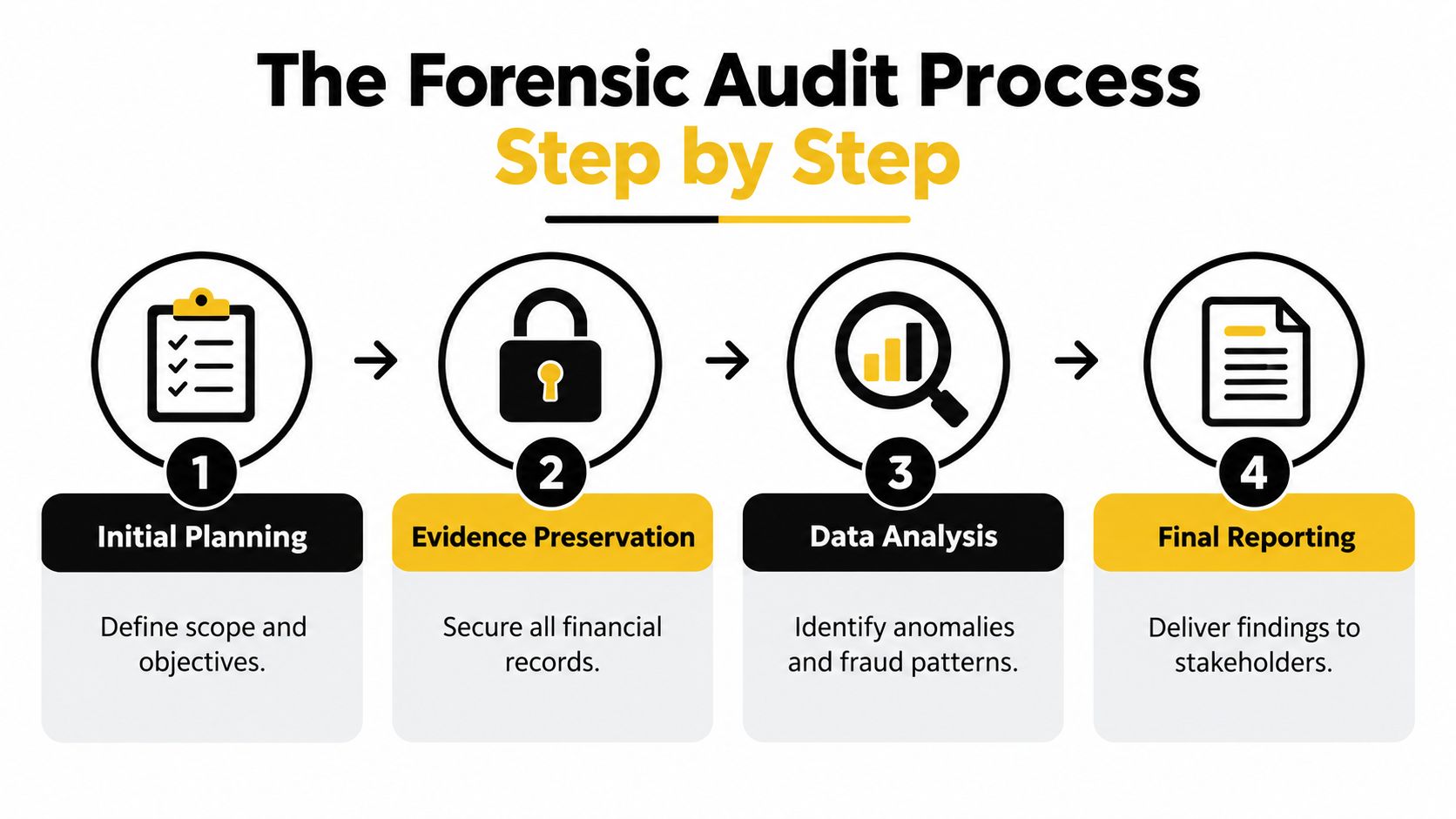
A defensible forensic audit process begins with a problem, not a fishing expedition. The business owner, attorney, board, insurer, or regulator should identify the concern, define the objective, and establish the authority for the review before anyone starts interviewing employees or downloading random files.
Start with scope and fraud-risk triage
First, define the allegations, relevant accounts, people, entities, systems, transaction types, and review period. The scope should be narrow enough to control cost but broad enough to test the actual hypothesis. For example, a concern about vendor overbilling may require purchasing records, contracts, invoices, approvals, bank activity, employee access logs, and related-party information.
Next, perform fraud-risk triage. Rank the red flags, identify the highest-risk transaction clusters, and establish extraction criteria. Don't begin with every transaction the company has ever recorded. Start with the population most likely to answer the question.
Preserve evidence before analysis
Evidence preservation comes before interviews and substantive testing. Use legal holds where appropriate, preserve accounting exports and email records, create forensic images of relevant devices, verify hash values, and maintain a chain-of-custody log. These controls help show that the evidence wasn't altered after collection.
A practical workflow moves from scope definition and fraud-risk triage to data matching and data mining, then to statistical sampling, while documenting the evidence chain for admissibility. The forensic audit implementation research specifically identifies preservation controls such as legal holds, imaging, hash-value verification, and chain-of-custody logging.
Collect, normalize, and analyze
The audit team gathers general ledger data, bank statements, payroll records, invoices, contracts, expense reports, tax filings, point-of-sale records, and relevant system logs. The data must be normalized before comparison because different systems often use different vendor names, dates, account codes, and transaction identifiers.
Analysts then match records across systems, search for duplicate payments, examine unusual journal entries, trace transfers, identify round-dollar activity, compare vendor and employee information, and test transactions against approval policies. Interviews should follow the documentary work, not replace it. Asking an employee to explain a transaction before securing the underlying records can influence testimony and weaken the investigation.
For a practical preparation list, use this forensic audit checklist to organize records and questions before the engagement begins.
Interview and report with discipline
Interviews test explanations against the evidence. A good interviewer asks open questions first, documents the answers carefully, and then addresses specific discrepancies with supporting records. The final report should explain the scope, procedures, evidence reviewed, factual findings, limitations, and conclusions without overstating what the evidence proves.
If attorneys, insurers, law enforcement, or regulators are involved, coordinate communications through the appropriate professionals. Don't edit source files, coach employees, or circulate unverified accusations. A clean accounting system makes every stage faster, less expensive, and more defensible.
Red Flags That Demand a Forensic Audit
Not every bookkeeping error requires a forensic engagement. A pattern of unexplained errors, weak controls, and conflicting explanations does. Owners should treat red flags as signals to investigate, not inconveniences to reclassify at month-end.
The warning signs in ordinary business activity
Commingled expenses are an immediate concern. When an owner pays personal bills from the company account, or an employee uses a business card without clear limits, the general ledger stops showing a reliable business purpose. That creates tax documentation problems and makes it harder to identify intentional misuse.
Unusual cash flow patterns deserve more than a casual explanation. Look for transfers that don't match payroll, inventory, project schedules, loan terms, or documented owner distributions. A healthcare clinic may show deposits that don't reconcile to billing reports. A construction firm may show cash leaving a project account without a corresponding subcontractor invoice or approved change order.
Missing receipts and invoices weaken every conclusion. If the business can't show what it bought, who approved it, and why it needed the purchase, a legitimate transaction can look suspicious. Repeated missing support is a control failure even when no theft is ultimately proven.
Unusual journal entries may indicate an effort to move losses, inflate revenue, conceal expenses, or correct activity after someone asks questions. Review entries posted near period-end, entries made by users who don't normally post them, and entries with vague descriptions.
A lack of segregation of duties leaves one person able to authorize, pay, record, and reconcile a transaction. Small businesses often can't separate every task completely, but an owner can add compensating reviews, bank alerts, approval limits, and independent reconciliations.
A practical risk screen
Ask these questions before deciding that a routine cleanup is enough:
- Access: Can one employee create a vendor, approve a bill, issue payment, and reconcile the account?
- Documentation: Can the business produce support for material purchases, reimbursements, payroll changes, and transfers?
- Consistency: Do bank activity, billing reports, payroll, job-cost reports, and the general ledger tell the same story?
- Independence: Does someone outside the transaction process review reconciliations and unusual entries?
- Explanation: Do employees provide consistent explanations supported by documents?
A “yes” to several risk questions doesn't prove fraud. It does show that management lacks reliable visibility. That's when a fractional CFO should coordinate with a CPA or forensic specialist instead of allowing staff to investigate themselves.
One study found that forensic-accounting skills had a positive, significant effect on fraud detection, with β = 0.204 and p < 0.005, while engaging forensic accountants increased the odds of fraud detection with an odds ratio of 3.911, described in that study as roughly a 291.1% increase. Those findings come from research on forensic accounting capability and fraud detection. The lesson isn't that a statistic guarantees an outcome. It's that investigative skill and targeted analysis matter.
For businesses ready to move beyond a warning-sign review, forensic audit services can address fraud investigations, asset tracing, insurance claim verification, and litigation support.
Why Every Small Business Needs a Fractional CFO
Most small businesses don't need a full-time CFO sitting in the office every day. They do need someone who can interpret financial information, challenge weak explanations, plan for tax obligations, establish controls, and guide the owner through decisions that affect cash and compliance.
A bookkeeper records activity. A fractional CFO asks whether the activity makes sense, whether the business can support it, and what management should do next. That distinction matters in a clinic managing payroll and insurance collections, a contractor tracking job profitability, or a nonprofit handling restricted funds.
Compliance requires active ownership
Small-business compliance isn't a single annual tax return. It includes payroll filings, contractor reporting, sales and use tax responsibilities where applicable, reconciliations, expense substantiation, record retention, payroll classifications, owner compensation, and timely responses to notices. Requirements change, and many owners don't know what applies to their industry or entity structure.
For 2026, the IRS says the standard mileage rate for business use of a car is 72.5 cents per mile, and the maximum net self-employment earnings subject to the Social Security part of self-employment tax is $184,500, as stated in IRS Publication 334. A CFO does not memorize those figures. They make sure the company has a mileage policy, contemporaneous records, correct bookkeeping treatment, and a tax plan that reflects the owner's actual situation.
Prevention beats reconstruction
A fractional CFO can establish approval workflows, review bank reconciliations, monitor cash conversion, compare actual results with budgets, and investigate unexplained variances. They can also coordinate with a CPA, attorney, payroll provider, insurance carrier, or forensic accountant when a matter requires specialized work.
That guidance is especially valuable when the owner is also the sales manager, hiring manager, estimator, and person signing checks. A busy owner may approve a payment because a trusted employee asks for it. A CFO asks for the purchase order, contract, invoice, receiving evidence, and business purpose.
A clean month-end close is not the finish line. It is the evidence that management has control of the business.
The right accounting partner also helps management turn financial reporting into decisions. Cash-flow forecasts reveal pressure before payroll is at risk. Job-cost reporting shows which projects are consuming margin. Department reporting exposes unusual spending. A documented close process gives the next reviewer a reliable trail.
Every company may not need a full-time CFO, but every growing company needs access to CFO-level judgment. Waiting until an IRS notice, partner dispute, theft allegation, or lender question arrives is poor financial leadership. Fractional CFO services provide a practical way to add that guidance without building a full executive department.
DIY Bookkeeping vs. Professional Accounting – The Cost of Cutting Corners
DIY bookkeeping looks inexpensive when the only comparison is the monthly fee for help. That calculation ignores owner time, missed filings, unsupported deductions, incorrect payroll treatment, lost documentation, preventable fraud, and the cost of rebuilding records under pressure.
An owner using QuickBooks may know how to enter a bill. That doesn't mean the owner has designed a defensible chart of accounts, tested access controls, reconciled every balance, or identified a related-party transaction. Software records what people enter. It doesn't determine whether the entry is accurate or appropriate.
The two approaches side by side
| Area | DIY or unqualified bookkeeping | Professional, forensic-ready accounting |
|---|---|---|
| Recordkeeping | Transactions may be entered inconsistently or after long delays. | Accounts are reconciled, documented, and reviewed through a defined close process. |
| Tax compliance | The owner may rely on memory or outdated instructions. | A CPA team tracks applicable filing, reporting, and documentation requirements. |
| Fraud prevention | One person may control purchasing, payment, and reconciliation. | Access, approvals, reviews, and segregation of duties are designed around risk. |
| Decision support | Reports describe activity without explaining it. | Reports connect cash flow, profitability, obligations, and operating decisions. |
| Investigation readiness | Records may be scattered across email, paper, and personal devices. | Source documents, exports, approvals, and reconciliations are retained systematically. |
| Owner workload | The owner becomes the backup bookkeeper and compliance officer. | The owner receives financial guidance and focuses on operating the company. |
The IRS says that for payments made after December 31, 2025, the information-reporting threshold for certain business payments rises from $600 to $2,000, and the same $2,000 threshold applies to backup withholding. Payments below that threshold aren't reportable under those rules, according to the IRS explanation of the business tax provisions. That change doesn't eliminate the need to keep vendor records or verify tax treatment. A threshold is not permission to stop documenting transactions.
Professional accounting also protects against a dangerous assumption: if a tax form was filed, the books must be correct. Tax filings can be prepared from incomplete or poorly classified records. A later review may uncover overstated deductions, omitted income, incorrect contractor treatment, or owner transactions that were never properly recorded.
Insurance and professional liability questions deserve attention too. Owners who want more context on how accounting professionals manage errors and claims can review this accountants E&O insurance guide from Select Insurance Group, Inc. It isn't a substitute for strong bookkeeping, but it reinforces why defined processes, documentation, and qualified review matter.
Before choosing a service model, understand the likely forensic audit cost and compare it with the cost of reconstructing records after a dispute. The cheapest accounting arrangement is often the one that prevents reconstruction entirely.
Your Action Plan – Staying Compliant and Audit-Ready
Audit readiness starts with ordinary management habits. Don't wait for a fraud allegation to ask whether your business can produce complete records, explain unusual transactions, and show who approved each payment.
Put these controls in place
Define expense rules. State what the business will reimburse, which purchases require approval, how receipts must be submitted, and how personal expenses are handled. Apply the policy consistently to owners and employees.
Create a digital document trail. Attach invoices, receipts, contracts, purchase orders, approvals, and payment evidence to the related accounting transactions. Keep source documents in a controlled system rather than scattered across personal inboxes.
Separate responsibilities. Don't let one person create vendors, approve bills, issue payments, and reconcile the bank without an independent review. If staffing limits prevent full segregation, add owner review, payment alerts, and documented reconciliations.
Review access regularly. Remove former employees, limit administrative permissions, and preserve relevant user activity when a dispute arises. Modern financial records may span cloud accounting, payroll, banking, messaging, and operational systems, so evidence preservation must cover more than paper files.
Schedule recurring financial reviews. A fractional CFO or CPA should review reconciliations, cash flow, unusual entries, tax accounts, payroll liabilities, vendor activity, and management reports throughout the year. A periodic forensic review is appropriate when risk indicators persist.
Treat compliance as a management system
For 2026, the IRS says the 20% qualified business income deduction under section 199A is permanent for qualified active trades or businesses. The phase-in range for limitations increases to $75,000 for individuals and $150,000 for joint filers in 2026, according to IRS Publication 334. Your tax professional must determine whether the deduction and its limitations apply to your business. The practical requirement is accurate entity information, properly classified income, complete payroll data, and books that support the return.
Digital controls deserve the same discipline. Businesses using accounting integrations, automated approvals, or AI-assisted workflows should preserve audit trails that show who initiated, changed, approved, and posted a transaction. For a useful perspective on code and process review automation, see enforce audit trails with DevArmor. The accounting principle is straightforward: automation should produce more traceability, not less.
The goal isn't to make every small business operate like a public company. It's to make the business explainable. When records are complete, access is controlled, and an experienced financial advisor reviews the numbers, an owner can respond to questions with evidence instead of guesses.
Bookkeeping and Accounting of Florida Inc. provides bookkeeping, tax preparation, payroll, audit, forensic accounting, and fractional CFO services for Jacksonville and Northeast Florida businesses. Visit Bookkeeping and Accounting of Florida Inc. to organize your books, strengthen compliance, and get financial guidance before an IRS notice or internal dispute forces the issue.