
82% of SMB failures are tied to cash-flow problems, so a fractional CFO for small business can be a practical necessity, not an executive luxury. This senior financial partner provides cash-management, forecasting, and compliance leadership that helps turn preventable financial stress into sustainable growth.
Thank you for reading this post, don't forget to subscribe!Many owners wait until payroll is at risk, a tax deadline has passed, or a lender asks for reports the business can't produce. By then, bookkeeping may show what happened, but it can't explain what happens next or which decision protects the company.
The 2026 tax environment adds pressure. Contractor reporting rules are changing, deductions require planning, and owner compensation can affect pass-through tax treatment. Most small businesses don't have an internal finance leader watching these details while also translating financial information into decisions.
A fractional CFO fills that gap. The role complements bookkeeping and accounting by creating financial discipline around cash flow, reporting, compliance, profitability, and growth. For companies in Jacksonville and Northeast Florida, the right outsourced CFO relationship can provide the guidance needed to stay compliant and make better decisions without carrying a permanent executive payroll burden.
Why Your Small Business Needs Financial Leadership Right Now
Cash-flow trouble rarely begins with one dramatic mistake. It develops through delayed customer payments, unprofitable work, unexpected tax obligations, excess inventory, weak approval controls, or growth that consumes cash faster than it produces revenue. A cited study connects 82% of SMB failures to cash-flow problems in the verified fractional CFO industry summary.
That figure changes the hiring question. The issue isn't whether a small business looks large enough to deserve a CFO title. The issue is whether the owner can reliably see cash needs, tax obligations, margins, and financial risks before they become emergencies. A bookkeeper may keep the ledger organized, but a fractional CFO builds the forward-looking system that helps management act.

2026 makes reactive finance more dangerous
Several tax and compliance changes deserve attention before year-end:
- Contractor reporting: Starting in 2026, the reporting threshold for Forms 1099-NEC and 1099-MISC rises from $600 to $2,000, according to the 2026 tax change summary from 1-800Accountant. That changes how businesses track outside labor and prepare year-end information reporting.
- Equipment planning: The Section 179 expensing limit is $2.5 million for 2025 and increases to $2,560,000 for 2026, as explained by Thomson Reuters. Timing qualifying equipment and software purchases requires more than a last-minute conversation with a tax preparer.
- Pass-through planning: The 20% QBI deduction remains in place in 2026, with thresholds rising to about $203,000 for single filers and $406,000 for joint filers, according to Millan CPA's 2026 IRS rules overview.
A fractional CFO helps connect these rules to cash forecasting, purchasing decisions, payroll, owner compensation, and documentation. That support matters because compliance isn't a once-a-year event. It depends on clean records and consistent processes throughout the year.
Practical rule: If you only discover a financial obligation when the deadline arrives, your accounting process is reporting history rather than guiding the business.
What a Fractional CFO Is and How It Works
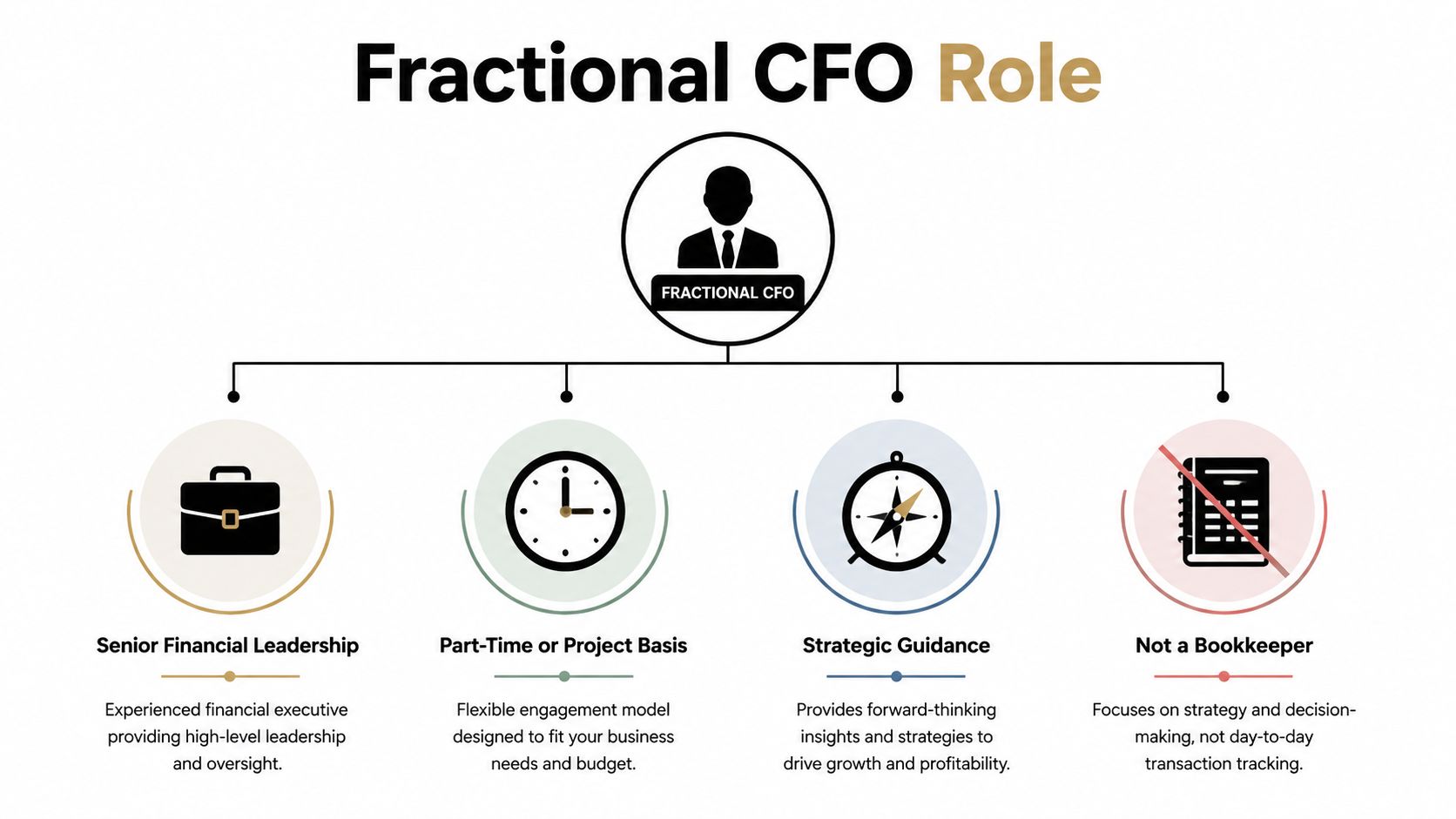
A fractional CFO is a senior finance executive who works with a company on a part-time, interim, or project basis. The model grew out of the broader outsourcing movement in the early 2000s, when experienced finance leaders began serving several smaller companies instead of accepting only full-time roles, as described in this history of fractional CFO services.
The arrangement suits small businesses that need executive judgment but can't justify a permanent CFO position. One industry estimate places the fully loaded cost of a full-time CFO at roughly $200,000 to $450,000 per year, while a fractional CFO may cost about $24,000 to $120,000 annually for 10 to 40 hours per month according to the same industry history.
The role sits above transaction processing
Bookkeepers record transactions, reconcile accounts, organize supporting documents, and maintain the general ledger. Controllers manage accounting operations, reporting processes, and the controls that support accurate and compliant financial statements.
A CFO works from that foundation but asks different questions:
- Cash direction: Will the company have enough liquidity for payroll, taxes, vendors, and planned investments?
- Performance: Which services, customers, locations, or projects create acceptable margins?
- Decision quality: What does the financial data say about pricing, hiring, expansion, borrowing, or capital spending?
- Risk: Which missing control, weak process, or unreliable report could create a costly surprise?
The fractional CFO doesn't replace a bookkeeper or controller. The CFO uses their work to build rolling forecasts, management reports, KPI dashboards, capital plans, and decision frameworks. If the underlying books are late or inaccurate, the CFO's recommendations will be unreliable.
Engagements should match the business problem
Some companies need a recurring monthly CFO meeting and forecast review. Others need focused help during a financing process, turnaround, acquisition, expansion, or budgeting cycle. A good firm defines the scope before work begins and increases or reduces support as the company's needs change.
The market has moved beyond the idea that fractional CFO work is merely a cheaper executive substitute. CFO Dive's coverage of demand in the AI era describes a role increasingly connected to strategic finance, digital transformation, and AI-enabled reporting. The useful question is what operating problem the CFO should solve first.
Core Services a Fractional CFO Delivers
A fractional CFO earns trust through concrete systems and decisions, not broad promises about financial guidance. The work usually begins with cash visibility, then expands into forecasting, performance reporting, financing, and profitability analysis.
Cash flow comes first
Cash-flow management is a top priority for 74% of clients in a recent industry summary, while 78% are increasing their focus on forecasting and 59% want more dashboards and KPI reporting as reported in the industry report summary.
A working cash system should show expected collections, payroll, taxes, debt service, vendor payments, and planned purchases. The CFO reviews assumptions with the owner and updates the forecast as invoices are paid, projects change, or sales slow. This gives management time to adjust hiring, inventory, capital expenditures, credit terms, or payment policies.
Businesses that need a practical explanation of the mechanics can review this guide to cash-flow forecasting. The important point is that a forecast must be maintained and used, not filed away after preparation.
Forecasting and budgeting turn history into choices
A budget sets expectations. A rolling forecast updates those expectations as actual results arrive. The CFO compares the two, identifies unfavorable trends, and explains whether the issue comes from volume, pricing, labor, overhead, collections, or project execution.
A 2026 academic study on SMEs found that cash-flow management indicators could forecast financial distress up to three years ahead using a neural-network framework, as summarized by LBMC's outsourced CFO guidance. A small business doesn't need to copy that research model to benefit from the principle. It needs timely indicators that reveal liquidity deterioration early.
Dashboards, fundraising, and margins
A useful KPI dashboard may track revenue, gross margin, accounts receivable aging, operating cash, labor utilization, customer concentration, project profitability, and budget variance. The CFO chooses measures that match the business rather than filling a screen with numbers nobody uses.
For fundraising or lending, the CFO prepares credible forecasts, explains assumptions, organizes reporting, and helps owners understand how much capital the business needs and why. Margin analysis then tests whether growth is profitable. A company can increase sales while weakening its financial position if pricing, labor, delivery costs, or overhead aren't controlled.
Fractional CFO Pricing Models and Proven ROI
The financial case for outsourced CFO support starts with flexibility. A business pays for a defined level of expertise instead of accepting the fixed payroll, benefits, recruiting burden, and unused capacity associated with a full-time executive.
Independent practitioner guidance places outsourced CFO pricing around $175 to $350 per hour or approximately $3,000 to $10,000 per month, while a full-time CFO can exceed $400,000 annually before benefits, according to NowCFO's pricing and benefits guidance.
| Model | Annual Cost Range | Best For |
|---|---|---|
| Fractional CFO hourly support | Approximately $175 to $350 per hour | Businesses needing targeted analysis, cleanup oversight, or project support |
| Fractional CFO monthly retainer | Approximately $3,000 to $10,000 per month | Companies needing recurring forecasting, reporting, and leadership |
| Full-time CFO hire | Can exceed $400,000 before benefits | Larger organizations requiring dedicated executive capacity |
These figures are market guidance, not a quote. The right arrangement depends on data quality, transaction volume, industry complexity, reporting needs, and whether the firm also provides bookkeeping, payroll, tax, or controller support. Businesses comparing software for management reporting can also review these in-depth reviews of reporting platforms, especially when deciding how dashboards will fit into the finance process.
ROI isn't limited to fee savings
70% of small and midsize businesses cite lower cost versus a full-time CFO as the main reason to outsource, according to the verified fractional CFO industry summary. Yet cost alone is a weak purchasing test. The better question is whether the engagement prevents avoidable losses and improves decisions.
A CFO may create value by identifying an unprofitable contract, improving collections, preparing a lender package, correcting payroll or sales-tax processes, or showing that a proposed expansion would strain liquidity. Those outcomes won't appear as a single guaranteed percentage. They should appear in agreed metrics such as forecast accuracy, reporting timeliness, receivables aging, gross margin visibility, compliance deadlines met, and cash surprises avoided.
Adoption is concentrated among smaller operators. Companies with 1 to 50 employees account for 65% of fractional CFO clients, according to the same industry summary. That reflects a practical reality: the model works when the business needs senior judgment but not full-time executive capacity.
For a business with changing needs, an hourly arrangement may control spending. For recurring decision support, a monthly retainer usually creates better continuity and accountability. Owners should compare the service scope, not just the headline rate.
Signs You Need a Fractional CFO and 2026 Compliance Changes
A business doesn't need to wait for a crisis to add financial leadership. The strongest signal is a repeated inability to answer basic questions about cash, profitability, obligations, or upcoming decisions.
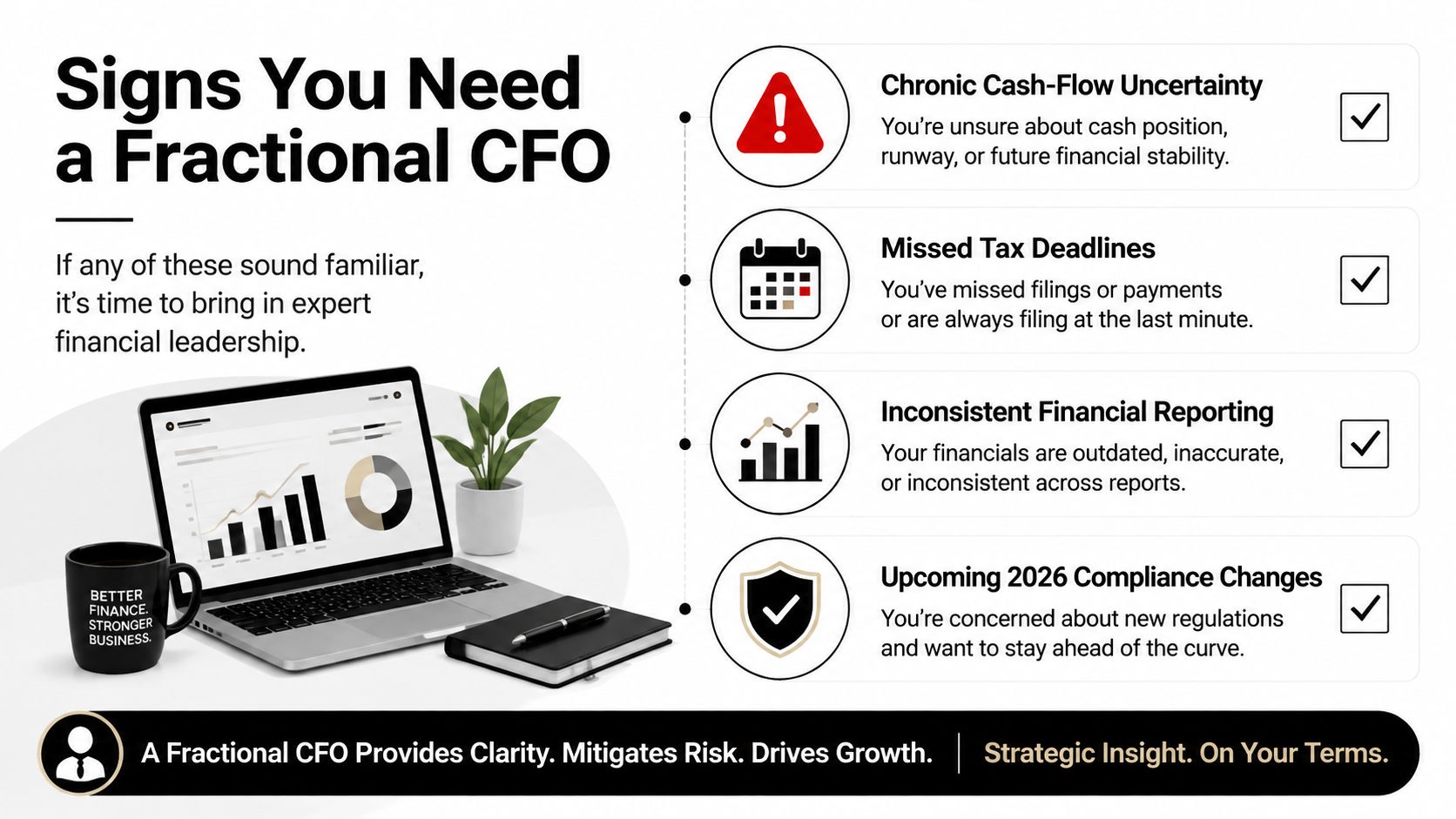
Look for these conditions:
- Cash uncertainty: You can't confidently see whether upcoming collections cover payroll, taxes, vendors, and debt.
- Late reporting: Financial statements arrive too late to influence operational decisions.
- Tax surprises: Tax balances, contractor records, payroll filings, or sales-tax obligations appear only near deadlines.
- Unexplained margins: Revenue grows, but profit falls and nobody can isolate the cause.
- Financing friction: A lender or investor requests forecasts, reporting, or controls the business can't produce promptly.
- Growth pressure: New equipment, locations, employees, contracts, or entities create financial complexity beyond the current process.
The 2026 changes make this checklist more urgent. Section 179 rises to $2,560,000 for 2026, and the 20% QBI deduction remains available with thresholds of about $203,000 for single filers and $406,000 for joint filers as outlined by the cited tax guidance. These rules can affect purchase timing, entity decisions, compensation planning, and cash reserves.
The contractor reporting threshold also changes from $600 to $2,000 in 2026 for Forms 1099-NEC and 1099-MISC, according to the cited 2026 compliance update. That doesn't eliminate the need to maintain complete payment records. It changes the reporting threshold, while good internal documentation still supports accurate books, tax preparation, and audit readiness.
A fractional CFO coordinates with the bookkeeper and tax professional so the owner isn't forced to interpret every rule alone. The CFO doesn't replace legal or tax advice, but makes sure business decisions reach the right specialist early enough to matter.
Industry Examples Showing Fractional CFO Impact
The same fractional CFO model looks different across industries because the financial risks are different. A healthcare practice needs revenue-cycle visibility. A construction company needs job-level profitability. A nonprofit needs restricted-fund reporting and dependable communication with its board.

Healthcare practice
A medical practice may collect revenue through multiple payers, face delayed reimbursements, and carry staffing costs that continue even when claims move slowly. A fractional CFO can review payer performance, monitor accounts receivable by aging category, connect visits to collected revenue, and build a cash forecast around expected reimbursements.
The work also supports regulatory discipline. When owners understand which services generate acceptable margins and where billing delays occur, they can improve operations without making decisions based only on appointment volume. For additional perspective on how practices can cut costs without sacrificing care, owners should still apply recommendations to their own payer mix and staffing model.
A healthcare CFO may also coordinate with the accounting team on payroll, provider compensation, vendor controls, and reporting that helps the practice meet its obligations.
Construction company
A contractor can appear profitable at the company level while individual jobs lose money. A fractional CFO introduces job-costing discipline, compares estimated and actual labor and materials, reviews change orders, and connects progress billing to cash needs.
That analysis helps owners identify margin erosion before a project closes. The CFO can also prepare information for bonding discussions and show whether the company has enough working capital to accept another project. The goal isn't more paperwork. It's knowing which work deserves additional capacity and which contract terms expose the business to avoidable risk.
Nonprofit organization
A nonprofit needs financial reporting that distinguishes restricted and unrestricted funds, supports grant reporting, and gives the board a clear view of liquidity. A fractional CFO can establish reporting routines, prepare for an audit, reconcile grant activity, and explain financial results in language board members can use.
The organization may not need a full-time finance executive, but it still needs someone who can protect reporting integrity while management focuses on programs and fundraising. The CFO's value comes from connecting compliance with mission sustainability.
Short videos can help owners visualize how financial leadership fits into operations, but the engagement should always produce usable forecasts, controls, and reporting.
How to Evaluate and Hire the Right Fractional CFO Firm
Treat the search as a senior leadership hire, even if the engagement is part-time. A polished presentation won't compensate for weak bookkeeping, unclear deliverables, or a CFO who has no experience with the financial pressures in your industry.
Start with the foundation. Ask whether the firm can assess the quality and timeliness of your books, payroll records, accounts receivable, job-costing data, and internal controls. If the data is incomplete, the firm should explain what must be corrected and who will do the work.
Questions worth asking
- Industry experience: Has the team worked with healthcare, construction, nonprofits, retail, or your specific operating model?
- Data readiness: What information must be available before forecasting and KPI reporting begin?
- Technology: Can the firm work with QuickBooks and the reporting tools your team already uses, or will implementation require a separate project?
- Service boundaries: Does the engagement include analysis only, or also accounting coordination, reporting preparation, tax planning support, and implementation?
- Success measures: Which financial and compliance indicators will be reviewed each month?
- Communication: Who answers urgent questions, and what response time should you expect?
A firm that promises strategy without addressing clean records is selling an incomplete solution. Financial leadership depends on accurate, timely information.
Review the agreement carefully
The contract should state the scope, meeting cadence, billing method, monthly or hourly caps, deliverables, response expectations, confidentiality obligations, and exit terms. Ask how the firm handles busy periods such as financing, budgeting, tax planning, audits, or a sudden cash shortfall.
The strongest relationships become ongoing strategy partnerships with execution support rather than isolated report projects. For local owners comparing options, fractional CFO services near Jacksonville can be evaluated alongside the firm's bookkeeping, payroll, tax, audit, and industry accounting capabilities.
Bookkeeping and Accounting of Florida Inc. is a locally owned Jacksonville CPA firm with more than 20 years supporting healthcare, construction, retail, and nonprofit organizations, and its team includes certified QuickBooks ProAdvisors. That combination matters because owners need both senior guidance and compliant accounting records that make the guidance usable.
Frequently Asked Questions About Fractional CFO Services
Does a fractional CFO replace a bookkeeper?
No. A bookkeeper records and reconciles transactions, maintains source documentation, and supports accurate financial statements. A fractional CFO uses that information for forecasting, KPI reporting, cash planning, profitability analysis, and strategic decisions. The two roles work better together than they do in isolation.
Is a fractional CFO only for businesses with high revenue?
No. A business can face cash-flow, tax, payroll, and compliance risk at any operating size. The practical test is financial complexity and decision pressure, not a particular revenue label. If the owner can't see upcoming obligations or evaluate growth decisions with reliable information, CFO-level support may be appropriate.
Is the cost worthwhile when margins are thin?
Thin margins make financial visibility more important, not less. A CFO may identify unprofitable pricing, weak collection practices, uncontrolled labor costs, or a tax obligation that wasn't reserved for. Owners should judge the service against defined outcomes and risks, not assume that a low fee is the only measure of value.
What happens if the business outgrows the arrangement?
A capable firm can adjust the engagement, add controller or accounting capacity, support multiple locations or entities, and help the owner decide when a full-time executive makes sense. The fractional relationship can also provide continuity during that transition, rather than forcing the company to rebuild its financial process around a new hire.
Financial leadership is the part many small businesses overlook because bookkeeping feels more immediate. Accurate books are necessary, but owners also need someone to interpret the numbers, anticipate obligations, coordinate compliance work, and guide decisions before cash becomes a crisis.
Bookkeeping and Accounting of Florida Inc. provides bookkeeping, accounting, payroll, tax, audit support, and fractional CFO services for growing companies in Jacksonville and Northeast Florida. Visit Bookkeeping and Accounting of Florida Inc. to discuss clean financial records, 2026 compliance planning, cash-flow forecasting, and the level of financial leadership your business needs.