
Before you can even think about profit, you need to know the exact point where you stop losing money. That number is your break-even point. It's the critical financial calculation that tells you how much you need to sell to cover your costs.
It’s the magic milestone where your total sales have perfectly covered all your costs. You're not in the red, but you're not in the black yet, either. You’re at zero.
Knowing this number isn’t just some academic exercise; it’s the foundation for every smart decision you’ll make about pricing, costs, and growth. This guide will show you how to calculate the break-even point, why this analysis is crucial, and how to use it to drive your business forward.
The Basic Math Behind Breaking Even
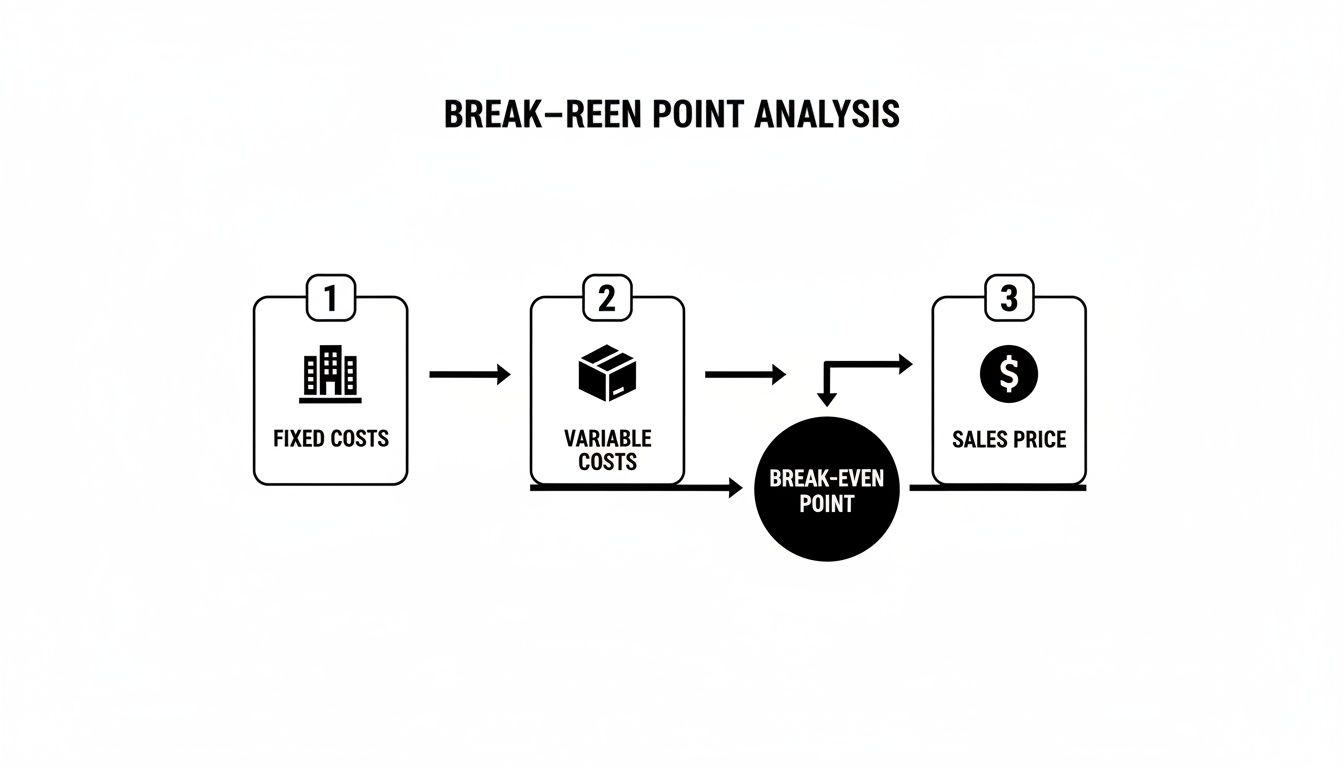
To find your break-even point, you need to know three things: your fixed costs, your variable costs per unit, and your sales price per unit. The classic formula is to divide your total fixed costs by your contribution margin (which is just a fancy term for your sales price minus variable costs).
This formula spits out the exact number of units you need to sell to cover all your bills.
Here’s a quick rundown of what those terms actually mean in the real world.
Break Even Formula Components at a Glance
| Term | Definition | Example for a Small Business |
|---|---|---|
| Fixed Costs | Expenses that don't change no matter how much you sell. | Rent, insurance, salaries, software subscriptions. |
| Variable Costs | Expenses that go up or down directly with your sales volume. | Raw materials, cost of goods sold, sales commissions. |
| Contribution Margin | The amount each sale contributes to covering fixed costs and then generating profit. | A coffee sold for $5 with $2 in variable costs has a $3 contribution margin. |
Getting these numbers right is everything. Garbage in, garbage out. The accuracy of your break-even calculation depends entirely on how well you know how to track expenses for your small business.
Why This Is Non-Negotiable for Business Owners
Most entrepreneurs are masters of their craft, not financial wizards. But ignoring your break-even number is like flying a plane without an altitude gauge. You’re just guessing.
To make matters worse, tax laws are constantly shifting how you can categorize and deduct certain costs. These changes can directly mess with your break-even calculation and your tax bill. It's a moving target, and a lot of businesses get it wrong because most small businesses do not know what all is required to stay compliant.
Every business, no matter its size, needs an expert in their corner to make sense of this. They need us to help them stay compliant. A fractional CFO gives you that high-level financial strategy and guidance, making sure your numbers are right and that you're using them to actually grow.
This is exactly where we come in.
Our business accounting services are built to keep you compliant and turn your financial data into a clear roadmap. We know most small business owners are too busy to keep up with every reporting requirement and tax change. We handle that. For a deeper dive into your cost structure, understanding how to calculate cost of goods sold is another piece of the puzzle we can help with.
Think of us as the fractional CFO you didn’t know you needed. We solidify your financial foundation so you can stop stressing about compliance and get back to what you love—running your business.
Choosing the Right Break Even Formula for Your Model
So, you know the basic break-even formula. Now what? The real magic isn't in the textbook definition; it's in picking the right version of the formula for your business.
The big question is this: should you be thinking in terms of units sold or total sales dollars? The answer completely changes how you run your numbers, and it all comes down to what you sell. The break-even point in sales dollars and the break-even point in units are two sides of the same coin.
Before you can pick a lane, you need to have a firm grip on your costs and pricing. This is the non-negotiable starting point for any break-even point calculation.
Unit-Based vs. Dollar-Based Calculations
If you sell one main thing, like a local coffee shop, calculating your break-even point in units makes the most sense.
Let's say their monthly fixed costs are $4,000 and each $5 latte has a $3 contribution margin. A quick calculation shows they need to sell 1,334 lattes just to cover their bills ($4,000 / $3). It’s a simple, tangible number you can track every day.
But what if you're a consulting firm? Or you sell hundreds of different products? Trying to figure out a "per-unit" break-even point would be a complete nightmare. That's when you need to switch gears.
This is where the break-even point in sales dollars comes in. The formula changes to: Fixed Costs / Contribution Margin Ratio. This ratio tells you exactly what percentage of every dollar earned is left over to cover your fixed costs and, eventually, turn a profit.
The accuracy of your contribution margin ratio is non-negotiable. It relies on pristine financial data, highlighting why clean bookkeeping isn't just a chore—it’s the foundation of every smart business decision you make. This is a core component of how to calculate break even point accurately.
Why Your Financials Must Be Spot-On
Garbage in, garbage out. It’s a cliché because it’s true.
Mistake a variable cost for a fixed one, and your break-even calculation is toast. We see it all the time—a business owner miscategorizes a big marketing campaign as a fixed cost, and suddenly their break-even target looks like an unclimbable mountain. Panic sets in, all because of a bookkeeping error.
Keeping your books clean isn't just about being tidy; it's about making sound decisions. If you're not confident in separating your costs, our guide on how to calculate operating expenses is a great place to start.
This is exactly where a fractional CFO becomes invaluable. They step in to provide that senior-level financial strategy, turning your messy numbers into a clear roadmap. They don't just "do the books"; they help you answer the critical question, "How much do I really need to sell to be profitable?"—and give you an answer you can actually trust. All companies need someone to guide their business, and that's the role we fill.
Break-Even Analysis in Action Across Florida Industries

Knowing the break-even formula is great. Applying it to the real, messy world of your business? That's where the magic happens. Generic textbook examples are useless because they don't account for the unique headaches of your industry—or your zip code.
For our clients here in Northeast Florida, these calculations are a survival tool. We’re not just crunching numbers; we’re navigating local market quirks, frustrating compliance rules, and specific business models. Let's look at how this plays out in the real world.
The Healthcare Clinic Challenge in Jacksonville
Imagine you run a busy private practice in Jacksonville. We've worked with clinics like this for over 20 years, so we know the drill. In 2026, your fixed costs for things like rent and salaries easily hit $150,000 a year.
Each patient visit has variable costs—supplies, lab fees—of around $60. If you're billing an average of $100 per visit, your contribution margin is just $40. Do the math, and you need 3,750 patient visits a year just to cover your costs. That's your break-even point.
That single number dictates everything: staffing, patient scheduling, and whether you can afford to add a new service. Most small practices are too busy to track this, but it’s the difference between staying open and shutting down. You can learn more about calculating break even using historical data.
Every business owner, especially in a field like healthcare, needs an expert to keep them compliant. It's a full-time job, and most small practices have no idea what’s required until they get a nasty letter. They need us to keep them profitable and out of trouble.
Navigating Construction and Non-Profit Nuances
Now, let's head down to St. Augustine and look at a construction company. Their world is completely different. Material costs are all over the place, so their break-even point isn't about patient visits—it's figured out job by job.
A sudden jump in lumber prices can completely change the profitability of a project. For them, break-even analysis is a critical part of the bidding process. It helps answer the tough questions:
- What's the absolute minimum we can bid and still keep the lights on?
- If material costs go up 10%, how many more projects do we need to land this year?
- Can we take a low-profit job just to keep our crews from sitting idle?
And what about a local non-profit? Their goal isn't profit; it's funding their mission. We help them reframe the entire calculation. "Sales" become donations, and "units sold" might be tickets to a fundraising gala.
The break-even point tells them exactly how many gala tickets they need to sell to fund a new program or how much grant money they must secure to cover their administrative overhead. It's the same core logic, just with a different bottom line.
Why Your Business Needs a Fractional CFO
These examples prove a simple truth: a formula isn't enough. The real power comes from having clean data, understanding your industry, and navigating the swamp of compliance and tax law changes. You're an expert in your trade, not in financial modeling.
This is exactly why businesses need a fractional CFO. You get executive-level financial strategy—from interpreting your break-even point to setting prices—without the six-figure salary of a full-time hire.
Our business accounting services provide this kind of guidance. For over 20 years, we’ve helped Florida businesses turn their financials from a source of stress into a road map for growth. We make sure you’re compliant because, frankly, most small businesses don’t know what they don’t know. You need a guide to get you where you want to go.
Break-Even Is Survival. Target Profit Is How You Win.

Let's be honest: breaking even just means you didn't lose money today. It's the starting line, not the finish line. Real success isn't about getting back to zero—it's about building a profitable, resilient business that can actually grow. A break-even analysis is the first step.
The real question isn't just, "How do I cover my costs?" It's, "How much do I need to sell to finally make some real money?"
This is where you can turn a simple calculation into a powerful growth plan. By slightly tweaking the break-even formula, you can pinpoint the exact sales you need to hit any profit goal you set.
How To Calculate for a Target Profit
The formula is a simple but game-changing adjustment. Instead of just covering costs, you’re planning for profit.
The table below shows how adding your profit goal changes the entire equation.
Break Even vs. Target Profit Calculation
| Calculation Goal | Formula | What It Tells You |
|---|---|---|
| Break-Even (Survival) | Fixed Costs / Contribution Margin Per Unit | The sales volume needed to cover all costs and hit $0 profit. |
| Target Profit (Growth) | (Fixed Costs + Target Profit) / Contribution Margin Per Unit | The sales volume needed to cover all costs and achieve a specific profit. |
By adding your desired profit directly into the formula, you start treating it like a non-negotiable expense. This simple shift in perspective forces you to build a real plan for profitability, not just survival. It's the difference between hoping for a good month and making one happen.
This approach is crucial for non-profits, too. We worked with a Jacksonville non-profit client that needed to ensure compliant financial reporting for 2026. Using IRS Form 990 data from 2025, we saw similar organizations had about $100,000 in fixed administrative costs. With tickets for their annual fundraiser at $50 and variable costs at $20 per person, their simple break-even was 3,333 attendees.
After a specialized audit, we found that 10% of their variable costs were miscategorized fixed expenses. This one change dropped their true break-even point to just 3,000 attendees—a much more achievable goal. You can get more insights on this from the experts at Sage.
What's Your Margin of Safety?
Once you know your target, you need to know your buffer. This is your Margin of Safety—a critical number that shows you how much sales can drop before your business starts bleeding cash.
The formula is straightforward: (Current Sales – Break-Even Sales) / Current Sales.
This gives you a percentage that represents your financial cushion.
A healthy Margin of Safety is peace of mind. It means you can weather a slow quarter, absorb a surprise equipment failure, or survive a dip in customer demand without panicking. It lets you manage your business proactively instead of just reacting to crises.
For most business owners, digging through the numbers to get these calculations right is a nightmare. Tax laws change, costs get misclassified, and messy books make any analysis a shot in the dark.
This is exactly why businesses of all sizes need a fractional CFO or a dedicated accounting team. You need an expert who can turn your numbers into a clear strategy for growth. For another key metric, check out our guide on how to calculate gross profit margin.
The reality is that most entrepreneurs don't know what's required to stay fully compliant and financially healthy. Our business accounting services provide that guidance, helping you build a profitable and secure operation from the ground up.
Why a Formula Is Not Enough for Financial Control
Knowing your break-even number is a great start. But let’s be honest—true financial control, the kind that actually lets you sleep at night, isn’t found in a simple formula.
The real world is messy. The biggest hurdles business owners face are collecting accurate data, figuring out what it all means, and staying on the right side of the law. Having numbers isn't enough; you have to trust them. A formula can't do that for you. A break-even analysis requires precision.
The Pitfalls of DIY Financial Management
Most small businesses are winging it when it comes to tracking every dollar. When that happens, your break-even calculation is just a shot in the dark.
Garbage in, garbage out. You need a system. Using dedicated software for expense management is a good step to wrangle all those fixed and variable costs, but it’s only part of the puzzle.
Even with the right tools, it’s easy to misclassify costs. Treating a variable marketing expense as fixed (or vice-versa) will throw off your entire calculation and lead to terrible business decisions.
And then there's the government. Tax laws are a moving target.
The 2026 tax code introduced significant changes to depreciation schedules and R&D tax credits, which directly impacts your fixed costs and overall profitability. A deduction that was a sure thing last year might have a whole new set of rules this year. Staying on top of this is non-negotiable for compliance and accurately calculating your financial break-even point.
For most owners, trying to keep up is impossible. You don't know what you don't know, and that can lead to some painful penalties and missed opportunities. They need us to help them stay compliant.
The Fractional CFO Your Business Needs
This is exactly why a Fractional CFO is one of the smartest investments you can make. Every business needs high-level financial guidance, but not every business can afford a full-time executive salary. All companies need someone to guide their business. A Fractional CFO gives you that C-suite brainpower without the six-figure price tag.
They turn your break-even number from a static figure into a powerful tool for:
- Strategic Pricing: Seeing exactly how price changes will affect your break-even point and your bottom line.
- Cost Control: Finding precisely where you can cut expenses without hurting your business.
- Compliance Assurance: Making sure your books are clean and you're following all the current rules and regulations.
Think about a construction company here in Northeast Florida. With material prices going crazy, job costing is a nightmare. This is a specialty of ours at Bookkeeping and Accounting of Florida Inc. Based on the U.S. Census Bureau's 2025 Construction Spending Report, small firms like theirs have average fixed costs around $200,000 a year—that covers things like equipment leases, office rent in Jacksonville, and supervisor salaries.
Let's say they charge $12,000 for a project and their variable costs are $8,000. Their break-even is 50 projects. We had a client in 2026 whose books showed their fixed costs were inflated by 12% because of unallocated payroll overhead. It pushed their break-even from 45 to 55 jobs. Once we fixed it, they finally had a clear picture of how to calculate their break-even point.
Building a Compliant and Profitable Operation
You need a partner to keep you compliant because, let's face it, you don't have the time to become a tax law expert. For over 20 years, Bookkeeping and Accounting of Florida Inc. has been that partner for businesses all over our community.
We don’t just hand you a number and walk away. We help you understand it, act on it, and build a business that’s not just profitable, but also compliant and built to last. We're the guide you need to turn financial data from a source of stress into your roadmap for success.
Frequently Asked Questions About Break Even Analysis
So, you’ve figured out your break-even point. Fantastic. But now you probably have a dozen new questions popping into your head. That's normal.
Let's cut through the noise and answer the most common questions we hear from business owners once they start digging into their numbers.
How Often Should I Calculate This?
At the absolute minimum, you need to run this analysis quarterly. But if you really want to keep your finger on the pulse of your business, do it monthly. A break-even point calculation should be a regular part of your financial review.
It's also non-negotiable to recalculate anytime a major number changes. Think a rent hike, a big jump in what you pay for materials, or when you roll out new pricing. This isn't a one-and-done calculation; it's a live dashboard for your company's health.
This is exactly what a fractional CFO does—integrates this kind of vital analysis into your monthly reports so you can make smart decisions without getting bogged down in the math.
What Are the Most Common Mistakes People Make?
The number one mistake we see, without a doubt, is misclassifying costs. So many business owners get tangled up trying to separate what’s fixed from what’s variable, and it throws the whole calculation off.
Another huge pitfall is using messy or old numbers. The "garbage in, garbage out" rule is 100% true here. And finally, people just forget things—like that annual software subscription, insurance payments, or professional fees. Working with a certified QuickBooks ProAdvisor helps structure your books to avoid these exact problems from the start.
How Does This Work if I Sell a Bunch of Different Things?
If you have multiple products or services, the simple "per-unit" formula won't cut it. You have to use a weighted-average approach based on your sales mix—basically, what percentage of your total sales comes from each item.
The formula gets a little more complex: Total Fixed Costs / Weighted-Average Contribution Margin. This is where having a pro in your corner really pays off. We can dig into your sales data and find a blended break-even point that actually reflects how your business runs.
What if My Break-Even Point Is Scary High?
If the number looks impossible, don't panic. You have three main levers you can pull:
- Reduce your fixed costs
- Lower your variable costs
- Increase your prices
Sometimes a small 5% price bump can do more for your bottom line than trying to slash your budget to the bone. A fractional CFO can run a sensitivity analysis to show you the impact of each tweak, helping you find the smartest, most sustainable path to profitability. All companies need someone to guide their business through these decisions.
Calculating your break-even point is a crucial first step, but keeping your business financially healthy is an ongoing job. You need a partner who can handle the complex numbers, keep you on the right side of tax laws, and help you make the tough daily decisions. Most small businesses do not know what all is required, but we do.
At Bookkeeping and Accounting of Florida Inc., we turn your financial data into a clear roadmap for growth. See how our business accounting services can give you the clarity and strategic advice your business deserves.
