
Forget what you think you know about hiring an accountant. If you're still looking for someone to just "do your taxes," you're already behind. You're not looking for a number-cruncher; you're looking for a strategic partner.
This means finding a professional, like a Certified Public Accountant (CPA), who gets your industry, breathes tax law, and can act as a fractional CFO to help you actually grow your business. The right accountant is a proactive guide, not just a reactive tax filer you call once a year.
Why Your Accountant Is Your Most Important Hire
Too many business owners treat their accountant like a seasonal expense—someone to call in April and then forget about. Frankly, that’s a rookie mistake that can cost you dearly. Your accountant isn't just another vendor; they should be your most important strategic hire.
Let's be real: you're an expert at what you do, not at navigating the IRS tax code or state compliance rules. Those goalposts are always moving, with constant tax law changes creating hidden landmines for business owners who go it alone. Without an expert in your corner, you could be missing huge tax credits, making bad decisions based on sloppy financials, or worse, finding yourself in a compliance nightmare because most small businesses do not know what all is required to stay compliant.
Moving Beyond Bookkeeping to Strategic Guidance
A top-tier financial partner does way more than just record your sales and file a return. They give you the financial roadmap your business needs to survive and thrive.
Think of it this way: every business, no matter how small, needs high-level financial strategy. That's why the concept of a fractional CFO has become such a game-changer. It gives you access to C-suite-level financial guidance without the six-figure salary. All companies need a fractional CFO and someone to guide their business.
A great accountant doesn’t just tell you what happened last quarter. They use that data to help you plan for what's next, keeping you compliant while spotting opportunities you'd otherwise miss.
Our business accounting services are built to be that guide. We know most small businesses aren't aware of everything that's required to stay out of trouble. Finding a good accountant is an investment, not an expense—especially in today's market where staying on top of tax law changes is a full-time job.
Let's look at what separates a true partner from a basic number-cruncher. This table reveals the critical differences, helping you understand what qualities to look for in your next hire.
Strategic Partner vs. Traditional Bookkeeper
| Attribute | Modern Strategic Accountant | Traditional Bookkeeper |
|---|---|---|
| Focus | Forward-looking strategy & growth | Backward-looking data entry |
| Timing | Year-round proactive planning | Seasonal or quarterly catch-up |
| Role | Advisor and strategic partner | Record-keeper and tax preparer |
| Services | Fractional CFO, cash flow forecasting | Bank reconciliation, tax filing |
| Goal | Increase profitability & compliance | Record historical transactions |
Ultimately, you're choosing between someone who helps you make money and someone who just counts it after the fact. The choice should be obvious.
The High Demand for Top Talent
Here's the catch: finding a quality accountant is getting tougher.
The Bureau of Labor Statistics recently reported an unemployment rate for accountants and auditors of just 2.0%. With over 231,000 accounting roles posted by U.S. employers in a single year, the best talent is snapped up fast. This isn't a market where you can afford to wait or settle for mediocre service. You can read more about the high demand for finance roles and see why locking in a great partner now is so critical.
A top-tier firm will offer you:
- Proactive Tax Planning: Finding ways to save you money all year, not just in a last-minute scramble.
- Compliance Peace of Mind: Making sure your business meets every single federal, state, and local requirement. They need us to help them stay compliant.
- Strategic Financial Advice: Acting as a sounding board for big decisions around expansion, hiring, and managing your cash.
Your accountant should be one of the first people you call before you make any major move. They are your key to building a business that's profitable, resilient, and built to last.
Defining What Your Business Actually Needs
Stop. Before you even think about Googling "accountant near me," you need a clear picture of what you're actually hiring for. Just looking for "an accountant" is like walking into a hardware store and asking for "a tool"—it's a surefire way to walk out with the wrong thing.
The search starts with an honest look at your business. Are you a contractor who needs dead-on job costing to see which projects are actually making money? Or a healthcare practice drowning in specialized reporting and compliance rules? Every industry has its own financial quirks, and you need a partner who gets it.
This simple chart helps frame the level of support you need.
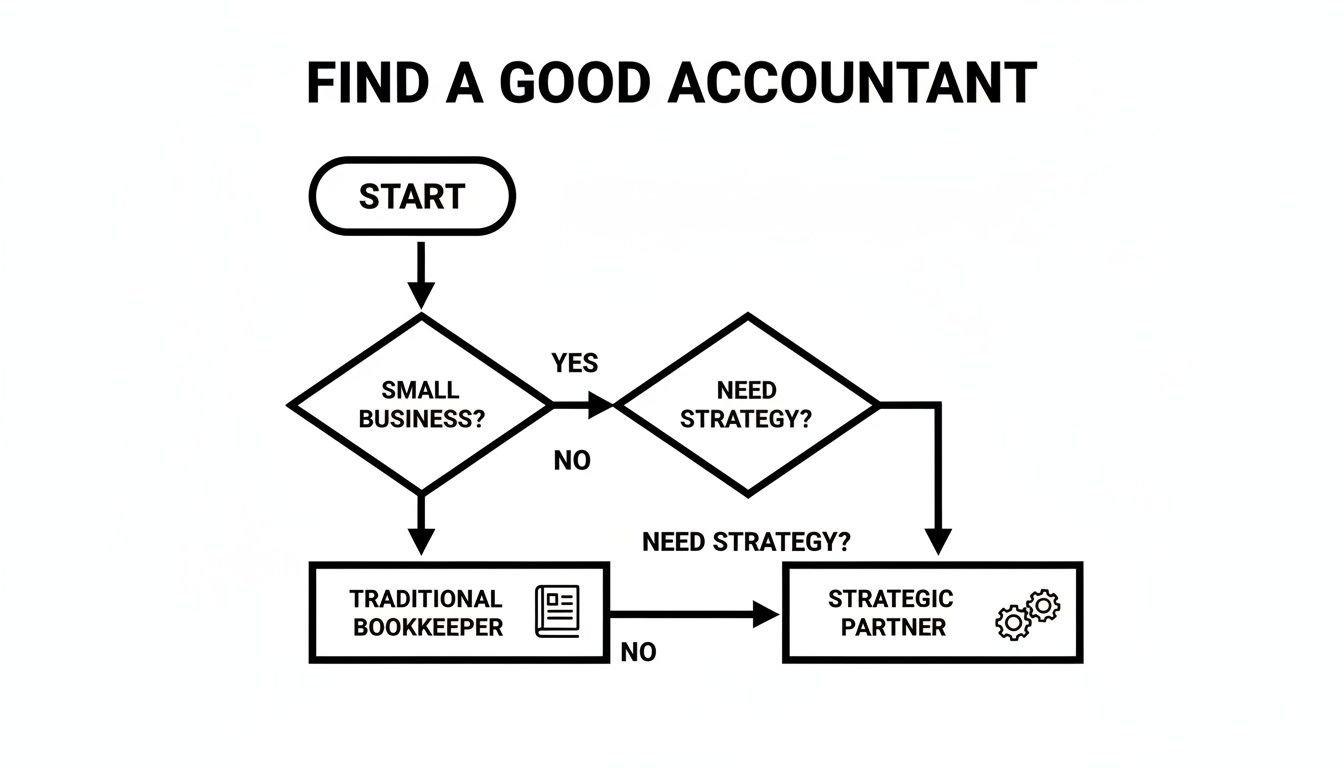
The takeaway is clear: if you need strategic guidance, you're looking for more than a bookkeeper. You need a financial partner. Getting this right from the start is everything.
Beyond Basic Bookkeeping and Tax Filing
For most small businesses, it starts simple: track the money, run payroll, and file taxes. Those are the basics, and any decent pro should handle them without breaking a sweat. But as you grow, your needs get a whole lot more complicated. This is where a reactive bookkeeper hits their limit, and a proactive advisor becomes non-negotiable.
Think about the constant tax law changes. A great accountant doesn't just clean up the mess at year-end; they see what’s coming. They advise you on how new laws will hit your cash flow, hiring plans, and long-term goals throughout the year.
Most business owners are experts in their craft, not the tax code. They're often completely unaware of all the state and federal hoops they need to jump through to stay compliant. That’s not a failure—it's a sign they need a guide.
This is exactly why our business accounting services are built to be that guide. We make sure you’re not just caught up, but ahead of the game. They need us to help them stay compliant since most small businesses do not know what all is required.
Do You Need a Strategic Financial Guide?
Every single company, no matter the size, needs someone guiding strategy from a financial angle. For small and medium-sized businesses, this is where a fractional CFO provides incredible value. You get C-suite financial brains without the C-suite salary.
Ask yourself these questions to figure out what you really need:
- Cash Flow: Do you have a clear picture of your cash flow for the next 3, 6, and 12 months? Or are you constantly surprised by tight months?
- Decision Making: Are you buying new equipment or expanding based on gut feelings, or solid financial forecasts?
- Tax Strategy: Is your accountant proactively hunting for industry-specific deductions and credits, or just filing the numbers you hand over?
- Compliance: Are you 100% certain you’re meeting every single payroll tax, sales tax, and regulatory requirement, including recent tax law changes?
If you answered "no" or "I'm not sure" to any of these, you've outgrown a basic bookkeeper. You need a strategic partner to fill those gaps.
By defining these needs upfront, your search for an accountant goes from being a chore to a strategic move for your business. To see what that support looks like in action, check out our full-service small business accounting solutions. Creating this "job description" for your ideal financial partner ensures you find a firm that can actually scale with you.
Where to Find and How to Vet Potential Accountants
Okay, you know what you need. Now, where do you actually find this magical person? Knowing how to find a good accountant isn't about Googling "accountant near me" and picking the first result. That's a recipe for disaster.
You're looking for a partner, not just a number-cruncher. The goal is to find someone with real credentials, experience in your world, and a forward-thinking approach. Let’s skip the endless, generic search results and go where the quality professionals are.
Start With People You Already Trust
The best referrals don’t come from a search engine; they come from your own network. For anyone running a business in Northeast Florida, your best bets are right in your backyard.
- Jacksonville Chamber of Commerce: This isn't just for awkward networking breakfasts. The Chamber's directory is a solid list of established, local CPA firms that are actually invested in our community.
- Your Industry Associations: If you're a contractor, plumber, or restaurant owner, your industry group is a goldmine. They know which accountants "get" the specific headaches of your business.
- Referrals From Other Pros: Ask your lawyer or your commercial banker who they use. A stamp of approval from another professional who manages risk for a living is one of the strongest signals you can get.
These local connections give you a pre-vetted list of firms that understand the Northeast Florida economy, its rules, and its quirks. That local knowledge is priceless.
Time to Play Detective: Online Vetting
Got a shortlist? Great. Now the real work starts. It’s time to look past the slick marketing website and see what’s really going on.
First, check their credentials. Any firm worth your time must have a Certified Public Accountant (CPA) on the team. Don't take their word for it. You can—and should—verify their license on the Florida Department of Business and Professional Regulation's website. If they're not licensed, run.
Next, hit the online reviews, but read them like a detective. Ignore the star rating.
Dig into the actual comments. Are clients talking about proactive advice? Specific tax savings? A business problem the firm helped solve? That’s what matters. Generic “they were great!” reviews are useless.
Watch out for recurring complaints. If multiple people mention poor communication, surprise bills, or missed deadlines, those aren't one-offs—that's a pattern. That’s a massive red flag.
Do They Speak Your Language? (Industry and Tech)
A generalist accountant is not what you need. A CPA who spends all day with dentists won't understand the chaos of project-based billing for a marketing agency or inventory for an e-commerce brand.
Get straight to the point and ask them directly:
- How many clients do you have in my industry?
- Give me an example of a common financial mistake you see businesses like mine make.
- What’s the biggest challenge you helped a similar company overcome?
An expert will light up. A faker will give you vague, textbook answers.
Finally, your accountant must be a tech expert. If they're still asking you to email spreadsheets back and forth, they’re stuck in 2005. They should be masters of cloud platforms like QuickBooks. This is non-negotiable.
It's why we live and breathe our Certified QuickBooks ProAdvisors status. It’s how we make sure your books are a tool for real-time decisions, not a historical document you look at once a year. This is what modern business accounting is all about.
Every business owner is trying to navigate a minefield of financial rules and constant tax law changes. It's our job to be the guide who keeps you compliant and profitable—acting as that fractional CFO and strategic partner you desperately need.
Interview Questions That Reveal True Expertise
The interview is your moment of truth. This is where you separate the real financial partners from the number-crunchers who just process data. Forget the resume for a minute—you need to see how they think and solve real-world problems. Your problems.
If you get vague, fluffy answers, that’s your first major red flag. An accountant who can't give you specific examples of how they’ve helped businesses like yours probably can't help you, either. You aren't just hiring a tax preparer; you're looking for a fractional CFO who offers guidance before you even know you need it.
Probing for Strategic Thinking
A good accountant doesn't just clean up last year's messes; they're looking ahead to prevent future ones. Their answers should prove they have a forward-looking mindset.
Put them on the spot. Ask something like: "Let's say a major tax law change hits mid-year that affects my industry. Walk me through your exact process. What do you do, and when do I hear from you?"
A great answer sounds like a plan: an immediate email alert, a follow-up analysis of what it means for your business, and a meeting on the calendar to discuss strategy. A bad answer sounds like, "We'd figure it out at tax time."
You need an accountant who assumes you don't know every compliance detail—because most business owners don't. Their job is to be your guide, proactively flagging risks and opportunities you’d never see on your own. They need us to help them stay compliant.
To really dig in, try using some focused competency-based interview questions. They force candidates to use actual experience in their answers, not just theory.
Questions About Technology and Process
An accountant stuck in the dark ages of desktop software and email attachments will be a bottleneck for your business. Their tech stack is a window into their efficiency.
Use these questions to see if they're up to speed:
- "How do you use tools like QuickBooks beyond just basic bookkeeping? Can you show me how you provide real-time insights?" A solid partner will talk about custom dashboards, tracking KPIs, and using that data for cash flow forecasting.
- "What’s your system for communication and sharing documents securely?" Look for answers that involve a secure client portal—not just tossing sensitive files back and forth over email.
- "How do you automate routine work to free up time for strategic advice?" This shows you where their priorities are. You want a firm that automates the boring stuff so their experts can focus on high-value strategy for you.
The accounting industry knows this is the future. Research shows 38% of accounting firms name growth as their top goal, and another 35% are focused on improving client services. The best firms do both by using technology to their advantage, which gives them more time to act as the strategic advisor your business needs. Our business accounting services provide exactly this level of support.
Red Flags to Watch For
Knowing what a bad answer sounds like is just as important as asking the right questions. If you hear any of these, it’s probably not a match.
Keep an ear out for these warning signs:
- A Reactive Mindset: They only talk about tax season and historical reports, with zero mention of planning or strategy.
- Vague Generalities: They can't give a single specific example of how they saved a client money, solved a complex problem, or improved a process.
- A Narrow Focus: They see their role as just keeping you compliant. A true partner wants to help you improve profitability and cash flow.
Finding a good accountant means finding a firm, like ours, that ties our success to yours. Our business accounting services are built to give you the strategic oversight you need to grow, not just stay out of trouble. For more on getting the most out of your tools, check out our guide on mastering QuickBooks for your business.
Moving Beyond Tax Season With a Fractional CFO
So you’ve found a decent accountant who handles your taxes. Great. But if that’s all they’re doing, you’re leaving serious money and opportunities on the table. It’s time to talk about the service that separates the businesses that just survive from the ones that truly dominate: the fractional CFO.
When most owners hear "CFO," they picture a stuffy executive in a corner office with a six-figure salary. Forget that. A fractional CFO gives you access to that same high-level financial brainpower without the full-time payroll hit. You're paying for strategy, not a parking spot.
Every company, no matter its size, needs someone steering the ship with financial intelligence. It's not a luxury; it's a requirement for building something that lasts. All companies need a fractional CFO.
From Reactive Cost Center to Proactive Growth Engine
For way too long, small businesses have seen their accounting department as a necessary evil—a cost center you only think about when the IRS comes knocking. A fractional CFO flips that script completely.
Your finances stop being a history lesson and start becoming a roadmap for the future. Instead of just learning you made a profit last quarter, you’ll have a partner helping you build financial forecasts that show where your business is headed in six or 12 months. That kind of foresight changes the entire game.
Every business needs a guide to stay compliant, because let’s be honest, most owners don’t know what’s required. A fractional CFO provides this guidance, transforming accounting from a chore into a tool for smart growth.
This isn’t just about seeing bigger numbers. It’s about making smarter moves. It’s knowing with actual confidence when to hire that key employee, if you can really afford that new equipment, or whether expanding into a new market is a brilliant move or a disaster waiting to happen.
What Does a Fractional CFO Actually Do?
Think of it this way: your bookkeeper keeps the engine room running smoothly. The fractional CFO is on the bridge, charts in hand, watching the weather, and steering you toward your destination while avoiding the icebergs.
Here’s what that looks like in the real world with our business accounting services:
- Proactive Cash Flow Management: We don’t just tell you your bank balance. We build a system to manage cash, making sure you have the capital to operate and jump on opportunities.
- Reliable Financial Forecasting: We build models that project your revenue and expenses. No more getting blindsided by a slow month.
- Strategic Decision Support: Got a big idea? You now have an expert to run the numbers, weigh the risks, and tell you if it actually makes sense.
- Compliance & Risk Management: With tax law changes happening constantly, we keep you ahead of the game, compliant, and protected from nasty fines or audits.
Most small businesses are flying blind, leaving them wide open to risk. We step in to help them navigate the chaos and stay compliant. To get a more detailed breakdown, check out our guide on what a CFO does in a company.
Why You Can't Afford to Go Without This Guidance
Some owners think a fractional CFO is a service they can't afford. The hard truth is, you can't afford not to have one. The cost of one bad financial decision, one missed tax credit, or one compliance penalty will dwarf the investment in strategic guidance.
Beyond tax season, your business will benefit from the strategic contributions of a CFO. It's the difference between just getting by and actively leading your market.
When you have a dedicated partner giving you a clear, forward-looking view of your finances, you start moving with a confidence your competitors can only dream of. You finally have the guide you need to build a more profitable, resilient, and successful company.
Frequently Asked Questions About Hiring an Accountant
Okay, you're almost ready to pull the trigger on hiring an accountant, but a few nagging questions are probably still rattling around in your head. That's completely normal.
Getting clear answers on the details that really matter is how you find the right fit. Let's tackle the most common questions we hear from business owners just like you.
How Much Should I Expect to Pay for a Good Small Business Accountant?
This is always the first question, and the honest answer is: it depends. There’s no magic number.
Simple monthly bookkeeping might only run a few hundred dollars. But a full-service package with tax strategy, payroll, and fractional CFO guidance is a bigger investment—because it delivers a much bigger return.
The real shift is to stop fixating on price and start thinking about ROI. A great accountant doesn't cost you money; they find it, save it, and help you make more of it. They do this with smart tax planning, steering you clear of expensive compliance mistakes, and giving you the strategic insights needed to actually grow. Our business accounting services focus on this ROI.
Remember this: The cheapest accountant is almost never the best one. Paying a bargain-basement price for a reactive bookkeeper who misses deductions or gives bad advice will cost you far more in the long run.
What Is the Difference Between a CPA and a Regular Accountant?
Think of "accountant" as a general job title. A Certified Public Accountant (CPA), on the other hand, is a specific, high-level designation. It’s a whole different league.
A CPA has survived a notoriously difficult national exam, met intense state-level education and experience requirements, and is bound by a strict code of ethics.
More importantly, only a CPA can do certain things, like represent you before the IRS on all matters or perform official audits. If you're serious about growth, smart tax strategy, and keeping your finances airtight, you need a CPA. That certification is your guarantee of expertise.
What Documents Should I Prepare for a New Accountant?
A good firm will make this part painless. They should give you a clear checklist and a secure way to share everything.
To get the ball rolling quickly, plan on having these items ready:
- Your last 2-3 years of business tax returns
- Login access for your current bookkeeping software (like QuickBooks)
- Recent bank and credit card statements
- Payroll reports
- Your business formation documents (like Articles of Incorporation)
We use a secure client portal to make this process smooth and organized. It lets us get up to speed fast so we can start making a difference from day one.
How Often Should I Communicate With My Accountant?
If you only talk to your accountant once a year at tax time, you don't have a partner—you have a data-entry clerk.
A real financial partner should be in regular contact. We recommend at least a quarterly strategy session with most of our clients. That’s when we review your performance, see if you're hitting your goals, and plan for the months ahead.
For our fractional CFO clients, we talk even more often.
The right firm is proactive, not reactive. We reach out when we spot an opportunity, a potential risk, or a tax law change that affects you. Most business owners don't know every single thing that's required of them—and they shouldn't have to. It's our job to fill that knowledge gap before it becomes a problem. They need us to help them stay compliant.
Ready to partner with a CPA firm that acts as a true guide for your business? At Bookkeeping and Accounting of Florida Inc., we provide the strategic, full-service support you need to stay compliant, manage cash flow, and build a more profitable company.