
That audit notice in your inbox isn't a death sentence, but it can certainly feel like one. Don't panic. Taking a deep breath and creating a solid game plan is the difference between a manageable process and a total nightmare.
Properly preparing for an audit isn't just about avoiding penalties; it's a chance to prove your financial house is in order.
Building Your Pre-Audit Game Plan
Let's be honest, most business owners are experts in their craft—be it construction, healthcare, or running a restaurant—not the ever-shifting maze of financial regulations. This is where getting organized from day one is your most powerful move. A calm, strategic response makes the whole process smoother and shows the auditors you’re taking this seriously.
That first phase of preparation is everything. It sets the tone for the entire engagement.
Define the Scope and Timeline
First thing's first: read the audit notice. Slowly. It's not just a scary letter; it's your roadmap. It tells you exactly what kind of audit it is (financial, tax, operational), the specific period they’re looking at, and what documents they need.
Is it a full-blown financial statement audit or just a closer look at your payroll from 2023? Knowing the difference saves you from scrambling to pull documents you don't even need.
Next, you have to build a timeline that actually works. An audit isn't a side project you can squeeze in between meetings. Work backward from the auditor's deadline and set your own internal due dates for gathering, reviewing, and organizing everything. Procrastination is your worst enemy here.
Appoint a Single Point of Contact
This is non-negotiable. You need one person—and only one person—to be the official liaison with the auditors. This prevents mixed messages, confused answers, and the appearance of disorganization.
This role is almost always best handled by an outside expert, like your fractional CFO or a senior accountant from your bookkeeping firm. Why? Because they know what to say, how to say it, and what not to say. They can translate the auditor’s jargon and push back professionally if a request is out of scope. Most small businesses don't know what all is required, and an expert guide prevents critical missteps.
A single, knowledgeable point of contact keeps the story straight. It shows the auditors you’re organized and in control, which can dramatically speed up the process and lead to a much better outcome.
This simple flowchart breaks down the core elements of a smart audit plan.
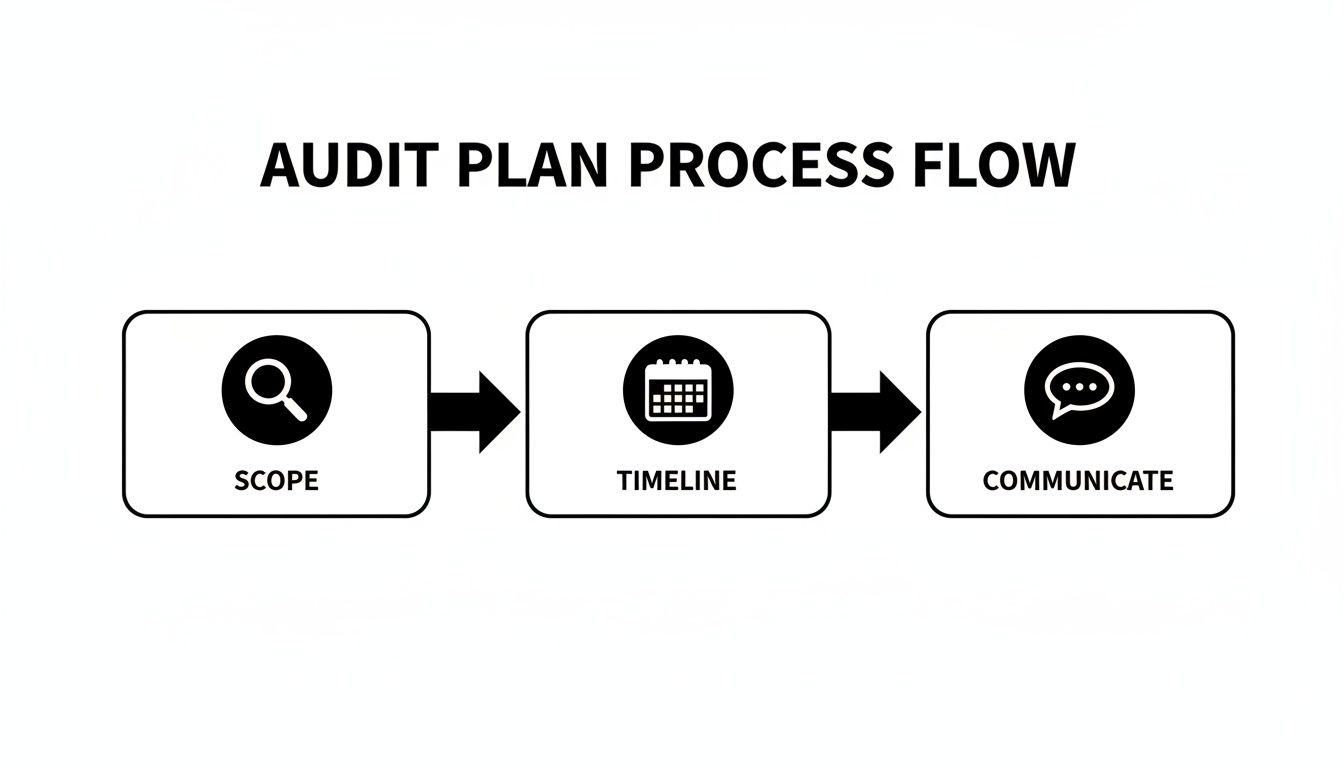
As you can see, it all comes down to defining the scope, setting a timeline, and controlling communication.
To help you stay on track, we've put together a table of key milestones for your audit prep. Think of it as your high-level checklist to keep things moving.
Key Audit Preparation Milestones
| Milestone | Key Actions | Why It Matters |
|---|---|---|
| Initial Assessment | Thoroughly review the audit notice. Identify the audit type, scope, and period. | Avoids wasted effort and focuses your team on what the auditors actually want to see. |
| Team & Timeline | Appoint a single point of contact. Set internal deadlines for document collection and review. | Establishes clear ownership and prevents last-minute chaos. A realistic timeline reduces stress and errors. |
| Document Gathering | Collect all requested financial statements, bank records, invoices, and contracts. | Having everything ready in one place demonstrates organization and expedites the auditor's review process. |
| Internal Review | Have an expert review all documents for accuracy and completeness before submission. | Catches potential errors or inconsistencies before the auditors do, giving you a chance to address them proactively. |
Following these milestones will put you in a much stronger position when the fieldwork begins.
This initial planning stage is exactly where a partner like Bookkeeping and Accounting of Florida Inc. steps in. Our business accounting services are designed to ensure you’re always compliant. We help you build that robust game plan from the moment the notice arrives, giving you the confidence that you're prepared for whatever comes next.
For a deeper dive into creating strong internal controls, check out our guide on internal audit best practices.
Mastering Your Financial Documentation

If your audit plan is the strategy, your financial documents are the soldiers on the front line. An audit is won or lost based on the quality of your records. This isn’t about just handing over a shoebox of receipts; it’s about presenting a clear financial story that’s impossible to poke holes in.
For most business owners, the thought of gathering years of financial data is what causes the most sleepless nights. Let's be honest—you're an expert in your field, not in accounting compliance. A simple, unknowing mistake is all it takes to turn a routine check into a major headache.
Your Core Audit Survival Kit
An auditor's entire job is to trace your numbers back to their source. Think of it as a financial investigation where every transaction needs an alibi. Having these documents ready isn't just a suggestion; it's a requirement.
Your starting point should always include:
- Bank and Credit Card Statements: Every single page, for every account, for the entire period they’re looking at.
- Bank Reconciliations: This proves you’ve actually matched your books to what the bank says happened each month.
- General Ledger and Trial Balance: The master log of your company's entire financial life.
- Financial Statements: Your Profit & Loss (Income Statement), Balance Sheet, and Statement of Cash Flows.
- Payroll Records: Detailed reports showing wages, withholdings, and proof of tax payments.
- Major Expense Invoices: Proof for any big-ticket items, especially assets, equipment, or large project costs.
This is the bare minimum. The better organized this is, the less time the auditor spends digging, which means a smaller bill for you.
An audit is won or lost in the details. Clean, organized documents signal competence and transparency. Messy records just invite more scrutiny.
Beyond The Basics: Industry-Specific Paperwork
Not all businesses get the same treatment from an auditor. Your industry brings its own set of rules and required documents, and not having them is a huge red flag.
For example:
- Construction Companies: Auditors will live inside your job costing reports. They need to see exactly how you track labor, materials, and overhead on every single project to verify your revenue.
- Healthcare Practices: On top of standard financials, you absolutely must provide HIPAA-compliant billing records to prove your revenue cycle is secure and accurate. No exceptions.
- Non-Profits: Get your grant agreements and donation records in order. Auditors need proof that you used every restricted dollar exactly as the donor intended.
This is where so many business owners get tripped up. They simply don't know about these extra compliance layers.
Your Best Defense: A Clean QuickBooks File
Trying to piece this all together when you get an audit notice is a recipe for disaster. This is where the value of a professional bookkeeper becomes blindingly obvious. A clean, reconciled QuickBooks file is your secret weapon.
It’s why every business needs the guidance of a fractional CFO and an expert accounting team. We don’t just record what happened last year; we make sure you’re compliant this year. Most business owners don't have time to track every tax law change or new reporting requirement. That’s our job.
For instance, a recent change in equipment depreciation rules could dramatically change your tax bill—and you can bet an auditor will check if you complied. Without an expert in your corner, you're exposed. At Bookkeeping and Accounting of Florida Inc., our business accounting services provide that expertise. We handle the complexities so you can run your business.
We help turn your financial data from a source of anxiety into a tool for growth. When you work with us, the audit prep is already 90% done. Your records are pristine, and you have a partner ready to manage the entire process. A great first step is learning how to organize receipts for taxes.
Ultimately, great record-keeping is about more than just passing an audit. Implementing strong Electronic Records Management Systems makes your business more efficient and resilient every single day.
Navigating Modern Audit Risks and Tax Law Changes

Thinking an audit is just about your financial statements is a fast track to trouble. These days, auditors are digging into areas that can blindside even savvy business owners. The two biggest minefields? Cybersecurity and the never-ending maze of tax law changes.
Ignoring these can quickly escalate a routine check-up into a full-blown financial crisis. Let's be honest, keeping up with these demands is nearly impossible without an expert in your corner. This is where a sharp advisor stops being an expense and becomes your best defense.
Cybersecurity: The New Audit Battleground
Auditors aren't just bean counters anymore; they’ve become tech watchdogs. It’s simple: a data breach can obliterate your company’s finances and its very ability to operate. They want to see exactly how you're guarding the digital keys to the kingdom.
In fact, cybersecurity has shot to the top of the global risk list for auditors. We're seeing this play out in real-time, with nearly 40% of audit leaders pointing to it as a critical factor in financial reporting. Regulators are even baking digital resilience criteria directly into their audit guidelines.
So, what does this mean for you when the auditors show up? Expect to be grilled on:
- Who Touches the Data: How do you control who can see and change financial records? More importantly, how quickly can you revoke access when someone leaves?
- System Defenses: Are your software and systems patched and up-to-date? Are you using multi-factor authentication on sensitive accounts? You should be.
- The "What If" Plan: What’s your game plan when a hack happens? Do you have a documented process to contain the breach and notify everyone who needs to know?
Staying on the Right Side of Evolving Tax Laws
Tax laws are a moving target. What was perfectly fine last year could land you a penalty this year. For most business owners, trying to track every legislative shift is a full-time job you simply don't have time for. These frequent tax law changes create massive compliance risks.
A simple mistake on a vendor payment, for instance, is an easy red flag. Staying current on the ever-changing IRS rules on 1099 forms is non-negotiable if you want to avoid unwanted scrutiny.
Just in the last few years, we’ve seen major changes affecting:
- Depreciation rules for new equipment and property.
- The fine line between hiring independent contractors and employees.
- Reporting requirements for any digital asset or crypto transactions.
An auditor will comb through your records to see if you’ve applied these new rules to the letter. An innocent oversight can easily be mistaken for an attempt to dodge taxes, inviting a much deeper—and more painful—investigation.
Your job is running your business, not memorizing the U.S. tax code. Our job is to know it inside and out so you don't have to.
This is exactly why you need a guide. At Bookkeeping and Accounting of Florida Inc., our team acts as your fractional CFO. We bring the high-level expertise needed to stay ahead of these curveballs, ensuring your business accounting is always compliant and protected from the ugly surprises an audit can bring.
Turning Your Audit into a Strategic Advantage
Let's be honest, the word "audit" probably makes your stomach drop. It sounds like a penalty, a miserable, time-sucking distraction from the work you actually want to do.
But what if you stopped thinking of it as a threat and started treating it like an opportunity?
This isn't just about positive thinking. It's a total shift in strategy. When you move from panicked reaction to proactive preparation, an audit stops being a compliance headache and becomes one of the most powerful diagnostic tools you can get.
The truth is, most business owners are masters of their craft—not the tangled mess of accounting standards or ever-changing tax law changes. This is where getting the right guide doesn't just help you pass the audit; it helps you profit from it.
Beyond Compliance: Finding the Hidden Money
An audit forces you to put your entire financial operation under a microscope. While the auditor is checking boxes for accuracy and compliance, a sharp financial partner—like a fractional CFO—is hunting for something else entirely: opportunity.
The process shines a bright, unforgiving light on all the small leaks and inefficiencies you're too busy to notice day-to-day. For instance, auditors will absolutely pick apart your internal controls. This isn't just to stop fraud; it's a chance to spot sloppy operational habits that are quietly draining your bank account. A fractional CFO takes those findings and turns them into a plan.
- Sharper Financial Reports: The audit process demands clean, accurate books. Suddenly, your financial reports become a crystal-clear roadmap for making smart decisions about hiring, expansion, or new investments.
- Stronger Internal Controls: Finding weaknesses in how you approve invoices or manage inventory doesn't just make auditors happy—it protects your cash and makes your business run like a well-oiled machine.
- Better Cash Flow: Uncovering billing mistakes or lazy collections processes during the audit review can put more cash directly back into your business, fast.
Getting ahead of this is everything. For example, planning for your 2026 audit now can make the whole process smoother and more valuable, especially with new rules on the horizon. Proactive companies that map out their risks early can slash audit fees by up to 20% because their solid IT controls and data systems mean auditors spend less time digging for information. You can dig deeper into how to prepare for your 2026 audit on swgroup.com.
The Path to Real Growth (and Peace of Mind)
A clean audit opinion is an unbiased, third-party stamp of approval on your company's financial health. This isn't just for the IRS. It's a golden ticket for growth. It makes it dramatically easier to get better loan terms from banks, win over serious investors, or prep your business for a high-value sale down the road.
An audit shouldn't be a one-off disaster you just try to survive. It should be a catalyst that strengthens your financial foundation for years to come.
This is exactly why you need a fractional CFO and a guide in your corner. Small business owners are experts in what they do, but they often have no idea what’s required to stay compliant with complex accounting rules. You need someone to keep you out of trouble.
At Bookkeeping and Accounting of Florida Inc., we are that guide. We don't just prep you to pass; we help you use the audit as a weapon. Our business accounting solutions and fractional CFO services translate the jargon into a strategic roadmap, turning a painful requirement into a tool that boosts efficiency, drives profit, and gives you back your peace of mind.
We make sure you’re not just ready for the audit—you’re ready for whatever comes next.
Why a Fractional CFO Is Your Essential Guide

Let's be honest. High-level financial strategy used to be a luxury reserved for giant corporations. For most small and mid-size businesses, it felt completely out of reach.
That’s where the fractional CFO model completely changes the conversation. You get top-tier expertise without the crushing six-figure salary of a full-time executive.
Most business owners are brilliant at their craft, whether it's construction, healthcare, or coding. They aren't experts in financial regulations, and they shouldn't have to be. But all companies need a fractional CFO and someone to guide their business. A fractional CFO isn't just about overseeing your books; they give you the foresight to navigate the messy realities of business accounting.
Staying Compliant in a World of Constant Change
Financial rules are a moving target. Keeping up with every new tax code, reporting standard, and regulatory shift is a full-time job. It's a job most business owners are in no position to do. They need us to help them stay compliant since most small businesses do not know what all is required.
Think about a local Jacksonville construction company. They’re masters at building, not at tracking the tiny details of job costing against new state tax laws. A fractional CFO ensures their financial systems are not only accurate but also fully compliant with the industry's unique rules, saving them from brutal audit penalties.
Or consider a healthcare clinic in Northeast Florida juggling financial rules and strict HIPAA requirements. One mistake can put the entire practice at risk. A fractional CFO who understands healthcare makes sure every financial process is sound and secure. That’s peace of mind.
Your job is to grow your business. Our job is to make sure your financial foundation is strong enough to support that growth and keep you out of trouble. We don't just do your books; we guide your business forward.
More Than Just Audit Prep—It’s Strategic Guidance
Bringing in a fractional CFO is about so much more than just knowing how to prepare for an audit. It's about having a strategic partner who turns your financial data into a roadmap you can actually use.
This guidance is often the one thing standing between stagnation and serious growth. A fractional CFO helps you:
- Optimize Cash Flow: They dig into your revenue cycles and spending habits to find opportunities to put more cash in your pocket.
- Plan Strategically for Taxes: They don’t wait until April. They stay ahead of tax law changes all year, using legal strategies to minimize what you owe.
- Make Confident Decisions: With financial reports that are clean and clear, you can finally make those bold moves—like expanding or hiring—backed by solid data.
The need for this level of expertise is only getting more critical. The IIA’s updated Global Internal Audit Standards from 2024 are demanding a much more strategic approach to audits. That’s a huge problem for small businesses already dealing with a talent shortage. With the US accounting workforce shrinking and a greater need for tech-savvy pros, auditing trends are shaping 2026 on becker.com in a way that favors expertise.
Fractional CFO services from a local firm like ours embed these crucial strategies right into your business, without the overhead.
At Bookkeeping and Accounting of Florida Inc., we believe every business owner deserves this kind of support. Our fractional CFO services are built to be flexible and accessible, giving you the senior financial leadership you need to not just survive an audit but to thrive long after. Learn more by reading our guide on what fractional CFO services include. We’re here to help you build a more resilient, profitable, and bulletproof business.
The Questions We Hear After Every Audit Notice
That official-looking envelope lands on your desk, and your stomach drops. It's an audit notice. We get the panicked calls all the time, so trust us, you're not alone.
Feeling anxious is normal, but the questions that follow are almost always the same. Getting straight answers is the first step to turning that worry into a solid game plan.
Okay, I Got an Audit Notice. Now What?
First, don't panic. Panicking solves nothing and leads to bad decisions.
Your first real move is to read the audit notice from top to bottom. Understand exactly what they're looking for—the scope of the audit, the specific years, and what type of audit it is.
Then, before you do anything else, call your accounting partner. Don't even think about trying to handle this alone. An expert can translate the jargon, build a real action plan, and act as your official representative. This puts a professional buffer between you and the auditors from day one, setting a cooperative tone for the whole ordeal.
How Long Is This Going to Take, and What Will It Cost Me?
That's the million-dollar question, and the honest answer is: it depends. The timeline and cost swing wildly based on your business size, how complex your transactions are, and—most importantly—the state of your financial records. An audit can wrap up in a few weeks or drag on for months.
The one thing you can control is the quality of your books. We see it every year: businesses with clean, organized records managed by a professional firm always have faster, cheaper audits. Think of proactive business accounting and a fractional CFO not as an expense, but as an investment in a much smaller audit bill later.
The most expensive audit is the one you try to handle yourself. Professional representation isn't a line item; it's financial armor.
Can't I Just Handle It Myself to Save a Few Bucks?
Trying to DIY an audit to save money is like trying to do your own dental work—painful, risky, and almost certain to end badly. It often costs far more in the long run.
Auditors are highly trained experts in dense tax law changes and accounting principles. They know exactly where to look for weak spots.
One wrong answer or a misplaced document can trigger massive penalties and turn a simple review into a deep, invasive investigation. You need an expert in your corner who knows the rules of the game. A fractional CFO understands what auditors need and how to present your financial story accurately, protecting you from crippling mistakes. This isn't just for big corporations; every business needs a guide for high-stakes situations like this.
What Are the Biggest Mistakes People Make?
We see the same preventable errors trip up business owners over and over again. The most common—and costly—ones include:
- Sloppy Records: Handing over a shoebox of receipts or disorganized files is an instant red flag.
- Hiding Information: This is the worst thing you can do. It obliterates trust and guarantees the auditors will dig deeper.
- Getting Confrontational: Arguing or being difficult only makes them more suspicious and the process more agonizing.
- Missing Deadlines: Failing to provide documents on time screams disorganization and can lead to penalties.
- Conflicting Stories: Letting multiple people talk to the auditor is a recipe for contradictory answers.
This is precisely why you need a single, professional point of contact managed by your accounting firm. They make sure your records are pristine, all communication is handled correctly, and every deadline is hit. It’s how you sidestep these expensive pitfalls, because frankly, most business owners have no idea what's required.
Don't wait for that dreaded envelope to get your financial house in order. At Bookkeeping and Accounting of Florida Inc., we provide the expert guidance and fractional CFO services that keep your business prepared, compliant, and ready for anything.
Let us handle the numbers so you can get back to running your business. Visit us at https://bookkeepingandaccountinginc.com to see how we can give you that peace of mind.
