
A lender asks for “an audit.” Your board chair repeats it. Your investor forwards the request with a one-line email that somehow raises your blood pressure before breakfast.
Thank you for reading this post, don't forget to subscribe!That's usually when business owners lump every kind of audit into one ugly bucket and assume they're all the same. They aren't. And if you treat them the same, you'll waste time, overpay, and still hand the wrong thing to the wrong people.
The practical version is simple. Internal audit helps you run the business better. External audit helps you prove the numbers to outsiders. One is for improvement. The other is for assurance. If you own a small or midsize business in Jacksonville or anywhere in Northeast Florida, knowing the difference matters for your bottom line, your bank relationships, your tax planning, and your compliance posture.
A lot of owners also miss the opportunity. Internal audit vs external audit isn't just an academic comparison. Smart internal reviews, even informal ones led by a solid advisor or fractional CFO, can make mandatory outside audits far less painful. That's where the money is. That's where the stress drops. And that's where good accounting stops being overhead and starts acting like management infrastructure.
When Your Business Needs a Closer Look
You're in a conference room. The bank wants updated financial statements. A potential buyer wants more diligence. Your controller says, “We may need an audit.” You nod like that sentence made perfect sense.
It probably didn't.
Most small business owners hear “audit” and think IRS trouble, penalties, and a stranger digging through receipts from three years ago. Sometimes that fear is earned. Most of the time, the bigger issue is confusion. Are you trying to improve the business internally, or are you trying to satisfy an outside party who needs independent assurance?

The common small business mistake
Owners often grab the nearest accountant, run a quick internal review, then try to hand that report to a lender or investor as if it carries the same weight as an outside opinion. It doesn't. Independence matters. Outsiders care about that more than your intentions.
That's also why some situations call for more specialized work than a standard audit label suggests. If the issue involves suspicious transactions, employee theft concerns, partner disputes, or records that don't add up, you may need something closer to forensic audit services than a standard review of controls or financial statements.
Practical rule: If the audience is inside your company, think internal review. If the audience is a bank, investor, regulator, or buyer, think external assurance.
Why this matters more now
Tax law changes, shifting compliance requirements, payroll reporting pressure, grant restrictions, lender covenants, and industry-specific rules have made “good enough” bookkeeping a risky hobby. Most small businesses do not know everything that's required to stay compliant. That's not a character flaw. It's reality.
That's why this topic belongs in the same conversation as business accounting, tax planning, and fractional CFO support. You need clean books in QuickBooks or whatever system you use. You need documented processes. You need someone who sees problems before they become expensive. And yes, most growing companies need that kind of guidance more often than they admit.
Internal vs External Audit A Core Comparison
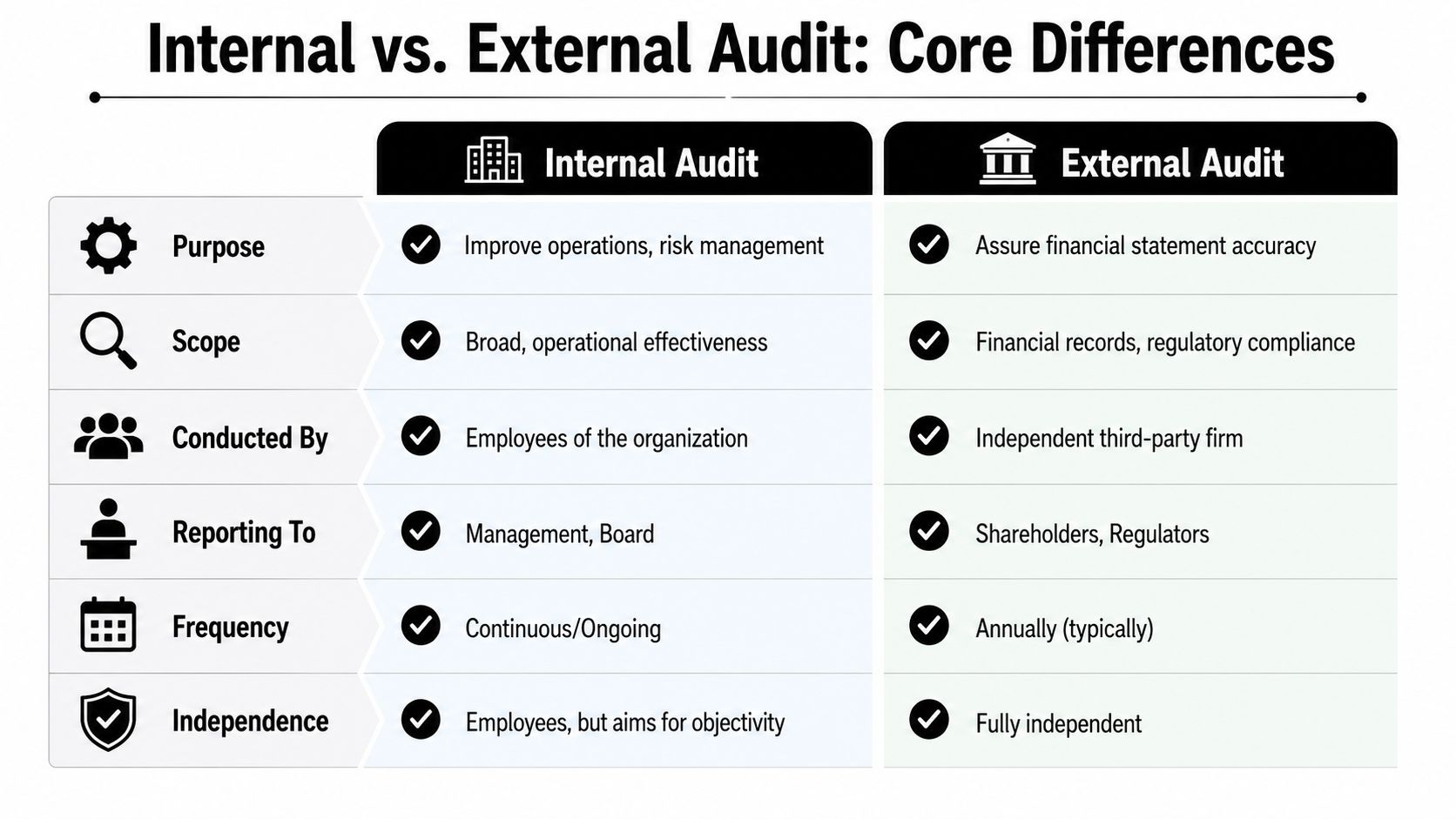
Let's strip out the jargon first. Internal audit is about making the company better from the inside. External audit is about giving outside parties confidence that your financial statements are accurate.
Here's the plain-English version.
| Criterion | Internal Audit | External Audit |
|---|---|---|
| Purpose | Improve operations, controls, and risk management | Provide independent assurance on financial statements |
| Scope | Broad. Can include operations, governance, compliance, non-financial information, and fraud detection | Narrower. Focused on financial statements, disclosures, and compliance with accounting standards |
| Conducted By | Company employees or an internal audit function | Independent CPA firm |
| Reporting To | Senior management and the audit committee | Shareholders, regulators, lenders, investors, and other outside stakeholders |
| Frequency | Ongoing or periodic, based on a risk-based audit plan | Typically annual, or tied to events like financing, IPOs, or mergers |
| Independence | Internal objectivity, but still inside the company | Full independence from the organization |
| Main Outcome | Better processes, fewer surprises, stronger controls | An independent opinion on the financial statements |
Who does the work
One fact matters more than most owners realize. External auditors must always be performed by an independent CPA firm to maintain strict independence from the audited organization, focusing solely on financial statements and disclosures, while internal auditors are company employees who report to senior management and the audit committee to drive daily operational improvements and risk mitigation according to Hilbert College's explanation of external audit vs internal audit.
That independence is the dividing line. Not personality. Not skill. Not how many spreadsheets they use. Independence.
A short explainer helps if you want the visual version.
What each one is trying to accomplish
Internal audit asks questions like:
- Are our controls working: Are approvals happening, reconciliations getting done, and exceptions getting flagged?
- Are we bleeding cash somewhere: Is inventory disappearing, are jobs underbid, are write-offs climbing, are reimbursements sloppy?
- Are we keeping up with change: Are tax law changes, payroll rules, and internal policies reflected in daily operations?
External audit asks a different set of questions:
- Do the financial statements fairly present the business: Can outside users rely on the numbers?
- Are disclosures and accounting treatment appropriate: Do the books follow the required framework?
- Is there enough support for balances and transactions: Can the audit firm trace numbers back to evidence?
Internal audit is a flashlight. External audit is a notarized statement.
The bottom-line difference
If you're thinking about internal audit vs external audit as a small business owner, don't ask which one is “better.” Ask which problem you're trying to solve.
If you need sharper operations, better compliance, stronger controls, cleaner tax readiness, and fewer ugly surprises, you need internal review work. If you need lender confidence, investor comfort, or required independent assurance, you need an external audit.
What Each Audit Actually Looks For
At this point, theory stops and real life starts.
An internal audit doesn't feel like a ceremonial accounting exercise. It feels like someone walking through your business and asking the uncomfortable questions you've been too busy to ask yourself. Why are credits piling up in accounts receivable? Why does payroll need manual cleanup every cycle? Why does one person approve vendors, enter bills, and cut checks? Why are tax notices showing up after you thought everything was filed?
What internal audit work looks like in practice
Internal audits are non-mandatory and run on an ongoing or periodic basis through a risk-based audit plan, while external audits are mandatory for public companies and occur annually, as explained in MindBridge's discussion of internal vs external audit. For a small business, that usually means the internal function is flexible. You don't need a giant department. You need discipline.
A good internal review often checks things like:
- Cash controls: Who can move money, approve payments, and reconcile accounts
- Revenue processes: How invoices get issued, whether collections are timely, and where write-offs creep in
- Payroll and tax compliance: Whether filings, classifications, and support match the rules on the ground
- Systems and access: Who can change records in QuickBooks, your payroll platform, or billing software
- Operational leaks: Inventory errors, job costing problems, duplicate vendors, weak documentation, or poor approval trails
What a fractional CFO is really doing
A lot of SMB owners say, “We don't have internal audit.” Maybe not by title. But if you've got a strong advisor or fractional CFO reviewing controls, analyzing variance, documenting workflows, tightening reporting, and flagging compliance issues, you've got the bones of an internal audit function.
That's one reason I keep saying all companies need a fractional CFO at some stage. Not because it sounds impressive. Because most small businesses don't know what's required until a bank, tax agency, buyer, or board member forces the issue.
A fractional CFO doesn't replace your CPA or your bookkeeper. They connect the dots so the business stops operating on guesswork.
What external auditors actually care about
External auditors are not there to fix your business. They're there to determine whether the financial statements can be trusted by outsiders. That means they focus tightly on records, balances, support, disclosures, and whether your accounting follows the required rules.
They don't care that your AP process is annoying unless it creates risk in the financials. They don't care that your billing workflow is clunky unless it affects revenue recognition, receivables, or disclosure.
So if you're expecting your external auditor to act like an operating consultant, you're paying for the wrong service.
Audits in Action for Healthcare Construction and Non-Profits
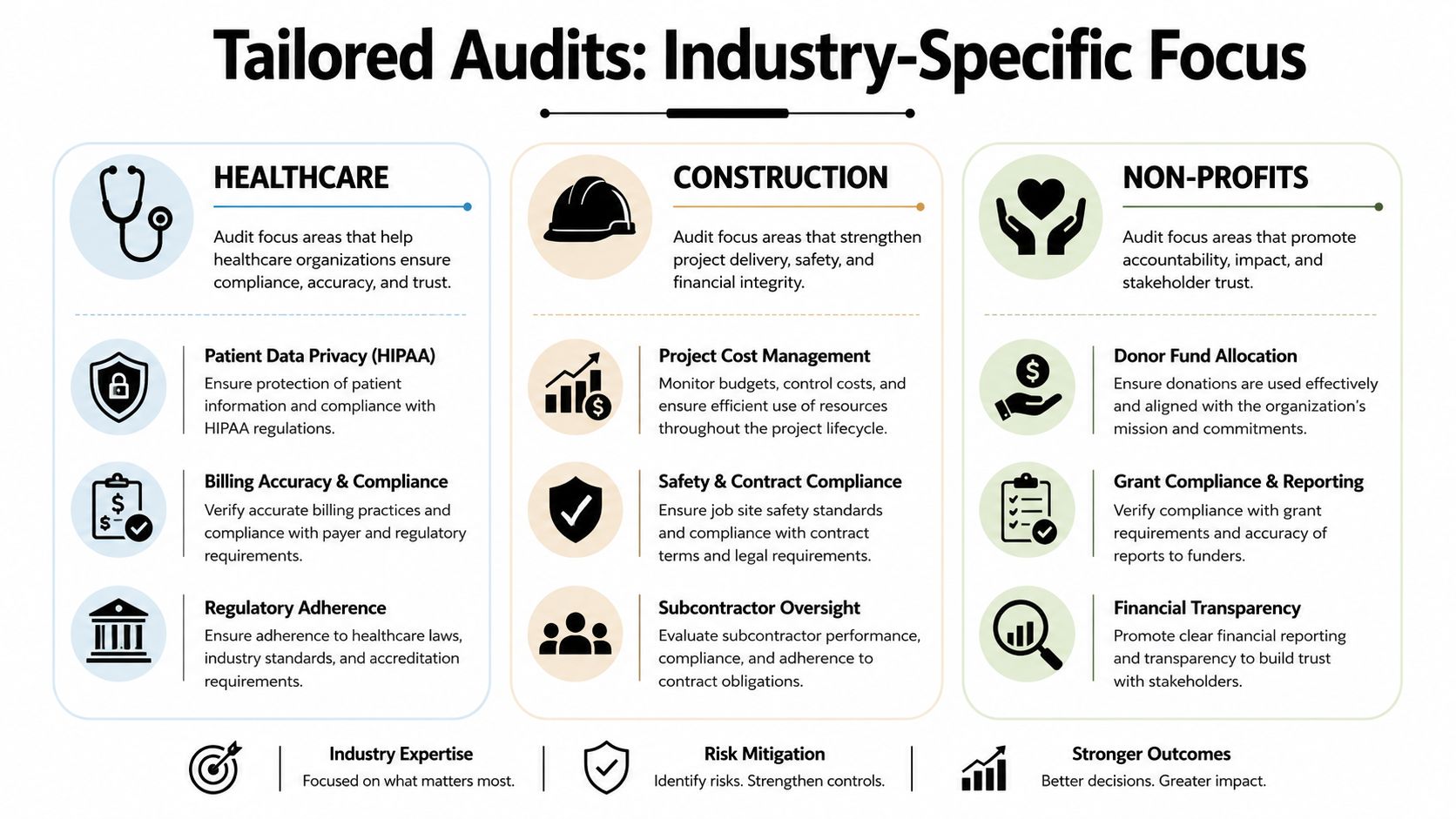
General audit advice is fine. Industry reality is better. The risks in a medical practice are not the same as the risks in a construction company, and neither of those behaves like a non-profit managing restricted funds.
Healthcare
A healthcare group usually feels audit pressure from two sides at once. Inside the business, management needs confidence that billing, coding support, access controls, and patient data handling are working. Outside the business, a lender or investor may want financial statement assurance before expansion.
That's where owners get tripped up. Regulators and lenders strictly reject internal reports for external assurance due to independence requirements, and that matters a lot for healthcare and non-profit organizations dealing with issues like HIPAA or grant compliance, as outlined by Linford & Co. in its explanation of internal vs external audits.
A clinic may run an internal review of billing accuracy, user access, vendor payments, and privacy procedures. Useful? Absolutely. Enough for a bank package? No.
Construction
Construction companies usually don't fail because nobody worked hard. They fail because the numbers lied slowly.
Job costing slips. Change orders get documented late. Payroll allocations don't match field reality. Subcontractor paperwork sits in a truck or inbox until someone panics. An internal review in construction should attack those weak spots directly. It should test how costs flow, how contracts are documented, how draws are supported, and whether reporting shows the truth early enough to matter.
Then the external side shows up. Bonding companies, lenders, and outside stakeholders don't want a pep talk. They want independently verified financial information. That's where external audit or related outside assurance becomes essential.
In construction, bad controls don't just create accounting mess. They can erase profit one project at a time.
Non-profits
Non-profits have a special talent for being held to business standards while being expected to operate with fewer resources. That's why internal reviews matter so much.
A sound internal review can test whether donor restrictions are tracked properly, grant spending matches purpose, payroll is allocated consistently, and reporting to the board reflects reality. But if the state, a major foundation, or another outside stakeholder requires external assurance, the internal work still won't substitute for an independent report.
State rules can complicate that picture fast, so organizations should review nonprofit audit requirements by state before they assume what applies to them.
The hybrid approach that actually works
For many Florida healthcare groups and non-profits, neither a standard internal review nor a plain vanilla external audit fully covers the compliance burden. They often need a hybrid approach. That can include operational testing, independent reviews, targeted compliance work, and outside financial assurance handled as separate but coordinated projects.
That's the adult version of audit planning. Not throwing one report at every problem and hoping it sticks.
Making Your Audits Work Smarter Not Harder
Here's the expensive mistake. A business drifts through the year with messy documentation, inconsistent approvals, weak reconciliations, and no real control narrative. Then the external auditors arrive and have to rebuild the story from scratch. You pay for every hour of that pain.
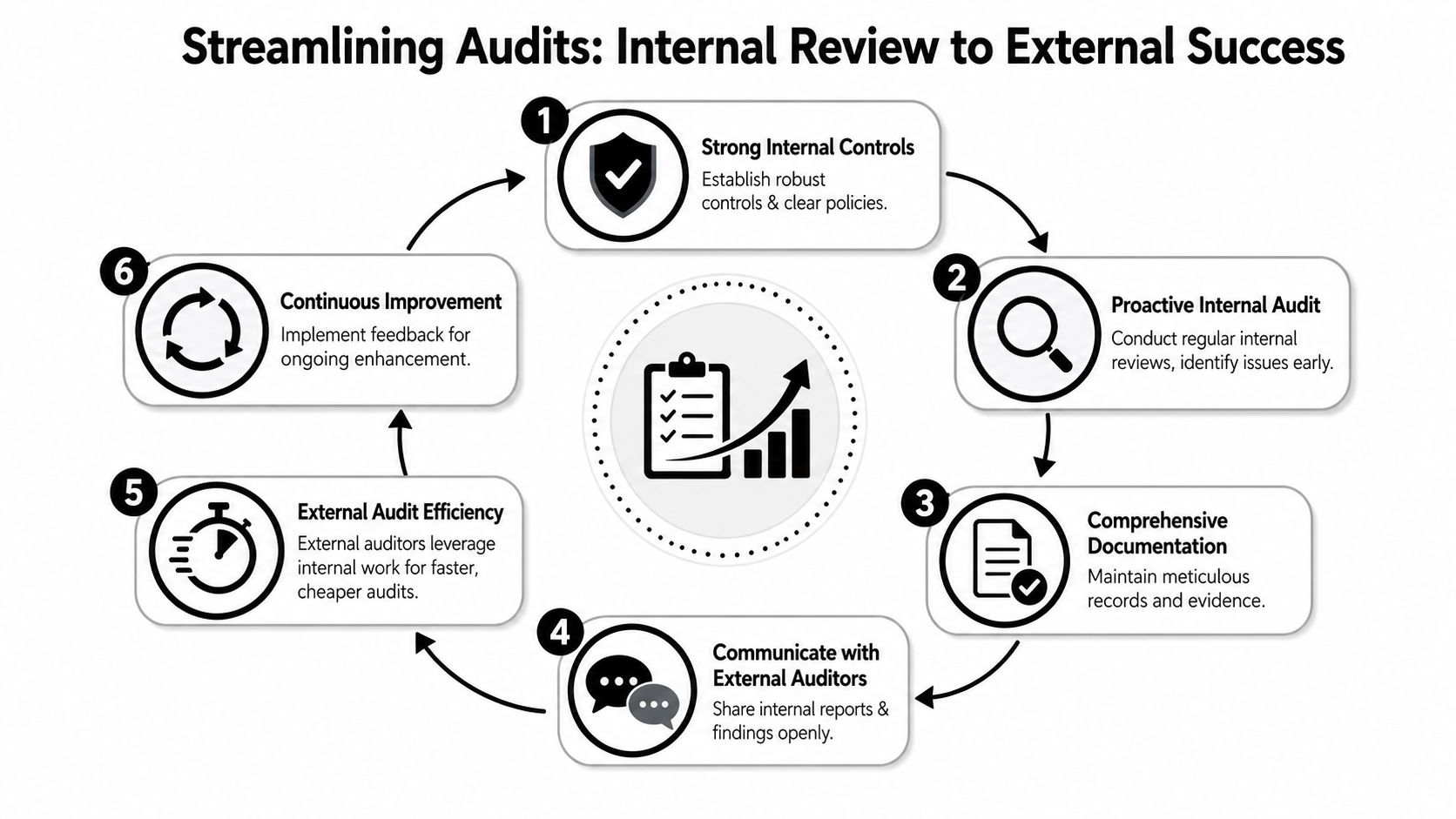
The smarter move is to close the strategic reliance gap. That means your internal reviews are organized in a way outside auditors can effectively use.
Why this saves money
This isn't theory. Benchmark data shows chief audit executives report that internal audit teams reduce external audit fees by 10–15% when internal audit findings are thorough and well-documented, because external auditors can rely on that work and reduce sampling scope, according to The IIA Benchmark Hub.
For a small or midsize business, that's a big deal. Not because everyone loves audits. Because nobody likes paying twice for the same work.
What external auditors need from you
If you want your external audit to move faster and cost less, give the auditors something useful:
- Documented controls: Who approves what, who reconciles what, and where exceptions go
- Risk-focused reviews: Notes on the areas management already examined during the year
- Clean support files: Contracts, invoices, reconciliations, board minutes, payroll reports, tax filings, and bank support organized before fieldwork
- Consistent accounting: Fewer year-end cleanups in QuickBooks and fewer last-minute reclasses
- A guide inside the company: Someone who understands the books and can answer questions without creating fresh confusion
One practical resource for building that discipline is this guide to internal audit best practices.
Why SMBs should care even if they're not public
A lot of guidance on internal audit vs external audit is written for giant companies with SOX teams and layers of staff. That's not your world. Your world is leaner. Which is exactly why this matters.
You don't need a full in-house audit department. You need someone acting like a financial adult in the room. That can be a fractional CFO, an advisory CPA, or a firm that handles bookkeeping, accounting, audit readiness, tax coordination, and compliance support together.
If your external auditor is the first person asking serious questions about your controls, you waited too long.
The right internal review process also helps with tax law changes. When rules shift, you need someone assessing how those changes affect payroll treatment, entity planning, documentation, owner compensation, and reporting workflows. That's not separate from audit readiness. It is audit readiness.
Getting Audit Ready and Staying Compliant
Most small businesses don't need a full-time internal audit staff. They need a system. More specifically, they need clean books, timely reporting, documented controls, solid tax coordination, and a senior advisor who can tell the difference between a nuisance issue and a real exposure.
A simple decision filter
Ask yourself these questions:
- Do outsiders need assurance: If a lender, investor, regulator, or board requires independent validation, you're in external audit territory.
- Do you need operational cleanup: If cash flow surprises, bookkeeping errors, payroll issues, tax notices, or control gaps keep popping up, you need internal review work first.
- Are you growing faster than your processes: Growth without oversight is how companies become audit clients for the wrong reasons.
- Does no one own the financial roadmap: That's usually the clearest sign you need fractional CFO support.
Staying compliant without building a giant department
Internal audit functions that align with business strategy use performance metrics such as mean time to detect (MTTD) and mean time to respond (MTTR) to show measurable improvement in risk mitigation, a forward-looking approach external audits don't provide, as described by Wolters Kluwer's analysis of internal audit performance measures. Small businesses may not track those exact measures formally, but the principle is dead right. Good internal review work helps you spot problems faster and fix them sooner.
That's the difference between compliance as a yearly scramble and compliance as a management habit.
You also shouldn't ignore the professional side of the equation. Firms that perform audit and assurance work face their own exposure, which is why resources like Protecting CPAs during audits are useful reading if you want to understand the risk environment on the advisor side of the table.
My blunt recommendation
If you're still treating bookkeeping, tax prep, compliance, and audit readiness as separate little chores, stop. They belong in one operating system. Most small businesses don't know all the filing requirements, reporting expectations, tax changes, and documentation standards they're supposed to follow. That's normal. Trying to wing it is not.
Get your accounting cleaned up. Get your processes documented. Get a fractional CFO or experienced CPA advisor involved before the bank, investor, or regulator makes the timetable for you. In the internal audit vs external audit debate, the winning move is usually both. Internal discipline first. External assurance when required.
If your business needs cleaner books, stronger compliance, sharper financial guidance, or help getting audit-ready without hiring a full finance department, talk with Bookkeeping and Accounting of Florida Inc.. Their team helps Northeast Florida businesses handle bookkeeping, accounting, tax preparation, internal and independent audits, and fractional CFO support so you can understand your numbers, meet deadlines, and stay compliant without the usual scramble.