
For small and mid-sized businesses, the month-end close isn't just about balancing the books; it's a critical function for survival and strategic planning. An inaccurate or delayed close can obscure vital cash flow problems, lead to costly tax penalties, and result in poor business decisions based on flawed data. With tax laws constantly shifting, most business owners in Jacksonville and across Northeast Florida simply don't have the time or specialized knowledge to ensure full compliance. This is where a strategic accounting partner becomes essential.
Thank you for reading this post, don't forget to subscribe!A disorganized financial closing process leaves your company vulnerable. You might miss new tax credits you are entitled to or fail to comply with updated payroll regulations, exposing your business to audits and significant fines. The reality is that every company, regardless of size, needs senior financial guidance to navigate this complexity. Most small businesses do not know all the requirements to stay compliant, which can put their future at risk.
This article provides more than just a generic month end close process checklist. It delivers a structured, actionable guide tailored for industries like healthcare, construction, and non-profits. We will break down each step, from bank reconciliation to financial statement preparation, explaining its purpose and how to execute it correctly.
More importantly, this guide highlights why partnering with a firm like Bookkeeping and Accounting of Florida Inc. for fractional CFO and business accounting services is not a luxury. It is a necessity for staying compliant, competitive, and in control of your financial destiny. We help you understand not just what to do, but why it matters, transforming your financial data from a historical record into a forward-looking roadmap for growth. Let's dive into the essential steps that will solidify your financial foundation.
1. Bank Reconciliation and Cash Account Verification
The first and most fundamental step in any month-end close process checklist is reconciling your cash. This process involves comparing the cash balance in your company's accounting records against the corresponding balance shown on your bank statement. The goal is to identify any differences and make necessary adjustments to ensure your financial reporting for cash is precise. This isn't just a bookkeeping chore; it's a critical control for managing your business's most liquid asset.

Without accurate cash reconciliation, your financial statements are built on a shaky foundation, making it impossible to make sound business decisions. It’s the primary way to detect bank errors, unauthorized transactions, or internal fraud early. For businesses in Florida, where seasonal revenue fluctuations are common, maintaining a tight grip on cash flow through timely reconciliation is essential for stability.
Implementation Across Industries
Different business types face unique challenges with cash management, making reconciliation a tailored process:
- Healthcare Practices: A clinic in Jacksonville must reconcile daily patient co-pays and electronic funds transfers (EFTs) from insurance carriers. This confirms that all expected payments have been received and correctly posted against patient accounts, preventing revenue leakage.
- Construction Companies: A construction firm often manages separate bank accounts for general operations, payroll, and specific job deposits. Reconciling each account separately is critical for accurate job costing and ensuring that funds designated for a project (e.g., retainage) are not accidentally spent on operational overhead.
- Non-Profits: Organizations must meticulously track cash from different funding streams. Reconciliation helps ensure that restricted donations are held in the correct accounts and not co-mingled with unrestricted operational funds, which is vital for maintaining donor trust and audit compliance.
Actionable Tips for Accurate Reconciliation
To make this process efficient and effective, start it before any other closing procedures. Its accuracy affects nearly every other part of the close.
A dedicated fractional CFO can establish these reconciliation controls for you, creating a system that protects your assets and provides the clarity needed for strategic growth. This guidance is invaluable for small business owners who may not be aware of all compliance requirements.
- Timing is Key: Reconcile all bank and credit card accounts within five to seven business days of receiving the month-end statement.
- Automate Matching: Use the bank feed features in accounting software like QuickBooks. This automates the matching of most transactions, leaving only discrepancies for manual review.
- Investigate Old Items: Any outstanding checks or deposits in transit older than 30-60 days should be investigated immediately. They may represent uncashed checks that need to be voided and reissued or lost deposits that require a claim.
- Maintain Documentation: Keep digital copies of bank statements, deposit slips, and any correspondence related to reconciling items in organized folders. This creates a clear audit trail.
Mastering this first step sets the tone for a smooth and accurate financial close. If you find the process overwhelming, remember that expert help is available. Our business accounting services are designed to handle these meticulous tasks, freeing you to focus on your core operations while ensuring your financials are flawless.
2. Accounts Receivable Aging and Collections Review
The second critical component of an effective month-end close process checklist is a thorough review of your accounts receivable (AR). This involves running an AR aging report, which categorizes all outstanding customer invoices into time-based buckets (e.g., current, 1-30 days, 31-60 days, 61-90 days, and 90+ days past due). The objective is to gain a clear picture of who owes you money, how overdue their payments are, and what the overall health of your incoming cash flow looks like. For small businesses, AR often represents a significant portion of working capital, and managing it proactively is essential for survival and growth.

Neglecting AR analysis can lead to severe cash flow shortages, inaccurate revenue reporting, and an understatement of bad debt. By systematically reviewing aged receivables, you can identify collection problems early, implement targeted follow-up strategies, and make an informed estimate for your allowance for doubtful accounts. This discipline is not just about chasing payments; it’s a strategic function that directly impacts your company’s liquidity and profitability.
Implementation Across Industries
Each industry has distinct challenges in managing receivables, making a customized approach to AR aging review necessary:
- Healthcare Practices: A Jacksonville-based clinic must track both patient balances after insurance and outstanding claims with carriers. An AR aging report helps identify which insurance claims are aging out and require immediate follow-up to prevent denial, as well as which patient accounts need to be moved to a collections process.
- Construction Companies: Firms often deal with progress billings and retainage, where a portion of the payment is held until project completion. Reviewing AR aging is vital to ensure retainage is collected on time and that clients are paying their invoices according to the contract schedule, which is critical for funding ongoing job costs.
- Service-Based Firms: A marketing agency with monthly recurring invoices can use the aging report to spot clients who are consistently late. This highlights potential issues with service satisfaction or a client's financial instability, allowing the firm to address the problem before it escalates.
Actionable Tips for Accurate Reconciliation
An effective AR review process turns data into cash. It should be a proactive, not reactive, part of your monthly financial rhythm.
An experienced fractional CFO can design and implement a collections process tailored to your business. This expert guidance helps you establish clear credit policies and communication protocols, ensuring you stay compliant and get paid faster without alienating valuable customers.
- Prioritize Problem Accounts: Run the AR aging report just before finalizing your month-end financials. Immediately focus collection efforts on accounts over 60 days past due, as the probability of collection drops significantly after this point.
- Set Clear Credit Policies: Communicate payment terms, due dates, and late payment penalties clearly on all invoices and contracts. This sets expectations from the start and gives you a firm standing during collections.
- Document Everything: Keep detailed notes of every collection call, email, and payment promise in your accounting software or CRM. This documentation is invaluable if legal action becomes necessary.
- Make Collections a Weekly Habit: Don't wait until month-end. Dedicate a specific time each week to follow up on overdue invoices. Consistent, friendly reminders are often all that's needed to prompt payment.
3. Accounts Payable Review and Accrual Verification
A meticulous review of your accounts payable (AP) is a critical pillar of the month-end close process checklist. This step ensures that all vendor invoices for goods and services received during the month are accurately recorded. It's about more than just paying bills; it’s about capturing every expense in the correct period to reflect your company's true profitability and financial position. This process of recording expenses that have been incurred but not yet invoiced or paid is known as accruing expenses.
Proper AP and accrual management prevents duplicate payments, catches vendor billing errors, and is fundamental to maintaining strong vendor relationships. For small businesses, especially those in Northeast Florida navigating complex supply chains, this process provides critical control over cash flow and expenses. It ensures your financial statements are not just a record of cash transactions but a true picture of your operational obligations.
Implementation Across Industries
Each industry has unique AP challenges, requiring a specific approach to accrual verification:
- Retail Operations: A boutique in Jacksonville must accrue for utilities, rent, and inventory purchases that were received before month-end but invoiced in the following month. This ensures the cost of goods sold and operating expenses match the revenue generated in that period.
- Construction Companies: A general contractor in St. Augustine needs to rigorously track subcontractor bills and material supplier invoices. Accruing for work completed by subs, even if the invoice hasn't arrived, is essential for accurate job costing and understanding the true profitability of each project.
- Non-Profits: An organization must carefully track and accrue for grant-related expenses and contracted service costs. This ensures that expenses are matched to the correct funding source and reported within the proper period, which is vital for compliance and transparent donor reporting.
Actionable Tips for Accurate Reconciliation
To make AP review and accrual verification efficient, it should be done after preliminary bank reconciliations but before finalizing the income statement. This ensures all known cash payments are accounted for while leaving room to add non-cash expense accruals.
A fractional CFO can implement a robust AP system for you, establishing controls that protect against errors and fraud. For small business owners who may not be aware of all compliance requirements, this guidance is invaluable in ensuring expenses are properly documented for tax purposes and audits.
- Create an Accruals Checklist: Maintain a list of recurring monthly expenses like rent, utilities, software subscriptions, and professional services. At month-end, review this list to ensure an expense has been recorded for each item, accruing it if an invoice is missing.
- Review Vendor Statements: Compare statements from your key vendors against the bills you have recorded in your accounting software. This quickly highlights missing invoices or discrepancies that need investigation.
- Set Vendor Payment Schedules: Use the bill management features in QuickBooks to track open invoices and schedule payments. This helps manage cash flow strategically and avoids late fees.
- Document Accruals: Every accrual entry must have clear supporting documentation, such as a purchase order, a contract, or an email confirmation. This creates a solid audit trail and makes reversing the accrual in the next month straightforward.
A disciplined AP and accrual process is essential for accurate financial reporting. Our business accounting services can streamline your payables, ensuring accuracy and freeing up your time.
4. Inventory Count, Valuation, and Reconciliation
For any business that holds physical products, accurately managing inventory is a cornerstone of the month-end close process checklist. This step involves physically counting your inventory and reconciling that count with the records in your accounting system. The objective is to identify discrepancies, account for shrinkage or damage, and ensure your Cost of Goods Sold (COGS) and inventory asset value on the balance sheet are correct.
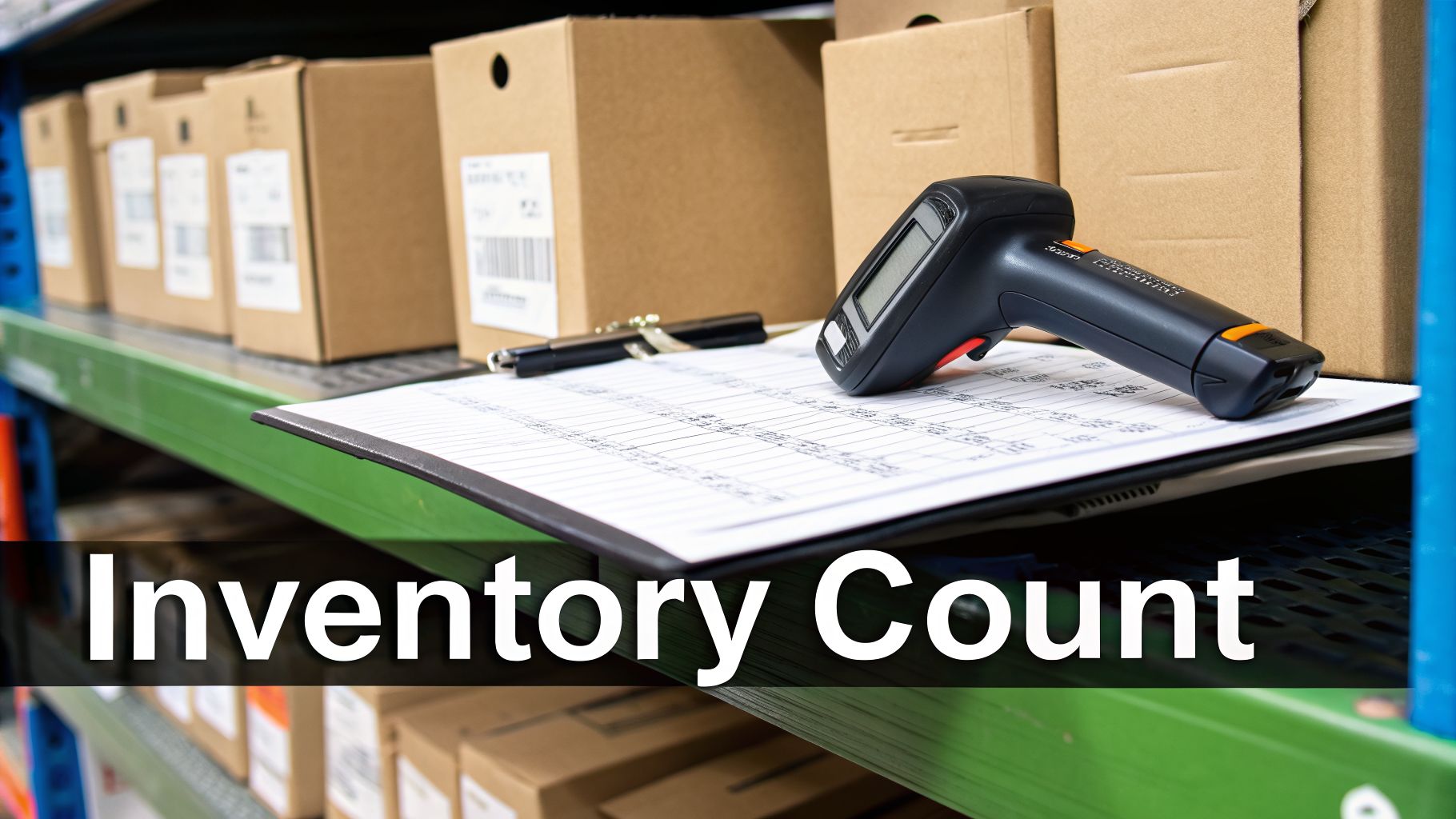
Neglecting inventory reconciliation leads to distorted profit margins and a flawed balance sheet. This process is essential for detecting theft, identifying obsolete or slow-moving stock, and refining purchasing strategies. For businesses in Northeast Florida, where supply chain reliability can vary, precise inventory tracking helps prevent stockouts that disappoint customers and overstock situations that tie up valuable cash.
Implementation Across Industries
Inventory management looks different depending on the business, but its importance is universal:
- Healthcare Practices: A medical clinic must count and value its inventory of pharmaceuticals, vaccines, and high-value medical supplies. This process is critical for regulatory compliance, managing expiration dates to prevent loss, and accurately billing for supplies used in patient procedures.
- Construction Companies: A general contractor in Jacksonville needs to track materials like lumber, piping, and fixtures stored at a warehouse and at various job sites. Accurate reconciliation ensures materials are correctly allocated to job costs, preventing budget overruns and providing a true picture of project profitability.
- Retail Stores: A boutique must perform regular physical counts to verify stock levels against its point-of-sale system. This helps identify theft patterns, understand which products are selling, and make data-driven decisions for seasonal ordering.
Actionable Tips for Accurate Reconciliation
A systematic approach to inventory counting prevents it from becoming a chaotic, error-prone task at month-end.
An experienced fractional CFO can design and implement a perpetual inventory system that gives you real-time data. This level of control is vital for managing cash flow and profitability, especially since most small business owners are not experts in inventory costing methods like FIFO or LIFO.
- Schedule Strategically: Conduct physical counts as close to the last day of the month as possible. Establish clear cut-off procedures to ensure sales and purchases are recorded in the correct period.
- Use Modern Tools: Employ barcode scanners and inventory management software to speed up the process and reduce manual counting errors. Even for smaller inventories, QuickBooks has features to help compare physical counts to system records.
- Implement Cycle Counts: Instead of one massive year-end count, perform smaller, regular counts of specific inventory sections throughout the month. This makes the month-end reconciliation much faster and less disruptive.
- Investigate Variances: Immediately document and investigate any significant differences between the physical count and system records. The cause could be anything from data entry errors and unscanned items to supplier shortages or theft.
For a visual guide on setting up and managing your inventory within your accounting software, this video provides a helpful overview:
Proper inventory reconciliation is not just about counting boxes; it's about gaining financial control and operational insight.
5. Payroll Processing, Accrual, and Tax Verification
A critical part of the month end close process checklist involves a thorough review of your payroll. This step ensures that all employee compensation, tax withholdings, and related liabilities are accurately recorded for the period. It goes beyond simply running payroll; it’s about verifying that every dollar spent on labor is correctly accounted for, taxes are properly accrued, and your business remains compliant with ever-changing regulations. Incorrect payroll can lead to misstated profits, tax penalties, and unhappy employees.
Without this verification, you risk significant financial and legal exposure. For instance, misclassifying an employee or failing to remit payroll taxes on time can result in hefty fines and audits. For many small business owners, especially in Florida, navigating complex state and federal payroll laws is a major challenge. A precise payroll close provides clarity on your largest expense and protects your business from compliance failures, especially with constantly changing tax laws.
Implementation Across Industries
Payroll complexity varies greatly, making a customized approach essential for accurate financial reporting and job costing:
- Service Firms: A marketing agency in Jacksonville must meticulously allocate payroll expenses to specific client projects or billing codes. This verification is crucial for determining project profitability and ensuring accurate client invoicing, directly impacting cash flow and business strategy.
- Construction Companies: Firms must track labor costs by specific job and employee classification (e.g., foreman, laborer). A month-end payroll review ensures these costs are correctly assigned, which is fundamental for accurate job costing and competitive bidding on future projects.
- Non-Profits: Organizations often manage salaries funded by multiple grants, each with unique restrictions. The month-end process must confirm that payroll expenses are allocated to the correct grant, preventing cross-funding and maintaining compliance with donor and governmental requirements for a clean audit.
Actionable Tips for Accurate Reconciliation
A disciplined payroll review prevents last-minute scrambles and ensures your financial statements are reliable. It’s a foundational control for any business.
Many small business owners are unaware of all the compliance requirements surrounding payroll. A dedicated fractional CFO can implement a robust payroll verification system, helping you stay compliant with complex tax laws and providing the financial clarity needed for strategic decisions.
- Review Before Closing: Always review the payroll register for the entire month before finalizing the close. Compare it to the previous month to spot significant variances.
- Verify Tax Withholdings: Confirm the accuracy of federal, state, and local tax withholdings and payments. Maintain a payroll tax calendar to track all filing and payment deadlines without fail.
- Automate Where Possible: Use the features within QuickBooks Payroll or integrate with a dedicated provider like ADP. Automation reduces manual errors in calculations and tax filings.
- Document Accruals: If payroll dates don't align perfectly with the month's end, you must accrue for wages earned by employees but not yet paid. Document these accrual calculations clearly with supporting timesheets or reports for a clean audit trail.
6. Fixed Asset Review, Depreciation, and Disposal Documentation
A thorough review of your fixed assets is a critical step in the month-end close process checklist. This procedure involves verifying your fixed asset register, calculating and recording monthly depreciation, and correctly documenting any assets that have been sold or disposed of. It ensures your balance sheet accurately reflects the value of your property, plant, and equipment.
This is more than just an accounting task; it’s a strategic function that impacts your tax liability and financial reporting integrity. Correctly managing your fixed assets ensures capitalization decisions are appropriate, prevents misstatement of net income, and maintains a clear record for audits. For businesses in Florida, tracking assets like vehicles or specialized equipment subject to regional wear and tear requires precise management to ensure financial statements are reliable.
Implementation Across Industries
Different industries handle fixed assets in unique ways, requiring a specific approach to tracking and depreciation:
- Retail Operations: A retail store in Jacksonville must track its point-of-sale (POS) systems, store fixtures, and security cameras. A proper review ensures that as stores are remodeled or equipment is upgraded, old assets are removed from the books and new ones are capitalized and depreciated correctly, providing a true picture of store profitability.
- Healthcare Practices: Medical practices manage high-value equipment like MRI machines, exam tables, and specialized diagnostic tools. Accurately tracking these assets and their depreciation is essential for calculating the true cost of services and making informed decisions about future equipment investments.
- Construction Companies: A construction firm’s most significant assets are its heavy machinery, vehicles, and tools. Monthly review and depreciation are vital for accurate job costing. Assigning equipment depreciation to specific projects helps determine the real profitability of each job.
Actionable Tips for Accurate Asset Management
To ensure your fixed assets are managed effectively, integrate these practices into your monthly closing routine. This keeps your balance sheet accurate and provides data for strategic decisions.
Many small business owners are unaware of how to stay compliant with complex asset and depreciation rules. A fractional CFO can implement a fixed asset management system, helping you navigate capitalization policies and tax implications to protect your business and support strategic growth.
- Establish a Capitalization Policy: Set a clear dollar threshold (e.g., $1,000) for capitalizing an asset. Items below this amount are expensed immediately.
- Use an Asset Module: Accounting software like QuickBooks has a fixed asset module that can automate depreciation calculations and maintain a detailed register.
- Document Disposals: When an asset is sold or retired, document the date, sales price, and reason for disposal. This is necessary to calculate any gain or loss for tax purposes.
- Reconcile to the Balance Sheet: Monthly, ensure the total value of assets in your fixed asset register matches the corresponding accounts on your balance sheet.
- Coordinate with Your Tax Preparer: Discuss your depreciation methods (e.g., straight-line, MACRS) with your tax advisor to align your bookkeeping with your tax strategy, especially with changing tax laws.
Properly managing depreciation is fundamental to accurate financial reporting. To get a better handle on the concept, you can get more details on depreciation in accounting and see how it impacts your bottom line.
7. Accrued Expenses, Liabilities, and Period-End Adjusting Entries
A critical step in producing accurate financial statements is recognizing expenses in the period they are incurred, not just when they are paid. This is the core of accrual accounting. This part of the month end close process checklist involves identifying and recording accrued expenses and liabilities through adjusting journal entries, ensuring your books reflect a true picture of your financial obligations. This is how you convert cash-basis activities into GAAP-compliant financials.
These entries capture costs like professional fees for services received, employee bonuses earned, or utilities used in the current month, even if the invoice hasn't arrived. Ignoring these liabilities can significantly overstate your net income for the period, leading to poor strategic decisions based on flawed data. It is a fundamental control for accurate financial reporting.
Implementation Across Industries
Accruals are not a one-size-fits-all process; they reflect the unique operational cycles of different businesses:
- Service Firms: A Jacksonville-based marketing agency must accrue for freelance writer or graphic designer costs for projects completed in the month, even if invoices are submitted in the following month. This correctly matches expenses to the revenue they helped generate.
- Construction Companies: A general contractor needs to accrue for subcontractor work that is finished but not yet billed. It is also essential to accrue for potential warranty obligations on completed projects, setting aside funds for future repairs and maintaining profitability on a per-job basis.
- Healthcare Practices: A medical clinic must accrue for physician bonuses tied to monthly performance metrics and contributions to employee benefit plans. This ensures that compensation expenses are correctly aligned with the service period in which they were earned.
- Non-Profits: An organization must record accrued expenses related to program activities or grant-funded projects that have taken place. This is vital for compliant grant reporting and demonstrating responsible stewardship of funds to donors and oversight bodies.
Actionable Tips for Accurate Adjusting Entries
To build a reliable accrual process, systematize your approach to identifying and recording these period-end adjustments.
Small business owners often miss these crucial entries, creating compliance risks and a distorted view of their profitability. A fractional CFO can implement a disciplined accrual system, ensuring your financials are always audit-ready and accurately reflect your company's performance.
- Maintain an Accruals Checklist: Create a list of all recurring monthly accruals (e.g., interest, professional fees, commissions). Review it each month to ensure nothing is missed.
- Create Journal Entry Templates: For standard, recurring accruals, use templates in your accounting software like QuickBooks. This improves consistency, reduces errors, and speeds up the closing process.
- Document Your Estimates: Every accrual is an estimate. Attach supporting calculations, emails, or notes to the journal entry to provide a clear audit trail explaining how the amount was determined.
- Reverse Prior Accruals: Start each new month by reversing the prior month's accruals. This prevents the double-counting of expenses when the actual invoices are received and paid.
- Coordinate with Operations: Regularly communicate with department heads and project managers to identify work that has been completed by vendors or subcontractors for which invoices have not yet been received.
8. Financial Statement Preparation, Review, and Management Reporting
The final, and arguably most important, item in the month end close process checklist is the creation and analysis of your financial statements. This is where all the preceding steps of data collection, reconciliation, and adjustment come together to tell the financial story of your business for the month. It involves generating the core statements: the Income Statement, Balance Sheet, and Statement of Cash Flows, and then translating that raw data into actionable management reports.
This step moves beyond simple bookkeeping into true financial management. These reports are the primary tools you use to understand performance, spot trends, identify potential issues, and make informed strategic decisions. Without this final analysis, the month-end close is just an accounting exercise; with it, the process becomes a powerful engine for business growth and stability.
Implementation Across Industries
Each industry measures success differently, and management reporting must reflect those unique key performance indicators (KPIs):
- Retail Operations: A boutique in Jacksonville needs to go beyond top-line revenue. Management reports should track gross margin on specific product lines, inventory turnover rates, and sales per square foot to optimize product mix and store layout.
- Construction Companies: Profitability isn't just about the final number. A contractor must analyze job profitability reports, compare actual costs to budgeted costs for each project, and monitor labor absorption to ensure bids are accurate and projects remain on track.
- Healthcare Practices: A medical clinic must review more than just total collections. Key reports include patient revenue per provider, supply costs as a percentage of revenue, and staffing efficiency metrics to ensure the practice is both medically and financially healthy.
Actionable Tips for Effective Reporting
To turn financial data into business intelligence, your reporting must be timely, consistent, and insightful. This is a critical part of the month end close process checklist that informs all future decisions.
A fractional CFO transforms standard financial statements into a strategic roadmap. They highlight the "why" behind the numbers, explain variances, and provide the forward-looking guidance that small business owners need to navigate complex decisions and stay ahead of the competition.
- Use Consistent Formats: Present your financial statements and management reports in the same format each month. This consistency makes it easy to spot trends and identify anomalies over time.
- Analyze Variances: Always compare your current month's results to the budget and the prior year's performance. Investigate and document the reasons for significant variances, as this provides critical context for decision-makers.
- Calculate Key Metrics: Go beyond the standard statements by calculating and tracking industry-specific KPIs like Days Sales Outstanding (DSO), customer acquisition cost, or program expense ratios for non-profits.
- Create a Management Summary: Prepare a one-page executive summary that highlights the key financial results, positive trends, and areas of concern. This ensures busy owners and managers can grasp the most important information quickly.
Month-End Close: 8-Point Checklist Comparison
| Item | Process Complexity 🔄 | Resource Requirements ⚡ | Expected Outcomes 📊 ⭐ | Ideal Use Cases | Key Advantages & Tips 💡 |
|---|---|---|---|---|---|
| Bank Reconciliation and Cash Account Verification | Medium — routine matching, complex with multiple accounts | Moderate — accounting staff, bank feeds (QuickBooks), time for investigation | Accurate cash balances; fraud detection; fewer year‑end adjustments ⭐⭐⭐ | Businesses with multiple accounts, retail with daily deposits, healthcare, seasonal FL firms | Prevents cash misstatement. Tip: reconcile within 5–7 days of month‑end. |
| Accounts Receivable Aging and Collections Review | Medium — requires timely invoicing and follow‑up | Moderate–High — AR clerk, collections time, aging reports/software | Improved cash flow; realistic receivable quality; lower bad debts ⭐⭐⭐ | SMBs with significant receivables: service firms, healthcare, construction | Prioritizes collections. Tip: focus collection action on 60+ day accounts. |
| Accounts Payable Review and Accrual Verification | Medium — invoice review and cutoff testing | Moderate — AP processor, vendor statements, bill‑pay tools | Complete expense recording; fewer duplicate payments; better cash planning ⭐⭐ | Firms with many vendors: construction, retail, healthcare | Prevents overpayments. Tip: maintain accrual checklist for recurring bills. |
| Inventory Count, Valuation, and Reconciliation | High — physical counts and cutoff testing can be disruptive | High — staff time, barcode scanners/software, possible off‑hours counting | Accurate COGS; detect shrinkage/obsolescence; correct balance sheet impact ⭐⭐⭐ | Retail, manufacturing, construction materials, healthcare supplies | Detects theft/obsolescence. Tip: use cycle counts and barcode scanning to reduce month‑end load. |
| Payroll Processing, Accrual, and Tax Verification | High — tax rules and multiple pay classifications add complexity | High — payroll software (ADP/QuickBooks), HR input, tax expertise | Compliant payroll; accurate labor cost allocation; avoided tax penalties ⭐⭐⭐ | Any employer, especially healthcare & construction with job costing needs | Prevents compliance issues. Tip: reconcile payroll bank account and maintain a tax calendar. |
| Fixed Asset Review, Depreciation, and Disposal Documentation | Medium — judgment on capitalization and useful lives required | Moderate — asset register, tagging, depreciation tools | Accurate asset values; correct depreciation/tax treatment; audit trail ⭐⭐ | Capital‑intensive businesses: healthcare, construction, retail | Ensures proper capitalization. Tip: set capitalization threshold and tag assets. |
| Accrued Expenses, Liabilities, and Period‑End Adjusting Entries | Medium–High — estimating and coordinating accruals | Moderate — accounting staff, accrual schedules, approval process | GAAP‑compliant statements; accurate period profitability; proper liability recognition ⭐⭐⭐ | Service firms, construction, healthcare, any accrual‑basis entities | Prevents income misstatement. Tip: use standardized templates and document assumptions. |
| Financial Statement Preparation, Review, and Management Reporting | Medium — depends on completion of prior close tasks | Moderate — accounting team, reporting tools, optional fractional CFO | Timely management insights; KPI tracking; informed decision‑making ⭐⭐⭐ | All businesses needing management reporting and forecasting | Translates data to action. Tip: distribute reports within 10–15 days of month‑end; consider fractional CFO for deeper analysis. |
From Checklist to Competitive Edge: Your Path to Financial Clarity
Navigating the month-end close process can feel like a repetitive, time-consuming chore. However, as we've detailed, moving beyond a simple task list is where true business value is created. This comprehensive month end close process checklist is more than just a series of steps to reconcile accounts, review payables, and prepare statements; it's a foundational blueprint for gaining deep, actionable insights into your company's financial health. From verifying every cash transaction to accurately valuing inventory and closing out fixed assets, each step builds upon the last to create a complete and reliable financial picture.
The real power, however, doesn't come from just completing these tasks. It emerges when you use the resulting data to make strategic decisions. Understanding your accounts receivable aging report helps you manage cash flow, while a detailed review of job costing in construction or patient billing in healthcare can reveal profitability drains that were previously invisible. This is the transition from bookkeeping to financial strategy.
The Challenge of Complexity and Compliance
For many small and medium-sized business owners in Jacksonville and across Northeast Florida, the biggest hurdle isn't the process itself, but the immense complexity that lies beneath it. The business world is not static. Tax laws change, industry regulations evolve, and compliance requirements become more demanding.
Consider these common pain points for small businesses:
- Keeping Up with Tax Law: Do you know how the latest state and federal tax code changes affect your depreciation schedules or payroll tax obligations? Missing these can lead to costly penalties.
- Industry-Specific Needs: A non-profit's reporting needs are fundamentally different from a construction company's job costing requirements. A generic checklist often fails to address these critical nuances, leading to inaccurate data.
- Lack of Strategic Insight: Your financial statements tell a story. Are you equipped to read it? Most entrepreneurs are experts in their trade, not in financial analysis. They see numbers, not the narrative of opportunity, risk, and growth potential hidden within them.
This is precisely why almost every company, regardless of size, benefits from professional guidance. A fractional CFO or a dedicated accounting partner does more than just ensure compliance; they act as a strategic guide. They translate the complex language of finance into clear, actionable advice that helps you steer your business toward its goals.
Turning Financial Data into a Strategic Asset
The goal of a flawless month-end close is to produce financial statements that are not just accurate, but also useful. When your reports are reliable, you can confidently make decisions about pricing, staffing, expansion, and capital investments. To truly gain a competitive edge, consider modern approaches like leveraging AI and automation in FinOps to streamline data management and enhance business insights derived from your financial statements.
Ultimately, mastering your month-end close is about transforming a back-office function into a forward-looking strategic tool. It's about achieving the peace of mind that comes from knowing your financial foundation is solid, your compliance is handled, and every decision you make is backed by accurate data. Don't let your month-end process be a source of stress and uncertainty. Instead, make it the engine that drives your business's clarity, confidence, and competitive advantage.
Ready to transform your month-end close from a stressful obligation into a strategic advantage? The experts at Bookkeeping and Accounting of Florida Inc. specialize in providing tailored business accounting, bookkeeping, and fractional CFO services that give you the clarity and confidence to grow your business. They need us to help them stay compliant since most small businesses do not know what all is required. Contact us today to learn how we can help you stay compliant and make data-driven decisions.