
You're probably searching for nonprofit bookkeeping services near me because your books aren't just “behind.” They're starting to interfere with decisions. The board wants clean reports. A grantor wants backup. Your treasurer is doing heroic volunteer work in spreadsheets. Payroll, reimbursements, donor restrictions, and Form 990 questions keep piling up.
Thank you for reading this post, don't forget to subscribe!That's the point where many nonprofits make a costly mistake. They look for the cheapest bookkeeper nearby and hope basic data entry will solve a compliance problem. It won't.
Nonprofit finance is different. You need accurate books, but you also need someone who understands restricted funds, board reporting, audit preparation, payroll, tax filings, and the operational question: what level of support does your organization need?
Why Your Mission Needs More Than Just a Bookkeeper
It usually starts the same way. The executive director is preparing for a board meeting. The treasurer wants a cash position. A grant report is due Friday. Payroll already cleared, but no one is fully sure which expenses hit restricted funds and which hit operations. The bookkeeping is technically "done," yet nobody trusts the numbers enough to make a decision.
That is not a small back-office inconvenience. It is a leadership problem.
A nonprofit can survive messy books for a while. It cannot grow on them. When reports are late, incomplete, or unclear, leadership slows down. Hiring gets delayed. Program decisions get pushed. Board meetings turn into line-by-line damage control instead of oversight and planning.
Clean books protect your credibility
Reliable books do more than keep the bank account reconciled. They protect your standing with the board, donors, grantmakers, and auditors.
Nonprofits operate in a large, highly visible part of the economy. The UN has noted that the social and solidarity economy accounts for nearly 10 percent of employment worldwide in its overview of the social and solidarity economy and decent work. In the United States, the IRS maintains data showing roughly 1.8 million tax-exempt organizations, including more than 1.4 million 501(c)(3) organizations, through its tax-exempt organization statistics. Your organization is not operating in some informal corner of the economy. It sits in a regulated sector with reporting rules, fiduciary expectations, and real scrutiny.
That is why treating bookkeeping as cheap data entry is a mistake.
A capable nonprofit finance partner gives you current reconciliations, dependable monthly reporting, and books that hold up under questions. That changes how you lead. You stop reacting to confusion and start using financial information to decide when to hire, when to conserve cash, and when to invest in growth.
Compliance failures start small
Very few nonprofits get into trouble because of one dramatic event. Problems usually begin with ordinary sloppiness. A reimbursement gets coded to the wrong class. Grant revenue is recorded inconsistently. Deferred revenue is ignored. The board packet goes out with numbers that do not match last month.
Then the consequences get expensive. Year-end close takes too long. The CPA has to clean up avoidable errors. Staff spend weeks digging for support. If you are unsure whether your reporting practices could trigger a review or audit, read this guide to nonprofit audit requirements by state. Those requirements do not become easier because the books are behind.
The fix is not another heroic volunteer effort in Excel. The fix is a finance function that is built to support the mission.
The right hire is a financial partner
You are not really looking for someone to categorize transactions. You are looking for a fractional financial partner who keeps the organization compliant, gives leadership usable numbers, and helps the mission scale without losing control.
That matters even more for associations and member-based nonprofits. Systems decisions affect dues tracking, reporting accuracy, and cash visibility, which is why teams often benefit from comparing nonprofit membership tools alongside their finance setup.
Good bookkeeping is operational. Great nonprofit financial support is strategic. Pay for the second one.
Understanding Your Nonprofit's Unique Financial Needs
A nonprofit can collect donations, pay bills, and still have unusable books. I see it constantly. The ledger looks tidy until someone asks a basic question. How much of this cash is available, which grant is overspent, and why does the board report not match the filing support?
Nonprofit accounting fails when leaders treat it like small-business bookkeeping with a different tax status. It is a different operating model. Your books have to show purpose, restriction, timing, and accountability at the same time. If the structure is wrong, every report built on top of it is wrong too.
Fund accounting is where many nonprofits lose control
Your organization needs more than categorized transactions. It needs books that preserve donor intent, support grant reporting, and tell leadership what resources are available to use.
A workable bookkeeping process is clear. Set up the chart of accounts and classes around restrictions and programs. Record transactions with the right fund, grant, or department at the source. Reconcile every bank and credit card account monthly. Then produce financial statements and supporting schedules that explain variances and cash position. That discipline is the difference between books that satisfy a preparer and books that help management make decisions, which is why this bookkeeping workflow for nonprofits is a useful reference.
Skip any step and the mistakes spread.
What your books must track without fail
- Restricted donations: Donor restrictions have to be recorded clearly so leadership does not spend money that is not available for general operations.
- Grant activity: Each grant may require separate revenue recognition, expense coding, reimbursement support, and reporting against approved budgets.
- Functional expenses: Program, management and general, and fundraising costs need to be allocated consistently if you want credible reporting and a cleaner year-end process.
- Board reporting: A board packet should explain liquidity, budget variance, and program spending. A generic profit and loss report is not enough.
Misclassifying restricted revenue is not a minor bookkeeping error. It is a compliance failure that can mislead management and the board.
Form 990 raised the bar
The IRS uses Form 990 as the annual information return for tax-exempt organizations, and the filing now asks for far more governance, financial, and operational detail than many executives realize. You can review the IRS instructions directly in the official Instructions for Form 990 Return of Organization Exempt From Income Tax, which show the scope of reporting now expected.
That matters because Form 990 is not a year-end storytelling exercise. It reflects the quality of your accounting all year long. If monthly close is weak, functional expenses are inconsistent, or restricted revenue is poorly tracked, those problems surface in the filing.
If you need a practical overview before you hire outside help, review these Form 990 filing requirements. Every executive director and finance committee chair should understand the basics, even if a specialist prepares the return.
Your systems should support the mission, not create cleanup work
Bad system design creates accounting problems that no month-end scramble can fix. Membership organizations run into this constantly. Dues, events, renewals, and deferred revenue often sit in one platform while the accounting records sit somewhere else, which turns reconciliation into guesswork and weakens cash visibility. Teams that are serious about fixing the root problem should spend time comparing nonprofit membership tools before they add more manual workarounds.
This is why the search for nonprofit bookkeeping services should not focus only on price. You are choosing a fractional financial partner who keeps you compliant, gives leadership reliable numbers, and helps the organization grow without losing financial control. Cheap bookkeeping usually costs more. It just waits until audit prep, board reporting, grant compliance, or cash trouble to send the bill.
Finding a Local Expert Who Understands Your Mission
A search for nonprofit bookkeeping services near me can produce a long list of firms, freelancers, and virtual providers. Most of them say the same things. Accurate books. Reliable service. Customized support. That language is useless.
You need a vetting process that exposes whether a provider understands nonprofit finance or just wants another monthly retainer.
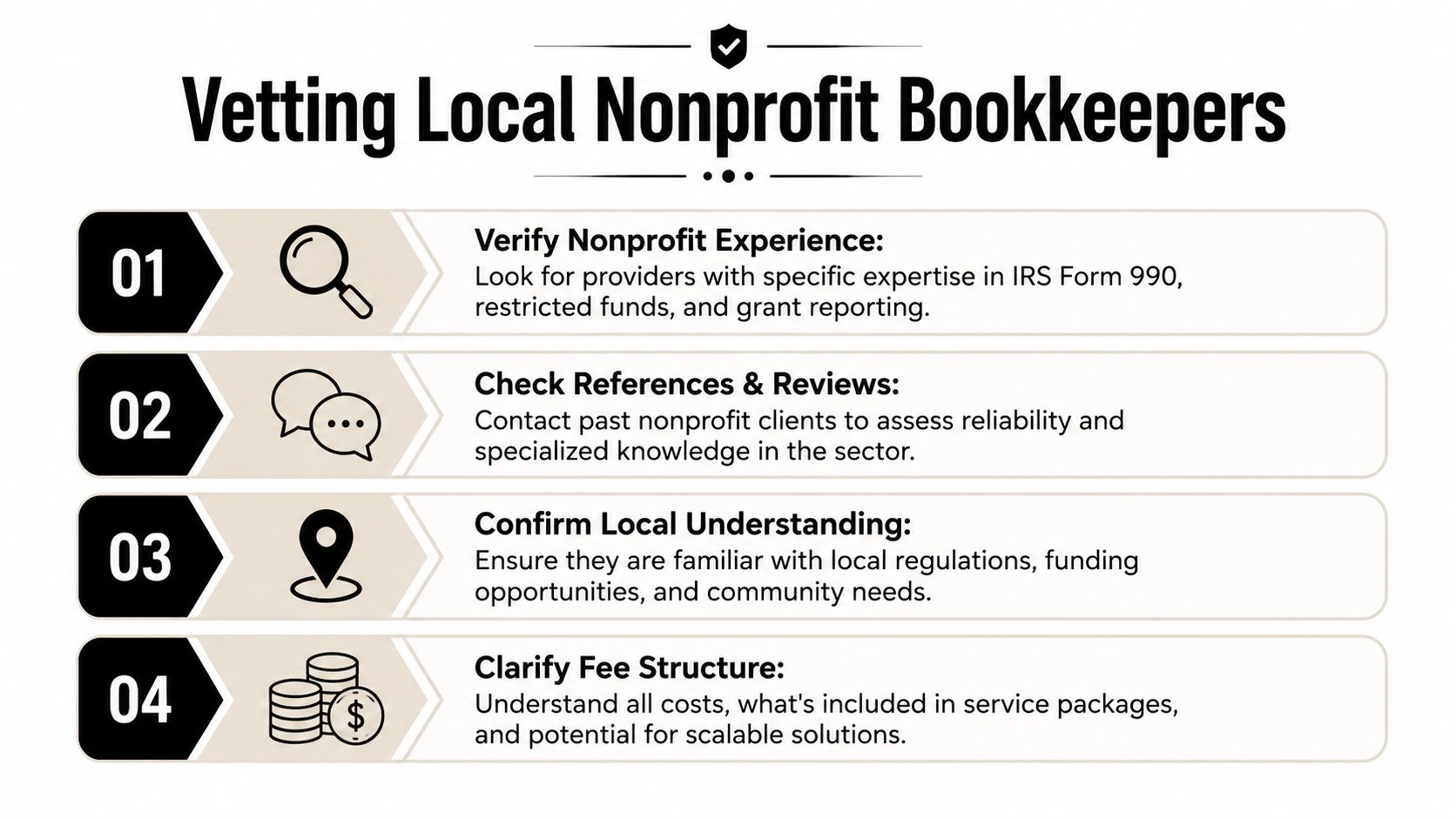
What to verify before you take a meeting
Start with experience, not charm.
| What to check | What a strong provider should show |
|---|---|
| Nonprofit specialization | Familiarity with restricted funds, grant reporting, board packages, and audit prep |
| Software capability | Experience with cloud accounting systems and cleanup work, not just data entry |
| Process discipline | A monthly close routine, reconciliations, supporting schedules, and document management |
| Communication | Clear ownership of deadlines, questions, and who talks to your board, auditor, or tax preparer |
A lot of firms call themselves “full service” when they really mean they'll post transactions and hand you a generic P&L. That's not enough for most nonprofits.
Four questions that separate specialists from generalists
- Ask about restricted funds: A qualified provider should explain how they track donor restrictions and releases, not give you a vague answer about using classes “if needed.”
- Ask about grant reporting: They should be comfortable tying expenses to grant requirements and producing support that matches your reporting deadlines.
- Ask about board reporting: Good firms know that boards need readable monthly financials, not accounting jargon.
- Ask about year-end readiness: They should describe how monthly work supports Form 990 preparation, 1099s, and auditor requests.
Local matters, but specialization matters more
A nearby provider can help when you want in-person meetings, local relationship-building, and someone familiar with state-specific compliance habits. That's useful. It's not the deciding factor.
For many nonprofits, the best local bookkeeper is not always the cheapest or nearest. Value is specialized knowledge of compliance-heavy reporting and audit readiness, especially when a provider handles pre-audit bookkeeping and restricted fund tracking as core work, as discussed in this overview of specialized nonprofit bookkeeping support.
Proximity is convenient. Expertise is expensive to replace.
What I'd recommend
If you're comparing providers, narrow your list to firms or advisors who can do all of the following without hesitation:
- Explain their month-end close process.
- Show how they handle documentation for grants and donor restrictions.
- Produce sample board reporting.
- Coordinate with outside tax and audit professionals when needed.
- Scale into controller or CFO support if your needs grow.
That last point matters more than most leaders realize. You may start by hiring a nonprofit bookkeeper near you, but what you need is a partner who can grow with the organization.
Questions to Ask Before You Hire And Answers to Look For
The interview stage is where weak providers collapse. Most candidates can say they work with nonprofits. Fewer can explain what they do when your books are messy, your grants overlap fiscal years, and the board wants answers before next week's meeting.
Start with scenario questions. They reveal how a provider thinks.
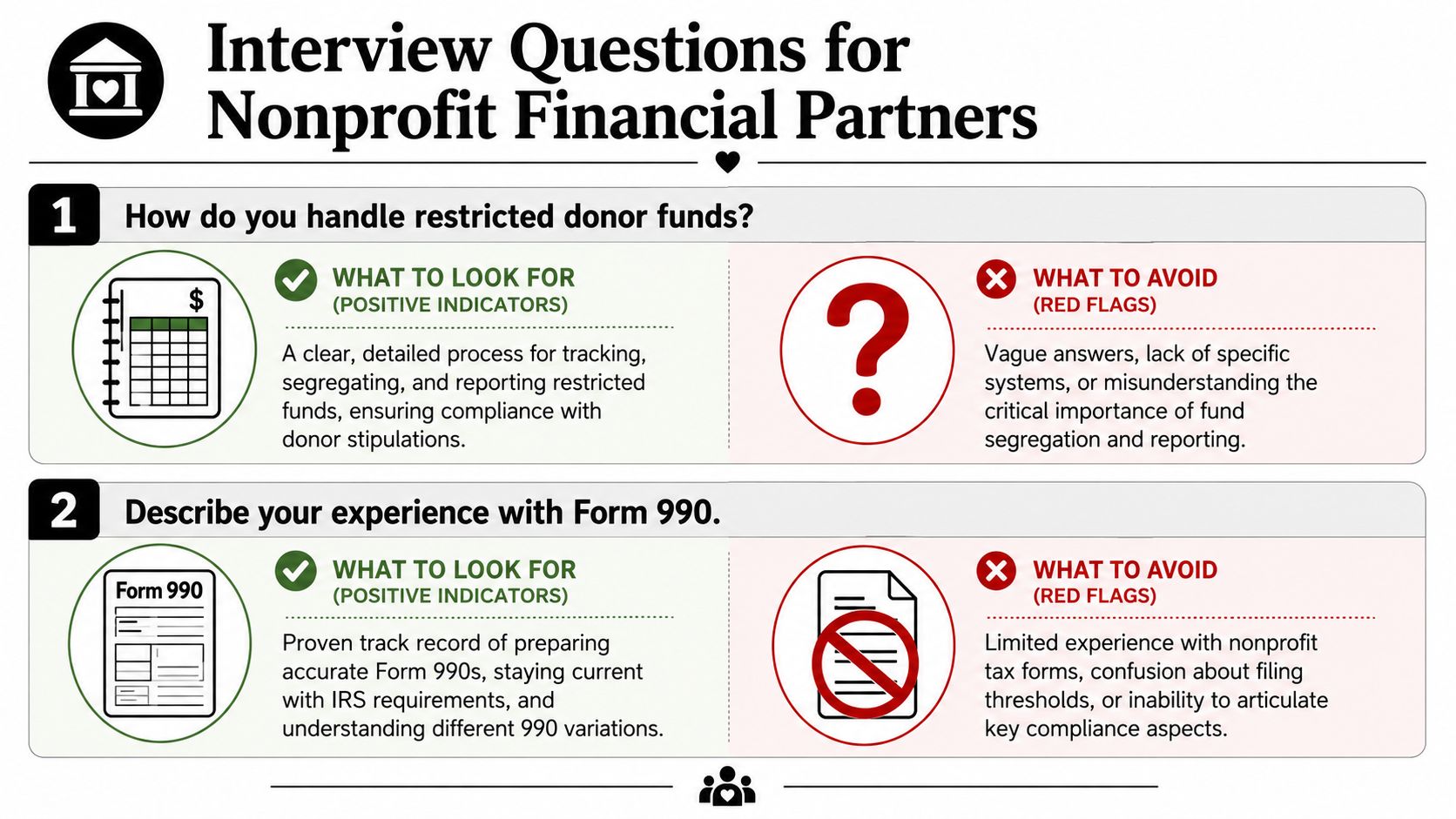
Ask questions that force a real process answer
Use questions like these:
“How do you handle a new restricted grant?”
Strong answer: they describe setup, coding, documentation, reporting, and review.
Weak answer: they say they'll “track it in QuickBooks.”“What happens during your monthly close?”
Strong answer: they mention reconciliations, review of unusual items, financial statements, and follow-up questions.
Weak answer: they talk only about data entry.“How do you support board reporting?”
Strong answer: they tailor reports, explain variances, and help leadership understand what changed.
Weak answer: they email standard reports with no interpretation.“What's your role in Form 990 preparation?”
Strong answer: they know bookkeeping drives tax prep quality and can explain handoff, support schedules, and issue resolution.
Weak answer: they minimize the form or treat it like a routine afterthought.
Here's a quick visual summary to keep in mind during interviews.
Ask the scope question early
One of the smartest questions isn't technical. It's operational.
A key question is whether your nonprofit needs bookkeeping help year-round or only during audit or tax season. The primary buying decision isn't just who does bookkeeping. It's what scope you need, especially when your organization deals with restricted funds, grant reporting, or complex board packages, as explained in this discussion of nonprofit bookkeeping scope and service models.
That question changes the conversation. Instead of shopping by hourly rate, you start defining responsibility.
Red flags you should take seriously
Not every bad fit is obvious. Watch for these:
- They downplay compliance: If someone treats nonprofit reporting like standard small-business bookkeeping, walk away.
- They can't explain fund accounting plainly: Complexity is fine. Confusion is not.
- They push one software setup for every client: Good advisors adapt systems to the nonprofit, not the other way around.
- They avoid ownership: If nobody can tell you who reviews reports, who handles reconciliations, or who responds to auditor questions, you're buying a gap, not a service.
If a provider can't explain their process clearly in a sales call, they won't bring clarity once they have your books.
The best interview outcome is simple. You should leave the conversation knowing exactly what they'll do each month, what they won't do, and how they'll help you stay compliant.
From Basic Bookkeeping to a Fractional CFO
Month-end closes. The numbers are technically done. Then the executive director asks three basic questions. Can we hire? Are we spending restricted funds correctly? What happens if the grant renewal is late? A bookkeeper can keep the ledger accurate. Those questions still go unanswered.
That is the line between bookkeeping and financial leadership. If your nonprofit is growing, adding grants, hiring staff, or facing tighter board scrutiny, you need more than clean reconciliations. You need someone who can interpret the numbers, pressure-test decisions, and keep the organization out of compliance trouble.
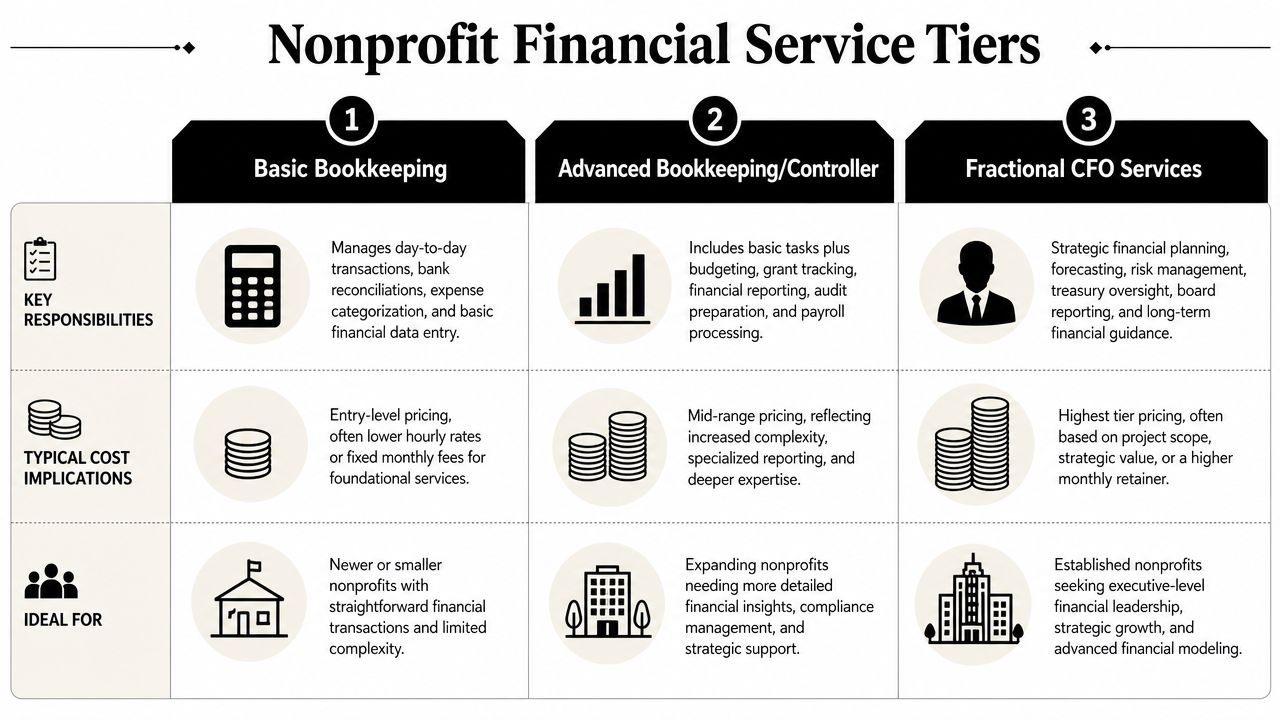
What each service tier actually does
| Service level | What it covers | Where it falls short |
|---|---|---|
| Basic bookkeeping | Transaction entry, reconciliations, routine reports | No forward-looking analysis, weak board support, little help with financial decisions |
| Advanced bookkeeping or controller support | Better reporting, payroll coordination, grant tracking, year-end support | Limited cash forecasting, budget modeling, and strategic planning |
| Fractional CFO | Budget leadership, cash planning, scenario analysis, board guidance, financial strategy | More involvement than a very small nonprofit with simple activity may need |
The mistake I see all the time is buying the cheapest layer and expecting executive-level insight from it. Bookkeeping records what happened. Controller work tightens reporting and oversight. CFO work turns financial information into action.
Signs you need CFO-level support
The need usually shows up before leadership names it clearly. Board packets go out, but they do not answer the critical questions. Cash gets tight even though revenue looks healthy on paper. Program growth outpaces the finance process. The executive director becomes the default finance department.
At that point, the problem is not data entry. The problem is missing financial judgment.
You should move beyond basic bookkeeping if your team needs to:
- forecast cash by month instead of checking the bank balance and hoping
- model hiring or program expansion before committing
- explain restricted vs. available funds clearly to the board
- prepare for audits, grantor reviews, or lender questions without a fire drill
- connect budgets to strategy instead of treating them as static spreadsheets
This also changes how you should view cost. Stop treating finance support as overhead to squeeze. Charity Navigator has pushed back on the old overhead-ratio obsession and explains why administrative spending alone does not measure nonprofit effectiveness: Charity Navigator on the overhead myth. Smart nonprofits invest in the finance capacity that protects compliance, supports decisions, and prevents expensive mistakes.
A fractional CFO is often the right middle ground. You get senior financial leadership without paying for a full-time executive before your organization is ready. If you need help deciding what that role should include, this breakdown of fractional CFO services for growing organizations is a useful starting point.
My recommendation
If your nonprofit has restricted funding, recurring board reporting, payroll complexity, grant deadlines, or audit pressure, buy a finance function, not isolated tasks. Start with accurate bookkeeping. Add controller discipline where needed. Bring in CFO guidance once leadership needs forecasts, scenario planning, and stronger board communication.
Bookkeeping and Accounting of Florida Inc. is one example of a firm that offers bookkeeping, accounting, payroll, audit-related support, and fractional CFO services under one roof. That structure matters because disconnected vendors create gaps, and gaps are where compliance problems start.
One more practical point. Growth creates visibility. New grants, new programs, and major announcements bring outside attention, which means your financial story needs to hold up as well as your public messaging. If your team is preparing a campaign or funding announcement, a solid nonprofit press release template helps with communications, but finance still has to back every claim with credible numbers.
You do not need a fancy title. You need a financial partner who can keep the books clean, explain what matters, and help leadership make decisions before small problems turn into expensive ones.
Taking Control of Your Nonprofit's Financial Future
It is the week before the board meeting. Your executive director wants a clean budget-to-actual report. A grantor needs backup for restricted spending. Payroll already cleared, but one program charge looks wrong. If your books are behind or unreliable, leadership is forced to guess, and guessing is how nonprofits drift into compliance problems, cash strain, and avoidable board tension.
A nonprofit with disciplined financial reporting runs better. Board conversations stay focused. Year-end closes faster. Leaders can decide whether to hire, expand a program, delay spending, or protect cash because the numbers are current and credible.
This search is not about finding the cheapest person to categorize transactions. It is about putting a real finance function in place. The right partner keeps your books clean, catches reporting issues early, explains what the numbers mean, and helps leadership make decisions before small errors become audit findings, grant problems, or cash shortfalls.
That matters most when the organization is growing. New programs, grant restrictions, donor reporting, payroll changes, and board scrutiny all increase at the same time. Generic bookkeeping falls apart under that pressure. A nonprofit needs a financial partner who can handle fund tracking, reporting deadlines, documentation, and leadership questions without turning every month-end close into a scramble.
Rules change. Filing expectations change. Documentation standards tighten. Small nonprofits usually find out after something was missed, and by then the fix is more expensive than getting the process right from the start.
If your team is also raising visibility for the mission, public communications need financial discipline behind them. Announcing a new initiative is easier with a clear nonprofit press release template, but the stronger move is making sure every public claim is supported by records, reporting, and a finance team that knows the numbers will hold up.
That is the return on investing in experienced nonprofit bookkeeping and CFO support. You get accurate books, stronger compliance, better board reporting, and leadership capacity. You also get a guide who helps the organization grow without losing control.
If your nonprofit needs reliable bookkeeping, stronger compliance support, or fractional CFO guidance, Bookkeeping and Accounting of Florida Inc. can help you build a finance function that fits your organization. The firm is a locally owned, full-service CPA practice in Jacksonville with more than 20 years of experience serving nonprofits and other growing organizations across Northeast Florida. Schedule a consultation to talk through your bookkeeping, Form 990, payroll, reporting, audit, or CFO support needs and get a practical plan for cleaner books and better decisions.