
You're staring at a QuickBooks file that doesn't add up, and the bad news is it won't fix itself. Maybe the bank balance is off again, payroll hit the account, and the profit and loss report looks like it was assembled by a raccoon with a calculator. That's usually the point where Jacksonville owners stop “keeping an eye on it” and start needing QuickBooks Cleanup Services.
Thank you for reading this post, don't forget to subscribe!For local businesses, messy books aren't a cosmetic problem. They block lending conversations, muddy tax prep, and make it hard to know if you're making money or just staying busy. In a market like Jacksonville, where construction, healthcare, retail, and nonprofit reporting all have their own headaches, clean books are the difference between making a smart move and making an expensive guess.
The Telltale Signs Your QuickBooks Needs a Deep Clean
Your books don't have to be on fire to need help. Sometimes they just smell like smoke. A Jacksonville owner usually notices the problem in the same few places, the checking account won't reconcile, reports change every time someone clicks refresh, and the month-end close drags on because nobody trusts the numbers.

What messy books actually look like
A bad file usually shows up as duplicate income, unreconciled bank accounts, odd balances in Undeposited Funds, and expenses sitting in the wrong buckets. That's not “just bookkeeping.” A QuickBooks cleanup is a corrective accounting process that reviews, organizes, and fixes transactions, account balances, and reports so the financial statements are accurate and consistent, which is exactly why year-end reporting gets ugly when cleanup is ignored (Dillon Advisors).
If you've ever looked at a balance sheet and thought, “That can't be right,” you're already in cleanup territory. The same goes for owners who are about to apply for financing, bring in a partner, or hand records to a CPA right before tax season. Clean books aren't a vanity project, they're a credibility issue.
If the books can't survive a normal bank reconciliation, they definitely won't survive a lender's questions.
The stress isn't abstract either. One internal guide on the ugly truth about unreconciled accounts gets at the same reality, unreconciled accounts turn routine accounting into a scavenger hunt. If that sounds familiar, you're past the point of “let me take another look this weekend.”
Why Jacksonville owners should treat this as urgent
Small businesses often wait too long because the problem feels internal. It isn't. Dirty books can distort taxable income, hide cash leakage, and make it harder to answer basic questions like whether a job, a clinic, or a location is profitable.
The fix is a professional cleanup, not another round of spreadsheet archaeology. If you're seeing bounced payments, mismatched deposits, or reports that change depending on who ran them, the file needs a deep clean before it costs you a loan, a filing deadline, or your sanity.
Your Pre-Cleanup Checklist for a Smooth Handoff
A good cleanup starts before anyone opens QuickBooks. If you hand over a half-baked stack of documents and say “good luck,” you'll pay for the back-and-forth later. Bring the right materials up front, and the project moves faster, cleaner, and with fewer surprises.
Start with access and source records
First, gather the login details for QuickBooks Online or Desktop, plus any payroll, bank, credit card, and lending portals tied to the books. That matters because cleanup work often depends on verifying transactions at the source instead of guessing from exports. If payroll, merchant services, or loan payments live in separate systems, the cleanup team needs access to trace the money correctly.
Bring the monthly bank statements, credit card statements, prior financial reports, and any reconciliation summaries you already have. Those documents help establish what the books should have looked like before things went sideways. If you've changed bookkeepers, added entities, or opened new accounts, say so early. That history saves time.
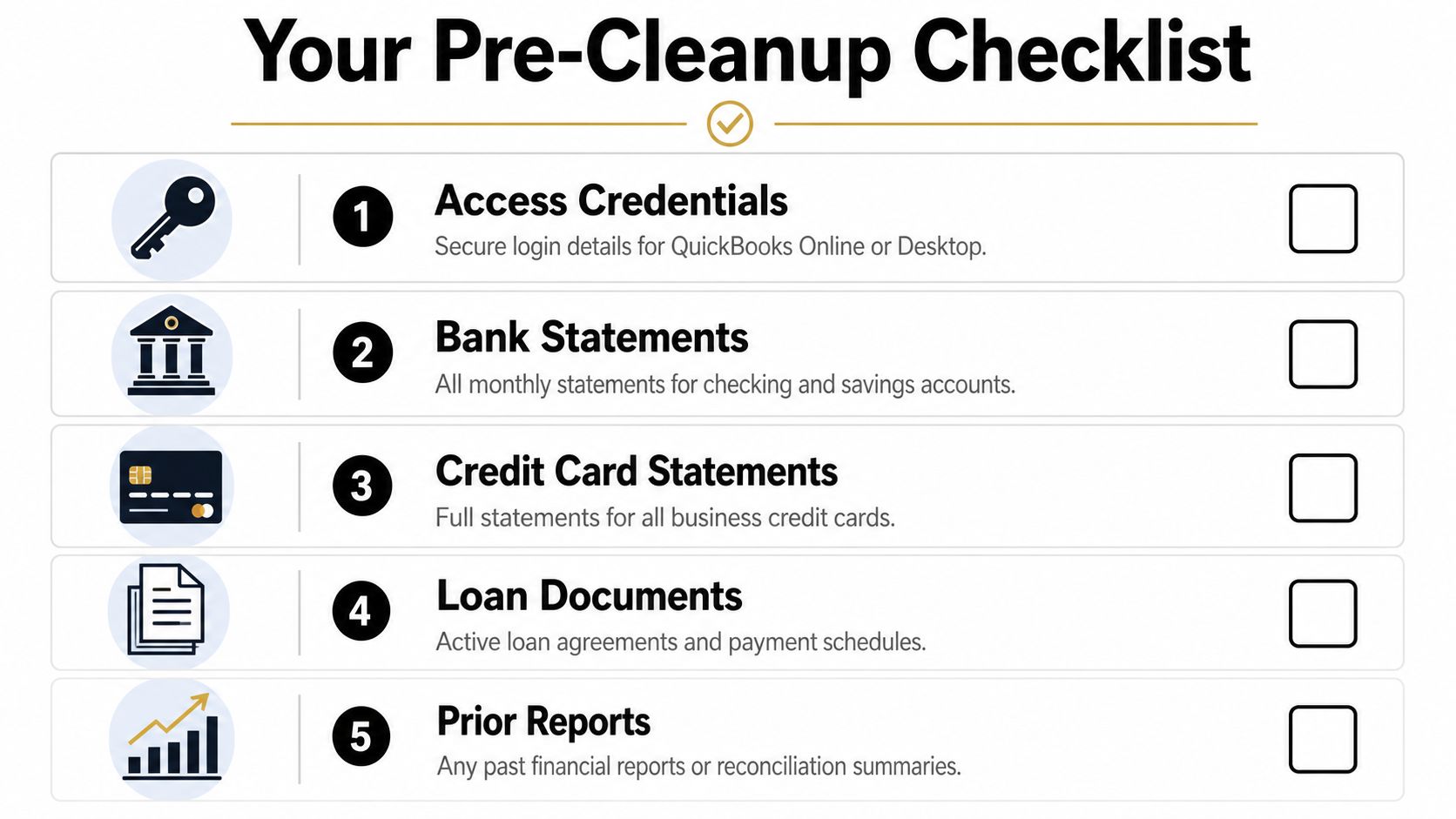
Use this as your working list:
- Access Credentials: Secure logins for QuickBooks and any connected financial platforms.
- Bank Statements: Full monthly statements for every operating and savings account.
- Credit Card Statements: Complete statements for all business cards.
- Loan Documents: Active loan agreements and payment schedules.
- Prior Reports: Old profit and loss statements, balance sheets, and reconciliation summaries.
Bring tax and setup history too
If you've got prior tax returns, send those as well. They help the cleanup team compare the books to filed numbers and spot gaps that need to be corrected before the CPA signs off. For account structure, a useful internal reference is how to set up chart of accounts in QuickBooks, because a bad chart of accounts can turn a cleanup into a permanent headache.
Give the cleaner the paperwork, not the puzzle.
That's the whole game. The better the handoff, the less time gets wasted chasing missing context, and the faster your books move from “who knows” to “usable.”
The Anatomy of a Full QuickBooks File Restoration
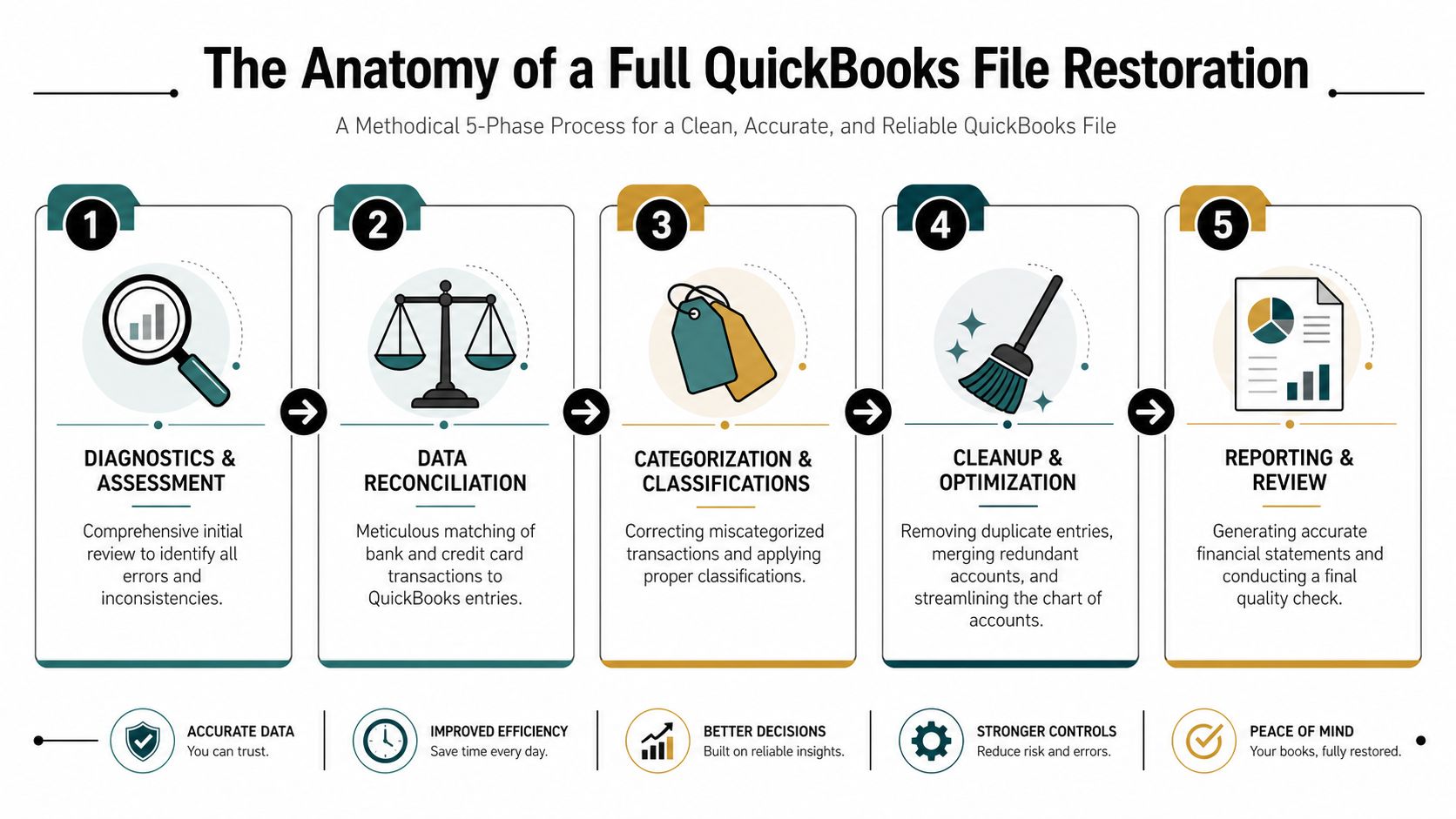
A real cleanup is not one big click. It's a controlled restoration, the kind that starts with diagnosis and ends with numbers you can trust. The best operator playbooks break it into phases because that's how you avoid rework and keep the repair from turning into a second disaster.
Phase 1 and 2, diagnose first, then reconcile
The workflow usually begins with intake and diagnostics, then moves into cleanup sprints, QA, and handoff. One operator playbook outlines that sequence and recommends fixing cash and liabilities before touching revenue and COGS, because the rest of the file depends on those foundation accounts being right (Omniga). That order matters. If bank and credit card activity is still broken, everything built on top of it is suspect.
The professional services of a local CPA or QuickBooks ProAdvisor command their fee. They aren't just hunting typos. They're matching cleared transactions, finding the cause of open reconciliations, and checking for bank-rule conflicts and subledger-to-GL mismatches. For a Jacksonville contractor, that can mean tracing job-costing messes. For a healthcare practice, it can mean cleaning up patient co-pays and deposits that were posted in the wrong place.
If the underlying records are physically damaged or missing because a system failed, a separate data recovery experts resource can help retrieve the files before accounting work begins. That's a technology rescue, not a bookkeeping fix, but sometimes you need both.
Phase 3 and 4, classify correctly and clean the structure
Once the base is reconciled, the cleanup turns to classification. That means removing duplicate transactions, correcting miscategorized expenses, cleaning up the chart of accounts, and making sure the financial reports reflect reality instead of software shortcuts. It also means rebuilding reports like the balance sheet and income statement so management can use them without squinting.
A practical data backups and accounting because oops isn't a strategy reminder belongs here too. If you're cleaning a file without a backup plan, you're gambling with the one record that matters most.
For firms with older files, a structured cleanup also helps surface the long-tail exceptions that hide in obscure accounts. That's the part most DIY attempts miss. The first pass catches the obvious errors, the second pass catches the stuff that made the first error look normal.
Reconciliation is boring in the best possible way. It's where truth starts showing up in the numbers.
Phase 5, verify and hand off
The final pass is quality assurance and handoff. The file gets tied out, reports are reviewed, and the client receives books that can support tax filing, lending, or management reporting. That's the point where cleanup stops being a repair job and becomes a usable financial system again.
For businesses that want a full-service path after cleanup, Bookkeeping and Accounting of Florida Inc. is one option that handles bookkeeping, accounting, payroll, tax prep, and fractional CFO support for Jacksonville companies. The reason that matters is simple, cleanup without follow-through tends to decay again.
Decoding Timelines and Pricing for Cleanup Services
Owners always ask two questions first, how much, and how long. Good. They should. Cleanup is not cheap, and it shouldn't be. If someone quotes you like they're estimating pizza delivery, they probably haven't seen enough broken files to be trusted with yours.
Industry pricing data shows QuickBooks cleanup projects typically range from $1,500 to $7,500, with most completed in 10 to 20 business days (Jumpstart Partners). That's your budgeting anchor. Cleanup is a finite recovery project, not an endless monthly service, and that's exactly how business owners should plan for it.
What changes the price
The bill depends on how many months are unreconciled, how many accounts are involved, how bad the transaction coding is, and whether the file has issues with payroll, inventory, or loan tracking. A file with a few bad months and one messy bank account is one thing. A year of neglected books with duplicate income, missing liabilities, and broken reconciliation history is another animal entirely.
One practitioner's rough benchmark is about one hour of cleanup per month of records, and the safer approach is to quote a range instead of a fixed price so unknowns can be absorbed mid-project (YouTube practitioner guidance). That's not a scare tactic. It's honesty. Exception density is the killer, and the deeper you go, the more hidden problems usually show up.
DIY cleanup vs professional service
| Factor | DIY Approach | Professional ProAdvisor Service |
|---|---|---|
| Error detection | You catch what you already suspect | Systematic review finds hidden issues |
| Time use | Nights, weekends, and guesswork | Controlled project timeline |
| Risk | Higher chance of repeat mistakes | QA and tie-out reduce rework |
| Reports | Often still inconsistent | Cleaned reports support filing and lending |
| Cash flow impact | Delay, stress, and uncertainty | Predictable project window |
The DIY route looks cheaper until it eats two months of owner time and still leaves you unsure about the numbers. Professional cleanup costs real money, but so does filing bad returns, missing deductions, or making a borrowing decision off fiction.
Beyond the Cleanup Keeping Your Books Clean and Compliant
A clean file is good. A clean file that stays clean is better. That second part is where a lot of small businesses get lazy, and that laziness gets expensive fast. Someone does a heroic cleanup, then the owner goes right back to throwing receipts at the screen like confetti.
Put controls around the mess
Keep the cleanup from unraveling by locking in routine bank reconciliations, requiring consistent coding rules, and reviewing reports every month before the numbers age into folklore. That's not glamorous, but neither is explaining to your CPA why last quarter's expenses are buried in the wrong account. Good internal controls keep a fresh file from sliding back into swamp mode.
There's also a hard boundary between cleanup and ongoing bookkeeping. Independent guidance treats cleanup as a project-based repair, and says its value is maximized when it transitions into recurring support that maintains accuracy (TechBrot). That's the part owners skip when they try to save a buck, then wonder why the books fall apart again six months later.
Why ongoing guidance matters now
Tax law changes don't care that you were too busy to read the update. Neither do lenders, vendors, or payroll deadlines. If your numbers are messy, every compliance decision gets harder, and small businesses usually don't know how much is required until something goes wrong. That's why ongoing bookkeeping plus a fractional CFO is a practical combination, not a luxury.
For owners who want a broader support model, business accounting solutions are worth reviewing as a category, especially if you need bookkeeping, reporting, and advisory work to stay aligned. Clean books feed cash flow planning, job costing, and tax readiness. Without that base, strategic advice is just expensive guessing.
Clean books don't just reduce stress. They make better decisions possible.
And that's the primary sell, not “tidy records,” but usable information. The point of cleanup is to get your company ready for the next decision, the next filing, and the next stage of growth.
Choosing Your QuickBooks ProAdvisor in Jacksonville
Jacksonville businesses don't need a generic national help desk with a nice logo and no context. They need someone who understands local payroll realities, construction job costing, healthcare billing quirks, nonprofit reporting, and the way a messy file turns into a tax-season emergency. That's why picking a local QuickBooks ProAdvisor matters.

A good Jacksonville CPA does more than clean the file. They tell you what the numbers mean, what still needs fixing, and what should change in the way the business runs. Intuit's formalization of QuickBooks Live Expert Cleanup is a strong signal that cleanup is a recognized professional service, not a casual workaround, and that structured remediation belongs in the hands of certified experts who can rebuild accurate balance sheet and income statement reporting (Intuit).
That matters even more in regulated or billing-heavy fields. If you want a useful outside reference for healthcare operations, the roundup of best medical billing companies shows how much discipline those workflows require. Accounting is the same way, if the process is sloppy, the output is unreliable.
What to ask before you sign
- Do they clean up and maintain? A one-time fix without follow-through usually drifts back into chaos.
- Do they understand your industry? Construction, healthcare, retail, and nonprofits have different reporting pressure points.
- Do they offer CFO-level guidance? Clean books are the starting point, not the finish line.
- Will they explain the numbers plainly? If you need a decoder ring, you don't have a partner.
For Jacksonville owners who want bookkeeping, tax prep, audits, healthcare accounting, or fractional CFO support from one local firm, the smart move is to choose the team that can handle both the cleanup and the next decision after it. That's what separates a repair from a real financial strategy.
If your QuickBooks file is already costing you time, sleep, or credibility, stop treating it like a side project. Reach out to Bookkeeping and Accounting of Florida Inc. and get a cleanup plan from a Jacksonville CPA who can fix the books, keep them compliant, and help you use the numbers to run the business like an adult.