
The owner of a Jacksonville clinic opens QuickBooks on a Monday morning and finds a familiar mess: unreconciled bank transactions, a stack of 1099s, payroll reports that don't quite match the general ledger, and a deadline approaching fast. The question isn't really, “Can someone prepare my tax return?” It's, “Which filing is due first, what did I miss, and can I trust these numbers?”
Thank you for reading this post, don't forget to subscribe!That's the search behind tax services Jacksonville FL. A business may need tax preparation, payroll compliance, sales tax filing, bookkeeping cleanup, entity planning, or financial guidance for its next hire. Treating those needs as an annual April project is how owners end up paying for rushed corrections instead of using their numbers to run the company.
A Jacksonville CPA should help build a year-round system. Bookkeeping and Accounting of Florida Inc. is a locally owned Jacksonville firm offering bookkeeping, tax preparation, payroll, audits, reviews, forensic accounting, and fractional CFO support. The practical question is whether your business needs another tax preparer or a financial partner who keeps the books usable long after filing season.
Why Most Jacksonville Small Businesses Wait Too Long to Call a Tax Pro
A contractor can spend the winter focused on jobs, payroll, and material purchases, then discover that subcontractor records are incomplete just as information returns are due. A growing medical practice can have owner compensation, payroll filings, patient-related deductions, and several bank accounts moving at once. A retailer may collect sales tax correctly on one product category and misclassify another for months without noticing.
By the time the owner searches for tax services in Jacksonville, FL, the issue usually isn't a single return. It's a pileup of obligations, entity questions, payroll records, contractor payments, and unclear deadlines. The tax return becomes the visible problem because it has a due date, but the underlying problem is weak financial administration.
Practical rule: If your tax professional only sees your books once a year, they're reviewing history after the decisions have already been made.
The better approach starts with bookkeeping that supports compliance every month. Bank and credit card accounts need reconciliation. Payroll should agree with the ledger. Contractor payments need tracking before year-end forms are prepared. Sales tax settings need review when products, services, locations, or billing methods change. An owner shouldn't need to reconstruct the business from email attachments in March.
The cost of waiting
Late cleanup creates more than inconvenience. It makes tax planning reactive, increases the chance of mismatched filings, and leaves owners guessing about cash available for hiring, equipment, or expansion. It also prevents a CPA from giving useful advice because the financial information arrives too late to influence the outcome.
That's why a small business tax professional in Jacksonville should be involved before the deadline pressure starts. The right firm coordinates bookkeeping, payroll, tax filings, and planning so each part supports the next.
A partner beyond April
You don't need a full-time controller to receive senior financial guidance. A fractional CFO can review cash flow, forecast upcoming obligations, prepare management reporting, and help you make decisions while the business is still small enough to move quickly.
The firms that handle this well don't just ask for last year's return. They ask how you price work, how you pay owners, whether your entity still fits, where cash gets trapped, and which deadlines your current process can't reliably manage. That's the difference between tax preparation and a functioning financial system.
The Core Tax Services a Jacksonville CPA Firm Actually Provides
A full-service accounting firm should match the service to the problem. “We do taxes” is too vague to help an owner decide what needs attention first. Use the table below as a practical starting point.
Core Tax and Accounting Services at a Glance
| If your business is dealing with… | The service you actually need | What it looks like in practice |
|---|---|---|
| Unclear deductions, entity questions, or a rushed annual return | Tax preparation and planning | The CPA prepares the return, reviews supporting records, identifies planning opportunities, and coordinates estimated payments before the next deadline. |
| Payroll errors, missing notices, or employees working across states | Payroll tax and multi-state filing support | Payroll reports are reconciled to the books, withholding obligations are reviewed, and required state filings are organized around where work is performed. |
| Incorrect invoice tax settings or mixed taxable and non-taxable sales | Sales-and-use tax compliance | The firm reviews item taxability, customer locations, invoices, exemption records, and filing data so collected tax matches the underlying transactions. |
| Financial statements that lenders, owners, or boards don't trust | Reviews and compilations | A compilation organizes client-provided data into financial statements. A review adds analytical procedures and inquiries appropriate to the engagement. |
| Suspected theft, disputed transactions, or unexplained losses | Forensic audit work | The accountant traces transactions, examines records, and documents findings for management, legal counsel, or other authorized users. |
| A growing ledger full of unreconciled accounts | Monthly bookkeeping and accounting | Bank, credit card, payroll, receivable, payable, and loan activity are recorded and reconciled on a recurring schedule. |
| A need to test controls or validate financial records | Internal or independent audit services | Procedures are designed around the organization's reporting, controls, compliance requirements, and intended users of the financial statements. |
Tax preparation is only one part of the machine. Planning helps owners decide whether a purchase, hiring decision, distribution, or entity change creates a tax issue before the transaction happens. Bookkeeping gives the planner reliable inputs.
Payroll deserves separate attention because payroll records feed tax filings, employee forms, cash planning, and often workers' compensation calculations. A payroll issue that sits unresolved can contaminate several reporting systems at once.
Start with the bottleneck
If your books are behind, begin with cleanup and monthly accounting. If your return is filed but your cash position remains unclear, add tax planning and fractional CFO support. If your organization needs financial statements for a lender, board, grantor, or transaction, ask about the appropriate compilation, review, or audit engagement.
Detailed tax compliance services for Jacksonville businesses should connect these pieces instead of treating every filing as a separate emergency. The point isn't to buy every service. It's to remove the failure point that keeps producing surprises.
Jacksonville-Specific Tax Rules That Change Your Compliance Playbook
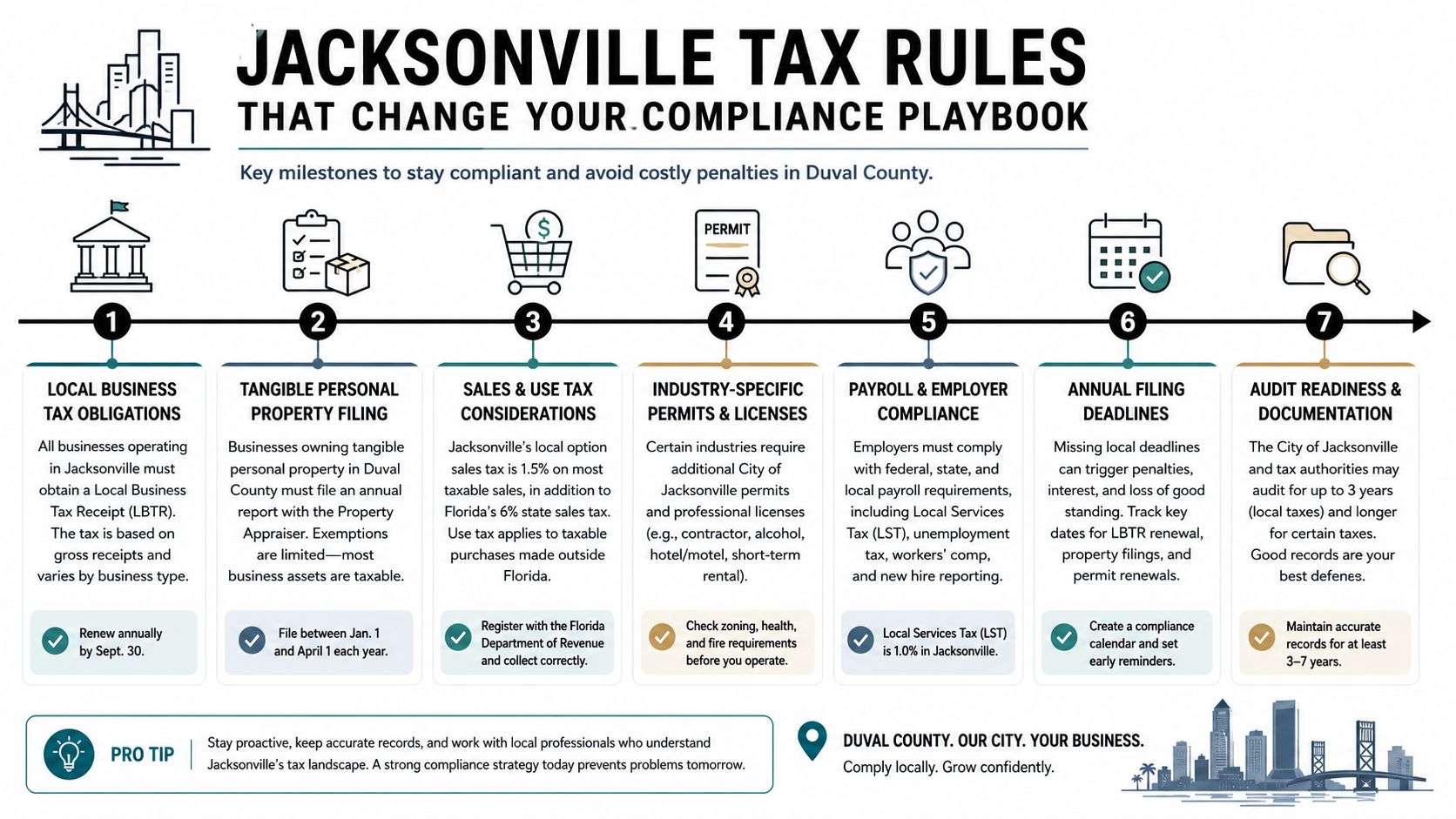
Jacksonville businesses operate in a state with no state income tax and no city income tax, but that doesn't mean compliance is simple. Florida corporate income tax is 5.5% of taxable income, with the first $50,000 exempt, and Florida starts its calculation with federal taxable income, as described in the Florida corporate income tax analysis. Entity classification therefore matters. A C corporation faces the levy, while pass-through entities such as S corporations generally don't.
That distinction changes how bookkeeping should preserve federal-to-state adjustments, entity records, and apportionment support. Choosing an entity because it sounds familiar is poor planning. Your CPA should model the structure against compensation, distributions, retained earnings, and administrative requirements.
Jacksonville also has a 7.5% combined sales tax rate, made up of Florida's 6% state rate and Duval County's 1.5% discretionary surtax. The city doesn't add another local sales tax, according to Jacksonville sales tax rate information. Invoice configuration must still be accurate at the county level.
Property and local reporting
Jacksonville reports a 2022 millage rate of 17.0303 on real property. Its tax structure page lists tangible personal property tax as exempt up to $25,000, while commercial property tax is capped at a 10% annual increase, subject to the applicable rules. Those details matter to businesses holding equipment, commercial space, or other reportable property, and they belong in planning conversations rather than last-minute filing sessions. The city's tax overview also cites a population estimate of 954,624, which helps explain the scale of the local market for accounting and tax services. These figures and rules come from Jacksonville's tax structure overview.
Deadlines collide quickly
For 2026, partnerships and S corporations generally file by March 16, 2026, while sole proprietors and C corporations generally file by April 15, 2026. Estimated tax dates run Jan. 15, Apr. 15, Jun. 15, and Sept. 15, 2026. W-2 and 1099 deadlines fall on Feb. 2, 2026, because Jan. 31 falls on a Saturday, as detailed in the 2026 small-business tax deadline calendar.
Your bookkeeping system should identify these obligations before the dates arrive. Businesses also need a process for payroll taxes, contractor reporting, and other recurring filings, not just income tax returns. For help with the transaction-level work, use a firm familiar with Florida sales tax filing.
Jacksonville's budget picture reinforces why property-related reporting deserves attention. The city's 2025–26 budget summary reports ad valorem tax revenue rising by $73,992,815 to $1,177,681,641, while a separate fiscal evaluation found property tax represented 49.4% of general fund revenues. The Jacksonville 2025–26 budget summary provides the budget figures and local context.
Industry-Specific Tax Work for Healthcare, Construction, and Non-Profits
A Jacksonville clinic, a roofing contractor, and a nonprofit don't need the same accounting workflow. They may share a payroll provider or accounting platform, but the risks sit in different places. Generic tax preparation misses those pressure points.
Healthcare practices and clinics
Healthcare accounting starts with clean separation between clinical revenue, owner compensation, payroll, operating costs, and provider-related payments. Physician compensation models need to align with the entity's structure and payroll records. The books should also support healthcare-specific deductions and make it easy to explain unusual expenses during an audit or review.
A common mistake is treating owner draws as if they were payroll, or letting payroll records and the general ledger drift apart. That creates confusion around compensation, taxes, and financial statements. Healthcare accounting services should reconcile those systems monthly and preserve documentation for significant deductions.
Clinics also need reporting that answers operational questions. Which providers are producing revenue? What are staffing costs doing to margins? Can the practice hire another employee without creating a cash squeeze? A tax return won't answer those questions, but accurate bookkeeping and management reporting will.
Construction and trades
Construction accounting depends on job costing. Revenue, labor, materials, subcontractors, change orders, and overhead need to be assigned to the correct project so the owner knows which jobs make money.
The recurring trap is a contractor who records every subcontractor payment as a generic expense and then scrambles to prepare 1099-NEC forms. The firm may have paid the bills, but it can't easily prove job profitability or confirm that contractor records are complete. Construction accounting should track vendors, project codes, payment types, and supporting documents throughout the year.
Workers' compensation considerations, payroll timing, retainage, and the cash-versus-accrual decision also affect month-end reporting. A contractor who watches only the bank balance can mistake collected project cash for earned profit. Regular job-cost reports give the owner a better basis for pricing and staffing decisions.
Nonprofits
Nonprofits need more than a clean income statement. They need restricted-fund tracking, board-ready reports, grant documentation, and appropriate Form 990 preparation. Donor-restricted money should remain distinguishable from funds available for general operations.
A common error is reporting restricted contributions as unrestricted cash because the money arrived in the same bank account. That can distort board reporting and create questions during an audit. Nonprofit accounting services should maintain fund-level records and establish a reporting cadence that directors can understand.
Audit and review work must also match the organization's obligations and intended users. The right engagement depends on the nonprofit's governing documents, grant requirements, financial reporting needs, and applicable rules. A Jacksonville CPA with nonprofit experience should explain that distinction before promising a particular service.
Why Every Growing Jacksonville Business Eventually Needs a Fractional CFO
A business can outgrow its bookkeeping long before it can justify a full-time CFO. That middle stage is where owners make expensive decisions with incomplete information. They know revenue, but not reliable cash runway. They see expenses, but not project-level profitability. They have reports, but no consistent interpretation.
A fractional CFO fills that gap with part-time senior financial guidance. Industry guidance describes the role as flexible and cost-effective, with benefits including better planning and forecasting, stronger controls, clearer cash visibility, and improved decision-making, as discussed by The Total CFO.
What the role should deliver
A useful fractional CFO doesn't just send another spreadsheet. The work should include:
- Cash visibility: A clear view of receivables, payables, payroll, taxes, debt, and upcoming commitments.
- Forecasting: Scenarios for hiring, pricing, equipment purchases, expansion, and slower collections.
- Management reporting: KPI dashboards and monthly commentary that explain what changed and what needs action.
- External readiness: Reports that make conversations with lenders, investors, partners, and advisors more productive.
- Tax alignment: Planning that connects entity structure, owner compensation, equipment decisions, and operating activity.
The 2026 rules make that coordination more valuable. The maximum net self-employment earnings subject to the Social Security part of self-employment tax is $184,500, and the business mileage rate is 72.5 cents per mile, according to the 2026 small-business tax guidance. Those figures affect owner planning, reimbursement policies, and recordkeeping.
A separate 2026 summary reports the SALT deduction cap for pass-through owners rising to about $40,400, while the Section 179 expensing limit increases to about $1.32 million, with phase-out beginning after about $3.29 million of qualifying purchases. See the 2026 rules for LLCs, S corporations, and partnerships. Equipment decisions should follow operational needs, not a last-minute desire to reduce taxable income.
Owners often ask, “Can I afford a fractional CFO?” The sharper question is, “Can I afford to price jobs blindly, miss compliance requirements, mismanage cash, or buy equipment without understanding the tax and operational consequences?” If the business has outgrown basic QuickBooks habits, senior guidance is no longer a luxury. It's a control system.
What Onboarding With a Jacksonville Tax and Accounting Firm Looks Like
Onboarding shouldn't feel like handing over your business to a black box. The firm should explain what it needs, what it will review, and what you'll receive during the first few months.
Start with discovery and document collection
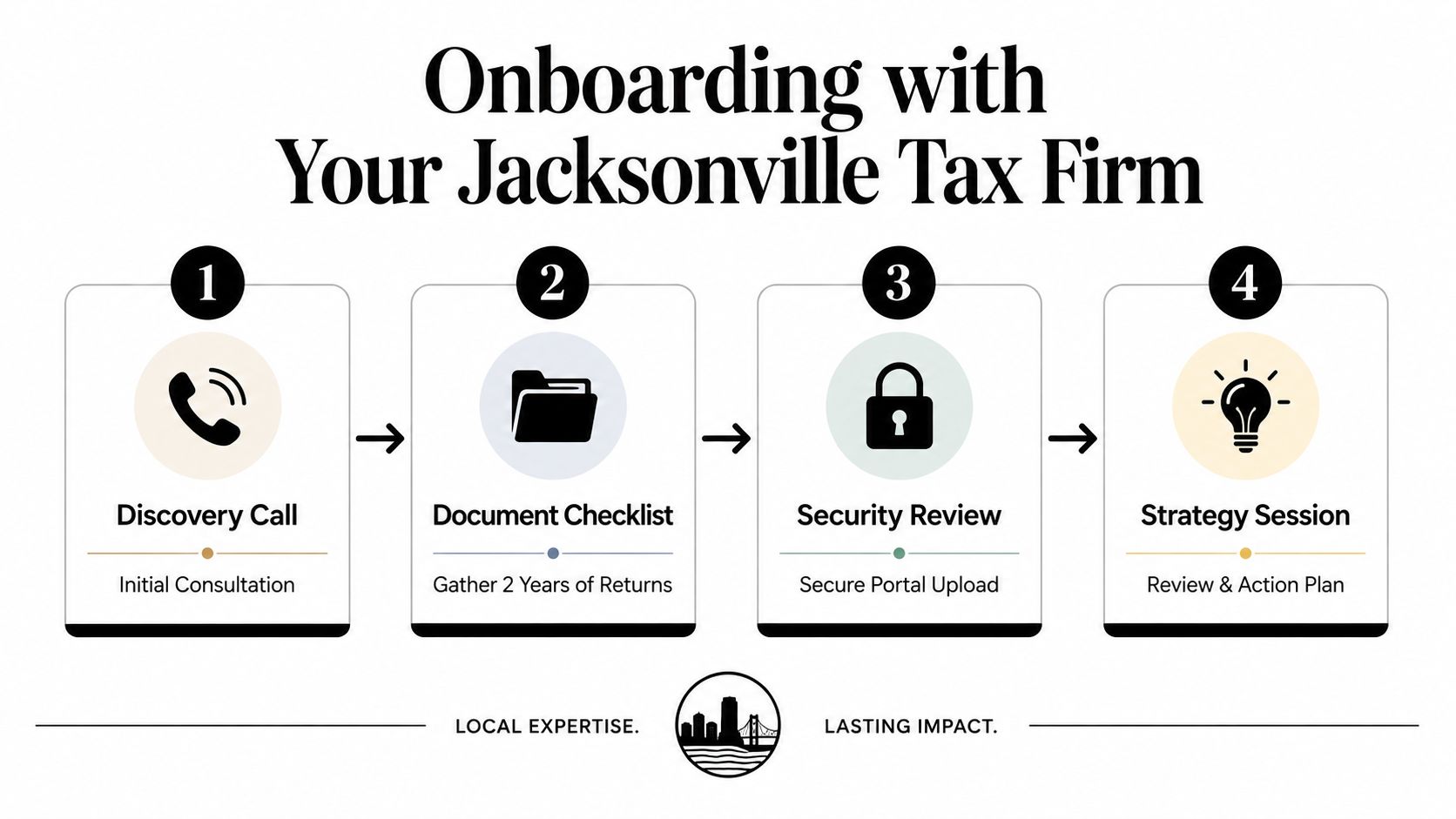
The discovery call establishes the basics: entity type, industry, tax history, accounting platform, payroll process, sales tax obligations, outstanding notices, and the decisions coming next. Then the firm requests the records needed to assess the situation.
Expect a checklist that may include:
- Prior returns: The previous two years of tax returns for the business and relevant owners.
- Core statements: Bank and credit card statements, loan documents, and access to QuickBooks or another general ledger.
- Payroll records: Payroll reports, employee information, tax filings, and contractor records.
- Entity documents: Formation records, ownership information, operating agreements, and prior elections.
- Tax records: Sales tax filings, notices, payment confirmations, and exemption documentation.
The firm should use secure cloud document storage rather than relying on scattered email attachments. A QuickBooks ProAdvisor can also review the existing file, correct the chart of accounts, establish an appropriate workflow, and organize permissions.
The first 30, 60, and 90 days
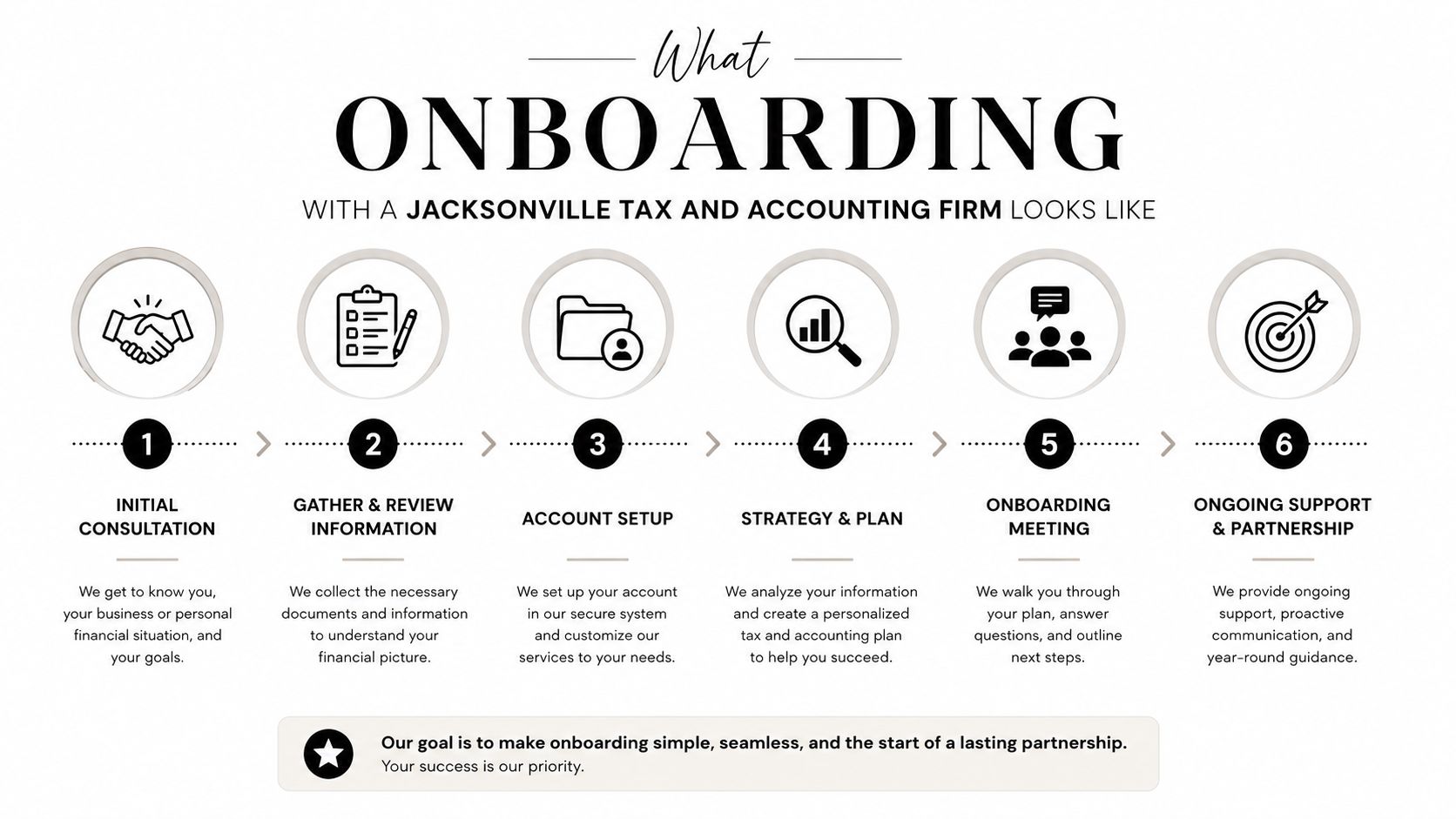
During the first 30 days, the priority is discovery, access, cleanup assessment, and deadline identification. The team should determine whether accounts reconcile, whether payroll agrees with the ledger, and whether the business has unresolved filing gaps.
By 60 days, recurring bookkeeping should be operating on an agreed schedule. Management should receive usable reports, not just a message saying the books are “done.” The firm should identify obvious process weaknesses, such as uncategorized transactions, missing vendor information, or inconsistent sales tax coding.
By 90 days, the owner should have a clearer reporting rhythm and a prioritized action plan. This is the right point for a strategic conversation about entity structure, cash flow, hiring, pricing, equipment, or fractional CFO support.
Mid-year is not too late
Waiting until year-end usually increases the cleanup burden. Mid-year onboarding is often better because the firm can correct the process before more transactions accumulate, identify deadlines still ahead, and produce information that supports current decisions.
The owner's time commitment should be concentrated at the beginning. After access, documents, and responsibilities are clear, the monthly cadence should reduce interruptions. You shouldn't have to answer the same question repeatedly because no one established a document process.
Trust Signals, Pricing Models, and How to Choose the Right Jacksonville Firm
A credible local firm should explain its scope, deliverables, communication process, and engagement terms before asking for a commitment. Look for experience with your industry, QuickBooks ProAdvisor certification, responsive scheduling, audit and review capabilities, and strategies designed for the company rather than a generic tax package.
Bookkeeping and Accounting of Florida Inc. reports more than 20 years serving Jacksonville and Northeast Florida, work across healthcare, construction, retail, and nonprofits, QuickBooks ProAdvisor certification, and a top-ten regional ranking. Those are useful evaluation points, but the true test is whether the firm can explain what happens each month.
Common engagement models include monthly bookkeeping, year-round tax advisory, project-based cleanup, audit or review work, and fractional CFO retainers. Pricing varies by transaction volume, complexity, industry, filing requirements, and reporting needs, so a firm that quotes without asking questions is guessing.
For broader keyword and service research, this accounting keyword guide from LPagery can help owners understand how firms describe different specialties online.

Choose the firm that asks about your operations, not just your last 1040. If the conversation never reaches payroll, sales tax, contractor records, cash flow, or the decisions ahead, you're probably being treated like a line item.
Tax Services Jacksonville FL Questions Owners Ask Before Hiring
How is pricing structured? Monthly bookkeeping, project cleanup, tax advisory, audit work, and fractional CFO services are usually scoped separately. Ask what records, meetings, reports, and filings each engagement includes.
What happens during the first 90 days? Expect document collection, system access, cleanup review, deadline mapping, recurring bookkeeping, and an initial strategy plan.
How often should we meet? Monthly is a practical baseline for most growing businesses. Add meetings when hiring, expansion, financing, or major equipment decisions require active planning.
Is switching mid-year painful? It can be organized. Provide prior returns, statements, payroll records, 1099s, loan documents, entity files, and sales tax filings so the new firm can establish continuity instead of guessing.
Owners also benefit from understanding how local financial firms approach visibility and discovery, including this resource on regional SEO for wealth managers. The immediate business decision is simpler: schedule a consultation, identify the compliance gaps, and get the books under control before the next deadline.
Bookkeeping and Accounting of Florida Inc. provides Jacksonville bookkeeping, tax preparation, payroll support, audits, industry-specific accounting, and fractional CFO guidance for businesses that need more than an annual filing. Visit Bookkeeping and Accounting of Florida Inc. to schedule a consultation and replace deadline panic with a working year-round financial system.