
You don't need another dashboard. You need a shorter list of numbers you can trust when the phone rings, payroll is due, and a tax deadline is coming up faster than you'd like. Most owners I meet in Jacksonville have data everywhere, in QuickBooks, bank feeds, spreadsheets, and inbox screenshots, but they still can't answer one plain question without hunting: are we on track or not?
That's where understanding Key Performance Indicators stops being a buzz phrase and starts being real management. A KPI is supposed to tell you whether the business is moving toward the result you want, not just dump more reporting on your desk. If your numbers don't change a decision, they're just noise.
Why Most Small Businesses Are Flying Blind
I've seen the same scene over and over. An owner opens a spreadsheet, a bookkeeper pulls a QuickBooks report, somebody else sends a sales chart, and nobody agrees on which number matters. The meeting starts with confusion and ends with a guess.
That's not a reporting problem, it's a leadership problem.
The business has data, but no discipline
A lot of small businesses confuse activity with control. They can tell you what was booked, billed, posted, or printed, but they can't tell you which of those numbers should trigger action. That gap is exactly why the KPI discipline matters, because KPIs are critical, quantifiable measures of progress toward a desired result and they're meant to support decisions, resource allocation, and improvement priorities, not just record history, as defined by the KPI Institute's basics page (KPI basics).
The strongest KPI systems balance leading indicators with lagging indicators, so you can see what's coming and confirm what already happened, which is the whole point of turning bookkeeping into management. A good KPI also has a clear objective, a target, a data source, a review cadence, and an owner, which is why a monthly close and a monthly KPI review belong in the same conversation (KPI basics).
Practical rule: if you can't recite your top three KPIs from memory, you're not steering the business, you're reacting to it.
The cost of too much reporting
Owners often think more reports will bring clarity. It usually does the opposite. You end up with vanity metrics, old charts, and meetings where everyone defends their favorite number instead of making a decision.
Small business guidance is blunt on this point, a KPI set should stay limited and actionable, with only four to six KPIs at a time being a useful working range for many firms (SimpleKPI guidance). Another KPI planning model recommends 3 to 4 key performance areas and then 3 to 5 KPIs per area, which keeps the scorecard focused instead of bloated (ThoughtSpot KPI guide).
That's why my advice is simple. If a metric won't change pricing, staffing, collections, inventory, or compliance behavior, cut it. Jacksonville and Northeast Florida business owners don't need more dashboards. They need a tighter list and a monthly habit.
What a KPI Is and What It Is Not
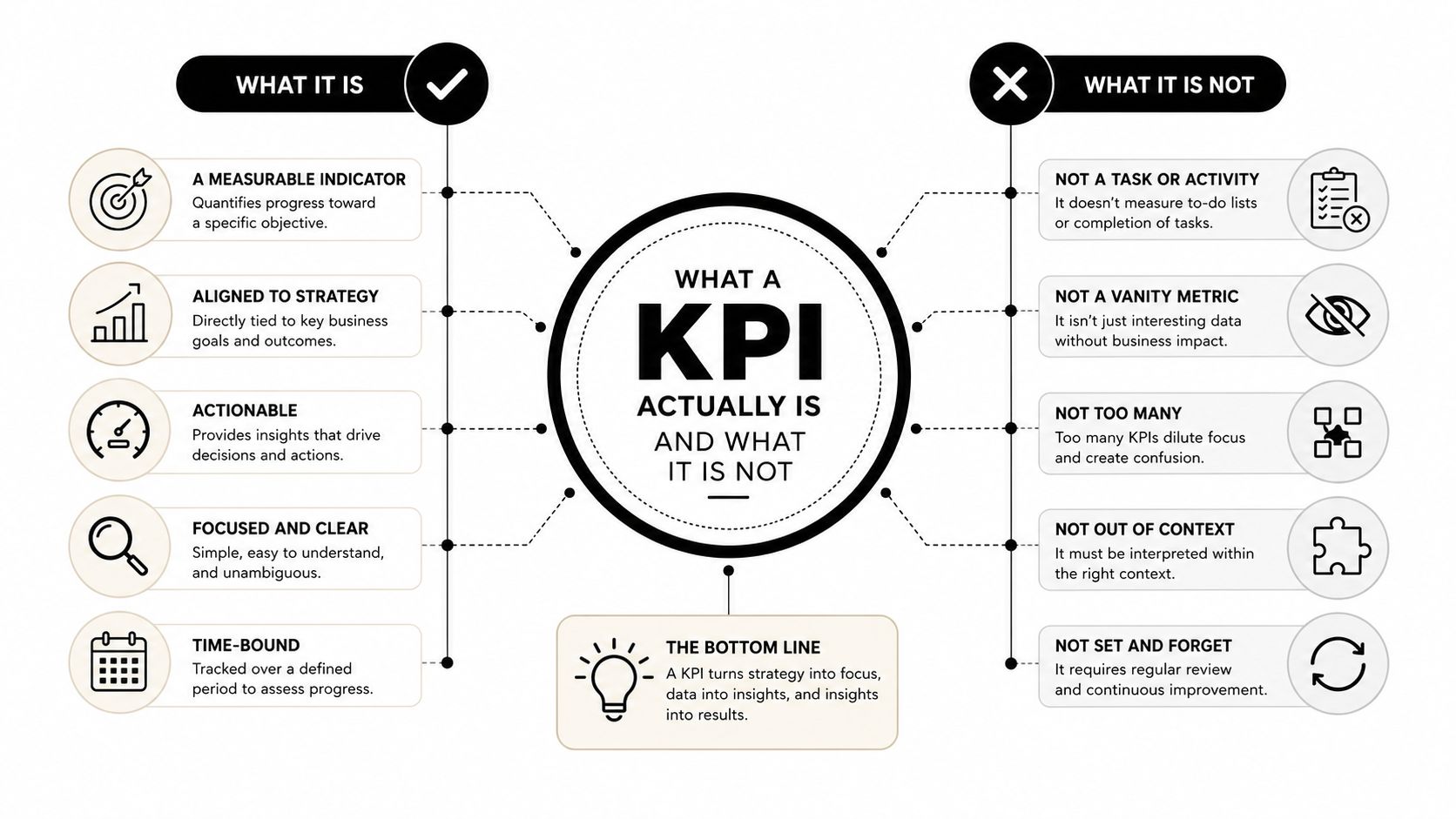
A KPI is the number that forces a decision. If it does not point to a goal, a choice, and an owner, it is just a metric sitting on a dashboard. That is the standard I use with small business clients in healthcare, construction, retail, and non-profits, because those owners do not need more noise. They need numbers that change behavior, support compliance, and show whether the business is drifting or under control.
A speedometer tells you how fast you are going. A GPS tells you whether you are still on the right route. A warning light tells you something needs attention now. Businesses need all three, but each one serves a different job.
The anatomy of a real KPI
A good KPI has a few operational parts that make it usable, and if one part is missing, the metric gets fuzzy fast. The core pieces are a measure, a target, a data source, and a reporting frequency, with an owner as the practical fifth piece, as described in KPI planning guidance from OnStrategy and ClearPoint Strategy (OnStrategy examples).
The SMART frame still holds up because it keeps people honest. A KPI should be Specific, Measurable, Achievable, Relevant, and Time-bound. Penn State's planning handbook adds the discipline most owners skip, the KPI should be valid, realistic, tied to a defined data source, and focused on impact, not just activity (Penn State KPI metrics handbook).
Plain truth: counting presentations tells you how busy someone was. It does not tell you whether the work changed the result.
How to spot a vanity metric
Vanity metrics look good on a slide and do very little for the business. Social likes, page views, and counts of completed tasks can all be useful in the right context, but they only become KPIs when they influence a decision. That is the filter.
If a number changes and nobody knows what to do next, it does not belong on the main dashboard. If a number is there because it is easy to measure, it is probably a vanity metric. That is the mistake I see most often in small firms trying to impress themselves with reporting instead of running the business.
The same logic shows up in the guide for FedEx contractors preparing a sale, where operational metrics matter only when they help the owner judge readiness and make a better call.
Choosing KPIs by Industry for Real Decisions
The right KPI list depends on the business model. A healthcare practice does not need the same scorecard as a remodeler, and a nonprofit shouldn't be chasing retail-style inventory metrics. Owners get into trouble when they copy someone else's dashboard without asking what decision each metric supports.
Healthcare, construction, retail, and non-profits need different lenses
For healthcare practices, I care about the flow of cash and payer behavior first. Days in accounts receivable is a lagging indicator because it confirms collection speed after the fact. Net collection rate tells you whether billing and follow-up are working. Payer mix helps leadership spot concentration risk before it hits the schedule or the bank account.
For construction and trades, the pressure is job-level control. Job costing variance is the kind of lagging KPI that shows whether you bid cleanly and managed the work properly. Work-in-progress percentage and labor burden act more like leading indicators because they help owners spot labor and production issues before the month closes. That matters when payroll, materials, and change orders all hit at once.
For retail, I'd look at gross margin return on inventory, sell-through rate, and customer repeat purchase. Inventory is cash sitting on shelves, so these numbers tell you whether the assortment is working or dead weight is building up. A good retail dashboard ties purchasing, markdowns, and customer behavior together instead of treating them as separate conversations.
For non-profits, the scorecard should protect mission and compliance. Program expense ratio shows how much money is reaching the mission work. Fundraising cost per dollar raised helps leaders evaluate efficiency, and reserve months gives the board a clearer view of financial resilience. Those are not vanity numbers, they're survival numbers.
Lead indicators and lagging indicators should sit together
Each vertical needs both kinds of signals. Leading indicators help you act early. Lagging indicators tell you whether the action worked. If you only watch outcomes, you find out too late. If you only watch activity, you confuse motion with progress.
A gym can borrow the same discipline from retention work, which is why resources like Fitness GM's gym member retention tactics are a useful reminder that repeat behavior beats one-time activity. The same logic applies to a clinic, a contractor, a retailer, or a nonprofit fundraiser.
The Monthly KPI Tracking Workflow Inside QuickBooks
QuickBooks should not be a dumping ground for random coding. It should be the source of truth for a simple monthly workflow that feeds your KPIs without turning every close into a scavenger hunt. If your books are messy, your dashboard is lying to you.
Clean books first, then build the scorecard
Start with chart-of-accounts hygiene. If categories are vague, duplicated, or overloaded, the reports will blur the story. Then use class and location tracking where it makes sense, especially for businesses that need department, job, branch, or program visibility.
After that, the monthly routine is basic but required. Reconcile bank and credit-card accounts, clear uncategorized transactions, separate personal spending from business spending, and clean up stale accruals. Those problems corrupt KPI reporting because they distort the numbers before anyone sees them.
Make the workflow repeatable
A Certified QuickBooks ProAdvisor can set up memorized reports, scheduled sends, and a dashboard view so the owner and the bookkeeper are looking at the same data. That's the right model. The owner should not be rebuilding the KPI view every month from scratch.
For teams that want a practical system, automation helps, but only after the bookkeeping is clean. Supercenter's process automation for SaaS teams is a useful parallel because the point of automation is to reduce manual touchpoints, not to automate bad data.
The best dashboard is the one that matches the books, every time.
You can also tie the KPI view to a dedicated reporting page like this business performance metrics dashboard resource, then keep the monthly close on one calendar. That keeps QuickBooks, reporting, and owner review aligned instead of scattered across different systems.
Setting Targets, Cadence, and Sample KPI Templates
If a target is fuzzy, the owner ends up arguing with the dashboard instead of running the business. A KPI needs a threshold, a review rhythm, and a reason the number matters in the actual world. In healthcare, construction, retail, and non-profits, that means the metric has to support compliance, cash flow, staffing, or service delivery, not just fill a report.
Build targets the way managers can use them
A practical target has a clear direction and a deadline. Use plain numbers and a time frame, then write down what happens if the result slips. That keeps the KPI tied to a decision, which is how small businesses avoid turning the scorecard into decoration.
ThoughtSpot's KPI guidance gives simple examples, and the value is in the discipline, not the exact example. The point is to set a result the team can act on, then define the owner, data source, and measurement frequency for each metric (ThoughtSpot KPI guide). For a small business, that usually means fewer targets, tighter ownership, and a cleaner QuickBooks workflow so the numbers are reviewed the same way every month.
Here's the structure I recommend for a simple template:
- KPI name: Keep it plain, not clever.
- Target: State the outcome in numbers and time.
- Thresholds: Define the point where the owner should act, not just watch.
- Data source: Name the report or system feeding it.
- Owner: One person, not a committee.
- Review cadence: Daily, weekly, monthly, or quarterly.
Match the cadence to the decision
Cash should be checked daily. Pipeline, labor, production, or collections often belong on a weekly review. The owner dashboard should be monthly, because that is where the management conversation belongs. Then reset the strategy quarterly so the scorecard does not drift away from the business.
For owners who want to see how targets connect to actual results, a variance analysis reporting guide fits naturally with KPI work. Variance is where the plan meets the books, and that is where a fractional CFO or controller should press for answers, especially when the target is being missed for reasons that touch pricing, payroll, inventory, or tax compliance.
Common KPI Mistakes and the Tax Law Changes You Should Not Miss
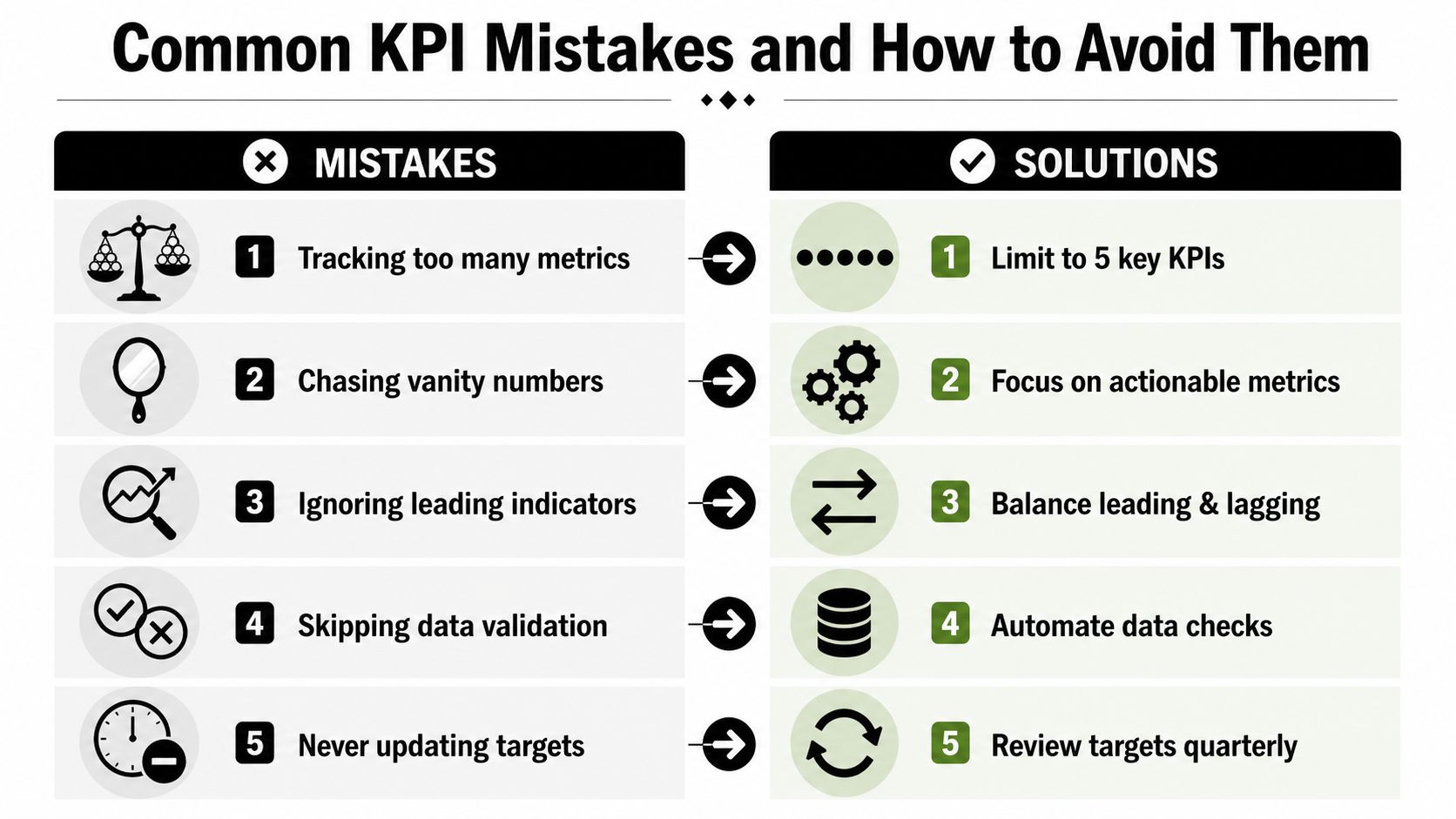
The five mistakes that wreck KPI systems are the same ones I keep seeing in small businesses. They track too many metrics, chase vanity numbers, ignore leading indicators, skip data validation, and never update targets. That combination creates a dashboard that looks busy and behaves badly.
Fix the KPI mistakes before they fix you
The first mistake is tracking too many metrics. The fix is to cut the list until every KPI has a decision attached. If it doesn't change staffing, pricing, cash, inventory, or compliance behavior, it doesn't belong on the front page.
The second mistake is chasing vanity numbers. The fix is to ask what the number changes in the world. If the answer is nothing, move it off the KPI sheet and into a lower-level report.
The third mistake is ignoring leading indicators. Owners love final results because they feel definitive, but by the time the lagging KPI looks bad, the damage is already done. Pair outcomes with upstream signals so you can intervene earlier.
The fourth mistake is skipping data validation. If your books are wrong, the KPI is wrong. Reconciliations, clean coding, and review of accruals are not back-office chores, they are scorecard controls.
The fifth mistake is never updating targets. A target that made sense last year can be useless now. Review it on a regular cycle and adjust it when the business changes.
Tax law changes belong in the KPI conversation
Current-year tax law changes affect cash planning, and owners who ignore them usually find out too late. That includes updated expense deductibility thresholds, Section 179 planning, retirement contribution caps, and payroll tax adjustments that affect cash flow. I'm not giving you numbers here because the rules change and the exact limits depend on the current tax year, but the management point is simple, tax shifts change the KPIs you should be watching.
A stale KPI set can hide compliance gaps until year end. That's a problem because most small businesses don't know everything required of them, and waiting until tax season makes the fix more expensive and more stressful. Keep a tax watchlist inside the KPI review so the owner and CPA can spot changes early, not after deadlines have passed.
The fix is practical. Ask your accountant to identify which expense categories, payroll items, retirement plans, and quarterly estimates need attention this year, then build those checks into the monthly dashboard. That's how KPI discipline protects both performance and compliance.
How Fractional CFO and Bookkeeping Services Keep the System Alive
A KPI system falls apart when nobody owns it. That's why fractional CFO oversight and solid bookkeeping are not optional extras, they're the layer that keeps the data useful after the first meeting. A dashboard without a financial operator behind it is just decoration.
What the fractional CFO actually does
A fractional CFO brings the strategic layer. That includes cash-flow forecasting, pricing and margin review, KPI design, lender and investor reporting, and the conversations an owner rarely has time to prepare properly. The role is not about fancy language, it's about helping the business make smarter calls with better timing.
If you want a direct example of that kind of support, our fractional CFO services overview shows how senior financial guidance can sit above the day-to-day books without adding full-time overhead.
Bookkeeping services keep the engine running. Clean reconciliations, correct coding, and timely closes are what make KPI reporting trustworthy. Without that base, healthcare reporting gets messy, construction job costing drifts, retail margins blur, and nonprofit books become painful at audit time.
Why small businesses need outside guidance
Most small and mid-sized firms don't need more in-house complexity. They need someone who can translate numbers into action and keep the system compliant while the owner focuses on operations. That's especially true in healthcare, construction, retail, and non-profits, where the bookkeeping structure has to match the reality of the business, not just the bank feed.
Bookkeeping and Accounting of Florida Inc. handles bookkeeping, accounting, payroll, tax preparation, audits, healthcare accounting, and fractional CFO support for businesses that need accurate financials and clear decisions. That combination matters because KPI discipline only works when the records are clean and the review process is steady.
Your One-Page KPI Action Checklist
Use this as your monthly filter. If a number doesn't fit one of these steps, it's not ready to be called a KPI.
- Daily cash check: Watch cash balance and near-term obligations.
- Weekly operating review: Look at collections, labor, pipeline, or inventory movement.
- Monthly owner dashboard: Review the small set of KPIs that drive decisions.
- Quarterly strategy reset: Drop stale metrics, update targets, and refine ownership.
For healthcare, start with accounts receivable, net collection rate, and payer mix. For construction, start with job costing variance, work-in-progress, and labor burden. For retail, start with gross margin return on inventory, sell-through, and repeat purchase. For non-profits, start with program expense ratio, fundraising efficiency, and reserve months.
If a KPI misses target, if the books are late, or if tax law changes affect cash flow, bring in your CPA or fractional CFO right away. Accurate, timely financial information is what makes every other business decision possible, and staying compliant now is a lot cheaper than catching up later.
If your KPIs are scattered, stale, or built on messy books, Bookkeeping and Accounting of Florida Inc. can clean up the reporting, tighten the monthly close, and give you a scorecard you can use. Visit Bookkeeping and Accounting of Florida Inc. to get bookkeeping, tax, and fractional CFO support built around clear numbers and real accountability.