
An accounts payable aging report lists every unpaid supplier invoice, grouped by vendor and sorted by how many days each one is past its due date. If you've ever opened your bank account, seen a healthy balance, paid a few bills, and then felt squeezed at payroll, you already know why that list matters.
Thank you for reading this post, don't forget to subscribe!A bank balance doesn't tell you what's due tomorrow, what's already overdue, or which vendor is about to call. This report does, but only if you read it as more than a stack of bills. Used well, it's a cash, control, and compliance dashboard for your business.
What an Accounts Payable Aging Report Tells You
Picture the expiration-date shelf in a clinic supply cabinet. Fresh items sit in front, items nearing their date need attention soon, and anything past its date needs a decision now.
The report works the same way. To understand What Is Accounts Payable Aging Report in practice, start with its structure. It's a structured snapshot of unpaid supplier obligations organized by vendor, invoice, due date, and days outstanding.
The Date That Actually Matters
The key measure is the gap between the report date and the invoice due date, not the invoice date. Your obligation runs from the terms your supplier agreed to. An invoice created 45 days ago on net 60 terms isn't late, while one created 20 days ago on net 15 terms is.
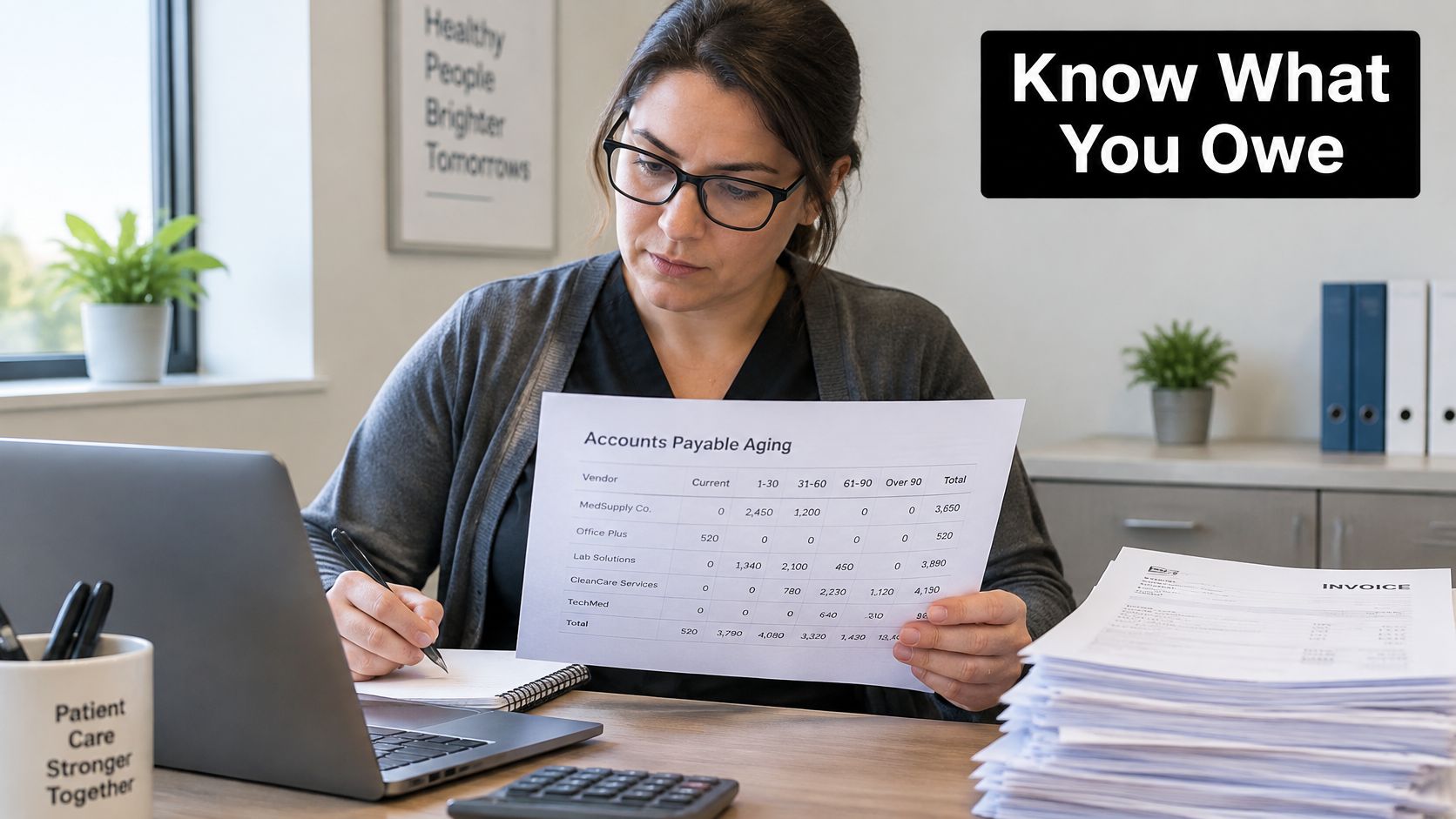
A detailed report normally shows:
- Vendor details: vendor name and invoice number
- Timing: invoice date, due date, and payment terms
- Money: original amount, payments applied, and remaining balance
- Aging bucket: where the balance sits by days past due
Two Jobs at Once
First, it's a cash-planning tool. It shows what must be paid in the next few weeks, which suppliers need attention, and whether cash covers payroll, taxes, subcontractors, and rent.
Second, it's an accounting control. The total of all open invoices should reconcile to the accounts payable control account in your general ledger at the reporting date. If those two numbers don't agree, don't trust the forecast.
Owners who review this alongside other monthly accounting reports that turn balances into payment decisions get a fuller picture. For any report you receive, check three things first: the vendor, the due date, and the bucket.
Reading the Aging Buckets Row by Row
An aging report works like a dashboard: each bucket shows timing, but the details behind the balance determine whether the picture is accurate. A missing receipt can make a valid bill look disputed. An unapplied credit can make a supplier's balance appear higher than it is.
Many reports use 30-day bands. Some separate older balances into 91 to 120 days and over 120 days. Use the company's bucket definitions consistently, and check how the report counts days past due.
| Bucket | What It Signals | Typical Action | Watch For |
|---|---|---|---|
| Current (not yet due) | Obligation is within agreed terms | Schedule payment for the due date | Paying early and leaving less cash for payroll |
| 1–30 days past due | Possible processing or approval delay | Check approvals and match receipts | Invoices waiting in an approval queue |
| 31–60 days past due | Payment is slipping past terms | Contact the vendor and confirm the balance | Late fees or a vendor credit hold |
| 61–90 days past due | Possible dispute or missing paperwork | Investigate before paying | Duplicate bills or disputed charges |
| 91+ days past due | Possible process failure or cash shortfall | Escalate and decide whether to pay or dispute | Supplier stoppage or an incorrect liability |
How Escalation Should Work
Schedule current invoices according to the agreed terms. Paying early may reduce cash available for other obligations.
For balances 1 to 30 days past due, check your own process first. Was the invoice approved? Was the receipt recorded? A missing receipt can hold up a legitimate payment, while an unapplied credit can distort the amount due.
At 31 to 60 days, contact the vendor to confirm the balance, ask about any late fees, and agree on a payment date. Keep a record of the conversation and update the invoice status.
Balances 61 to 90 days or older need a closer review. Check for duplicate bills, disputed charges, missing paperwork, and cash constraints before releasing payment. The report is a control tool as well as a payment list, so investigate discrepancies rather than treating every displayed balance as correct.
Cash-flow pressure can make payment timing harder for small businesses. A large current bucket is only healthy if the cash will be available when those bills come due.
Add up what is due within 30 days, then compare it with available cash and expected receipts. A review of how accounts receivable aging tracks what customers owe you can help you compare incoming payments with upcoming bills. Before acting on an old balance, confirm the invoice, receipt, payment history, and any credits on the vendor account.
A Worked Example With Five Vendors
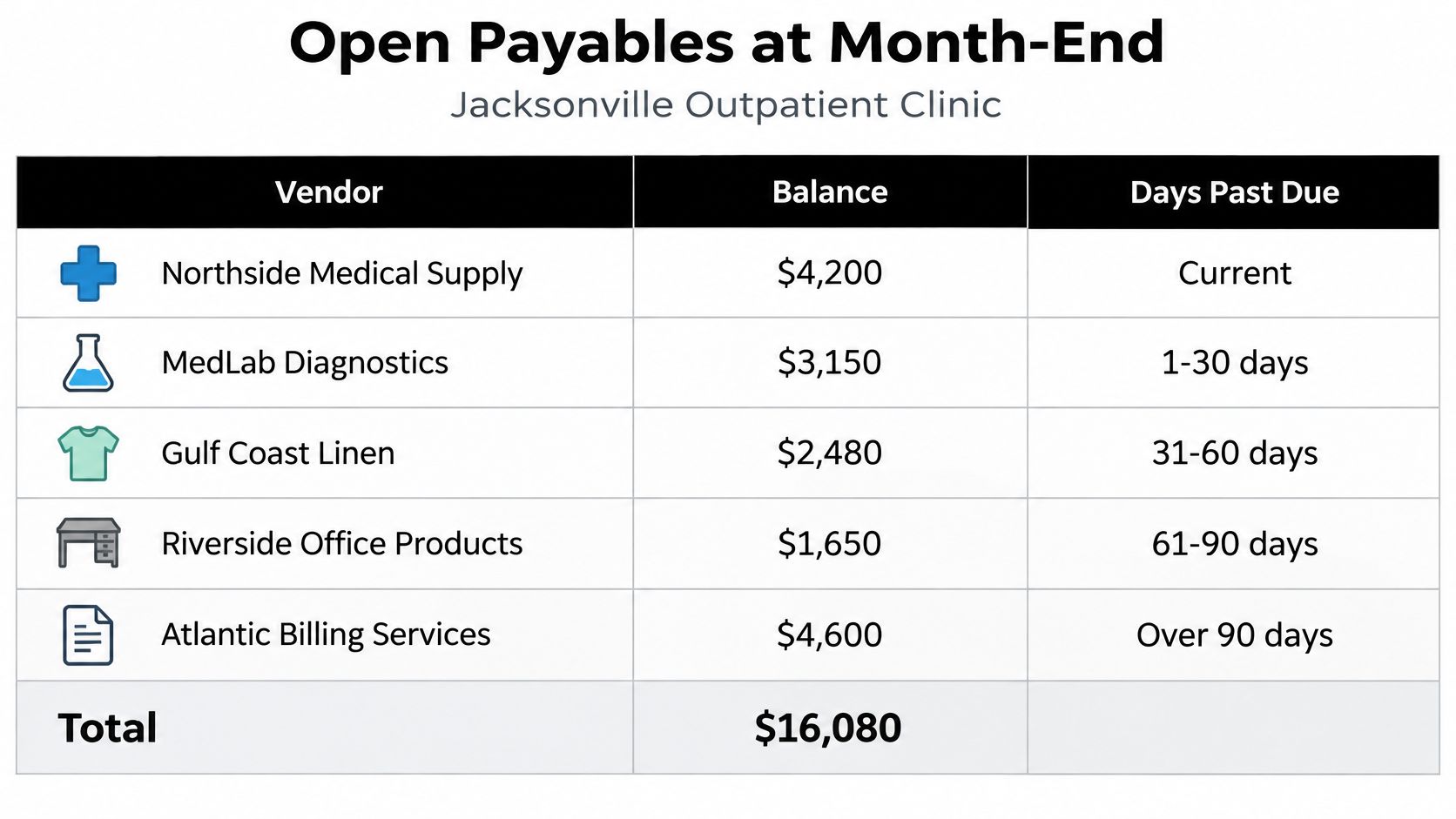
A Jacksonville outpatient clinic reviews open payables on the last day of the month. Five vendor balances total $16,080.
| Vendor | Current | 1–60 Days Past Due | 61+ Days Past Due | Total |
|---|---|---|---|---|
| Medical Supply Co | $4,200 | $1,850 | $0 | $6,050 |
| Steel and Fastener Co | $0 | $3,400 | $900 | $4,300 |
| Cleaning Services LLC | $1,650 | $0 | $0 | $1,650 |
| Billing Software Inc | $0 | $0 | $780 | $780 |
| Lab Equipment Repair | $2,200 | $1,100 | $0 | $3,300 |
| Total | $8,050 | $6,350 | $1,680 | $16,080 |
Reading the Totals First
Current bills are $8,050. That means about half of what's owed, $8,030, is already past due, split between $6,350 at 1 to 60 days and $1,680 at 61-plus days.
Don't start by writing checks. Start with three decisions.
- Medical Supply Co: It has $1,850 in the overdue columns. Call before the next payment run, confirm the status, and protect a supplier the clinic depends on daily.
- Steel and Fastener Co: The $900 balance at 61-plus days needs investigation. Pull the invoice and look for a dispute or missing receiving document.
- Billing Software Inc: The $780 past 90 days is a classic exception. Check whether someone paid it by card or entered it twice.
Practical rule: Pay what's verified and due, and fix what's old and unexplained, in that order.
If the clinic paid all $8,050 of current bills early, cash would drop by that amount while the $8,030 overdue stayed unresolved. The better move is to schedule current bills to their due dates, clear the exceptions, and keep cash for payroll and taxes.
How to Build the Report in QuickBooks Each Month
Menu names change between QuickBooks versions, so confirm the exact path in your own software. The sequence below stays the same.
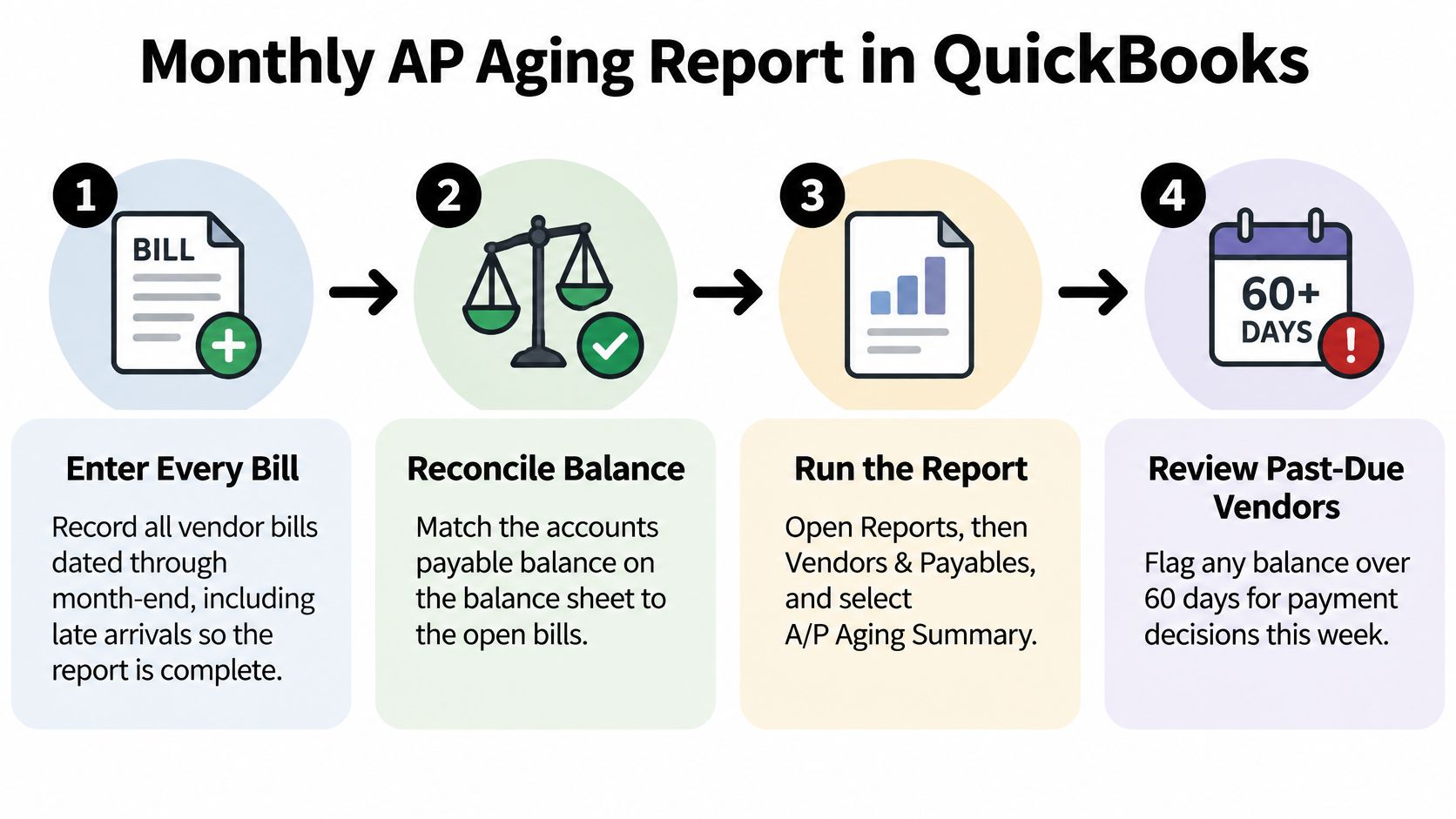
- Enter every vendor bill through month-end. Include bills that arrived late. If a bill isn't entered, your liabilities are understated and the report looks better than reality. Teams handling paper and emailed invoices can automate invoice data extraction to reduce manual entry errors before bills reach QuickBooks.
- Reconcile accounts payable to the balance sheet. Match the open bills list to the general ledger control account. Investigate any difference before you share the report.
- Run the aging reports. Search Reports for aging, open the A/P Aging Summary and A/P Aging Detail, set the date to month-end, and use the due-date basis if your settings allow it.
- Clear credits and unapplied payments. Apply vendor credits and credit memos to open bills. One unapplied credit can make a vendor look overdue when you owe nothing.
- Check the exceptions. Look for duplicate-looking bills, debit balances, missing due dates, and bills posted to the wrong period. Each one distorts a bucket.
- Assign a reason to every overdue item. Use plain labels such as approval delay, missing receipt, dispute, or duplicate. The owner should see the cause, not just the age.
- Save, share, and decide. Save the report as a PDF, review it with the owner, and build the next payment run starting with verified current and 1 to 30 day items.
This short walkthrough shows the report on screen so you can match the steps to your own file.
Don't skip step 4. It's where many clean-looking reports go wrong without anyone noticing, because credits sitting in a vendor account hide real balances in one place and inflate them in another.
Tax Rules That Change Your Record-Keeping Duties
Keep this reference where you close the books.
| Record Type | How Long to Keep | Why It Matters |
|---|---|---|
| Employment tax records | At least 4 years after the tax is due or paid, whichever is later | Payroll tax reviews and deposit checks |
| Records supporting income, deductions and credits | As long as needed to prove them | Vendor invoices, receipts and canceled checks |
| Property and asset records | Until the limitation period ends for the year the property is disposed of | Depreciation, basis and gain or loss |
| Sick-leave, family-leave and employee retention credit claims | At least 6 years | Support for credit claims during review |
Payables Records Are Tax Evidence
A paid invoice isn't finished when the bank payment clears. Keep it with its purchase order, receipt, approval, and proof of payment, because together they support deductions and explain transactions during an IRS review. The IRS recordkeeping guidance on retaining records to prove income, deductions, or credits ties retention length to how long you may need that proof.
Property records need special care. They support depreciation, basis, and gain or loss, so you keep them until the limitation period expires for the year you dispose of the property.
Deadlines That Compete With Vendor Bills
Employers generally file Form 941 each quarter by April 30, July 31, October 31, and January 31, with 10 extra calendar days if all taxes were deposited on time, per the IRS employment tax due dates for Forms 941, 940, W-2, and W-3. Forms W-2 and W-3 and Form 940 are generally due by January 31.
Employers with annual employment-tax liabilities of $1,000 or less may be eligible to file Form 944 annually if the IRS approves. Rules and deadlines can change, so review current IRS guidance at the start of each year.
Payroll taxes come first. They're liabilities you must reserve before paying vendor invoices, and a missed deposit creates penalties, interest, and correction work.
Add each payroll tax deposit and filing date to your 30-day cash forecast as a reserved outflow. Then approve vendor payments only from the cash that remains.
Common Errors and Industry-Specific Fixes
A bill can look overdue because a receipt was never posted, a credit was left unapplied, or the invoice landed in the wrong accounting period. The aging report is a cash, control, and compliance dashboard, not just a bill list. One small recordkeeping gap can shift balances into the wrong bucket.

A procure-to-pay case study of 42 invoices aged beyond 90 days found receipt-data errors, items still being searched for, missing items, and unposted receipts accounted for approximately 83% of delays in that study. This result describes those 42 invoices, not all companies. Three-way matching compares the purchase order, goods receipt, and supplier invoice to catch discrepancies before payment.
Errors can also mean duplicate payments. U.S. Bank reporting that 39% of invoices contain errors also notes that roughly one-third of organizations experience duplicate payments. Review exceptions before each payment run.
Five Numbers Worth Tracking
- Percentage past due: past-due AP dollars divided by total AP dollars.
- Days payable: dollar-weighted days payable outstanding, calculated using the method your business consistently applies.
- Old balance load: count and total value of invoices more than 90 days old.
- Blocked speed: average days from an invoice being blocked to its resolution.
- Match failures: unmatched invoices divided by invoices checked over the same period.
There is no single good value for every business. Compare each measure with your own prior periods, then investigate increases or unexplained changes.
Fixes by Industry
- Healthcare practices: Match each supply invoice to its purchase order and receiving log. For lab charges, check service dates and test counts against the order and records of work received. Flag repeated invoice numbers or charges before approval.
- Construction and trades: Age payables by job, match subcontractor bills to change orders and retainage, and hold payment until paperwork agrees.
- Nonprofits: Separate aging by restricted fund so grant-funded bills are paid from the right money.
Don't pay early just to shrink the report. That uses working capital without resolving duplicates, missing receipts, unapplied credits, or wrong-period postings. Verify vendor bank-detail changes by phone before sending payment.
Get Your Aging Report Reviewed Before Your Next Payment Run
Most small business owners don't know every record and filing rule that applies to them. That's not a personal failure, it's a capacity problem, and it's why a precise-looking report can still produce a wrong cash forecast.
Bookkeeping and Accounting of Florida Inc. is a locally owned, full-service CPA firm in Jacksonville with more than 20 years serving healthcare practices, construction and trades companies, retailers, and nonprofits across Northeast Florida. Its services include bookkeeping and accounting, payroll, tax preparation, internal and independent audits, reviews, healthcare accounting, and forensic audits.
The team are certified QuickBooks ProAdvisors who set up, clean up, and maintain books. That matters here because clean vendor records and applied credits are what make aging buckets trustworthy.
Every growing company also needs fractional CFO guidance, not only large ones. A senior adviser helps you plan cash flow, time payables, reserve payroll deposits, and follow the tax calendar without the cost of a full-time hire, so problems get caught before they reach the books.
Start with three steps before your next payment run. Pull your current aging report, confirm it reconciles to the balance sheet, and review practical guidance on how to manage accounts payable day to day. Then request a review if anything old can't be explained in one sentence.
If your aging report has balances nobody can explain, credits nobody applied, or tax deadlines competing with vendor bills, get it reviewed before you pay from it. Visit Bookkeeping and Accounting of Florida Inc. to schedule bookkeeping, payroll, tax, and fractional CFO support that keeps your payables accurate and your business compliant.