
You don't need a scandal to end up in this mess. A bookkeeper notices a vendor payment that doesn't line up with the invoice, payroll looks a little off, and the bank balance keeps drifting lower than it should. By the time an owner asks questions, the paper trail is messy, the staff is nervous, and the core issue is no longer whether something happened, it's whether the business can prove what happened and recover what it lost.
That's where forensic accounting comes in. It is not routine bookkeeping, and it is not a normal year-end audit. It is an evidence-driven investigation built to reconstruct transactions, identify who did what, when it happened, and who benefited, then package that proof for legal, insurance, regulatory, or internal use as described in forensic accounting practice and in litigation-focused accounting work. If you run a small business in Jacksonville or anywhere in Northeast Florida, you usually don't meet a forensic accountant because of a headline-grabbing fraud case. You meet one because a dispute got ugly, a claim got challenged, or the numbers stopped making sense.
If you want a plain-English overview of how this work helps business owners recover losses from fraud, the explanation from Kons Law is a useful starting point. For a more service-focused view, the firm's own forensic audit services page shows how investigative accounting gets used when the books are no longer enough.
Why Businesses Call a Forensic Accountant
The call usually starts with a sentence no owner wants to hear. “The numbers don't match.” Cash is short. A vendor got paid twice. Payroll shows a pattern nobody can explain. At that point, you do not need a prettier set of books. You need someone who can trace the money and document the story before it disappears into excuses and revised spreadsheets.
What forensic accounting does
Forensic accounting turns accounting records into evidence. It reconstructs transactions, follows funds across accounts, and ties each movement back to a person, a vendor, a job, or a claim. The work has to hold up in settings where ordinary internal reports will not cut it, because the findings may end up in litigation, insurance claims, arbitration, or regulatory review as outlined in forensic accounting references.
That is why the word “forensic” matters. It does not mean crime scene work. It means work suitable for court and other formal proceedings. Small businesses often need this kind of support in civil disputes, shareholder fights, divorce-related business matters, valuation disagreements, asset tracing, or fraud recovery work, not just when law enforcement is involved as noted in broad practice coverage.
Practical rule: if you need proof, not just cleanup, you are past bookkeeping and into forensic territory.
Why the stakes matter more than most owners expect
Occupational fraud typically costs organizations about 5% of annual revenue, according to ACFE-based research summarized in the verified source, and the ACFE's 2024 Report to the Nations analyzed 1,921 cases across 138 countries. That same data shows a median loss of $145,000 per fraud scheme, a median duration of 12 months, and a median loss of $1.7 million for schemes lasting 24 months or longer source. Those numbers are why this is not a niche bookkeeping topic. It is a risk-management issue.
A business in Jacksonville can lose real money long before anyone calls the police. If you have unexplained variance, missing support, or a vendor relationship that suddenly looks suspicious, that is the point to bring in forensic help. Waiting for more evidence usually gives the other side more time to clean up the mess.
Some owners try to save money by sending the problem to routine bookkeeping or a standard review. That works for basic cleanup. It fails when you need to show how the loss happened, who controlled the transactions, and whether the numbers support a claim. In healthcare, that often means billing irregularities, reimbursement disputes, or employee access to patient-related funds. In construction, the warning signs are job-cost overruns, change-order fights, subcontractor disputes, and payroll issues tied to multiple projects. In nonprofits, the red flags are restricted funds, missing donor documentation, and board members who cannot get a straight answer from the books. If the issue sits in one of those buckets, a forensic accountant is worth the cost. If you only need the monthly records cleaned up, call your bookkeeper.
Forensic Accounting vs Audits vs Fraud Examinations
Owners mix these up all the time, and the confusion costs money. A standard audit, a fraud examination, and a forensic accounting engagement can all look similar from the outside, but they serve different purposes and produce different deliverables. If you hire the wrong one, you'll get the wrong answer, or no usable answer at all.
The clean distinction that matters
A standard audit checks whether the books comply with GAAP and company policy. That is valuable, but it is not built to prove fraud. A forensic accountant is hired to investigate evidence, reconstruct activity, and present findings in a way that can support legal use, including work papers, exhibits, and expert testimony that must satisfy admissibility standards such as Rule 702 as described in practice guidance.
Fraud examinations sit in between. They tend to be narrower than full forensic engagements and are often focused on identifying whether a specific scheme happened. For a business owner, the decision is simple. If the issue is routine accuracy, use normal accounting or audit services. If you need proof tied to a dispute, claim, or legal process, call a forensic accountant.
A clean audit opinion does not prove no one stole from you. It only means the audit did what an audit is designed to do.
Side-by-side comparison
| Criteria | Standard Audit | Fraud Examination | Forensic Accounting |
|---|---|---|---|
| Purpose | Check compliance with accounting rules and internal policy | Determine whether a suspected fraud scheme occurred | Reconstruct transactions and build evidence for legal or administrative use |
| Scope | Broad financial reporting review | Narrow, allegation-driven review | Case-specific, evidence-heavy investigation |
| Methodology | Sampling, controls review, verification | Targeted inquiry, document review, interviews | Transaction tracing, evidence collection, analysis, reconstruction |
| Deliverables | Audit opinion, management letters | Findings on suspected misconduct | Reports, exhibits, damages support, expert testimony |
| Legal standing | Useful for assurance, not proof of fraud | May support an internal or legal matter | Built for admissibility, litigation support, and expert use |
When IRS issues change the equation
If the problem has already reached tax controversy territory, you need specialized representation, not just cleanup. A useful resource on professional help for IRS audits can help owners understand that tax disputes and forensic work often overlap, but they are not the same job. One is about defending the tax position, the other is about proving what happened in the records.
For small businesses in Northeast Florida, the rule is blunt. Don't pay for a forensic engagement when you only need a routine review. Don't settle for a routine review when you need evidence that can survive scrutiny.
How the Forensic Accounting Process Works
A proper forensic engagement starts with boundaries. The accountant defines the question, gets authorization, identifies the records to preserve, and sets the scope so nobody wastes time wandering through irrelevant months of transactions. If the issue is embezzlement, the focus may be on cash receipts, bank activity, and access rights. If it's a construction dispute, the focus may shift to job-costing, change orders, payroll allocations, and subcontractor payments.
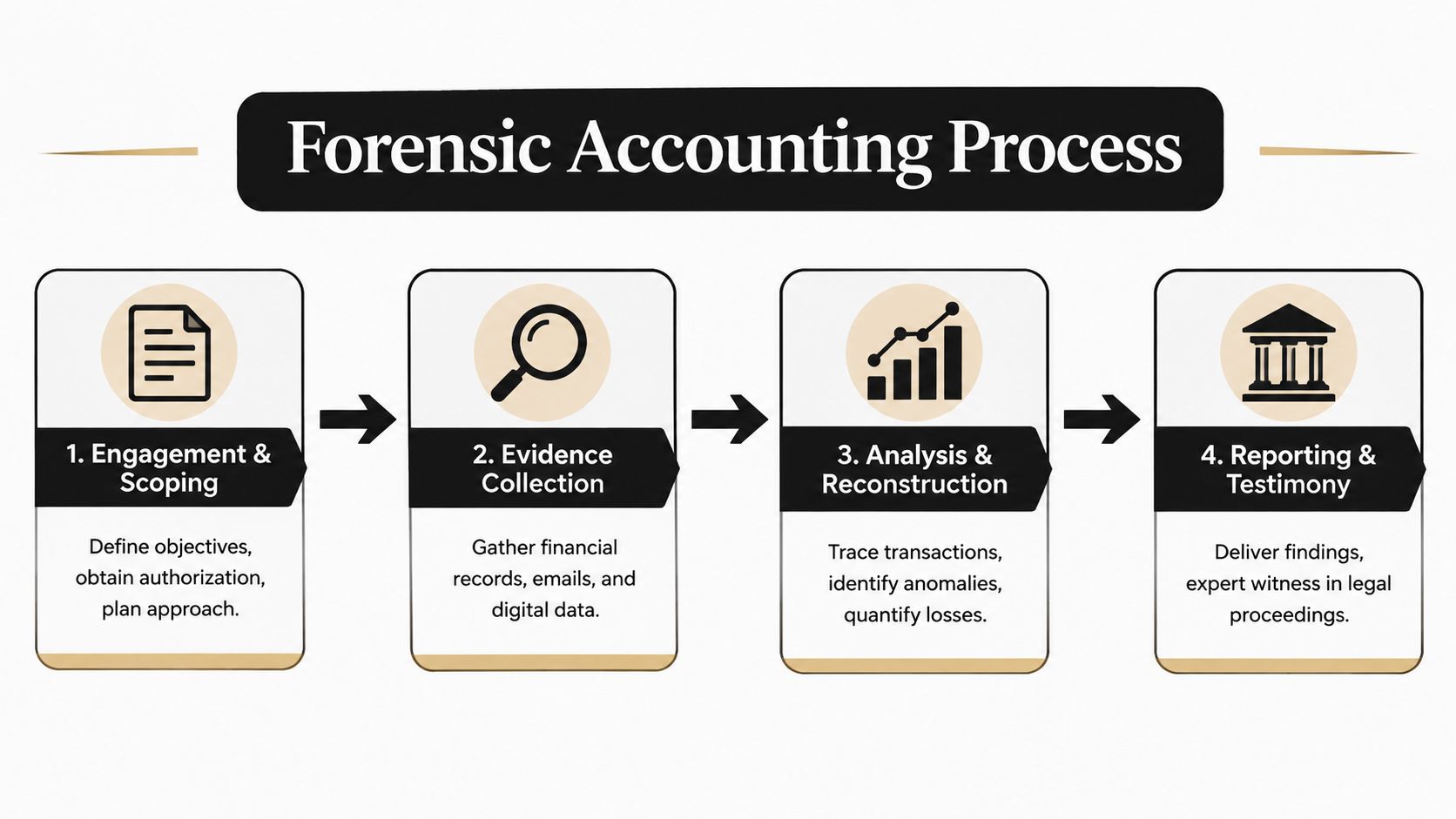
Stage one through stage four
1. Engagement and scoping. The forensic accountant identifies the objective, confirms authority, and decides what has to be preserved. That might include QuickBooks files, bank statements, email threads, invoices, payroll records, and access logs.
2. Evidence collection. The record gathering gets serious here. Digital records matter as much as paper records, and chain of custody matters if the matter might end up in court. If physical evidence needs special handling, even equipment like Material Handling USA drying cabinets can matter in evidence preservation workflows.
3. Analysis and reconstruction. The accountant traces transactions, looks for anomalies, and rebuilds the flow of money. A stolen check deposit, for example, might lead through several accounts before the benefit becomes obvious. In a construction matter, job-cost records may reveal that labor or materials were shifted to hide overruns.
4. Reporting and testimony. The findings get documented in a format that lawyers, insurers, regulators, or executives can use. If the matter escalates, the accountant may testify as an expert witness.
What this is not
This is not ongoing bookkeeping. It is not monthly reconciliation. It is a reactive, case-specific process built to answer one hard question with proof. That's why the work is usually project-based and why the deliverables look more like evidence packets than management reports.
A forensic accountant should be able to tell you, early in the engagement, what records they need, what they will produce, and what they will not do. If they sound vague, keep shopping.
Warning Signs Your Business Needs a Forensic Accountant
The red flags are usually boring at first. That's the trap. A billing glitch appears. A payroll entry gets explained away. A vendor payment lands in the wrong bucket, then another one does too. Owners tell themselves they'll sort it out next week, but next week is where losses get bigger and records get weaker.
Industry-specific warning signs
Healthcare practices need to watch for billing irregularities, phantom patient records, and insurance claim mismatches. Those patterns often point to sloppy processes at first, then to deliberate manipulation. If the revenue cycle is foggy, someone can hide a lot of abuse inside it.
Construction companies should be looking at job-costing manipulation, subcontractor payment fraud, and ghost employees on payroll. When labor charges drift across jobs and supporting documents are inconsistent, the financial picture can be engineered instead of reported. In that environment, a forensic accountant can help separate real project overrun from fraudulent allocation.
Nonprofits face a different danger set. Restricted fund misuse, donation diversion, and grant compliance violations can damage donor trust fast. These cases are often painful because the harm is both financial and reputational.
Universal clues you should not ignore
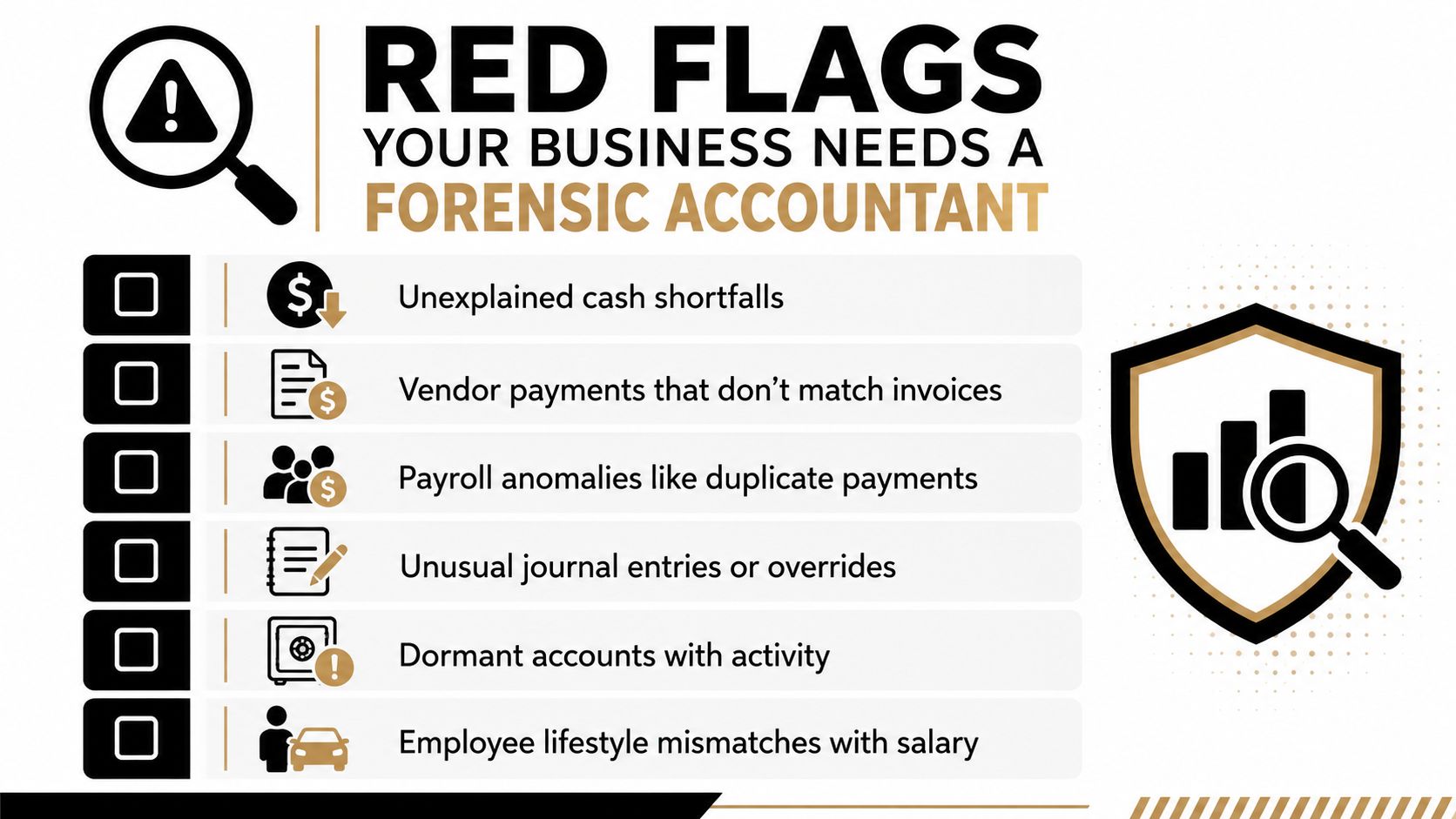
- Unexplained cash shortfalls, especially when the explanation changes from month to month.
- Vendor payments that don't match invoices, which often means someone is pushing through unsupported spending.
- Payroll anomalies like duplicate payments, off-cycle checks, or employees paid for hours they didn't work.
- Unusual journal entries or overrides, because manual postings can hide a lot.
- Dormant accounts with activity, which can point to hidden access or concealed transactions.
- Employee lifestyle mismatches with salary, which don't prove fraud by themselves, but do justify a closer look.
If the story keeps changing, the problem is probably deeper than a clerical error.
The right move is to investigate early. Waiting for the situation to “settle down” usually means more records disappear, more people get warned, and your legal options narrow. In Northeast Florida, that's especially true for small teams where one person controls both the books and the excuses.
Qualifications Costs and How to Hire the Right Forensic Accountant
Don't hire a forensic accountant because they sound aggressive. Hire one because they can prove things. That means looking for a CPA credential, a CFE designation, and real experience with litigation support, damages work, asset tracing, and testimony. If they've never had to explain a set of findings to a lawyer or a judge, they're not fully ready for the job.
What to ask before you sign
Ask how they preserve evidence and maintain chain of custody. Ask whether they've handled cases in your industry, because healthcare, construction, and nonprofits each have their own records and fraud patterns. Ask what the final deliverable looks like, because a court-ready report is very different from a cleanup memo.
Also ask about privilege and scope. The engagement letter should say who hired them, what records they can access, what they're expected to find, and whether they'll testify later. If the answer is vague, that's a bad sign.
Cost and service reality
Forensic engagements are usually more expensive than routine bookkeeping because the work is more intensive and the output has to stand up under scrutiny. That's not a markup, it's the cost of evidence-driven work. For a ballpark view of how firms think about engagement cost structure, the firm's forensic audit cost page is a practical reference point.
If you need an ongoing finance partner as well as investigation support, a full-service firm can help. Bookkeeping and Accounting of Florida Inc. provides forensic audit services, but it also handles bookkeeping, payroll, tax preparation, internal and independent audits, reviews, and fractional CFO support. That matters because many small businesses need both cleanup and ongoing guidance, not just a one-time investigation.
The hire-or-walk-away filter
- Choose experience over slogans, because courtroom-ready work is earned, not marketed.
- Choose industry familiarity, because the records tell different stories in healthcare, construction, and nonprofits.
- Choose clear scope control, because open-ended investigations burn money fast.
- Choose a firm that can explain the findings plainly, because if the owner and the attorney can't follow the logic, the report won't help.
Why Proactive Accounting Prevents Forensic Investigations
A Jacksonville contractor misses payroll tax changes. A nonprofit in Northeast Florida misreads grant reporting rules. A healthcare practice lets approval controls slide until a billing dispute turns into a records fight. That is how forensic work starts. Many small businesses miss key requirements around tax law changes, industry-specific reporting, payroll rules, grant requirements, and internal control failures, and the gap usually shows up only after money is missing or the books no longer line up.
The smarter investment is guidance before the crisis
A fractional CFO gives a business senior financial oversight without the cost of a full-time executive. Owners do not need another stack of reports. They need someone who can read cash flow, catch control gaps, and flag compliance problems before they turn into investigation work. Clean books maintained by certified QuickBooks ProAdvisors also matter because organized records create a usable audit trail and cut down the time spent fixing year-end chaos.
Direct advice: if your books are late, messy, or owner-dependent, you are already paying for risk.
A proactive firm can also tighten tax preparation, payroll, and reporting discipline so problems surface early instead of after the fact. That is where a practical guide like preventing small business fraud starts with your books fits. It puts the focus on the records first, which is where most small business fraud, error, and control failures begin.
For owners in Jacksonville and Northeast Florida, the local detail matters. Healthcare practices need clean billing and reimbursement controls. Construction companies need job costing that matches actual labor, materials, and subcontractor activity. Nonprofits need grant tracking, approval discipline, and reporting that lines up with donor or board expectations. When those pieces are weak, the accounting cleanup gets expensive fast.
In that setting, Bookkeeping and Accounting of Florida Inc. is one practical option for owners who want a local CPA partner that can handle bookkeeping, tax, audits, reviews, and fractional CFO services under one roof. That setup is usually cheaper than paying separate people to untangle a preventable mess later.
The takeaway for owners
Forensic accounting is what you call after the problem turns adversarial. Proactive accounting is how you keep the fight from starting. Stay current, document properly, and get senior financial oversight in place, and you lower the odds that a small irregularity becomes a full investigation.
Next Steps for Protecting Your Business Finances
Start with a blunt review of your own books. Look for unexplained balance changes, unsupported journal entries, payroll oddities, vendor mismatches, and gaps in documentation. If you run healthcare, construction, or a nonprofit in Jacksonville or Northeast Florida, check whether billing, job costing, grant tracking, and approval controls match how money moves in your operation.
Then make the decision most owners avoid. If the issue is routine, fix the bookkeeping and tighten the process. If the issue involves possible fraud, asset tracing, insurance loss, or a dispute that could end up with lawyers, bring in forensic accounting help before the evidence gets thinner.
The right accounting partner should do more than prepare reports. It should help you understand your numbers, stay compliant, and make better decisions with less panic. That's the difference between a business that reacts to chaos and a business that stays ahead of it.
Bookkeeping and Accounting of Florida Inc. helps Jacksonville and Northeast Florida businesses with bookkeeping, tax preparation, audits, reviews, forensic audit services, and fractional CFO support, so owners can get clear financial information before small problems become expensive disputes. If you're dealing with suspicious transactions, compliance pressure, or messy books that need real oversight, visit Bookkeeping and Accounting of Florida Inc. and ask for a consultation.