
You can have a profitable month and still be one missed filing away from a nasty surprise. That's the part most owners hate admitting, because the books look fine, the bank balance looks decent, and the annual return got filed on time, so everything feels under control until a payroll deposit slips, a sales tax return gets missed, or a notice shows up asking questions you wish you'd answered six months earlier. Tax Compliance Services exist for exactly that gap between “we're busy” and “we're compliant.”
Thank you for reading this post, don't forget to subscribe!The work has changed, too. Compliance isn't a once-a-year chore anymore, it's a steady stream of registrations, records, reconciliations, filings, and responses that sit on top of normal operations. The IRS handled about 271 million returns and forms in fiscal year 2023, nearly 9 million more than FY 2022, and those filings generated roughly $4.7 trillion in tax receipts IRS/TIGTA fiscal year 2023 filing volume. That kind of volume is why sloppy systems get expensive fast, and why a good CPA doesn't just “do taxes,” they keep the whole machine from slipping.
Why Tax Compliance Keeps Business Owners Up at Night
The owner usually notices the problem in a boring way, which is exactly why it gets missed. A restaurant owner thinks the annual return is done, then learns the payroll deposits weren't synced correctly. A contractor has clean revenue numbers but missed local filings in a state where work crossed a border. A clinic kept up with patient care and payroll, then discovered the tax trail needed better documentation than “we'll fix it at year end.”

The annual return is not the finish line
A lot of small businesses confuse filing with compliance. That mistake makes sense if your experience has been one return, one payment, one sigh of relief. But the environment is recurring and messy, with registrations, documentation, deadline tracking, and recordkeeping that have to hold together all year.
The compliance burden is also real money, not just nuisance work. An OECD-backed EU study estimated that companies across 28 countries spend about EUR 204 billion annually to comply with corporate income tax, VAT, wage-related taxes and contributions, property and real estate taxes, and local taxes EU tax compliance cost study. That same study put the burden at roughly 1.3% of GDP and the average enterprise's compliance cost at 1.9% of turnover. When the paperwork burden is that heavy, “we'll catch up later” turns into a management problem, not an admin problem.
Practical rule: if compliance only gets attention when the return is due, the business is already behind.
Why this becomes a growth issue
Growth multiplies the mess. More employees means more withholding and payroll touches. More locations mean more tax jurisdictions. More service lines mean more chances to trigger a filing rule you didn't know existed.
That's why tax compliance services matter even more as a company gets busier. They reduce the chances that the owner is juggling operations, notices, and deadline calendars at the same time. And once the business starts crossing state lines or adding new entities, the risk isn't just penalties. It's time loss, cash flow friction, and the slow grind of fixing things that should've been right the first time.
What Tax Compliance Services Actually Cover
The cleanest way to think about tax compliance services is this, they turn scattered obligations into a controlled process. That means the work is not limited to preparing a return in March and hoping for the best. It includes gathering data, validating it, reconciling it, filing it, and keeping proof that each step happened on time.
Modern providers increasingly use software-driven workflows that automate preparation, validation, reconciliation, and filing across indirect taxes like sales tax, VAT, and GST, which cuts manual touchpoints and supports a more touchless process Thomson Reuters indirect tax compliance. They also centralize data and keep a full library of federal, state, and local forms while using diagnostics and AI-enabled data ingestion to catch exceptions earlier Thomson Reuters tax compliance platform. That matters because the danger usually isn't one giant error, it's ten small mismatches that never got caught.
The core pieces that should be covered
A serious compliance relationship usually handles these moving parts together:
- Federal income tax filings. Annual return preparation, extensions, estimated payments, and support for entity-level obligations.
- State and local filings. Multi-state reporting, local registration issues, and jurisdiction-specific deadlines.
- Payroll tax compliance. Withholding, deposits, and year-end reporting like W-2 and 1099 support.
- Sales tax and indirect tax. Collection, remittance, exemption support, and rate setup across jurisdictions.
- Documentation and reconciliation. Clean books, recordkeeping, and support for notices or audit requests.
The best compliance setup isn't just accurate, it's repeatable. If your process depends on one person remembering everything, you don't have a process, you have a hope.
Why the pieces can't be treated separately
Owners often hand these jobs to different people and assume the parts will line up. They usually don't. Payroll can affect tax deposits, sales tax can vary by location, and a late reconciliation can distort the numbers used for filings and planning. Once the systems stop talking to each other, the business spends more time untangling the books than running the company.
For owners in Florida who want to see how this looks in a practical service model, the 2026 BPP tax compliance tips are a useful reminder that compliance lives in the details, not in slogans. The same logic applies here. You want a process that keeps the records straight before anyone asks for them.
Industry-Specific Compliance Requirements You Might Be Missing
A business can file on time and still be out of line. That happens when the tax process stops at annual return prep and never turns into ongoing, data-driven compliance. A restaurant, a contractor, a retailer, and a nonprofit each face different rules, and the business owner who treats them as the same will eventually pay for the mistake, usually in notices, corrections, or a wasted afternoon with a state website.
Healthcare and construction need different controls
Healthcare practices deal with more than payroll and a tidy general ledger. They have provider records, reimbursements, deductions tied to specialized work, and paperwork that needs to stay clean all year, not just at tax time. A once-a-year cleanup is a weak substitute for that kind of control.
Construction businesses have a different set of headaches. Job costing, payroll across locations, and accounting methods that match how work is recognized over time all affect what gets reported and when. If the numbers do not track the jobs, the tax filings will not track the business.
That is why service providers with healthcare accounting or contractor-focused support matter. The work is not glamorous, but it keeps the compliance process tied to what is happening in the field. For a growing company, that kind of oversight is often where a fractional CFO starts pulling real weight, because the books, tax filings, and operating decisions need to line up before the quarter turns into a mess.
Retail and nonprofit rules aren't optional details
Retail owners usually watch inventory, margins, and staffing. Tax compliance asks different questions. Where is sales tax due? Which items are taxable? Which jurisdiction gets the remittance? If you sell across lines, the answers are not always obvious, and the wrong assumption can create a mess fast. The firm's Florida sales tax filing guide walks through the jurisdiction-specific rules that catch retailers off guard.
Nonprofits carry their own burden. They need to protect tax-exempt status, keep Form 990 filings on track, and maintain clean donor acknowledgment records. Sloppy records turn into repair work, and repair work eats mission time.
The practical lesson is simple. Industry rules are not a side note for the tax department, they are part of how the business runs. If your company has specialized revenue, specialized labor, or specialized exemptions, your compliance process has to match that reality. A one-size-fits-all bookkeeping service usually will not.
How to Choose the Right Tax Compliance Partner
A good provider doesn't sell you “tax help.” They tell you exactly what gets handled, how fast they respond, and where the handoffs are. That's the difference between paying for confidence and paying for confusion.
The first filter is scope. Ask what's included in federal filings, state filings, payroll support, sales tax, notices, and year-end reporting. Then ask how they handle multi-state compliance, because that's where many small firms fail. If they can't explain their process in plain English, keep shopping.
Compare the options before you buy on price
| Provider Type | Best For | Typical Cost Range | Limitations |
|---|---|---|---|
| DIY software | Very simple businesses with few filings | Lowest upfront cost | No judgment, weak notice support, easy to miss exceptions |
| Basic bookkeeper | Businesses with steady, low-complexity activity | Moderate | May not handle complex filings, tax notices, or strategic planning |
| Tax preparer only | Owners who need annual returns done | Moderate | Focuses on filing, not ongoing compliance or cash flow |
| CPA firm with compliance and advisory | Growing businesses with payroll, sales tax, and multi-jurisdiction work | Higher, but broader support | Requires more collaboration and cleaner internal records |
Pricing usually comes in three flavors. Monthly retainers fit owners who want ongoing oversight. Per-return pricing can work for simple, predictable filing needs. Hourly consulting is fine for a clean-up project, but it's a bad way to run recurring compliance because the clock keeps running while the problem stays alive.
If you've reached the point where notices, sales tax, payroll, and entity filings are all happening at once, DIY and basic software are no longer enough. At that stage, a firm like Bookkeeping and Accounting of Florida Inc. is worth evaluating because the work goes beyond filing and into the systems behind filing. You're not paying for a form. You're paying for fewer surprises.
Questions that separate real partners from form-fillers
- Notice response: How fast do you handle IRS or state letters?
- Systems integration: Do you work with QuickBooks and other accounting tools?
- Industry knowledge: Have you handled businesses like mine before?
- Communication: Who answers when I have a deadline problem on a Friday afternoon?
If the provider only talks about April, they're selling a seasonal service. You need year-round control.
Common Compliance Mistakes That Trigger Audits and Penalties
Most compliance mistakes don't come from bad intent. They come from owners running a business like they're patching a boat in motion. The books get pushed aside, receipts pile up in a shoebox or an inbox, and the next deadline shows up before anyone cleaned up the last one.
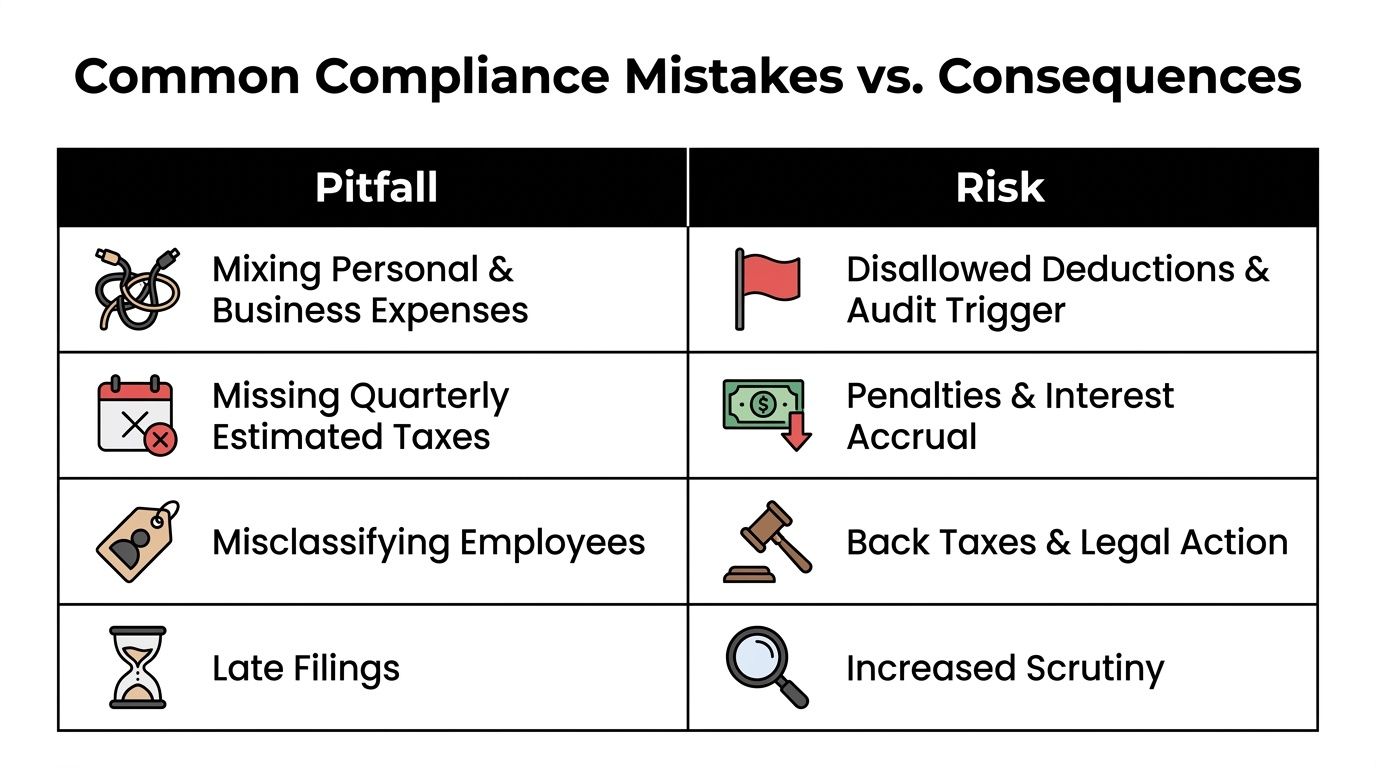
The mistakes that cause the most pain
- Mixing personal and business expenses. That creates disallowed deductions and makes audit support messy fast.
- Missing estimated tax payments. The business can still fall behind even when revenue looks healthy.
- Misclassifying workers. Contractor mistakes can turn into back taxes and legal headaches.
- Filing late or incompletely. Late filings bring penalties, interest, and more scrutiny.
Those problems show up most often when compliance is treated like year-end cleanup instead of a live process. The OECD's compliance risk guidance is plain about the core mechanics, registration in the system and reporting complete, accurate information are central to staying compliant OECD compliance risk management guidance. In plain English, the numbers and the paperwork have to stay right all year.
The same rule applies to bookkeeping discipline. A practical industry overview notes that many jurisdictions require records to be kept for five to ten years, and that filing may be monthly, quarterly, or annual depending on the jurisdiction tax compliance overview. If records are scattered across inboxes, spreadsheets, and memory, you're asking for trouble.
For owners in trades or construction, construction compliance tips are a good reminder that documentation and process control matter as much as the work itself. That lesson applies far beyond one industry.
What happens after the mistake
The cost is not just the penalty notice. It is the hours spent rebuilding records, the stress of answering questions under a deadline, and the drag on management time while the business should be growing. Compliance errors also make financing and planning harder, because messy books make lenders and advisors nervous.
When the IRS or state sends a notice, knowing how to prepare matters. This guide on preparing for an audit helps owners respond correctly, gather the right records, and avoid making a small problem bigger.
Why Growing Businesses Need More Than Just Tax Filing
A growing business needs more than someone to file returns after the year ends. It needs someone to keep the numbers reliable while decisions are still being made. That's where fractional CFO services earn their keep, because they connect compliance, cash flow, budgeting, and strategy instead of treating them as separate worlds.
Businesses don't usually fail because one filing was annoying. They struggle because nobody is steering the financial system. A fractional CFO helps owners read the numbers, anticipate tax impacts, and make decisions with better timing. Clean books support financing conversations, reduce cleanup work, and make recurring compliance easier to manage.
The point is not to turn every owner into a finance nerd. The point is to stop letting the business drift. If you've got multiple locations, payroll, sales tax, or industry-specific reporting, you need more than annual filing support. You need someone who can guide the structure of the business before the next problem shows up.
That's also where a full-service CPA relationship can save money in a less obvious way. Better records mean fewer surprises. Fewer surprises mean less cleanup. Less cleanup means your team spends more time on customers and less time hunting receipts from last quarter.
Bookkeeping and Accounting of Florida Inc. fits that model because it combines bookkeeping, payroll, tax preparation, compliance, and fractional CFO support under one roof. For a small business owner, that's the difference between reacting to the tax calendar and running the company with a plan.
Your Tax Compliance Action Plan
Start with the basics. Gather your filed returns, payroll records, sales tax reports, bank statements, and any IRS or state notices. Then review what's been filed, not what you think got filed, and flag anything that looks late, missing, or inconsistent.
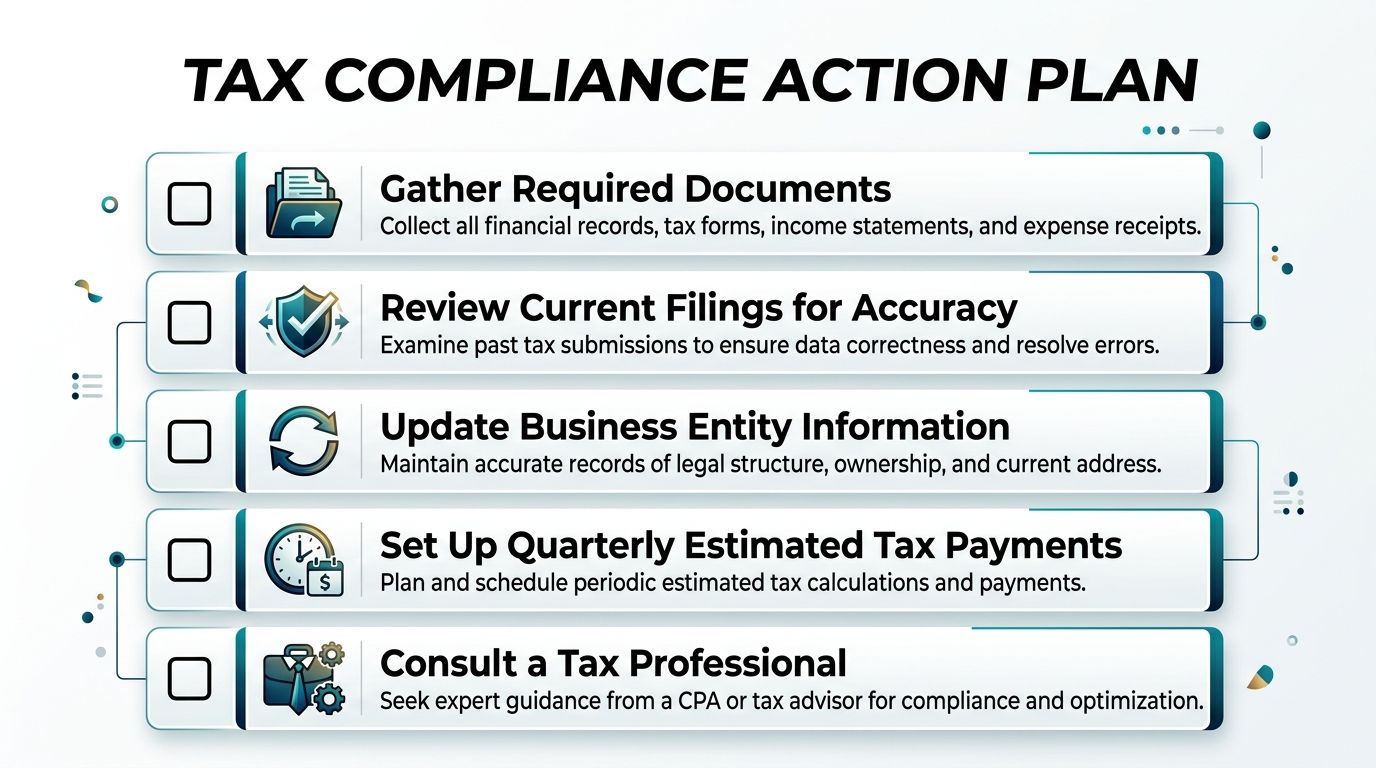
Five moves to make now
- Gather required documents. Pull returns, payroll reports, exemption certificates, and year-end forms into one place.
- Review current filings for accuracy. Look for gaps, duplicates, and anything filed under the wrong entity.
- Update business entity information. Keep registrations, addresses, and ownership details current.
- Set up quarterly estimated tax payments. Don't wait for a surprise balance due.
- Consult a tax professional. Get eyes on your situation before the next deadline hits.
Jacksonville and Northeast Florida owners should also choose a firm that understands Florida's filing environment and local business realities. If your company is dealing with sales tax, payroll, or industry-specific reporting, it helps to work with a CPA team that already lives in that world.
If you want a clean read on where you stand, schedule a review now, not after the next notice arrives. The right conversation can save a lot of time, and probably a lot of nerves.
Bookkeeping and Accounting of Florida Inc. helps growing businesses clean up the books, manage compliance, and build a tighter financial process with bookkeeping, tax preparation, payroll, and fractional CFO support. If you want a practical review of your current tax compliance setup and a clearer plan for what needs fixing, visit Bookkeeping and Accounting of Florida Inc. and schedule a consultation.