
You're in Jacksonville, your business is growing, and the books are becoming a second job. You're reviewing QuickBooks at midnight, matching bank transactions against spreadsheets, wondering whether a deduction was categorized correctly, and worrying that the next email could be an IRS notice. The problem isn't that you're careless. It's that compliance, payroll, tax planning, and financial reporting have outgrown the time available to manage them.
Thank you for reading this post, don't forget to subscribe!Virtual accounting services can solve that problem, but only when they deliver more than remote data entry. The right provider combines cloud accounting technology with experienced bookkeepers, CPAs, controllers, and fractional CFO guidance. That gives you current financial information, documented controls, tax support, and someone who can explain what the numbers mean before you make an expensive decision.
Why Virtual Accounting Services Are Transforming Small Business Finance
Virtual accounting means your finance function works through secure cloud systems instead of requiring an accountant to sit in your office. Your provider can manage bookkeeping, payroll, reconciliations, reporting, tax preparation support, and advisory work remotely while you retain access to the records and reports your business needs.
Cloud adoption has made this model practical at scale. A 2026 industry benchmark reported that 71% of small and midsize businesses use cloud accounting, with companies below $10 million in revenue reaching that level after moving away from on-premises systems that dominated just five years earlier, as documented in this cloud accounting adoption benchmark. A separate UK report found that 47% of accountants were already using cloud-based software, while another 34% used a hybrid mix of cloud and on-premises tools, showing how normal remote accounting workflows have become.

Who benefits most from a virtual model
A healthcare practice may need accounting support that understands insurance collections, patient billing, payroll classifications, and documentation expectations. A construction company needs job-costing discipline, subcontractor payment tracking, payroll coordination, and reports that show whether each project is profitable. A nonprofit needs restricted-fund tracking, grant documentation, budget reporting, and records that can withstand an audit.
Generic virtual bookkeeping often misses those distinctions. Industry-specific accounting knowledge matters because the wrong classification can distort margins, create tax exposure, or weaken compliance evidence.
The market is also moving beyond basic remote bookkeeping. One 2024 estimate placed the global virtual bookkeeping services market at $4.5 billion, with a projection of $12.5 billion by 2032 and a projected 15% compound annual growth rate, according to this virtual bookkeeping services market estimate. That growth reflects a real shift from location-bound bookkeeping to outsourced, cloud-enabled delivery.
If you're evaluating staffing options, a practical introduction to hiring remote accountants via Virtustant can help you understand the remote delivery model. But don't confuse remote access with complete financial management. You still need clear ownership, review procedures, tax expertise, and a local advisor who understands your business.
Core Services Included in Virtual Accounting Packages
A serious virtual accounting package should give you a dependable financial operating system, not a login to software and a promise that someone is “keeping an eye on things.” Most small-business owners don't know every filing, reconciliation, payroll rule, documentation standard, and tax deadline attached to their company. That knowledge gap is where professional accounting earns its keep.
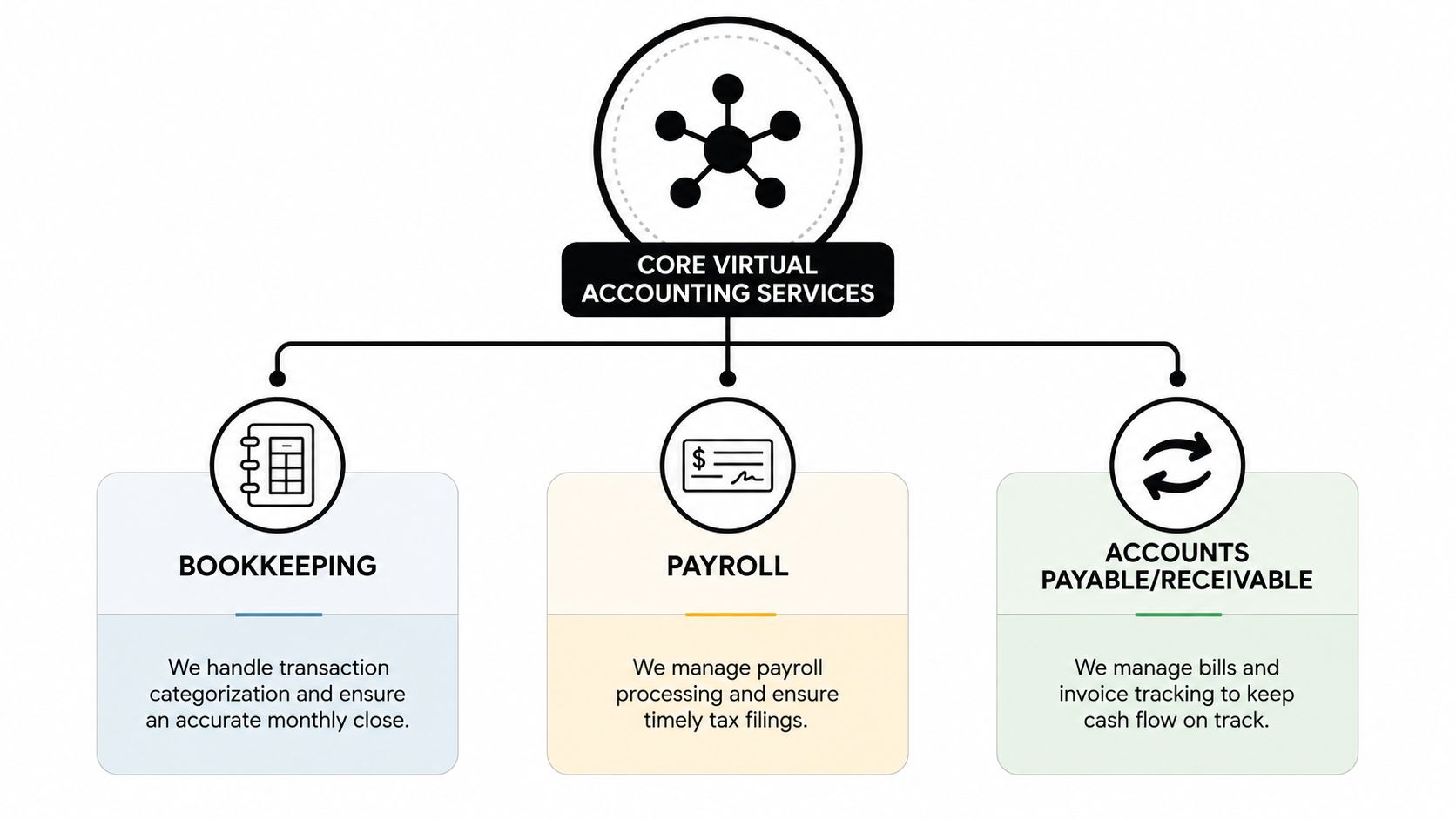
Bookkeeping and monthly close
Your provider should connect bank and credit-card feeds, categorize transactions, reconcile accounts, review unusual activity, and close the books on a defined schedule. You should receive a monthly profit and loss statement, balance sheet, and cash flow report, with explanations for material changes rather than unexplained numbers.
Expense categorization isn't clerical trivia. Mixing personal expenses with business costs, misclassifying equipment, or recording owner distributions as operating expenses can create misleading reports and invite questions during tax preparation or an audit. A structured close process creates a reliable record before year-end pressure arrives.
Payroll and payroll tax filings
Payroll requires more than issuing checks. Your accounting team should coordinate payroll processing, maintain employee records, reconcile payroll liabilities, and prepare or manage required payroll tax filings. Timely filings and accurate wage data help prevent penalties, incorrect employee forms, and cash-flow surprises.
Ask whether payroll is reviewed by someone other than the person who prepares it. Remote teams need separation of duties, especially when payroll changes, payment runs, and tax submissions happen through connected systems.
Payables, receivables, and cash control
Accounts payable support should include invoice collection, coding, approval routing, payment scheduling, and vendor record maintenance. Accounts receivable support should cover invoice tracking, collections follow-up, payment application, and aging reports.
A provider can improve your visibility quickly. You should know which bills are awaiting approval, which customers are late, and whether a temporary cash shortage comes from weak profitability or slow collections. A virtual team can also organize receipts, contracts, invoices, and supporting documents in a secure portal instead of leaving critical evidence scattered through email.
Reporting, tax support, and audit readiness
Monthly reports tell you what happened. Tax planning helps you decide what to do before the year closes. Your provider should prepare a year-end tax package, coordinate with the CPA handling the return when necessary, identify missing documents, and support responses to tax notices.
Audit support requires organized schedules, reconciliations, source documents, and an audit trail. Before choosing software or dashboards, take time to compare financial reporting tools, then choose a reporting process your team will maintain.
Virtual Accounting vs In-House Teams and Traditional CPA Firms
There isn't one correct accounting model for every company. A large organization with heavy daily transaction volume, complex inventory, or constant operational finance needs may justify an in-house controller and accounting staff. A small service business may need only monthly bookkeeping and tax support. A growing Jacksonville company often sits between those two extremes.
| Factor | In-House Team | Traditional CPA Firm | Virtual Accounting Services |
|---|---|---|---|
| Cost structure | Salaries, benefits, software, management, and office resources | Professional fees, often focused on tax and year-end work | Flexible service fees matched to the work required |
| Expertise | Depends on who you can hire and retain | Strong tax and compliance expertise, but day-to-day availability varies | Access to bookkeeping, controller, CPA, and CFO capabilities when properly staffed |
| Scalability | Requires recruiting as needs expand | May offer limited ongoing operational support | Can add services as transactions, employees, or reporting needs grow |
| Response time | Immediate for an established internal team | Varies by season and engagement scope | Defined communication channels and review cadence should be part of the agreement |
| Local insight | Built into the team if employees understand the market | Usually strong local relationships | Best results come from remote delivery combined with local Florida knowledge |
| Best fit | High-volume, complex daily finance operations | Tax returns, attest work, and specialized projects | Growing businesses needing recurring accounting plus advisory flexibility |
A traditional local CPA firm may provide excellent tax preparation and audit services but not handle your invoices, reconciliations, payroll coordination, and weekly cash questions. An in-house employee may know your operation well but lack experience with construction job costing, healthcare accounting, nonprofit reporting, tax planning, or CFO-level forecasting.
Use this decision test
Choose the model based on four questions:
- Business size: Can the company support a full finance team, or would that create unnecessary fixed overhead?
- Transaction volume: Do you need daily internal processing, or can a defined monthly close meet the business need?
- Industry complexity: Do your books require healthcare, construction, nonprofit, grant, project, or compliance expertise?
- Growth stage: Are you maintaining operations, or are you deciding whether to hire, expand, borrow, acquire, or raise capital?
The strongest option for many Northeast Florida businesses is a hybrid model. You get secure virtual delivery, cloud access, and flexible staffing, while a local accounting partner brings knowledge of Florida requirements, local business conditions, and face-to-face accountability when the situation demands it.
Technology Stack and Security Controls You Should Expect
Virtual accounting works because cloud systems let authorized people access current records, documents, approvals, and reports without passing files around by email. A practical stack may include QuickBooks Online, secure document sharing, bank-feed automation, payroll software, receipt capture, video meetings, and a reporting dashboard.
The software matters, but the controls matter more. A cheap platform with weak permissions can create more risk than a properly managed system with clear responsibilities.
The core technology layer
Your provider should be able to explain how each tool connects to the next:
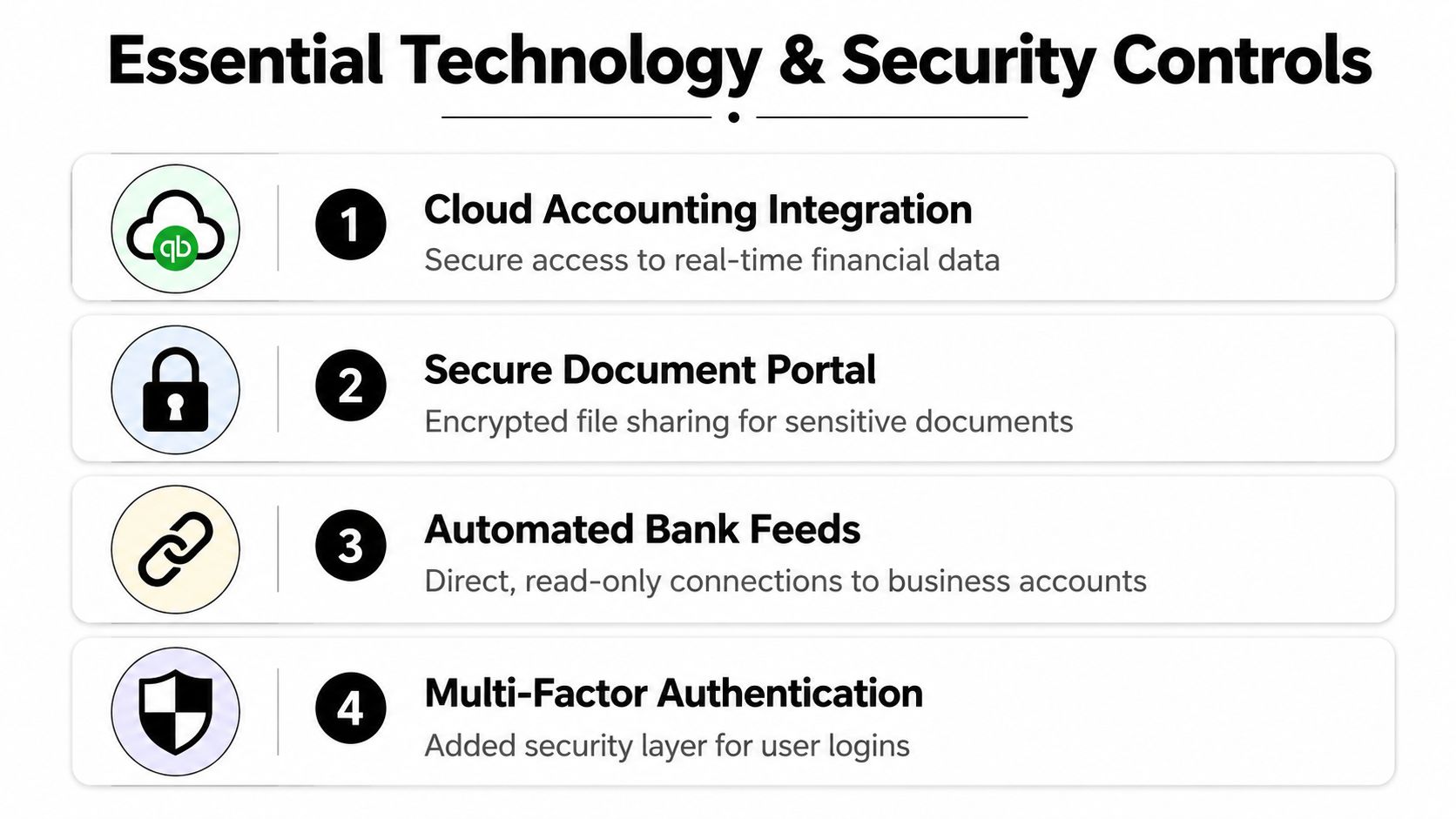
- Cloud accounting integration: QuickBooks Online or another approved ledger should remain the central source for transactions and reports.
- Secure document portal: Receipts, invoices, payroll records, tax notices, and contracts should move through controlled file sharing rather than ordinary email.
- Automated bank feeds: Direct connections reduce manual entry, but the provider should still reconcile accounts and investigate exceptions.
- Real-time dashboards: Owners should be able to review cash, receivables, payables, margins, and key operating measures without waiting for a year-end meeting.
You can also review the firm's approach to cloud accounting services when deciding whether the technology supports the level of access and collaboration your business requires.
Controls that should never be optional
Virtual accounting increases the number of locations, devices, and users involved in financial work. Providers should use role-based access control, multi-factor authentication, encryption in transit and at rest, and immutable audit logs, as outlined in this guidance on cloud-based financial data access.
A maker-checker workflow is particularly important. One person creates a vendor payment, payroll change, or tax filing, and another authorized person reviews and approves it. That separation of duties makes fraud harder and gives you evidence of who did what.
Practical rule: If a provider can't show you how it limits access, records approvals, and handles terminated users, don't give it control of your books.
Ask direct questions. Who can add a vendor? Who approves payments? How are bank credentials protected? Are audit logs retained? What happens after a security incident? Which compliance certifications or independent assessments support the firm's security claims? Reputable providers should answer clearly, without hiding behind the name of a software product.
Why Every Growing Business Needs Fractional CFO Services
Bookkeeping records the past. A fractional CFO helps you decide what to do next.
That distinction becomes important when your business has enough activity that every major decision affects cash, staffing, pricing, and risk. A CFO can build cash-flow forecasts, prepare budgets, model growth scenarios, support fundraising, and deliver board-level financial reporting. Those responsibilities require judgment, not just accurate data entry.
Decisions that need senior financial guidance
Suppose a Jacksonville clinic is considering another location. The question isn't whether revenue could increase. You need to model staffing, lease obligations, equipment, collections timing, payer mix, and the point at which the new location can support itself.
A construction company may need to compare project profitability, evaluate whether a subcontractor structure is working, or decide whether a new equipment purchase makes financial sense. A nonprofit may need to forecast restricted and unrestricted cash separately, evaluate grant sustainability, and prepare clear information for its board.
Other decisions that deserve CFO-level review include:
- Hiring versus outsourcing: Compare the full financial effect of payroll, benefits, capacity, and service quality.
- Product or service profitability: Separate direct costs and overhead so pricing decisions reflect reality.
- Expansion timing: Model cash requirements before signing a lease or committing to new staff.
- Financing and investment: Prepare reliable forecasts and reporting for lenders, investors, or acquisition discussions.
The warning signs are obvious once you know where to look. Reports arrive late, cash balances feel unpredictable, margins change without explanation, owners approve spending based on bank balance alone, or every growth decision turns into a guess.
Clean books tell you where you've been. A fractional CFO helps you decide whether the next step is affordable.
CFO.com describes fractional CFOs as a flexible source of experienced financial leadership for small and midsize businesses, with a lower overall cost than hiring a permanent CFO, as explained in its overview of fractional CFO value for SMBs. You can also review what fractional CFO services include before deciding whether your company needs forecasting, planning, or decision support beyond monthly bookkeeping.
How to Vet Virtual Accounting Providers and Avoid Costly Mistakes
Don't choose a virtual accounting provider because the monthly price is attractive or the sales call feels polished. Choose the firm that can explain how it will protect your records, meet deadlines, handle exceptions, and apply accounting judgment to your industry.
Start with credentials, but don't stop there. A QuickBooks ProAdvisor certification can demonstrate software proficiency. CPA credentials matter for tax, audit, review, and complex accounting questions. Neither credential proves that a provider understands your specific workflow, so ask for examples involving businesses similar to yours.
Questions to ask before signing
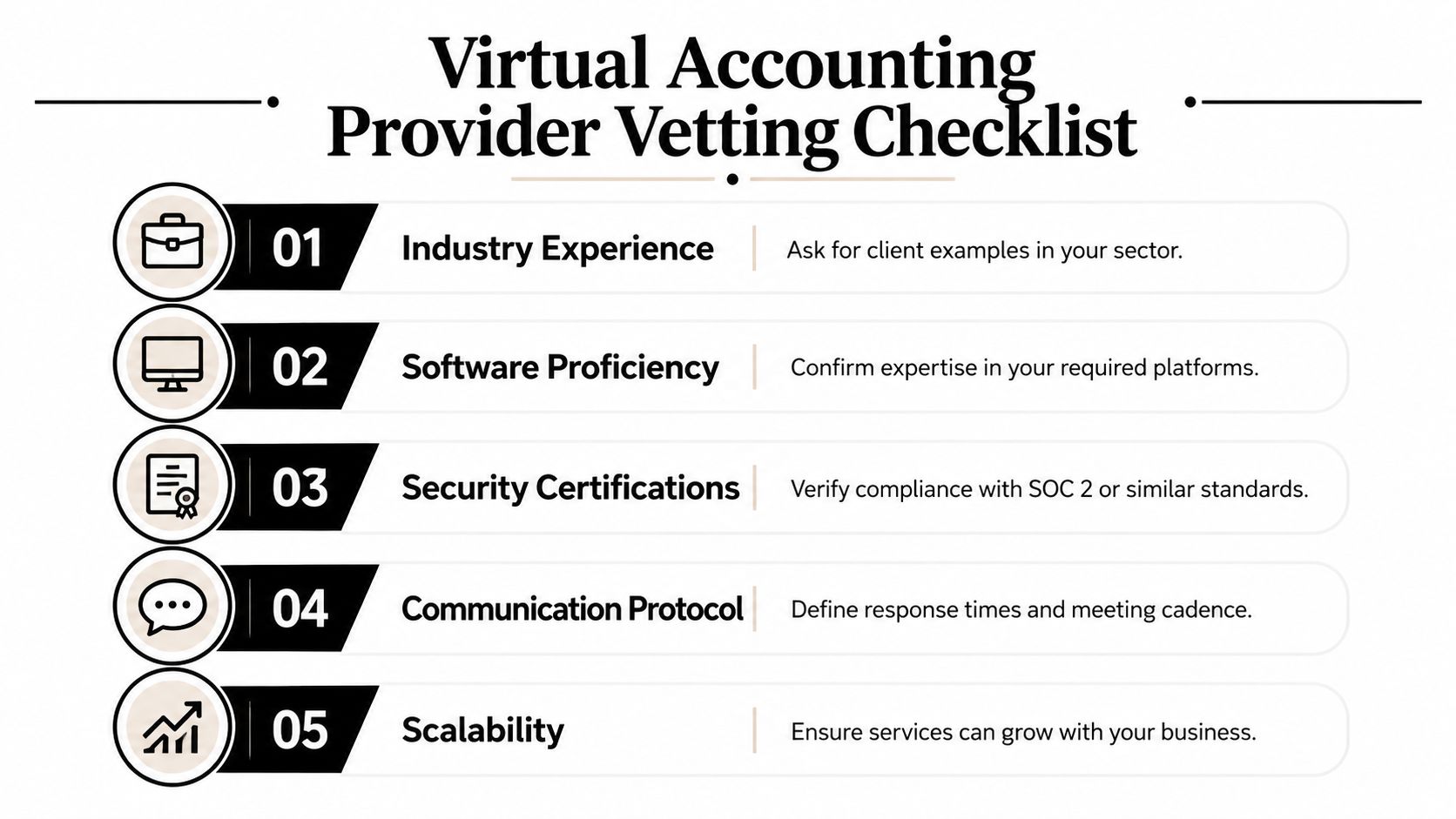
Use this interview checklist:
- Industry experience: Can you describe work with a healthcare practice, construction company, nonprofit, or another business like mine?
- Software proficiency: Who will configure and maintain QuickBooks Online, payroll, receipt capture, and reporting tools?
- Review responsibility: Who performs the second review, and how are errors documented and corrected?
- Communication protocol: How often will we meet, who answers urgent questions, and what response standard applies?
- Tax and notice support: Who handles tax notices, missing forms, filing coordination, and year-end schedules?
- Scalability: Can the same team support new locations, more employees, financing, or fractional CFO needs?
- Security: How do you manage multi-factor authentication, permissions, audit logs, and document retention?
- Service agreement: What deliverables, deadlines, exclusions, and correction policies appear in writing?
A high-performing outsourced accounting model uses one checklist for each workflow, a two-step review before delivery, weekly quality tracking, and quarterly checklist updates based on observed errors, according to this guidance on quality control in outsourced accounting. Ask the provider to explain its close calendar, error-rate monitoring, reconciliation process, and rework policy.
Be cautious when a firm can't name the person responsible for your account, promises that every task will be automated, or offers a price without asking about your industry and transaction complexity. If you're considering financing alongside accounting support, a clear SBA loan broker overview can help you understand the separate role a financing broker may play. Your accountant should still prepare the financial information lenders need.
2026 Tax Law Changes That Make Professional Guidance Essential
Tax rules change faster than most owners can track while running a business. In 2026, the 20% Qualified Business Income deduction is permanent, and Section 199A remains important for pass-through entities such as S corporations, partnerships, and sole proprietorships, according to this 2026 small-business tax update.
That doesn't mean every owner automatically receives the deduction. Your accounting team still needs accurate books, the right business structure information, eligible income calculations, payroll context, and documentation. An LLC taxed as a sole proprietorship and an S corporation may face different planning questions even when the owners perform similar work.
Reporting thresholds and payment platforms
Beginning in 2026, the reporting threshold for Forms 1099-NEC and 1099-MISC rises from $600 to $2,000, with future inflation adjustments, as reported in this 2026 tax changes summary. Third-party payment platforms such as PayPal and Venmo return to a 1099-K threshold of $20,000 and 200 transactions.
You still need clean vendor records and payment reconciliations. A changed information-reporting threshold doesn't erase the underlying obligation to track deductible payments, classify contractors properly, or retain documentation. Construction companies, healthcare practices, and nonprofits often work with multiple vendors and contractors, which makes consistent year-round records especially important.
SALT and pass-through planning
For pass-through entity owners, the SALT deduction cap rises from $10,000 to $40,000 for 2025 through 2029, according to this 2026 tax guide for small businesses. The same guide says the 20% QBI deduction remains permanent, adds a $400 minimum deduction for active owners in 2026, and expands phase-in ranges.
Your provider should review entity structure, owner compensation, estimated payments, contractor reporting, payment-platform records, and year-end documentation together. That's why tax compliance services should be part of an ongoing accounting relationship, not a frantic appointment after the books are already closed.
Bookkeeping and Accounting of Florida Inc. provides cloud-enabled bookkeeping, payroll, tax preparation, compliance support, industry-focused accounting, and fractional CFO guidance for Jacksonville and Northeast Florida businesses. Visit Bookkeeping and Accounting of Florida Inc. to discuss your current books, upcoming tax obligations, and the level of virtual accounting support your company needs.