
You finish a project, send the invoice, and still can't answer the question that matters most: Did the job make money? Your bookkeeper may have reconciled the bank account, but retainage is sitting in the wrong account, labor hours are missing job codes, and the work-in-progress report doesn't match what your project manager sees in the field. Then a tax payment arrives, and the cash you thought was available disappears.
Thank you for reading this post, don't forget to subscribe!That's the operating reality for many small and midsize contractors. Construction accounting services aren't ordinary data entry with industry vocabulary added later. They connect job costing, payroll, billing, revenue recognition, tax compliance, cash flow, and management decisions in one system. If those pieces aren't connected, clean-looking books can still hide serious risk.
The need for specialized support is clear. The global construction accounting outsourcing service market was estimated at USD 2.53 billion in 2025 and is projected to reach USD 5.16 billion by 2034, with an 8.4% CAGR over the forecast period, according to the market information referenced by Miter's job-costing resource. Bookkeeping and payroll together represented more than half of outsourced demand in that data, which makes sense. Those are the areas where small errors quickly become payroll, tax, margin, and compliance problems.
Why Construction Accounting Is Nothing Like Regular Bookkeeping
A subcontractor invoice can look perfectly ordinary in the general ledger and still damage a contractor's financial picture. A construction accountant must assign it to the correct project, phase, cost code, contract, and reporting period. That work determines whether management sees a reliable margin or a misleading one.
Consider a commercial contractor with several active jobs. Vendor bills sit in email, employee timecards remain in a payroll system, change orders live in project software, and draw requests sit in spreadsheets. The bank reconciles, so the office assumes the books are accurate. Then overtime posts to the wrong project, a subcontractor invoice omits committed-cost information, and retainage receivable is classified as ordinary accounts receivable. The statements look orderly while job profitability is wrong.

Project revenue follows progress, not invoice timing
Construction revenue is often recognized with a cost-to-cost percentage-of-completion method. The contractor compares costs incurred with estimated total contract costs, calculates progress, and recognizes revenue and gross profit according to that progress instead of waiting for an invoice to be paid. The technical treatment appears in this construction accounting guidance on percentage-of-completion reporting.
A missing labor burden, misclassified material purchase, or incomplete subcontract commitment can distort the completion percentage. The resulting WIP report may show excessive revenue, inflated profit, or a healthy-looking project already moving toward a loss. That gap undermines cash-flow forecasts, bonding discussions, and estimate-at-completion decisions.
A general bookkeeping workflow asks whether a transaction entered the ledger. A construction accounting workflow asks whether it entered the right job cost structure and whether managers can trust the resulting project margin. Contractors comparing systems should also review this bookkeeping guide for contractors before choosing a workflow.
Practical rule: If your books cannot explain profit by project, phase, and cost category, they are not giving you construction financial control.
Compliance creates another layer of exposure
Prevailing-wage and federally funded work impose requirements that ordinary payroll processing does not address. Certified payroll must capture worker classifications, hours, wages, deductions, fringe benefits, and supporting documentation. The U.S. Department of Labor updated the WH-347 certified payroll form effective January 6, 2025, so contractors should review payroll systems and recordkeeping workflows against the current form. The requirements are outlined in this construction payroll compliance guide.
Your accounting setup must also show retainage, progress billing, accounts payable timing, collections, and the cash required to finish each job. Payroll, insurance, job costing, and claims documentation often intersect, so contractors should also understand the process for managing workplace injury claims.
Small contractors facing 2026 tax law changes cannot rely on delayed month-end reports alone. Fractional CFO support gives owners a disciplined review of project margins, cash requirements, tax exposure, and reporting controls before a compliance problem becomes expensive.
If your bookkeeper only produces monthly financial statements, ask whether the system can support a bonding application, certified payroll review, IRS examination, and live project-margin discussion. If the answer is unclear, hidden risk is already in the process.
Core Services Every Construction Accounting Firm Should Deliver
A contractor can have clean bank reconciliations and still lose money on a project. A construction accounting partner must build controls around how work is estimated, staffed, billed, changed, completed, and collected. That system should expose margin erosion while the owner can still correct it.
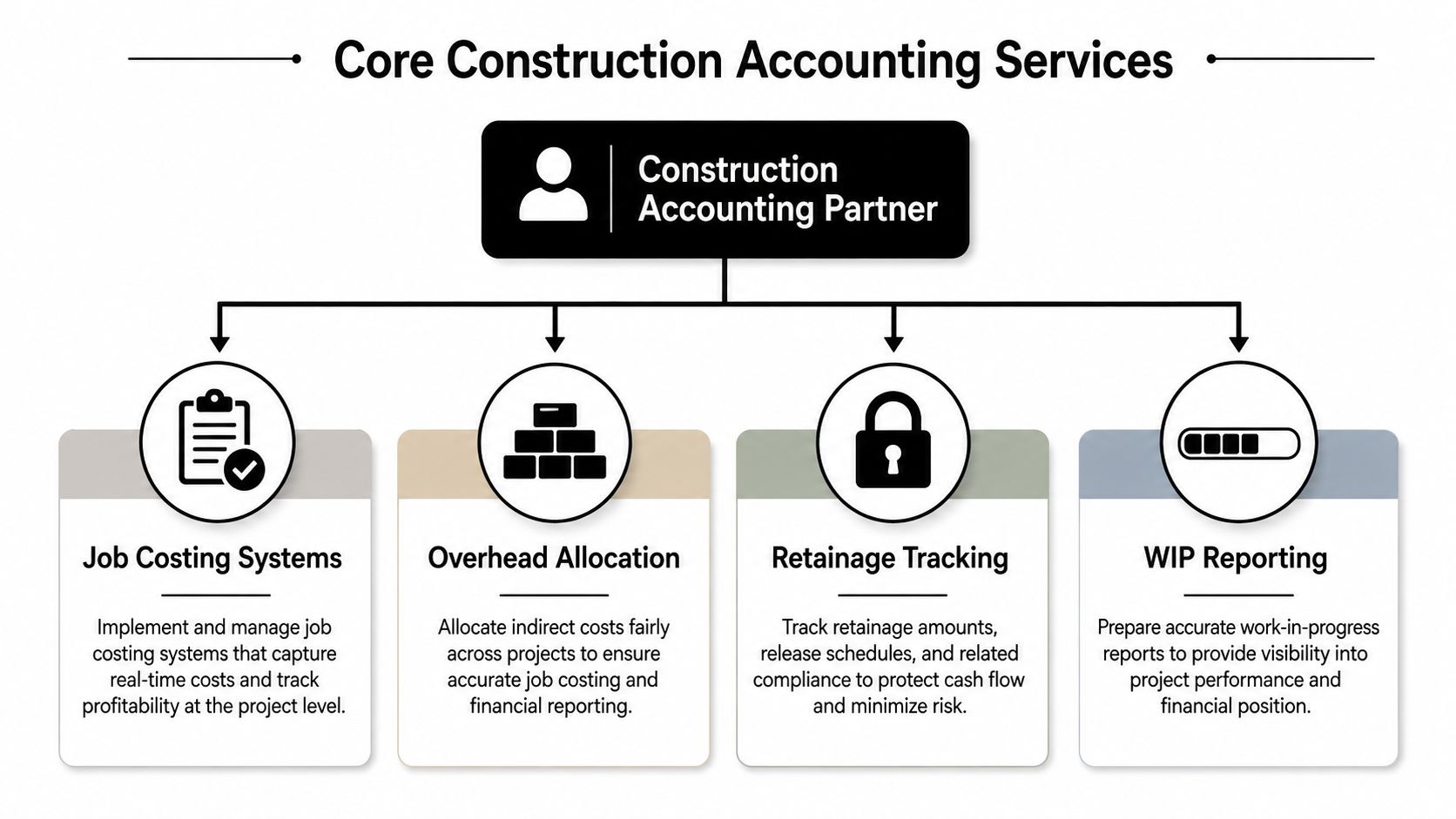
Job costing must reach the project level
Start with job costing that separates:
- Direct labor: Employee wages assigned to the correct project, phase, and cost code.
- Materials: Purchases tied to the job, including items received before billing.
- Subcontractors: Commitments and invoices compared with subcontract values.
- Equipment: Project usage and related operating costs.
- Allocated overhead: Indirect costs assigned consistently instead of buried in general expenses.
A residential builder may need cost codes for site work, concrete, framing, plumbing, electrical, and finishes across several subdivisions. A commercial contractor may need distinct codes for public works, change orders, retainage, and bonded contracts. The accounting firm should compare the original budget, committed costs, actual costs, and forecast-to-complete figures. If those views do not agree, the reported margin is unreliable.
Construction software increasingly combines billing, job costing, payroll, budgeting, payables, receivables, and reporting. The market direction described by Growth Market Reports reflects that shift from manual tracking to connected systems. The precise forecast matters less than the operational requirement: owners need current project information, not a month-end surprise.
Payroll and certified payroll need construction logic
Construction payroll must separate regular wages, overtime, and labor burden by project and phase. Timekeeping should feed the correct job codes, while fringe benefits and payroll taxes receive consistent burden rates. Reconciliations should compare actual labor rates and productivity with the estimate, so payroll variances appear in the project margin before they become a claim or cash problem.
For Davis-Bacon work, configure certified payroll reporting as part of the accounting workflow. Weekly records need worker classifications, daily and weekly hours, gross wages, deductions, net pay, and a signed statement of compliance. Retain the required records for at least three years after project completion, following the Department of Labor compliance guidance.
Billing, retainage, and WIP reporting must agree
Progress billing should follow contract milestones and approved work, not the contractor's immediate cash needs. Track retainage receivable separately, including the amount withheld, release conditions, expected collection timing, and missing project documents.
WIP reporting should connect production to financial results. It should show contract value, approved changes, costs incurred, estimated total cost, billings, recognized revenue, gross profit, and projected final margin. Review it during the job. Waiting until year-end can reveal that remaining work will consume the profit already reported.
Contractors comparing platforms across markets can review top accounting tools for UK trades. Tax and compliance rules differ by jurisdiction, but the evaluation criteria still apply: job costing, payroll, billing, reporting, integrations, and audit trails.
The firm should also handle tax planning, monthly reconciliations, accounts payable and receivable, depreciation schedules, journal entries, financial statements, and management reporting through one construction-specific process. Owners facing 2026 tax law changes should require fractional CFO review of tax exposure, project margins, cash requirements, and reporting controls. An overview of this connected approach appears in construction accounting and financial management.
The Compliance Risks That Sink Unprepared Contractors
A contractor can finish a profitable-looking project and still face tax, payroll, or audit exposure. The usual cause is a shortcut: using a neighboring business's revenue method, running a crew through generic payroll, or treating a small job as too minor for detailed records. Those choices can create problems after the work is complete.
Revenue recognition requires a contract-specific decision
The IRS generally requires the percentage-of-completion method under IRC §460 for long-term construction contracts. Eligible small contractors and home construction contractors may qualify for exceptions, but the exception must be tested against the contractor's facts. IRS Publication 5522 outlines the relevant framework, including possible use of cash, accrual, completed contract, or an exempt percentage-of-completion method by eligible small contractors.
Eligibility depends on average annual gross receipts for the prior taxable years being below the applicable threshold. That threshold does not provide a universal shortcut. Review the contractor's contract type, tax position, and project facts separately. The small-contractor exception also differs from the rules for home construction contracts, as summarized in the construction industry audit guidance.
Document the accounting method for each relevant contract, then reconcile the tax return to the underlying job-cost records. Under the completed contract method, income and expenses are reported when the project is completed and accepted. Under PCM, income follows the percentage of costs incurred against total estimated contract costs, as explained in IRS guidance on construction income recognition.
The 2026 tax change needs deliberate planning
The One Big Beautiful Bill Act expands the home-construction exception so residential construction contracts may also be excluded from mandatory PCM. The cited guidance identifies the change as applying to contracts entered into after enactment, including 2026 for calendar-year taxpayers. Review contract dates, project classification, the current accounting method, and tax reporting consequences before changing anything. CLA's construction tax update explains the change and its planning implications.
Certified payroll creates a separate audit trail. The updated WH-347 form, effective January 6, 2025, requires review of payroll data, fringe benefits, worker classifications, signatures, and supporting records. Even occasional Davis-Bacon work needs a repeatable process. Build guidance for managing workplace injury claims into broader risk reviews, and keep payroll controls separate from assumptions about project size.
Compliance standard: If a rule requires documentation, build that documentation into the workflow before the project starts.
Small contractors often miss requirements that apply to them. Construction accounting services should therefore include proactive compliance reviews, not only after-the-fact filing. A fractional CFO should test job-cost assumptions, identify missing records, monitor tax-law changes, review project exposure, and set reporting controls before a payroll review, bonding request, or IRS audit exposes the gaps.
How to Evaluate and Choose the Right Construction Accounting Firm
A contractor can receive clean-looking books and still miss a profit fade, misstate work in progress, or discover a compliance gap during a bonding review. Choose a firm that understands construction operations, not one that applies general bookkeeping routines.
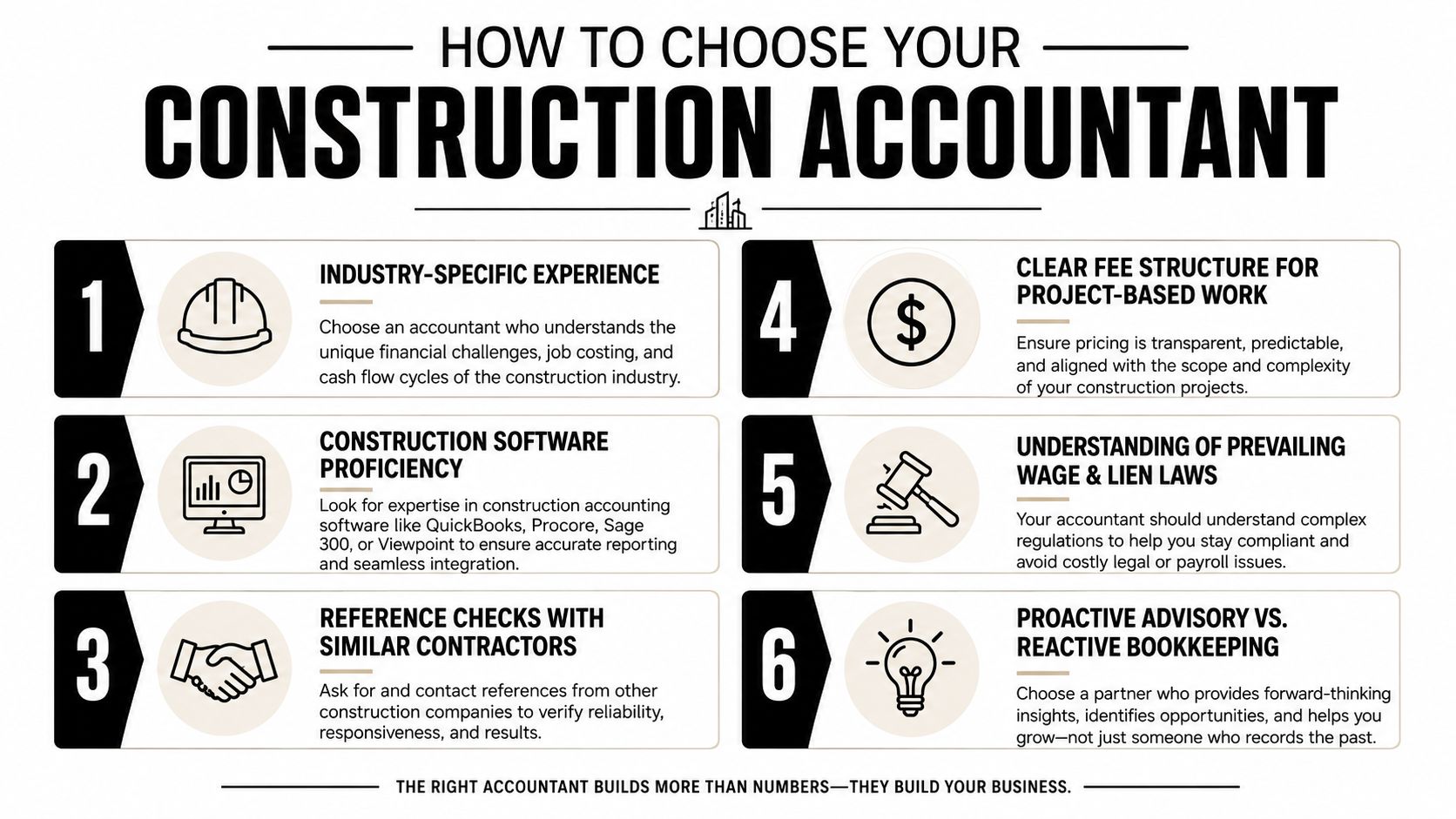
Start with industry capability
Use the first consultation to test the firm's construction knowledge. Ask:
- How do you structure job-cost codes? The answer should cover labor, materials, subcontractors, equipment, overhead, phases, and change orders.
- How do you prepare and review WIP reports? Look for a clear process covering contract value, estimated cost, percent complete, billings, recognized revenue, and forecast margin.
- How do you handle certified payroll? The firm should understand prevailing-wage classifications, fringe benefits, WH-347 workflows, and record retention.
- Which construction platforms integrate with your process? QuickBooks Online or QuickBooks Desktop may fit, but the firm should also understand payroll, project-management, timekeeping, and document systems.
- Can you support bonding and lender reporting? The accountant should explain how financial presentation and job performance affect external stakeholders.
For a broader overview of contractor bookkeeping needs, review bookkeeping services for contractors.
QuickBooks ProAdvisor certification helps confirm platform knowledge. It does not show that the firm can interpret a profit fade, reconcile committed costs, or challenge an unrealistic estimate-at-completion. Ask for examples of how the team identified a margin problem before the final project closeout.
Test the operating relationship
Request references from contractors with similar project types. Ask how quickly the firm responds to payroll issues, whether owners receive management reports on schedule, and whether the accountant raises problems without waiting to be asked. A firm that only reports historical results will leave you reacting to cash and margin problems.
Review the fee structure carefully. Monthly retainers often fit recurring bookkeeping, payroll, tax coordination, and advisory work. Hourly billing may suit cleanup or one-time projects, but it can create uncertainty when regular financial oversight is required. The lowest proposal is a poor bargain if it excludes WIP reporting, tax planning, certified payroll support, or management calls.
Jacksonville and Northeast Florida contractors should ask whether the firm understands local operating conditions, prevailing-wage work, sales-tax considerations, lien processes, and reporting expectations from regional lenders and sureties. Bookkeeping and Accounting of Florida Inc. is a Jacksonville-based firm offering QuickBooks ProAdvisor support, construction accounting, payroll, tax services, and fractional CFO guidance.
Use the embedded overview to assess what a construction accounting relationship should cover.
Why Every Growing Contractor Needs a Fractional CFO
Many owners assume a CFO belongs in the budget only after the business becomes very large. That's backward. A contractor usually needs strategic financial guidance when project volume, payroll complexity, bonding requirements, and cash demands begin outgrowing the owner's ability to manage them personally.
A fractional CFO doesn't replace the bookkeeper. The CFO interprets the information, challenges assumptions, and turns accounting output into decisions. That includes cash-flow forecasting tied to the project pipeline, bid and margin analysis, bonding-capacity planning, working-capital strategy, and real-time review of project profitability.
The cash crunch is usually visible before it becomes urgent
A profitable project can still create a cash crisis. Payroll may be due before an owner payment arrives. Suppliers may require payment while retainage remains outstanding. A new project may require mobilization costs before the first draw. Without a forward-looking forecast, the owner sees the problem only when the bank balance becomes uncomfortable.
A fractional CFO can model those timing issues against active contracts, expected billings, payroll obligations, subcontractor commitments, equipment needs, and projected collections. That analysis helps the contractor decide whether to pursue a bid, negotiate payment terms, slow expansion, or arrange financing before the pressure becomes acute.
Real-time margin control beats month-end hindsight
Monthly financial statements tell you what happened. Construction management requires a sharper question: What is happening on each job right now, and what will the final margin be if current production continues?
A fractional CFO reviews estimate-at-completion assumptions, compares actual labor productivity with the budget, examines change-order exposure, and identifies margin leakage. The role also gives owners a senior financial advisor without the fixed overhead of a full-time executive. Contractors looking for a detailed explanation of that model can review fractional CFO services for growing businesses.
Owner's test: Don't ask whether you can afford financial leadership. Ask whether you can afford another project decision based on outdated numbers.
The best time to add fractional CFO support isn't after a failed bonding application or a severe cash shortfall. It's when the company has enough activity that one wrong assumption can affect payroll, borrowing, bidding, or owner distributions.
Your Onboarding Checklist for a Smooth Accounting Transition
A clean transition starts before the new firm touches the ledger. The goal isn't merely to import old balances. The goal is to establish a reliable connection between contracts, cost codes, payroll, billing, WIP, tax reporting, and management decisions.
Gather the records that explain the business
Prepare:
- Historical accounting files: General ledgers, trial balances, bank reconciliations, tax returns, and prior financial statements.
- Contract documents: Original contracts, approved change orders, billing schedules, retainage terms, and payment conditions.
- Project data: Budgets, cost codes, committed costs, purchase orders, subcontract agreements, and current estimates to complete.
- Payroll information: Employee classifications, wage rates, timekeeping records, benefits, payroll tax filings, and certified payroll history.
- Tax and compliance records: Sales-tax filings, contractor licenses, insurance records, lien documentation, and correspondence with tax agencies.
Don't hide messy records. A new accountant needs to know where the gaps are so the firm can prioritize cleanup without disrupting payroll or active billing.
Build the system in stages
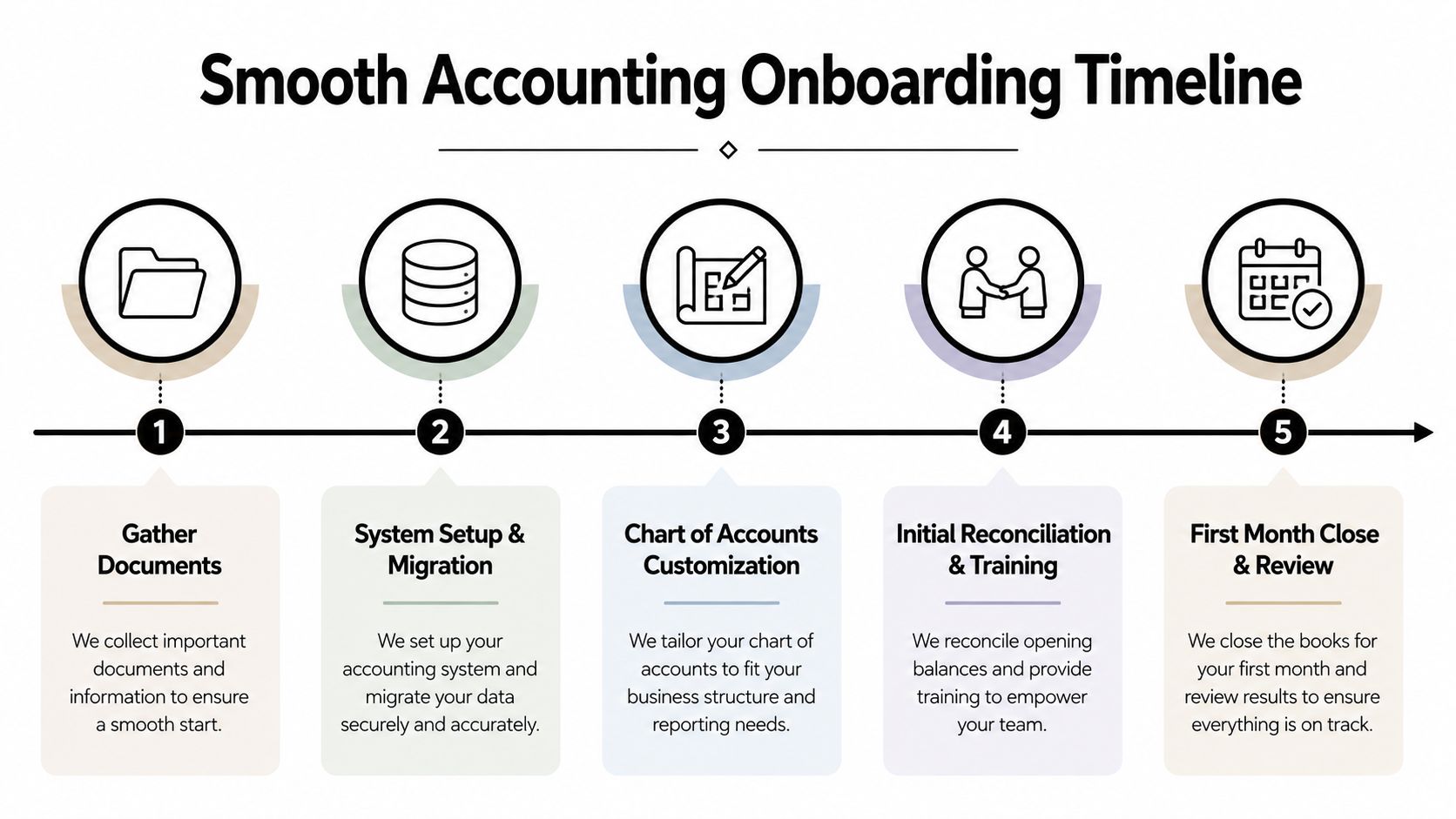
During the initial stage, the firm should review the chart of accounts, establish project and phase codes, map payroll categories, and confirm how overhead will be allocated. If the chart of accounts is too generic, management reports will remain generic even after migration.
The next stage should include bank, credit-card, payroll, accounts payable, and accounts receivable reconciliations. The accountant should compare the accounting file with contract schedules and project records, then document unresolved differences rather than carrying them forward.
By the first monthly close, you should receive a defined reporting package. That may include a balance sheet, income statement, cash summary, accounts receivable aging, accounts payable aging, job-cost detail, and WIP report. The firm should also train the people responsible for approving bills, submitting timecards, reviewing change orders, and authorizing payments.
Set expectations for the first 30, 60, and 90 days around data collection, system setup, reconciliation, training, and management review. Those milestones create accountability on both sides and prevent the common mistake of expecting perfect reporting before the underlying data has been corrected.
Answers to the Questions Contractors Ask Most
Can a small contractor handle certified payroll for occasional Davis-Bacon work?
Yes, but not with an improvised spreadsheet created after the pay period closes. Set up worker classifications, fringe-benefit treatment, timekeeping, signatures, supporting records, and review procedures before the first federally funded project begins. The updated WH-347 requirements and recordkeeping obligations make system design more important than frequency.
Can QuickBooks support construction job costing?
QuickBooks can support a useful construction workflow when the chart of accounts, customer and job structure, cost codes, payroll mappings, classes, items, and reporting rules are configured properly. Software won't correct missing timecards, uncoded invoices, or poor estimates. The system is only as reliable as the process feeding it.
How often should we review WIP?
Review WIP often enough to catch labor overruns, missing commitments, billing delays, and estimate changes before they become permanent. Active projects with volatile labor, subcontractor, or material conditions require more attention than stable jobs. A monthly review is a baseline for many contractors, but management should increase review frequency when project conditions change.
What if the previous bookkeeper left a mess?
Freeze unnecessary changes, preserve the accounting file, gather contracts and payroll records, and commission a structured cleanup. The new firm should reconcile opening balances, verify job assignments, review retainage, identify tax filing gaps, and document every unresolved item. Do not start entering new transactions into an unreliable historical file.
When should we move beyond basic bookkeeping?
Escalate when you can't explain project margin, cash needs, WIP balances, payroll compliance, or tax-method choices. That's the point where construction accounting services and fractional CFO guidance become operational necessities, not optional upgrades.
Bookkeeping and Accounting of Florida Inc. provides construction bookkeeping, job costing, payroll, tax preparation, compliance support, financial reporting, and fractional CFO services for contractors in Jacksonville and Northeast Florida. Visit Bookkeeping and Accounting of Florida Inc. to schedule a review of your accounting system and identify the compliance and profitability gaps that need attention now.