
You've got more customers, more payroll, and more money moving through the bank account, yet you still can't answer a basic question with confidence: How much cash will the business have available over the next several weeks? Your bookkeeper is recording transactions, your CPA is preparing tax filings, and your banker is discussing financing. You're still making hiring, pricing, equipment, and expansion decisions from a mixture of instinct and incomplete reports.
Thank you for reading this post, don't forget to subscribe!That's the point where CFO services for small business stop being a luxury. A fractional CFO gives you forward-looking financial leadership without requiring a permanent executive hire. The value isn't another spreadsheet. It's a reliable system that connects clean books, cash forecasting, tax planning, compliance, and operating decisions.
Why Every Growing Business Eventually Needs CFO Guidance
A Jacksonville contractor can be busy every day and still run short of cash. Customer invoices may be outstanding while payroll, materials, insurance, and equipment payments arrive on fixed dates. A healthcare practice may show revenue growth while payer delays and rising labor costs weaken liquidity. A retail owner may see strong sales but have no clear view of which products, locations, or channels produce acceptable margins.
Bookkeeping records what happened. CFO guidance helps you decide what happens next.
The growth problem behind the numbers
Many owners begin with a practical arrangement: a bookkeeper handles transactions, the owner watches the bank balance, and a CPA handles tax preparation. That approach can work while operations remain simple. It breaks down when the business adds employees, locations, debt, inventory, long-term contracts, multiple revenue streams, or major equipment purchases.
The problem isn't a lack of effort. It's that historical financial statements arrive after the decisions that matter have already been made. A monthly income statement can show that expenses increased, but it won't automatically tell you whether to slow hiring, renegotiate vendor terms, change pricing, or preserve cash for taxes.
Practical rule: If you're making major business decisions before reliable financial information is available, you already need CFO-level guidance.

The inflection points owners often miss
You should consider a fractional CFO when the business faces decisions that basic accounting doesn't answer:
- Cash pressure: Sales are increasing, but collections, payroll, taxes, and vendor payments don't line up.
- Expansion: You're considering another location, a new service line, additional vehicles, or a larger team.
- Margin uncertainty: Revenue looks healthy, but you can't identify the jobs, customers, or services producing the strongest profit.
- Financing needs: Your lender, investors, or partners need dependable forecasts and decision-ready reporting.
- Compliance exposure: Your team doesn't consistently track tax obligations, contractor payments, payroll records, or equipment purchases.
A fractional CFO turns those concerns into an operating process. The CFO establishes reporting standards, builds forecasts, tests scenarios, and gives the owner a financial view that supports action. You don't need a full-time executive schedule to benefit from that discipline. You need someone accountable for turning financial data into decisions.
Fractional CFO vs Full-Time CFO vs Your Current Advisors
A bookkeeper, CPA, banker, and CFO each serve a different purpose. Confusing those roles creates expensive gaps. Your bookkeeper may keep the general ledger accurate, but that doesn't mean someone is modeling cash needs. Your CPA may file an accurate return, but tax compliance alone doesn't create an operating plan. Your banker may understand your cash position and lending options, but the bank doesn't run your internal financial planning.
A fractional CFO fills the strategic space between the records and the decisions. For owners comparing outsourced finance leadership with other outsourced functions, the distinction is similar to the difference between executive financial oversight and fractional IT for Canadian SMBs, where specialized guidance supplements internal capacity rather than replacing every operational role.
Financial Advisor Roles Compared
| Role | Primary Focus | Typical Cost | Best For |
|---|---|---|---|
| Bookkeeper | Transaction recording, reconciliations, accounts payable and receivable | Usually the lowest-cost recurring finance support | Businesses that need organized, current books |
| CPA | Tax compliance, tax filings, reviews, audits, and technical accounting advice | Varies by filing and engagement complexity | Owners who need compliant tax and accounting work |
| Business banker | Cash position, lending relationships, deposits, and financing discussions | Often relationship-based, with financing costs separate from advisory work | Businesses evaluating credit or banking products |
| Fractional CFO | Forecasting, budgeting, financial strategy, capital planning, and decision support | Monthly retainer or project pricing based on scope | Growing companies that need senior financial leadership without a permanent executive |
| Full-time CFO | Dedicated executive finance leadership and internal management | Executive salary, benefits, payroll taxes, and related employment costs | Larger or highly complex businesses requiring continuous internal leadership |
A full-time CFO can be the right answer when the company needs a dedicated executive every day, but many small businesses aren't ready for that structure. The fractional CFO service overview explains why an outsourced arrangement can provide strategic oversight while keeping the engagement proportional to actual needs.
Where your existing advisors fit
Your banker remains important for borrowing strategy and lender communication. Your CPA remains essential for tax interpretation, filing, and technical compliance. Your bookkeeper remains responsible for maintaining the records that every advisor relies on. A CFO coordinates the financial picture so those professionals are working from consistent information.
That distinction matters because small-business owners often trust the advisor they already see most often. A survey reported that 84% of firms consider their business banker a key adviser for cash position, decision-making, and cash flow, while 27% turn to CPAs for lending and growth-related issues (NJBIZ coverage). Those figures don't make bankers or CPAs less valuable. They show why owners need a clear explanation of the CFO's separate role.
What CFO Services Actually Include for Small Businesses
CFO services should produce specific work, not vague promises about “strategic growth.” A capable fractional CFO builds a repeatable finance function around your actual business model, including cash timing, margins, operating expenses, financing, tax obligations, and management reporting.
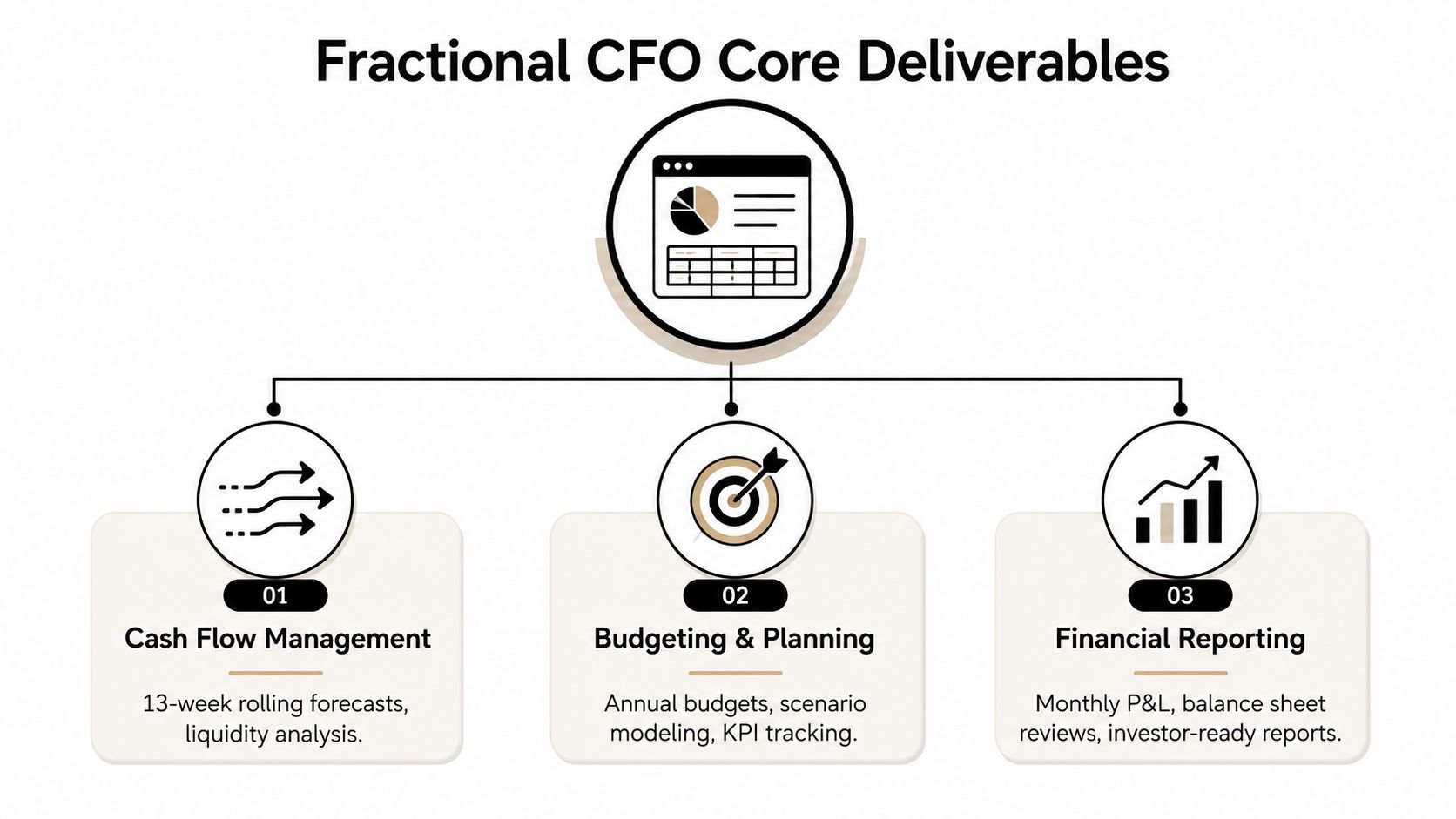
The core deliverable is often a rolling 13-week cash flow forecast. It starts with actual opening cash, maps non-discretionary outflows such as payroll, taxes, debt service, and critical vendor payments, then forecasts collections according to customer payment behavior rather than booked revenue. Weekly updates allow the owner to compare expected and actual collections, payables timing, and borrowing needs (PKF O'Connor Davies guidance).
The recurring finance package
A practical monthly engagement may include:
- Cash flow management: Review the 13-week forecast, identify upcoming shortfalls, and coordinate collection or payment actions.
- Budgeting and variance analysis: Compare actual revenue and expenses with budget, then explain the operational reason behind meaningful variances.
- Management reporting: Deliver a monthly profit and loss statement, balance sheet review, cash summary, and selected key performance indicators.
- Scenario planning: Model the effect of hiring, price changes, new equipment, debt, expansion, or a slower collection cycle.
- Decision support: Give the owner a clear recommendation, not just a data dump.
For owners interested in the mechanics of short-term forecasting across specialized digital businesses, OneSafe's resource on cash flow modeling for web3 businesses offers useful context. The same forecasting discipline applies in Jacksonville, even when the business sells construction services, medical care, or retail products.
The CFO should also adapt the analysis to the industry. A construction company needs job costing by project, change-order visibility, labor allocation, retainage tracking, and margin analysis before a job closes. A healthcare practice needs reporting that separates provider production, payer mix, collections, denial activity, and revenue-cycle performance. A retailer needs product, location, inventory, and purchasing analysis. A nonprofit may need fund accounting, grant restrictions, board reporting, and compliance support.
The embedded video provides another visual introduction to the role of a CFO in business finance:
How a Fractional CFO Engagement Actually Works
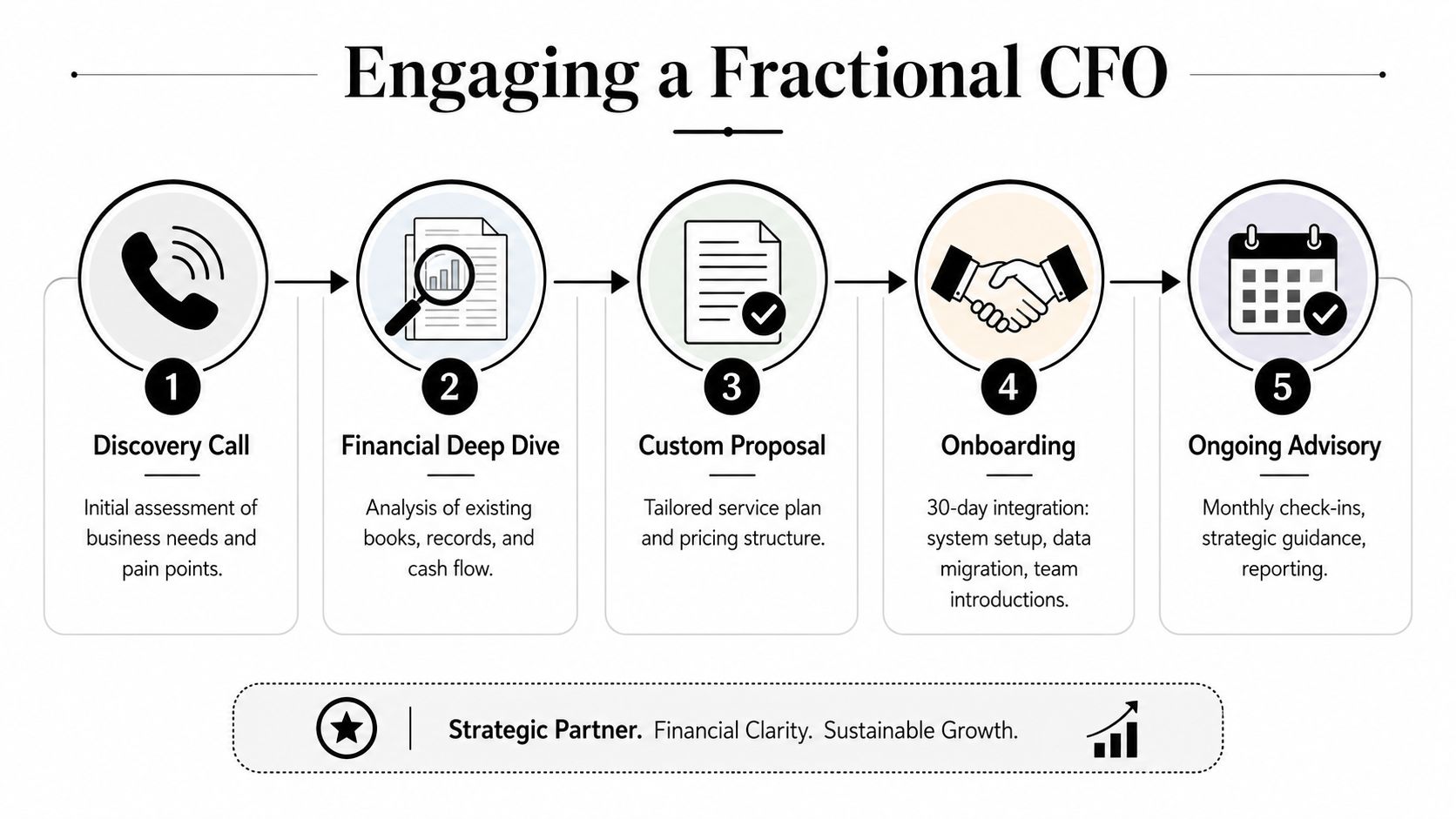
A good engagement starts with diagnosis, not a generic package. The CFO needs to understand how you make money, how customers pay, what obligations arrive each month, which reports you trust, and where your current process breaks.
Start with the financial deep dive
The first stage is a discovery conversation followed by a review of the accounting file, bank reconciliations, accounts receivable, accounts payable, payroll, debt, tax records, and management reports. The CFO identifies whether the primary issue is inaccurate bookkeeping, weak reporting, poor cash visibility, disconnected software, or a lack of planning.
The first month may include cleanup. That can mean reconciling accounts, correcting classifications, separating personal and business activity, reviewing chart-of-accounts design, and setting a close schedule. No forecast can be more reliable than the records underneath it.
Minimum readiness for useful CFO work
You don't need perfect books before hiring a CFO. You do need a willingness to establish basic operating discipline:
- Accounting access: Use a central system such as QuickBooks Online or another suitable cloud accounting platform, with controlled user permissions.
- Bank discipline: Reconcile operating, credit card, loan, and merchant accounts consistently.
- Transaction documentation: Preserve invoices, receipts, payroll records, contracts, and vendor information.
- Close cadence: Produce management-ready monthly financial statements on a dependable schedule.
- Operational data: Connect sales, payroll, inventory, job-costing, or practice-management data where those systems drive financial results.
The CFO then creates baseline reporting, defines the key metrics, and establishes a communication rhythm. Monthly meetings review results and actions. Quarterly sessions revisit assumptions, capacity, hiring, financing, and strategic priorities. The annual budget becomes a living plan rather than a document that sits in a folder.
Your team should know who owns each task, what the CFO will deliver, and which decisions require owner approval. That clarity prevents the fractional CFO from becoming an expensive substitute for unresolved bookkeeping responsibilities.
2026 Tax Law Changes That Make CFO Guidance Urgent
Year-end tax preparation is too late for many tax-planning decisions. The owner needs current books throughout the year to evaluate entity structure, taxable income, equipment purchases, vendor payments, and cash reserves before the opportunity or deadline passes.
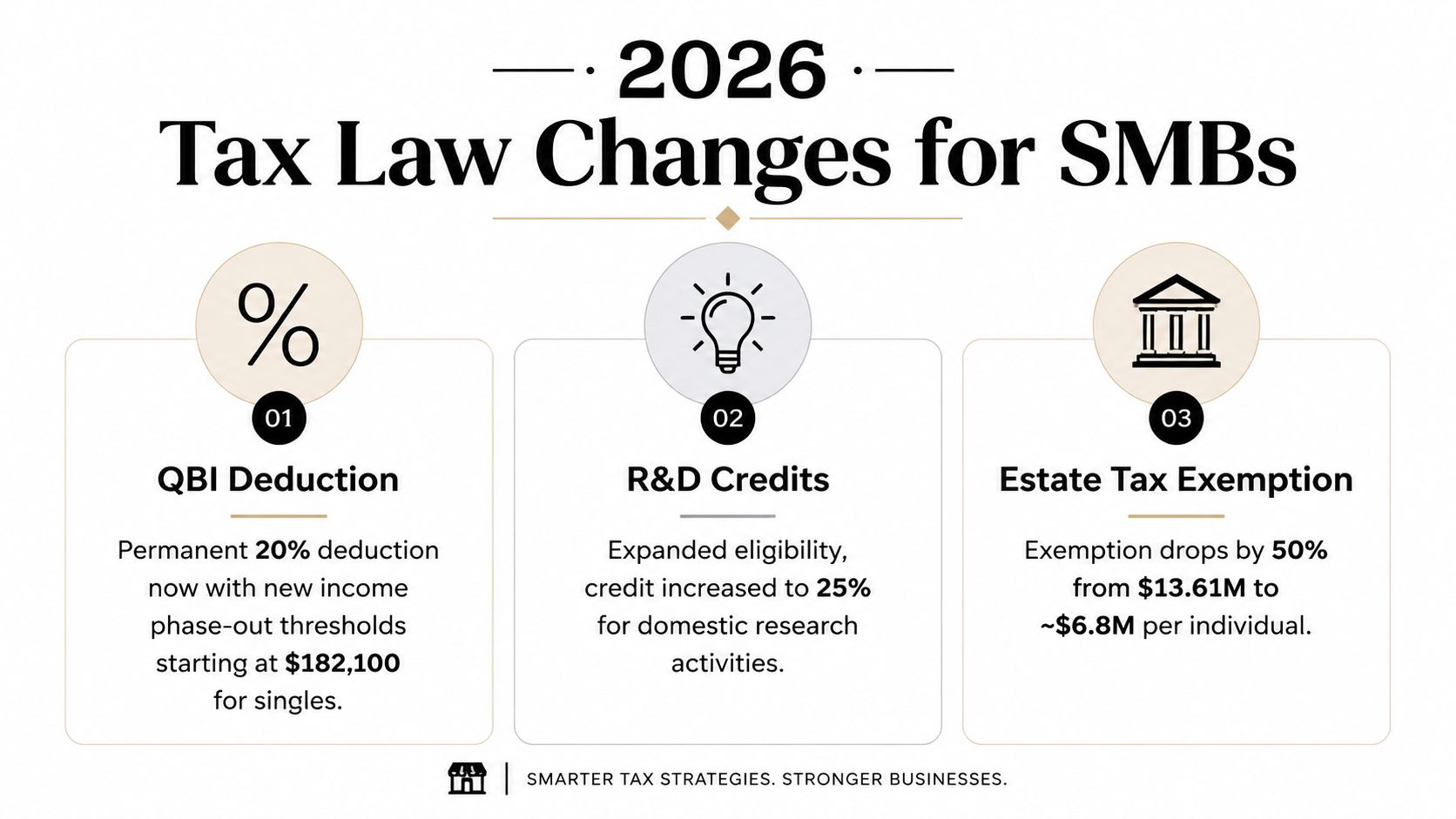
The IRS states that the 20% Qualified Business Income deduction is permanent for qualified active trades or businesses. For 2026, inflation adjustments raise the income thresholds to about $203,000 for single filers and $406,000 for joint filers (IRS Publication 334). Eligibility and interaction with entity structure and taxable income require current accounting, not an estimate assembled after the year closes.
Purchases and vendor reporting need planning
Tax summaries report that beginning in 2026, Forms 1099-NEC and 1099-MISC reporting thresholds rise from $600 to $2,000, while the Section 179 expensing limit increases to $2,560,000 with inflation indexing (2026 tax changes summary). Those changes don't eliminate the need to track vendor payments or equipment purchases. They make accurate classifications and documentation more important.
Independent tax guidance also reports that the One Big Beautiful Bill Act permanently restored 100% bonus depreciation and made the 20% QBI deduction permanent, with provisions generally applying to tax years beginning after December 31, 2024 (CRI tax guidance). The right purchase may create a deduction, but buying equipment solely for a tax result can damage cash flow. A CFO models the after-tax cash impact, financing terms, depreciation treatment, and operational return before you commit.
Compliance reality: A tax provision is only useful when your records support it.
A fractional CFO doesn't replace your CPA's technical tax judgment. The CFO organizes the operating data, models choices, and keeps the business from treating compliance as an annual emergency.
Pricing Models and Return on Investment for CFO Services
CFO services usually fit one of three commercial structures. A monthly retainer provides recurring reporting, forecasting, and advisory support. A project engagement works for a defined need such as cleanup, lender reporting, acquisition analysis, or a new budgeting system. An hourly advisory arrangement suits owners who need occasional senior review but aren't ready for a recurring schedule.
Pricing should reflect business complexity, industry requirements, data quality, reporting frequency, and the level of decision support you expect. A construction company with job costing and payroll complexity needs a different engagement from a professional services firm with a straightforward billing model. Ask for defined deliverables, response expectations, meeting cadence, and the assumptions behind the fee.
Judge the return through decisions
Don't evaluate a fractional CFO by asking whether the monthly fee feels small. Evaluate the engagement by tracking the financial decisions it improves:
- Cash preservation: Did better collection and payment timing reduce avoidable cash pressure?
- Tax planning: Did current records help your CPA evaluate QBI, depreciation, equipment purchases, and reporting obligations?
- Pricing discipline: Did margin analysis change how you price jobs, services, or products?
- Compliance control: Did the business establish a reliable process for payroll, vendor reporting, sales records, and tax deadlines?
- Growth planning: Did the forecast show whether hiring or expansion was financially supportable?
The strongest ROI comes from connecting decisions to multiple forecasting horizons. A 13-week rolling forecast protects near-term liquidity. A 6- to 12-month forecast supports operating planning. An 18-month or longer strategic forecast informs capital allocation and hiring. Guidance for scaling businesses recommends weekly updates for the short-term view, monthly refreshes for the medium-term view, and quarterly review of the long-term plan (CFO Pro Analytics).
For an owner comparing engagement structures and advisory economics, this fractional CFO hourly rate guide can help frame the conversation. The right question isn't “What's the cheapest option?” It's “Which level of financial leadership prevents costly surprises and supports the decisions I'm already facing?”
Choosing the Right CFO Partner in Northeast Florida
Choose a CFO partner who can work with the business you operate, not an abstract growth company. Ask whether the provider understands your industry, can work with your accounting and payroll systems, delivers reports on a dependable schedule, and explains financial results in plain English.
Questions to ask before signing
- Industry fit: Can the team handle healthcare revenue cycles, construction job costing, retail inventory, or nonprofit fund restrictions?
- Technology compatibility: Will the CFO work effectively with QuickBooks, payroll platforms, payment processors, inventory systems, and existing dashboards?
- Reporting standards: What will you receive monthly, and when will it be ready?
- Implementation support: Will the provider help clean the books and establish the close process, or only review reports after the fact?
- Communication: Who attends meetings, how quickly are urgent questions answered, and which decisions receive written recommendations?
- Advisor coordination: Will the CFO collaborate with your CPA, banker, payroll provider, and internal bookkeeper?
Local access can matter for Jacksonville and Northeast Florida owners who want in-person planning, regional business context, and a partner familiar with Florida operations. A full-service firm can also reduce handoffs between bookkeeping, tax, payroll, and advisory work.
Bookkeeping and Accounting of Florida Inc. provides bookkeeping, tax, payroll, audit, review, healthcare accounting, forensic audit, and fractional CFO services for Jacksonville-area businesses. The firm has served local companies for more than 20 years, uses certified QuickBooks ProAdvisors, and supports healthcare, construction, retail, and nonprofit organizations. Owners comparing broader CPA support can review this guide to a small-business CPA while defining the scope they need.
Before the first meeting, gather your recent financial statements, bank information, accounts receivable and payable aging, payroll records, debt schedules, tax returns, major contracts, and current budget. Write down your top three financial priorities, such as stabilizing cash flow, improving job margins, preparing for expansion, or staying current with compliance. That preparation lets the CFO address the decisions that matter instead of spending every meeting searching for missing records.
Bookkeeping and Accounting of Florida Inc. offers clean bookkeeping, tax support, reporting, and fractional CFO guidance for Jacksonville and Northeast Florida businesses that need a dependable financial roadmap. Visit Bookkeeping and Accounting of Florida Inc. to schedule a discovery conversation and bring your cash flow, compliance, and growth decisions under one coordinated process.