
A fractional CFO hourly rate typically runs $175 to $450 per hour. That price isn't for basic bookkeeping. It's for strategic financial leadership that helps you make better decisions, control cash flow, and avoid expensive compliance mistakes.
If you're reading this, there's a good chance your business looks healthy from the outside but feels murky from the owner's chair. Revenue comes in, payroll goes out, taxes keep changing, and somehow you're still asking the same annoying question every month: “Where did the cash go?”
That's where a lot of Jacksonville business owners get stuck. They've got a bookkeeper, maybe a tax preparer, maybe an office manager doing double duty in QuickBooks. But nobody is steering the ship. Nobody is translating numbers into decisions.
A fractional CFO fills that gap. Not full-time overhead. Not vague “advisory.” Real financial guidance, on a part-time basis, with enough horsepower to help you forecast, stay compliant, and stop running your company by bank balance.
Beyond Bookkeeping Why Your Business Needs a Strategic Guide
A contractor lands more work than expected. A clinic adds providers. A retailer has strong sales but can't explain why cash is tight. Different businesses, same problem. The books tell you what happened. They don't tell you what to do next.
That's the difference between accounting and leadership.

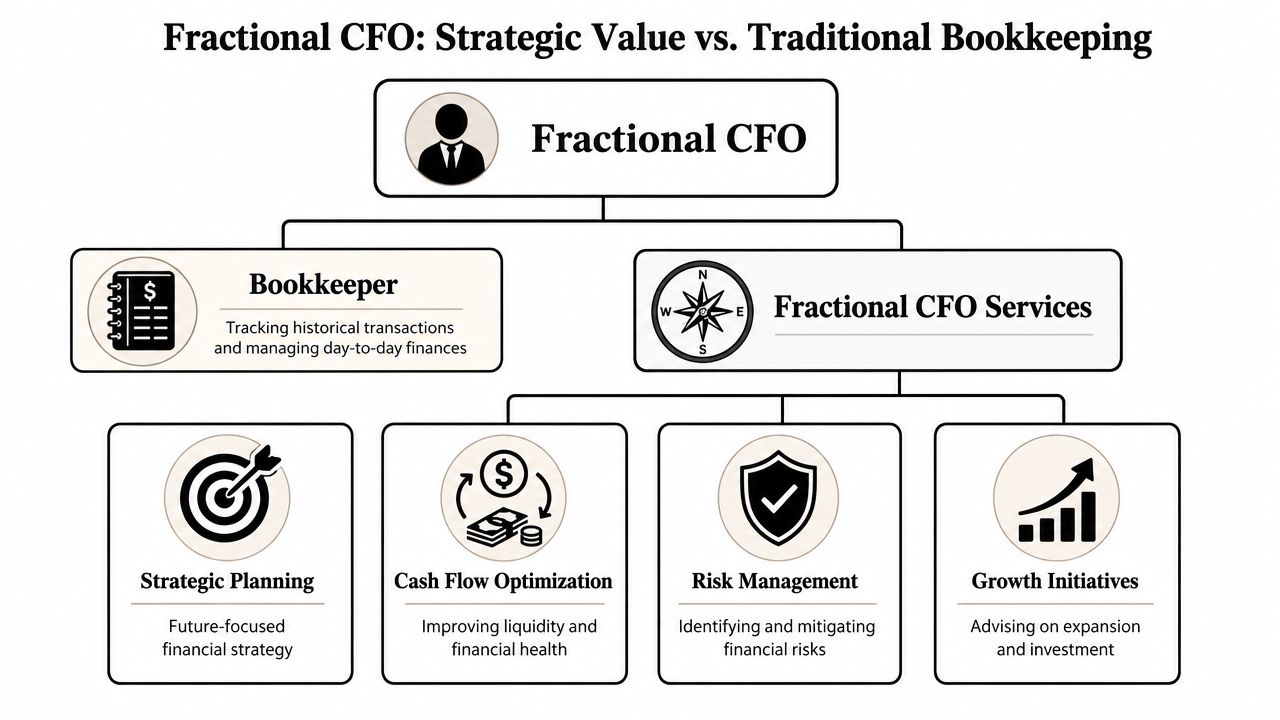
Bookkeeping records the trip. A CFO reads the map
Bookkeeping is necessary. Clean books matter. Payroll matters. Reconciliations matter. But those are rearview mirror tasks.
A fractional CFO looks forward. That person helps you answer questions like:
- Can we afford this hire: before you extend the offer
- Will this tax bill hurt cash flow: before the deadline hits
- Are margins slipping: before the year is gone
- Should we borrow, invest, or wait: before you make a costly call
That's why more owners are looking beyond data entry and tax prep. A good CFO turns financial noise into priorities.
Most small businesses don't fail because they lacked effort. They fail because nobody translated the numbers early enough.
Compliance got harder, not easier
Florida owners already juggle sales tax, payroll filings, entity structure issues, and federal tax changes that never seem to get simpler. Add industry-specific rules for healthcare, construction, or nonprofits, and it's easy to miss something important.
Most owners are not supposed to be experts in tax law, reporting deadlines, and cash forecasting. They're supposed to run the business.
A fractional CFO helps keep the operation disciplined. That includes building a process around reporting, spotting weak controls, and making sure the business isn't treating compliance like an afterthought. If you want a deeper look at why that role matters, this explanation of why a business needs a CFO even if it's fractional makes the point well.
The real purchase is confidence
You're not buying hours for the sake of hours. You're buying judgment.
When an owner says, “I just need someone to help me understand what these numbers are saying,” that's not a bookkeeping problem. That's a leadership problem. And a fractional CFO is often the cleanest fix.
What a Fractional CFO Hourly Rate Actually Buys You
A bookkeeper keeps score. A CFO calls the plays.
That's the simplest way to think about it.
If all you need is reconciled accounts and organized records, don't pay for CFO time. But if you need someone who can look at your margins, tax exposure, staffing plans, debt load, and growth decisions in one sitting and tell you what's smart and what's nonsense, then the hourly rate makes sense.
What you're actually paying for
A fractional CFO usually steps into the gap between day-to-day accounting and executive decision-making. In practical terms, that often includes:
- Cash flow forecasting: seeing trouble before payroll week gets interesting
- Budgeting and variance analysis: comparing plan versus reality and fixing the drift
- Financial modeling: testing hiring, expansion, equipment, or pricing decisions before money leaves the building
- KPI dashboards: turning QuickBooks, payroll, and operational data into something a business owner can put to use
- Board and lender reporting: producing reports that sound like they came from an executive, not a pile of exports
- Tax-aware planning: coordinating decisions so growth doesn't create ugly surprises at filing time
- Process discipline: tightening approvals, reporting cadence, and internal controls
Why the price gap exists
A full-time CFO can cost upwards of $393,377 annually, or about $33,000 per month, while fractional support often lands around $5,000 to $12,000 per month for roughly 8 hours per week, according to this fractional CFO cost breakdown. That's the appeal in plain English. You get senior financial leadership without carrying a full-time executive salary.
That doesn't mean every business needs a full-blown finance strategist every week. It means many businesses need one regularly enough that guessing is more expensive than guidance.
Practical rule: If your business is making decisions about hiring, financing, expansion, pricing, or tax exposure without a reliable forecast, you already have a CFO problem. You just haven't priced the mistakes yet.
Compliance is part of the value
A competent fractional CFO doesn't replace your CPA, payroll provider, or tax preparer. That's not the job. The job is to keep those moving parts aligned so the business stays compliant and informed.
For healthcare groups, that often means stronger revenue oversight and cleaner reporting habits. Teams looking for a broader framework to protect financial health can see how operational discipline and financial discipline need to work together, especially when collections and compliance are tangled.
In other words, the hourly rate buys more than time. It buys fewer blind spots.
Decoding Fractional CFO Rates in 2026 National vs Jacksonville
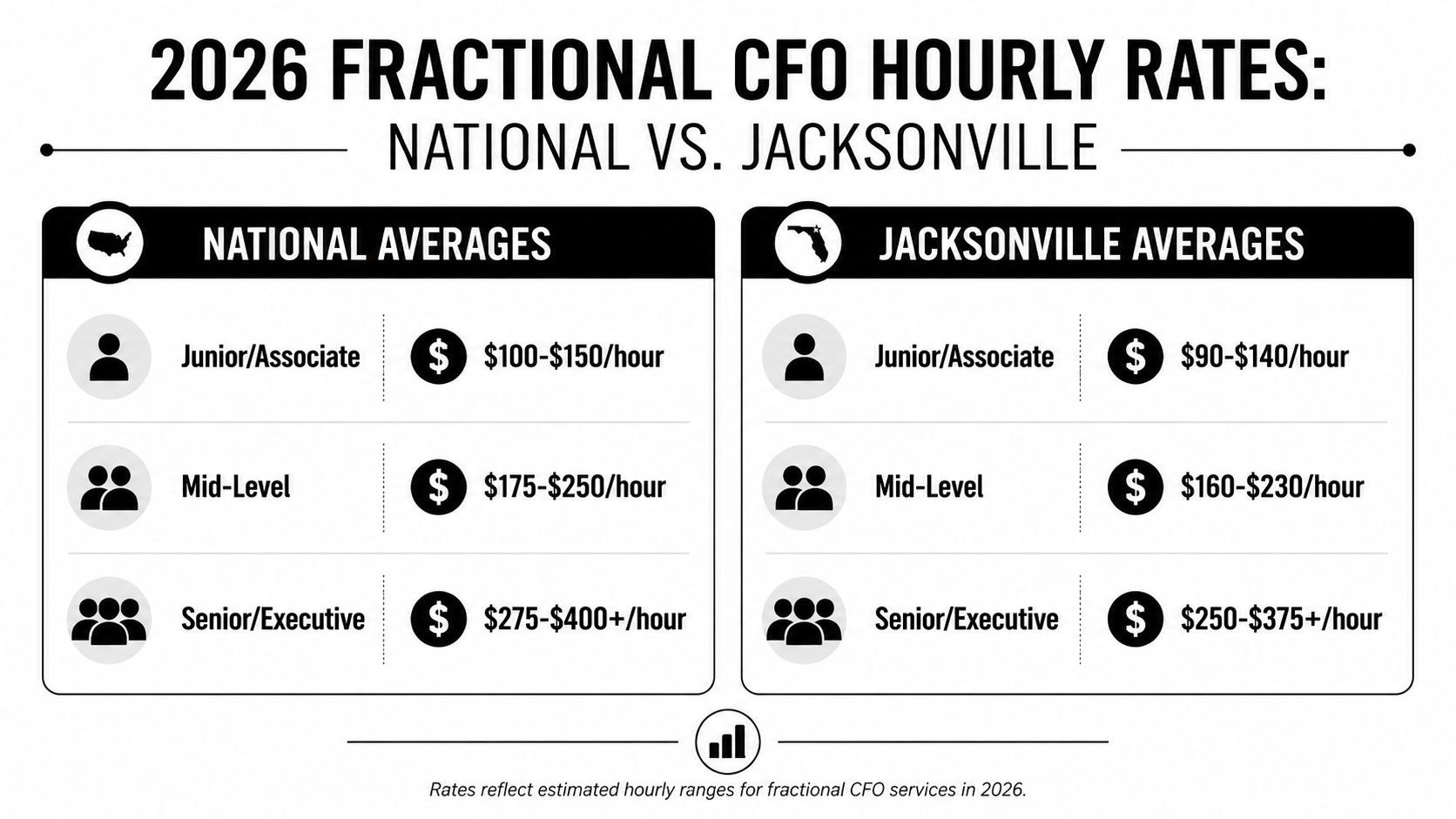
Nationally, the market is fairly clear. In 2025, fractional CFO hourly rates commonly range from $175 to $450 per hour, and experience changes the number fast. Professionals with 5 to 10 years of experience often charge $150 to $250 per hour, while 15+ years with specialized fundraising or M&A skills can reach $350 to $500 per hour, according to this fractional CFO pricing guide.
That's the national benchmark. Jacksonville owners should use it as the anchor, not as a blind rule.
What Jacksonville businesses should expect
Jacksonville and Northeast Florida usually don't price exactly like Miami, New York, or San Francisco. But the same logic still applies. When the work is basic and the scope is narrow, rates stay toward the lower end of the national range. When the work involves strategic planning, lender conversations, compliance cleanup, multi-entity oversight, or board-level reporting, rates push upward.
That matters locally because many businesses here aren't simple.
A medical practice may need financial leadership that understands reimbursement pressure, payroll complexity, and reporting discipline. A construction company may need job costing, work-in-progress visibility, subcontractor payment coordination, and better forecasting. A growing family-owned business may need someone to sort out entity sprawl, owner draws, and tax planning before expansion makes the mess bigger.
Those aren't bookkeeping projects. Those are CFO-grade problems.
Why rates move up
A national guide aimed at major U.S. markets notes that fractional CFO hourly rates typically cluster around $175 to $350 per hour, with higher-end pricing tied to strategic oversight, forecasting, and board-level support, as explained in this look at fractional CFO hourly rates in major markets.
Here's the blunt version. You don't pay more because someone uses nicer spreadsheets. You pay more because judgment yields greater impact.
A seasoned CFO can spot that your margins don't support your hiring plan. They can tell you your debt payments are about to squeeze operations. They can point out that your tax posture and your cash position are heading for a collision. That's worth more than transaction processing.
For local owners comparing options, this overview of fractional CFO services near me is useful for understanding what service depth should look like.
A short video can also help if you want a plain-English overview before talking to anyone:
The Four Key Factors Driving Your Fractional CFO Cost
The rate on paper is only half the story. The actual price depends on what kind of business you run, what kind of mess you're handing over, and whether you need a strategist or a firefighter.
Experience and niche expertise
A CFO with broad small-business experience is useful. A CFO with relevant industry depth is more useful.
If you own a simple service company with straightforward reporting, you may not need the highest-priced advisor in the market. If you run a healthcare practice, nonprofit, or construction company, you probably do need someone who's seen your kind of headaches before.
The reason is simple. Context saves time. A CFO who already understands provider compensation issues, job-costing logic, grant reporting, or multi-entity structures gets to the problem faster.
Industry complexity
It's common for owners to under-budget here.
Regulated or operationally complex firms in sectors like healthcare and construction can expect to pay 15% to 25% higher rates for a fractional CFO with niche expertise, based on this analysis of how industry specialization affects fractional CFO rates.
That premium makes sense. In healthcare, the financial story can't be separated from compliance, coding workflow, and reimbursement timing. In construction, you need somebody who respects job costing, payroll realities, and project timing. A generic advisor may be cheaper, but cheap advice in a specialized business is how owners create expensive corrections.
A CFO who understands your industry on day one is usually less expensive than a generalist who bills you to learn your business on your time.
Scope of work
Not every engagement is equal. Some businesses need monthly review meetings, cleaner reporting, and cash flow planning. Others need lender-ready reporting, tax-aware forecasting, margin analysis, pricing review, and decision support for expansion.
Scope is what separates “light oversight” from “we need adult supervision in finance.”
Here is a practical perspective:
- Light scope: monthly financial review, cash check-ins, high-level guidance
- Moderate scope: forecasting, budgeting, KPI reporting, tax coordination
- Heavy scope: fundraising prep, acquisition support, restructures, multi-entity cleanup
The broader the scope, the higher the cost. That's not padding. That's workload plus responsibility.
Engagement urgency
Urgency is the silent price driver nobody likes to talk about.
If you hire a fractional CFO before a crunch, you can build systems calmly. If you call when payroll is tight, taxes are behind, and the bank wants reporting yesterday, you're not buying advisory anymore. You're buying triage.
Urgent work usually means more meetings, more analysis, more cleanup, and faster decisions. Owners often focus on the hourly number and ignore the urgency premium created by their own delay.
A quick self-check
If you want a rough sense of where your business sits, ask yourself:
- Are your books clean enough for decisions: or just good enough for tax season?
- Does your industry have compliance landmines: that a generic advisor might miss?
- Do you need regular guidance: or occasional project help?
- Are you planning ahead: or calling for help after problems have already surfaced?
Your answers won't give you an exact quote, but they'll tell you whether you're shopping for basic support or specialized leadership.
Hourly vs Retainer vs Project Choosing Your Pricing Model
Here, owners often make the wrong choice. They fixate on hourly rates when the primary question is fit.
The best pricing model is the one that matches the way your business uses financial leadership.
Fractional CFO Pricing Models Compared
| Model | Best For | Cost Structure | Predictability |
|---|---|---|---|
| Hourly | Occasional advice, short-term analysis, targeted support | Pay for time used at an agreed hourly rate | Lower predictability |
| Retainer | Ongoing strategic guidance, recurring meetings, active oversight | Fixed monthly fee tied to scope and expected involvement | Higher predictability |
| Project | One-time deliverables like a model, cleanup initiative, or reporting buildout | Fixed fee for a defined outcome | High predictability if scope stays tight |
When hourly makes sense
Hourly works when the need is narrow. Maybe you want a second set of eyes on pricing, cash flow, or a financing decision. Maybe you need help building a budget or tightening reporting before a lender meeting.
Hourly is flexible. It's also easy to misuse.
If you need regular support but insist on hourly because it “sounds cheaper,” you can end up with stop-and-start guidance. That's like paying a mechanic to inspect the car every month but never letting them fix the alignment.
When a retainer is the smart move
Retainers fit businesses that need a steady hand.
For budgeting purposes, an engagement at 8 hours per week with a rate of $175 to $350 per hour translates to roughly $5,600 to $11,200 per month, according to this breakdown of how hourly CFO pricing converts into monthly cost. Separate market guides also note that many small to mid-sized businesses land on monthly retainers of $5,000 to $7,500 for broader support when the engagement is structured around ongoing leadership rather than one-off tasks.
That model works well when your business needs monthly forecasting, recurring reporting, tax coordination, and actual accountability. You're not wondering whether to call. The relationship is already in place.
If you need someone to learn your business, track your numbers, and guide decisions every month, a retainer is usually the cleaner deal.
When project pricing works
Project pricing is ideal when the deliverable is obvious.
Examples include:
- Investor model build: for financing or capital planning
- Cash flow overhaul: when collections, payables, and timing need structure
- Reporting redesign: building lender, board, or owner dashboards
- Finance cleanup project: untangling books and processes before growth
The catch is scope creep. If the project starts as “build a forecast” and turns into “also fix payroll mapping, owner distributions, tax planning, and department reporting,” the fixed fee stops being realistic.
A simple way to choose
Use this rule of thumb:
- Choose hourly if your need is occasional and specific.
- Choose a retainer if you want ongoing guidance and consistency.
- Choose project pricing if the outcome is defined and finite.
If you're unsure, start by defining the decision you need help making. Owners who can name the decision usually pick the right pricing model faster than owners who just ask for “some financial help.”
Hiring Smart Red Flags and Your CFO Vetting Checklist
A slick proposal means nothing if the person can't think clearly, communicate plainly, or work in your industry.
Too many owners hire based on personality, title, or the hope that “any CFO is better than no CFO.” That's not a hiring strategy. That's wishful spending.
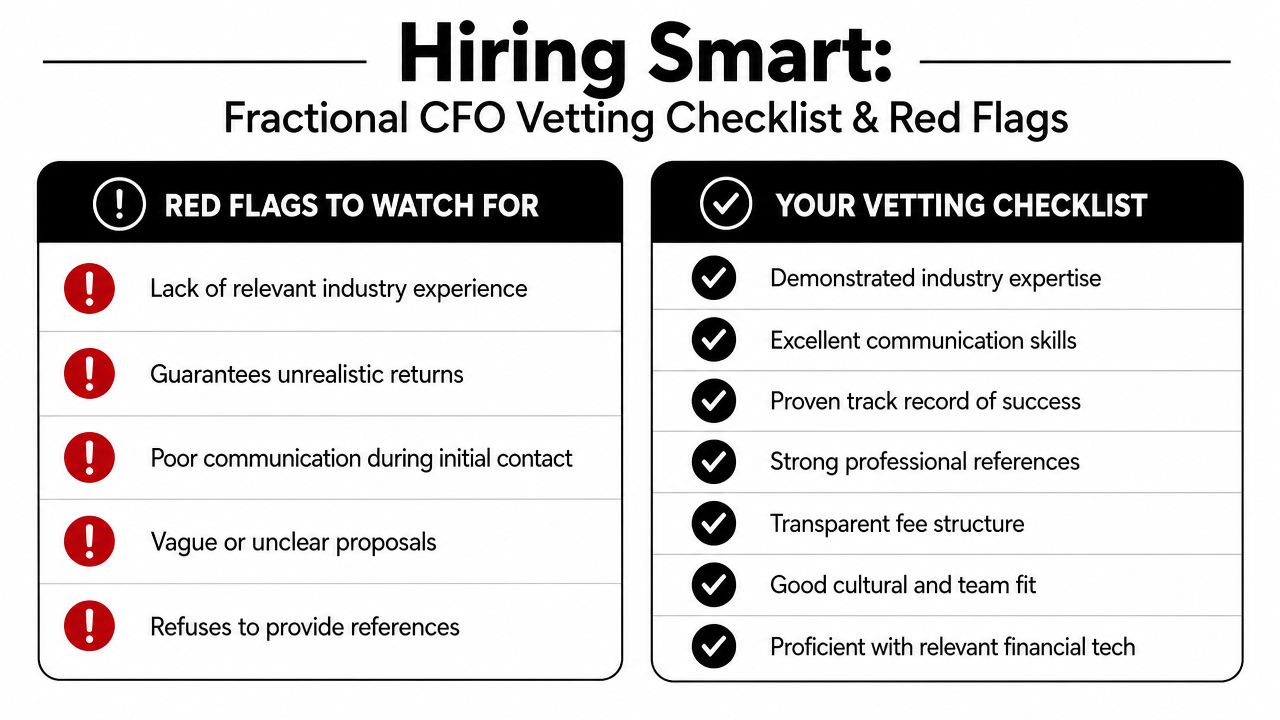
Red flags that should make you pause
Watch for these early:
- Vague proposals: If the scope sounds polished but tells you nothing concrete, expect billing confusion later.
- No industry relevance: A smart finance person still isn't the right fit if they don't understand your business model.
- Weak communication: If they're hard to pin down before you hire them, they won't become easier afterward.
- Grand promises: Serious CFOs don't guarantee miracle outcomes.
- No references or work examples: If they won't show how they think, keep moving.
Your vetting checklist
A good interview should leave you with confidence, not more fog. Ask for specifics.
- Ask how they forecast cash: Not theory. Their real process.
- Review sample reporting: You want dashboards and commentary that an owner can use.
- Clarify tax and compliance coordination: They don't need to do every filing, but they should know how to keep the moving pieces aligned.
- Confirm cadence: Weekly, biweekly, monthly. If nobody owns communication, issues drift.
- Test their judgment: Give them a real scenario from your business and listen to how they reason through it.
- Check tech comfort: They should be comfortable with tools like QuickBooks and standard reporting workflows.
For a broader hiring lens, this guide on how to find a good accountant is worth reviewing because many of the same screening habits apply.
Hire the person who makes your numbers easier to understand, not the person who makes finance sound more impressive.
Negotiate scope, not just rate
Owners often waste energy haggling over the hourly number while ignoring the bigger issue, which is whether the scope is right.
A lower rate with muddled responsibilities can cost more than a higher rate with crisp deliverables, regular reporting, and clear ownership. Ask what's included. Ask what triggers extra billing. Ask what happens in a crunch month.
That's how adults buy professional services.
Your Partner in Florida Business Growth
A fractional CFO isn't a luxury for giant companies. It's a practical move for businesses that need better decisions, cleaner reporting, tighter compliance, and less guesswork. The right fractional CFO hourly rate reflects judgment, industry knowledge, and the ability to keep tax, cash flow, and strategy moving in the same direction.
For Jacksonville and Northeast Florida businesses, that matters even more. Local companies don't just need accounting. They need guidance that fits how real Florida businesses operate.
If your business needs clear financial direction, stronger compliance, and a smarter plan for growth, talk with Bookkeeping and Accounting of Florida Inc.. Their Jacksonville team provides bookkeeping, tax support, and fractional CFO services that help business owners stop guessing and start running the numbers with confidence.