
You're in Jacksonville, it's April 14, and your business tax return still isn't ready. A stack of 1099s sits beside mismatched bank feeds, the profit-and-loss statement won't reconcile, and the person who normally handles the books is out of the office. You've got two bad choices in front of you: rush a return built on unreliable numbers or ignore the deadline and hope the IRS gives you a pass.
Thank you for reading this post, don't forget to subscribe!Neither is a strategy. A business tax filing extension can give you additional time to prepare an accurate return, but it doesn't give you additional time to pay the tax you owe. The IRS describes Form 7004 as an automatic extension for certain business income tax, information, and other returns, provided the request is filed by the original due date and completed properly. The IRS explains the requirements for Form 7004 here.
That distinction drives every sound extension plan. You need clean books, a reasonable liability estimate, the correct form, and a payment strategy before the original deadline. Panic filing, ignoring the deadline, or assuming the government grants automatic mercy can expose your company to failure-to-file penalties, failure-to-pay penalties, and interest. The extension is useful, but only when you treat it as a compliance tool rather than a hiding place.
When You Realize You Need More Time
The Jacksonville owner in this situation usually knows the return is incomplete before the calendar reaches April 14. The bank reconciliation has unresolved deposits, several transfers lack descriptions, and the year-end balance sheet doesn't agree with the supporting records. The owner may understand the business operations perfectly and still lack the financial information needed to sign an accurate tax return.
Filing a rushed return can create a different problem from filing late. An incorrect return may require an amended filing, confuse lenders, distort taxable income, or carry errors into the next tax year. Ignoring the deadline is worse. The IRS doesn't treat silence as an extension request, and an extension request filed after the original deadline generally won't provide the intended automatic protection.
What the extension actually changes
For many eligible returns, the IRS provides an automatic filing extension through Form 7004. Most extension periods are six months, although certain C corporations with tax years ending June 30 have historically received a seven-month extension for some years. The IRS outlines these extension periods and exceptions.
The extra time applies to filing the return, not paying the underlying tax. A calendar-year partnership or S corporation generally moves from its March deadline to September, while a calendar-year C corporation generally moves from its April deadline to October. The exact result depends on the entity, tax form, and tax year.
Practical rule: Use the extension to finish the return correctly. Don't use it to postpone deciding what you owe.
Your business still needs to estimate its tax liability by the original deadline. If you pay too little, the unpaid balance can generate failure-to-pay penalties and interest. If you file late without a valid extension, the failure-to-file penalty can apply as well. The cost of guessing is financial and operational, while the cost of a deliberate extension strategy is usually the time required to organize the records and make a defensible estimate.
That's why a stale general ledger matters. The IRS form is only the final step. The work starts with reconciling bank and credit card accounts, identifying owner transactions, confirming payroll records, reviewing contractor payments, and checking whether the income statement reflects the business's actual activity.
Forms, Deadlines, and the Paperwork Trail
The correct extension form follows the tax classification, not just the word “LLC” in your company name. A multi-member LLC taxed as a partnership generally follows partnership filing rules, while a single-member LLC reporting business activity on Schedule C generally uses the owner's individual extension process.
Which extension form applies to your business entity
| Entity Type | Federal Return | Extension Form | Original Deadline | Extended Deadline |
|---|---|---|---|---|
| Partnership | Form 1065 | Form 7004 | March 16, 2026 | September 15, 2026 |
| Multi-member LLC taxed as a partnership | Form 1065 | Form 7004 | March 16, 2026 | September 15, 2026 |
| S corporation | Form 1120-S | Form 7004 | March 16, 2026 | September 15, 2026 |
| C corporation | Form 1120 | Form 7004 | April 15, 2026 | October 15, 2026 |
| Sole proprietor | Form 1040 with Schedule C | Form 4868 | April 15, 2026 | October 15, 2026 |
| Single-member LLC taxed as a disregarded entity | Form 1040 with Schedule C, when applicable | Form 4868 | April 15, 2026 | October 15, 2026 |
The 2026 calendar-year deadlines above reflect the entity-specific rules summarized by TaxAct's 2026 small-business extension guide. Don't rely on a generic calendar. Confirm the return form, tax year, entity classification, and applicable due date before transmitting anything.
How to build a valid submission
For many business returns, Form 7004 is the federal extension request. The form must be filed by the original due date. The IRS instructions require the business to identify the applicable return, provide the required taxpayer information, calculate the requested extension details, and make a proper estimate of tax when applicable. Review the IRS Form 7004 instructions before filing.
Use this workflow:
- Confirm the classification: Verify whether the company files Form 1065, Form 1120-S, Form 1120, or another eligible return.
- Check the tax year: A wrong tax year can make an otherwise timely form unusable.
- Verify the EIN and legal name: Match the IRS record and the filed return.
- Estimate the liability: Use reconciled books, prior-year results, current-year activity, and known adjustments.
- Submit by the original deadline: Electronic filing is usually the cleanest operational choice.
- Pay the estimated balance: The extension doesn't cancel the original payment obligation.
If you need a paper transmission for a special filing situation, understand the documentation trail and retain confirmation. A resource explaining how to fax the IRS can help you prepare a professional cover sheet and preserve evidence of what was sent.
Federal and state obligations don't always line up. Some states accept a properly filed federal extension, while others require a separate state filing. Florida generally doesn't impose a state personal income tax return on individuals, but corporations can still have Florida corporate filings, annual reports, and other state obligations. Before you assume the federal extension handles everything, review your estimated quarterly tax payments and map each obligation to its own deadline.
An unsigned submission, wrong tax year, incorrect entity code, or missing payment can undermine the entire plan. Keep the acceptance notice, payment confirmation, copy of the transmitted form, and supporting estimate in one compliance folder.
Paying What You Owe Even With an Extension
A filing extension only works financially when the business treats payment as a separate deadline. You're buying preparation time, not a payment holiday. The IRS expects the company or owner to estimate the tax due by the original deadline and pay what the business reasonably expects to owe.
For a Form 7004 filer, the estimate is part of the extension process, including the applicable liability information. A sole proprietor generally handles the extension through Form 4868 and pays the estimated individual liability connected to the business income. The estimate doesn't need to match the final return perfectly, but it needs to be based on real records rather than wishful thinking.
The cash-flow problem behind most extensions
Suppose a Jacksonville retailer expects a $40,000 tax liability but pays only $10,000 by the original deadline. The unpaid balance remains exposed while the owner finishes the return. By the extended filing date, penalties and interest may have accumulated, and the business still needs cash for the remaining tax.
The specific penalty calculation depends on the facts, payment timing, filing status, and applicable IRS rules. Don't promise yourself that a valid extension eliminates every charge. It mainly addresses the filing deadline, while underpayment remains a separate problem. The IRS's Form 7004 guidance makes that separation clear.
A better approach is to create a tax cash reserve and update the estimate as the books close. Your fractional CFO should model at least three outcomes:
- Base case: Current revenue, ordinary expenses, and expected taxable income.
- Conservative case: Higher taxable income or lower deductions than currently projected.
- Cash-preservation case: The minimum payment that protects liquidity while identifying the remaining exposure.
The extension window should also support tax compliance work, not just tax preparation. Reconciled books reveal whether the estimate is credible, whether owner distributions are correctly recorded, and whether payroll or contractor records need attention. Businesses that wait until October to discover these problems have converted a manageable project into an emergency.
Use tax compliance services when the company has multiple entities, pass-through owners, payroll complexity, tax credits, or incomplete records. A fractional CFO can connect the tax estimate to cash-flow forecasting, borrowing decisions, hiring plans, and owner distributions instead of treating the payment as an isolated bill.
The right question isn't “Can we delay the return?” It's “What must we pay now, and what records will prove that estimate is reasonable?”
Florida and Jacksonville-Specific Filing Notes
Florida's lack of a state personal income tax doesn't mean a Jacksonville business has no state filing responsibilities. Corporate entities can still face Florida corporate income or franchise tax obligations, and the federal extension doesn't automatically suspend every state or local requirement.
A Florida corporation generally files Form F-1120 by the original state deadline, typically the 15th day of the fourth month after the end of the tax year. A separate Florida Form F-7004 may extend the filing time, but it doesn't extend payment of the estimated tentative tax due. Treat the federal and Florida forms as separate compliance tasks unless your tax professional confirms otherwise.
State and local deadlines that remain active
| Filing Obligation | Extendable? | Extension Form / Deadline | Penalty If Missed |
|---|---|---|---|
| Florida corporate income or franchise return | Filing may be extendable separately | Form F-1120, with applicable Florida extension process | Late-filing and payment exposure |
| Florida annual report through Sunbiz | Generally not handled by a federal extension | Due by May 1 for most Florida corporations | $350 late fee |
| Florida reemployment tax, Form RT-6 | No general extension beyond the filing requirement | Filed quarterly, with no extension beyond 30 days | Applicable late filing, payment, and compliance consequences |
| Florida sales tax, Form DR-15 | No extension | Monthly or quarterly based on the assigned filing schedule | Applicable late filing and payment consequences |
| Jacksonville occupational license tax | Local requirement, not paused by federal extension | Follow the city or county renewal schedule | Local penalties or loss of good standing |
| Duval County business tax receipt | Local requirement, not paused by federal extension | Follow Duval County's renewal schedule | Local penalties or enforcement action |
| Tangible personal property tax obligations | Not generally paused by a federal income tax extension | Follow the applicable property tax filing and payment schedule | Local property tax consequences |
The $350 Sunbiz late fee and the May 1 annual report deadline are identified in the Florida-specific requirements summarized above. Don't assume that a tax preparer handling Form 7004 is also handling the corporate annual report. Those are different filings with different systems and consequences.
Jacksonville owners should maintain a separate local compliance calendar for occupational license tax renewals, Duval County business tax receipts, and tangible personal property records. Equipment, furniture, fixtures, and other business assets may create local reporting considerations even when the federal income tax return is on extension.
Your operational checklist should include:
- State corporate return: Confirm whether Form F-1120 applies.
- Annual report: Verify the Sunbiz status before May 1.
- Sales tax: File Form DR-15 on the assigned schedule.
- Reemployment tax: File Form RT-6 quarterly.
- Local registrations: Check Jacksonville and Duval County requirements.
- Property records: Keep tangible business assets documented and current.
For a coordinated review, tax services in Jacksonville, Florida can help connect federal, Florida, and local obligations instead of leaving each deadline in a different file.
Why Most Small Businesses Still Get This Wrong
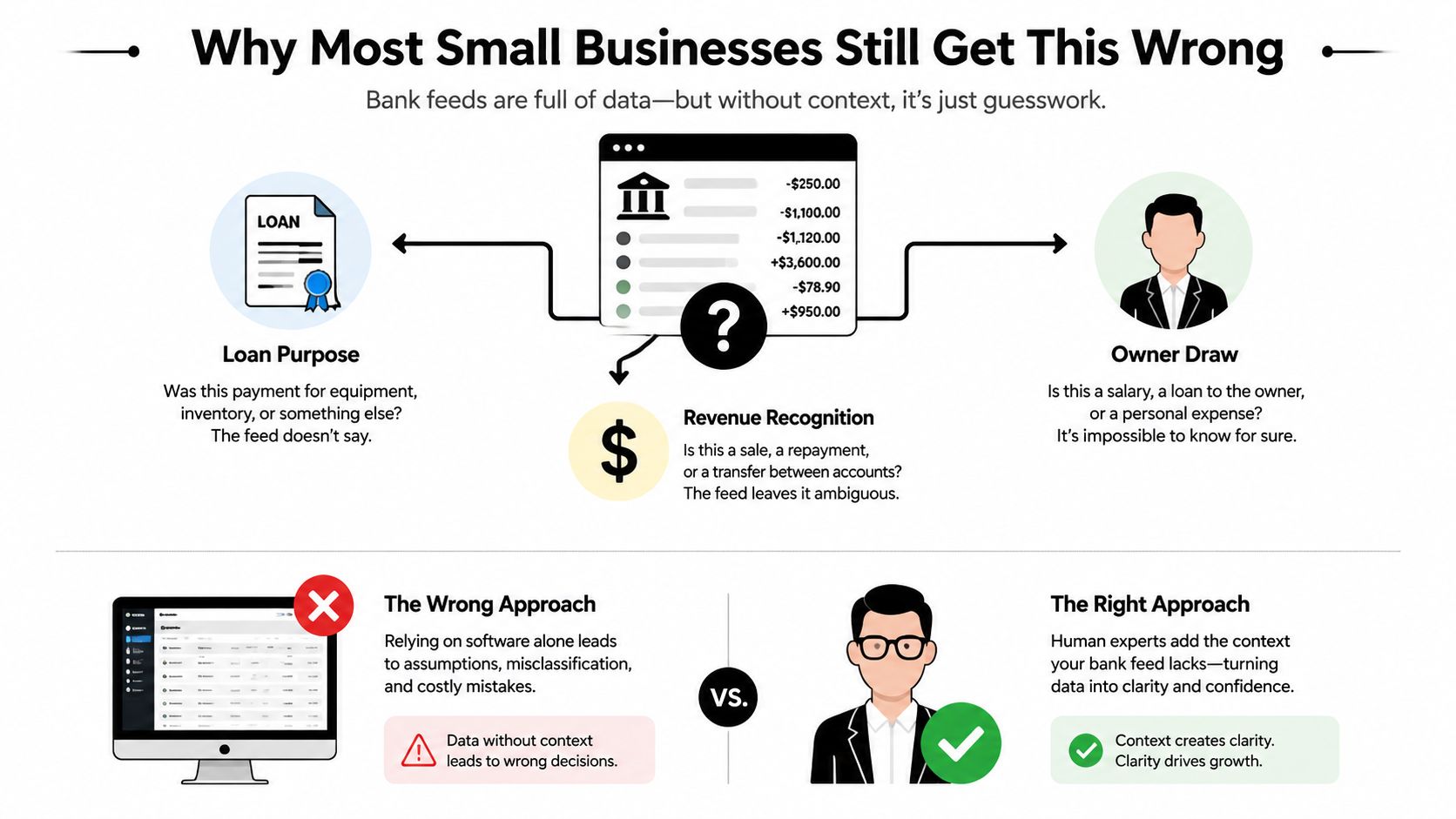
A bank feed can record a transaction without explaining it. A December wire may be a loan, owner contribution, customer payment, or refund. The software sees money moving. A trained accounting professional checks source documents, agreements, invoices, and equity records before assigning the transaction.
That distinction changes the extension estimate. Classifying a loan as revenue can overstate taxable income. Classifying customer revenue as a contribution can understate it. Either error can push a Jacksonville owner toward the wrong payment amount and a preventable cash problem.
Four recurring Jacksonville failure patterns
The business extends the return but ignores the balance due. The owner submits the form, feels relief, and sends no payment because the return is unfinished. The unpaid exposure remains while the business waits.
The owner treats the income-tax extension as a payroll extension. Payroll deposits and employment tax obligations follow separate schedules. An income tax extension does not excuse late payroll deposits, and trust fund recovery rules can make payroll tax problems personal for responsible individuals.
The company handles federal paperwork and misses state or local obligations. Florida corporate filings, sales tax, reemployment tax, annual reports, occupational license renewals, and Duval County requirements do not share one IRS calendar.
The books go stale during the extension period. The owner files in spring, stops updating the accounting system, and hands the CPA months of unreconciled activity by October.
Software produces reports. People determine whether those reports describe the business accurately.
Outsourced accounting closes the gap between automated data entry and IRS-ready records. Monthly closes, account reconciliations, transaction review, payroll coordination, and document retention give the tax preparer dependable records. A fractional CFO handles the decisions that require a wider view, including cash forecasting, liability modeling, entity coordination, and whether the company can safely pay owners or reinvest cash.
The cost of repeated cleanup includes management time, delayed financial decisions, strained lender relationships, missed registrations, and avoidable tax exposure. Use daily operational playbooks, including local SEO tips by Transactional LLC, to support growth, but do not mistake marketing activity for financial control. Growth pays off only when the books, tax estimates, and compliance work stay current.
Tax Law Changes and the Case for Expert Guidance
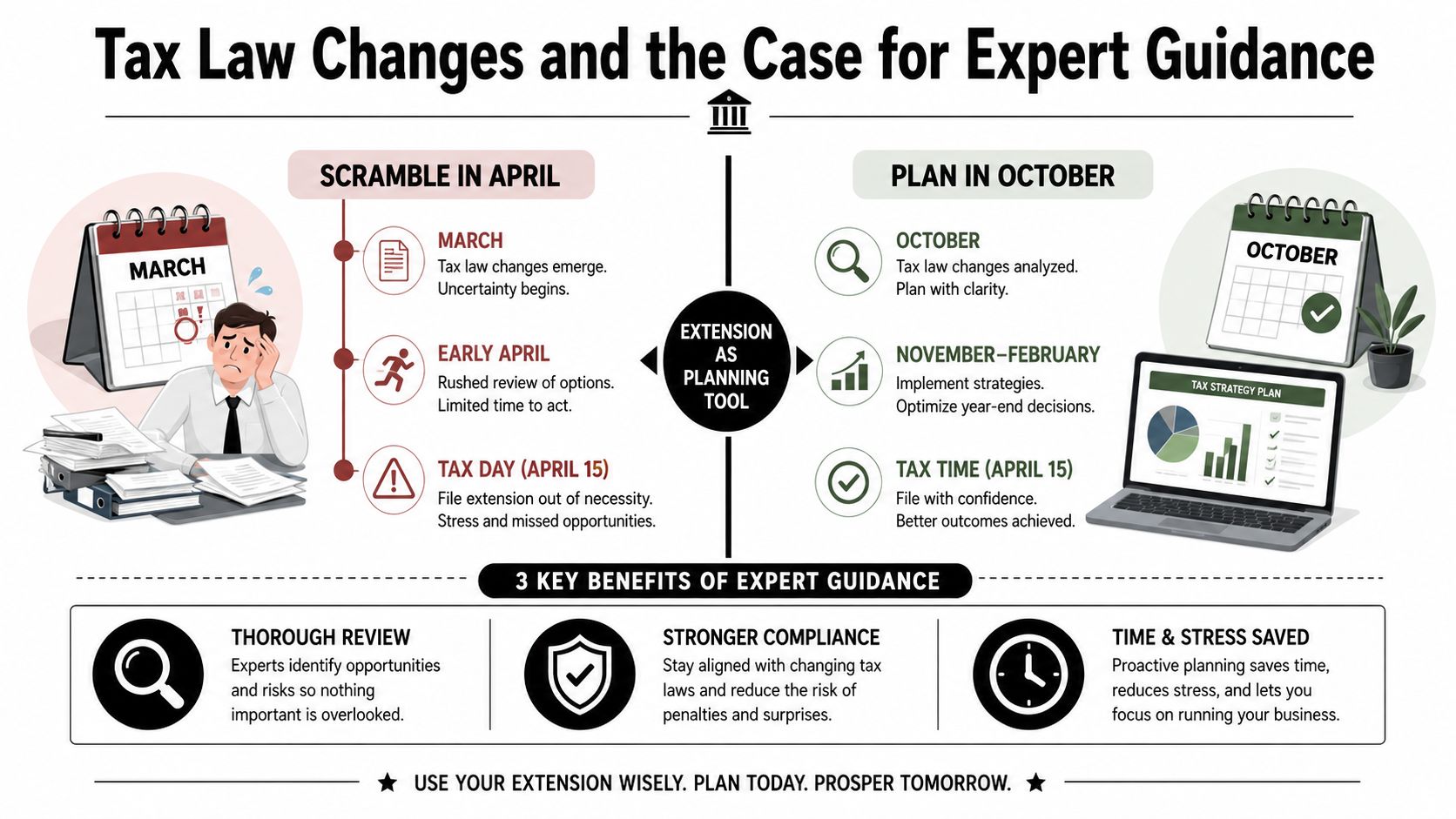
An extension should create a planning runway, not a longer period of avoidance. Businesses that use the additional months to update forecasts, review tax positions, and correct their books can make better decisions. Businesses that postpone the work usually face the same uncertainty later, with less time to fix it.
Tax planning in 2026 requires attention to moving rules. Relevant issues may include the Section 199A qualified business income deduction, bonus depreciation under current TCJA-era rules, reporting thresholds for Form 1099-K, and the treatment of research and experimental expenditures under Section 174. These items can affect taxable income, owner estimates, deductions, documentation, and cash needs. The rules are technical enough that a software-generated projection shouldn't be treated as a final answer.
Federal legislation also changes planning opportunities. Beginning in 2026, federal legislation provides a 12% increase in the state low-income housing tax credit ceiling, a change that can matter to businesses involved with tax credits, pass-through structures, or real-estate activity. Grant Thornton's 2026 business tax planning guide discusses this legislative update.
A fractional CFO turns rules into decisions
A fractional CFO doesn't replace tax counsel or tax preparation. The role is to translate financial activity into timely decisions before the return is due. That includes:
- Forecasting: Updating expected income, expenses, cash balances, and tax reserves.
- Scenario planning: Showing how hiring, equipment purchases, owner compensation, or distributions may affect liquidity and tax.
- Compliance coordination: Tracking federal, Florida, payroll, sales tax, and local obligations together.
- Management reporting: Giving owners a current balance sheet and income statement instead of an outdated snapshot.
Florida businesses may also need to monitor county-level surtaxes, sales tax changes affecting Duval County, and reemployment tax rate adjustments. The point isn't to memorize every rule. The point is to maintain a process that identifies changes, assigns responsibility, and updates the forecast.
Bookkeeping and Accounting of Florida Inc. provides bookkeeping, payroll, tax preparation, audit support, and fractional CFO services for Jacksonville and Northeast Florida businesses. Its team can maintain organized QuickBooks records, support monthly reporting, and connect financial information to extension planning. Even non-tax compliance matters deserve the same discipline. For example, a business reviewing its website obligations may also need guidance on planning your 2026 privacy policy.
A clean monthly close turns the eventual return into a controlled project. Stale books turn it into a reconstruction exercise.
Your Action Checklist and Common Questions
Start before the original due date. A business tax filing extension is simple only when the records and classification are already clear.
Fast action checklist
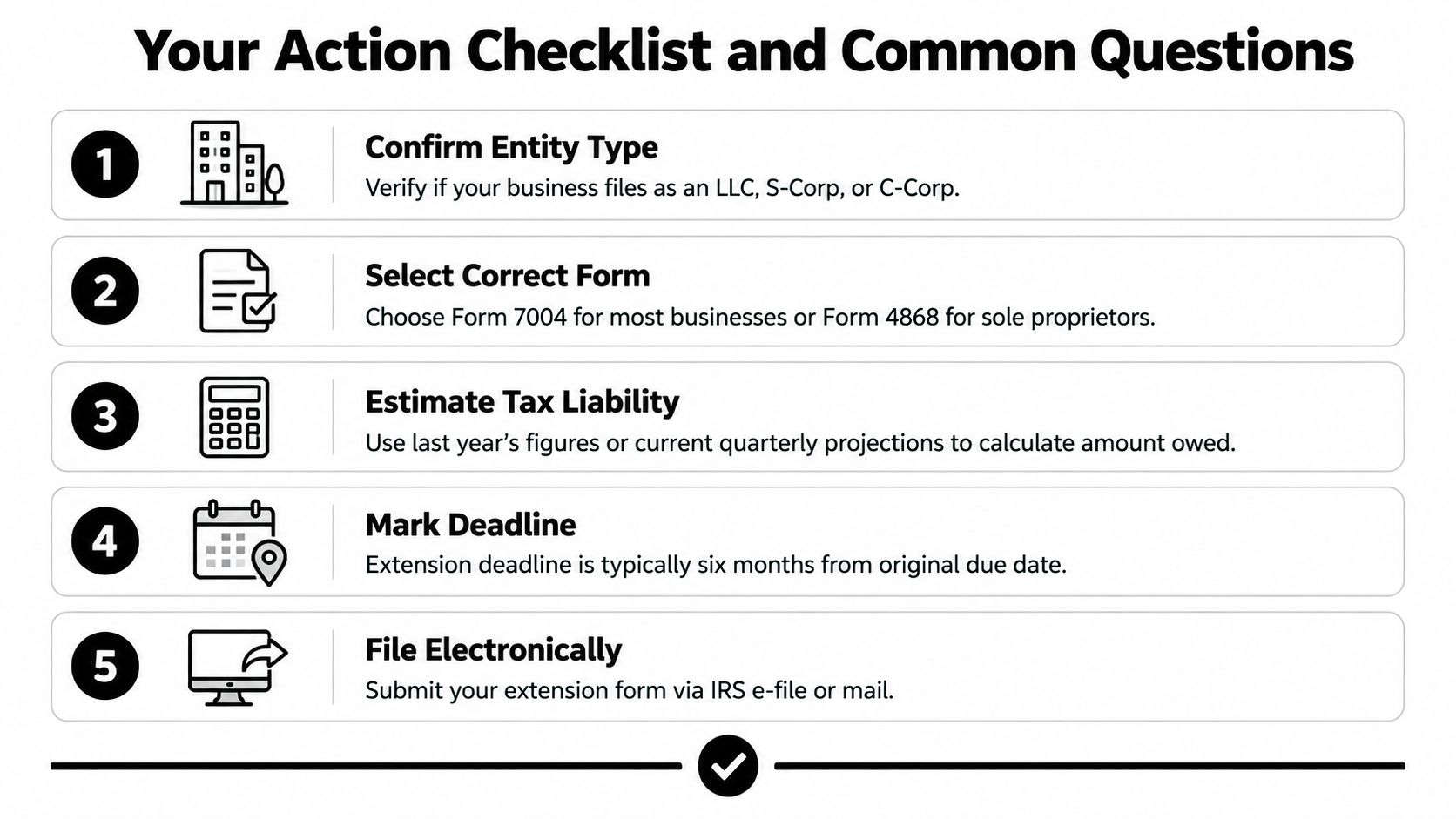
- Confirm entity type: Verify whether the business files as a partnership, S corporation, C corporation, sole proprietor, or another classification.
- Select the correct form: Use Form 7004 for many business returns and Form 4868 for sole proprietors and applicable single-member LLC owners.
- Estimate liability: Use prior-year information, current reconciled books, and updated projections.
- Submit payment: Use an approved IRS payment method, such as Direct Pay or EFTPS when applicable, and retain confirmation.
- Mark every deadline: Record the extended federal date along with Florida, Jacksonville, Duval County, payroll, sales tax, and annual report dates.
Common questions
Does filing an extension trigger an audit? No. A properly filed extension is a standard compliance mechanism. It doesn't guarantee that the return won't be examined, so accurate records still matter.
How does Form 7004 differ from Form 4868? Form 7004 generally applies to eligible business returns, while Form 4868 is generally used when a sole proprietor or applicable single-member LLC reports business activity through an individual return.
Do payroll tax deposits pause during the extension? No. The income tax extension doesn't suspend payroll deposit duties. Handle payroll compliance on its assigned schedule.
What if payment was missed? Pay as much as possible promptly, preserve the filing and payment records, and contact a tax professional about the remaining balance and response strategy. Waiting usually makes the problem harder to manage.
Bookkeeping and Accounting of Florida Inc. can keep your books current, coordinate tax preparation, estimate your business tax filing extension liability, and provide fractional CFO guidance when the numbers involve multiple entities or uncertain cash flow. Visit Bookkeeping and Accounting of Florida Inc. to schedule a practical review before your next deadline becomes an emergency.