
A growing Jacksonville company can lose control of its finances without losing a single invoice. When approvals live in email, invoices sit in spreadsheets, and vendor documents stay scattered across inboxes, owners may not know which obligations are legitimate, which expenses are deductible, or which payments are about to strain cash flow. A documented, automated workflow changes that. Accounts payable automation benefits reach far beyond faster invoice entry. Accurate AP data supports cash planning, legitimate tax deductions, audit readiness, fraud prevention, vendor compliance, and better management decisions.
Thank you for reading this post, don't forget to subscribe!Bookkeeping and Accounting of Florida Inc. is a locally owned Jacksonville CPA firm providing bookkeeping, QuickBooks support, tax preparation, compliance guidance, and fractional CFO services. The firm serves healthcare practices, construction and trades companies, retailers, nonprofits, startups, and other Northeast Florida businesses that need reliable financial information without the overhead of a full-time finance executive.
The accounts payable automation market's expansion reflects this shift. One market report estimated global AP automation at USD 3.07 billion in 2023, with a projection of USD 7.1 billion by 2030 and a 12.5% CAGR from 2024 to 2030. A separate forecast estimated USD 5.42 billion in 2025, projecting USD 14.38 billion by 2030 and a 21.6% CAGR. These projections are historical markers, not guarantees, but they show why businesses increasingly treat AP as infrastructure. The right business process automation strategy still requires professional judgment, especially as tax rules and reporting obligations change.
1. Enhanced Invoice Processing Speed and Reduced Manual Data Entry Errors
Manual invoice entry ties up staff and creates opportunities for coding and transcription errors. Accounts payable automation captures invoice details through digital intake and optical character recognition, then routes each document for coding and approval. An industry survey found that 95% of companies using automation said it made tasks like data entry more efficient. The same benchmark reported that 60% of AP teams still manually key invoices into ERP systems, down from 85% in 2023.
For a Jacksonville construction company, accurate capture keeps subcontractor costs connected to the correct project. A healthcare practice can reduce repetitive supplier entry while retaining documentation for review. A nonprofit can route grant-funded expenses to the proper fund instead of reconstructing coding decisions at year-end.

The KPI and implementation decision
Track invoice processing time, data-entry corrections, exception rate, and invoices processed per staff member. Begin with high-volume invoice categories, standardize the vendor master file, and set approval paths according to actual authority levels. Automation should not determine whether a repair is a capital improvement or whether an expense belongs to a restricted grant. A bookkeeper or fractional CFO should establish those rules before configuration.
Practical rule: Automate repetition, not judgment. Review automatically coded invoices quarterly to identify systematic errors before they affect tax returns.
Bookkeeping and Accounting of Florida Inc. helps businesses connect AP workflows with accurate bookkeeping and tax-ready documentation. Owners comparing platforms can review this guide to accounts payable automation software.
A short demonstration of invoice processing can expose workflow gaps before implementation:
2. Improved Cash Flow Management Through Predictable Payment Scheduling
Cash flow improves when an owner can see obligations before they become emergencies. An automated AP workflow centralizes invoice due dates, approval status, payment terms, and expected cash requirements. That visibility helps a retailer plan around seasonal sales, a construction company match payments to project receipts, and a medical practice coordinate supplier obligations with patient revenue.
The useful question isn't “Can we pay this invoice?” It's, “What payment timing protects liquidity without damaging vendor relationships or forfeiting a worthwhile discount?” A fractional CFO can use AP data alongside revenue forecasts to model hiring, equipment purchases, inventory decisions, and estimated tax payments. The system supplies organized information. The financial leader supplies context.
The KPI and implementation decision
Track days payable outstanding, scheduled versus overdue invoices, cash forecast variance, discount capture, and payment exceptions. Run conservative and optimistic cash forecasts, then review payment terms with important vendors. Don't set every invoice to pay immediately just because the software allows it. Faster payment can be helpful, but it can also drain reserves that the business needs for payroll, taxes, or project materials.

A Jacksonville owner can make a practical decision this month: list recurring obligations, identify their due dates and terms, and compare that list with the business's revenue calendar. Then ask whether the current bookkeeping process provides a reliable forward view. If it doesn't, cash flow forecasting tools and fractional CFO guidance can turn AP records into an operating plan.
3. Audit Trail Compliance and Documentation Standards Under Evolving IRS Requirements
An invoice isn't complete merely because it was paid. A defensible record should show what was purchased, who approved it, when the transaction changed, which account received the charge, and where the supporting document is stored. AP automation can create a structured history of receipt, coding, approval, exception handling, and payment.
That structure matters for businesses with complex documentation needs. A healthcare practice may need organized records for supplier payments and internal review. A construction company may need approval evidence for subcontractor costs. A nonprofit must connect expenditures with the appropriate program, grant, or restriction. A retailer needs records that support inventory and operating expense treatment.
The IRS states in Publication 334 that tax reporting depends on specific mechanics, including the 2026 business standard mileage rate of 72.5 cents per mile and the $184,500 maximum net self-employment earnings subject to the Social Security part of self-employment tax. Those figures don't make AP software compliant by themselves. They illustrate why organized records and professional review matter when bookkeeping feeds tax planning and owner compensation decisions.
The KPI and implementation decision
Measure the percentage of invoices with complete support, approval turnaround, unresolved documentation exceptions, and time required to retrieve a record. Write approval authority limits into the workflow. Archive records securely, train staff that audit trails protect the company rather than monitor individuals, and compare system practices with applicable IRS and industry requirements.
Use electronic records management to support consistent retention and retrieval. A fractional CFO can review documentation during year-end planning and identify missing approvals, inconsistent coding, or weak evidence before an examiner or auditor does.
4. Duplicate Invoice Prevention and Fraud Detection Through Automated Controls
A duplicate payment can begin innocently. Two departments may forward the same invoice, a vendor may resend a document, or an employee may enter a bill manually after an emailed version already entered the system. Without a control, the business pays twice and may also carry an incorrect expense balance.
AP automation can compare vendor identity, invoice number, amount, date, purchase order details, and payment history. It can flag potential duplicates and unusual activity for a person to review. More advanced controls can surface new vendors, unexpected payment patterns, altered banking information, or invoices outside normal business behavior.
Consider a Jacksonville contractor receiving invoices for the same materials through both a project manager and the main office. A duplicate alert doesn't replace investigation, but it gives the company a chance to stop the payment before it clears. A nonprofit can also separate vendor creation from payment approval, reducing the opportunity for one person to control the entire transaction.
Control that works: Require a documented response to every high-risk flag. “Reviewed” isn't enough. Record who reviewed it, what evidence they considered, and why payment proceeded or stopped.
The KPI and implementation decision
Track duplicate invoices flagged, duplicate payments prevented, vendor master changes, payment exceptions, and confirmed fraud attempts. Restrict vendor creation and bank-detail changes to authorized staff. Reconcile AP alerts with bank activity, and review detection logs with a fractional CFO who can recognize patterns that may be invisible inside one department.
The decision for an owner is straightforward: treat fraud controls as part of accounting design, not as an optional software feature. A system with impressive detection tools still fails if employees bypass vendor controls or approve their own exceptions.
5. Accurate Expense Categorization and Tax Deduction Optimization
Automation can apply coding rules consistently, but consistency isn't the same as correctness. A vendor name may suggest one category while the invoice details point to another. A building repair may require different treatment from an improvement. Inventory, supplies, subcontractor labor, equipment, owner expenses, and reimbursable costs can affect financial statements and tax reporting in different ways.
That's why a fractional CFO or experienced CPA should define the chart of accounts and automation rules before staff turns on automatic coding. The software can recognize recurring patterns. It shouldn't independently make tax-sensitive judgments that require knowledge of the business, its accounting method, and current law.
A construction company might separate subcontractor labor from materials for job costing. A healthcare practice may distinguish disposable medical supplies from capital equipment. A nonprofit can separate restricted and unrestricted spending. A retailer needs clean inventory records so cost of goods sold and gross profit reporting aren't distorted by operating purchases.
The KPI and implementation decision
Measure coding correction rate, uncategorized expenses, tax-adjustment entries, job-cost variance, and expenses lacking business-purpose documentation. Document coding rules in writing and test them against current invoices each quarter. Review the rules annually with a tax professional because tax treatment can change even when the vendor and invoice format stay the same.
The 2026 information-reporting change makes vendor records especially important. For payments made after December 31, 2025, the threshold for Forms 1099-NEC and 1099-MISC rises from $600 to $2,000 for tax year 2026, and the threshold is indexed for inflation beginning in 2027. The backup withholding threshold follows the same $2,000 level, according to this 2026 tax compliance explanation. Vendor classification, W-9 collection, and year-end payable tracking still need human oversight. An automation rule won't fix a missing W-9.
6. Real-Time Financial Reporting and Strategic Decision-Making Capabilities
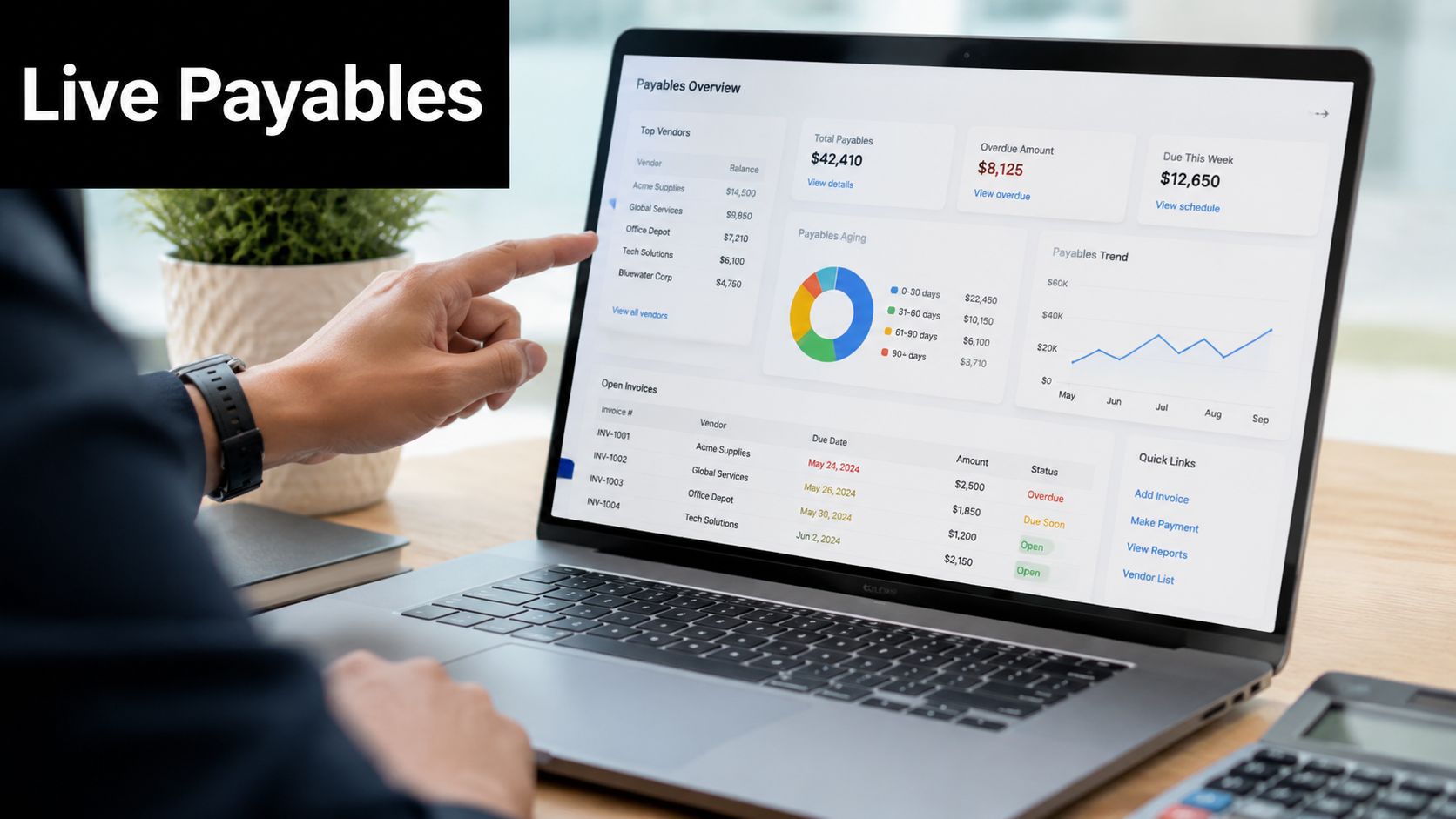
Owners make expensive decisions with stale information when AP records remain in inboxes or get entered only during month-end cleanup. A connected workflow can give management a current view of unpaid invoices, aging, expense categories, project obligations, and upcoming cash requirements. That information is useful for pricing, staffing, purchasing, expansion, and vendor negotiations.
A construction company can compare project expenses with the current bid assumptions before the job is too far along to correct course. A healthcare practice can notice a supplier price increase while contract discussions are still possible. A nonprofit can monitor program spending against available funding. A retailer can review inventory-related payables before placing its next order.
The KPI and implementation decision
Choose a small set of management indicators, such as payables aging, expense variance, cash forecast accuracy, invoice exceptions, and close time. Review them weekly or on a schedule that fits the business. More dashboards aren't automatically better. A screen full of metrics can hide the one trend that needs action.
A fractional CFO turns reporting into decisions. That may mean renegotiating a vendor agreement, revising a project forecast, delaying a purchase, or preparing for a tax payment. The value isn't the dashboard itself. It's the disciplined conversation that follows the numbers.
7. Vendor Compliance and Contract Term Management for Risk Mitigation
Vendor management extends beyond paying invoices. Businesses also need to know whether contractors carry required insurance, whether licenses remain current, whether agreements are approaching renewal, and whether payment terms match the signed contract. AP automation can store vendor documentation and trigger reminders for missing or expiring records.
This matters in Northeast Florida industries with meaningful vendor exposure. A construction company may need subcontractor insurance and workers' compensation documentation before payment. A healthcare practice may need organized vendor compliance records and appropriate contractual safeguards. A nonprofit may need contractor documentation that supports program and donor requirements. A retailer can track licensing and service-provider obligations.
The IRS also highlights why disciplined compliance oversight matters. Its 2026 bulletin states that certain entities must separately calculate, report, and pay employment tax obligations under their own name and EIN for wages paid on or after January 1, 2026, and separately report, calculate, and pay applicable taxes for taxable periods beginning on or after that date. AP automation doesn't determine which rule applies to an entity, but accurate vendor, payroll-adjacent, and payment records help a qualified professional identify obligations.
The KPI and implementation decision
Track vendors with current compliance documents, expired certificates, contract renewals approaching, invoices blocked for missing documentation, and vendor concentration. Establish qualification standards before onboarding and require the necessary documents before initial payment. Review vendor compliance reports quarterly with a bookkeeping or fractional CFO partner.
The practical decision is whether to make vendor compliance part of the payment workflow. If the answer is yes, the system can stop a missing document from becoming a costly surprise. If the answer is no, the owner should understand that payment may proceed without complete operational protection.
8. Cost Reduction and Operational Efficiency Through Process Automation ROI
AP automation earns its place when it lowers measurable operating cost without weakening controls. It can reduce repetitive data entry, paper handling, approval follow-up, reconciliation work, and exception management. That gives staff more time for collections, vendor communication, job-cost review, and financial analysis.
For Northeast Florida SMBs, the business case should reflect local operating realities. A contractor may measure invoice processing against job-cost accuracy. A healthcare practice may focus on exception handling and payment controls. A retailer may prioritize close speed and staff hours during seasonal peaks. The same platform will not produce the same return in every industry.
Start with a baseline before choosing software. Record invoices received, staff hours spent processing them, correction work, approval delays, exceptions, payment errors, and days required to close the books. Compare those measures after implementation, then separate software expense from labor savings and control improvements.
The KPI and implementation decision
Track cost per invoice, processing time, exception rate, duplicate-payment rate, close time, discount capture, and staff hours redirected to higher-value work. Use trusted KPI guidance to structure the measurement framework, then have a fractional CFO test whether the projected savings remain credible after integration, training, and oversight costs.
Implement in stages. Begin with the invoice types and approval paths that create the most manual work, set permissions, preserve tax-ready documentation, and review results monthly. Keep a clear exception path for unusual invoices, industry-specific requirements, and disputed charges.
The owner's decision is practical: approve automation only if the workflow reduces friction while preserving approvals, records, and tax oversight. A lower-priced system with unreliable coding or weak integration can create more cleanup than savings.
Accounts Payable Automation, 8-Benefit Comparison
| Item | 🔄 Implementation complexity | Resource requirements | ⚡ Speed / ⭐ Effectiveness | 📊 Expected outcomes | 💡 Ideal use cases |
|---|---|---|---|---|---|
| Enhanced Invoice Processing Speed and Reduced Manual Data Entry Errors | Medium, OCR setup, integrations, workflow design | Moderate, OCR software, accounting integration, staff training, fractional CFO guidance | ⚡ High, days → hours; ⭐ High, up to 80% fewer entry errors | Faster processing, improved audit trails, earlier payment discounts | High-volume invoicing (construction, healthcare, non-profits); start with top invoice types |
| Improved Cash Flow Management Through Predictable Payment Scheduling | Medium, calendar & forecasting configuration | Moderate, bank integration, forecasting dashboard, CFO modeling | ⚡ Moderate, real-time forecasts; ⭐ High for cash optimization | Optimized working capital, fewer overdrafts, strategic payment timing | Seasonal retail, project-based construction, practices with variable revenue |
| Audit Trail Compliance and Documentation Standards Under Evolving IRS Requirements | Medium–High, permissioning, immutable storage, policy design | High, secure storage (7–10 yrs), audit-log capable system, user training | ⚡ Low–Medium, not speed-focused; ⭐ Very High for compliance | Reduced audit risk, faster responses, stronger internal controls | Regulated industries or businesses with frequent audits; maintain date-stamped approvals |
| Duplicate Invoice Prevention and Fraud Detection Through Automated Controls | Medium, matching rules, anomaly detection, exception flows | Moderate, clean vendor data, PO/receipt capture, monitoring resources | ⚡ Moderate, rapid flagging; ⭐ High, prevents 2–5% leakage | Fewer duplicate/fraud payments, documented controls, cost savings | Multi-department companies, many vendors; enforce vendor master governance |
| Accurate Expense Categorization and Tax Deduction Optimization | High, rule engine, tax-rule mapping, ongoing updates | High, fractional CFO tax expertise, GL mapping, rule maintenance | ⚡ Moderate, faster coding; ⭐ Very High for tax accuracy | Consistent classifications, maximized legitimate deductions, fewer reclassifications | Construction, healthcare, retail, non-profits needing precise tax treatment |
| Real-Time Financial Reporting and Strategic Decision-Making Capabilities | Medium–High, live integrations, dashboard design | Moderate, live GL integration, reporting tools, data governance, CFO reviews | ⚡ High, real-time insights; ⭐ High for strategic decisions | Data-driven decisions, better cash control, timely tax planning | Growth-stage firms, multi-site retailers, project-driven businesses |
| Vendor Compliance and Contract Term Management for Risk Mitigation | Medium, vendor master enhancements, alert rules | Moderate, compliance document storage, alerting, staff to manage renewals | ⚡ Low–Medium, alerts vs. automation; ⭐ High for risk reduction | Fewer regulatory lapses, proactive renewals, lower liability exposure | Construction, healthcare, non-profits with vendor regulatory requirements |
| Cost Reduction and Operational Efficiency Through Process Automation ROI | Medium, process redesign, ROI measurement | Moderate, automation software, implementation, CFO to quantify ROI | ⚡ High, 50–70% per-invoice cost reduction; ⭐ High for ROI realization | Lower cost per invoice, recovered FTEs, typical payback 12–18 months | High invoice-volume organizations seeking scalability and cost savings |
Turn Faster Payments Into Better Guidance
The best implementation starts with the process, not the software. Document how invoices arrive, who codes them, who approves them, how exceptions are handled, how payments are released, and where records are stored. Include paper invoices, recurring bills, employee reimbursements, subcontractor payments, credit memos, and unusual transactions. The messy edge cases are where many controls fail.
Next, establish a baseline. Track processing time, cost per invoice, exception rate, duplicate-payment rate, days payable outstanding, discount capture, approval time, and close time. Use those measures to select a controlled pilot involving a manageable group of vendors or one business unit. Test the integration with QuickBooks or another accounting system, confirm that approval permissions work, and review automatically coded transactions before expanding the workflow.
AI adoption doesn't eliminate this discipline. A 2025 industry survey reported that approximately 75% of AP departments used some form of AI or automation, while 62% identified reducing manual errors and speeding processing as the primary driver. The same survey reported measurable benefits for 79% of respondents, including faster invoice processing for 50%, quicker approvals for 46%, improved employee satisfaction for 44%, stronger payment timing or discount capture for 42%, and better reporting for 41%. These figures describe survey responses, not a guaranteed result for every Jacksonville business. The survey source also supports a practical point: choose the outcome you want to measure before choosing the technology.
Control and resilience deserve equal attention. Research found that 63% of respondents spent more than 10 hours per week on invoice processing, 66% manually entered invoice data into ERP systems, and 39% stored AP documentation fully digitally. Those figures show why partial automation may leave audit and continuity risks in place. The accounts payable trends research supports asking not only how much time a system saves, but how it improves internal controls and audit readiness.
Tax law changes also require periodic review of coding rules, vendor records, retention practices, and filing obligations. Automation doesn't replace accounting judgment, tax preparation, payroll oversight, or compliance guidance. It organizes information so qualified professionals can apply judgment consistently.
That's where a reliable bookkeeping partner and fractional CFO add value. Small businesses need someone to guide implementation, QuickBooks integration, cash-flow forecasting, vendor compliance reviews, tax planning, and ROI measurement. They also need a professional who understands that an invoice workflow must support the company's industry, whether that means construction job costing, healthcare documentation, nonprofit reporting, retail inventory, or payroll-adjacent payments.
Bookkeeping and Accounting of Florida Inc. provides bookkeeping and accounting, accounts payable support, QuickBooks services, payroll, tax preparation, audits, reviews, healthcare accounting, forensic audits, and fractional CFO services for Jacksonville and Northeast Florida businesses. Owners don't need to build a full finance department to gain disciplined guidance. They do need clean records, clear controls, and someone accountable for reviewing whether the system is working.
Contact Bookkeeping and Accounting of Florida Inc. for a payables assessment that identifies process weaknesses, establishes practical KPIs, and creates an implementation path suited to your business. The firm can help you turn faster invoice handling into stronger cash-flow planning, better compliance, and more useful financial guidance through finance automation with AY Automate.
Bookkeeping and Accounting of Florida Inc. offers bookkeeping, QuickBooks support, tax preparation, accounts payable assistance, compliance guidance, and fractional CFO services for businesses in Jacksonville and Northeast Florida. Visit Bookkeeping and Accounting of Florida Inc. to request a payables assessment and discuss accounting support customized for your industry.