
A profitable business can still fail on a Friday afternoon. The reason is simple: profit belongs to the income statement, but payroll, rent, suppliers, and debt require available cash. A widely cited U.S. Bank finding links about 82% of business failures to poor cash-flow management or a poor understanding of cash flow (Intuit's summary of the QuickBooks cash-flow study).
Thank you for reading this post, don't forget to subscribe!That risk is especially sharp for small and midsize businesses. The median U.S. small business held only 27 days of cash buffer, according to the JPMorgan Chase Institute benchmark cited in the same source. A delayed customer payment, an unexpected tax obligation, or an inventory order can turn a healthy-looking company into an overdraft problem before the owner has time to complain about the shoebox receipts.
Cash flow management is important because it controls more than survival. It determines how much working capital stays trapped in receivables, inventory, and payables, and how much becomes available for hiring, equipment, marketing, debt reduction, or an opportunity that won't wait for a slow-paying customer. In 2026, tax reporting changes and deduction planning make that timing even more consequential.
Profitable on Paper, Broke at the Bank
A profitable P&L can still leave an owner unable to clear Friday's payroll. Revenue looks impressive, margins appear reasonable, and the bank balance has the financial strength of a wet paper towel. That is not a bookkeeping curiosity. It is an operating failure.
A contractor can complete a job, record the revenue, and send a $25,000 invoice while payroll, fuel, rent, insurance, and suppliers require cash immediately. If the invoice is paid after those obligations fall due, the books remain technically correct while the bank account takes the hit. A business can show profit and still need a short-term loan to cover work it has already completed.
The 27-day median cash buffer leaves little room for slow collections, excess inventory, or a poorly timed tax bill. Owners confuse revenue for solvency, then blame the bank when emergency borrowing becomes necessary. Banks do not accept accounts receivable as payment for payroll.
Jacksonville CPA rule: If you don't know what cash will be available before the next major payment run, you aren't managing the business. You're reading its obituary in installments.
Cash is a working-capital lever
Cash flow management keeps the lights on, but it also determines how much working capital remains trapped in ordinary operations. Hackett's 2025 working-capital research reported a record $1.94 trillion total working-capital opportunity across observed businesses, up from $1.73 trillion in 2024 (CFO's coverage of the Hackett research). That total does not belong to every small business. It does show where owners should look: collections, purchasing, inventory, and supplier terms.
Collect invoices sooner, purchase inventory deliberately, and schedule supplier payments around actual cash availability. Those choices can release liquidity without adding sales or debt. A fractional CFO turns them into a working-capital process, with a forecast that shows which decision improves the next payment cycle.
The $2,000 1099-NEC and 1099-MISC threshold, the $20,000 and 200-transaction 1099-K test, and the OBBBA deduction changes add reporting and planning work that affects the cash calendar. Track those items during the year. Dumping receipts into a box in January is not a control system, even if the box is labeled “reasonable salaries.”
Cash moves through inventory, receivables, and payables. Managing those balances determines whether profit reaches the bank in time to do useful work.
The Cash Conversion Cycle in Plain English
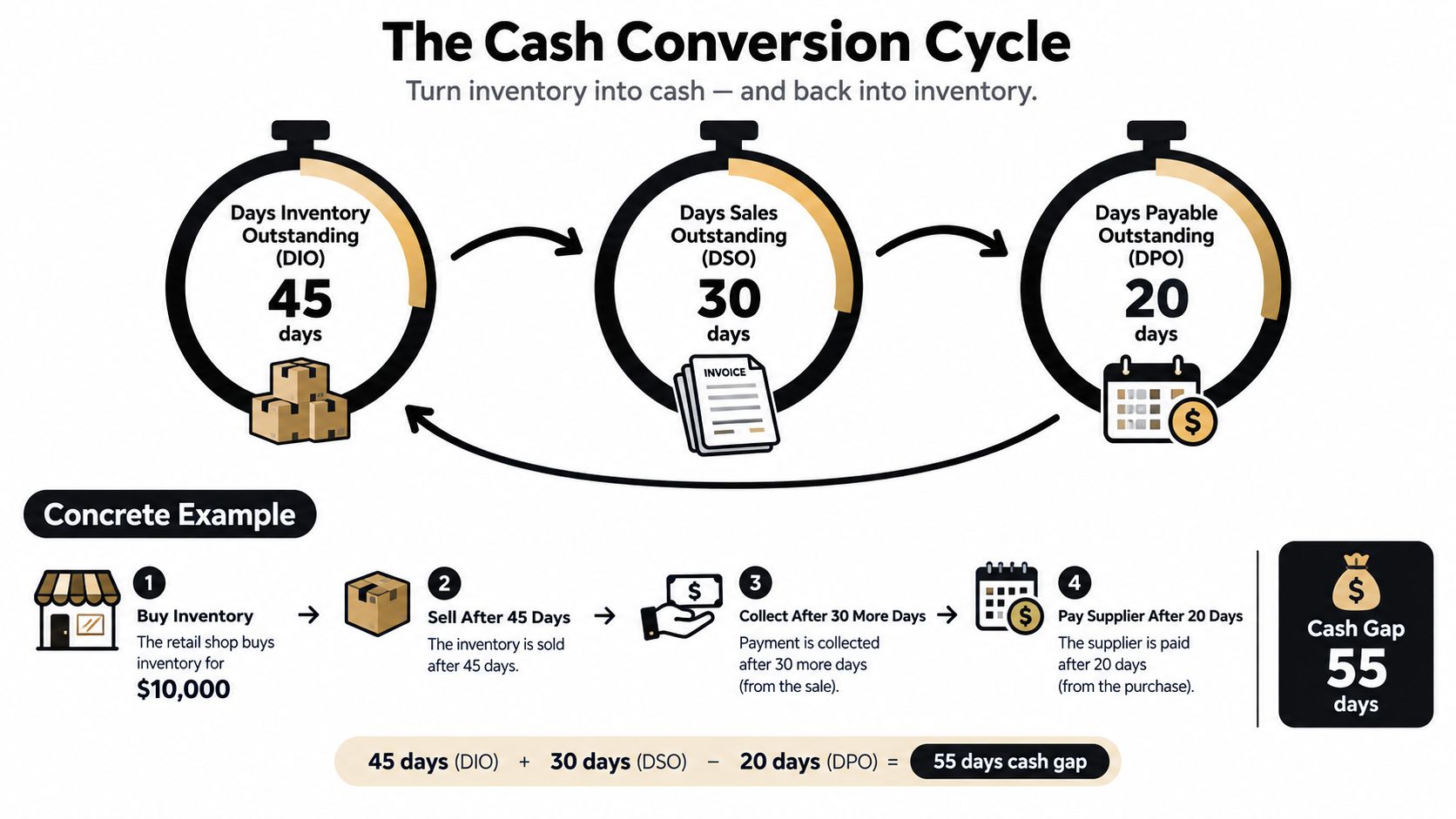
The cash conversion cycle, or CCC, shows how long operating cash stays tied up before collections return it to the bank. It has three timers:
- Days Inventory Outstanding, or DIO: How long cash remains in products, materials, or work in progress before sale.
- Days Sales Outstanding, or DSO: How long customers take to pay after invoicing.
- Days Payable Outstanding, or DPO: How long the business takes to pay suppliers.
The formula is DIO plus DSO minus DPO. Buy materials early, sell slowly, collect late, and pay vendors quickly, and your cash is working harder than the owner.
Take a $25,000 invoice billed on Day 1. The supplier offers Net 30, so the related bill can arrive before the customer's payment. Friday payroll still runs on Friday. The P&L records the sale, while the bank account records cash leaving first. That timing gap is the operating problem.
The roughly one-month median cash buffer introduced earlier leaves little room for sloppy timing. A business collecting receivables in roughly 32 days while paying suppliers in roughly 28 days has a built-in mismatch before payroll, rent, and taxes are paid. Those figures are illustrative, not universal benchmarks. They show how quickly a short runway can vanish.
Growth can widen the gap. New sales may require inventory, labor before billing, and customer credit. If every added sale consumes cash before collected cash arrives, growth demands financing. In 2026, that calendar also has to account for the $2,000 1099-NEC and 1099-MISC threshold, the $20,000 and 200-transaction 1099-K test, and the OBBBA deduction stack. A fractional CFO builds those obligations into the forecast instead of discovering them beside a shoebox of receipts.
For a plain explanation of booked sales versus usable liquidity, read understanding cash from sales vs revenue. For the money customers owe you and the money you owe suppliers, use this guide to compare accounts payable and accounts receivable.
The CCC gives owners a working-capital control point. Shorten collection time, manage inventory deliberately, and set supplier payments against the actual cash calendar. That is how profitable growth reaches the bank.
Metrics That Tell You If Cash Is Actually Healthy
A bank balance is a snapshot. Healthy cash flow management requires a small set of recurring measurements that show where the business is heading.
| Metric | Plain-English Formula | Healthy SMB Benchmark | Warning Sign |
|---|---|---|---|
| Operating Cash Flow | Cash generated by normal operations | Positive and consistent | Net income is positive while operating cash is negative |
| Free Cash Flow | Operating cash flow minus capital expenditures | Enough to fund planned reinvestment | Equipment purchases repeatedly require new borrowing |
| Cash Conversion Cycle | DIO plus DSO minus DPO | Stable or shortening | The cycle expands while sales grow |
| Current Ratio | Current assets divided by current liabilities | Above 1.5 as a practical SMB benchmark | Near or below 1.0, or assets are not collectible |
| Burn Rate and Runway | Monthly cash loss and available cash divided by that loss | Burn falls and runway expands | Cash declines with no funded recovery plan |
Read the numbers in context
Operating cash flow comes from the statement of cash flows, not net income. It answers whether ordinary operations are producing cash after collection timing, payroll, supplier payments, and other operating movements.
Free cash flow subtracts capital expenditures from operating cash flow. This is the measure that tells you whether the company can fund growth internally or needs financing for every meaningful purchase.
The CCC identifies the delay inside the operating cycle. A rising DSO points toward collections or credit terms. A rising DIO points toward inventory or production planning. A falling DPO may mean the business is paying suppliers too quickly or losing negotiating power.
The current ratio deserves suspicion when owners treat it as a trophy. A 2.0 current ratio with receivables 90 days past due isn't safety. It's a collection problem wearing a costume.
Runway matters when profit hasn't arrived
For an unprofitable company, track burn rate, the amount of cash consumed during a period, and runway, the amount of available cash divided by that burn. A business can have strong customer demand and still run out of time if each month consumes more cash than the forecast can support.
These metrics reveal symptoms, not causes. The causes usually hide in collections, inventory, payment terms, payroll decisions, and tax planning.
Where Cash Quietly Disappears
Cash leakage usually follows a pattern. It isn't a personality flaw, although the owner who approves every expense from memory may eventually make it one.
Five failure patterns
Late receivables: Loose Net 30 or Net 45 terms become Net 60 in practice. The bank-statement warning is simple: receivables over 60 days are climbing. Use an aging report, assign collection responsibility, and follow up before the due date, not after the customer has forgotten the invoice.
Inventory bloat: Owners order ahead of vendor price increases and end up financing products that aren't moving. Watch for slowing inventory turnover and purchases that rise while sales remain flat. Inventory isn't cash until someone buys it.
Payment-term mismatches: Suppliers demand Net 10 while customers stretch to Net 60. The warning sign is a recurring gap between vendor withdrawals and customer deposits. Negotiate terms that resemble the actual collection cycle instead of accepting the first vendor document placed in front of you.
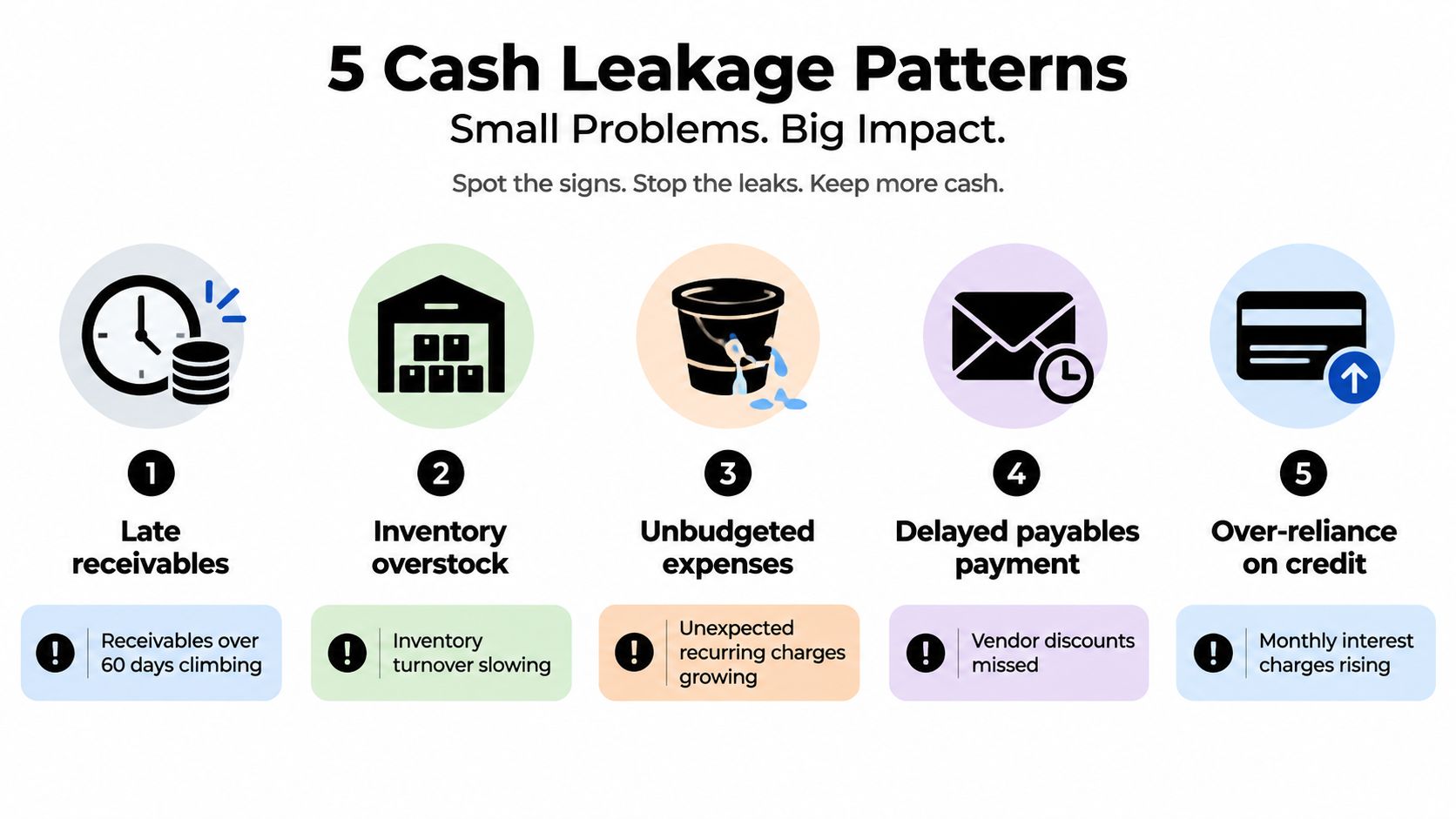
Payroll surprises: Owner draws, changing compensation, and untracked contractor payments can make payroll look stable until the account takes a sharp dip. “Reasonable salary” isn't a substitute for a payroll budget, and contractor payments don't become organized because they were typed into a memo field.
Tax underestimation: Quarterly estimates are easy to underfund when the owner watches sales instead of taxable income and cash obligations. A sudden January or April drain usually means the business didn't forecast taxes, not that the tax bill appeared from outer space.
For owners who need a disciplined receivables follow-up process, the Truespeak invoice reminder guide offers practical context on invoice reminders and collection workflows. Automation helps, but it doesn't replace a person reviewing disputed invoices and calling important customers.
A 30-60-90 Day Plan to Tighten the Flow
You don't need to buy software on Monday morning. You need clean information and the willingness to stop treating the bank account as a diary.
Days 1 through 30
Pull the last 90 days of bank and credit-card activity and classify every outflow. Build an accounts-receivable aging report that separates current invoices from overdue balances, disputed amounts, and customers who need a call.
Then tighten the front door. Move standard customer terms toward Net 15 where the relationship supports it, consider a 2% early-payment discount, and stop paying vendor invoices early unless the discount or strategic value justifies the cash cost.
Days 31 through 60
Open a separate operating account if personal and business transactions are still mixed. Negotiate the two largest supplier relationships toward Net 45, then schedule invoice reminders at 7, 14, and 30 days. Your goal is not to send more polite emails. Your goal is to make collection a process rather than an act of personal courage.
Build a 13-week rolling cash forecast from actual receipts and scheduled payments. A forecast that uses optimistic sales guesses is a motivational poster, not a management tool. For a fuller explanation of the discipline, review what is cash flow forecasting.
Days 61 through 90
Add scenarios for slower collections, higher payroll, inventory purchases, and tax payments. Set a cash-reserve target based on actual obligations, not a number that sounds impressive at a chamber-of-commerce breakfast.
By this point, ask the uncomfortable question. Is the owner still the right person to maintain the forecast, review AR and AP, coordinate tax payments, and explain the results? If the answer is no, hire a fractional CFO before the next shortage forces the decision.
How 2026 Tax Rules Reshape Your Cash Calendar
Tax compliance changes cash timing well before a return is filed. Vendor records, processor reconciliations, deduction planning, and estimated payments all affect when money leaves the bank. A fractional CFO turns those requirements into a working-capital plan instead of another shoebox full of receipts.
For payments made after December 31, 2025, the information-reporting threshold for Forms 1099-NEC and 1099-MISC rises from $600 to $2,000. The IRS also applies that $2,000 level to backup withholding for those reportable payments (IRS Publication 334). Keep complete vendor records anyway. Smaller payments can accumulate, require corrections, or affect withholding and filing decisions. Track each vendor throughout the year, not during filing-season panic.
The 1099-K rule uses a dual test. A payment card or third-party network organization must issue Form 1099-K when payments reach $20,000 and at least 200 transactions. Businesses using payment apps, card processors, or marketplaces need sales records that separate gross receipts from processing fees, refunds, and chargebacks. Reconcile processor reports to bank deposits every month, then use the results in the cash forecast.
| Rule | Threshold | Cash-Flow Effect | Owner Action |
|---|---|---|---|
| 1099-NEC and 1099-MISC | $2,000 for post-2025 payments | Earlier vendor-data discipline and fewer filing surprises | Track each vendor cumulatively throughout the year |
| 1099-K | $20,000 and 200 transactions | Platform receipts must reconcile to actual sales cash | Match processor reports to deposits, fees, refunds, and chargebacks |
| Section 179 and bonus depreciation | Deduction timing depends on eligibility and planning | Can change taxable income and estimated-payment needs | Review purchases before committing cash |
| R&E safe-harbor election | Retroactive election required by July 6, 2026 for many affected taxpayers | May affect whether research costs are currently deducted or capitalized | Separate domestic and foreign research costs and review affected years |
The OBBBA deduction stack includes Section 179, 100% bonus depreciation, and planning around state-and-local-tax deductions. Coordinated with operations, these provisions can improve cash timing and working-capital decisions (Alloy Silverstein's OBBBA cash-flow guidance). Review purchases before spending cash solely for a deduction.
The IRS also announced a Small Business Taxpayer Safe Harbor for research and experimentation expenses. Many affected taxpayers must make the retroactive election by July 6, 2026. Separate domestic and foreign research costs, review affected years, and schedule the work before the deadline. Missed elections or misclassified expenses can change current deductions, capitalization, refunds, and filing accuracy. A tax calendar that ignores those decisions is not a cash plan.
When a Fractional CFO Pays for Itself
A bookkeeper records what happened. A fractional CFO helps decide what happens next.
That distinction matters when cash is tight. A bookkeeper may reconcile accounts, maintain ledgers, process payroll, and produce reports. A fractional CFO turns those reports into a maintained 13-week forecast, weekly AR and AP reviews, covenant monitoring, KPI dashboards, board-ready monthly packages, and year-round tax planning. A full-time CFO provides deeper internal capacity, but that role carries full-time compensation and benefits that many SMBs don't need every day.
| Role | Primary Focus | Cash Management Deliverables | Typical Monthly Cost |
|---|---|---|---|
| Bookkeeper | Accurate transaction records | Reconciliations, categorization, basic reports | Varies by scope |
| Fractional CFO | Decisions, forecasting, and working capital | 13-week forecast, AR/AP actions, KPIs, tax coordination | $3,000 to $7,000 |
| Full-time CFO | Executive finance leadership | Internal finance function, strategy, banking, reporting | $180,000 to $300,000 before benefits |
Those cost figures are engagement examples, not universal prices. The payback question is operational. A fractional engagement priced at $3,000 to $7,000 per month could be justified if it prevents an overdraft fee of $150 to $300 and tightens one collection cycle enough to release $40,000 of working capital. Those are scenario figures, not promised results. The correct analysis compares the engagement cost with the cash opportunities and risks visible in your own books.
A fractional CFO is not an expensive bookkeeper. The bookkeeper protects the records. The CFO protects the decisions built on those records.
A fractional CFO becomes difficult to avoid when revenue surpasses $1 million, payroll grows beyond 15 W-2 employees, a loan or SBA refinance approaches, the owner prepares for a sale, or a margin-compression event has already consumed 90 days of runway. Businesses needing that level of guidance can review fractional CFO services for small business.
Your First Seven Steps and the Bottom Line
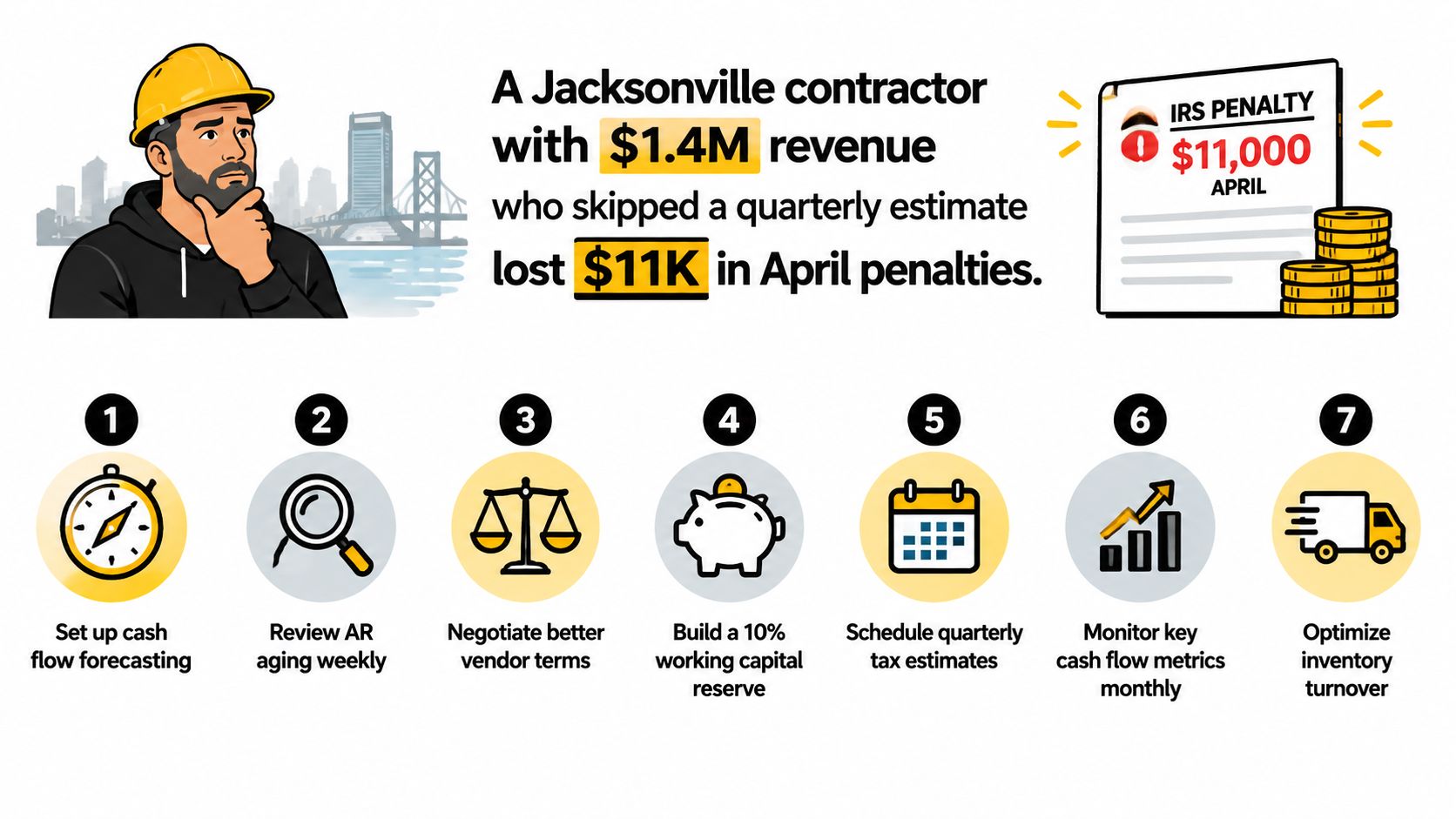
A Jacksonville contractor with $1.4 million in revenue skipped a quarterly estimate and watched $11,000 of working capital disappear in April penalties. That representative story captures the problem: the company didn't necessarily lack sales. It lacked a calendar, a forecast, and someone tasked with challenging the owner's optimism.
Print this checklist and start Monday morning:
- Pull the records: Download the last 90 days of bank and credit-card statements, then tag every outflow by category.
- Build the forecast: Create a 13-week rolling cash forecast in a spreadsheet using expected receipts and scheduled payments.
- Tighten collections: Move customer terms from Net 45 toward Net 15 and consider a 1.5% early-payment discount where the economics work.
- Renegotiate suppliers: Ask your top three suppliers for at least Net 30 terms.
- Calendar tax payments: Schedule all four 2026 quarterly estimated-tax deadlines and model payments using 110% of prior-year safe-harbor figures where applicable. Confirm the calculation with your tax advisor.
- Reconcile reporting data: Review 1099 vendors against the new $2,000 threshold and reconcile payment platforms against the $20,000 and 200-transaction 1099-K test.
- Book a diagnostic: Schedule a 45-minute fractional CFO review before year-end and bring the forecast, AR aging, AP list, tax projections, and bank statements.
The bottom line is plain. Cash flow management is the operating discipline that decides which profitable SMBs survive 2026. It protects payroll and supplier relationships, but it also releases working capital, improves tax timing, and gives owners room to grow without borrowing every time a customer pays late. Most small businesses don't know every reporting, payroll, tax, and reconciliation requirement they face. That's why clean business accounting and experienced financial guidance matter.
Bookkeeping and Accounting of Florida Inc. provides bookkeeping, payroll, tax preparation, reconciliations, cash-flow forecasting, and fractional CFO guidance for growing companies in Jacksonville and Northeast Florida. Visit Bookkeeping and Accounting of Florida Inc. to schedule a review of your cash cycle, compliance records, and 2026 tax calendar before a profitable month turns into a cash emergency.