
Are you choosing an audit because someone asked for “financial statements,” or are you assuming a compilation will satisfy a lender, grantor, or board? Those are different questions, and confusing them creates expensive compliance problems.
Thank you for reading this post, don't forget to subscribe!For a small business in Jacksonville or Northeast Florida, the right answer depends on who will use the statements, what they require, and how much independent assurance they expect. A compilation organizes management's information. A review adds inquiry and analytical procedures. An audit performs more extensive testing and provides the highest assurance level available under the framework described below.
The choice also affects your readiness for 2026 tax compliance, financing, grant reporting, payroll obligations, and strategic planning. Bookkeeping alone won't answer those questions. You need financial statements that match the purpose, plus someone who can guide the business before a deadline exposes weak records.
Why Most Business Owners Get Financial Reporting Wrong
It's April. Your lender wants updated financial statements. Your bookkeeper has a folder of receipts, payroll reports, bank statements, and unexplained transactions. You're trying to decide whether to order an audit, a review, or a compilation while also dealing with tax filings and payroll.
That situation is common among small businesses. The mistake is treating these services as interchangeable paperwork. They aren't. Each one gives outside users a different level of confidence, and the wrong choice can leave you paying for work nobody required or submitting statements that nobody accepts.

The cost of choosing badly
Consider a Jacksonville construction company seeking financing for a new project. If the bank requires a review, a compilation won't meet the request because it provides no assurance. The owner then loses time replacing the engagement, answering new questions, and cleaning records that should have been addressed earlier.
A different business may order an audit when its board only needs a review. That creates unnecessary work and expense. The audit may still be valuable, but it isn't automatically the responsible choice. The responsible choice is the one that satisfies the stakeholder without creating needless procedural work.
Practical rule: Ask the lender, grantor, investor, or board to state the required engagement level in writing before you authorize accounting work.
The distinction matters because the financial statements can look polished at every level. A compilation report doesn't verify the numbers. A review report provides limited assurance and says the accountant isn't aware of material modifications needed. An audit report expresses an opinion based on more extensive procedures.
Your books determine more than your report
The engagement also reveals whether management understands its own numbers. A review may raise questions about revenue recognition, related-party activity, estimates, or unusual changes between periods. If nobody can explain those items, the problem isn't merely the report format. The business has a reporting-control problem.
Current audit-quality reporting continues to identify weaknesses involving documentation, sampling, evidence handling, systems understanding, fraud risks, and estimates. The ICAEW discussion of smaller audit firms and less complex audits shows why engagement labels alone don't solve weak records. A lower-assurance service only makes sense when your books can support the questions that service requires.
Start with the user of the statements. Then assess your records. Only after that should you select the service.
Understanding the Three Levels of Service
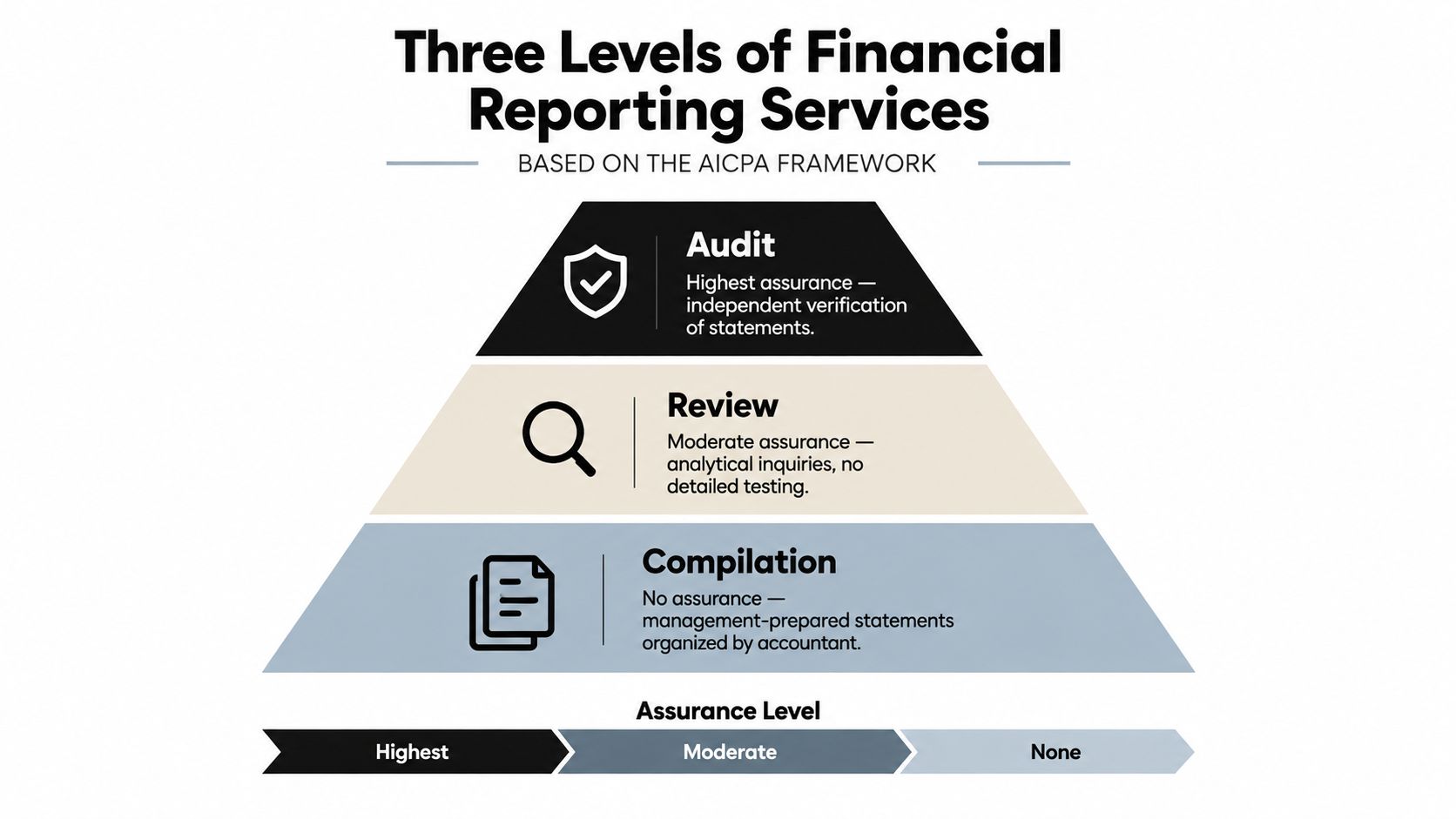
The AICPA framework separates the three services by what the accountant does and what the report promises. Historically, the Accounting and Review Services Committee formalized the distinctions through Statements on Standards for Accounting and Review Services, or SSARS. AR-C Section 60 establishes general principles, AR-C Section 70 covers preparation, AR-C Section 80 covers compilations, and AR-C Section 90 covers reviews. The AICPA framework excerpt provides the underlying structure.
Compilation means presentation, not verification
A compilation is the lowest reporting service. The accountant takes information supplied by management and presents it in financial statement form under the applicable reporting framework. The accountant reads the information for obvious errors, but doesn't verify the underlying numbers through testing.
That makes a compilation useful when the main need is organized reporting. A startup may need clean statements for internal planning. A small professional firm may want financials prepared consistently for tax planning and management meetings. A compilation can also be issued when the accountant isn't independent, provided that lack of independence is disclosed.
The critical limitation is simple: a compilation provides no assurance. It doesn't tell a lender that the numbers have been independently checked.
Review means limited assurance
A review sits between compilation and audit. The accountant performs inquiries and analytical procedures. Those procedures may involve comparing periods, investigating unusual changes, and asking management about revenue recognition, significant estimates, related-party transactions, and other matters that could require modification.
The report doesn't express an audit opinion. Instead, it states that the accountant isn't aware of material modifications needed for the statements to conform to the applicable framework. A review therefore gives outside users limited assurance, not reasonable assurance.
A review also requires independence. That matters when selecting a provider and when evaluating whether the engagement can be performed under the intended standard. For a practical explanation of what a review involves, see this guide to financial statement review services.
Audit means more extensive evidence gathering
An audit is the highest assurance service among the three. The auditor obtains reasonable assurance through more extensive procedures, including testing and evidence gathering. The auditor expresses an opinion on the financial statements.
Reasonable assurance isn't an absolute guarantee. It reflects the nature of audit work, which relies on risk assessment, sampling, controls understanding, and evidence rather than checking every transaction. The audit is still the right choice when outside stakeholders need independently tested financial information or when a contract, regulator, grantor, or lender requires it.
The progression is clear:
- Compilation: Management information organized by an accountant, with no assurance.
- Review: Inquiry and analytical procedures, with limited assurance.
- Audit: More extensive testing and evidence gathering, with reasonable assurance.
A major reporting change came through SSARS No. 24, which revised compilation and review reporting requirements for periods ending on or after June 15, 2019, while allowing early application. The Journal of Accountancy overview of the revised requirements explains that milestone and its practical importance.
Side-by-Side Comparison of Audits, Reviews, and Compilations
The fastest way to understand audit vs review vs compilation is to compare the promise behind each report. Don't choose based only on price. Choose based on the level of confidence the intended user requires.
| Service Level | Assurance Level | Key Procedures | Reporting Language |
|---|---|---|---|
| Audit | Reasonable assurance | More extensive procedures, testing, and evidence gathering | The auditor expresses an opinion on the financial statements |
| Review | Limited assurance | Inquiry and analytical procedures focused on unusual items, estimates, changes, and other risks | The accountant says they aren't aware of material modifications needed |
| Compilation | No assurance | Management-provided information is assembled and read for obvious errors, without verification | The report disclaims verification of the underlying numbers |
What the table means in practice
An audit gives the strongest external comfort, but it also demands the strongest supporting records. Management should expect detailed requests around account balances, estimates, internal processes, unusual transactions, and evidence. A clean general ledger helps, but a clean-looking trial balance alone won't answer an auditor's questions.
A review is narrower. It doesn't involve the same detailed testing as an audit, but it isn't a formatting exercise. The accountant has to ask questions and analyze the statements. Management must explain significant swings and support its accounting judgments. If the books are disorganized, the review can become a cycle of corrections and follow-up.
A compilation depends most heavily on management's information. The accountant presents what management provides and doesn't verify whether the underlying figures are correct. That can be appropriate for internal reporting, but it's a poor fit when an outside party expects independent comfort.
Choose the report the recipient requested
The report language matters because users often read more assurance into a polished financial statement than the engagement provides. A compilation may look professional while carrying no assurance. A review offers a defined, limited conclusion. An audit provides an opinion based on more extensive work.
Before engaging a CPA, send the provider the lender's request, grant agreement, purchase agreement, or board policy. Ask for confirmation of the required service level. Then prepare the records that match the engagement.
Use an audit readiness checklist to organize reconciliations, supporting documents, account schedules, and open questions before fieldwork begins. Preparation doesn't turn a compilation into an audit, but it does make every engagement more efficient and more defensible.
The practical ranking is straightforward. Compilation is for organized information. Review is for limited independent comfort. Audit is for reasonable assurance and formal opinion. Confusing those purposes is how owners pay twice or miss a requirement.
Who Needs What in Industry-Specific Guidance
Industry determines the questions behind the financial statements. A healthcare clinic, construction company, nonprofit, and professional services firm don't carry the same compliance risks. They shouldn't receive identical reporting advice.

Nonprofits need requirement-driven reporting
Nonprofits often manage restricted funds, grants, board oversight, donor reporting, and program expenses. A compilation may help management organize statements, but it may not satisfy a grantor or governance requirement. A review can provide limited assurance when an outside party wants more than management-prepared information but doesn't require an audit.
An audit becomes the appropriate choice when a grant, contract, regulator, or board requires the highest assurance level. The organization shouldn't guess. It should read every funding agreement and confirm the reporting language before the fiscal year closes.
Healthcare practices need controlled records
Healthcare practices face payroll, compliance, revenue-cycle, privacy, and reimbursement concerns. A review can help identify unexplained changes in revenue, receivables, expenses, and estimates through targeted inquiry and analysis. An audit may be warranted when ownership, financing, contractual obligations, or a regulatory requirement demands independently tested statements.
Bookkeeping by itself won't tell a clinic whether its reporting process can support those questions. Management needs reconciled accounts, consistent classifications, and documentation for unusual items. A fractional CFO can help turn those requirements into a recurring close process rather than a year-end emergency.
Construction companies need job-cost visibility
Construction businesses need financial information that separates projects, tracks labor and materials, and supports payroll and cash-flow decisions. A compilation can be useful for internal job-cost reporting when no outside user requires assurance. It won't independently validate project information or satisfy a stakeholder who requests a review or audit.
Lenders, bonding relationships, project owners, and investors may expect a higher engagement level. The right answer depends on the actual request, not just on the company's size. A construction owner who waits until financing is underway may discover that incomplete job records delay the statements.
The engagement level should follow the stakeholder's requirement and the risk in your records, not a generic industry label.
Most small companies need more than bookkeeping. They need someone to monitor reporting quality, explain cash flow, review compliance deadlines, and coordinate with the CPA performing the engagement. That guidance is especially valuable when the owner is also handling sales, hiring, operations, and customer issues.
The Hidden Value of Fractional CFO Services
A fractional CFO isn't a replacement for your bookkeeper or CPA. The role connects the two. Your bookkeeper records transactions. Your CPA may prepare tax returns or perform an audit, review, or compilation. A fractional CFO helps management use accurate information to make decisions and stay ready for those services.

Build the reporting system before the deadline
Start with a monthly close. Reconcile bank and credit accounts, review receivables and payables, classify transactions consistently, and document unusual entries. Then create a question list for significant estimates, related-party activity, revenue recognition, and large period-to-period changes.
Next, match the financial statement service to the users:
- Internal planning: Determine whether management mainly needs organized statements and consistent reporting.
- External comfort: Confirm whether a lender, investor, board, or grantor requires limited assurance through a review.
- Formal verification: Identify whether a contract, funding arrangement, regulator, or stakeholder requires an audit.
- Ongoing compliance: Assign responsibility for tax, payroll, reporting, and documentation deadlines.
The overview of fractional CFO services explains why small companies use senior financial guidance without hiring a full-time executive. That guidance helps management interpret statements, plan cash needs, improve close procedures, and prepare for outside scrutiny.
A fractional CFO also serves as a point of contact for auditors and helps organize financial documents for audit preparation, a role described in NerdWallet's fractional CFO overview. This is practical support, not a luxury. Small businesses often don't know every requirement that applies to payroll, tax filings, financial reporting, grants, and industry compliance.
Use technology, but don't outsource judgment
Accounting software can improve consistency, but automation won't decide whether a lender requires a review or whether an estimate needs documentation. It won't explain a sudden margin change to a reviewer. People still need to establish controls, interpret the numbers, and follow up on exceptions.
Watch this short presentation for a visual look at the financial leadership role:
Your fractional CFO should review reports with you, not merely send them. Ask what changed, why it changed, what evidence supports it, and whether the current engagement level still fits the business. That conversation catches problems before they become lender questions, tax corrections, or audit findings.
2026 Tax Law Changes and Compliance Implications
Financial reporting and tax compliance are connected. If your books don't separate income, expenses, payroll, assets, and owner activity correctly, you can't apply tax rules confidently. The 2026 changes make that risk more concrete.
For 2026, the IRS says the maximum net self-employment earnings subject to the Social Security portion of self-employment tax is $184,500, and the standard business mileage rate is 72.5 cents per mile. The IRS Publication 334 guidance also says P.L. 119-21, the OBBBA, permanently extends the disallowance of a deduction for excess business losses.
Section 199A requires deliberate planning
Grant Thornton's 2026 individual tax planning guide says the OBBBA makes the Section 199A qualified business income deduction permanent at 20%. It also raises the phase-in thresholds for the limitation to $75,000 for individuals and $150,000 for joint filers.
Those rules require clean classification and timely projections. An owner needs reliable information about qualified business income, wages, ownership structure, and taxable income before making planning decisions. A fractional CFO can coordinate that information with the tax CPA instead of waiting for year-end totals.
Equipment, tips, and overtime create reporting work
For 2026, the Section 179 expensing limit is $2.5 million, and the deduction begins to phase out when qualifying property placed in service exceeds $4.09 million, according to Thomson Reuters' summary of upcoming tax law changes. The same source says the OBBBA added a $400 minimum QBI deduction for 2026 when the taxpayer has at least $1,000 of QBI.
Grant Thornton also says employers must separately report qualified tips and qualified overtime compensation on Form W-2 or Form 1099-NEC. That affects payroll setup, worker classification, timekeeping, and year-end reporting. A bookkeeper can process payroll, but management still needs a system that captures the right information.
Don't treat these provisions as a reason to buy equipment or change compensation without analysis. Treat them as reasons to close the books consistently, document decisions, and have a qualified advisor review the facts before filing.
How to Choose the Right Financial Partner
Choose the service after answering three questions: Who needs the statements? What assurance level do they require? Can your records support the engagement?
A compilation may fit internal reporting. A review may fit a lender or board that wants limited assurance. An audit may be necessary for formal verification, financing, grant, regulatory, or contractual requirements. Your CPA should confirm the answer before work begins.
For Jacksonville and Northeast Florida companies, Bookkeeping and Accounting of Florida Inc. provides bookkeeping, payroll, tax preparation, financial statement compilations and reviews, audit services, healthcare accounting, forensic audits, and fractional CFO support. The firm also provides QuickBooks setup and ongoing accounting organization. If you're evaluating technology alongside financial controls, this guide to accounting automation in 2026 offers useful context for building more consistent workflows.
The right partner doesn't just produce statements. They help you understand the numbers, meet deadlines, prepare for stakeholder questions, and stay aligned with changing tax requirements.
Bookkeeping and Accounting of Florida Inc. helps Jacksonville and Northeast Florida businesses with clean bookkeeping, payroll, tax compliance, compilations, reviews, audits, and fractional CFO guidance. Visit Bookkeeping and Accounting of Florida Inc. to discuss the engagement level your lender, board, grantor, or business requires.