
You're staring at a shoebox full of receipts, your tax deadline is approaching, and your lender has asked for financial statements you can defend. The bookkeeping may look “good enough” in QuickBooks, but good enough isn't the same as accurate, complete, or compliant. After tax law changes, shifting reporting expectations, and growing regulatory pressure, small businesses can't afford to treat accounting as an afterthought.
Thank you for reading this post, don't forget to subscribe!So, what is an independent audit? It's an objective examination of your financial statements, records, transactions, and controls by an auditor who isn't responsible for preparing the information being examined. The purpose isn't to punish you or guarantee perfection. It's to provide reasonable assurance that your financial reporting is reliable and to expose compliance blind spots before the IRS, a lender, an investor, or a regulator finds them first.
The Shoebox Disaster and Why Independent Audits Exist
A Jacksonville contractor once brought a box of receipts to tax preparation season with complete confidence. The receipts covered fuel, materials, meals, equipment repairs, and personal purchases. Some were faded. Others had no business purpose written on them. A few belonged to a different company entirely.
The owner didn't think of the box as a problem. He thought of it as an accounting system.
That approach may feel harmless while business is busy, but it creates serious trouble when someone asks for proof. A receipt without a clear date, vendor, purpose, or connection to the business doesn't defend a deduction very well. A bank statement showing money leaving your account doesn't prove why it left. A spreadsheet built from memory doesn't establish a reliable audit trail.

The cost of casual bookkeeping
Professional bookkeeping is more than entering transactions. It connects source documents to the general ledger, reconciles bank and credit card accounts, classifies expenses consistently, and preserves documentation that supports tax and financial reporting positions.
A business owner who handles everything alone often misses:
- Unrecorded liabilities: Bills may arrive after month-end and never make it into the books.
- Improper classifications: Equipment, repairs, owner distributions, payroll, and personal expenses can end up in the wrong accounts.
- Weak supporting records: A transaction may be recorded, but the documentation may not explain its business purpose.
- Control gaps: One person may approve payments, issue checks, record transactions, and reconcile the bank account.
Independent audits exist because management's records need an outside challenge. Independent auditing became a regulated profession during the nineteenth and early twentieth centuries. Major milestones included the 1845 U.K. Consolidation Act for railway company auditors, the 1862 Companies Act requiring audit provisions for joint-stock companies, and the 1900 Companies Amendment Act, which made audits of registered limited companies compulsory. In the United States, the modern era accelerated after the 1929 market crash, followed by the 1934 creation of the Securities and Exchange Commission, which made certified financial audits mandatory for listed companies. This history of independent auditing shows why audits developed into a legal safeguard for investors and creditors.
Practical rule: If you'd be embarrassed to hand your bookkeeping file to a lender or examiner, it isn't ready for an independent audit.
An audit won't rescue records that were never created, but it can identify missing documentation, inconsistent processes, and reporting weaknesses while you still have time to correct them. That's preventive medicine for your business, not optional paperwork.
What Independence Means in Practice
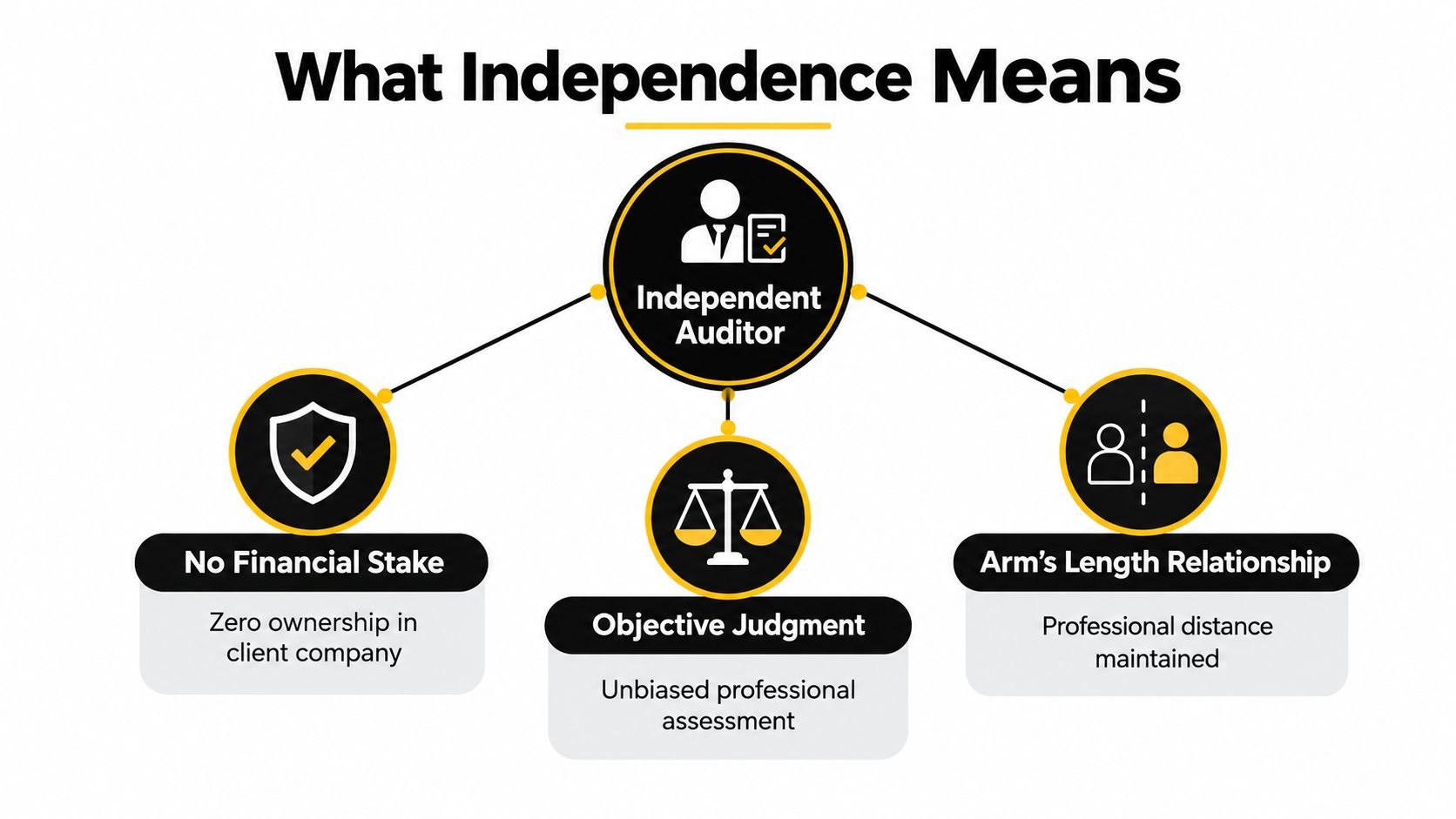
An independent auditor cannot prepare your books and then approve the same work. That setup may save time, but it gives you no real outside challenge and can leave compliance weaknesses hidden after tax law changes.
Independence requires the auditor to remain objective and impartial in fact and appearance throughout the engagement. PCAOB standards apply a reasonable-investor perspective, asking how a financially informed outsider would view the relevant facts and circumstances. In practical terms, the auditor must be able to question management without fear, favoritism, or divided loyalty. PCAOB guidance on auditor responsibilities explains how independence supports confidence in the audit opinion.
Apply the reasonable investor test
Before choosing an auditor, examine three risks.
Financial interest: Ownership, loans, contingent fees, or another financial connection can weaken perceived objectivity.
Prior decision-making: The auditor should not approve a control, create a financial statement position, and then evaluate that same work.
Outside perception: A close personal relationship, dependence on one client, or pressure from management can undermine confidence even when the accounting is technically correct.
A bookkeeper may prepare monthly reports, file tax returns, recommend a bank, and provide useful accounting advice. That person still may not qualify as independent for the audit. Preparation and verification require different responsibilities, and combining them can create a compliance blind spot.
Independence protects the owner, too. An outside auditor can challenge unusual revenue, unsupported expenses, related-party transactions, unusual journal entries, and weak approval procedures without treating those questions as personal criticism. That professional distance gives you a clearer answer about whether your financial statements can withstand scrutiny.
Treat the audit as preventive medicine. Fixing a questionable record before a lender, regulator, or tax examiner asks about it is far cheaper than defending a preventable reporting problem later.
Regulatory Reality and Inspections
Audit quality isn't judged only by whether a report looks polished. Regulators inspect audit work, evaluate the evidence supporting conclusions, and track recurring deficiencies across firms and jurisdictions.
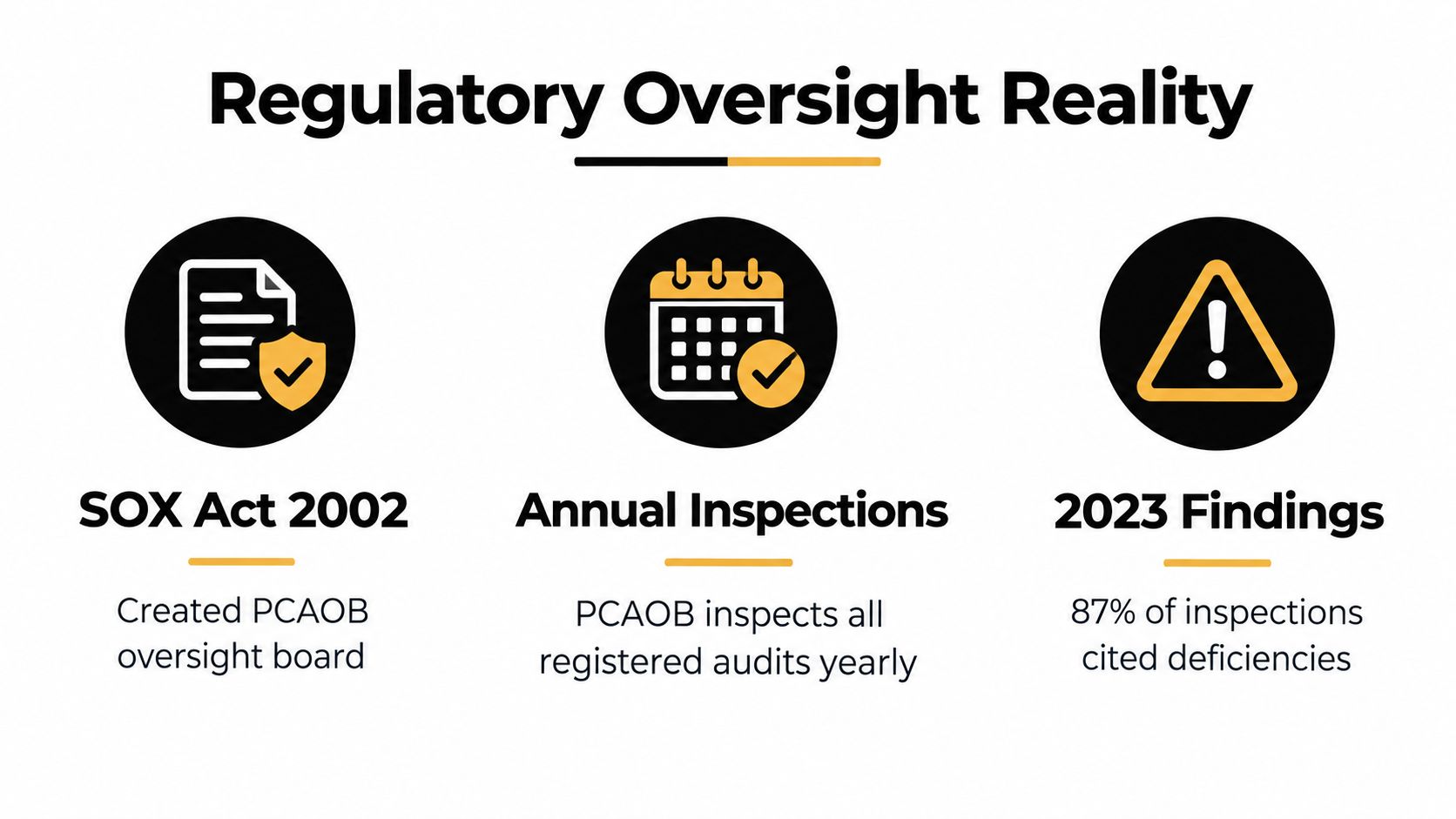
The Sarbanes-Oxley Act of 2002 created the Public Company Accounting Oversight Board, or PCAOB, to inspect public-company audits. That shift made audit quality a measurable regulatory issue rather than a private matter between an accounting firm and its client. Global regulators then began tracking inspection findings more systematically.
What inspection findings reveal
The International Forum of Independent Audit Regulators reported that at least one inspection finding appeared in 47% of inspected files in its first global aggregation. That share later fell from 42% in 2016 to 32% in 2020. The improvement matters, but the remaining findings show that independence and audit quality continue to require active oversight across public-interest entity audits. IFIAR inspection findings and audit quality provides the regulatory context.
Small businesses may not face PCAOB inspection, but they still face consequences when their financial information lacks support. A lender may question inconsistent margins. An investor may delay due diligence. A government agency may request records. The IRS may challenge deductions or classifications. In each situation, management's explanation carries less weight when the underlying documentation is incomplete.
Compliance reporting also reaches beyond filing a tax return. It can involve financial statements, payroll records, sales tax support, grant reporting, industry requirements, internal controls, and documentation showing that your business followed its own policies. For a practical explanation of what compliance reporting means for SMEs, review the distinction between reporting obligations and the internal processes needed to support them.
Why this matters in Jacksonville
A local business can operate for years without an independent audit and still have serious weaknesses hidden inside otherwise respectable financial statements. The absence of a warning isn't proof that your controls work. It may only mean nobody has tested them yet.
An independent audit creates accountability around the records your company uses to borrow, invest, file, plan, and grow. That accountability becomes more valuable when tax law changes alter deductions, reporting requirements, payroll treatment, or documentation expectations.
Reasonable Assurance Versus Absolute Certainty
An audit does not certify that every figure and control is flawless. It gives owners a disciplined conclusion based on evidence, professional judgment, and the applicable standards.
An independent audit provides reasonable assurance. The auditor defines the scope, assesses risk, tests selected transactions and controls, and uses sampling rather than examining every entry. That process lowers the chance that a material misstatement remains undiscovered, but it cannot promise that every error, fraud, or control failure will be found. Guidance on reasonable assurance explains why owners should treat assurance as a measured conclusion, not a guarantee.
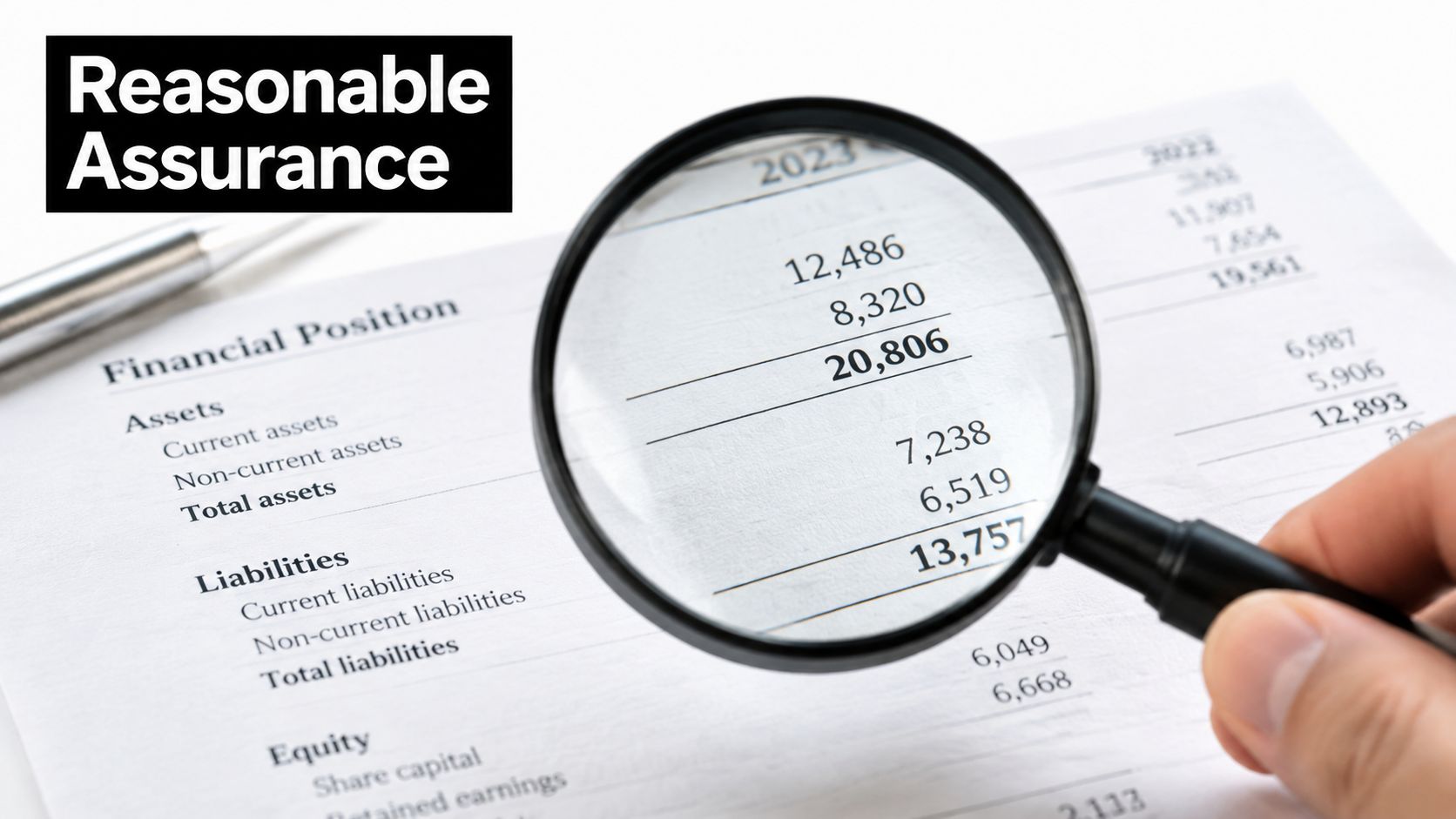
The auditor is trying to obtain enough reliable evidence to support a conclusion about the financial statements. That evidence may identify a material misstatement, confirm support for an account, or expose a control that needs attention. It does not convert your statements into an absolute guarantee.
IFIAR inspection findings reinforce that limitation. Reviews have identified recurring weaknesses in internal control testing, audit sampling, and accounting estimates. Those findings matter to small businesses because tax law changes can make weak documentation, unsupported estimates, and poorly reviewed classifications harder to defend.
Use the audit as preventive medicine, not optional paperwork. Before an auditor arrives, owners should:
- Document decisions: Retain support for estimates, unusual transactions, related-party activity, and tax positions.
- Separate duties: Keep authorization, payment, recording, and reconciliation responsibilities apart where staffing allows.
- Investigate exceptions: Resolve unexplained variances and stale balances instead of accepting them as routine.
- Expect questions: Treat an auditor's questions as a control check, not an accusation of failure.
A clean opinion still does not mean your controls are perfect. It means the auditor reached a conclusion from the evidence available under the applicable standards. Owners who understand that distinction use the report to address compliance blind spots before a lender, agency, investor, or tax reviewer exposes them.
Internal Reviews Versus Independent Audits
An internal review and an independent audit can both find errors, but they answer different questions.
An internal review asks, “What can we identify and fix using our own people and processes?” An independent audit asks, “Can an objective professional obtain sufficient appropriate evidence to support a conclusion about these financial statements?”
The difference is not cosmetic. PCAOB standards state that evidence from a knowledgeable source independent of the company is more reliable than evidence from internal company sources. This comparison of audits, reviews, and compilations can help owners understand how the level of assurance changes between services.
Internal review
Your bookkeeper or controller may review reconciliations, inspect expense reports, compare budgets with actual results, and identify coding errors. That work is valuable, especially between formal audits. It helps management respond quickly and improve daily operations.
But internal personnel may be too close to the process to challenge assumptions aggressively. They may have created the spreadsheet, approved the transaction, or designed the control now under review. Their work can improve accuracy without meeting the independence standard required for an independent audit.
Independent audit
An independent auditor examines evidence from multiple sources. Evidence may include written and electronic records such as checks, electronic fund transfer records, invoices, and contracts. The auditor may also use inspections, observations, inquiries, confirmations, reconciliations, and tests of controls.
The auditor looks for both confirming and contradictory evidence. A management explanation may be plausible, but the auditor still needs documentation that supports it. A bank balance may agree to the ledger, but the auditor may also evaluate cutoff, outstanding items, unusual transfers, and related documentation.
| Internal review | Independent audit |
|---|---|
| Performed for management use | Performed by an independent auditor |
| Often focuses on errors and process improvement | Evaluates financial statements and supporting evidence |
| May rely heavily on internal records | Seeks corroboration from independent and external evidence |
| Usually provides limited assurance or recommendations | Provides an audit opinion with reasonable assurance |
An audit committee, where one exists, oversees the financial reporting process, selects the independent auditor, and receives audit results. Smaller companies may not have a formal audit committee, but owners should still preserve that separation of duties. The person responsible for producing the numbers shouldn't be the only person deciding whether those numbers are reliable.
Fractional CFO Services and Compliance Readiness
Independent audits verify information after it has been prepared. Fractional CFO services help you prepare better information in the first place.
A fractional CFO is a part-time financial leader who provides strategic guidance without the cost of a full-time executive. That role can include building accounting frameworks, establishing reporting lines, improving financial reporting, monitoring cash flow, supporting compliance, and tightening documentation for tax and audit readiness. This overview of fractional CFO services describes how small businesses can use that kind of financial leadership.
Why bookkeeping alone isn't enough
Most small business owners don't know every requirement that applies to their company. They're experts in patient care, construction, retail, consulting, nonprofit management, or another profession. They shouldn't have to become tax attorneys, payroll specialists, internal control designers, and financial analysts just to keep the doors open.
Recent tax law changes have made that problem more serious. A change can affect how you document expenses, classify workers, handle deductions, report income, manage payroll, or prepare for an examination. Waiting until tax filing season to discover the impact is a poor strategy.
All companies need access to a fractional CFO or another qualified financial guide as they grow. That doesn't mean every company needs a full-time CFO. It means every owner needs someone who can interpret the numbers, identify compliance exposure, and turn accounting records into decisions.
A practical compliance system should connect:
- Daily bookkeeping: Transactions are recorded accurately and supported by source documents.
- Monthly reporting: Owners receive timely financial statements and investigate unusual results.
- Tax readiness: Records support positions taken on returns and required filings.
- Control monitoring: Someone independent of transaction entry reviews approvals, reconciliations, and access.
- Audit preparation: Documents are organized before an auditor requests them.
Bookkeeping and Accounting of Florida Inc. provides bookkeeping, tax preparation, reviews, internal and independent audits, healthcare accounting, construction job-costing, nonprofit audit support, forensic investigations, and fractional CFO services for businesses that need structured financial guidance. Pairing ongoing accounting leadership with periodic independent verification gives owners both a working system and an objective test of that system.
When Your Business Needs an Independent Audit Now
Tax law changes have made compliance more complex, not less. If your business has never had an independent audit, don't assume that means you don't need one. It may mean no outside professional has tested the reliability of your records.
You should seriously consider an independent audit when:
- You're applying for financing: Lenders may need confidence that your statements reflect actual performance and obligations.
- You're preparing for investors: Due diligence exposes unsupported revenue, weak controls, owner transactions, and inconsistent reporting.
- Your company is growing quickly: Revenue, employees, locations, vendors, and transactions can expand faster than your bookkeeping process.
- Your industry has specific requirements: Healthcare, construction, nonprofit, and regulated businesses often face reporting and documentation expectations that general bookkeeping doesn't address.
- Your records have changed hands: New staff, outsourced accounting, software conversions, or mergers can create gaps in the audit trail.
- You've received a notice or inquiry: Waiting until an IRS, lender, grantor, or regulator asks for documentation limits your options.
- You want defensible financial statements: Peace of mind comes from evidence and controls, not from hoping no one asks questions.
Start with an audit-readiness review, even if a full independent audit isn't yet required. Use an audit readiness checklist to organize reconciliations, contracts, invoices, payroll records, bank statements, tax filings, policies, and explanations for unusual balances.
The right time to address compliance gaps is before a crisis. Your financial statements should help you defend the business, secure financing, manage cash, and make decisions. They shouldn't become a liability because the records were assembled from memory at the last minute.
Bookkeeping and Accounting of Florida Inc. helps Jacksonville and Northeast Florida businesses organize their books, prepare for tax and audit requirements, and access independent audit and fractional CFO support. Visit Bookkeeping and Accounting of Florida Inc. to schedule a consultation and turn your accounting process into a defensible compliance system.