
You opened your bookkeeping file after New Year's and found three problems waiting for you: a contractor's paperwork is missing, several card charges are still uncategorized, and the profit shown in QuickBooks doesn't match what you thought the business earned. April hasn't arrived, but the tax work is already late.
Thank you for reading this post, don't forget to subscribe!Tax preparation for small business owners is not an annual paperwork exercise. It's an operating system built around clean books, accurate income reporting, payroll compliance, estimated payments, and the filing path tied to your legal entity. Treat it like a once-a-year scramble, and you'll pay for the delay through rushed decisions, missed deductions, avoidable notices, and cash-flow surprises.
Why Tax Season Starts in January, Not April
Your January bookkeeping review shows a missing contractor form, an unreconciled loan-interest charge, and payment-platform income that does not match your books. April is still months away, yet the tax work is already waiting. That is how filing season turns into a scramble.
Tax preparation for small business owners runs on a year-round operating system. January should close the prior year's records, verify source documents, and expose errors while the transactions are still easy to explain. Waiting until the return is due leaves less time to correct books, recover receipts, or contact vendors.
The familiar 1099 scramble points to larger control problems. A missing 1099-NEC, an unexpected payment-platform form, an unreconciled loan-interest entry, or an expense parked in “uncategorized” can all appear during filing. By then, the transaction may be months old, the receipt may be gone, and the person who can explain it may be difficult to reach.
The IRS guidance for small businesses lays out the filing paths. Sole proprietors and many single-member LLCs generally report business activity on Form 1040 with Schedule C. Partnerships generally file Form 1065, while S corporations generally file Form 1120-S. Calendar-year partnerships and S corporations are typically due in March. Sole proprietors and C corporations are typically due in April. Fiscal-year businesses follow a different calendar based on the month their year ends.
January is documentation month
Gather W-2s, 1099s, bank and credit card statements, loan records, payroll reports, and receipts. Compare bookkeeping income with payment-platform reports and client records. Confirm vendor information before year-end statements arrive.
February and March belong to cleanup. Reconcile each account, investigate unusual balances, review owner draws, confirm fixed assets, and correct transactions posted to the wrong category. Decide whether a purchase was equipment, supplies, a personal expense, or a reimbursable business cost before the return is being prepared.
Practical rule: April is a filing checkpoint, not the starting gun.
The businesses that file cleanly usually treat tax work as routine financial management. Monthly records, quarterly reviews, and entity-specific calendar entries prevent the last-minute hunt for deductions. A fractional CFO can provide the missing operating layer by assigning ownership, reviewing the tax calendar, and connecting bookkeeping decisions to cash planning. For an owner who has outgrown reactive bookkeeping, that support can make tax preparation a controlled process instead of an annual emergency.
Building a Year-Round Tax-Ready Workflow
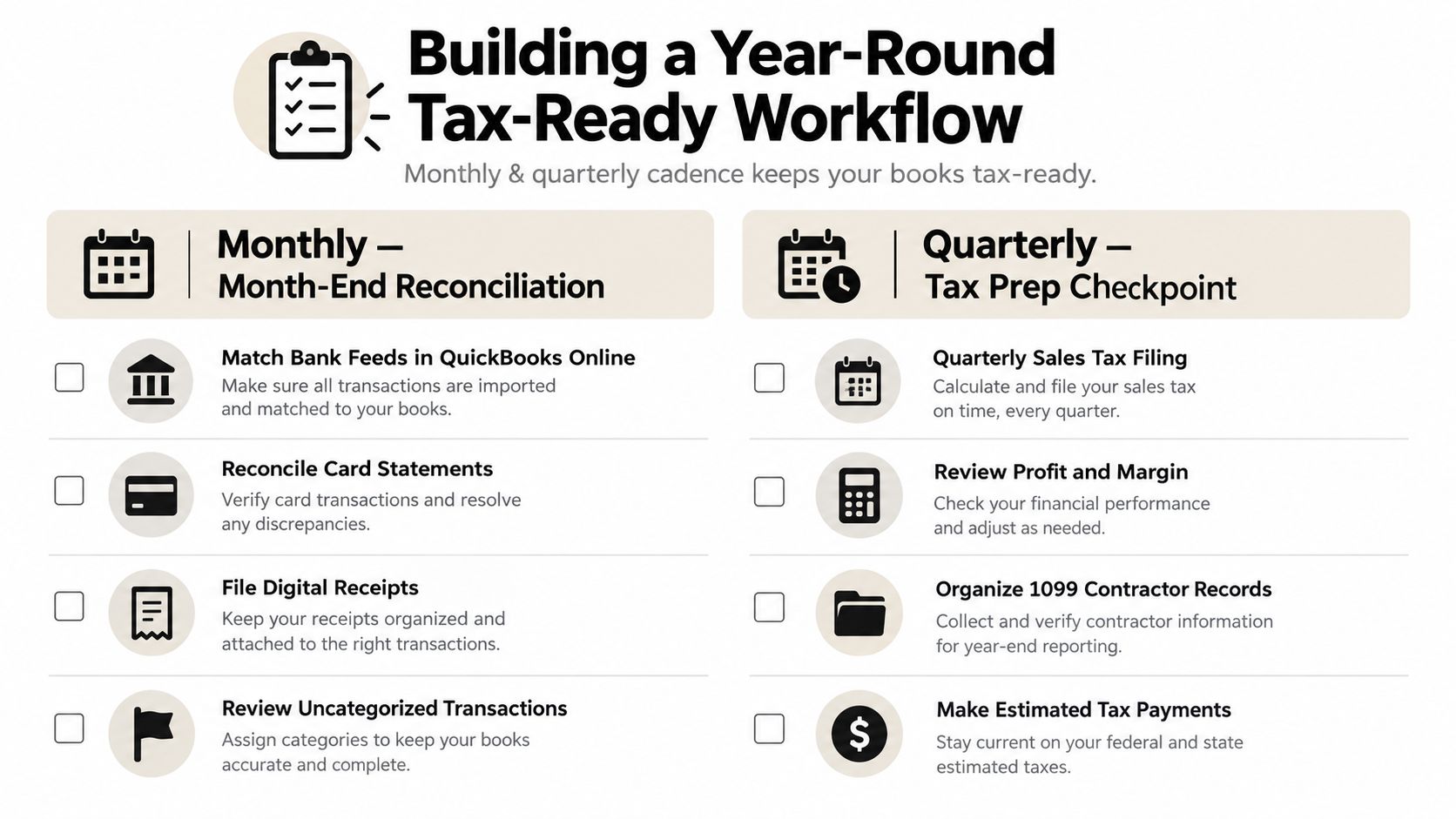
Your books should be tax-ready every month, not merely accurate enough to produce a bank balance. In QuickBooks Online, that means matching bank feeds to statements, reconciling credit cards, attaching digital receipts, categorizing expenses, tagging owner draws correctly, and reviewing uncategorized transactions before they pile up.
Look at the profit and loss statement against the prior month. A sharp change in payroll, contractor costs, revenue, vehicle expense, or owner compensation deserves an explanation while the transaction is still fresh. This review also gives you a better basis for estimated tax decisions than a year-end report assembled under pressure.
Monthly records prevent quarterly surprises
Capture contractor details as payments are made, rather than trying to reconstruct them in January. Keep receipts connected to the transaction they support. If receipt files are scattered across email, glove compartments, and paper folders, use this practical resource on receipt organization for taxes to create one consistent process.
A monthly close should answer five basic questions:
- Did the books reconcile? Bank and card balances should agree with statements.
- Is income complete? Compare deposits with invoices, payment platforms, and client records.
- Are expenses supportable? Every major deduction needs a clear business purpose and documentation.
- Are contractors identified? Keep vendor names, addresses, taxpayer information, and payment totals organized.
- Does cash reflect reality? Review unpaid invoices, upcoming payroll, debt payments, and tax obligations.
A useful operating reference is this guide to bookkeeping and taxes, especially if your current process depends on a spreadsheet rebuilt during filing season.
Quarterly reviews protect cash flow
The IRS generally expects estimated payments when a business expects to owe at least $1,000 when filing, and payroll-related deposits must be made electronically and on time. Late or incorrect payroll deposits can create penalties, so keep payroll calendars separate from ordinary bill-payment reminders. Review federal estimated taxes, Florida obligations, payroll deposits, and sales tax filings where applicable at each quarter-end.
December deserves its own review. Record fixed assets, check depreciation information, complete inventory procedures where relevant, verify contractor W-9 records, and identify transactions that need professional judgment. A tax-ready workflow must live in the same system used for daily operations. If the final numbers exist only in a separate workbook, the business has two accounting systems, and one of them will eventually be wrong.
Matching Your Entity to the Right Filing Path
Your entity determines the tax return, the supporting schedules, the payment rhythm, and the records your preparer needs. Calling the business an “LLC” isn't enough. A single-member LLC and a multi-member LLC can follow different federal tax paths, and an S corporation has payroll responsibilities that a sole proprietor doesn't.
Entity Filing Paths at a Glance
| Entity Type | Federal Form | Filing Deadline | Tax Treatment | Key Prep Step |
|---|---|---|---|---|
| Sole proprietor | Form 1040 with Schedule C | Typically April 15 for calendar-year businesses | Business income generally flows to the owner's individual return, with self-employment tax considerations | Reconcile business income and expenses, then review estimated payments |
| Single-member LLC | Generally Form 1040 with Schedule C | Typically April 15 for calendar-year businesses | Often reported on the owner's individual return unless another election applies | Confirm the tax classification and keep business spending separate |
| Partnership or multi-member LLC | Form 1065, with Schedule K-1s | Typically March 15 for calendar-year businesses | Pass-through treatment generally reports each owner's share | Reconcile partner contributions, distributions, and K-1 information |
| S corporation | Form 1120-S | Typically March 15 for calendar-year businesses | Pass-through treatment with separate payroll and entity reporting | Coordinate owner compensation, payroll filings, and the corporate return |
| C corporation | Form 1120 | Typically April 15 for calendar-year businesses | Corporate tax treatment rather than ordinary pass-through reporting | Track corporate income, expenses, estimated taxes, and shareholder transactions |
Florida's lack of a state individual income tax can simplify part of the filing picture, but it doesn't remove federal reporting, payroll, sales tax, reemployment tax, or entity-specific requirements. A first-time filer can still miss a federal deadline while assuming the state structure makes compliance simple.
The practical mistake is choosing a form based on what sounds familiar. Confirm the entity classification before preparing the return, then map deductions, payroll records, owner payments, and estimated taxes to that filing path. The form should drive the checklist, not the other way around.
Deductions and Credits Small Businesses Leave on the Table
Deductions don't disappear because they're complicated. They disappear because the bookkeeping never separates the underlying transactions or preserves the records needed to support them.
Common areas for review include home office costs, vehicle use, health insurance premiums, retirement contributions, equipment, research and development activity, and the qualified business income deduction. Eligibility depends on the facts, the entity, the type of expense, and the applicable tax rules. Don't claim a category merely because another business owner mentioned it.
Separate the expense from the proof
A vehicle deduction needs a reliable business-use record. A home office claim needs measurements, business-use details, and supporting household costs. Equipment may involve capitalization, depreciation, or an available expensing election. Health insurance and retirement contributions often require coordination between the business return and the owner's individual return.
The same principle applies to research and development activity. Keep project descriptions, payroll or contractor support, invoices, and evidence of qualifying work together. For energy-efficient commercial improvements, preserve invoices, property details, and the records supporting the claimed improvement.
| Category | Where to Claim | Records to Keep |
|---|---|---|
| Home office | Business or individual return, depending on entity and treatment | Workspace measurements, household costs, business-use explanation |
| Vehicle use | Business return or applicable owner schedule | Mileage log, business purpose, vehicle expenses |
| Equipment and depreciation | Business return | Purchase invoice, placed-in-service date, asset description |
| Health insurance | Relevant business and owner reporting | Premium statements, eligibility records, payment history |
| Retirement contributions | Applicable business and individual reporting | Plan documents, contribution confirmations, payroll records |
| Research and development | Applicable business return | Project notes, labor records, contractor invoices, technical support |
| Energy-efficient improvements | Applicable business return or credit form | Invoices, property records, improvement documentation |
| Work opportunity and childcare credits | Applicable credit forms | Employee eligibility records, payroll records, provider documentation |
Florida still has compliance work
Florida's state income-tax position doesn't mean every state obligation disappears. Surtaxes, reemployment tax, sales tax, local requirements, and payroll reporting can still affect the business. Keep those accounts distinct from federal income-tax planning so you don't mistake a simpler state income-tax picture for a complete compliance exemption.
A deduction is valuable only when the business can explain it. Build the documentation at the time of purchase, not after an IRS question arrives.
Handling Payroll, Contractor 1099s, and Quarterly Estimates
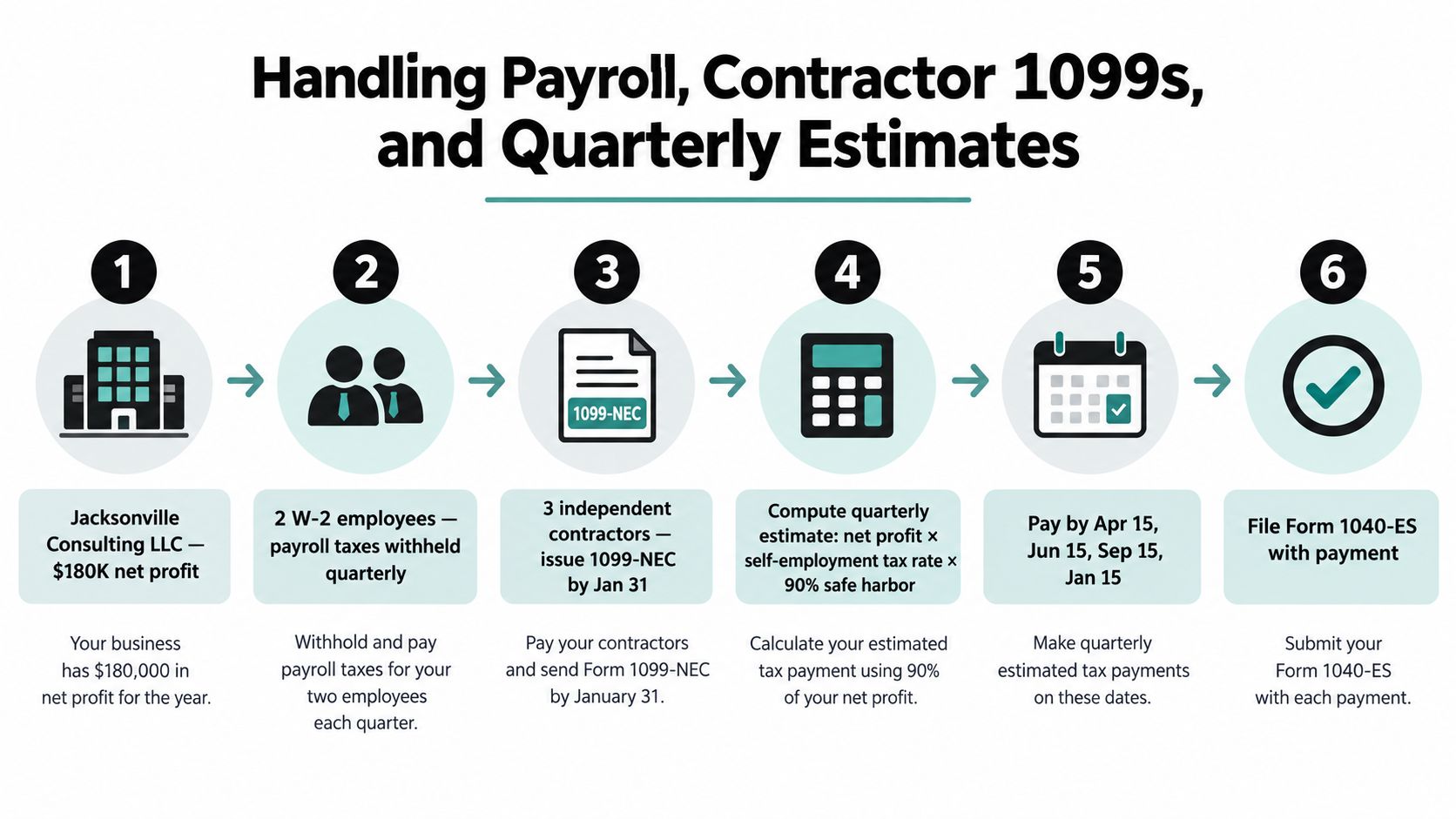
A Jacksonville consulting LLC can miss a tax problem while serving clients, paying staff, and sending contractor invoices. Payroll withholding, contractor reporting, and estimated payments are separate systems. Run them as one year-round control process, or a missed handoff will surface at filing time.
Suppose the business has $180K in net profit. That figure appears in the required workflow illustration, but it does not determine the owner's quarterly payment by itself. Filing status, household income, deductions, self-employment tax, withholding, prior-year liability, and expected current-year results all affect the calculation. Use Form 1040-ES as the planning framework, then have a tax professional review the estimate before the business sends money.
Payroll and contractor records need different controls
Payroll deposits follow the required electronic process, while payroll tax reporting stays separate from the income-tax return. Form 941 generally covers federal payroll tax reporting during the year, and Form 940 covers federal unemployment tax reporting. Save deposit confirmations with payroll reports, then verify that each payment landed in the correct period.
Contractor reporting has its own deadline. The common deadline for 1099-NEC forms is January 31. Collect a W-9 before paying a new contractor, total payments throughout the year, and compare the 1099 file with the general ledger before forms go out. Fix missing information before filing rather than explaining it after a notice arrives.
Worker classification can turn a routine payment process into a costly correction. An incorrectly classified contractor may create payroll-tax corrections, wage issues, amended filings, interest, or penalties. An invoice does not establish contractor status. Review the actual working relationship and get professional advice when the facts point toward employee status.
Use this estimated quarterly tax payments process overview to build the calendar, then assign an owner to each deadline.
Your monthly control should reconcile payroll, confirm deposits, update contractor totals, save W-9 records, review profit, and reserve cash for estimated taxes. A fractional CFO can connect those tasks to cash planning and tax forecasting, filling the operational gap between bookkeeping and annual tax preparation. If a quarter gets skipped, recalculate the year-to-date position and correct the schedule promptly.
Filing Mistakes That Trigger IRS Notices
Most IRS notices don't begin with advanced tax theory. They begin with records that don't agree. A contractor reports one amount, the business reports another, a payment is applied to the wrong period, or a form omits information that the IRS expected to see.
The IRS warning about costly small-business tax errors highlights unreported income, excessive deductions, repeated losses, worker misclassification, and simple mathematical or identification errors as recurring trouble spots. These failures usually come from weak process control, not from an owner deliberately trying to create a problem.
The notice usually points to a mismatch
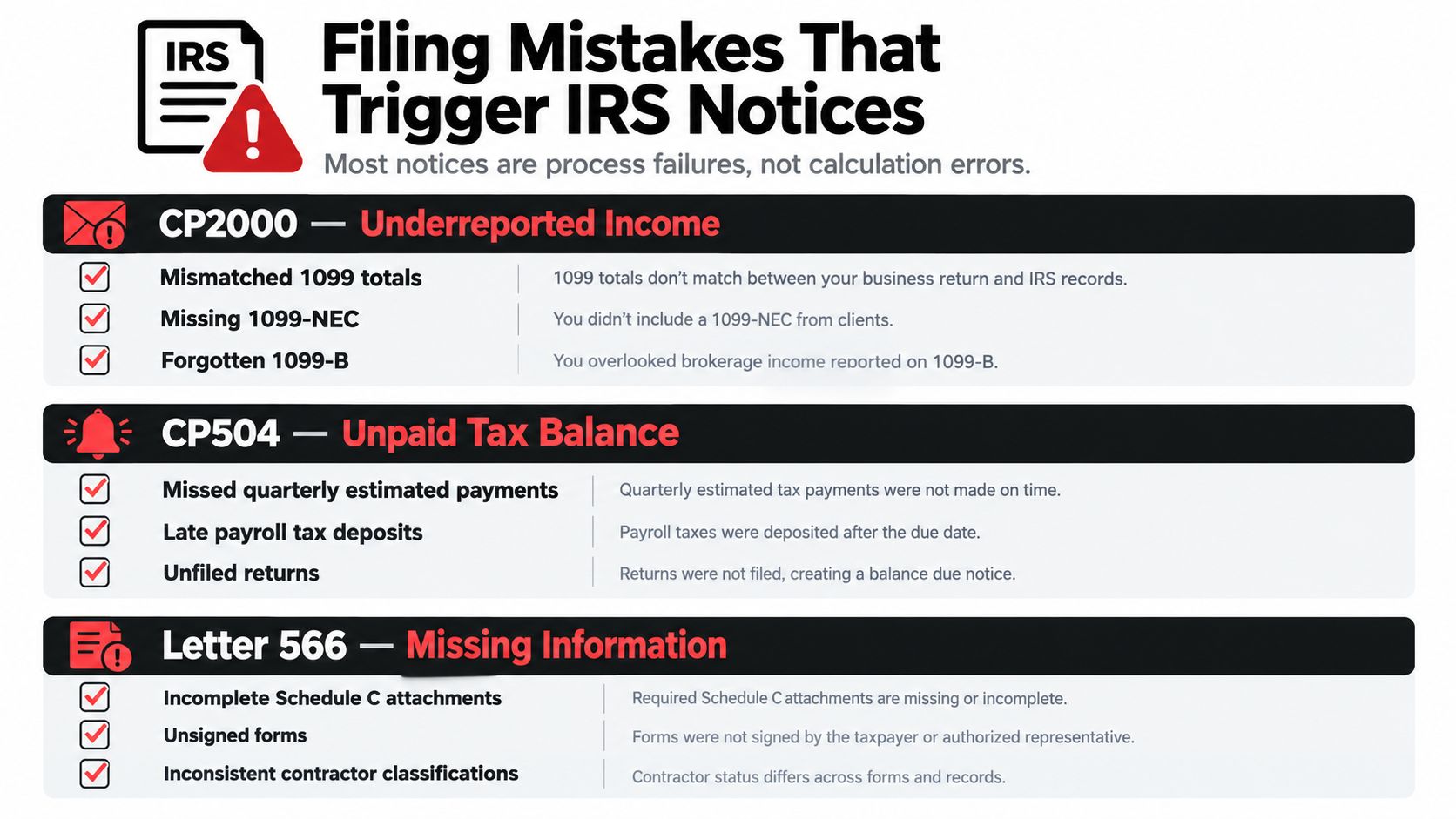
A CP2000 can follow a difference between income reported to the IRS and income shown on the return. That may involve a missing 1099-NEC, a payment-platform form, brokerage income, or a contractor payment that never reached the tax file.
A CP504 can signal an unpaid balance. Missed estimated payments, late payroll deposits, or an unfiled return can push the business into collection activity. Letter 566 may request missing information or supporting documentation, including incomplete schedules, unsigned forms, or inconsistent reporting.
Red flags start in the bookkeeping
Round-number expenses, a claim that a vehicle was used entirely for business, or a home-office area that exceeds the home itself can invite questions. The issue isn't that every round number is wrong. The issue is that unsupported precision, weak logs, and inconsistent records make a legitimate claim harder to defend.
The fix is not another spreadsheet at filing time. Reconcile the books monthly against source statements and filed forms, then investigate differences before the IRS does. Owners who have made filing errors are not unusual. QuickBooks reports that 34% of business owners have made tax-filing errors, according to the tax-error benchmark cited for small businesses. A controlled close gives you a chance to correct the record while the facts are still available.
When a Fractional CFO Becomes the Smartest Hire You Make
Payroll is due Friday, a contractor invoice is waiting, and estimated taxes are based on numbers nobody has reviewed since the last return. That is the point where tax preparation stops being a once-a-year task and becomes an operating problem.
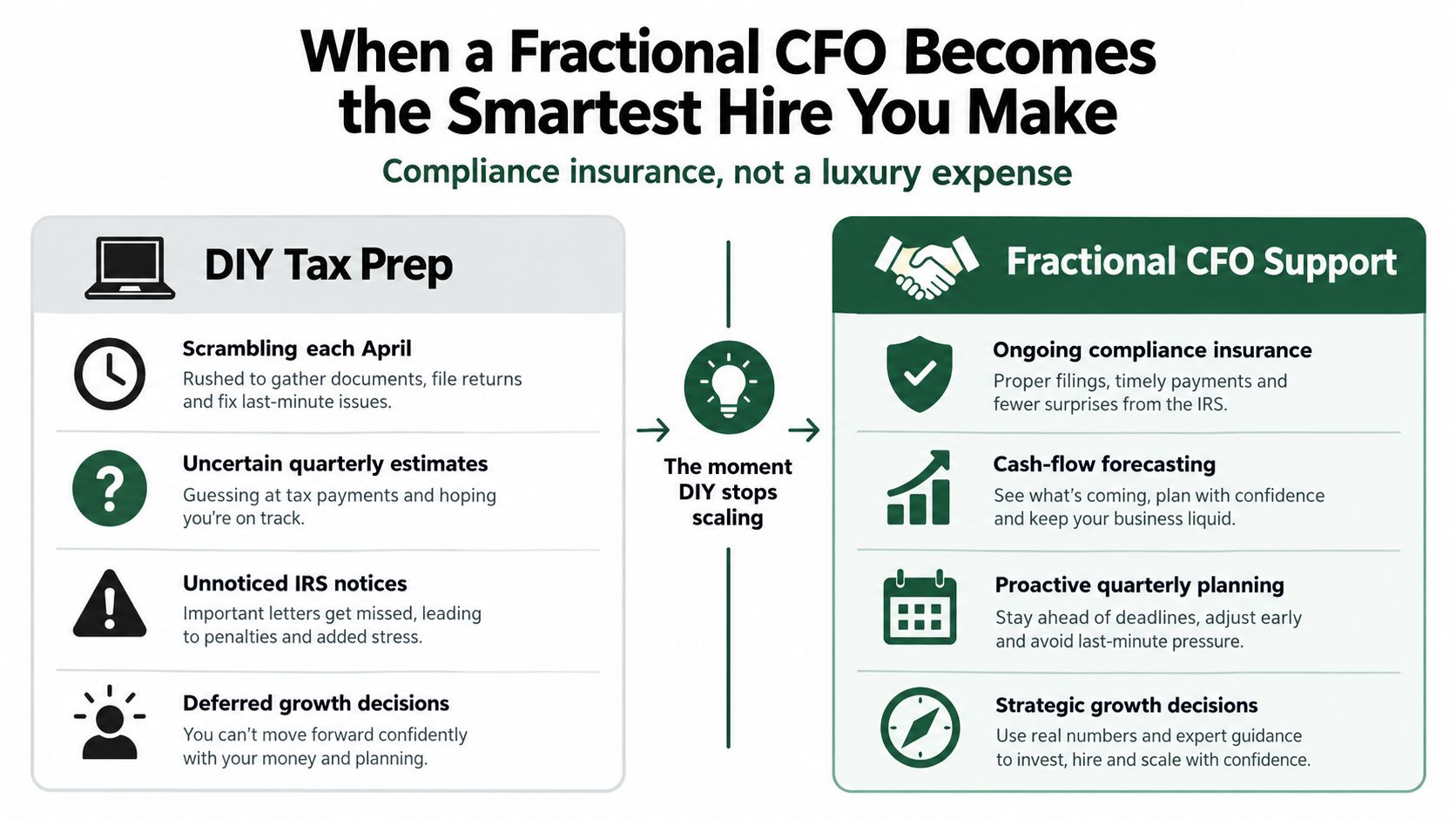
A fractional CFO gives a growing small business ongoing financial direction and decision support. The right question is not, “Can we file the return?” Ask whether you understand the numbers, know which cash is committed, and can see which decision may create the next tax or payroll issue.
A bookkeeper records activity. A tax preparer reports the completed year. A fractional CFO connects those functions by reviewing performance, forecasting cash, planning major purchases, monitoring margins, and coordinating tax information before deadlines. That connection matters when you are running payroll, signing contracts, hiring contractors, and making spending decisions without a dependable forward view.
The warning signs are operational
Outside financial leadership makes sense when:
- Estimated payments keep surprising you: Revenue changes, but nobody updates the payment plan.
- Payroll requires repeated corrections: Deposits, filings, and employee records do not reconcile cleanly.
- The books close only at tax time: You cannot explain current profit, debt, or available cash.
- Deductions are discovered too late: No process tracks equipment, vehicle use, research, or retirement planning.
- Growth decisions rely on guesswork: Hiring, pricing, expansion, and borrowing happen without a dependable forecast.
The fractional CFO model for small businesses uses part-time or contract financial leadership. The work may cover cash management, forecasting, budgeting, KPI reporting, tax reporting, and planning. Owners can also use fractional CFO support for small business forecasting and tax coordination without adding a full-time executive before the business needs one.
Compliance should support growth
A fractional CFO does not replace a qualified tax preparer. The CFO's job is to give that preparer complete, reconciled, well-documented information and explain the business decisions behind the figures. The CFO can also flag rule changes before they create filing surprises.
For the coming compliance cycle, reporting rules and expensing provisions are changing. A 2026 small-business tax report describes a restored higher 1099 reporting threshold and more favorable treatment for certain expensing provisions. It also warns that owners need to reconsider contractor reporting and capitalization decisions. Review the small-business tax enforcement and uncertainty report with your advisor before assuming last year's process still works.
Someone must own financial direction and compliance coordination. That person may be the owner, controller, CPA, or fractional CFO. If nobody fills that role, the business is leaving important decisions unmanaged.
Bookkeeping and Accounting of Florida Inc. provides bookkeeping, payroll, business tax preparation, tax planning, compliance support, and fractional CFO guidance for Jacksonville and Northeast Florida businesses. Visit Bookkeeping and Accounting of Florida Inc. to get your books reconciled, filing calendar organized, and year-round tax workflow under control.