
You're staring at a profitable month, a healthy-looking bank balance, and a stack of unpaid invoices, yet you still can't answer one basic question: Can this business make payroll and cover its bills next month? That situation is common among Jacksonville owners who are excellent at serving customers but have books that lag behind the decisions they need to make.
Thank you for reading this post, don't forget to subscribe!Financial statements for small business should do more than satisfy tax season. They should tell you whether pricing works, whether customers pay quickly enough, whether debt is manageable, and whether growth is affordable. Clean bookkeeping turns scattered transactions into information you can use this quarter.
Why Financial Statements Matter More Than You Think
A Jacksonville contractor may see strong deposits and assume business is thriving, while retainage and unpaid progress billings leave too little cash for payroll. A medical practice may report impressive revenue while insurance reimbursements remain outstanding. A retail owner may show profit but have cash tied up in inventory.
The problem isn't always low sales. Often, the owner is using unreliable numbers to answer questions those numbers can't support. A bank balance doesn't show unpaid bills. A profit and loss statement doesn't show when loan principal leaves the account. A tax return isn't a management dashboard.
The U.S. Small Business Administration describes the balance sheet as the foundation of financial management because it presents assets, liabilities, and owners' equity at a specific date. The SBA also explains that financial statements help owners monitor capital, account for costs such as employees and supplies, and develop cash-flow projections through its small-business management guidance.
What changes when the books are clean
Reliable monthly statements give you a consistent basis for decisions about:
- Pricing: See whether revenue covers direct costs, overhead, payroll, and financing.
- Hiring: Test whether a new employee fits the business's recurring cash capacity.
- Borrowing: Give a lender organized evidence instead of a last-minute spreadsheet.
- Expansion: Compare the cash requirements of a new location, service line, or equipment purchase.
- Collections: Identify customers whose unpaid invoices are absorbing working capital.
The shift is practical. Instead of asking, “Where did the money go?” you can ask, “Which customer segment is profitable, which costs are rising, and what will cash look like after payroll, taxes, debt payments, and owner distributions?”
Practical rule: If you can't explain your latest financial statements in plain English, you aren't ready to make a major financial commitment.
Most small-business stress traces back to delayed, incomplete, or poorly classified information. A disciplined monthly reporting process fixes that gap by connecting accounting records to decisions. The rest of the work is not about learning accounting theory. It's about knowing which report answers which question and making sure the report reflects reality.
The Three Core Financial Statements Explained
Start with the three reports every owner should recognize: the income statement, the balance sheet, and the statement of cash flows. Each answers a different question, and none can replace the others.
The income statement measures operating performance
The income statement, also called the profit and loss statement or P&L, covers a defined period. It lists operating revenue, returns or allowances, cost of goods sold, payroll, rent, insurance, marketing, professional fees, depreciation, interest, taxes, and other expenses. The result is net income or net loss.
Its question is simple: Is the business profitable during this period?
A service company may focus on service revenue, labor, subcontractors, and overhead. A retailer may need a clear cost-of-goods-sold section and gross profit. A more complex company may use a multi-step statement that separates operating results from non-operating income, interest, gains, and losses. If you want a practical walkthrough before reviewing your own report, how to build an income statement offers useful context.
The balance sheet shows financial position
The balance sheet is a snapshot at a specific date. Assets include cash, accounts receivable, inventory, prepaid expenses, equipment, and property. Liabilities include accounts payable, payroll liabilities, sales-tax obligations, credit cards, loans, and other amounts owed. Owners' equity reflects the owners' investment, accumulated results, and distributions.
Its question is: What does the company own, what does it owe, and what remains for the owners?
A balance sheet can expose trouble hidden by a profitable P&L. Receivables may be growing faster than collections. Inventory may be absorbing cash. Debt may be increasing while equity stagnates.
The cash-flow statement follows actual movement
The statement of cash flows explains why cash increased or declined. It organizes cash movement through operating activities, investing activities, and financing activities. Customer receipts, vendor payments, payroll, equipment purchases, borrowing, debt repayment, and owner distributions all matter.
Its question is: Can the company pay its obligations when they come due?
Cash and accrual accounting change the timing of reported activity. Under the cash method, transactions are generally recorded when money is received or paid. Under accrual accounting, revenue and expenses are recorded when the underlying sale or obligation occurs. The SBA notes that GAAP uses accrual-based reporting, although private companies aren't universally required to follow GAAP.
Read the reports together. The P&L tells you about performance, the balance sheet tells you about financial position, and cash-flow reporting tells you about liquidity.
Profit Is Not Cash and Why That Costs Owners Money
A profitable business can still run out of cash. That isn't an accounting contradiction. It happens when revenue is recorded before customers pay, inventory absorbs funds, vendors require faster payment than customers provide, or loan principal leaves the bank account without reducing the expense line on the P&L.
Use a cash reality bridge to reconcile the two views. Start with accounting profit, then adjust for:
- Increases or decreases in accounts receivable
- Inventory purchases and changes
- Accounts payable and other unpaid bills
- Loan principal repayments
- Payroll and sales-tax payments
- Owner draws and distributions
- Equipment purchases and other capital spending
The result is closer to the cash available for payroll, vendors, taxes, and operating reserves. For a deeper explanation of moving from accrual results toward cash understanding, the AmbitionCFO accrual to cash guide provides a useful reference.
Match each decision to the right report
| Decision | Primary report | What to inspect |
|---|---|---|
| Is pricing producing a margin? | Income statement | Revenue, direct costs, gross profit, operating expenses |
| Can the company support more debt? | Balance sheet | Cash, receivables, liabilities, equity, working capital |
| Can we make payroll and pay vendors? | Cash-flow report and forecast | Timing of receipts, payroll, taxes, debt, and vendor payments |
| Why did cash decline despite profit? | All three reports | Receivables, inventory, payables, principal, and distributions |
A rolling 13-week cash forecast is the owner's early-warning system. List expected customer receipts by week, then subtract payroll, taxes, rent, vendor payments, debt service, equipment purchases, and owner distributions. Update it as invoices move, customers delay payment, or expenses change.
For a plain-language refresher, how to read a cash flow statement can help you interpret the report before building the forecast.
Jacksonville contractors, healthcare practices, and seasonal companies need this discipline because billing cycles rarely match bank activity. A profitable P&L may support long-term analysis, but the cash forecast decides whether you can survive the next payment cycle.
How to Produce Monthly Statements That Actually Work
A monthly close shouldn't mean exporting a report and hoping the totals look reasonable. It should be a controlled process that confirms each major balance before management relies on the numbers.
Close the books in a fixed order
Use the same checklist every month:
- Reconcile bank and credit-card accounts: Match statement activity to the ledger and investigate unexplained differences.
- Clear uncategorized transactions: Assign each item an account, date, counterparty, tax treatment, payment status, and supporting document.
- Verify payroll liabilities: Confirm payroll taxes, benefits, garnishments, and other liabilities are recorded and paid correctly.
- Review accounts-receivable aging: Identify overdue invoices, disputed balances, credits, and customers who need collection attention.
- Match inventory or job costs: Tie materials, labor, subcontractors, and equipment costs to the right products or projects.
- Document unusual journal entries: Explain corrections, accruals, write-offs, and reclassifications.
- Tie the trial balance to the prior month: Investigate material changes instead of allowing unexplained fluctuations to roll forward.
The IRS states that business records should clearly show income and expenses and should be supported by invoices, receipts, deposit slips, paid bills, and canceled checks through its guidance on records small businesses should keep.
Build a reporting stack the owner will use
QuickBooks works well for everyday transactions when the chart of accounts, bank feeds, classes, customers, and projects are configured properly. Bookkeeping and Accounting of Florida Inc. is a certified QuickBooks ProAdvisor and can use QuickBooks as the transaction system, while supplemental spreadsheets handle job costing, grant tracking, or specialized operational details.
The owner shouldn't receive a dozen confusing reports. A practical monthly statement pack includes the P&L, balance sheet, cash-flow report, accounts-receivable aging, accounts-payable summary, and a short commentary page explaining unusual changes. The goal is a pack you can read in five minutes and discuss with your advisor.
Clean historical statements should also feed three scenarios:
- Base: Current pricing, staffing, collections, and operating assumptions.
- Downside: Slower collections, weaker sales, higher costs, or an unexpected repair.
- Growth: Additional staff, equipment, marketing, inventory, or location expenses.
The monthly close is valuable because it supports decisions before the year ends. For a practical overview of recurring reports, see monthly accounting reports.
Industry-Specific Notes That Generic Templates Miss
A generic financial statement can be mathematically correct and still be operationally useless. Industry timing, restricted funds, job costs, and reimbursement cycles determine whether the report helps an owner manage the business.
Healthcare practices
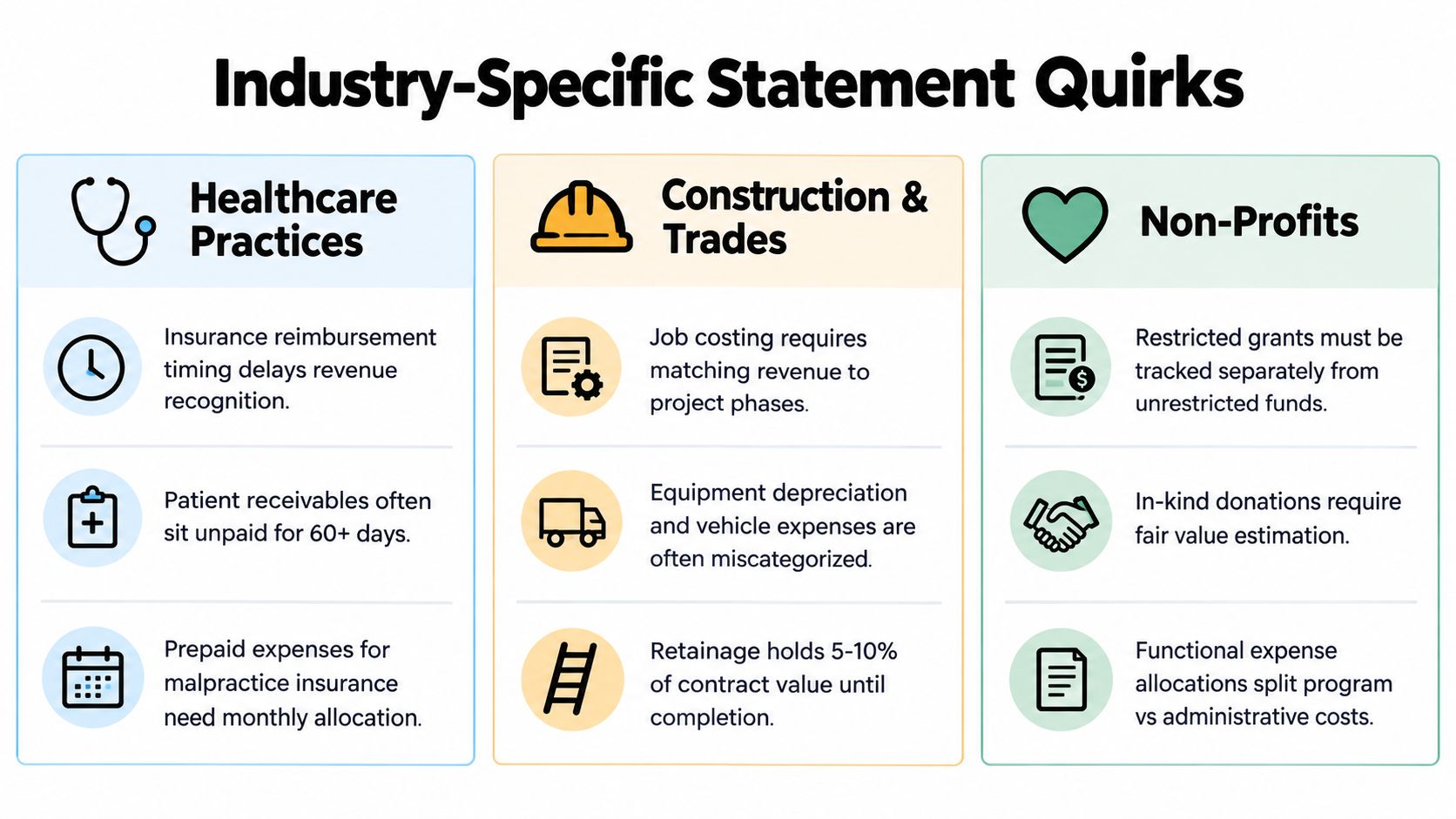
Healthcare accounting must separate patient receivables from insurance receivables and show the difference between services delivered and cash collected. Insurance reimbursement timing can delay cash after the practice has already paid clinical staff, rent, supplies, malpractice coverage, and technology costs.
A clinic should review payer aging, denials, contractual adjustments, patient balances, and collections by provider or service line. Payroll deserves special attention because clinical staffing often represents a substantial operating commitment. Prepaid insurance and similar costs also need proper allocation across the periods they cover.
Construction and trades
Construction statements need project-level visibility. Job costing should connect labor, materials, subcontractors, equipment, and allocated overhead to the correct project and phase. Progress billings and retainage can make revenue appear healthy while the company waits for cash.
Review work in progress, estimated costs to complete, billed versus earned revenue, change orders, retainage, and certified payroll reporting where applicable. Equipment depreciation and vehicle expenses also need consistent classification. A lender wants to know which jobs create margin, not merely whether total revenue increased.
Non-profit organizations
Non-profits must distinguish restricted and unrestricted funds. Grant tracking should show the funding source, permitted use, expenses charged, remaining balance, and supporting documentation. Functional expense reporting also separates program services, management and general expenses, and fundraising.
Donor restrictions create an audit trail requirement. The organization must connect contributions and grant spending to the restriction that governs them. A template that only shows total revenue and total expenses cannot answer whether funds were used properly.
The IRS requires electronic records to meet the same basic standards as paper records, including support for income, expenses, deductions, and credits. That makes source-document control essential across all three industries.
Common Mistakes and Red Flags That Cost Real Money
Most statement problems don't begin with fraud or a dramatic accounting failure. They begin with small shortcuts that make the reports less trustworthy each month.
Errors owners can spot early
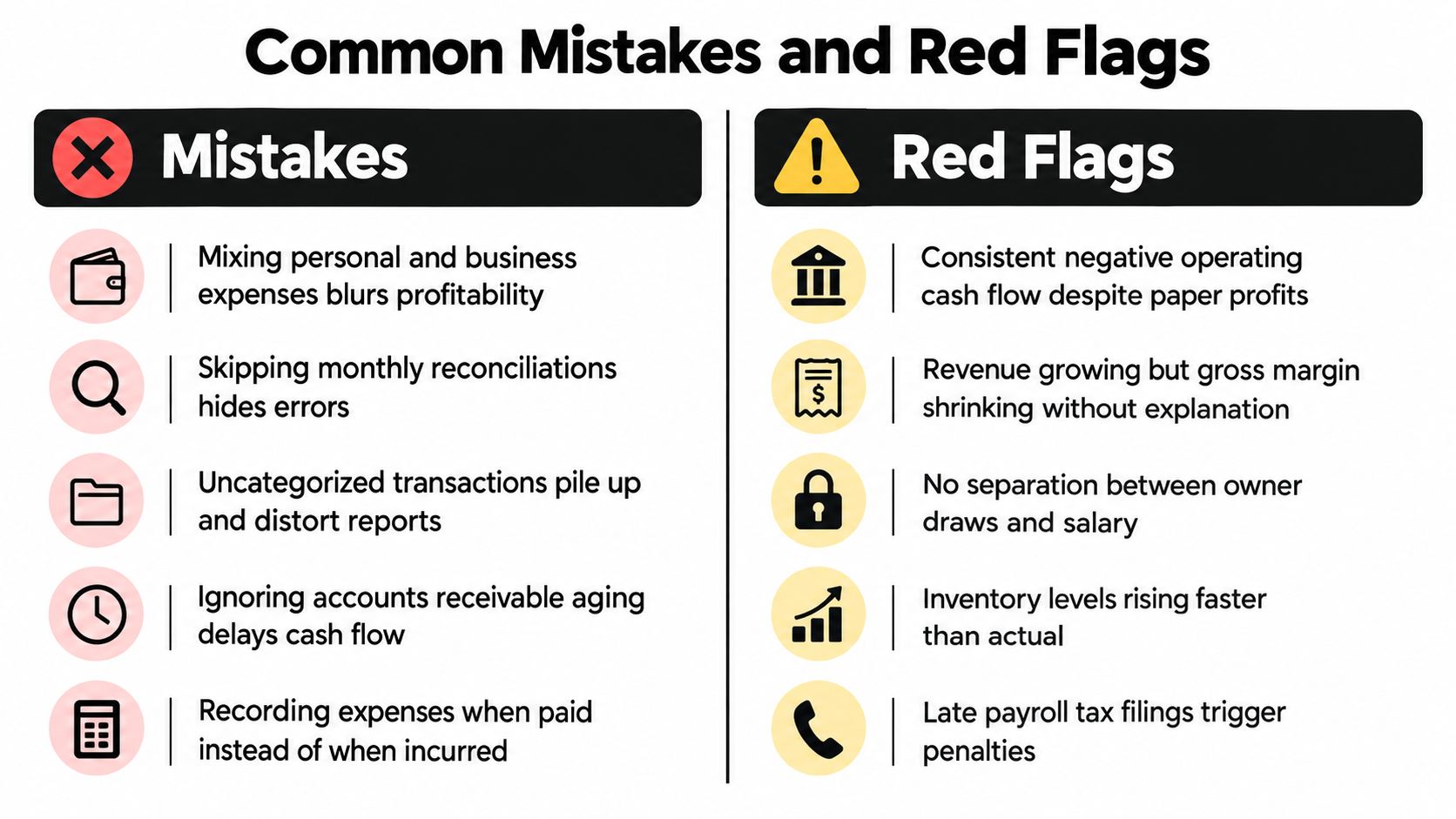
- Mixing personal and business expenses: The P&L becomes a record of spending rather than a measure of business performance. It also complicates tax support and makes lender review harder.
- Skipping reconciliations: Bank differences, duplicate entries, missing transactions, and unauthorized charges remain hidden.
- Letting uncategorized transactions accumulate: Revenue, expenses, owner activity, and tax classifications become unreliable.
- Ignoring sales-tax and payroll-tax liabilities: The balance sheet understates obligations, and late filings can create penalties and cash surprises.
- Treating owner draws as free money: Distributions reduce available cash and equity even when they don't appear as operating expenses.
- Allowing receivables to age: Revenue may look strong while overdue invoices consume the funds needed for payroll and vendors.
A healthy-looking P&L can't compensate for a balance sheet filled with unexplained accounts. The IRS explains in its recordkeeping publication that records must support the income, expenses, deductions, and credits reported on a return, and that employment-tax records generally need to be retained for at least four years.
Red flags that deserve a management meeting
| Red flag | What it may indicate |
|---|---|
| Negative operating cash flow despite reported profit | Slow collections, excess inventory, weak margins, or heavy working-capital needs |
| Revenue rising while gross margin falls | Pricing pressure, cost increases, job-costing errors, or product mix changes |
| No clear separation between owner draws and salary | Poor equity reporting and unclear personal compensation |
| Inventory increasing faster than sales | Cash trapped in stock, obsolete items, or purchasing discipline problems |
| Late payroll-tax filings | Compliance exposure and insufficient cash planning |
Don't treat these signals as personal failures. Treat them as prompts to investigate. The earlier you identify the cause, the more options you have before a lender, auditor, taxing authority, or vendor discovers it first.
When to Bring in a Fractional CFO and Real Bookkeeping Help
Every growing company needs senior financial guidance. Not every company needs a full-time CFO, but relying on the owner to handle bookkeeping, payroll, tax deadlines, financial analysis, and strategic planning is a poor substitute.
Bring in help when you're preparing for a bank conversation, responding to an audit notice, growing quickly, managing multiple entities, facing owner burnout, or dealing with recent tax law changes. Tax rules and filing requirements change, and most small-business owners don't know every recordkeeping, payroll, sales-tax, deduction, and reporting obligation that applies to their structure. Staying compliant requires more than downloading software.

What a fractional CFO actually does
A fractional CFO turns accurate bookkeeping into management action. Each month, that may include:
- Building and updating the rolling cash forecast
- Reviewing margins, collections, debt, and working capital
- Creating KPI dashboards for the owner and managers
- Preparing lender packages and answering financial questions
- Modeling base, downside, and growth scenarios
- Coordinating tax planning with the CPA and tax preparer
- Establishing controls for payroll, expenses, approvals, and reporting
- Explaining what changed and what decision should follow
A CFO doesn't replace the bookkeeper. The bookkeeper maintains the transaction foundation. The CPA oversees tax, compliance, and assurance work. The fractional CFO interprets the numbers and helps the owner decide what to do next.
If you're comparing providers, this guide on how to find a fractional CFO for your service explains the role and the questions worth asking.
The right arrangement gives a small business access to senior judgment without full-time CFO overhead. For Jacksonville companies, fractional CFO services for small business can sit alongside bookkeeping, payroll, tax preparation, financial statement work, reviews, and audits.
Bookkeeping and Accounting of Florida Inc. provides bookkeeping, payroll, tax preparation, internal and independent audits, reviews, healthcare accounting, forensic audits, and fractional CFO support for companies in Jacksonville and Northeast Florida. The practical advantage is coordination. Your books, tax filings, financial statements, and forward-looking planning can use the same underlying records instead of forcing you to reconcile separate providers.
Recent tax law changes make that coordination more important. Don't wait until a tax surprise, audit request, or lender deadline exposes missing documentation. Have a CPA review your current chart of accounts, payroll process, sales-tax treatment, record retention, and reporting cadence this quarter.
Your Next Step Toward Clean Statements and Real Confidence
Clean financial statements aren't an annual project. They come from a monthly rhythm that your team can repeat:
- Reconcile bank, credit-card, payroll, receivable, payable, debt, and inventory accounts.
- Review the P&L, balance sheet, cash flow, aging reports, and unusual variances.
- Forecast cash through the next 13 weeks using realistic receipts and required payments.
- Decide what to change in pricing, collections, staffing, spending, borrowing, or distributions.
That sequence turns accounting into a management tool. The income statement shows whether the work makes money. The balance sheet shows whether the company can carry its obligations. The cash forecast shows whether the business can meet them on time.
Start this quarter by requesting a clean monthly statement pack and asking someone qualified to explain every material change. If your records aren't reconciled, your receivables are aging, or your tax and payroll liabilities are unclear, fix the accounting foundation before making a major expansion decision.
You don't need to solve every accounting issue alone. A CPA firm that combines bookkeeping, tax, compliance, financial statements, and fractional CFO guidance can help you move from annual panic to monthly control.
Bookkeeping and Accounting of Florida Inc. prepares reliable financial statements, bookkeeping, payroll, tax filings, audits, reviews, and fractional CFO reporting for Jacksonville and Northeast Florida businesses. Visit Bookkeeping and Accounting of Florida Inc. to schedule a conversation about cleaning up your books, building cash visibility, and staying compliant this quarter.