
You're a Jacksonville contractor checking your bank balance before approving payroll. There's more money in the account than last month, but your profit-and-loss report looks worse, and your bookkeeper says customers still owe you. Before you hire another crew or buy equipment, you need to know which money is available, which belongs to upcoming obligations, and whether the work you're doing actually makes a profit.
Thank you for reading this post, don't forget to subscribe!The Financial Picture Every Business Owner Should See
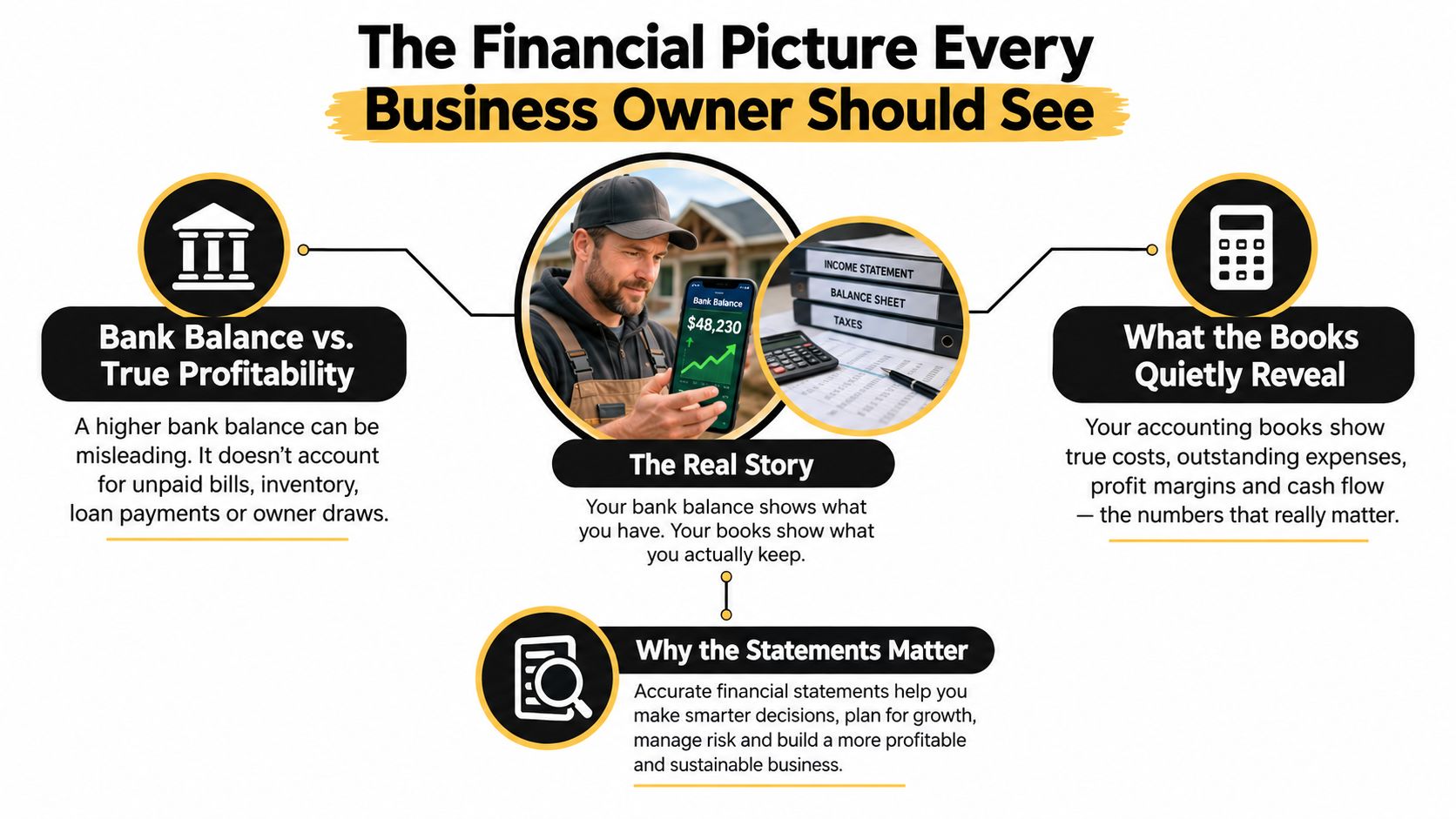
Your bank balance isn't a business performance report. It tells you what's in an account, not whether your pricing works, whether customers are paying promptly, or whether you can afford your next commitment.
When owners ask, “What are the financial statements in accounting?” they're usually asking something more practical: Can I trust what my books say, and what should I do next? The answer starts with a connected reporting package: the balance sheet, income statement, cash flow statement, and statement of changes in equity.
Don't choose whichever report makes the business look healthiest. Use the package to separate financial position, profitability, cash movement, and ownership changes.
Start with the decision, not the bank app
Before approving a major expense, ask your accounting team to connect the decision to these questions:
- Pricing: Does the work produce enough profit after its costs?
- Hiring: Can the business support the added commitment when collections slow?
- Financing: Are you funding a productive investment or covering a recurring shortfall?
- Owner withdrawals: What can you take without leaving the business short?
The same discipline applies to a healthcare practice waiting on reimbursements, a retailer buying inventory, or a Northeast Florida nonprofit planning program spending. Different operations, same need for dependable financial information.
This visual separates what you see in the bank from what you need to understand in the books.
Make monthly reporting a management habit
The IRS explanation of business financial statements and recordkeeping connects accurate records with financial statements, tax-return preparation, and dealings with banks or creditors. That's a practical reason to keep your accounting current, not just a filing-season concern.
My recommendation is straightforward: get reliable monthly financial statements and schedule time to review them. Ask about unexpected changes before approving spending, changing prices, or signing a loan.
You don't need to become an accountant. You need an accounting service that produces clear reports and someone who translates them into decisions you can act on Monday morning.
The Four Statements That Tell Your Money Story
The SEC's guide to financial statements identifies four primary financial statements: the balance sheet, income statement, cash flow statement, and statement of shareholders' equity. The balance sheet rests on the accounting relationship Assets = Liabilities + Equity.
Each report answers a different question. Read them together, but understand what each one is designed to show.
Position and performance
The balance sheet shows what you own and owe on a specific date. Its assets include resources such as cash, receivables, and equipment; liabilities show obligations; equity represents the owners' remaining claim.
A simple layout looks like this:
Assets → Liabilities → Owners' equity
Use it before taking on debt or making a large purchase. Ask whether the business has the resources to meet its obligations, not merely whether the account has money today.
The income statement, often called a profit-and-loss statement or P&L, reports revenue, expenses, and net income or loss over a period. It's where you evaluate whether your operations are profitable.
Its basic layout is:
Revenue → Expenses → Net income or loss
If sales increase but earnings don't, investigate pricing, direct costs, and overhead before celebrating growth.
Cash and ownership
The cash flow statement reports actual cash inflows and outflows across operating, investing, and financing activities. Use it to distinguish cash generated by operations from cash supplied by lenders or owners.
Its layout is:
Operating cash flows → Investing cash flows → Financing cash flows → Ending cash
The statement of changes in equity explains how ownership capital changed through earnings, contributions, distributions, dividends, or share repurchases. It helps you understand whether owners are building capital or withdrawing it.
Its layout is:
Beginning equity → Earnings and owner-related changes → Ending equity
The Four Primary Financial Statements at a Glance
| Statement | Question It Answers | Key Components | Review Cadence |
|---|---|---|---|
| Balance sheet | What do we own and owe? | Assets, liabilities, equity | Monthly management review |
| Income statement | Did we make money? | Revenue, expenses, net income | Monthly, with period comparisons |
| Cash flow statement | Where did cash come from and go? | Operating, investing, financing activity | Monthly, alongside cash planning |
| Equity statement | How did owners' capital change? | Beginning equity, earnings, contributions, distributions | Monthly close and ownership changes |
These review cadences are recommendations, not universal filing requirements. Nonprofit boards can also consult Grantlas' guide to nonprofit financial reports for boards when organizing their reporting discussions.
Don't overlook notes to the financial statements. They explain accounting policies, commitments, and unusual items that the report lines alone can't adequately describe.
Why a Profitable Business Can Still Run Out of Cash
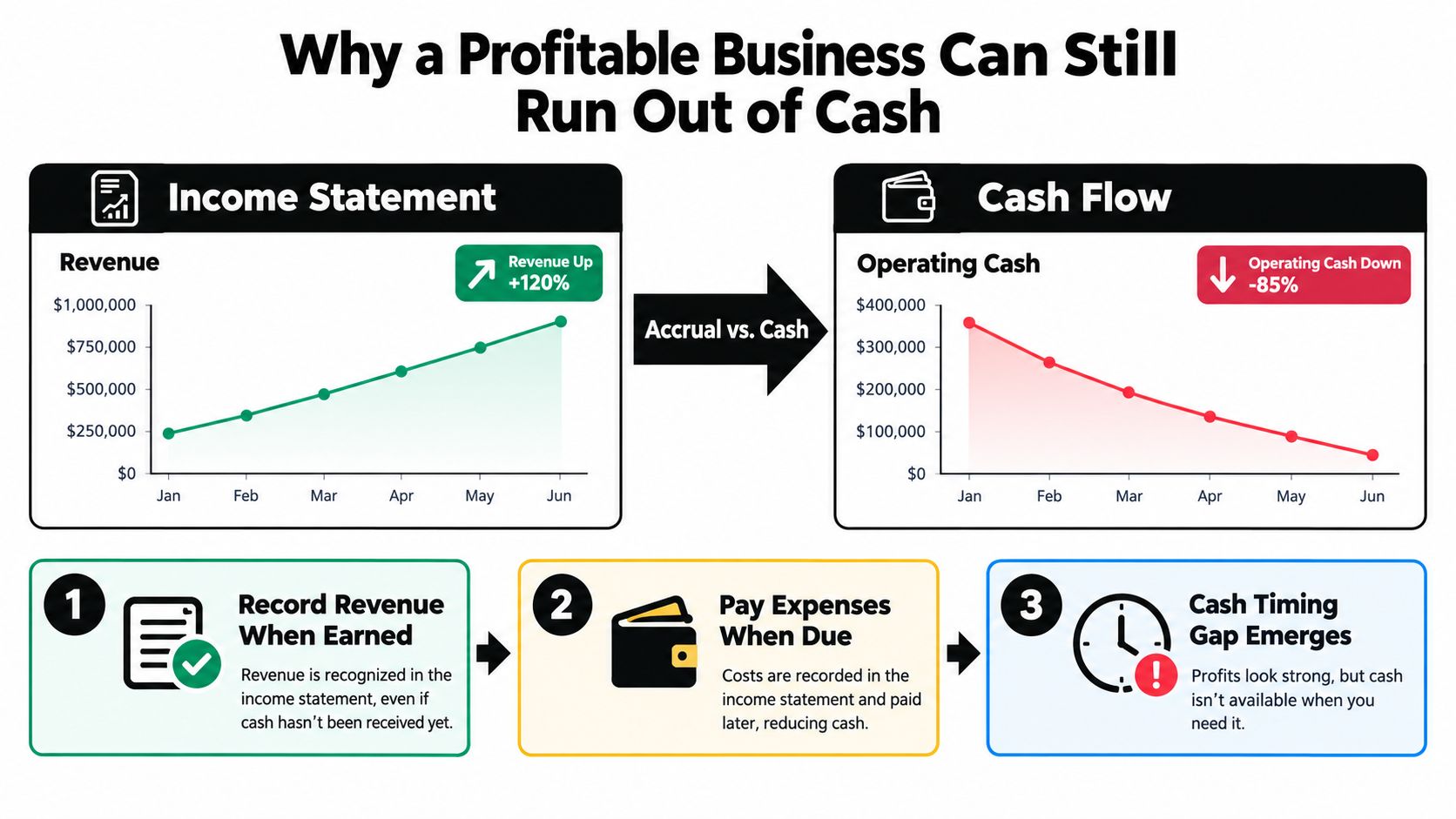
Profit isn't spendable cash. Under accrual accounting, an owner can earn revenue before collecting payment. Debt principal payments and equipment purchases also affect cash without generally becoming current-period expenses in the same way ordinary operating costs do.
The timing gap looks like this.
Follow a job from invoice to payment
Consider a hypothetical contractor completing more profitable work while customers take longer to pay. Revenue and net income rise, but receivables grow because the invoices haven't been collected.
Meanwhile, the contractor pays crews and suppliers. Operating cash falls because cash payments exceed operating collections, even though the income statement reports a profit.
The contractor also finances equipment and faces an upcoming tax payment. Those commitments create additional cash demands; equipment financing doesn't fix the collection problem, and the tax payment belongs in the forecast until it's paid.
A profitable job can still create a cash shortage if you must pay everyone else before the customer pays you.
Match your response to the cause:
- Slow collections: Assign responsibility for overdue invoices and resolve billing disputes.
- Unhelpful payment terms: Seek deposits or progress payments where appropriate.
- Excess inventory: Reduce purchasing that ties up cash unnecessarily.
- A genuine timing gap: Evaluate financing before you're forced to borrow urgently.
Separate history from the next payroll
The FDIC's cash flow management guidance distinguishes a historical statement, which reports cash already received and paid, from a projection, which estimates future cash movements. A 13-week cash forecast is a management tool for that forward-looking work, not a substitute for the historical statement.
Use the forecast when payroll, retainage, reimbursements, seasonal collections, or tax payments create uncertainty. Enter expected receipts by realistic payment date, list upcoming obligations, and update assumptions when circumstances change.
Our explanation of why cash flow management is important provides further context for turning those timing issues into a routine management process.
Use the video below as a companion to your cash flow discussion.
Key Metrics Small Business Owners Should Watch Every Month
Don't build a dashboard packed with numbers nobody uses. Select metrics that answer questions about pricing, collections, liquidity, and borrowing, then assign someone to investigate unfavorable changes.
The SBA's financial management guidance describes the balance sheet as a snapshot and foundation for tracking capital, assets, liabilities, equity, costs, and projected cash flow. Your management dashboard should turn that foundation into specific questions.
Build a decision-focused dashboard
The formulas below are working definitions for your management reports. Have your accountant document the inputs so comparisons remain consistent.
| Metric | Working Calculation | Report Inputs | Action Signal |
|---|---|---|---|
| Gross profit margin | Gross profit divided by revenue | Income statement | Direct costs are consuming more sales revenue |
| Net profit margin | Net income divided by revenue | Income statement | Overhead or other expenses are reducing earnings |
| Current ratio | Current assets divided by current liabilities | Balance sheet | Short-term obligations are growing faster than available resources |
| Quick ratio | Cash, short-term investments, and receivables divided by current liabilities | Balance sheet | Liquidity depends heavily on inventory or slow collections |
| Debt-to-equity | Total liabilities divided by equity | Balance sheet | Borrowing is increasing relative to owner capital |
| Days sales outstanding | Average receivables divided by credit sales, multiplied by days in the period | Balance sheet and sales records | Customers are taking longer to pay |
| Operating cash flow coverage | Operating cash flow divided by the obligations being assessed | Cash flow statement and liability records | Operations aren't generating enough cash for those commitments |
Use context instead of universal targets
There isn't a defensible healthy threshold for every business in every industry. A contractor's equipment financing, a nonprofit's funding restrictions, a clinic's reimbursement cycle, and a retailer's checkout collections call for different interpretations.
Compare your results with relevant industry benchmarks and your own prior periods. Investigate changes rather than chasing a ratio that looks impressive.
Dashboard rule: If a metric doesn't change a decision, it probably doesn't belong on your main dashboard.
For subscription businesses, Chartsy SaaS financial metrics offers a sector-specific resource to consider alongside accounting reports. Our guide to accounting key performance indicators can help you frame a more focused discussion with your financial advisor.
How the Statements Connect Into One Reporting Package
Reports that don't reconcile aren't ready for management decisions. Ask your accounting team to explain the connections, not just email separate PDFs with familiar titles.
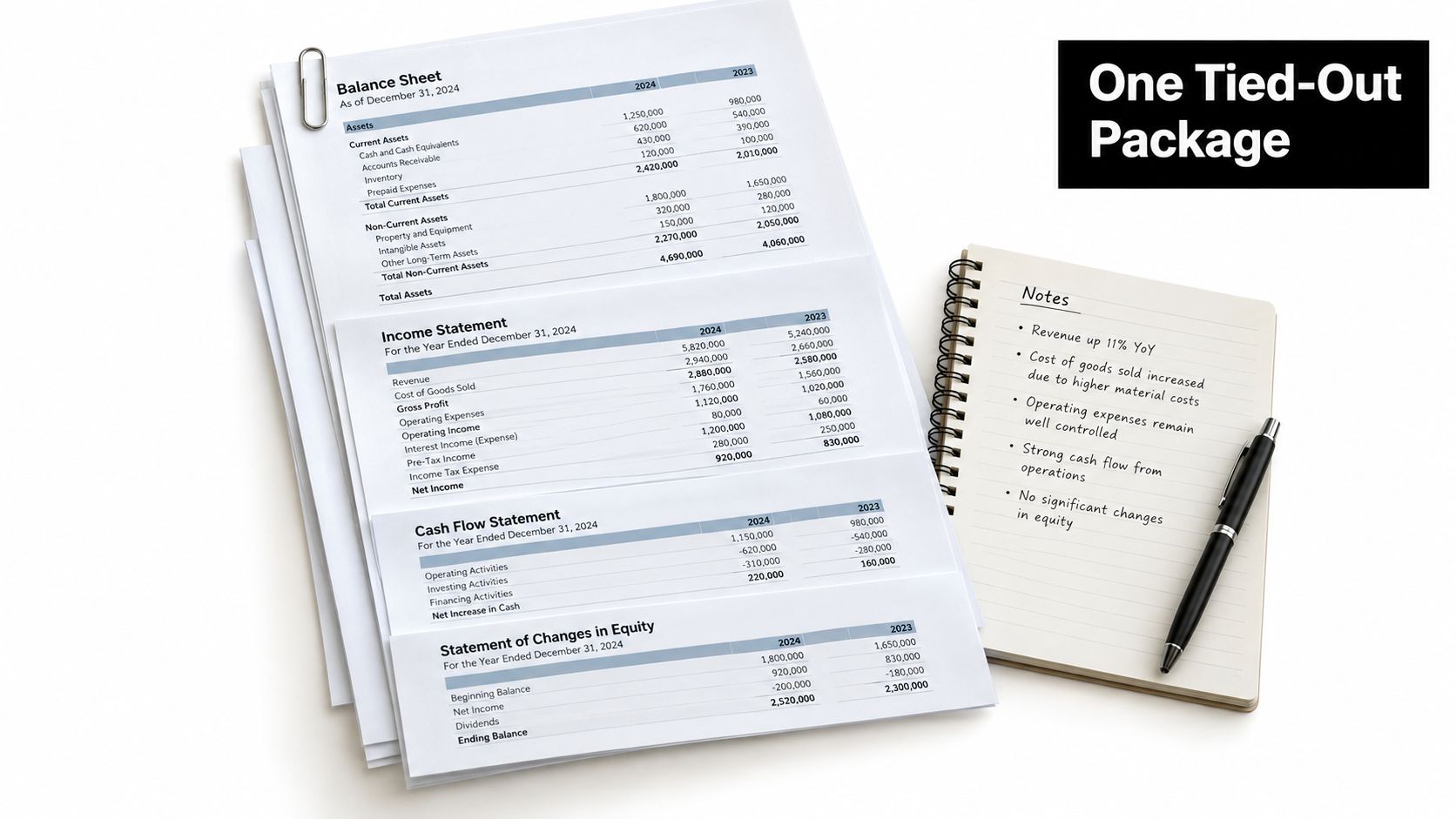
A reporting package should be organized for review as a whole.
Check the connections
Net income feeds the equity reconciliation through retained earnings or the applicable accumulated earnings account. Owner contributions and distributions must explain additional changes rather than being confused with operating revenue or expenses.
Ending cash on the cash flow statement should reconcile to the corresponding balance-sheet cash amounts. Unexplained differences deserve investigation before you use either report.
Have your reviewer check these relationships:
- Earnings to equity: Does the reported profit or loss agree with the equity movement?
- Cash to financial position: Does ending cash reconcile across the package?
- Supporting schedules to balances: Do receivable, payable, and debt details support the reported totals?
- Unusual changes to documentation: Can the team explain significant transactions and adjustments?
Compare periods and read the notes
Under IAS 1 presentation requirements, a complete set includes financial position, profit or loss and other income, changes in equity, cash flows, and explanatory notes. Its comparative requirements generally call for two statements of each type, together with related notes for the reporting and comparative periods.
That structure lets you examine change instead of judging a single snapshot. For management purposes, ask what changed, why it changed, and whether the change was expected.
Notes provide context about measurement methods, accounting policies, commitments, and unusual transactions. Management reports should also document how adjusted or non-GAAP measures reconcile to reported results.
A misclassified transaction can distort several statements at once. Accurate bookkeeping is foundational, while fractional CFO review adds questions about commercial meaning: Does this movement make sense given sales, purchasing, staffing, and borrowing?
A completed month-end close isn't the same as a completed management review. Require both before relying on the package for a major decision.
Compliance and Tax Law Changes That Raise the Stakes
Compliance starts with supporting records, not a finished tax return. A clean-looking P&L doesn't prove that expenses are properly documented or that payroll records are complete.
The IRS business recordkeeping requirements require books that clearly show income and expenses and support tax-return items. Electronic records must be complete, accurate, and accessible, and employment-tax records generally must be retained for at least four years.
Put responsibility behind the records
Create a workflow that connects transactions to their supporting documents:
- Sales and purchases: Retain invoices, receipts, and relevant transaction support.
- Payroll: Keep employment-tax records organized and reconcile payroll activity.
- Expense classifications: Resolve unclear charges before they reach tax preparation.
- Retention and access: Assign responsibility for keeping documents retrievable.
Monthly statements are my recommended compliance-supporting practice, not a blanket federal requirement that every company issue the same reports monthly. Your actual obligations depend on your entity, activities, agreements, and reporting framework.
Apply current tax guidance to clean books
IRS Publication 334's guidance for 2026 identifies a $184,500 maximum amount of net self-employment earnings subject to the Social Security portion of self-employment tax and a 72.5-cent business mileage rate.
That same publication describes changes under Public Law 119-21, known as the OBBBA, including permanent extension of the 20% qualified business income deduction, increased QBI limitation income thresholds, and permanent extension of the excess business-loss deduction disallowance with inflation-indexed thresholds for tax years beginning after 2025.
Those provisions don't mean every owner qualifies for every benefit. Applying them requires correctly categorized expenses, reliable owner-income information, and an assessment of the rules that apply to the business.
Ask your CPA to review mileage documentation, owner income, deduction eligibility, and estimated tax needs while you can still make informed decisions. Don't assume bookkeeping software has evaluated your tax position.
Compliance checkpoint: Someone must own the deadline, the supporting records, and the review. A reminder on your phone isn't a control system.
Waiting until filing season compresses investigation and planning into a deadline-driven exercise. Ongoing business accounting gives your advisor usable information sooner and gives you a clearer path to staying compliant.
Why Most Growing Companies Need a Fractional CFO
Every company needs someone accountable for financial guidance. That doesn't mean every startup needs an outside executive engagement immediately, but growing companies shouldn't leave senior financial decisions to the owner's instincts alone.
Bookkeeping records what happened. Fractional CFO guidance helps you decide what to do about it. Our fractional CFO consulting services provide an option for obtaining that guidance without adding a full-time executive position.
Match the advisor to the decision
Pricing needs an assessment of margins and operating capacity. Hiring needs a budget and a realistic view of future commitments, while financing needs a plan for repayment rather than an optimistic sales assumption.
Owner compensation, tax strategy, and growth investment also need coordinated analysis. Ask your advisor to connect those decisions instead of treating each as a separate conversation.
Evaluate a fractional CFO engagement by its deliverables:
- Decision support: Written assumptions behind hiring, expansion, or financing recommendations.
- Accountability: Named owners for collections, budget variances, and unresolved reporting issues.
- Planning: Forecasts and scenarios you can update as conditions change.
- Coordination: Alignment between bookkeeping, payroll, tax preparation, and management.
Reporting rules don't stand still
For businesses with international reporting relationships, the IFRS summary of reporting changes describes IFRS 18's defined profit-or-loss subtotals, management-defined performance measure disclosures, and aggregation principles, with a scheduled future effective date for annual periods beginning on or after January 1, 2027. It also identifies annual improvements effective January 1, 2026 involving IFRS 7, IFRS 9, IFRS 10, and IAS 7.
Identify whether your reporting basis is U.S. GAAP or IFRS and whether lender or parent-company requirements apply. Don't change systems blindly.
A fractional CFO pays for itself only when the value of better decisions, avoided problems, and useful oversight exceeds the engagement's cost. Start with a scoped review; its most useful deliverable may be a prioritized list of obligations and financial issues you haven't yet identified.
Your 30-60-90 Day Plan to Make the Statements Work for You
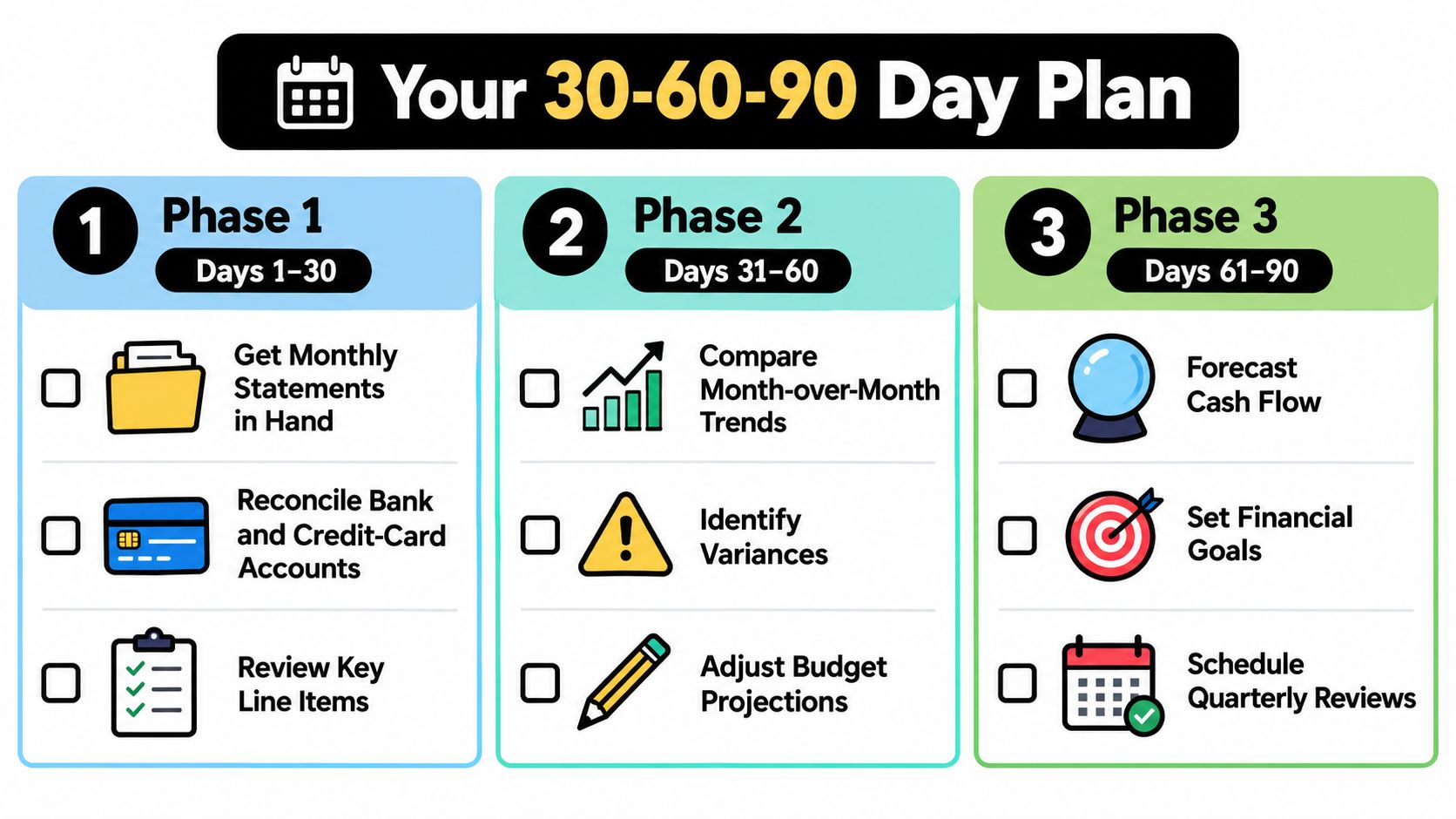
Don't try to repair the books, redesign reporting, and build a growth strategy in the same afternoon. Use this proposed 30-60-90 day plan to establish reliable information first, then decision-making discipline.
The checklist gives you a practical sequence.
First phase establishes reliable books
Get your current monthly reporting package in hand. Reconcile bank and credit-card accounts, review the chart of accounts, and identify balances nobody can explain.
If you use QuickBooks, have a qualified accounting professional review the setup and transaction classifications. Software can organize records, but your team still needs to verify the underlying information.
- Assign the work: Name who supplies documents, reconciles accounts, and approves adjustments.
- Resolve old questions: Collect missing support and investigate uncleared transactions.
- Set the routine: Agree on a recurring close and review schedule.
Second phase adds operating discipline
Build the dashboard around the decisions you face. Compare trends, identify budget variances, and put the cash forecast into a recurring review.
Require explanations that lead to action. “Expenses increased” isn't enough; identify the spending category, responsible person, and whether the budget needs changing.
Third phase connects reporting to strategy
Schedule quarterly tax-planning discussions and review owner compensation with your CPA. Use fractional CFO guidance to evaluate financing, growth investment, and the budget assumptions behind those choices.
Choose support according to your needs: internal accounting staff, an outside CPA firm, and fractional financial leadership can each play a role. Require clear responsibilities so important work doesn't fall between providers.
Accurate, timely financials aren't paperwork to file and forget. They're the operating information a Jacksonville business owner needs to make commitments deliberately, prepare for obligations, and recognize problems before the next payroll run.
Bookkeeping and Accounting of Florida Inc. offers bookkeeping, financial statement preparation, payroll, tax preparation, and fractional CFO guidance to connect your reports with business decisions. Visit Bookkeeping and Accounting of Florida Inc. to discuss your current books, unexplained balances, and the reporting and compliance support your business needs.