
You're probably staring at clean sales, messy books, and a bank balance that doesn't match the confidence in your next growth move. That's where fractional CFO consulting services earn their keep, not by adding more reports, but by giving owners a real financial control system that survives payroll, tax deadlines, expansion decisions, and cash squeezes.
Thank you for reading this post, don't forget to subscribe!A fractional CFO is the bridge between bookkeeping and a full-time finance executive. The model fits growing companies that need budgeting, forecasting, cash-flow planning, reporting, and financial strategy without hiring a permanent CFO, and the survey evidence points to smaller organizations as the main users. In a 2026 CFO Connect benchmark of 516 senior finance leaders across major markets, 89% of fractional CFOs primarily served businesses with fewer than 250 employees (fractional CFO statistics), which tells you exactly who this service is built for.
The situation is straightforward. If your business has outgrown basic accounting but can't justify a full-time executive, you need senior financial judgment on a part-time basis, not another spreadsheet hobby.
Scaling Up and the Fractional CFO Role
A business can look healthy on paper and still be one bad close away from trouble. Sales grow, receivables stretch, vendors expect payment, payroll gets heavier, and cash starts moving in ways the owner did not plan for. A fractional CFO steps into that pressure point and gives the business financial direction that can be acted on.
The role works because one seasoned finance leader can serve several companies at once. In the 2026 CFO Connect benchmark, 51% of fractional CFOs worked with three to four clients simultaneously, while 26% worked with two clients and 16% served five or more (fractional CFO statistics). That structure is why the model fits growing companies that need senior judgment without adding a full-time executive to payroll.
A practical overview is available in fractional CFO services explained. The point is simple. The fractional CFO sits between bookkeeping and a permanent finance leader, and that only works when the numbers are clean enough to trust.
Cloud accounting, remote collaboration, and automated reporting made this model more workable. Industry estimates put the U.S. fractional CFO addressable market at approximately $3.2 billion in 2026 and project it to $6.4 billion by 2028 (fractional CFO demand growth). Analysts also project the global virtual CFO market at $4.7 billion in 2026 and above $10 billion by 2035.
Treat those as estimates, not official counts. The larger point is unchanged. Businesses want experienced financial leadership without full-time overhead, and they want it before cash management slips out of control. That is also why clean, compliance-ready bookkeeping matters first. Bookkeeping and Accounting of Florida Inc. provides the accounting foundation that makes strategic CFO work possible. Without that groundwork, forecasts are guesswork and decisions carry avoidable risk.
Core Deliverables That Drive Business Decisions
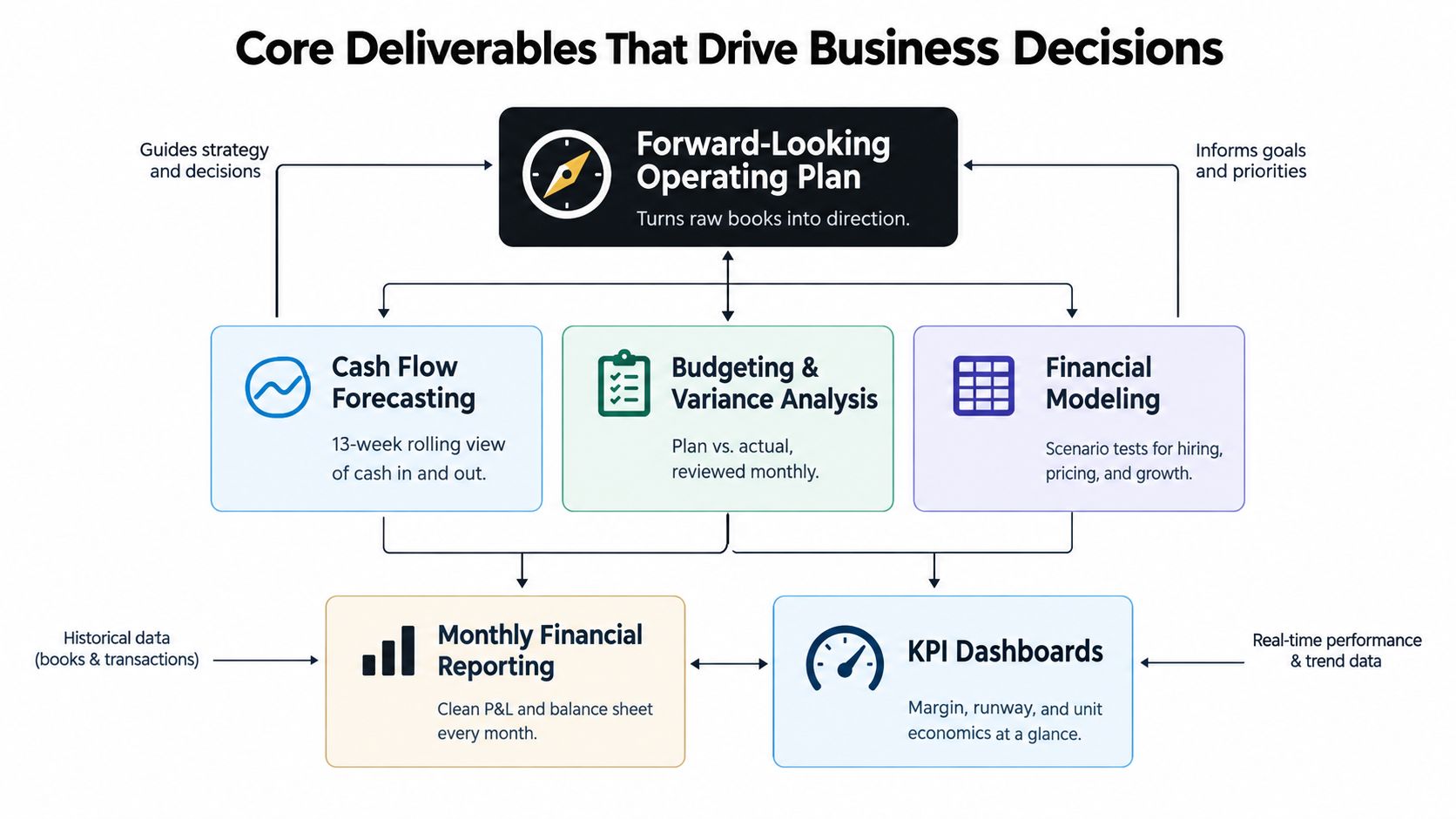
A fractional CFO should not just explain last month's results. The job is to build a forward-looking operating plan that helps owners decide what to spend, what to delay, what to collect, and what to question. If the work doesn't change decisions, it's reporting, not CFO support.
Cash flow comes first
The most practical deliverable is a 13-week rolling cash-flow forecast. Deloitte identifies that model, along with operational dashboards, prioritized initiatives, and overlaid forecasts, as core parts of structured cash and working-capital work (Deloitte cash and working-capital optimization). That matters because timing risk kills businesses faster than theoretical profitability.
A good forecast links expected collections, payroll, vendor payments, debt service, and discretionary spending by week. It should be refreshed weekly, tied to actual bank activity, and owned by named people inside the business. If a business can't explain why next week's cash balance changes, it's flying blind.
The reporting stack that owners can use
Cash forecasting works best when it sits on top of disciplined reporting. That means a monthly close calendar, KPI dashboards, budget-versus-actual review, and exception reporting that flags unusual activity instead of burying it. The point isn't prettier charts, it's tighter control.
A strong finance partner also makes the model decision-grade, not decorative. Owners should be able to look at margin, runway, working capital, and scenario assumptions without needing a decoder ring.
Bottom line: if a report doesn't lead to a decision, cut it or redesign it.
For businesses preparing for fundraising, expansion, new equipment, or a pricing reset, this structure matters even more. Strategic plans fail when the underlying numbers are late, incomplete, or too vague to trust.
Why Clean Books Must Precede Strategic Forecasting
Dashboards and AI don't rescue bad data. If bank feeds are broken, reconciliations are stale, or the chart of accounts is a mess, a forecast just gives bad numbers a cleaner presentation. That's why the hidden prerequisite of fractional CFO consulting services is clean, compliance-ready bookkeeping.
Data readiness is the gatekeeper
A fractional CFO should start with a finance-function diagnostic, not a fancy model. The work should test reporting-cycle speed, chart-of-accounts design, inventory or work-in-progress valuation, margin reliability, cash controls, and the link between operating metrics and financial results. Weak segregation of duties and sloppy approval procedures can distort cash and expense reporting, while poorly classified direct costs can wreck gross margin and lead to bad pricing or project decisions.
This is especially true for healthcare practices, contractors, and multi-location businesses. Timing differences, retainage, payroll liabilities, patient receivables, and job costs can all make a business look healthier or weaker than it really is. If the books can't support the forecast, the forecast should wait.
Repair the system before buying the strategy
That is why the first fix is often bookkeeping cleanup, not advisory polish. If your accounting is lagging, an internal diagnostic should confirm whether the business has current bank feeds, reconciled accounts, accurate AR aging, clean payables, payroll liability tracking, inventory or work-in-progress clarity, and a usable chart of accounts. A simple way to start is with a cleanup process like how to clean up QuickBooks Online.
More dashboards won't help if nobody trusts the inputs.
Recent SMB research found that nearly two-thirds of surveyed businesses couldn't access current cash positions across their accounts, and 20% had delays of days or weeks getting that information (CFO.com SMB paperless and cash visibility research). That's the core issue. Before you pay for strategic forecasting, make sure the books can tell the truth.
Navigating Tax Law Changes and Industry Compliance
Small businesses don't usually fail because they ignored strategy. They fail because they missed compliance details they didn't know mattered. The tax side of fractional CFO consulting services is where expert oversight saves time, money, and embarrassment.
What changed and why it matters
Beginning with payments made after December 31, 2025, the federal information-reporting threshold for certain business payments rises from $600 to $2,000 (IRS information-reporting threshold). That changes how many businesses approach Form 1099-NEC and Form 1099-MISC, but it does not remove recordkeeping duties. Vendor classification, taxpayer identification information, payment coding, and annual totals still need to be tracked correctly.
The IRS also requires a recordkeeping system that clearly shows income and expenses, with books summarizing transactions and showing gross income, deductions, and credits. Supporting records include sales slips, paid bills, invoices, receipts, deposit slips, and canceled checks, and employment-tax records generally must be retained for at least four years (IRS recordkeeping rules). If your records are a pile of PDFs and bank screenshots, you're not compliant, you're hoping.
Industry realities change the accounting
Different businesses need different controls. Construction firms need job costing, retainage tracking, and clean payroll classification. Healthcare clinics need disciplined patient receivables and privacy-aware reporting. Nonprofits need grant restrictions, audit trails, and reporting discipline that matches the funding terms, not just the bookkeeping software.
A fractional CFO helps the accounting team set rules, review year-end reports, and keep 1099 preparation organized. A useful companion to that process is tax preparation for businesses, especially when the year-end scramble is still part of the operating culture.
Tax planning also changed for pass-through entities. For tax years beginning in 2026, IRS Revenue Procedure 2025-32 sets the Section 199A threshold at $403,500 for married taxpayers filing jointly, with a phase-in range up to $553,500; for all other returns, the threshold is $201,750 with a phase-in range up to $276,750 (IRS Revenue Procedure 2025-32). Those numbers affect compensation, taxable income, and investment decisions, so they need to be tracked during the year, not guessed at after year-end.
Evaluating the Investment in Fractional Leadership
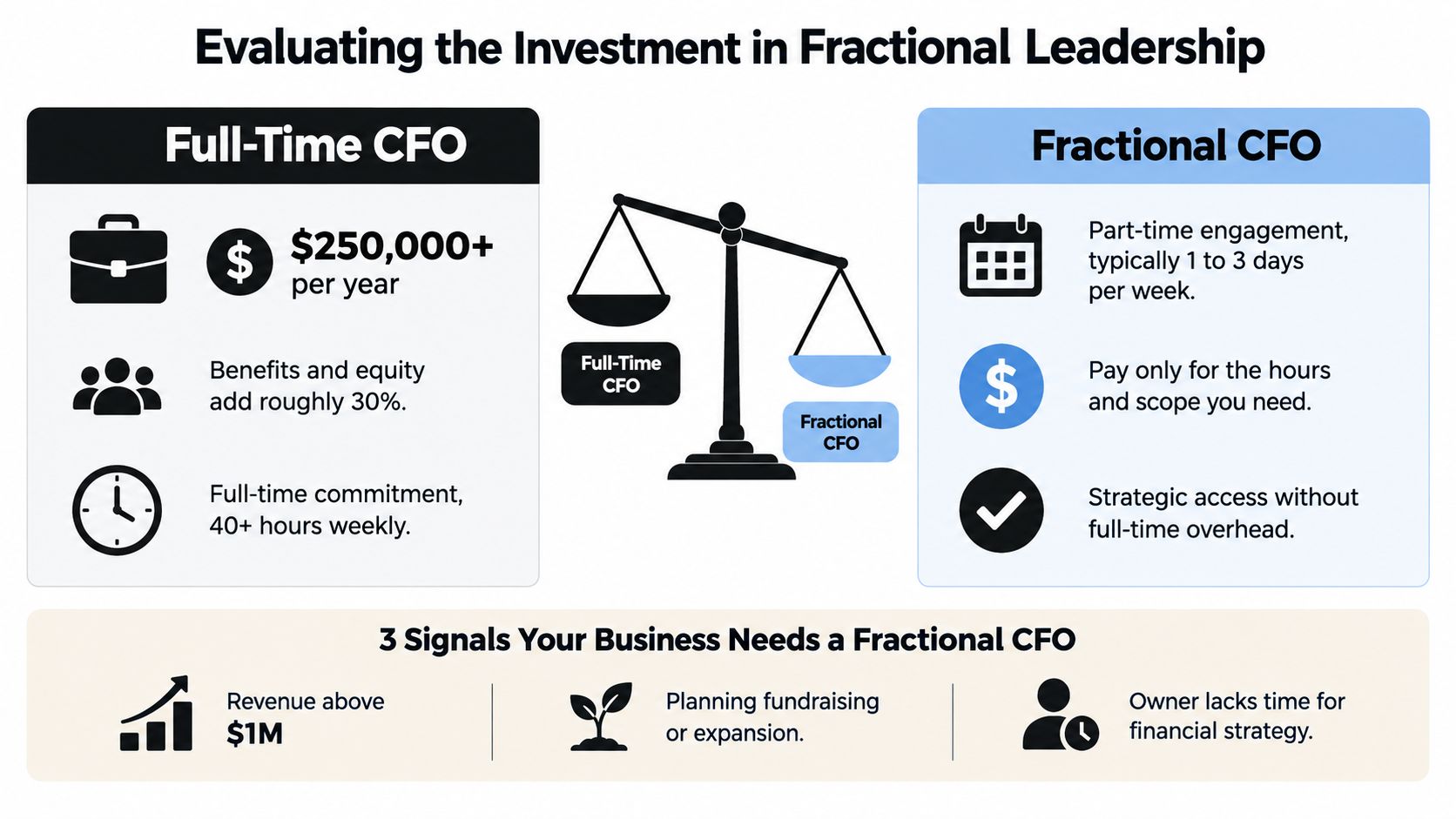
A growing business does not need another salary line when it needs sharper financial judgment. The central comparison is fractional CFO support versus carrying a full-time executive on payroll, or waiting until a cash mistake, lender concern, or tax problem forces a rushed decision. A fractional model keeps cost tied to the specific work you need.
Why the economics work
A business buys senior finance time without funding a full-time executive seat. That matters because the actual cost is not just salary, it is benefits, payroll taxes, and idle capacity when the role is not fully used. For a practical reference on pricing, review fractional CFO hourly rate.
A full-time CFO can make sense for a large, highly complex company. Most growing businesses do not need that level of fixed overhead. They need forecasting, cash discipline, and decision support from someone who can step in at the right level and stay focused on the numbers that drive action.
Signs you need one now
Complexity is the trigger. If cash visibility is weak, month-end reporting slips, lenders want better answers, or expansion decisions are being made without a reliable model, the business needs outside CFO judgment.
- Revenue growth outpacing reporting: the books close, but the numbers arrive too late to guide decisions.
- Planning fundraising or expansion: lenders, investors, and growth plans require cleaner forecasts and tighter financial storylines.
- Owner time is the bottleneck: if the founder is still acting as the finance department, strategy is already getting squeezed out.
The hidden requirement is clean, compliance-ready bookkeeping. A fractional CFO cannot steer with dirty data, and no amount of strategic skill fixes unreconciled accounts or weak transaction coding. Bookkeeping and Accounting of Florida Inc. fits that foundation role by keeping the records ready for analysis before leadership money is spent on higher-level advice.
A full-time CFO often costs far more than a growing company can justify. A fractional engagement usually matches the stage better because it buys only the senior hours the business can actually use. That is how owners protect cash while still getting expert financial direction.
The Advantage of a Unified Accounting Partner
A fractional CFO working on top of messy bookkeeping creates friction. Reports get delayed, assumptions get debated, and everyone starts pointing at the other system. The better setup is one accounting partner that handles cleanup, bookkeeping, tax, and CFO-level advisory under one roof.
Why one team beats two disconnected vendors
When the same firm maintains the books and advises on strategy, the numbers move faster and the conversation gets sharper. That matters in industries where timing and compliance are already stressful. It also matters when owners want payroll, tax prep, internal audits, and CFO guidance handled without having to mediate between separate vendors.
Bookkeeping and Accounting of Florida Inc. is one option for that unified model. The firm provides bookkeeping and accounting, payroll, tax preparation, internal and independent audits, reviews, healthcare accounting, forensic audits, and fractional CFO support for growing companies in Northeast Florida. That combination is useful because it keeps the cleanup work and the strategic work connected.
Compare the model, not just the title
If you're evaluating service partners, don't just compare CFO credentials. Compare who owns the books, who controls the close, who prepares tax support, and who is accountable when a report doesn't tie out. For a parallel example in another service field, business owners often compare operational models before choosing a provider, the same way they might compare medical billing options before outsourcing revenue-cycle work.
Recommendation: choose the team that can both repair the numbers and use them.
That's how you avoid the common trap of paying for strategy on top of unreliable accounting. A single accountable partner reduces confusion, improves turnaround, and makes it easier to stay compliant.
Next Steps to Secure Your Financial Future
Start with the books, not the wish list. Gather your profit and loss statement, balance sheet, cash flow reports, AR aging, AP aging, payroll liabilities, loan schedules, and tax filings, then ask whether the data is current enough to trust. If it isn't, no serious forecast will be useful yet.
What to ask before you hire
Use the first conversation to get specific. Ask how the firm handles cleanup, monthly close, cash forecasting, tax coordination, and reporting cadence. Ask who does the work, how often you'll meet, and what the first 90 days will focus on.
A disciplined process should include a finance-function diagnostic, a cleanup plan if the records are behind, a 13-week cash forecast, and a reporting calendar that keeps the close moving. If your monthly close still drifts for weeks, fix that before you ask for board-style analysis.
What a strong first 90 days looks like
The first phase should not be vague. It should identify broken feeds, reconcile key accounts, define KPI targets, clean up tax and compliance issues, and build a forecast that the owner can use. If you're in Jacksonville or Northeast Florida and need one team to handle bookkeeping, tax, and CFO advisory together, use that fact to your advantage instead of splitting the work across three vendors.
Simple test: if the business can't explain its cash position clearly, it's not ready for strategic finance work yet.
The fastest path forward is a conversation with a firm that understands compliance, cash flow, and growth at the same time. Visit Bookkeeping and Accounting of Florida Inc. to schedule a strategy session and get a finance system that's built for decisions, deadlines, and cleaner numbers.