
Your sales look fine on paper, the register is ringing, cards are settling, and the bank balance is moving. Then month-end hits, the inventory count is off, the marketplace payout doesn't match the deposit, and someone asks why gross profit vanished while the store was “busy.” That's the part retail owners hate, because the mess usually shows up after the money's already gone.
Accounting for retail business is not general bookkeeping with a prettier logo. Retail has constant inventory movement, discounts, refunds, shrinkage, card fees, marketplace deductions, and sales tax obligations that don't politely wait for you to catch up. The businesses that stay sane treat bookkeeping, tax compliance, and financial planning as one system, not three disconnected chores.
Why Retail Accounting Is Its Own Discipline
A Jacksonville shop owner usually does not realize the books are broken until the worst possible week. The POS says sales were strong, the bank deposit is short, and the inventory report insists everything should balance. It never does on the first pass, because retail accounting has more moving parts than a normal service business and fewer chances to fake precision.
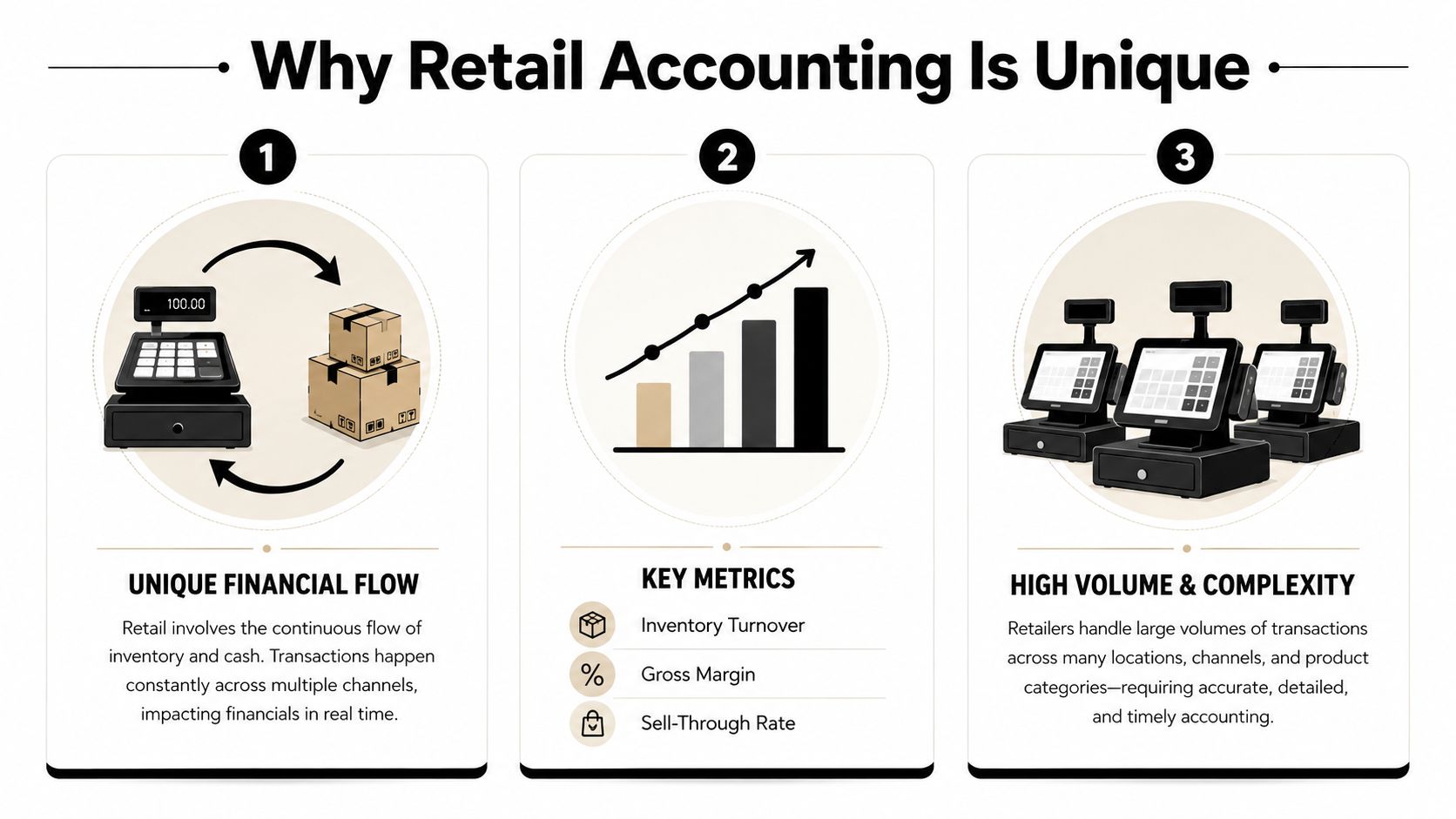
Retail accounting starts with the daily flow of goods, discounts, returns, taxes, and payment processor fees, then ends with a deposit that is usually not the same as the day's sales total. The retail inventory method exists because counting every item's exact cost one by one is often impractical. It calculates a cost-to-retail ratio from goods available for sale, then applies that ratio to ending inventory at retail to estimate ending inventory cost, which is why it works for stores with stable markups and large SKU counts (business.com retail accounting guide). That approach makes sense when transactions happen all day and inventory turns quickly, not when a business wants to eyeball numbers and call it clean.
Retail margins show why the discipline matters. NYU Stern data cited in 2024 showed average gross profit margin for general retail at 30.9%, while operating profit margin was only 4.4% and net profit margin was just 3.1% (NYU Stern retail margin data cited in 2024). Canada's 2023 industry statistics also found cost of goods sold at 65.2% of total expenses and pre-tax profit margin at 7% (Canada retail industry statistics). A store can look busy and still be one bad markdown policy away from a problem.
Practical rule: if your books do not separate sales, markdowns, returns, shrinkage, and tax, your margin report is lying to you in a very professional font.
A retail chart of accounts has to be built for those realities, and tax planning has to match them. If your business crosses state lines, sells online, or uses marketplaces, the accounting problem gets bigger fast. The 2026 tax-law shifts matter because deductions, credits, filing rules, and compliance thresholds can change what a retailer keeps after the sale, even when the top line looks fine.
The Daily Transaction Flow That Powers Your Books
Retail accounting starts at the register, not at the tax return. A sale is never just a sale, because the accounting side has to split gross sales, discounts, sales tax collected, refunds, payment fees, and the eventual deposit into separate buckets. If those pieces get jammed into one revenue line, the books become decorative.
The register is not the deposit
A proper workflow begins with the customer transaction. The POS records the sale, any promotion or loyalty discount, and the tax collected, then the payment processor handles settlement and fees before money lands in the bank. That means the daily deposit should never be booked as “sales” and forgotten, because the deposit is the net result of several events, not the event itself.
Take this example. A $120 item is sold with a 20% promotion, an 8% sales tax, a $5 loyalty discount, and a $20 partial return. In practice, those pieces should not be blended into one line in QuickBooks. Gross sales, promotional discounts, loyalty discounts, returns, and sales tax payable each need their own accounts so margin analysis and tax remittance stay clean.
A good daily process is simple, but not sloppy:
- Post gross sales separately so revenue isn't overstated.
- Book discounts and markdowns to their own accounts so you can see how often margin is being given away.
- Track returns and refunds apart from sales because a return is not a sale in reverse, it's a reduction in revenue.
- Hold sales tax in a liability account until it's remitted, because that money was never yours to spend.
- Record payment fees and chargebacks separately so merchant costs don't get buried in COGS.
Cash flow gets messy when owners treat the processor deposit as the source document. The source document is the transaction summary, not the net deposit.
Gift cards, layaway, and partial refunds deserve the same discipline. The point is to map the register summary to the general ledger one category at a time so the bank, the POS, and the tax return can all agree. If they don't, the books are not “close.” They're just waiting to embarrass you later.
Inventory Valuation Methods Retailers Use
Inventory is where retail accounting stops being theory and starts costing real money. A shirt on the rack, a case of parts in the back, or a shelf of seasonal goods all have to turn into numbers on financial statements, and the method you choose changes what profit looks like. That is why this part deserves more attention than it usually gets.
Picking the method that fits the store
The retail inventory method estimates ending inventory cost by applying a cost-to-retail ratio to ending inventory at retail, which is why it works well for stores with many SKUs and fairly stable markups. It is efficient, but it is not magic. Markdown activity, aged stock, shrinkage, and other exceptions can distort the retail value and throw off the estimate if they are not tracked separately. That is also why a sloppy promotion calendar can do more harm than an overworked bookkeeper on a Friday.
FIFO, LIFO, weighted-average, and specific identification all serve different needs. FIFO assumes the oldest goods sell first, which fits perishable items, seasonal stock, and product lines with obvious turnover. LIFO is less intuitive for retail owners and is usually discussed more in tax and inventory strategy than in day-to-day store management. Weighted-average smooths cost across units, and specific identification works best when each item is unique enough to track individually.
| Method | How It Works | Best Fit For | Watch Out For |
|---|---|---|---|
| FIFO | Oldest inventory cost is recognized first | Perishables, seasonal stock, goods with obvious flow | Can overstate inventory value in rising-cost periods |
| LIFO | Newest inventory cost is recognized first | Certain tax and reporting strategies where allowed | Hard to explain operationally, and not ideal for every retailer |
| Weighted Average | Cost is blended across available units | Similar items bought at varying costs | Can blur margin differences across product lines |
| Retail Inventory Method | Uses cost-to-retail ratio to estimate ending inventory cost | High SKU counts with stable markups | Breaks down when markdowns, shrinkage, or obsolete stock pile up |
| Specific Identification | Each item is tracked by its exact cost | High-value or unique items | Too manual for most busy stores |
Damaged goods, obsolescence write-downs, and shrinkage should not be buried inside COGS like they are a minor footnote. They should sit in separate lines or at least separate tracked buckets so management can see whether inventory losses are operational, pricing-related, or theft-related. That is the difference between real control and hoping the numbers stop being weird next month.
If the perpetual record says one thing and the physical count says another, the count wins. Even if your shop only does one full count a year, the result has to reconcile back to the books or the inventory system is just expensive fiction. For a deeper look at COGS mechanics, review how to calculate cost of goods sold. Retailers that manage large catalogs, seasonal swaps, or constant product edits also need a clean process for bulk edit listings, because bad item data turns inventory valuation into guesswork fast.
Connecting Your POS to QuickBooks and Reconciling Channels
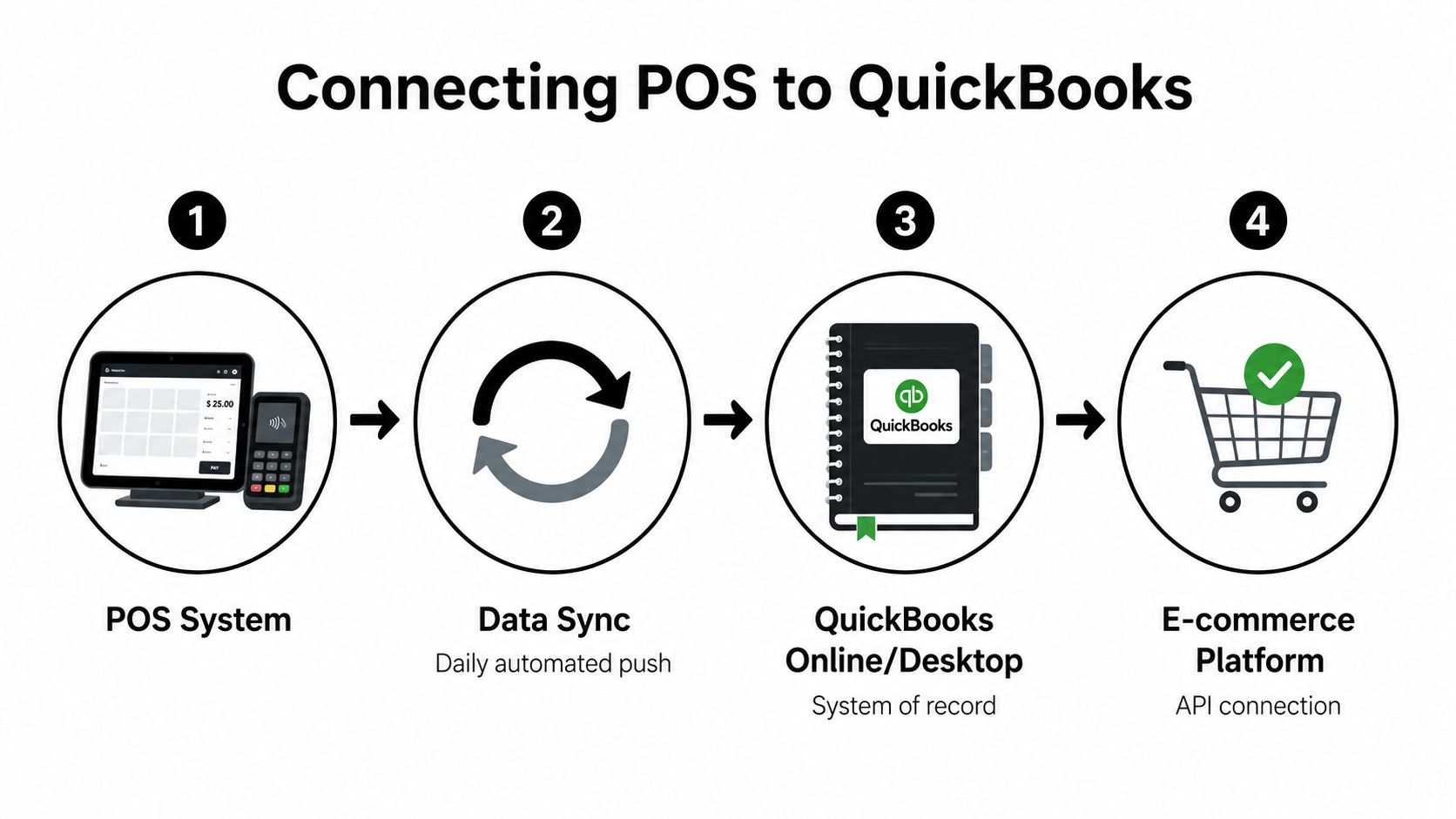
Retail owners lose time because they manually retype data that should already be connected. A cleaner setup is boring in the best way. POS sales flow into QuickBooks Online or Desktop as the system of record, and each channel posts to the right accounts without someone copying totals from one screen to another like it is 2009. That is how you stop the weekly, “why does this deposit not match?” routine.
What needs to reconcile
The omnichannel settlement gap is where a lot of owners get burned. Marketplace payouts, payment-processing fees, chargebacks, shipping credits, and channel-specific returns all have to be mapped to dedicated accounts so the owner can prove that the net deposit equals the underlying transactions (hellobooks.ai retail accounting guide). Beginner content often skips that part and pretends all sales land in one clean stream. They do not.
A practical reconciliation rhythm works better than a giant month-end cleanup.
Start with the POS sales summary, then move through the money trail. Match gross sales, discounts, returns, tax collected, and tender type. Compare merchant deposits to the processor settlement report. Check marketplace payouts against gross marketplace sales minus fees, refunds, and reserve holds. Tie the bank statement to the actual deposits and clearing accounts.
If those pieces do not line up, the differences usually sit in fees, timing delays, partial refunds, or shipping adjustments. That is also where a clean chart of accounts matters. Separate accounts for sales by channel, returns, discounts, COGS, sales tax collected, and regular expenses keep the ledger readable, which is why a proper chart of accounts in QuickBooks is not optional for retailers.
Bad item data creates bad accounting fast. Retailers with large catalogs, seasonal swaps, or constant product edits need a clean process for bulk edit listings, because a messy SKU file turns reconciliation into a guessing game, and software cannot reconcile nonsense into truth.
Payroll, Tips, and Job Costing for Retail Staff
Retail payroll is never just wages. It includes hourly pay, overtime, shift differentials, holiday pay, tips, commissions, bonuses, and sometimes draw-based compensation. If those pieces are coded wrong, labor erodes margin and the books stop showing where the money went.
A store with a flagship location and a pop-up cannot judge performance from one payroll line. Labor needs to be allocated by location or cost center so managers can see whether the pop-up made money or just looked busy doing it. Commission-based staff need the same discipline, because commissions should be tracked in a way that lets you compare labor cost against gross margin by department or store.
Tipped employees add another layer. Tip reporting has to flow into payroll tax filings, and any tip credit or similar payroll treatment has to be handled consistently so the liability side stays in sync. That part is tedious, and payroll tends to be tedious, which is why “we'll figure it out later” often becomes a tax problem with paperwork.
A clean setup usually includes:
- Hourly wages and overtime assigned to the right location.
- Shift differentials and holiday pay posted where labor occurred.
- Commission and bonus accounts kept separate from base wages.
- Tips and payroll tax reporting tied to payroll filings, not left in a spreadsheet.
- Draw-versus-commission structures documented so recoveries and payouts do not distort labor cost.
For setup details, the basics of payroll processing are worth reviewing before the year gets away from you. If you're using Shopify with other tools, automating Shopify bookkeeping workflows can reduce manual entry, but only if the payroll and sales mappings are already clean.
Labor belongs in the margin conversation. A store can post healthy sales and still lose money if the payroll structure is too loose, the commission plan is misclassified, or the labor cost center is too vague to manage. Retail owners do not need more noise. They need a payroll setup that shows the truth.
Internal Controls That Actually Prevent Shrinkage
Shrinkage is not just an operations problem. It's an accounting problem, because lost inventory, unauthorized discounts, voids, and sloppy receiving all change the numbers before anyone notices the shelf is missing product. If the same person can sell, refund, receive, and reconcile, the books are basically trusting hope.
Layer the controls instead of betting on one fix
The cleanest anti-loss setup uses three layers. Preventive controls stop easy abuse, detective controls catch what still slips through, and corrective controls force the business to respond before the leak becomes a habit. That's how you build a control environment that works even when staffing is thin and everyone's “just helping out.”
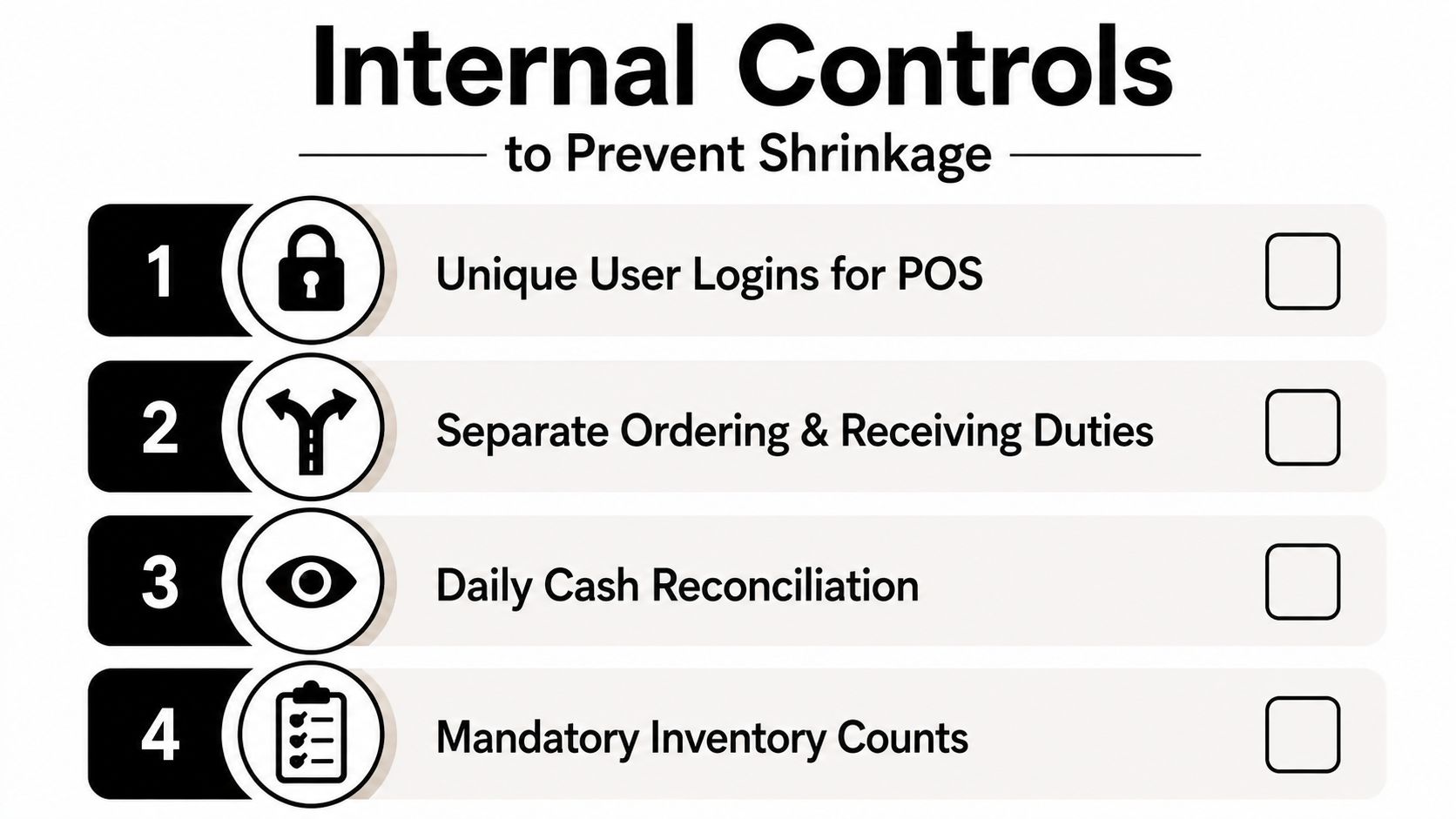
Preventive controls should include unique user logins for POS, separate ordering and receiving duties, two-person cash counts, and vendor delivery verification. Detective controls should include cycle counts, inventory variance reports, and exception reporting on voids, refunds, and unusual discounts. Corrective controls are the unglamorous part, disciplinary steps, policy updates, and vendor disputes when the numbers point outside the store.
Shrinkage should live as a tracked line item, not as a mystery inside COGS.
A 30-day control upgrade can be simple. First, remove shared passwords. Second, stop letting one employee control the full path from order to receipt to reconciliation. Third, require daily cash reconciliation and periodic inventory counts, even if they're small sample counts during the week. Fourth, review voids and refunds every month with an owner, not just the bookkeeper.
If loss keeps showing up and the source isn't obvious, Private investigator services can be part of the response when internal review isn't enough. That's not dramatic, it's just what some cases require once the numbers suggest behavior, not clerical error.
The point is to budget shrinkage, track it monthly, and react before it becomes normal. A busy store can still be leaky. In retail, “busy” is not the same thing as “healthy.”
Reports and KPIs Every Retail Owner Should Review Monthly
A retail owner who only looks at the bank balance is driving with one eye closed. Monthly reporting gives a clearer view of whether the store is making money, or just moving cash around fast enough to look busy. The three core statements are the income statement, balance sheet, and cash flow statement, and each one answers a different question about the business's health (NetSuite retail financial statements). The income statement shows profitability for the period, the balance sheet shows what the business owns and owes at a point in time, and the cash flow statement shows how cash moved.
A useful retail dashboard should not read like a wall of accounting jargon. It should show what changed, where margin slipped, and whether the store is turning inventory into cash at a sensible pace. Gross margin by category shows which products are pulling their weight. Inventory turnover and sell-through rate show whether stock is moving or gathering dust on the shelf.
Same-store sales still matter because they show whether the existing location is improving without hiding behind new-store growth. Average transaction value and conversion rate add another layer, since a busy store can still underperform if each visit brings in too little revenue. If the business sells to wholesalers or other business customers, days sales outstanding belongs on the page too, because invoices that sit unpaid too long turn into a cash problem with a dress code.
Revenue growth alone can fool an owner. If sales rise while margin weakens, discounts, shipping, labor, or product mix may be eating the gain before it reaches the bottom line.
The best monthly review asks one question, did cash move in the same direction as sales, or did it vanish into inventory, discounts, and overhead?
A practical monthly packet usually includes the income statement for profit, the balance sheet for inventory, payables, cash, and debt, and the cash flow statement for liquidity. It also needs gross margin by category for pricing discipline, inventory turnover and sell-through for stock health, same-store sales for trend quality, and average transaction value and conversion rate for sales effectiveness.
The owner who reads these numbers every month is harder to surprise, and that is the whole point. A store can stay busy and still leak money in half a dozen places. The monthly review is where you catch that before it turns into a habit.
When to Bring in a CPA and Why a Fractional CFO Pays for Itself
A retailer does not need outside help because bookkeeping is glamorous. Retailers need help because compliance gets ugly fast, and most small business owners don't know how much they don't know. Multi-state sales tax filings, nexus exposure, payroll tax penalties, 1099-K thresholds, and the 2026 tax-law shifts affecting deductions and credits can all create problems before the owner even realizes a filing obligation exists.
Cleanup and guidance are different jobs
A one-time CPA cleanup fixes the past. A fractional CFO helps prevent the same mess from coming back by building reporting, cash-flow discipline, pricing review, and inventory oversight into the business rhythm. That matters because one bad inventory decision, one missed sales-tax filing, or one broken channel reconciliation can cost more than ongoing senior financial guidance.
This is also where a coordinated firm relationship helps. A Jacksonville CPA firm that handles clean bookkeeping, QuickBooks setup, payroll, tax preparation, and fractional CFO services keeps the retailer from juggling five vendors and hoping they all talk to each other. Bookkeeping and Accounting of Florida Inc. offers that kind of integrated support, including bookkeeping, payroll, tax, reviews, audits, and fractional CFO services for growing businesses.
A good outsourcing decision usually starts when:
- Sales are spread across channels and the deposits no longer match the register.
- Inventory is too large for spreadsheet-level control.
- Payroll complexity keeps increasing.
- Tax filings are getting harder because the business crosses state lines or uses marketplaces.
- Management needs better cash-flow visibility than the bank balance provides.
The right help is not about handing over responsibility. It's about getting the books, tax compliance, and decision support into one system before the year-end scramble starts. If the numbers are already noisy, waiting only makes the cleanup more expensive and the tax conversations less pleasant.
If your retail books are getting harder to trust, don't wait for year-end to find out why. Reach out to Bookkeeping and Accounting of Florida Inc. for clean bookkeeping, QuickBooks setup, payroll support, tax help, and fractional CFO guidance that keeps your retail accounting compliant and readable before the next close gets messy.