
If you're running a construction company on standard accounting software, you're lighting money on fire. It's that simple. Off-the-shelf tools can't handle the messy reality of construction finance—complex job costing, retainage, or certified payroll. This isn't just a minor headache; it's a direct line to bad bids, painful cash flow gaps, and massive compliance risks. Navigating the intricate world of construction finance requires specialized tools and expert guidance.
Why Generic Accounting Software Fails Construction Firms
Trying to manage a construction business with generic software is like trying to frame a house with a Swiss Army knife. You might make a few cuts, but the whole thing is going to be wobbly, weak, and definitely not up to code. Standard platforms just weren't built for the financial chaos of the construction world.
Think about a contractor in Jacksonville juggling a dozen subs and suppliers on a single project. Without the right software, profit bleeds out through miscalculated costs and billing delays. We see this happen every single day at Bookkeeping and Accounting of Florida Inc. It’s a preventable disaster that underscores why you need not only the right accounting software for construction companies but also an expert team to manage it.
That guy in the picture? He’s stressed because his profits are vanishing, and his reports don't tell him why. That's what happens when your tools aren't made for your trade and you lack the expert guidance to interpret the data.
The Compliance and Tax Law Disconnect
Most business owners have no idea how deep the compliance rabbit hole goes in construction. We're talking certified payroll, Davis-Bacon wage laws, and ever-changing sales tax rules on materials. It's a full-time job just to keep up, and it's getting worse. Looming tax law changes will impact everything from depreciation on your heavy equipment to how you handle 1099-NEC reporting. For most small businesses, staying compliant is a major challenge because they simply don't know all the requirements.
The right accounting software isn't just for keeping score—it's your compliance engine. But a tool is only as good as the expert wielding it. They need us to help them stay compliant.
The market gets it. The global construction accounting software market is on track to jump from USD 2.64 billion in 2025 to a whopping USD 5.26 billion by 2035. That’s because contractors are finally ditching generic tools that can’t keep up. The U.S. market alone is set to nearly double, proving this isn't a fad; it's a necessary shift.
The Inefficiency Trap of Manual Workarounds
Generic software sentences your team to a prison of manual workarounds and spreadsheet hell. You spend more time typing than thinking. To get away from systems that depend on slow, error-prone manual input, using an AI data entry service can dramatically improve accuracy and free up valuable time.
Here’s where those generic systems completely fall apart:
- Job Costing: They can't track costs down to the project, phase, and cost code level. It's a black box.
- Progress Billing: Forget creating AIA-style G702/G703 forms for percentage-of-completion billing.
- Retainage Tracking: No built-in way to manage money held back from subs or by your clients.
- Change Orders: They fail to properly track scope changes and weave them back into the budget.
Look, all companies need a fractional CFO—a guide, an expert partner—who knows what’s required to stay compliant and profitable. Most small businesses just don't know what they don't know, and that's where we come in. A dedicated construction bookkeeping specialist doesn't just set up software; they implement a financial strategy that drives your growth.
Essential Features Your Construction Accounting Software Must Have
Using generic accounting software for a construction business is like trying to frame a house with a screwdriver. You might get a few screws in, but the whole thing is going to be wobbly and eventually fall apart.
Picking the right software isn't about a long list of bells and whistles. It’s about finding a system designed to solve construction-specific problems—the kind that can sink your profits if you’re not looking. This is core information you need to make the right choice.
Without these tools, you're flying blind. You won't know which jobs are actually making you money and which are secretly draining your bank account until it’s way too late.
Critical Software Feature Checklist for Construction Firms
I've seen too many contractors try to force a generic platform like QuickBooks Online to work for their complex needs. It always ends in messy workarounds and bad data. Here's a breakdown of what your accounting software for construction companies absolutely needs and why off-the-shelf software just doesn't cut it.
| Feature | Why It's Critical for Construction | Limitation in Generic Software |
|---|---|---|
| True Job Costing | Tracks labor, materials, and subs by cost code in real-time. Crucial for profitable bidding and managing project health. | Basic expense tracking, not true project costing. Can't link costs to specific job phases. |
| Progress Billing (AIA G702/703) | Automates schedule of values and percentage-of-completion billing, which is standard practice in the industry. | Lacks built-in templates for AIA forms. Requires manual, error-prone spreadsheet work. |
| Retainage Tracking | Manages money held back from you by clients and money you hold back from subs. A huge cash flow component. | No native feature for retainage. Tracking becomes a manual, confusing nightmare. |
| Change Order Management | Formally documents, approves, and integrates scope changes into the project budget and contract value. | No dedicated workflow. Change orders get lost in emails, leading to unpaid work. |
| Certified Payroll & Union Reporting | Generates mandatory, complex payroll reports for government and union jobs, ensuring compliance. | Cannot produce certified payroll reports. Requires expensive add-ons or manual data entry. |
| Committed Cost Tracking | Shows costs from POs and subcontracts before an invoice is paid, giving a true view of future expenses. | Only tracks expenses once an invoice is entered, leaving a massive blind spot in your budget. |
| WIP (Work-in-Progress) Reporting | Essential for understanding your true financial position on long-term jobs and a requirement for bonding. | Cannot generate accurate WIP reports, putting your bonding capacity at risk. |
Trying to run a construction company without these features is like driving with a blindfold on. You're just waiting for a crash.
Why This Stuff Actually Matters
Let's get real. Construction billing is weird. You don't just send one invoice at the end. You bill as you go, and your accounting software for construction companies has to handle that without you needing a PhD in spreadsheets.
A shocking number of businesses fail because of bad cash flow. For contractors, specialized billing features aren't a luxury—they're the difference between getting paid on time and going under.
That's where things like AIA billing come in. Automatically generating those G702/G703 forms saves a ridiculous amount of time and prevents the tiny errors that can delay a six-figure payment for weeks. The same goes for retainage tracking—if your software can't handle it, you're leaving money on the table.
And don't even get me started on change orders. They’re a fact of life, but if you don't track them properly, they become free work. Your system needs to make it easy to document the change, get it approved, and update the budget instantly.
Finally, there’s the compliance beast. Certified payroll, union reports, 1099s, and ever-changing tax law changes can bury a small business owner. The right software automates this, but it’s still just a tool. This is exactly why all companies need a fractional CFO or an expert accounting partner like us. We ensure the software is set up right and that you're actually using it to protect yourself—even from compliance rules you didn't know existed. They need us to stay compliant.
Brace Yourself: Tax Compliance and the 2026 Law Changes
For construction companies, staying compliant isn't a simple checklist item. It's a moving target, and missing it comes with seriously expensive consequences. Your accounting software for construction companies is your first line of defense, but it’s definitely not a magic wand. This critical information is why you need our business accounting services.
Big changes are on the horizon. Key parts of the Tax Cuts and Jobs Act (TCJA) are set to expire at the end of 2025, and your business needs to be ready. We’re not talking about small adjustments—these shifts will affect everything from how you write off that new excavator to your company’s overall tax rate.
The 2026 Tax Cliff Is Closer Than It Looks
Most contractors I talk to have no idea what’s about to hit them. For instance, the 100% bonus depreciation that allowed immediate write-offs on equipment is phasing out. By 2026, it could be gone entirely. Changes to Section 179 expensing limits are also coming, which will directly impact how you budget for big-ticket equipment. Furthermore, personal tax rates are set to increase, affecting pass-through entities like S-corps and LLCs, which are common in construction.
With these tax law changes looming, a basic spreadsheet or generic accounting software just won't fly anymore. Your system has to get it right. It must:
- Track fixed assets and apply the right depreciation schedules, year after year.
- Handle various subcontractor payments for perfect 1099-NEC reporting.
- Properly code every single expense so you can maximize your deductions under the new rules.
Getting this wrong is an open invitation for a costly audit. The penalties are steep, and the financial headache can be a nightmare for a small business.
Your Software Is Only Part of the Equation
Yes, specialized construction accounting software can automate a ton of this work. It can spit out the right reports and categorize expenses on the fly. But the software is only as smart as the person setting it up.
It’s dangerously easy to mess up the configuration or completely misread the data it’s giving you. That’s where the real risk is hiding. The core of good financial management, as outlined in frameworks like the Australian Auditing Standards, is about rigorous oversight—a principle that applies everywhere. You don’t know what you don’t know, and that knowledge gap can sink you.
Software gives you data. An expert tells you what that data means for your company's survival and growth. This is why all companies need a fractional CFO and a dedicated accounting partner to guide their business.
A fractional CFO isn't just checking your books. They're providing the high-level strategy to make sure your software is dialed in perfectly for construction finance, shielding you from compliance disasters you aren't even aware of.
You Need an Expert in Your Corner
Think of us as your financial co-pilot. Your software is the instrument panel, but we’re the ones who know how to read it, spot the turbulence ahead, and chart the most profitable course.
Our CPAs and fractional CFOs at Bookkeeping and Accounting of Florida Inc. live and breathe this stuff every single day. We keep businesses compliant because we know the rules inside and out, from certified payroll headaches to prepping for the 2026 tax cliff. We fill that critical expertise gap for small firms that can’t justify a full-time, six-figure CFO. When you use our business accounting, you're getting more than clean books. You’re getting the peace of mind that a pro is watching your six, ensuring your software is working for you—not against you—to squeeze out every tax advantage and keep you in the clear.
Your Practical Software Rollout Plan
Let's be honest. Switching your accounting software for construction companies feels like trying to change a tire on a truck that’s already speeding down the highway. It’s a messy, intimidating job.
But winging it is not an option. Without a clear plan, that powerful software you just invested in—the one with fancy job costing and certified payroll—is nothing more than a very expensive calculator. A good rollout is the difference between control and chaos. This information is key to a successful transition.
This is where a real process, guided by an expert, makes all the difference.
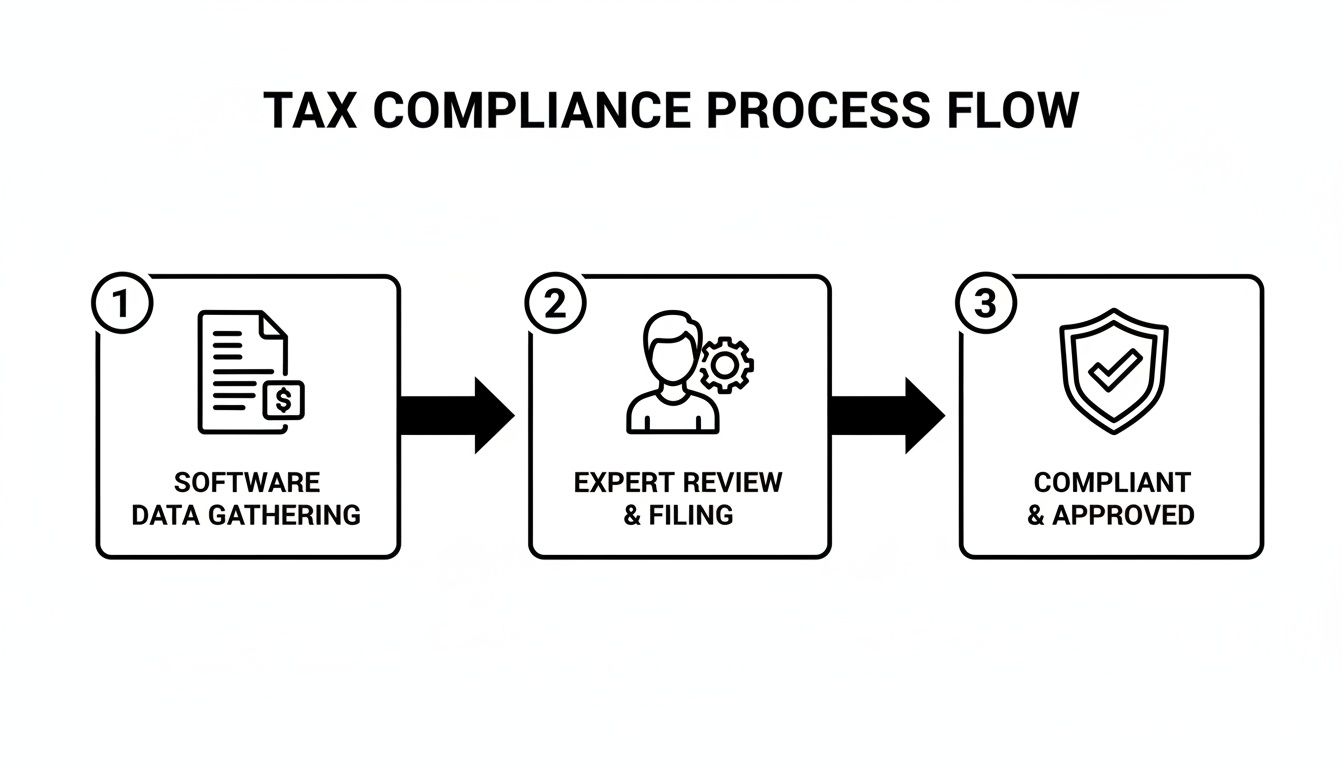
The software is great at collecting data, but it takes a human expert to translate that data into real-world compliance and smart financial decisions.
Your Rollout Playbook For A Smooth Transition
A successful rollout isn't a mad dash to the finish line. It's a methodical process that requires buy-in from your project managers in the field to the bookkeeper in the office. Skipping steps is the fastest way to get your team to ignore the new system and waste your investment.
This is exactly why our implementation services exist. We don't just hand you the software and wish you luck. Every construction company needs a fractional CFO or a battle-tested CPA to guide them through a change this big.
- First, Data Cleanup and Migration: Before anything gets moved, we clean house. Think of it as spring cleaning for your financials. We help you purge old vendor lists, archive completed jobs, and make sure customer data is consistent. Moving messy data into a new system is like pouring sand into a new engine—it will seize up.
- Second, Chart of Accounts Setup: This is the absolute foundation of your financial reporting. A generic chart of accounts is useless for construction. We design one specifically for detailed job costing, so you can see profitability by project, phase, and even cost code. This is non-negotiable, especially with tax law changes looming.
- Third, Run in Parallel: Don't kill the old system yet! For at least one full billing cycle, you'll run both systems side-by-side. This is your safety net. It allows us to compare reports, spot any weird discrepancies, and make sure your team feels confident before we make the final cutover.
- Finally, Training and Go-Live: Training can't be a footnote. We sit down with your team—in the office and in the field—and show them not just how to enter their data, but why it's so critical for the company's bottom line. When your crew understands how their daily logs impact job profit, you get clean data.
The Software Can’t Do Everything
The single biggest mistake I see is owners thinking the software itself is the solution. It’s not. It’s just a tool. Its real power comes from the expert who knows how to use it. Most business owners are too busy running their company to keep up with every payroll rule or the nuances of the 2026 tax law shifts.
Your software can spit out a WIP report, but it can’t tell you if you're overbilling in a way that’s going to panic your surety bonding company. That’s what a fractional CFO does. We provide the strategic oversight a machine can’t.
At Bookkeeping and Accounting of Florida Inc., our job is to be that expert partner. We help you choose and set up the right accounting software for construction companies, but we don’t disappear after that. We stick around to help you navigate the tricky regulations, find tax advantages, and turn all that data into profitable decisions. We’re here to fill the knowledge gap so you can focus on building your business. They need us to guide their business.
Why a Fractional CFO Is Your Most Valuable Asset
Even the best accounting software for construction companies just spits out data. You get tons of it—real-time job costing, budget vs. actuals, you name it. But raw data without an expert to interpret it is just noise. It’s like having a dashboard full of blinking lights but no pilot in the cockpit.
This is where your most valuable, and often overlooked, asset comes in: a fractional Chief Financial Officer (CFO). A fractional CFO isn’t just an outsourced bookkeeper. They are a high-level financial strategist who guides your growth and profitability without the six-figure salary of a full-time executive.
Moving Beyond Data to Decisions
Your software tells you what happened. A fractional CFO tells you why it happened and what to do next. This is the missing link for most small and mid-sized construction firms.
As a business owner, you're an expert at your trade. But you’re too busy running the show to dive deep into financial analytics or keep up with complex tax law changes. That’s a dangerous blind spot. A fractional CFO from Bookkeeping and Accounting of Florida Inc. closes that gap. We don’t just crunch numbers; we act as your strategic partner, turning that software data into real-world profit.
Here’s why you should use our business accounting:
- Cash Flow Forecasting: We analyze your project pipeline and payment cycles to predict your cash position, helping you avoid those nasty surprises.
- Job Profitability Analysis: We dig into your job cost reports to find out which jobs are actually making you money—and which ones are bleeding you dry.
- Strategic Bidding Advice: Using your own historical data, we help you build more accurate, competitive bids that actually protect your margins.
- Compliance & Tax Guidance: We make sure you’re ready for certified payroll audits and the major 2026 tax law shifts on the horizon, because you need us to help you stay compliant.
The software gives you the numbers; a fractional CFO tells you what to do with them. We translate financial information into a real competitive advantage.
A Real-World Scenario
We recently started working with a growing Jacksonville contractor. They were constantly busy but felt like they were just spinning their wheels. Their books showed a profit, but cash was always tight and margins were shrinking. They were stuck.
Our fractional CFO dove into their job cost data. We discovered that while their large commercial build-outs were home runs, the smaller residential jobs they took to fill the schedule were consistently running over budget on labor. The software had all the numbers, but no one had connected the dots.
We guided them to pivot their focus entirely to the commercial projects they excelled at. They stopped chasing low-margin filler work. The result? Within six months, their overall profit margins jumped by 12%, and their cash flow finally stabilized. This is a perfect example of why all companies need a fractional CFO.
Getting powerful accounting software is a great first step. But to unlock its true potential, you need an expert guide. If you want to see how this kind of high-level guidance can transform your business, we can show you how. We're here to help you not just survive, but thrive.
Your Top Construction Accounting Questions, Answered
Over the years, we've heard just about every question a construction business owner can ask. Let's cut through the noise and give you some straight answers based on what we see every day with firms just like yours.
Can I Get By with Just QuickBooks for My Construction Business?
Short answer? No. Not if you’re serious about making money.
While we love QuickBooks for many businesses, the off-the-shelf version simply wasn’t built for the grit and grind of construction. It completely lacks native tools for the things that make or break you: detailed job costing, progress billing, and tracking retainage.
Sure, you can try to bolt on expensive third-party apps, but you usually end up with a clunky, Frankenstein-like system that’s more trouble than it's worth. You’re almost always better off with a dedicated accounting software for construction companies or a heavily customized QuickBooks setup. Our certified QuickBooks ProAdvisors can show you the difference and provide the expert setup required.
How Much Does Specialized Construction Accounting Software Cost?
The price can range from a few hundred bucks a month to thousands for a massive enterprise system. But honestly, that's the wrong question. The real question is about the return, not the cost.
Think of it this way: the right software stops profit from leaking out of your jobs, makes your bids smarter, and frees up hundreds of hours of admin work. It pays for itself the first time it catches a major job costing error. Or the first time it keeps you compliant with upcoming tax law changes, like the 2026 TCJA expirations everyone is about to scramble over. Paired with our business accounting services, it's an investment in your company's future.
What’s the Biggest Mistake Contractors Make with Their Accounting?
This one’s easy, and it's fatal: failing to track job costs accurately and not having expert oversight.
When you don’t have a real-time, granular view of each project's profitability, you're flying completely blind. This leads directly to underbidding your next job, getting slammed by a cash flow crisis you never saw coming, and, eventually, going out of business. A solid accounting system is your cockpit—it prevents the crash.
The software gives you the numbers, but it can't give you the strategy. All companies need a fractional CFO to turn that data into profitable decisions and keep you compliant. Most small businesses don’t know what they don’t know—we do.
Our job is to be the expert guide you need. We don't just help you pick and set up your system. We provide the high-level financial oversight to navigate the complex rules and use your numbers to build a stronger, more resilient company. They need us to guide their business.
At Bookkeeping and Accounting of Florida Inc., we turn your financial data into a tool for real growth and peace of mind. Let us handle the accounting headaches so you can get back to building. Schedule your free consultation today.