
The most commonly reported monthly bookkeeping fee is $250–$499, selected by 29% of accounting firms, but your actual cost will vary with transaction volume, payroll, industry requirements, and the complexity of your books. A low-volume Jacksonville service business may fit near that benchmark, while a contractor, medical practice, or nonprofit can require a much more involved engagement.
Thank you for reading this post, don't forget to subscribe!You may be looking at your bank balance and wondering why bookkeeping should cost several hundred dollars every month. Or you may be doing the books yourself after dinner, hoping your QuickBooks file is accurate enough for tax season. Both situations are common across Jacksonville and Northeast Florida.
The problem is that bookkeeping isn't only data entry. It supports payroll, tax filings, cash-flow decisions, lender requests, financial reporting, and compliance with changing federal and state requirements. The cheapest monthly fee can become the most expensive option when missing records, unreconciled accounts, or incorrect classifications create year-end cleanup.
The Real Cost of Bookkeeping for Jacksonville Small Businesses
A Jacksonville contractor may start with a simple expectation: one bank account, a few employees, and a monthly bookkeeping bill near the low end of the market. That expectation changes quickly when the business adds job-costing, subcontractor payments, payroll allocations, equipment purchases, retainage, and multiple active projects.
The same pattern affects healthcare practices, inventory-based retailers, and nonprofits. The number of transactions matters, but the accounting dimensions behind those transactions matter just as much. A small number of entries can still require careful treatment when each one must be assigned to a project, fund, location, department, patient-service line, or compliance category.
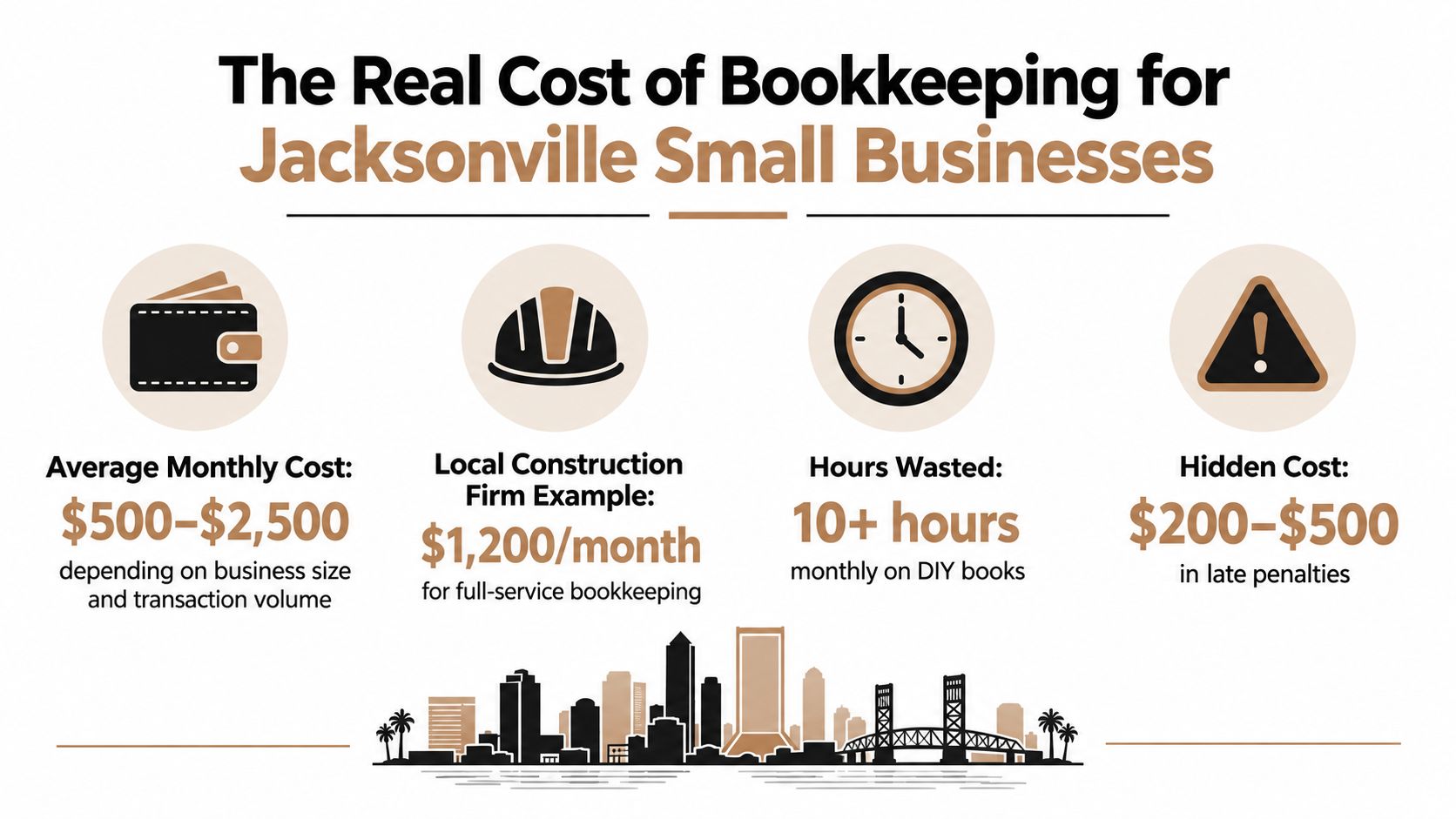
A 2025 U.S. pricing benchmark surveyed 219 accounting professionals and found that $250–$499 per month was the most commonly reported price for recurring monthly bookkeeping and accounting. Twenty-nine percent of firms selected that range as their most common fee. The benchmark is a useful starting point, not a universal average, because fees change with transaction volume, payroll, account reconciliation, reporting frequency, industry requirements, and CPA review. The published pricing benchmark explains the scope behind the range.
For a business paying within that benchmark range, annualized bookkeeping spending would be approximately $3,000–$5,988, before tax preparation, audit, advisory, or cleanup work. The lower end generally fits basic transaction categorization and reconciliations. The upper end can support more involved monthly accounting, especially when an accountant reviews the work.
Jacksonville owner's rule: Don't ask only, “What does bookkeeping cost?” Ask, “What level of accuracy, reporting, and professional review does my business require?”
That distinction protects you from comparing a basic data-entry package with a monthly close that includes reconciliations, financial statements, payroll coordination, and management review. A healthcare practice or construction company may pay more because its books carry more operational and compliance responsibility, not because the provider is charging more for the same work.
Bookkeeping should therefore be treated as a variable operating investment, not a commodity purchased at the lowest advertised price. If your records help you price work correctly, manage cash, meet filing deadlines, and catch problems before they spread, the monthly fee supports the business. If the service only categorizes transactions without answering whether the numbers are complete and useful, you may still be carrying the actual risk yourself.
Understanding Monthly Bookkeeping Price Tiers
Published U.S. pricing guidance places many small-business bookkeeping engagements between $200 and $1,000 per month, with a commonly cited midpoint near $300. One practical breakdown places basic bookkeeping at approximately $250–$350, mid-range work at $500–$700, and premium support at $1,000 or more per month. These figures are planning benchmarks, not promises, and the scope must be confirmed before you sign an engagement. This small-business accounting cost guide outlines the tiers and the factors behind them.
Basic bookkeeping
The basic tier usually fits a low-volume service business with straightforward income and expenses. It may include transaction categorization, bank reconciliation, and routine maintenance of a small number of accounts. Annualized, the broader $200–$1,000 range implies approximately $2,400–$12,000, while the basic and mid-range tiers imply about $3,000–$8,400 before separate tax, cleanup, audit, or advisory fees.
This tier isn't automatically inadequate. It becomes inadequate when the owner expects payroll support, sales-tax work, inventory accounting, management reports, or a CPA review without confirming that those services are included.
Mid-range accounting support
Mid-range work typically adds stronger monthly reporting and analysis. The provider may prepare financial statements, investigate unusual balances, coordinate payroll information, and give the owner a clearer view of profitability and cash flow. A growing Jacksonville company often needs this level because the owner can't make sound hiring, pricing, or expansion decisions from a bank balance alone.
Businesses with recurring payroll, several financial accounts, or multiple revenue streams should be cautious about choosing the cheapest tier just because the transaction count appears manageable.
Premium and specialized support
Premium support is justified when the books require deeper review or industry-specific accounting. Construction companies may need job-costing and payroll allocations. Healthcare practices may need specialized reporting. Nonprofits may require restricted-fund tracking and stronger compliance controls.
A business owner in a service industry can also benefit from resources focused on operational reporting, such as this guide to cleaning payroll and KPIs from Estimatty. The point isn't to copy another company's package. It's to identify which numbers must be accurate for the owner to manage the operation.
Review the scope of monthly bookkeeping services before comparing prices. A fixed monthly package is useful only when it states what gets reconciled, when reports arrive, who reviews the work, and which projects are billed separately.
Key Cost Drivers That Influence Your Monthly Fee
Two businesses can have similar revenue and radically different bookkeeping costs. The difference usually comes from the work required behind the ledger, not from the business name on the invoice.
Start with transaction volume and account count
A cited market comparison places basic ongoing work for a very small business at approximately $150–$200 per month. Businesses processing around 500 monthly transactions may pay roughly $400–$600, while packages that add financial reporting and analysis commonly fall near $300–$600. The market comparison connects these ranges to transaction volume and service depth.
More transactions create more categorization exceptions, reconciliation lines, documentation requests, and review time. Count more than bank activity. Include credit-card charges, payment processor deposits, merchant fees, transfers, loan activity, and recurring entries that require confirmation.
The number of active accounts also matters. One checking account is different from several bank accounts, credit cards, merchant processors, and financing accounts. Every account creates another reconciliation, another source of timing differences, and another place for an unnoticed error to remain.
Payroll, inventory, and tax activity raise the workload
Payroll adds deadlines, employee classifications, liabilities, benefit deductions, and coordination with payroll providers. Inventory adds purchasing, cost tracking, adjustments, and questions about whether reported margins reflect actual operations. Sales-tax activity can create additional filing and reconciliation responsibilities.
Industry complexity changes the quote even when transaction volume is modest:
- Construction: Job-costing, subcontractors, retainage, equipment, and labor allocations can require detailed project-level review.
- Healthcare: Specialized reporting, payroll treatment, and operational categories can make ordinary-looking transactions more sensitive.
- Nonprofits: Restricted funds and compliant reporting require controls that a basic small-business ledger may not provide.
- Retail: Inventory, payment processors, returns, and sales-tax activity can make reconciliation more demanding.
Request a quote that describes the work
Before asking for pricing, prepare a short scope sheet. Include:
- Monthly transactions: Estimate income, expenses, transfers, and payment activity.
- Financial accounts: List bank accounts, credit cards, loans, merchant platforms, and payroll accounts.
- Reporting needs: State whether you need a monthly profit and loss statement, balance sheet, cash-flow reporting, department reports, or project reports.
- Compliance duties: Identify payroll, sales tax, state reports, industry reporting, and ownership-record questions.
- Starting condition: Say whether the books are current or require catch-up and cleanup.
Distinguish recurring maintenance from one-time cleanup. Historical unreconciled balances can increase the initial fee even when the steady-state monthly workload is reasonable. Ask whether the quote includes software, payroll coordination, year-end support, CPA review, and a defined month-end close date.
A local firm can quote accurately only when you disclose the operational details that create the work. Hiding complexity to obtain a lower starting price guarantees a renegotiation later.
Why Fractional CFO Services Are Essential for Growth
Bookkeeping tells you what entered and left the accounts. A fractional CFO helps you decide what to do next.
That distinction matters when a Jacksonville business is growing but the owner still approves every payment, guesses at cash flow, and waits for year-end reports to discover that a profitable project produced little cash. Clean books provide the foundation. Financial leadership turns that foundation into pricing decisions, hiring plans, cash-management rules, budgets, forecasts, and useful performance indicators.
Every company needs access to CFO-level guidance, although not every company needs a full-time CFO on payroll. A fractional arrangement gives a small or midsize business senior financial involvement without requiring a permanent executive position. The value is highest when the owner faces decisions that routine bookkeeping can't answer.
Bookkeeping records the past, CFO guidance shapes the next move
A bookkeeper may reconcile accounts and prepare monthly financial statements. A fractional CFO can examine why margins changed, whether receivables are consuming cash, how a new hire affects the operating plan, and which services or projects deserve more attention.
That work can prevent expensive year-end surprises. A CFO-level review may identify inconsistent job costing, weak collection practices, unexplained expenses, or reporting categories that hide performance differences between locations and departments. It can also give the tax professional cleaner information before deadlines arrive.
Resources explaining how businesses can save 40-60% on fractional CFOs can help owners understand why outsourced financial leadership may be more practical than hiring internally. The right comparison isn't between “bookkeeping” and “CFO.” It is between basic recordkeeping and a coordinated financial system that supports decisions.
Guidance creates value before the problem becomes urgent
A fractional CFO should help you establish a reporting rhythm, define the numbers management needs, and connect accounting activity to business performance. For a contractor, that may mean reviewing project profitability. For a healthcare practice, it may mean monitoring provider productivity and collections. For a nonprofit, it may mean connecting restricted funding to compliant spending and reporting.
Bookkeeping and Accounting of Florida Inc. offers bookkeeping, CPA review, QuickBooks ProAdvisor support, tax preparation, payroll, audits, and fractional CFO services for businesses that need financial information connected to planning and decision-making. Its fractional CFO services are relevant when monthly reports need interpretation rather than simple delivery.

A monthly report that arrives without interpretation is information. A monthly report tied to a decision is management.
Don't add fractional CFO support just because it sounds impressive on paper. Add it when the business needs better cash-flow planning, profitability analysis, budgeting, forecasting, lender preparation, or operational accountability. In those situations, professional guidance can reduce cleanup, improve discipline, and keep the owner from making major decisions with incomplete numbers.
Staying Compliant with Changing Tax and Reporting Laws
Automation doesn't eliminate compliance responsibility. It changes where human review belongs.
QuickBooks, bank feeds, payroll platforms, and receipt tools can reduce manual entry. They can't reliably determine whether an owner is classified correctly, whether a transaction belongs to the right project or fund, whether a new entity has a reporting obligation, or whether an unusual payment requires investigation. Intuit's 2025 Accountant Technology Report surveyed 700 U.S. accounting professionals and separately analyzed a January 2025 survey of 2,487 U.S. small businesses with up to 100 employees. The report's relevance is practical: software adoption doesn't remove the need for people to design rules, review exceptions, reconcile accounts, and interpret risk. Intuit's report provides the technology-adoption context for accounting professionals and small businesses.
Technology adoption is also uneven. A 2025 survey of 16 small service businesses in Samarkand found that 88% used Excel or Google Sheets, while 19% used dedicated accounting software and 13% used cloud accounting platforms. Those figures come from a specific local survey, so they shouldn't be treated as a Jacksonville benchmark. They do challenge the assumption that every small business can immediately lower its bookkeeping fee through automation.
FinCEN rules require classification, not guesswork
FinCEN's beneficial-ownership rules changed substantially under a final rule issued on August 11, 2026. U.S.-created companies and U.S. persons are exempt from Corporate Transparency Act beneficial-ownership reporting, while certain foreign entities registered to do business in the United States may still need to report information about non-U.S. beneficial owners. FinCEN's small-business resource explains the current distinction.
The important point is not to memorize a headline. It is to verify the entity's formation, registration, ownership, and control facts before deciding that no filing applies. A domestic company, a foreign entity registered in the United States, and a business with non-U.S. beneficial owners may not face the same analysis.
Before the 2026 rollback, the reporting framework generally focused on individuals who exercised substantial control or owned or controlled at least 25% of a company. Required information included a beneficial owner's name, date of birth, and residential address, and reports were filed electronically rather than through a normal annual tax return. FinCEN's FAQ preserves the mechanics of the earlier framework.
IRS deadlines depend on formation records
The IRS states that certain corporations, LLCs, and similar entities created or registered to do business in the United States were subject to beneficial-owner reporting beginning January 1, 2024. The initial deadline depended on when the company received actual notice that its creation or registration became effective, not solely on its tax-year end. The IRS reporting guidance explains that deadline mechanism.
That is why a clean accounting file should sit alongside organized formation documents, ownership schedules, tax registrations, payroll records, and prior filings. Your software may contain transactions, but it won't necessarily contain the legal facts needed to determine an entity's reporting position.
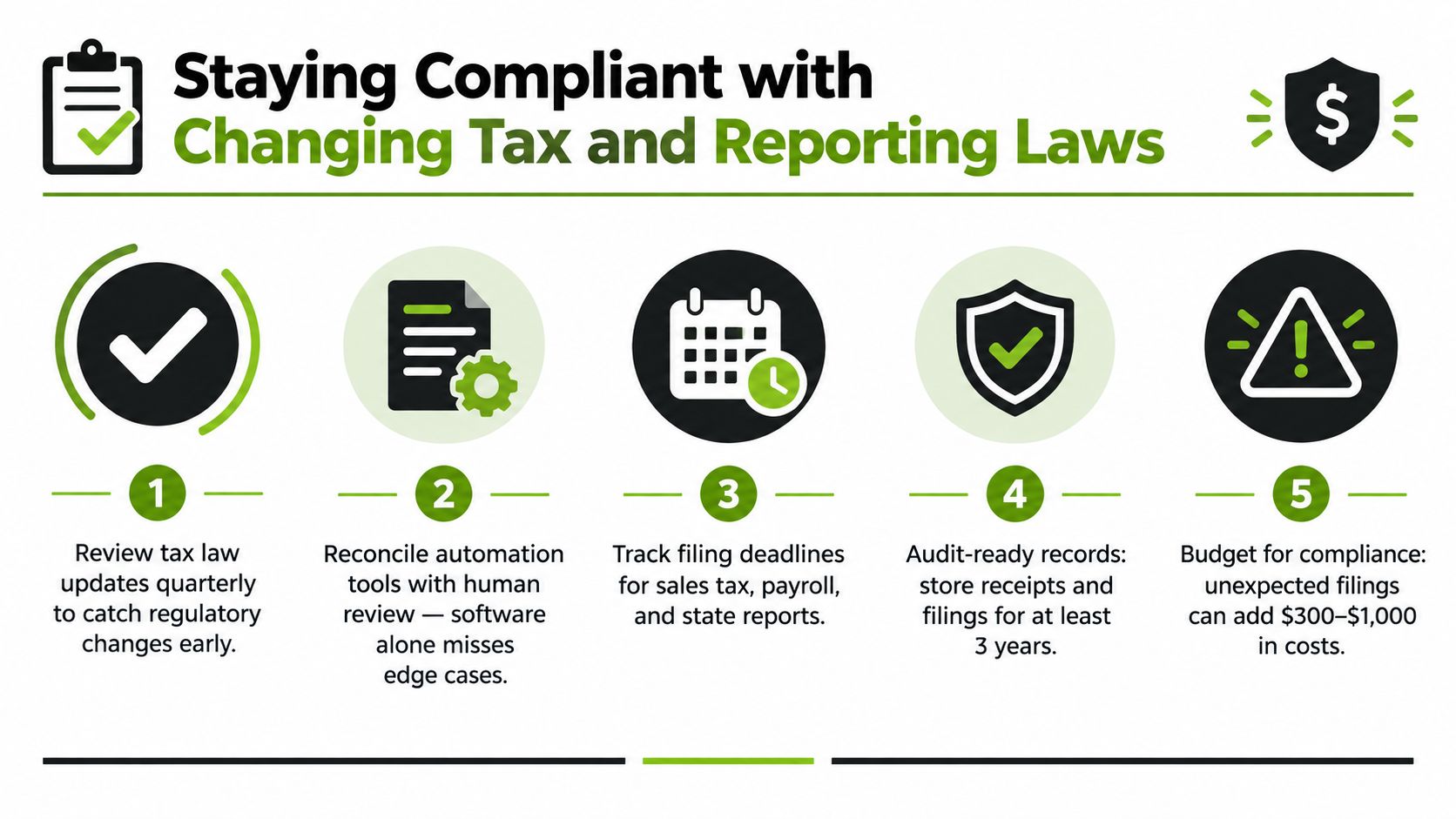
Jacksonville owners shouldn't assume that automation, an old online article, or a prior filing settles today's obligation. A CPA or qualified accounting professional should review the facts when entity status, ownership, or registration changes.
Practical Tips to Reduce Year-End Bookkeeping Costs
The best way to control average monthly bookkeeping costs is to make the scope visible before work begins. Don't ask a firm to price “the books” when you haven't identified the accounts, payroll activity, reporting needs, or condition of the file.
Use this decision framework:
First, measure the ongoing workload
Record your monthly transaction volume, active bank and credit-card accounts, payroll frequency, payment processors, inventory activity, sales-tax responsibilities, and desired reporting deadline. The more precise your information, the less likely a quote will depend on assumptions.
Then decide what you need every month. A low-volume business may need reconciliations and basic reports. A growing company may need a monthly close, management reporting, cash-flow planning, and professional review. A construction, healthcare, or nonprofit organization may need specialized accounting controls even when transaction volume looks modest.
Second, separate maintenance from repair
Ask the provider to price recurring bookkeeping separately from catch-up bookkeeping, historical cleanup, software implementation, opening-balance corrections, and staff training. Those projects shouldn't be hidden inside a monthly fee because they have different causes and different completion points.
Give the accountant access to prior reconciliations, tax returns, payroll reports, loan statements, ownership records, and supporting documents. A complete handoff reduces back-and-forth and helps the provider determine whether the opening balances are reliable.
Third, buy reporting you can use
A monthly profit and loss statement is useful, but it may not answer the question that keeps you awake. Contractors may need project profitability. Medical practices may need operational reporting. Nonprofits may need restricted-fund visibility. Owners who want to expand may need budgets and cash-flow forecasts.
Ask who reviews the numbers, when the reports arrive, which questions are included in the engagement, and whether tax, payroll, cleanup, and CFO work are separate services. Use a written year-end accounting checklist to organize documents before tax preparation and reduce avoidable delays.
Finally, choose guidance instead of false savings
DIY bookkeeping can work for a simple, current file when the owner understands the accounting and reviews the records consistently. It becomes a poor business decision when the owner postpones reconciliations, guesses at classifications, misses filing responsibilities, or can't explain the numbers to a lender, CPA, or business partner.
The right monthly package should keep the books accurate, make compliance responsibilities visible, and give you information early enough to act. Professional bookkeeping is not a substitute for management, but it prevents management decisions from resting on unreliable records.
Bookkeeping and Accounting of Florida Inc. provides ongoing bookkeeping, payroll, tax preparation, CPA review, compliance support, and fractional CFO guidance for Jacksonville and Northeast Florida businesses. Visit Bookkeeping and Accounting of Florida Inc. to discuss your current bookkeeping scope, reporting needs, and a monthly accounting plan built around your business.