

You've just finished a busy month. Customers paid at different times, a contractor sent an invoice by text, receipts are scattered across email and the truck console, and the balance in your bank account doesn't seem to match QuickBooks. Tax deadlines make the mess feel urgent, but the core issue started much earlier.
Thank you for reading this post, don't forget to subscribe!Monthly bookkeeping services replace that scramble with a dependable financial rhythm. Each month, transactions are organized, accounts are reconciled, reports are prepared, and compliance details are easier to track. The result isn't just cleaner records. It's a clearer view of whether your business can cover payroll, collect overdue invoices, invest in growth, and prepare for changing tax requirements.
For a Jacksonville business owner, bookkeeping should feel less like reconstructing the past and more like checking the dashboard before driving. The right provider can maintain the records, explain what the numbers mean, and provide fractional CFO guidance when a decision carries financial risk.
Why Monthly Bookkeeping Feels Overwhelming Without a System
At the end of the month, many owners face the same scene: receipts piled beside a laptop, bank-feed questions left unanswered, and a growing list of transactions labeled “to review.” The owner may know the business is busy, but the books don't clearly show whether that activity produced a profit.
That uncertainty creates a dangerous habit. The owner waits until tax preparation, then tries to remember which software charge was personal, which deposit belonged to a specific customer, and whether a vendor was paid twice. By then, a small error can be difficult to trace because several later transactions may depend on the original entry.

A monthly checkup for the business
Think of monthly bookkeeping like a regular health checkup. A doctor doesn't wait until a serious symptom appears to review vital signs. Likewise, a business owner shouldn't wait until year-end to discover that expenses were misclassified, receivables are aging, or cash is tighter than expected.
A recurring service creates a repeatable sequence:
- Collect: Gather bank activity, credit card records, invoices, bills, payroll information, and receipts.
- Classify: Assign transactions to the right income, expense, asset, liability, or equity accounts.
- Reconcile: Compare the accounting records with outside statements and investigate differences.
- Close: Review the period, post necessary adjustments, and produce usable financial reports.
- Act: Use those reports to decide what to collect, pay, postpone, price, or plan.
The value comes from the rhythm. A monthly close gives your CPA, bookkeeper, and management team a defined point at which the records are reviewed instead of allowing unfinished work to accumulate.
Practical rule: If your books only become understandable when taxes are due, they aren't supporting your decisions during the year.
Monthly bookkeeping has become a mainstream operational service for small businesses. One 2024 industry summary reported that 52% of small businesses outsource accounting and bookkeeping, while another dataset found that 37% outsource at least one business function. Among companies outsourcing finance work, bookkeeping and transaction processing represented 68% of the outsourced finance function. These figures help explain why recurring bookkeeping is now commonly connected to reconciliations, categorization, and monthly close work, not treated as a last-minute tax-season task. (Industry outsourcing data)
Bookkeeping and Accounting of Florida Inc. has supported businesses in Jacksonville and Northeast Florida for more than 20 years. A local firm that understands healthcare, construction, retail, and nonprofit operations can help turn a monthly chore into a compliance and planning process.
What Monthly Bookkeeping Services Actually Do
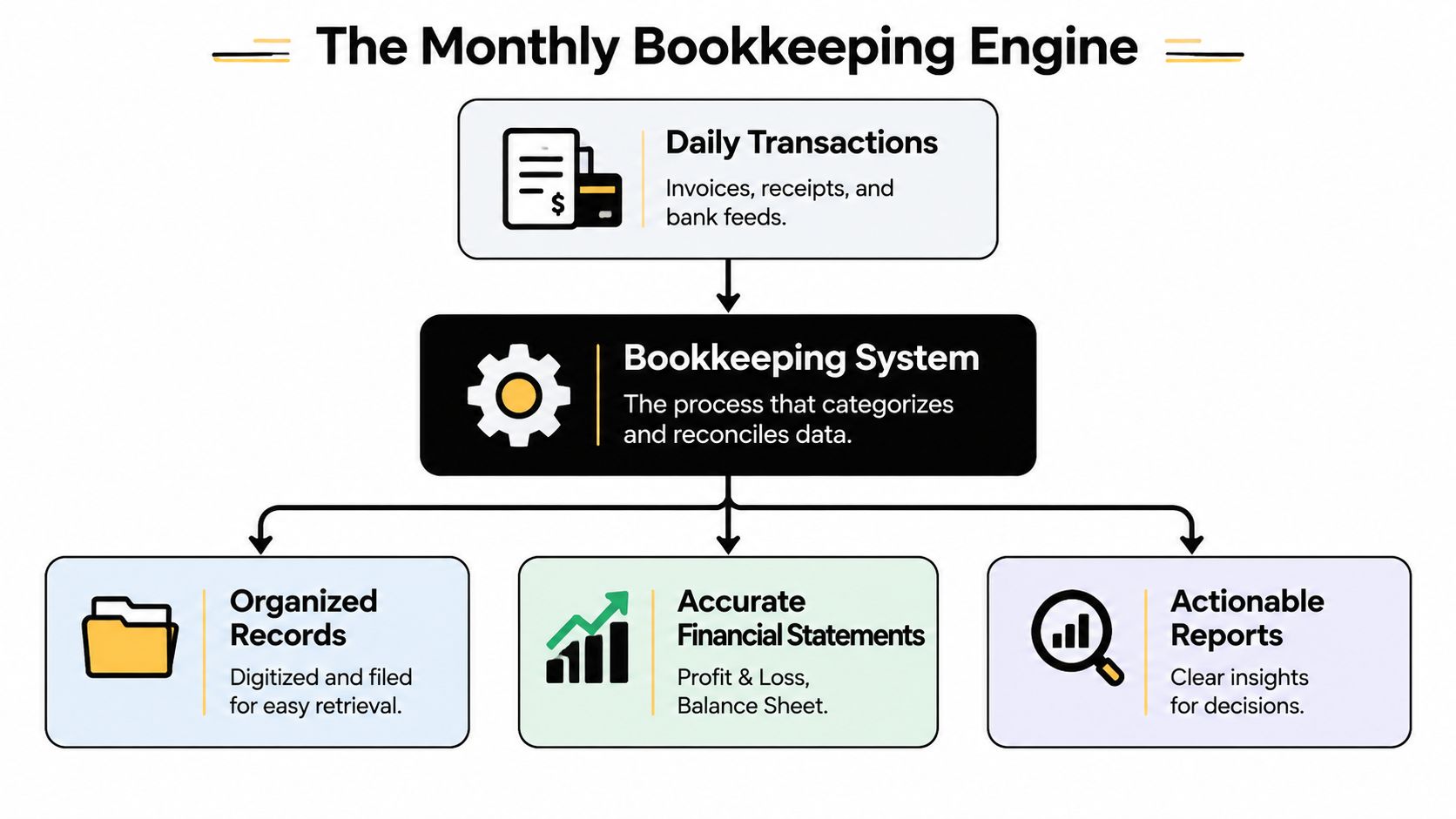
A useful way to understand monthly bookkeeping is to compare it with a ship's log. Every entry records something that happened, but the log only helps the captain steer if the entries are timely, accurate, and organized. A business's accounting system works the same way. Daily transactions are the raw observations, and the monthly close turns them into information you can use.
From activity to organized records
The first layer is transaction capture. Your provider reviews deposits, withdrawals, credit card charges, checks, invoices, receipts, payroll entries, and other source documents. Cloud platforms such as QuickBooks, Xero, and NetSuite make remote collaboration possible, while bank feeds reduce repetitive data entry.
Automation helps, but it doesn't remove the need for judgment. A bank feed may recognize a recurring software charge, but a person still needs to confirm whether it belongs in software expense, cost of sales, or another account. The same applies to owner draws, loan payments, equipment purchases, and transfers between accounts.
Next comes categorization. The goal isn't merely to place every transaction somewhere. The goal is to apply consistent rules so that revenue, expenses, liabilities, and assets appear correctly in the reports.
From records to a closed month
After categorization, the bookkeeper reconciles the accounts. That means comparing the accounting ledger with bank and credit card statements, identifying missing items, and resolving duplicates or mismatches. The reconciliation protects the integrity of everything that follows.
The final layer is the month-end close. The provider reviews open items, posts appropriate journal entries, checks account balances, and prepares reports such as the Profit and Loss statement and Balance Sheet. You're no longer looking at a pile of transactions. You're looking at a structured explanation of how the business performed and what it owns or owes.
This process matters because doing the books and having decision-ready books aren't the same thing. Data entry without reconciliation may look complete while still containing errors. A dependable monthly bookkeeping service gives you records that are organized, reviewed, and ready for tax preparation or management discussion.
Here's a short visual explanation of how the bookkeeping process connects transactions to reporting:
Inside Your Monthly Close and Key Deliverables
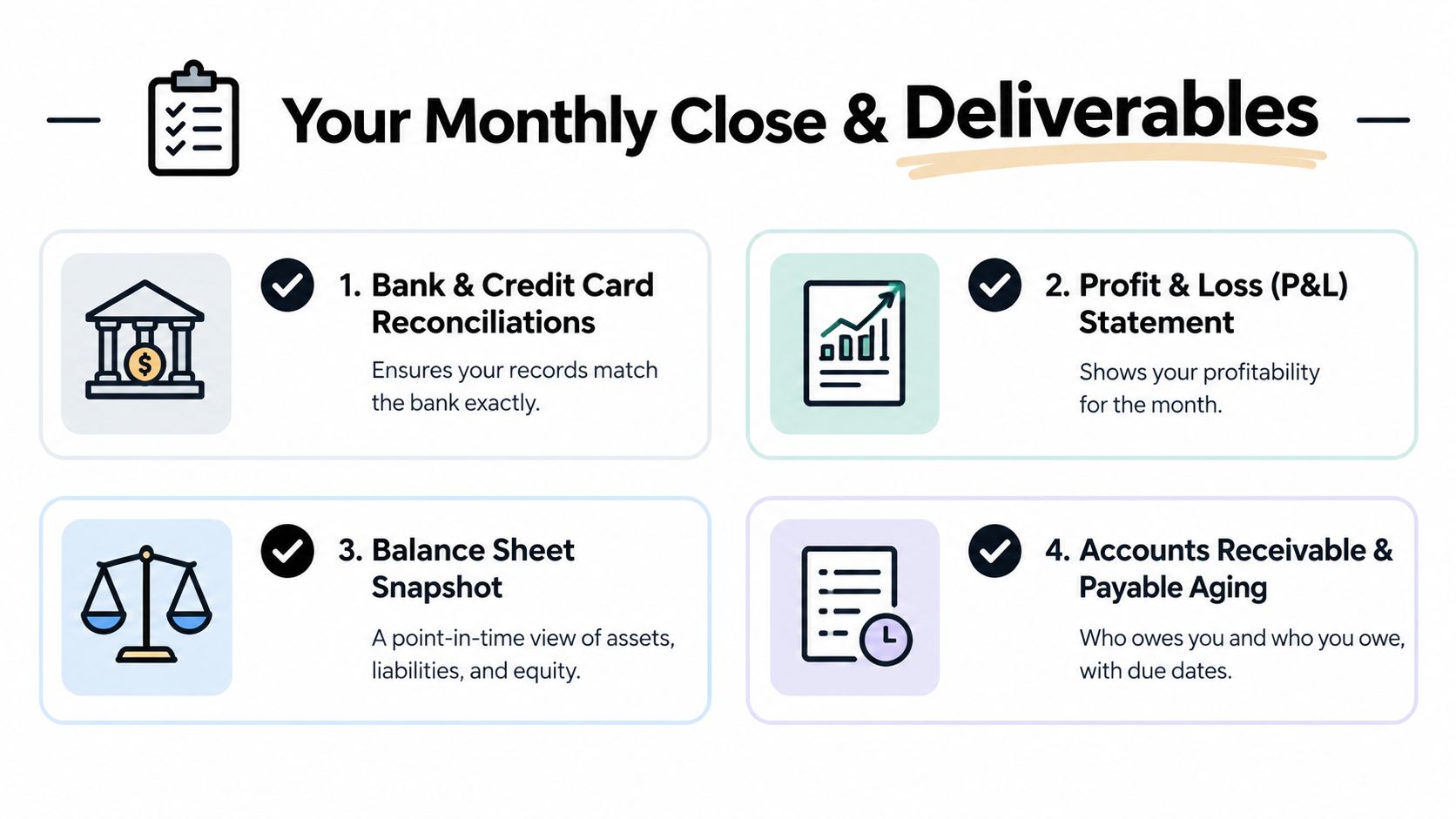
A complete monthly package should make it easy to answer practical questions. How much did the business earn? Which customers still owe money? Are the bank balances correct? What bills are coming due? Did payroll, sales tax, and recurring entries post correctly?
The deliverables below form the core of a well-managed close.
Bank and credit card reconciliations
Reconciliation compares your books with the statements from the bank and credit card companies. It catches timing differences, duplicate postings, transposition errors, missing entries, bank-feed mismatches, and opening-balance drift before those issues spread into later periods.
A sound monthly review includes checking the prior reconciliation, comparing subledgers with the general ledger, scanning for duplicate transactions, and investigating unusual balances. Monthly reconciliation is standard, while high-volume companies may need weekly or biweekly review to identify discrepancies sooner. (Bank reconciliation error guidance)
Profit and Loss statement
The Profit and Loss statement shows income and expenses for the period, leading to a reported profit or loss. It helps an owner examine pricing, direct costs, payroll, rent, software, professional fees, and other operating categories.
A profitable month doesn't automatically mean the bank account is full. The P&L uses accounting information, while cash timing depends on collections, payments, financing, and other movements. That distinction is why the P&L should be read alongside the Balance Sheet and cash-flow information.
Balance Sheet snapshot
The Balance Sheet shows assets, liabilities, and equity at a point in time. It can reveal whether cash, accounts receivable, inventory, loans, credit cards, and owner equity are recorded sensibly.
If accounts receivable is increasing but cash isn't, the business may be selling successfully while collecting too slowly. If liabilities are rising, the owner may need to understand upcoming obligations before approving new spending.
Receivables, payables, payroll, and taxes
Accounts receivable and payable aging reports show who owes your business and which vendors need payment. These lists turn vague cash concerns into specific follow-up work. A collections conversation is easier when the owner can see the invoice, due date, and outstanding balance.
Payroll posting should agree with payroll reports and the general ledger. Sales tax activity should also be recorded and reviewed according to the business's filing obligations. The exact responsibilities vary by jurisdiction and business structure, so a provider should clarify what it handles and what requires separate CPA or tax review.
The close checklist then confirms that reconciliations, journal entries, payroll, receivables, payables, and financial statements have been reviewed. For a practical checklist format, see the month-end close process checklist. The HireAccountants close process guide is another useful resource for comparing close procedures and identifying gaps in an internal process.
Published close benchmarks place the median month-end close at 6.0 calendar days, with a practical target of 3 to 5 business days for smaller QuickBooks-based clients once all documents are available. Cleaner coding, automated matching, and fewer exceptions can shorten the cycle. (Month-end close benchmarks)
How Monthly Bookkeeping Protects Cash Flow and Compliance
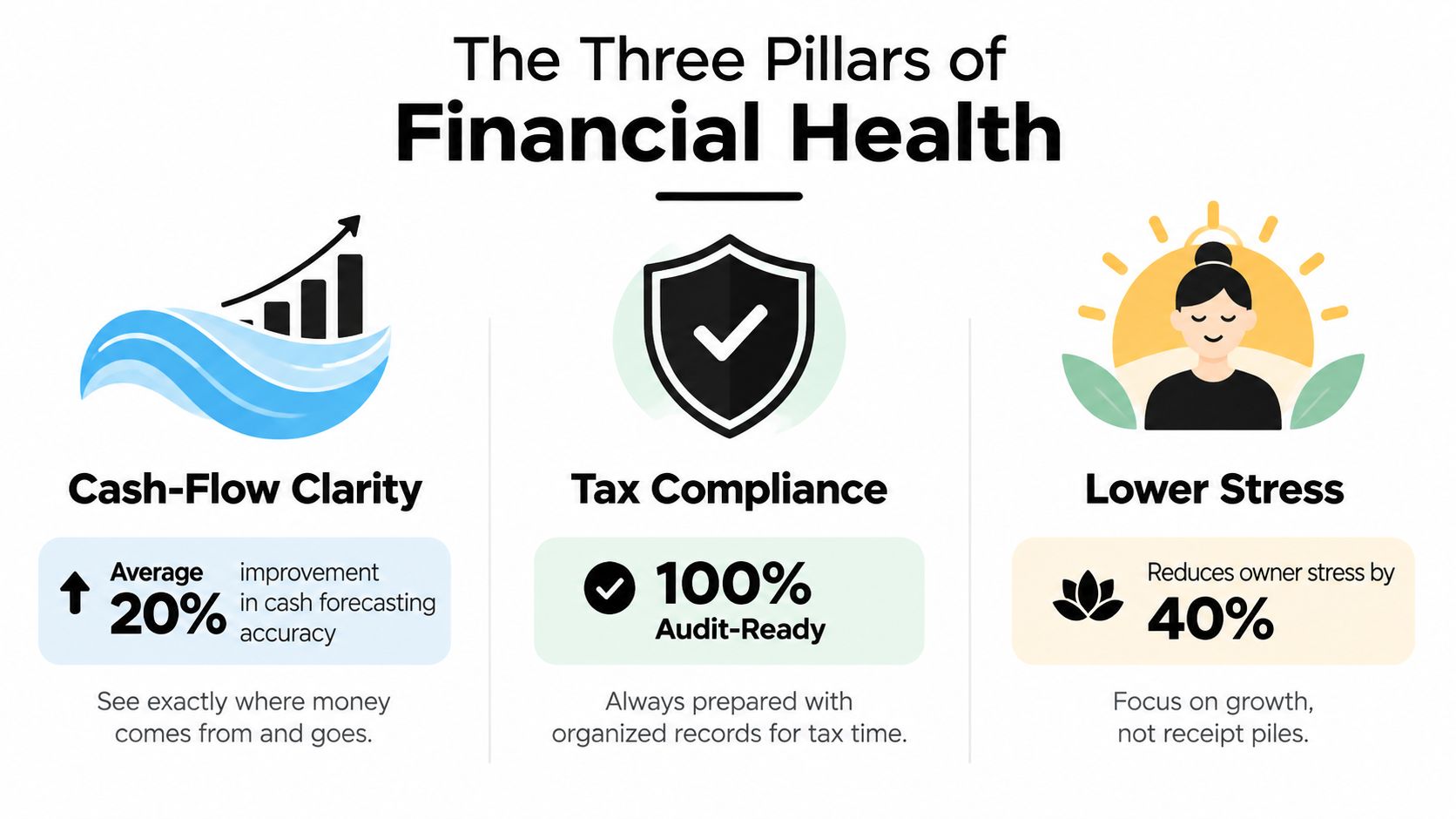
Clean books give an owner more than a tax file. They create an operating view of cash. You can see which customers need follow-up, which bills are approaching, and whether the next payroll or tax payment fits comfortably within available funds.
That view becomes more useful when the bookkeeping team produces weekly cash-flow foresight, not just a report after the month has ended. Recent accounting AI reporting describes platforms that can complete bookkeeping workflows end to end, shorten the close, support 90-day cash-flow forecasting, and prioritize collections. The buyer's question is therefore changing from “What does bookkeeping cost?” to “How will this process help me avoid a cash crunch next month?” (AI in accounting report)
Compliance requires current records
Small businesses often know they have obligations but don't know which records support them. Monthly bookkeeping helps maintain the documentation needed for income, deductions, credits, payroll, contractor payments, and estimated tax planning. The IRS states that businesses must keep records supporting income, deductions, and credits. (IRS Publication 334)
Tax year 2026 also brings changes owners should discuss with their tax professional:
- Standard deduction: The IRS lists $32,200 for married couples filing jointly, $16,100 for single filers and married individuals filing separately, and $24,150 for heads of household for tax year 2026. These amounts affect taxable-income calculations and planning for individual owners and pass-through businesses. (IRS 2026 inflation adjustments)
- Form 1099 reporting: Beginning in 2026, the Form 1099-NEC and 1099-MISC reporting threshold increases from $600 to $2,000 for qualifying annual vendor or contractor payments. Your books still need to identify payees and payment types accurately so the filing decision is based on complete information. (2026 Form 1099 changes)
- Self-employment records: IRS Publication 334 states that the maximum net self-employment earnings subject to the Social Security portion of self-employment tax is $184,500 for 2026. Accurate profit, payroll, and owner-payment records help support estimated tax planning. (IRS Publication 334)
Why guidance matters
A bookkeeper records and organizes information. A fractional CFO helps interpret it and connect it to decisions about hiring, pricing, financing, collections, and expansion. Companies don't need to wait until they can justify a full-time finance executive to receive that guidance.
Owner's perspective: A report tells you what happened. A financial guide helps you decide what to do before the next month closes.
Choosing Your Bookkeeping Model and Understanding Pricing
There isn't one correct staffing model for every company. The right choice depends on transaction volume, industry complexity, reporting needs, available supervision, and how much financial guidance the owner wants.
| Model | Best For | Monthly Cost Range | Pros | Cons |
|---|---|---|---|---|
| In-house bookkeeper | Businesses needing frequent internal support and direct daily oversight | Varies by role, hours, and local employment costs | Immediate access, internal familiarity, direct control | Hiring, training, coverage, and supervision remain with the owner |
| Fractional support | Owners who need senior accounting or CFO guidance without a full-time executive | Varies by scope and reporting cadence | Adds experienced guidance, planning, and interpretation | May not include every transaction-processing task unless separately scoped |
| Fully outsourced monthly services | Small and growing companies seeking an organized recurring finance function | About $300 to $2,500 per month for typical U.S. small-business ongoing bookkeeping, according to a 2026 market guide | Scalable, recurring process, access to broader expertise, less internal administration | Scope, response times, and industry fit must be confirmed before engagement |
The $300 to $2,500 monthly range is a starting benchmark, not a universal quote. Service businesses often cluster around $500 to $1,500, while complex inventory-heavy firms may pay $2,000 to $5,000 or more because inventory, purchasing, sales channels, and reconciliations create additional work. (Small-business outsourcing and pricing data)
What changes the price
A low-transaction consulting business may need categorization, reconciliations, and monthly reports. A company with inventory, multiple bank accounts, payroll, sales tax, job costing, or significant accounts receivable needs more review and coordination.
Revenue size also affects scope. One 2026 benchmark estimates basic outsourced bookkeeping for businesses under $1 million in revenue at $500 to $1,500 per month. Businesses between $1 million and $5 million often pay $1,500 to $5,000 per month for fuller close and controller oversight, while companies between $5 million and $25 million commonly spend $4,000 to $15,000 per month for outsourced accounting. (Finance and accounting outsourcing benchmarks)
Automation can narrow the workload, but it shouldn't be treated as a replacement for review. AI-assisted bookkeeping is reported to save about 10 hours per month and reduce bookkeeping costs by 40% to 50% in some settings. The appropriate question is which tasks can be automated safely and which require human review because of compliance, unusual transactions, or management judgment. (AI bookkeeping automation data)
For a more detailed discussion of service pricing and scope, review this guide to how much bookkeeping services charge.
Industry Add Ons That Make Monthly Books More Valuable
Monthly bookkeeping becomes more useful when the reports answer the questions specific to your industry. A generic Profit and Loss statement may be technically correct, yet still leave an owner unsure which service line, project, provider, or funding stream produced the result.
Healthcare practices and clinics
Healthcare accounting may require attention to provider collections, payer activity, patient receivables, payroll, and compliance reporting. A monthly close can separate operational revenue from adjustments and give owners a clearer view of collection performance and practice expenses.
The accounting team should also understand how clinical operations affect the financial records. A report that ignores those relationships may show totals without explaining why cash is delayed or why one provider's activity differs from another's.
Construction and trades
Construction companies often need job costing, progress billing, subcontractor tracking, retainage awareness, equipment records, and payroll support. Owners need to compare the budget and actual cost of each job, not just review one company-wide expense total.
Monthly reporting can help identify a project that is consuming materials or labor faster than expected. That information gives the contractor a chance to address pricing, change orders, scheduling, or billing before the final margin disappears.
Nonprofits
Nonprofits need records that distinguish restricted and unrestricted funds, grants, program expenses, administrative costs, and board reporting needs. Fund accounting and audit-ready documentation help demonstrate that money was used for its intended purpose.
The same monthly foundation still applies, but the reporting lens changes. A nonprofit board may care more about program spending, grant balances, and liquidity than a construction owner does about job margins.
Bookkeeping and Accounting of Florida Inc. works with healthcare, construction, retail, and nonprofit organizations across Northeast Florida. The practical advantage of industry-aware bookkeeping is that the monthly close can connect accounting entries to the operational questions owners, boards, and managers ask.
How to Evaluate Providers and Onboard With Confidence
Start with the provider's process, not just the advertised package. Ask who performs the work, who reviews it, which software they support, how questions are handled, and whether a fractional CFO or CPA is available when the numbers require interpretation.
Use this checklist during interviews:
- Credentials: Confirm QuickBooks ProAdvisor experience and relevant industry knowledge.
- Scope: Request a written list covering reconciliations, reports, payroll posting, accounts receivable, accounts payable, sales tax support, and tax-preparation coordination.
- Communication: Ask how quickly the team responds and where documents and questions are exchanged.
- Close timing: Discuss whether the provider can consistently target 3 to 5 business days for a smaller QuickBooks-based close after receiving complete documents. (Close-time benchmark)
- Specialized partners: Healthcare practices should also evaluate billing and collections support. A resource comparing the best medical billing company for 2026 can help separate billing operations from accounting responsibilities.
Onboarding usually begins with document gathering, access to bank and credit card accounts, chart-of-accounts cleanup, and confirmation of the accounting basis. The team then reviews opening balances, connects bank feeds, establishes document rules, and completes the first close. Ask how old unreconciled items will be handled rather than assuming the new monthly process will correct historical problems automatically.
A practical guide on how to hire a bookkeeper can help you prepare questions before signing an agreement. The strongest fit is a provider that can maintain accurate records now and add reporting, tax coordination, or fractional CFO guidance as the business becomes more complex.
Bookkeeping and Accounting of Florida Inc. provides ongoing monthly bookkeeping, reconciliations, financial reporting, tax support, and flexible fractional CFO guidance for businesses in Jacksonville and Northeast Florida. Visit Bookkeeping and Accounting of Florida Inc. to discuss your current books, compliance needs, and the monthly close process your business needs next.