
Most small businesses don't need another sales tactic first. They need a CFO. That sounds backwards until you look at what puts pressure on an owner: cash timing, payroll, tax obligations, debt, weak records, and decisions made with yesterday's information.
Thank you for reading this post, don't forget to subscribe!The CFO advisory market was valued at USD 14.5 billion in 2025 and is projected to reach USD 28.1 billion by 2034, with USD 15.6 billion projected for 2026, according to Intel Market Research's CFO advisory market estimate. That growth reflects a practical change. Businesses increasingly want senior financial guidance without immediately hiring a permanent executive.
A fractional CFO isn't a luxury bookkeeping upgrade. The role connects accurate accounting to decisions about hiring, pricing, financing, taxes, compliance, and growth. Without that connection, a profitable-looking business can still run out of cash or miss an obligation that becomes expensive to fix.
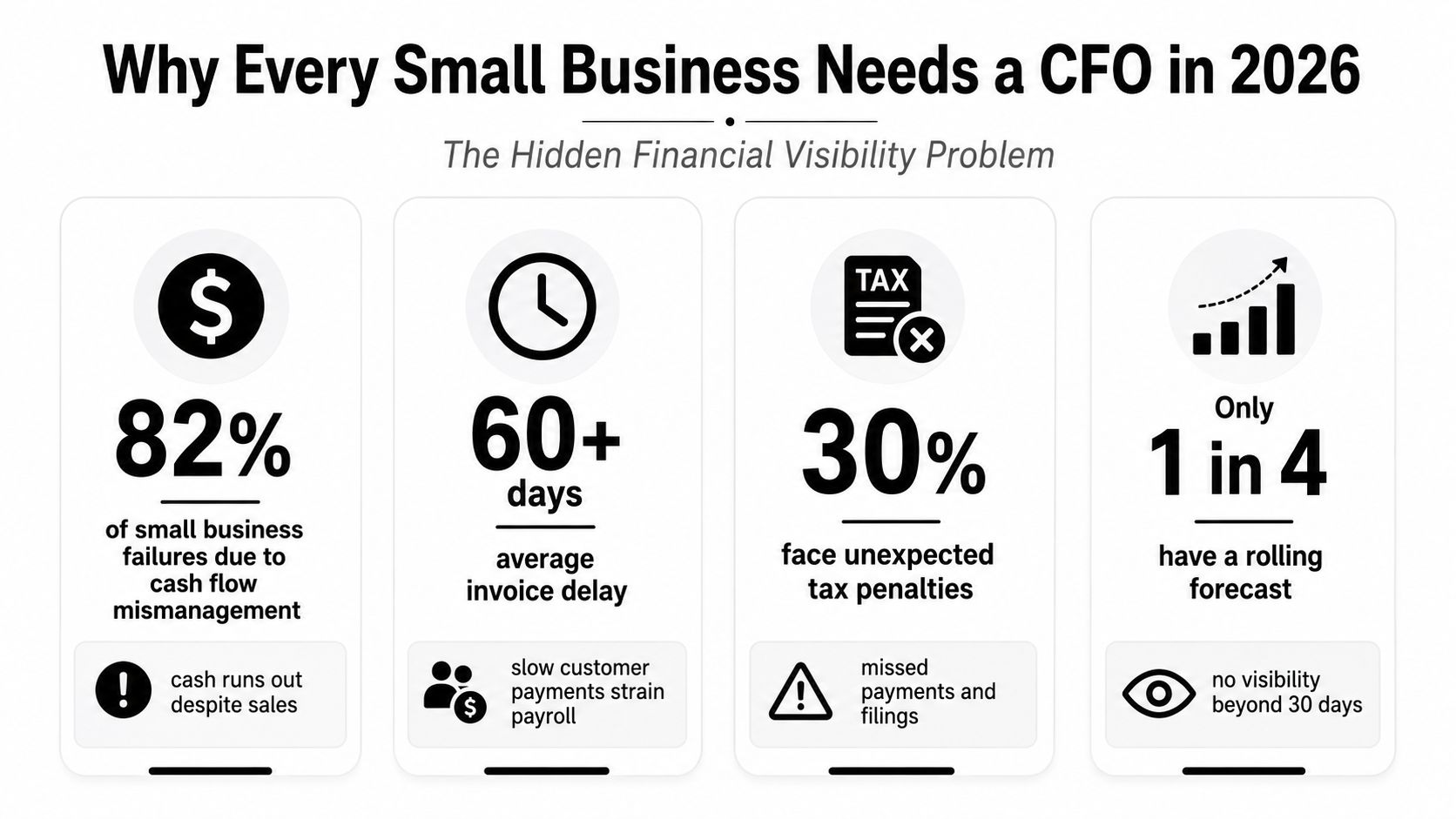
Why Every Small Business Needs a CFO in 2026
The most dangerous financial problem isn't always poor sales. It's poor visibility. Revenue may look healthy while customer invoices sit unpaid, payroll approaches, tax payments remain unplanned, and debt obligations tighten the available cash.
Owners also face a compliance blind spot. A missed filing, unsupported deduction, incomplete contractor records, or weak reconciliation may not show up on a monthly profit-and-loss statement. The problem often surfaces later, when a tax preparer, lender, auditor, investor, or regulator asks for records the business doesn't have.
CFO consulting services close that gap by giving owners senior oversight without requiring a full-time CFO commitment. The advisor reviews cash, strengthens reporting, coordinates with the tax team, and turns accounting information into decisions. The practical question isn't whether your business has an impressive dashboard. It's whether you know what cash is available, what the business owes, whether growth is affordable, and which deadline could cause trouble next.
Compliance belongs in the conversation
A CPA who appears only during tax season can prepare a return from the records available. That doesn't mean the business made the best decision before the deadline. CFO guidance adds a forward-looking review of entity structure, estimated payments, cash needs, documentation, and operational risk.
That matters more in 2026 because tax rules are changing. Waiting until year-end turns planning into damage control. Quarterly financial reviews give owners time to adjust spending, document deductions, plan purchases, and correct accounting records while options remain available.
Practical rule: If you can't explain your cash position, tax obligations, receivables, debt, and profit by service line, you're not managing the business from financial information. You're managing it from hope.
Not every small business needs a permanent CFO. Every growing business does need someone capable of connecting its accounting records to actual decisions. For many owners, a fractional CFO is the most sensible way to establish that discipline.
What CFO Consulting and Fractional CFO Services Actually Are
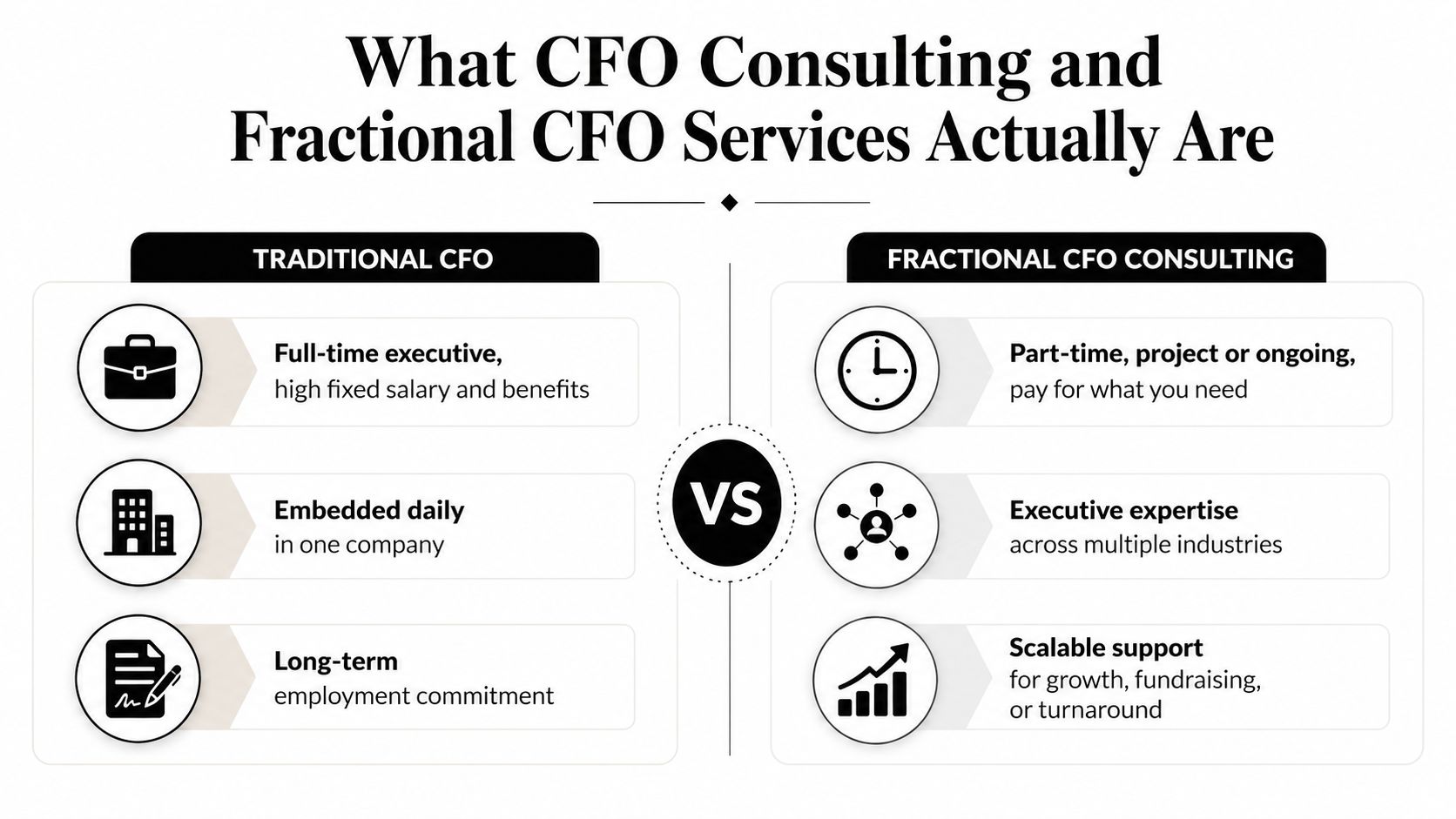
CFO consulting services provide executive-level financial support on a temporary, project-based, or ongoing basis. The work can include cash flow forecasting, financial reporting, budgeting, KPI tracking, tax strategy coordination, financing preparation, growth planning, and operational controls. The advisor doesn't just tell you what happened last month. They help determine what the business should do next.
A fractional CFO works with the business part time, usually as part of the senior leadership team. That arrangement creates continuity without the recruiting process, salary structure, benefits, and permanent commitment associated with a full-time executive. A project consultant, by contrast, comes in for a defined assignment such as audit preparation, a lender package, a budget rebuild, or a systems implementation.
The restaurant analogy works well. A full-time CFO is the head chef managing the entire kitchen every day. A fractional CFO is the experienced chef who comes in on a regular schedule, fixes the menu, trains the team, watches food costs, and keeps service from collapsing during the busy periods. A project consultant is the specialist hired to repair the walk-in freezer. You don't keep paying that specialist after the freezer works.
Match the engagement to the problem
Choose a fractional CFO service when the business needs recurring guidance, regular forecasting, management reporting, and a financial leader who can work with the owner over time. Choose project-based consulting when the need has a clear finish line. Choose a full-time CFO when the complexity, transaction volume, financing activity, or internal team requires daily executive attention.
The advisor should also coordinate with the bookkeeper, CPA, banker, insurance adviser, and attorney. Technically correct advice is not useful if it conflicts with the company's cash reality. Strong accounting tools can help organize financial information, but software doesn't decide whether you can afford a hire or whether a tax move creates a liquidity problem. People still have to do that.
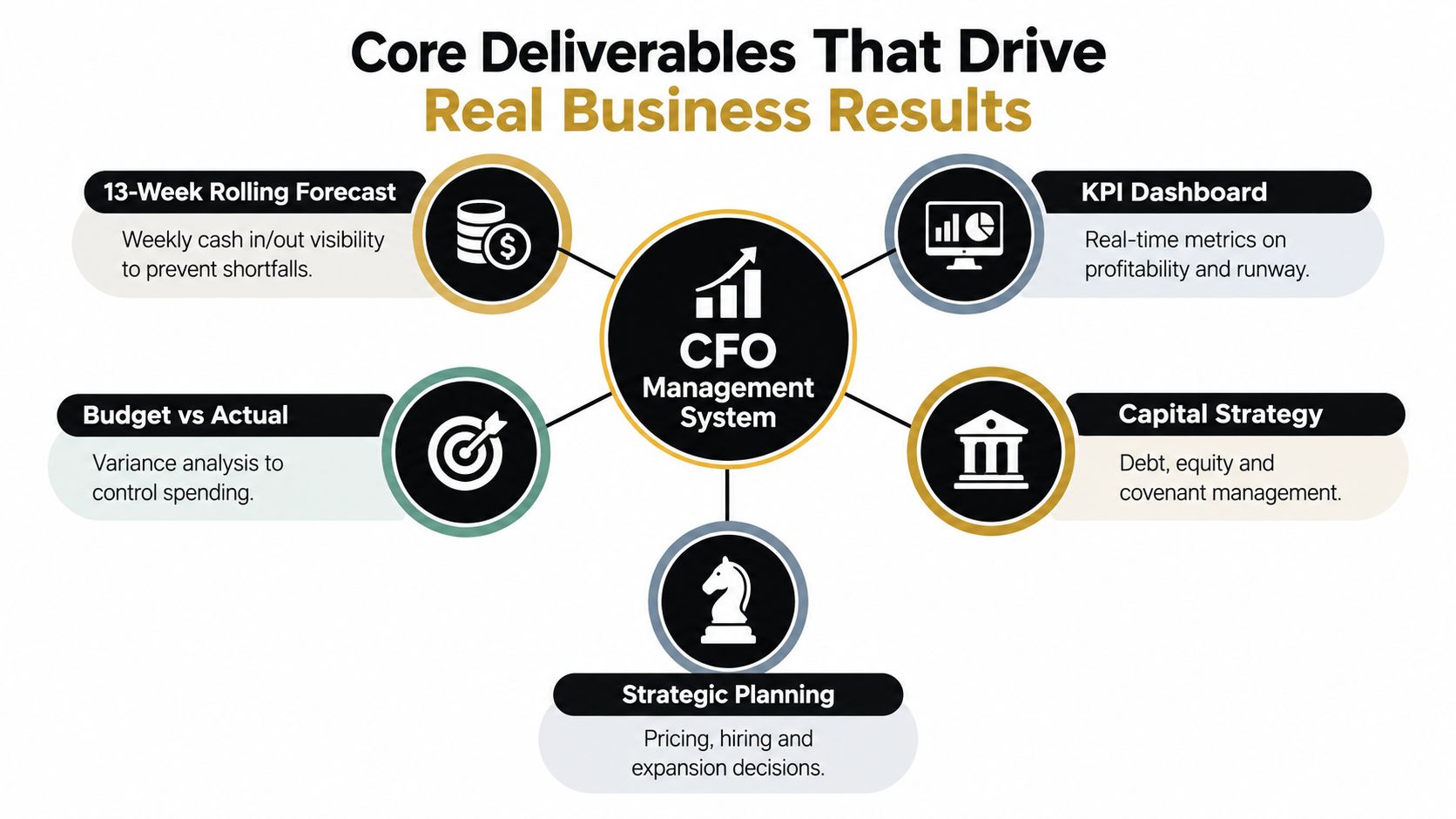
Core Deliverables That Drive Real Business Results
A CFO management system turns accounting records into an operating tool. The monthly financial statements remain important, but they aren't enough. Owners need a reliable way to see upcoming cash demands, understand profitability, measure variance, and make capital decisions before the consequences arrive.
Cash forecasting comes first. A 13-week rolling cash forecast maps expected inflows and outflows by week, including customer collections, payroll, taxes, debt service, and operating expenses. Because the forecast works at a weekly level, it can expose timing gaps that a monthly budget hides. A delayed receivable, retention billing lag, or grant reimbursement delay may threaten liquidity even when the income statement shows profit.
The deliverables that matter
- Cash management: Update the 13-week forecast each week and identify shortfalls early enough to accelerate collections, delay nonessential spending, negotiate supplier terms, or arrange financing.
- Budget versus actual reporting: Explain why results differ from plan. A variance report should lead to a decision, not become another spreadsheet nobody opens.
- Profitability reporting: Separate gross margin, service-line performance, job results, receivables, debt, and owner distributions so the owner can see which activities create value.
- KPI dashboards: Track the measures that fit the industry. A construction company needs job-costing and work-in-progress visibility. A healthcare practice needs payer mix, reimbursement timing, provider productivity, and patient-service profitability.
- Capital strategy: Evaluate debt, equity, equipment purchases, lender requirements, and covenant pressure before a cash shortage forces a bad decision.
- Audit preparedness: Reconcile accounts, organize support, test controls, and resolve exceptions before an auditor or funding source finds them.
Construction companies particularly need discipline around labor, materials, subcontractors, change orders, and overhead by project. A profitable bid can become a loss when actual costs aren't compared with the estimate while the work is still underway. Healthcare practices and nonprofits face their own reporting demands, including compliance documentation, audit readiness, grant or donor reporting, and clean separation of restricted and unrestricted activity.
A useful financial model also supports decisions about hiring, pricing, expansion, and ownership transitions. Owners moving between W-2 employment and consulting work may benefit from reviewing projections for W-2 to consulting before changing their structure or cash expectations. For a plain-English overview of the role, see what a CFO does in a company.
The result isn't a prettier dashboard. It's earlier warning, fewer surprises, stronger documentation, and decisions based on the business you operate.
2026 Tax Law Changes That Demand CFO-Level Guidance
Tax planning in 2026 can't be reduced to handing over documents at year-end. The One Big Beautiful Bill Act made the 20% qualified business income deduction permanent for pass-through business owners, while 2026 planning guidance describes a limitation phase-in increase to $75,000 for individuals and $150,000 for joint filers. Those thresholds can affect entity structure, owner compensation, and the timing of business decisions, as explained in Grant Thornton's 2026 individual tax planning guide.
Equipment purchases also require planning. 2026 guidance says Section 179 expensing increased from $1.25 million to $2.5 million plus inflation, and 100% bonus depreciation was restored permanently for qualifying property acquired after January 19, 2025, according to NFIB's small-business tax guidance. The deduction may look attractive, but a purchase still consumes cash. A CFO evaluates the tax benefit alongside liquidity, financing, utilization, and timing.
Compliance changes affect bookkeeping
The Form 1099-NEC and 1099-MISC reporting threshold rises from $600 to $2,000 starting in 2026, with future inflation adjustments, according to 2026 tax change guidance from 1-800Accountant. That makes contractor payment tracking and vendor records especially important. A business can't apply the rule correctly if its books don't distinguish contractor payments from other expenses.
The right response is a recurring review of entity structure, purchases, estimated payments, contractor records, and supporting documentation. Owners can also use practical tax strategies for business owners as a starting point, then have their CPA and CFO connect those strategies to the company's actual forecast.
Tax preparation tells the government what happened. CFO-level tax planning helps the owner decide what to do before it happens. The difference is substantial.
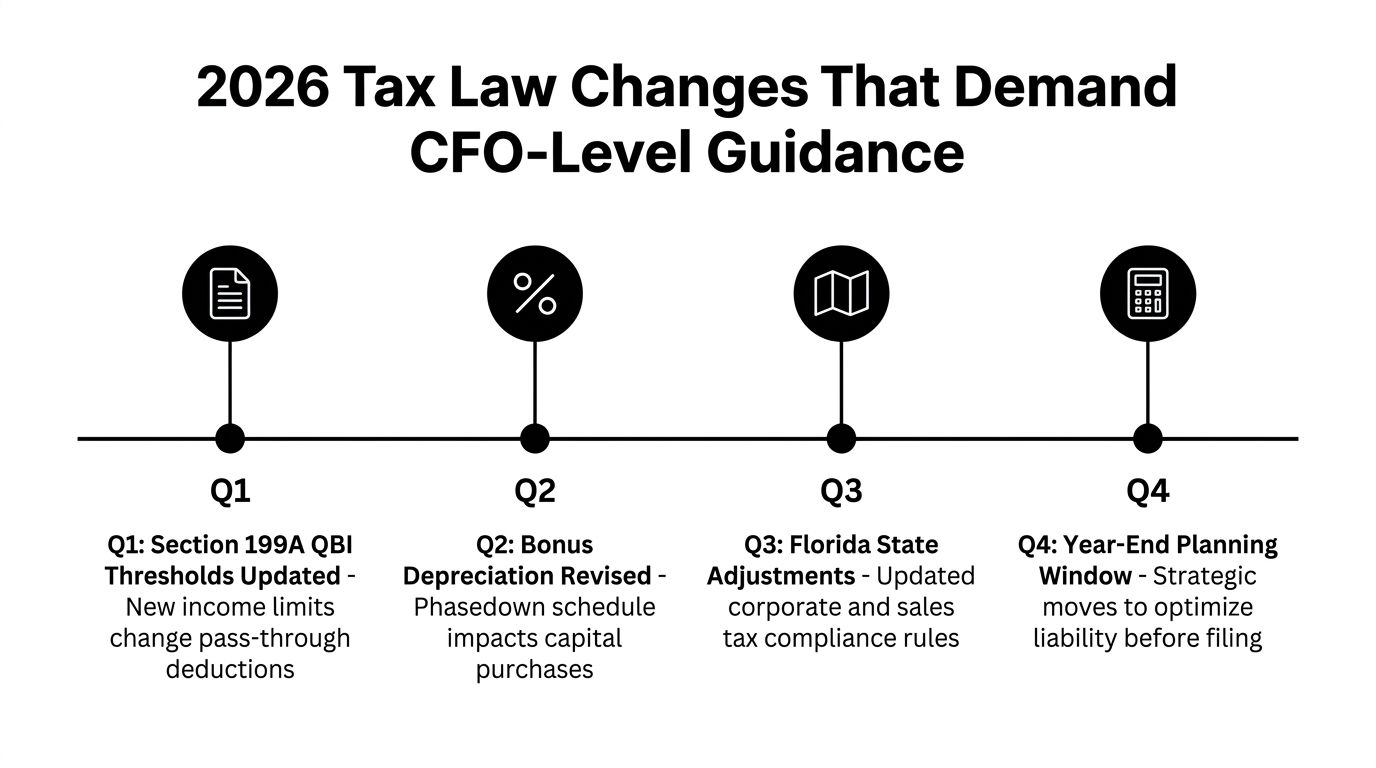
Jacksonville businesses should also have their CPA review Florida-specific sales tax obligations, contractor activity, marketplace transactions, and local requirements. Don't assume a federal planning conversation covers every state and local exposure. For broader planning context, review these business tax planning strategies.
Jacksonville Case Examples in Construction and Healthcare
A North Jacksonville commercial contractor had solid work but poor visibility. The owner estimated from memory, reviewed jobs after completion, and couldn't tell which projects were consuming margin through labor overruns, material costs, subcontractor changes, or delayed billing. A fractional CFO introduced work-in-progress reporting, monthly job reviews, and a rolling cash forecast.
The forecast showed that the company needed a $180,000 line of credit eight weeks before payroll would have bounced. That figure is a composite illustration, not a reported client result. The point is the timing. A lender conversation held while the company still had options is very different from an emergency request made after payroll is at risk.
A second composite example involves a Jacksonville specialty healthcare practice with six providers. The practice struggled with payer mix, unbilled encounters, and a budget that mixed physician compensation with general overhead. The CFO rebuilt revenue-cycle reporting, separated provider compensation from practice costs, and identified a profitable service line the owner had been under-pricing.
The work didn't begin with a grand strategy retreat. It began with clean categories, reconciled information, and an honest look at what each service produced.
| Metric | Construction Co. Before | Construction Co. After | Healthcare Practice Before | Healthcare Practice After |
|---|---|---|---|---|
| Financial visibility | Job results reviewed too late | Regular work-in-progress reviews | Revenue and overhead blended | Service-line reporting separated |
| Cash planning | Owner relied on memory | Rolling cash forecast supported financing timing | Collections and billing delays unclear | Revenue-cycle reporting clarified |
| Decision quality | Bids lacked reliable cost feedback | Labor, materials, and subcontractors reviewed by job | Pricing decisions lacked service profitability | Pricing informed by service-line results |
| Primary risk | Margin erosion and payroll pressure | Earlier lender and project decisions | Unbilled work and payer uncertainty | Better operational follow-up |
Your business may not resemble either example. The warning signs probably do. If you can't explain which jobs, providers, customers, or services generate cash, a financial leader can help expose the answer.
Step-by-Step Hiring Checklist for Northeast Florida Businesses
Start with your own records. Pull the last 24 months of financial statements and rate your confidence in the information on a 1-to-10 scale. The exercise isn't about passing an accounting exam. It reveals whether you need cleanup first, recurring CFO oversight, or both.
Next, write down the three financial decisions that concern you most over the next year. They might involve hiring, equipment, debt, pricing, ownership changes, expansion, or tax planning. A good advisor should respond to those decisions with a process, not a generic list of services.
Follow the selection sequence
- Define the engagement: Decide whether you need full-time leadership, a fractional CFO, or a project consultant. Estimate the hours you realistically need each month instead of buying an impressive package you won't use.
- Assess the accounting foundation: Confirm whether reconciliations, accounts receivable, accounts payable, payroll, inventory, job costing, and tax records are current. Strategy built on unreliable books is expensive fiction.
- Check credentials: Ask about CPA licensure, QuickBooks Online or Sage Intacct certifications, industry experience, and references you can verify.
- Request a sample deliverable: Ask to see a one-page cash-flow forecast or KPI dashboard using sanitized information. You should understand what the advisor will produce and how you will use it.
- Test communication: Ask how often you meet, who attends, what happens between meetings, and how urgent decisions are handled. A CFO who disappears until the next scheduled call isn't providing leadership.
Jacksonville and Northeast Florida businesses need a local compliance lens. Confirm that the firm understands Florida requirements, Duval County sales tax surtax rules, contractor reporting, and the banking environment. Ask whether the advisor understands lending expectations at institutions such as VyStar and First Florida Credit Union.
In-person access can matter during lender meetings, audits, operational reviews, and ownership decisions. Confirm whether the firm can meet in Riverside, Southside, or Ponte Vedra without adding travel charges. Ask how the advisor will work with your existing bookkeeper and tax preparer. You want one financial story, not three competing versions of the truth.
Pricing Models ROI and When a Fractional CFO Is the Wrong Fit
Pricing should match the work, not the title. A monthly retainer suits an owner who needs recurring reporting, cash forecasting, planning, and leadership. Hourly project work fits a defined assignment. Equity-linked or performance-based arrangements are less common and require careful documentation because incentives can become messy quickly.
The specific figures below are planning ranges, not universal market prices. Your quote will depend on records, complexity, industry, urgency, and the level of executive involvement.
| Engagement Model | Typical Price Range | Best Fit For | Expected ROI Window |
|---|---|---|---|
| Monthly retainer | $3,000 to $8,000 | Ongoing forecasting, reporting, and financial leadership | Measured against recurring decisions and identified exposures |
| Hourly project work | $250 to $450 per hour | Audit preparation, lender packages, cleanup, or defined analysis | Measured at project completion |
| Equity-linked or performance fee | Varies by agreement | Select growth-stage or transaction-focused engagements | Tied to documented milestones and outcomes |
A simple ROI test is more useful than a sales promise. If the advisor identifies $40,000 in tax exposure or recovers $60,000 in aged receivables, those outcomes can materially outweigh a year's retainer. Those are illustrative decision examples, not guaranteed results. The advisor should show how the engagement will identify, measure, and report outcomes.
Review fractional CFO hourly rates before you compare proposals. Then ask what you receive for the price.
When hiring one wastes money
A fractional CFO is the wrong fit for a pre-revenue startup under $500,000, a solopreneur whose only problem is bookkeeping cleanup, or an owner who wants strategic advice but refuses to share complete financial records. In those cases, pay for the narrower problem first. A CFO can't manufacture reliable insight from missing transactions and wishful thinking.
The right candidate should agree on measurable outcomes within 90 days, such as a usable cash forecast, reconciled reporting, a documented compliance calendar, clearer receivables, or management reporting that supports a specific decision. Book a scoping call, request a sample 13-week forecast, and walk away if the advisor can't explain what will change and how you'll know.
Bookkeeping and Accounting of Florida Inc. provides bookkeeping, tax preparation, payroll, audit support, and fractional CFO services for Jacksonville and Northeast Florida businesses that need accurate records and practical financial guidance. Visit Bookkeeping and Accounting of Florida Inc. to discuss your reporting, compliance, cash-flow, and growth needs with a local accounting team.