
A roofer can book three large projects, keep the crews busy, and still reach year-end wondering where the margin went. The bank balance may look respectable, QuickBooks may show revenue, and the owner may insist the company is profitable. Ask which jobs made money, which trade packages ran over budget, or how much overhead each project absorbed, and the room often gets quiet.
Thank you for reading this post, don't forget to subscribe!That silence is expensive. Construction job costing turns company-wide bookkeeping into project-level financial control. It connects estimated and actual labor, materials, equipment, subcontractor, and overhead costs while the work is still active. Without that comparison, a profitable job can subsidize a losing one, and the owner may discover the problem only after the final invoice has gone out.
The pressure isn't theoretical. A globally cited body of construction research found an average cost overrun of about 28% across roughly 70 years, with overruns ranging from 12% to 70% of contract value in many cases. A separate large-project study reported that 98% of megaprojects exceeded budget by more than 30%, with the average increase reaching 80% of the original value. See the construction cost overrun research for the underlying context.
Why Most Contractors Don't Actually Know Their Profit Margins
The roofer in that opening story doesn't necessarily have a bad business model. More often, the company has good production work and weak financial visibility. Crews submit broad labor hours, material receipts wait in an inbox, subcontractor invoices get posted without a phase or cost code, and overhead lands in one general account. The profit-and-loss statement may be accurate at the company level while remaining useless at the job level.

Construction job costing exists to stop that leak. It maintains a live comparison between the original estimate and actual spending for each project. That means labor hours and burden, materials and freight, equipment usage, subcontractor commitments, and an intentional share of overhead all need a clear home.
The industry made job costing unavoidable
Construction has a long-running pattern of systematic underestimation. In a global database of more than 16,000 projects, only 47.9% finished within the original budget, according to construction budget overrun analysis. Transportation infrastructure has performed particularly poorly, with almost 9 in 10 projects underestimated and actual costs averaging 28% above original estimates.
Those figures explain why job costing became foundational to estimating accuracy, change-order control, work-in-progress reporting, and project profitability management. It isn't bookkeeping theater performed after the money is gone. It's the operating discipline that tells you whether a labor productivity problem, supplier repricing, scope change, or scheduling delay is eating the contract.
Practical rule: If a cost can't be assigned to a job, phase, or overhead pool, your report isn't finished.
Start with a consistent chart of accounts and cost-code hierarchy. Capture field data daily, review committed and incurred costs weekly, and reforecast the estimated cost at completion whenever the facts change. Owners who want to sharpen preconstruction assumptions can also review these deck build budgeting tips from XTREME EDEALS INC., particularly when labor, materials, and scope decisions must be priced before mobilization.
The tax and compliance layer matters just as much. Small contractors often discover too late that job-cost records support tax reporting, lender conversations, change-order defense, and audit requests. A clean system protects margin before it becomes a postmortem.
Setting Up Construction Job Cost Codes and Chart of Accounts
A construction chart of accounts should make job reports easier, not turn QuickBooks into an archaeological dig. Build the structure around the way work is estimated, performed, billed, and reviewed. Each project should have a unique job record, while cost codes identify what the company bought or performed.
Build the hierarchy before entering transactions
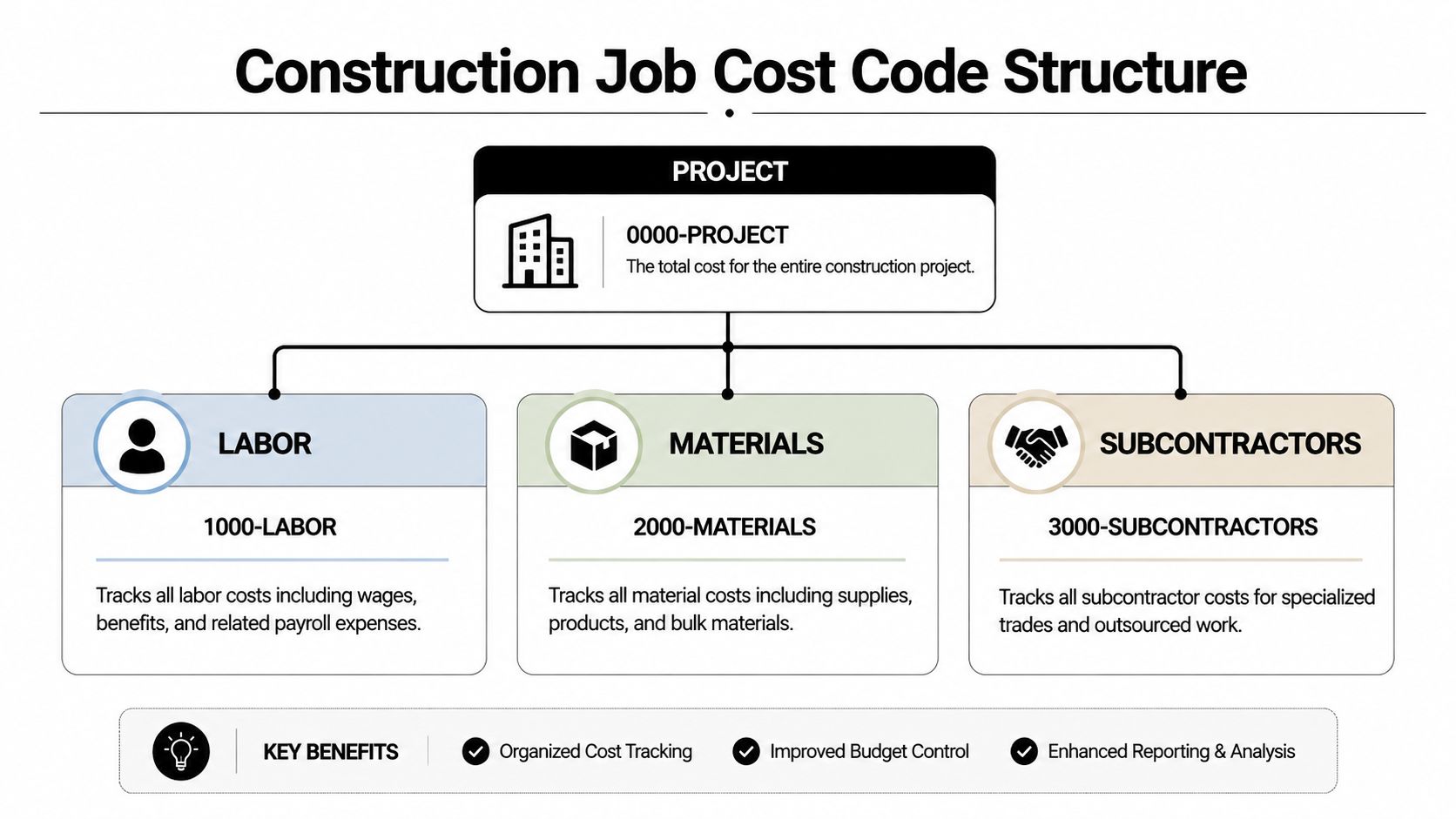
Use parent accounts for major cost types and child codes for useful detail. A practical structure might include:
- Labor: Direct crew wages, foreman time, and job-related labor burden assigned to the project.
- Materials: Job-specific purchases, freight, consumables, and material categories that need separate variance review.
- Equipment: Rentals, fuel, repairs charged to the job, and an agreed allocation for owned equipment.
- Subcontractors: Trade packages, supplier-installed work, retainage, and approved scope changes.
- Indirect job costs: Supervision, temporary facilities, permits, and other costs connected to production but not one task.
- Overhead: Office payroll, insurance, software, occupancy, and administrative expenses allocated through a documented method.
Don't create a code for every nail unless the business can maintain that detail. The right system gives management meaningful answers without forcing field staff to choose among hundreds of nearly identical options.
Configure QuickBooks around job-level reporting
In QuickBooks, connect estimates, customers, projects, classes, locations, products and services, purchase orders, bills, checks, and time entries to the same reporting logic. Use customer or project records for the job, classes for a stable business dimension such as division or type of work, and locations only when they answer a recurring management question. Too many overlapping dimensions create reporting noise and invite inconsistent data entry.
The chart of accounts should distinguish revenue from cost of revenue and operating overhead. A project report then needs to show estimated, committed, incurred, and forecast costs by category. The general ledger remains the legal accounting record, but the job ledger supplies the operational truth.
Review the chart of accounts setup guidance before rebuilding an existing file. A certified QuickBooks ProAdvisor can validate account mapping, clean duplicate accounts, and test whether a profit-and-loss report can be produced by job without manual spreadsheet surgery.
Set ownership and approval rules
Assign one person to maintain the code list, one person to approve field entries, and a clear escalation path for uncoded transactions. Require project managers to approve time and purchase allocations before the accounting close. If the crew can't find the right code, the answer is not “use miscellaneous.” Fix the code structure.
Capturing Real-Time Job Data for Labor, Materials, and Subcontractors
A cost-code system is only as honest as the data entering it. If workers record time to a generic labor account, receipts sit unassigned, and subcontractor bills arrive after the job is complete, the report becomes historical fiction.

Make daily capture non-negotiable
Workers should enter hours against the project and cost code worked, not merely against the company or crew. Supervisors need to review unallocated hours, split time across phases when necessary, and approve corrections while the work remains fresh. Salaried field personnel also need a consistent allocation process when they divide time between jobs and overhead.
Material purchases require the same discipline. Every receipt, vendor bill, freight charge, and field purchase should identify the job, phase, and cost category. A receipt that says “materials” is not a job-cost record. It is a future argument.
Subcontractors deserve special attention because their invoices often include progress billing, retainage, allowances, and change-order work. Record the commitment when the contract or purchase order is approved, then record the bill when incurred. Track retainage separately so the job's cost and cash position don't tell contradictory stories.
The month-end inbox is where profitable jobs go to die.
Use a repeatable rhythm:
- Daily: Field staff enter labor, equipment use, receipts, and production notes.
- Weekly: Supervisors approve entries, accounting matches bills and purchase orders, and project managers review committed costs against progress.
- Before close: Accounting investigates uncoded transactions, unusual variances, duplicate bills, missing change orders, and costs posted to the wrong project.
QuickBooks can preserve the trail through estimates, purchase orders, bills, expenses, time activity, and change orders. The exact screen matters less than the rule that every transaction carries the right project and cost code before it reaches the books.
The following video can help teams visualize the workflow, but software won't rescue a company that refuses to enforce approvals.
Use digital time and expense tools where they reduce delay, then integrate approved information with accounting. A ProAdvisor-style review should test whether field data, payroll, accounts payable, and project reports reconcile. If those systems produce different answers, the contractor needs process repair before buying another dashboard.
Allocating Overhead the Right Way Without Destroying Job Margins
Overhead is the quiet resident of every construction contract. Office payroll, insurance, bonding, software, occupancy, supervision, and administrative support may not belong to one wall or foundation, but every job consumes the capacity those costs fund.
The core job-cost formula is direct materials + direct labor + applied overhead. That makes overhead allocation a technical control point, not a decorative markup. If the company applies overhead inconsistently, management can't compare jobs or trust gross margin.
Choose an allocation method that matches the business
First, define the overhead pool. Exclude costs already assigned directly to jobs, then choose an allocation base that reflects how the company consumes resources. Direct labor dollars may suit a labor-intensive contractor. Job revenue may work for a broader portfolio, but it can distort results when projects differ dramatically in complexity.
| Method | Best For | Accuracy | Complexity |
|---|---|---|---|
| Actual overhead rate | Businesses with stable, timely cost data | Strong after costs are known | Moderate |
| Predetermined rate | Contractors needing consistent estimates and interim reports | Useful when reviewed and recalibrated | Low to moderate |
| Activity-based allocation | Firms with distinct trades, equipment, or support demands | Strong when activities are measurable | High |
An actual rate provides a clearer historical picture, but it arrives after spending occurs. A predetermined rate supports bidding and live reporting, yet it becomes dangerous when overhead changes materially and nobody updates it. Activity-based allocation can reveal differences between project types, but it requires disciplined data and management time.
Document the assumptions
Write down the pool, allocation base, review date, responsible approver, and treatment of unusual costs. Recalibrate when the overhead structure changes, not merely because the calendar turns. A fractional CFO can test whether the applied rate is absorbing enough overhead without making bids uncompetitive.
Contingency deserves separate treatment. It isn't a substitute for overhead, and an owner draw isn't a project cost. Contractors considering how to protect liquidity can review managing draws with Drawra contingency from Drawra, then keep contingency, distributions, and job costs distinct in the accounting system.
The objective is not perfect theoretical allocation. It is consistent, explainable, decision-useful allocation. A job report should tell the owner whether the contract covered the resources it consumed. If overhead is dumped into a year-end bucket, the answer arrives after the funeral.
Why Small Construction Firms Need Fractional CFO Guidance
Routine bookkeeping records what happened. Construction companies also need someone to interpret what is happening, what will happen next, and what the tax rules require the books to prove. That is the role of a fractional CFO, especially when hiring a full-time financial executive doesn't make economic sense.
A fractional CFO can establish a weekly variance review, compare bid assumptions with actual production, forecast cash flow against job progress, and challenge a project manager who says a cost is “temporary” for the third consecutive week. The service turns job costing from data entry into operating control.

Tax law now affects the costing architecture
The One Big Beautiful Bill Act permanently restores 100% bonus depreciation for qualifying property placed in service on or after January 20, 2025, eliminating the earlier phase-down schedule that would have reduced bonus depreciation to 40% in 2025, 20% in 2026, and 0% afterward, according to construction tax changes under the 2025 tax reform. Equipment, trucks, and tools therefore need clean capitalization records, placed-in-service dates, ownership details, and job-use information.
That tax benefit doesn't mean every purchase belongs in a job's direct cost. A CFO should separate capital budgeting from project costing, determine whether equipment is owned or rented, and coordinate depreciation planning with the financial statements and tax return. Otherwise, the company may celebrate a deduction while misunderstanding the contract margin.
Section 460 generally requires the percentage-of-completion method for long-term construction contracts. Guidance for 2026 references a $31 million threshold that may allow an exception for qualifying small contractors, while an expanded exemption applies to residential construction contracts entered into after enactment in 2026 for calendar-year taxpayers. The 2026 WIP schedule guidance explains why work-in-progress schedules, contract classifications, estimated costs, and revenue recognition must align.
External shocks need separate visibility
Labor gaps and higher costs remain central to the 2025 U.S. commercial construction outlook, while one industry report says average tariff rates have risen to about 20%, with steel, aluminum, and copper especially affected. Those pressures can hit one trade package harder than another, so a blended overhead rate may hide the problem.
A CFO should isolate tariff-sensitive material codes, document supplier price locks, track subcontractor repricing, and reset estimated cost at completion when labor scarcity changes productivity assumptions. Small businesses often don't know every record they must retain, every tax deadline they must meet, or how operational records support compliance. Professional guidance fills that gap.
Review fractional CFO services for small business when the company needs senior financial leadership without full-time overhead. A construction CFO doesn't replace the project manager. The CFO makes sure the project manager's decisions appear quickly and accurately in the financial forecast.
Job-Cost Reports and KPIs That Actually Drive Better Decisions
A job-cost report should answer three questions quickly. What did we expect to spend, what have we spent or committed, and what will the completed job likely cost? If the report only displays transactions, it describes the past without helping anyone steer the project.
Use a decision-ready report layout
Build the report by project, phase, and cost category. At minimum, include:
| Report field | Management question |
|---|---|
| Original estimate | What did we agree to spend? |
| Approved changes | What scope or price changed? |
| Committed costs | What have we promised to vendors and subcontractors? |
| Incurred costs | What has already hit the books? |
| Remaining forecast | What will the unfinished work require? |
| Cumulative variance | Where is actual or forecast cost diverging? |
| Gross margin by job | Is the project earning enough after job costs? |
The critical figure is not merely actual spend. A project can look favorable because invoices haven't arrived. Compare committed costs and earned progress, then investigate whether the favorable variance reflects real savings or delayed paperwork.
Watch the indicators that change behavior
Track gross margin by job, overhead absorption, labor productivity variance, material waste, and change-order capture. The exact presentation can vary by residential builder, commercial general contractor, or specialty trade, but the review questions stay practical:
- Labor: Are hours running ahead of installed work?
- Materials: Did supplier repricing, waste, or purchasing timing change the forecast?
- Subcontractors: Are commitments recorded before invoices arrive?
- Changes: Has approved work been priced and added to the budget?
- Cash: Do billing milestones cover upcoming commitments?
Use accounting key performance indicators to standardize the dashboard and assign an owner to each metric. A KPI without an accountable person is just office wallpaper.
Hold a weekly variance meeting
The superintendent explains production. The project manager explains scope and schedule. Accounting explains posted and committed costs. The owner decides whether to resequence work, negotiate purchasing, issue a change order, revise the forecast, or stop bidding similar work.
Good planning improves that conversation before the first invoice arrives. Contractors can also consult these benefits of planning in construction projects from Pinnacle Property Media for a broader view of why early scope and resource decisions matter.
Common Construction Job Costing Mistakes and Audit Controls
Month-end cleanup is not a control system. It is an apology written in spreadsheet cells after the project has already spent the money.
A contractor who waits until close to discover missing labor, uncoded invoices, or unapproved scope changes has surrendered the best chance to correct the outcome. Weekly variance review of committed costs against earned progress gives management time to act, which is why job costing should run continuously rather than as a monthly ritual.
The errors that deserve immediate correction
Personal and business expenses mixed together. An owner buys tools on a personal card and posts the charge wherever convenient. The correction is a separate business payment method, documented reimbursements, and a review of owner-related transactions before financial statements are issued.
Change orders disappear into the original budget. A client requests extra work, the crew performs it, and the accounting file never records the approved price or revised cost. Create a distinct change-order trail, update the estimate, and connect related labor, materials, and subcontractor costs.
Overhead gets applied differently by project. One manager uses revenue, another uses labor, and a third applies nothing. Choose a documented method, train the team, and review the rate when the cost structure changes.
Subcontractor invoices bypass job coding. Accounts payable posts a bill to general subcontract expense because the job number wasn't on the invoice. Require a project and cost code before approval, then hold exceptions for investigation.
Static estimates survive changing markets. Nonresidential construction costs rose 2.24% quarter-over-quarter and 3.91% year-over-year in Q1 2025, then increased 2.72% quarter-over-quarter and 5.42% year-over-year in Q2 2025, according to the Mortenson Construction Cost Index. A budget that isn't reforecast when suppliers reprice is not conservative. It's obsolete.
Audit control: Preserve the estimate, approved changes, purchase orders, invoices, time approvals, retainage records, and forecast history in one traceable job file.
Tax records need dates, not guesses
Section 179D may be unavailable for property whose construction begins after June 30, 2026. Separate guidance says wind and solar projects must begin construction by July 5, 2026, or be placed in service by December 31, 2027, to qualify for certain credits. The construction industry tax bill guidance makes the practical point clear: contractors need accurate accounting records and documented begin-construction dates.
Keep contracts, invoices, job-cost detail, and tax support together. Small and midsized firms benefit from professional bookkeeping, proactive tax compliance, and fractional CFO oversight because most owners didn't start construction companies to memorize every reporting requirement. They did start them to build profitable work. The books need to prove it.
Bookkeeping and Accounting of Florida Inc. provides construction bookkeeping, job-cost reporting, payroll support, tax preparation, compliance assistance, QuickBooks ProAdvisor services, and fractional CFO guidance for growing companies. Visit Bookkeeping and Accounting of Florida Inc. to build a job-costing system that keeps labor, materials, subcontractors, overhead, tax records, and cash-flow decisions connected.